Introduction
Floors and tiles cleaning UAE homes require a structured approach because local conditions rarely occur together anywhere else: fine desert dust, drifting sand, long periods of closed-window air conditioning, high outdoor heat, coastal humidity and dense apartment living. These factors mean that floors in Dubai, Abu Dhabi, Sharjah and across the wider UAE tend to show dirt faster, hold fine particles more stubbornly, and need more method than the generic advice found in most global cleaning articles.
The challenge is not only how often floors are cleaned, but in what order and with what method. Sweeping or mopping incorrectly can move sand around rather than remove it, push fine dust into grout lines, or leave a dull film on polished surfaces. A repeatable system matters far more than expensive products.
This guide explains why UAE floors get dirty faster, breaks down the common floor types found in local homes, and presents a five-layer cleaning system designed for desert conditions. It also covers grout care, frequency planning, commonly missed areas, mistakes that damage floors, sandstorm recovery, floor-specific methods, emirate-level differences, seasonal adjustments, and tailored recommendations for studios, apartments and villas. The focus throughout is on cleaning systems and maintenance, not product reviews.

UAE Floor Cleaning Formula
- Remove sand and dust
- Clean edges and door tracks
- Damp mop correctly
- Treat stains immediately
- Prevent contamination at entry points
Following this sequence prevents grout staining, reduces floor wear and keeps floors cleaner for longer.
| Step | Action |
|---|---|
| 1 | Remove sand and dust |
| 2 | Clean edges and tracks |
| 3 | Damp mop correctly |
| 4 | Treat stains |
| 5 | Prevent contamination |
Why Floors Get Dirty Faster in UAE Homes
In most climates, indoor floors are mainly affected by foot traffic and occasional spills. In the UAE, several pressures act on floors at the same time, which is why even a recently cleaned tile surface can look dusty again within a day or two.
Desert dust is extremely fine and stays suspended in the air for long periods. It settles continuously on horizontal surfaces, including floors, and is easily disturbed and redistributed by movement and airflow. Sand, which is coarser, is tracked indoors on shoes, blown onto balconies, and carried through open doors. Because UAE homes rely heavily on air conditioning, windows are often kept closed, yet fine dust still enters through gaps, balcony doors and ventilation, and is then circulated by the AC system itself.
High outdoor heat encourages residents to spend more time indoors, increasing foot traffic on the same floor areas. Coastal humidity, particularly in summer, can cause fine dust to bind together and form sticky deposits that are harder to lift than dry dust. The combined effect is floors that accumulate a mix of fine dust, sand grains, and occasional grease or moisture residue, all of which behave differently and call for a sequenced approach rather than a single quick mop.
The Cost of Poor Floor Maintenance in UAE Homes
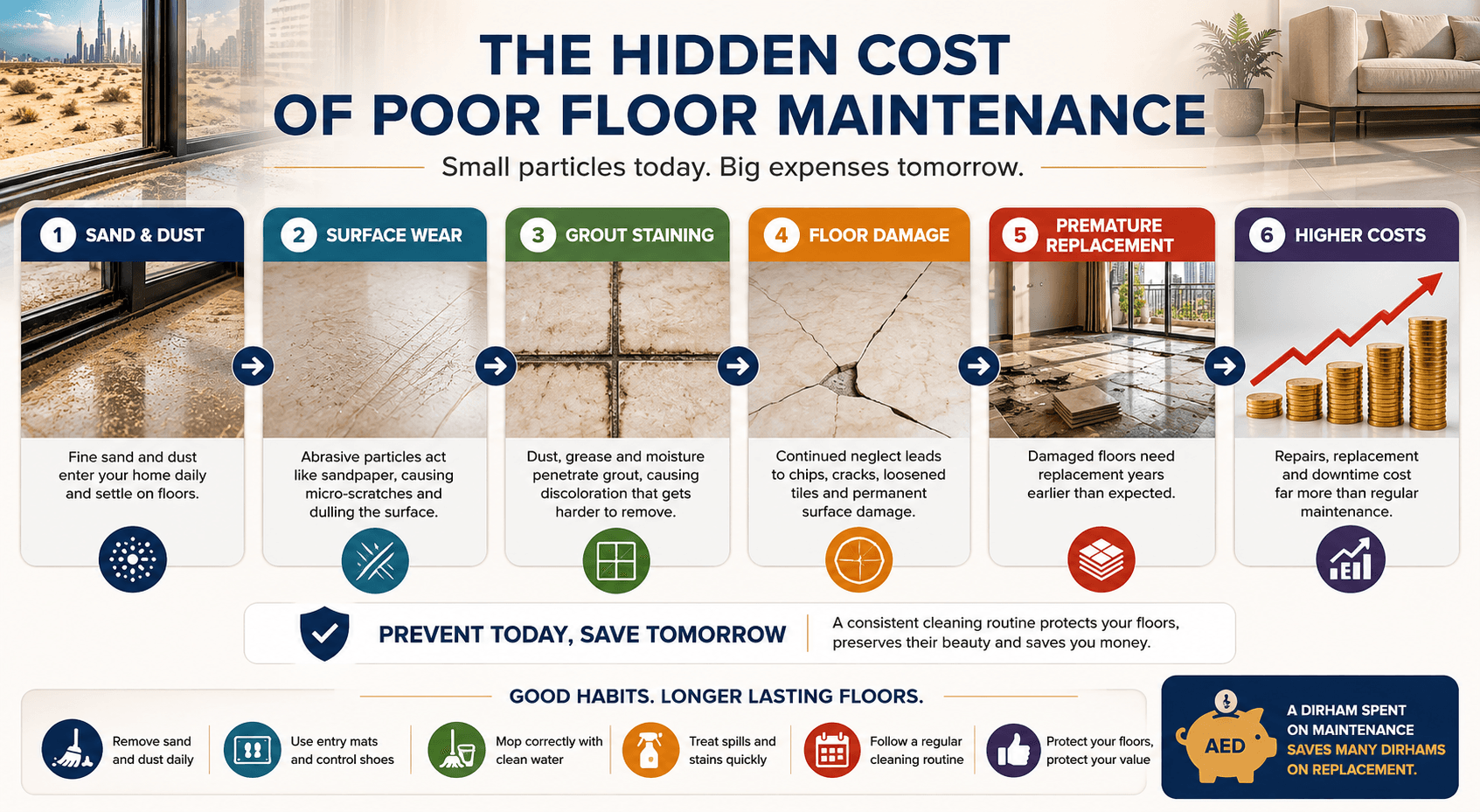
Neglecting floor care in the UAE is not only a cosmetic issue. The local mix of abrasive sand, fine dust and humidity means that poor maintenance habits tend to cause cumulative, and sometimes irreversible, damage over time.
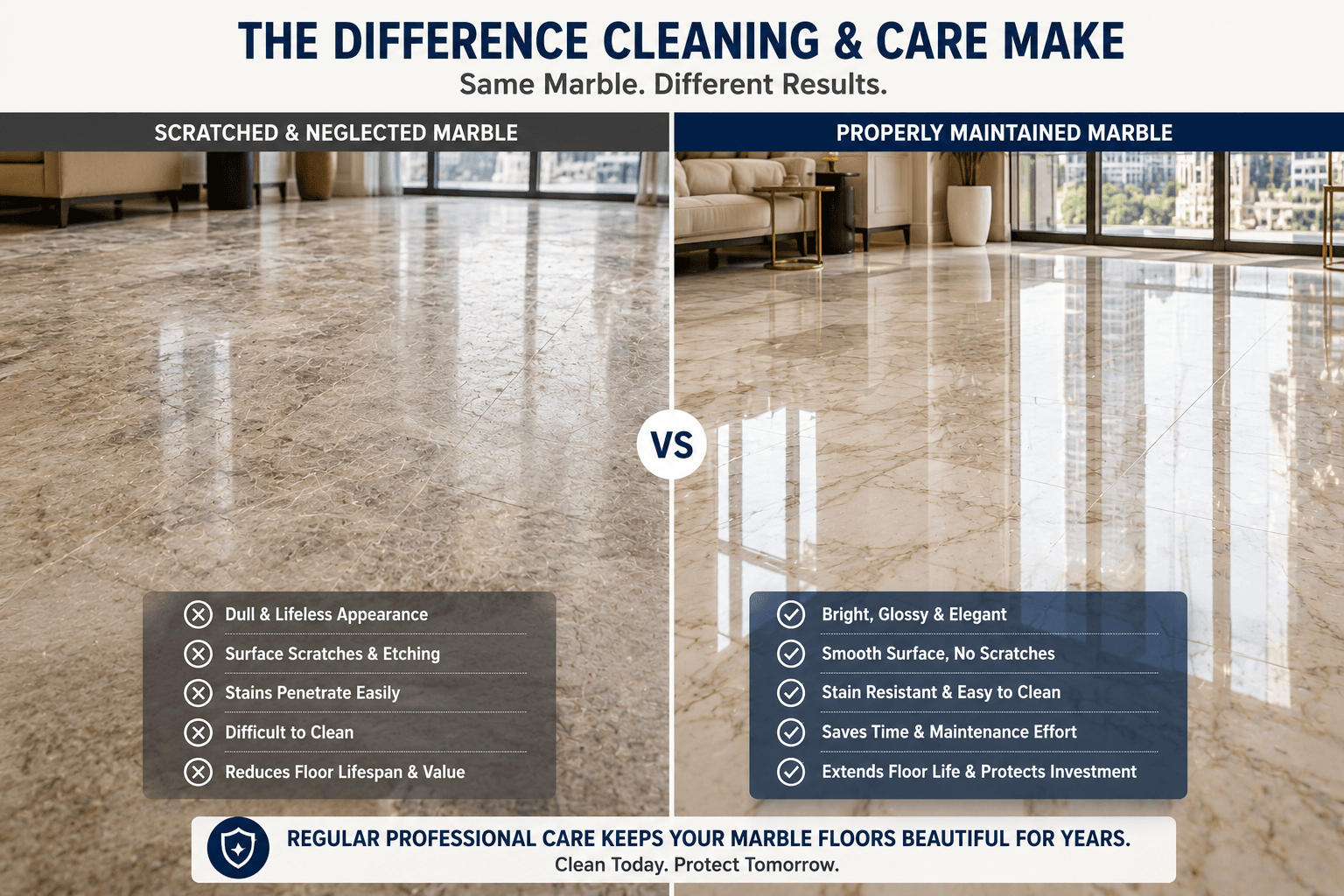
Scratched marble. Sand left on marble acts like fine sandpaper underfoot, gradually dulling the polish and leaving micro-scratches that are difficult and costly to restore. On a porous, premium surface, this kind of wear is often permanent without professional refinishing.
Permanent grout staining. Grout that is left to absorb dust, grease and moisture darkens over time. Once soiling is embedded deep in the porous grout, routine cleaning can no longer restore the original color, and the only remedies become deep restoration or regrouting.
Sand abrasion. Beyond marble, trapped grit slowly wears at the surface of vinyl, laminate and even tile finishes. This abrasion opens up surfaces to hold still more dust, creating a cycle where floors get dirtier faster and look worn sooner.
Premature floor replacement. Accumulated scratching, staining and moisture damage can shorten the usable life of a floor. For tenants, this can affect security deposits; for owners, it can mean replacing flooring years earlier than necessary.
Indoor dust accumulation. Floors that are not maintained become a reservoir of fine dust that is repeatedly disturbed and recirculated by foot traffic and air conditioning. This adds to the overall indoor dust load, which can affect both cleanliness and the comfort of the home.
Treating floor cleaning as a consistent system rather than an occasional task is the most reliable way to avoid these outcomes and protect the long-term value of the flooring.
Understanding UAE Floor Contamination Sources
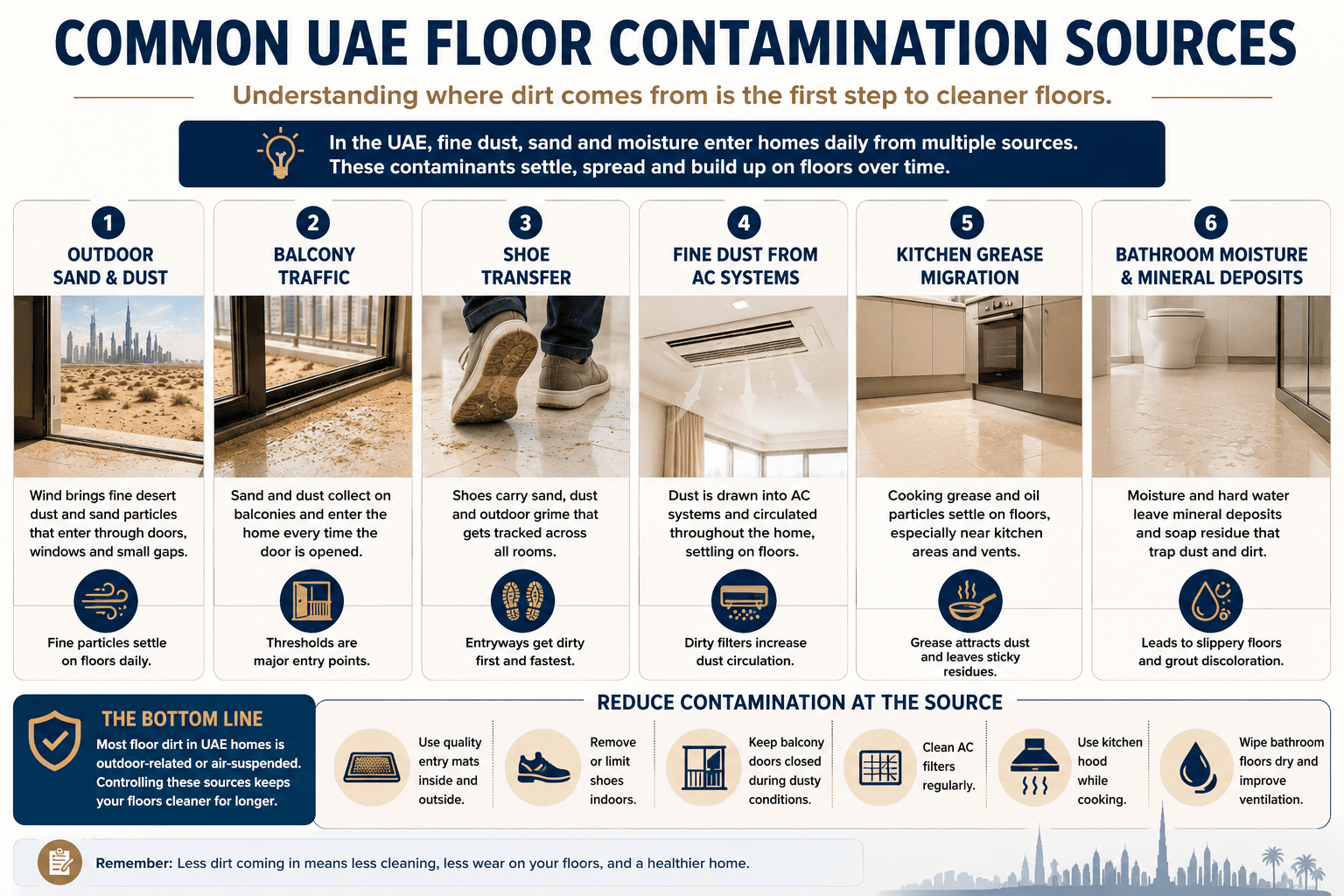
Knowing where floor contamination comes from makes it easier to target cleaning effort and reduce buildup at the source. UAE floors are typically affected by a predictable set of contributors.
Outdoor Sand and Dust
Fine desert dust and coarser sand are the most persistent floor contaminants in the UAE. Dust enters through small gaps around windows, doors and balcony thresholds, while sand is commonly tracked indoors on footwear or blown in during windy conditions. Sand grains are abrasive, which means walking on them can scratch softer floor finishes over time. For a deeper look at how airborne particles accumulate indoors, the guide on fine dust in apartments provides useful background.
Balcony Traffic
Balconies act as a primary entry point for outdoor contamination. Sand and dust settle on balcony floors and thresholds, then migrate indoors each time the balcony door is opened or someone steps back inside. In high-rise apartments, wind exposure can make balconies a constant source of fine particles. The guide on balcony dust problems explains how to manage this route.
Shoe Transfer
Footwear carries a surprising volume of fine dust, sand and outdoor residue into the home. Without a shoe-control system, this material is deposited directly onto floors near entrances and then spread further through normal movement. Entryways are usually the dirtiest floor zones in any UAE home.
Fine Dust From AC Systems
Air conditioning is essential in the UAE, but AC systems can circulate fine dust throughout a home if filters are not maintained. Dust drawn through the system can settle back onto floors and surfaces, contributing to the sense that floors get dusty again very quickly. Regular filter care reduces this effect, as covered in the AC filter cleaning guide.
Kitchen Grease Migration
Cooking releases airborne grease particles that settle on nearby floors. Over time, this creates a thin film that traps dust and makes floors feel slightly sticky, especially in kitchens and adjoining areas. Grease films require different treatment than dry dust, since plain water alone rarely lifts them effectively.
Bathroom Moisture and Mineral Deposits
Bathroom floors are exposed to moisture, soap residue and mineral content from water. In areas with harder water, mineral deposits can build up on tiles and grout, leaving dull or chalky marks. Combined with humidity, this can also encourage grout discoloration if floors are not dried and cleaned regularly.
Common Floor Types Found in UAE Homes
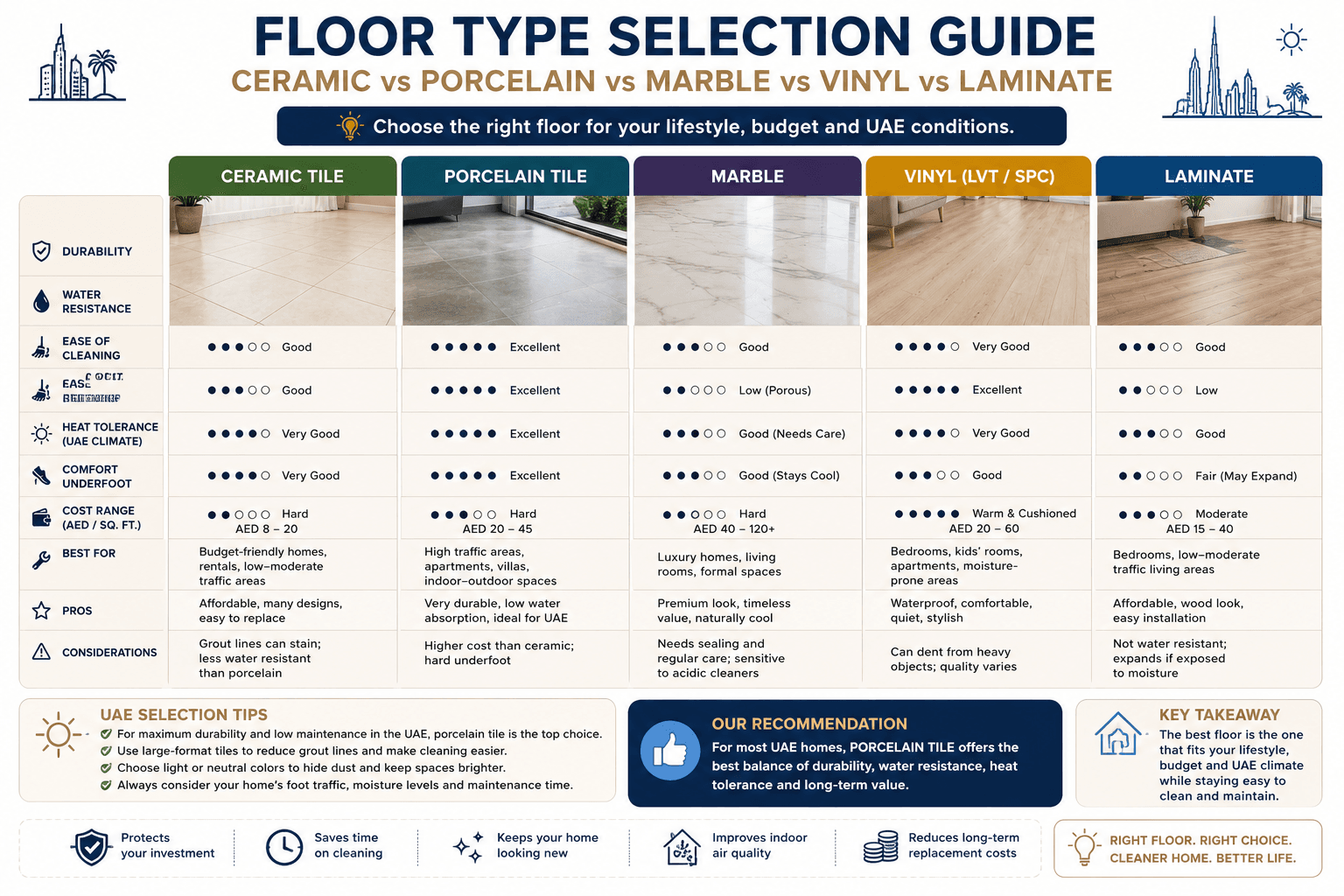
Different floors respond differently to UAE conditions. The right cleaning method depends on the material, since what protects one surface can damage another. The sections below outline the most common floor types in local apartments and villas.
Ceramic Tile Floors
Ceramic tile is one of the most widely used flooring materials in UAE homes due to its durability and suitability for hot climates.
Advantages
Ceramic tiles are generally hard-wearing, resistant to heat, and relatively easy to clean. They handle foot traffic well and do not absorb water readily on the glazed surface, which suits both apartments and villas.
Challenges
The main challenge with ceramic tile is the grout between tiles. Grout is porous and tends to trap fine dust and sand, gradually darkening if not cleaned. Glazed ceramic surfaces can also show streaks if mopped with dirty water or excessive cleaner.
Cleaning Requirements
Ceramic floors respond well to dry debris removal followed by damp mopping with clean water and a mild cleaner. Grout lines benefit from periodic dedicated attention using a soft brush. Abrasive scrubbing pads should be avoided on the glazed surface – Have a look at the Best spin mops for UAE tile floors.
Porcelain Tile Floors
Porcelain is a denser, harder version of ceramic tile and is common in newer UAE developments.
Advantages
Porcelain is highly durable, water-resistant and resistant to staining, making it well suited to high-traffic UAE homes. Its low porosity means it generally resists moisture and is less likely to absorb spills.
Challenges
Polished porcelain can show dust and footprints clearly, and fine sand can leave micro-scratches on glossy finishes if walked on repeatedly. As with ceramic, grout lines remain the weak point for dust accumulation.
Cleaning Requirements
Porcelain tolerates regular damp mopping. A neutral pH cleaner is commonly recommended to avoid leaving residue on polished surfaces. Consistent dry removal of sand before mopping helps protect the finish.
Marble Floors
Marble is a premium natural stone flooring found in many UAE villas and higher-end apartments.
Advantages
Marble offers a distinctive appearance and a cool surface underfoot, which is often appreciated in hot climates. It can elevate the look of living areas and entrances.
Challenges
Marble is porous and sensitive to acidic substances. Acidic cleaners, vinegar, lemon and many general-purpose products can etch or dull the surface. Sand is particularly problematic on marble because it can scratch the polished finish during sweeping or walking. Marble also stains more easily than tile if spills are left.
Cleaning Requirements
Marble requires gentle handling: careful dry dust removal, soft mops, clean water, and pH-neutral cleaners formulated for natural stone. Acidic and abrasive products should be avoided entirely. Spills should be addressed promptly to prevent staining. Guidance from natural stone authorities consistently emphasizes neutral cleaners and prompt blotting for marble care.
Vinyl and SPC Flooring
Vinyl and stone plastic composite (SPC) flooring have become more common in UAE apartments as a cost-effective, water-resistant option.
Advantages
Vinyl and SPC are water-resistant, comfortable underfoot, and generally easy to maintain. They resist many stains and tolerate damp cleaning well.
Challenges
The surface can be scratched by abrasive grit, so trapped sand is a concern. Some vinyl finishes can be dulled by harsh chemicals or excessive scrubbing, and standing water at seams should be avoided in lower-grade products.
Cleaning Requirements
Vinyl and SPC respond well to vacuuming or sweeping followed by a damp, not soaking, mop. Neutral cleaners are typically suitable. Removing sand before cleaning protects the wear layer.
Laminate Flooring
Laminate flooring is used in some UAE apartments, though it requires more caution in humid and high-traffic conditions.
Advantages
Laminate provides a wood-like appearance at a lower cost and is reasonably durable against scratches on quality products.
Challenges
Laminate is the most moisture-sensitive of the common floor types. Excess water can seep into seams and cause swelling or edge damage. Humidity and steam mopping are generally not recommended for laminate.
Cleaning Requirements
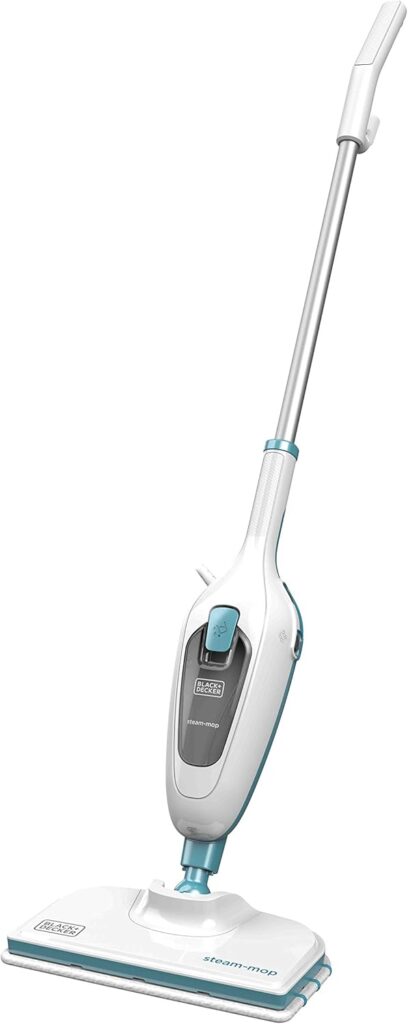
Laminate should be cleaned with dry methods and only lightly damp cloths or mops that are well wrung out. Pooling water must be avoided, and any spills wiped quickly. Steam cleaning is commonly discouraged for laminate. Have a look at the best steam cleaners UAE.
The UAE Floor Cleaning System
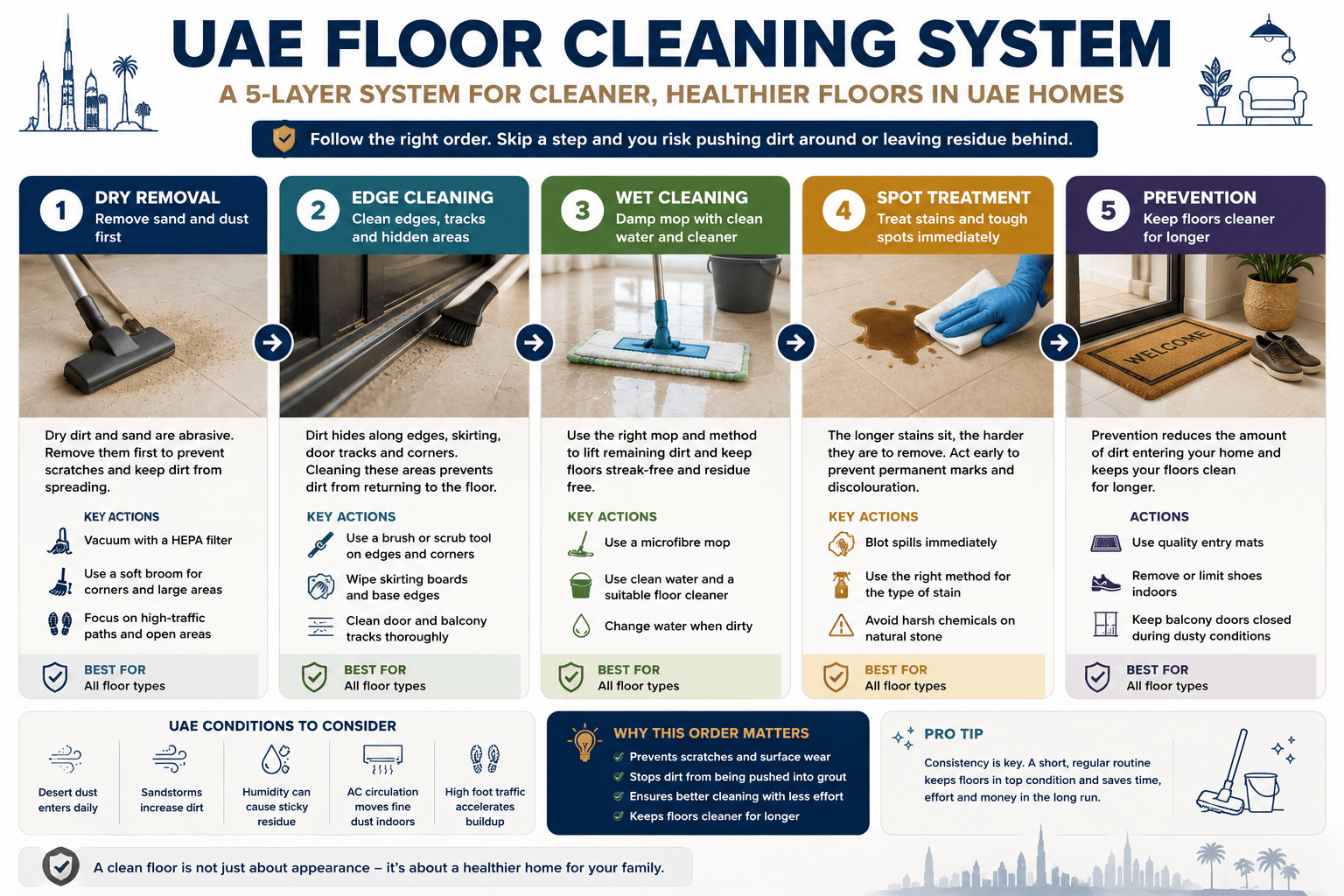
A consistent, layered system removes contaminants in the correct order and prevents the most common cleaning errors. This is the core framework behind effective floors and tiles cleaning UAE homes can rely on year-round. The five layers below move from dry removal through to prevention. Following them in sequence is what separates floors that stay clean from floors that look dusty again within hours.
Layer 1: Dry Debris Removal
Dry removal is the most important and most frequently skipped step in UAE homes. The goal is to remove sand, fine dust and loose debris before any water touches the floor.
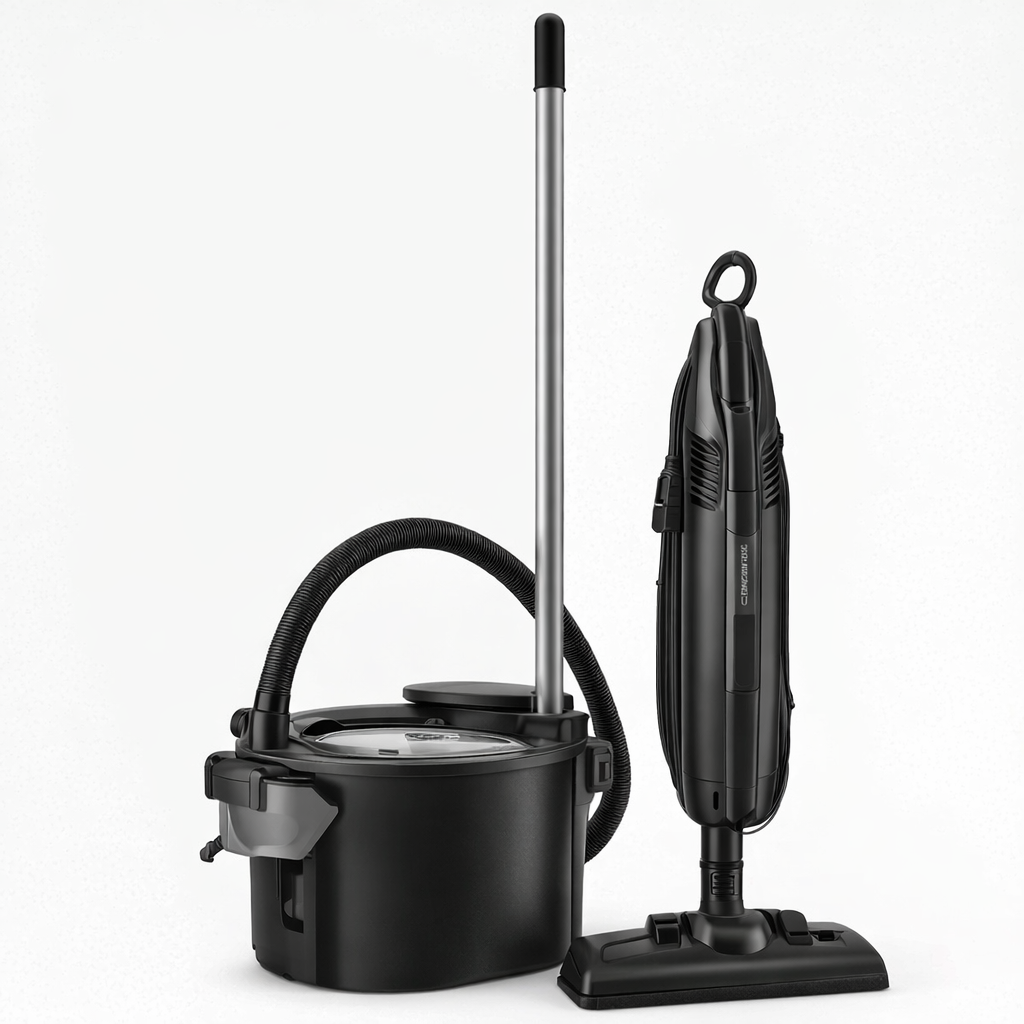
Vacuuming. Vacuuming is generally the most effective method for capturing fine dust and sand, particularly with a vacuum that retains fine particles rather than blowing them back into the air. For homes dealing with heavy dust, the comparisons in the best cordless vacuums and best HEPA vacuums guides explain the relevant considerations.
Sweeping. Sweeping with a soft broom can work for coarser sand, but it tends to lift fine dust into the air, where it resettles. A slightly dampened sweeping cloth or a microfiber dust mop captures fine particles more effectively than a stiff broom alone.
Dust capture principles. The aim is capture, not redistribution. Tools that trap dust, such as microfiber and vacuums with good filtration, are preferred over those that simply push particles around. Working from the far corner toward the exit avoids walking dust back across cleaned areas.
Mopping a floor that still has sand and dust on it turns loose particles into muddy streaks, drives grit into grout lines, and can scratch softer finishes such as marble and vinyl. Wet cleaning should always follow complete dry removal, never replace it.
Layer 2: Edge and Corner Cleaning
Dust and sand concentrate at the edges of rooms and in transition points that a standard mop pass misses. Addressing these zones prevents a slow buildup that eventually spreads back across the floor.
Skirting boards. Fine dust settles along skirting boards and baseboards, where it is easily disturbed. Wiping these with a slightly damp microfiber cloth removes the reservoir of dust that otherwise feeds the floor.
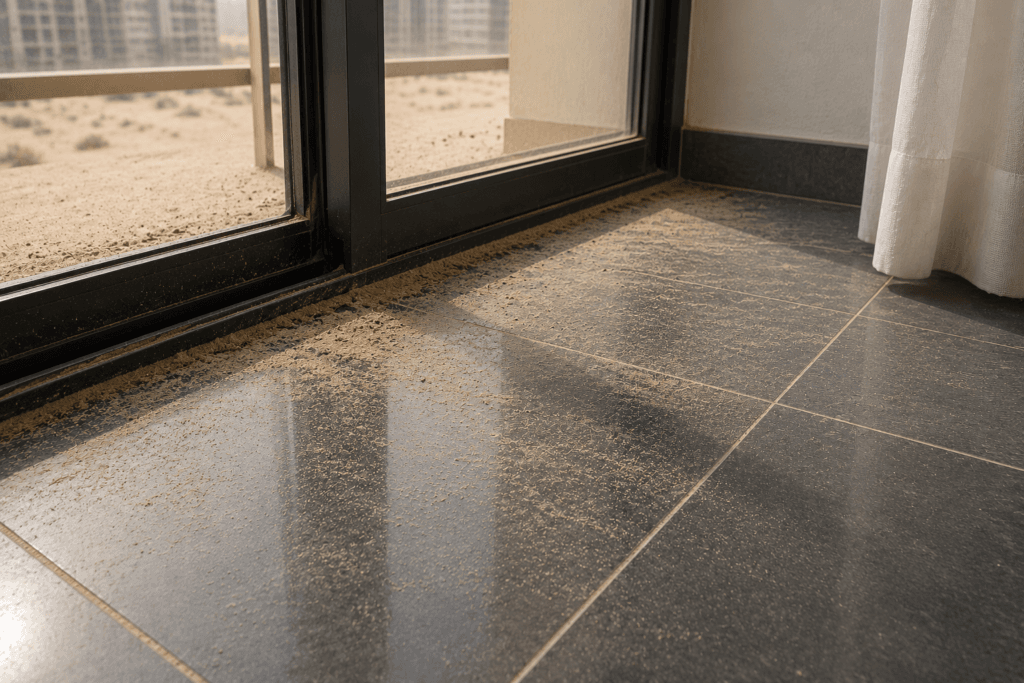
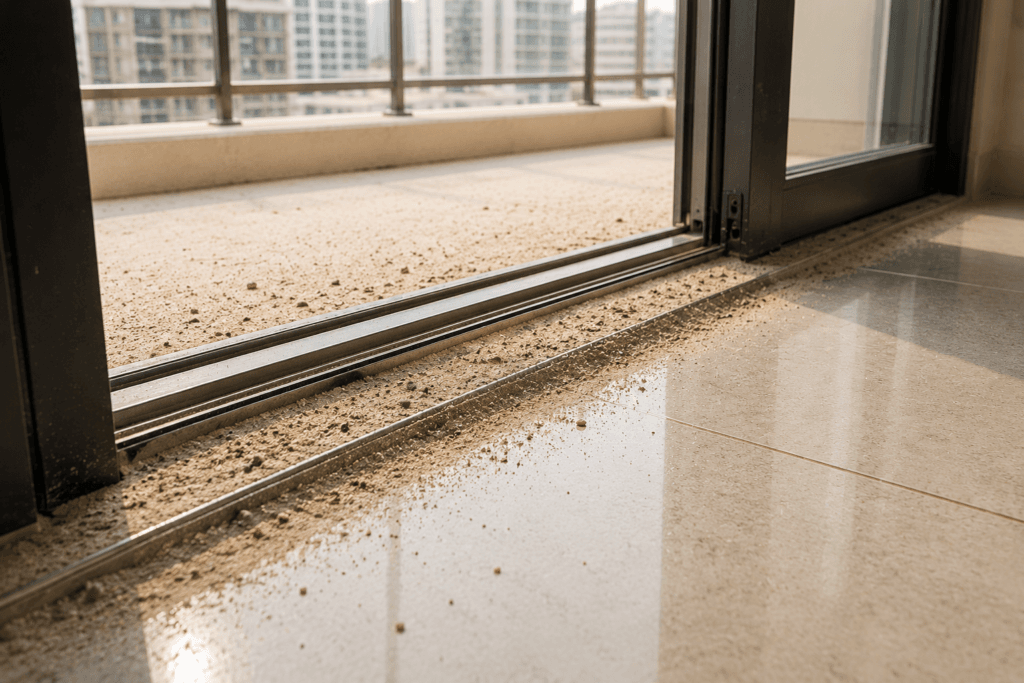
Door tracks. Sliding door tracks, especially balcony doors, collect significant amounts of sand and dust. These channels are a major contamination source and benefit from periodic vacuuming and wiping.
Furniture edges. Areas beneath and around furniture legs and bases trap dust because they are rarely walked on or mopped. Periodic attention prevents these from becoming dust pockets.
Balcony thresholds. The threshold between a balcony and the interior is one of the highest-contamination points in UAE apartments. Sand accumulates here and is carried inside repeatedly. Regular cleaning of this strip noticeably reduces indoor floor dust.
Layer 3: Wet Cleaning
Once dry debris and edges are handled, wet cleaning lifts the finer film of dust, grease and residue that dry methods leave behind. Technique matters more than the amount of product used.
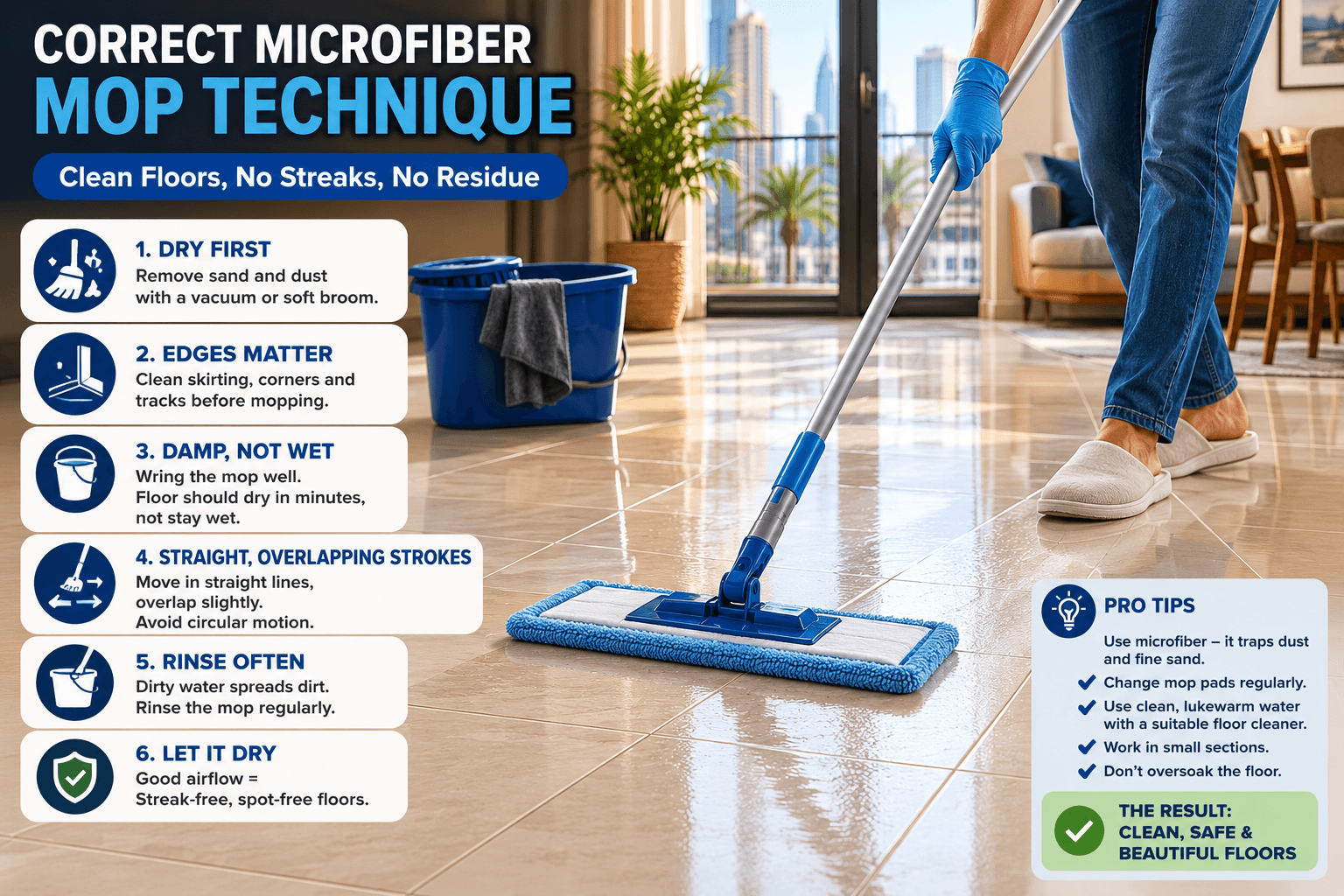
Correct mopping methods. Use a well-wrung mop that is damp rather than wet. Work in straight, overlapping strokes from the far side of the room toward the exit. For larger areas, divide the floor into sections so the cleaning solution does not dry before it is wiped.
Avoid excess water. Standing water can seep into grout, damage laminate, and leave streaks on polished surfaces. A damp mop is sufficient for most UAE floors; flooding is rarely necessary and often harmful.
Avoid dirty mop water. Mopping with dirty water spreads contaminants rather than removing them and leaves a dull film. Changing the water once it becomes cloudy, or using a two-bucket method that separates rinse water from cleaning solution, produces noticeably cleaner results.
Avoid circular spreading. Circular or random mopping tends to move grit and dust around the floor. Straight, directional strokes with frequent rinsing of the mop head lift contaminants instead of redistributing them.
Layer 4: Spot Treatment
Spot treatment addresses localized problems that general mopping does not resolve. Treating these promptly prevents permanent marks, particularly on porous surfaces.
Food spills. Spills should be blotted and removed quickly, especially anything acidic or staining, since residue attracts dust and can mark grout or stone.
Grease. Grease films near kitchens require a degreasing approach rather than plain water. A suitable cleaner applied to the affected area and wiped clean removes the sticky layer that traps dust.
Scuff marks. Scuff marks from footwear or furniture can often be lifted with a damp microfiber cloth and gentle pressure. Abrasive scrubbing should be avoided on glossy and stone surfaces.
Mud. Dried mud, common after rain combined with dust, should be allowed to dry, removed dry, and only then cleaned with a damp method. Wiping wet mud usually smears it further.
Mineral deposits. Mineral and limescale marks, common in UAE water conditions, may require a targeted cleaner. On marble and other natural stone, acidic descalers must be avoided, since they damage the surface. Neutral stone-safe products are the safer choice.
Layer 5: Prevention and Maintenance
Prevention reduces how much contamination reaches the floor in the first place, which lowers cleaning frequency and protects floor finishes over time. This layer delivers the greatest long-term benefit for the least daily effort.
Entryway systems. A combination of an outdoor coarse mat and an indoor absorbent mat captures a large share of sand and dust before it reaches living areas. Mat selection is covered in the best entry mats guide.
Shoe control. Establishing a shoe-removal point near entrances dramatically reduces the volume of sand and outdoor residue transferred to floors. A designated shoe zone keeps the dirtiest material contained.
Balcony management. Cleaning balconies regularly and keeping balcony doors closed during windy or dusty conditions reduces the migration of sand indoors. The balcony dust problems guide outlines practical steps.
Dust reduction. Maintaining AC filters, using entry mats, and addressing dust at its sources all reduce the overall dust load that settles on floors. The broader strategy is detailed in the guide on how to reduce dust in Dubai homes.
Cleaning Methods Compared
Each removal method has strengths and limits. Matching the method to the task, rather than relying on one tool, is what makes the five-layer system effective. The table below summarizes how common methods perform under UAE conditions.
| Cleaning Method | Dust Removal | Sand Removal | Water Use | Best For |
|---|---|---|---|---|
| Sweeping | Moderate | Good | None | Quick cleanup of coarse debris |
| Vacuuming | Excellent | Excellent | None | Daily UAE dust and sand control |
| Microfiber dust mop | Excellent | Good | None | Fine dust on hard floors |
| Damp mopping | Good | Poor | Moderate | Final cleaning stage after dry removal |
| Steam cleaning | Moderate | Poor | High | Occasional deep cleaning on suitable surfaces |
Sweeping and dry mopping handle loose material but are not a substitute for the fine-particle capture of a vacuum. Damp mopping is a finishing step, not a first step, since it performs poorly on loose sand. Steam cleaning has a limited role and is generally unsuitable for laminate and some natural stone.
Apartment vs Villa Floor Cleaning
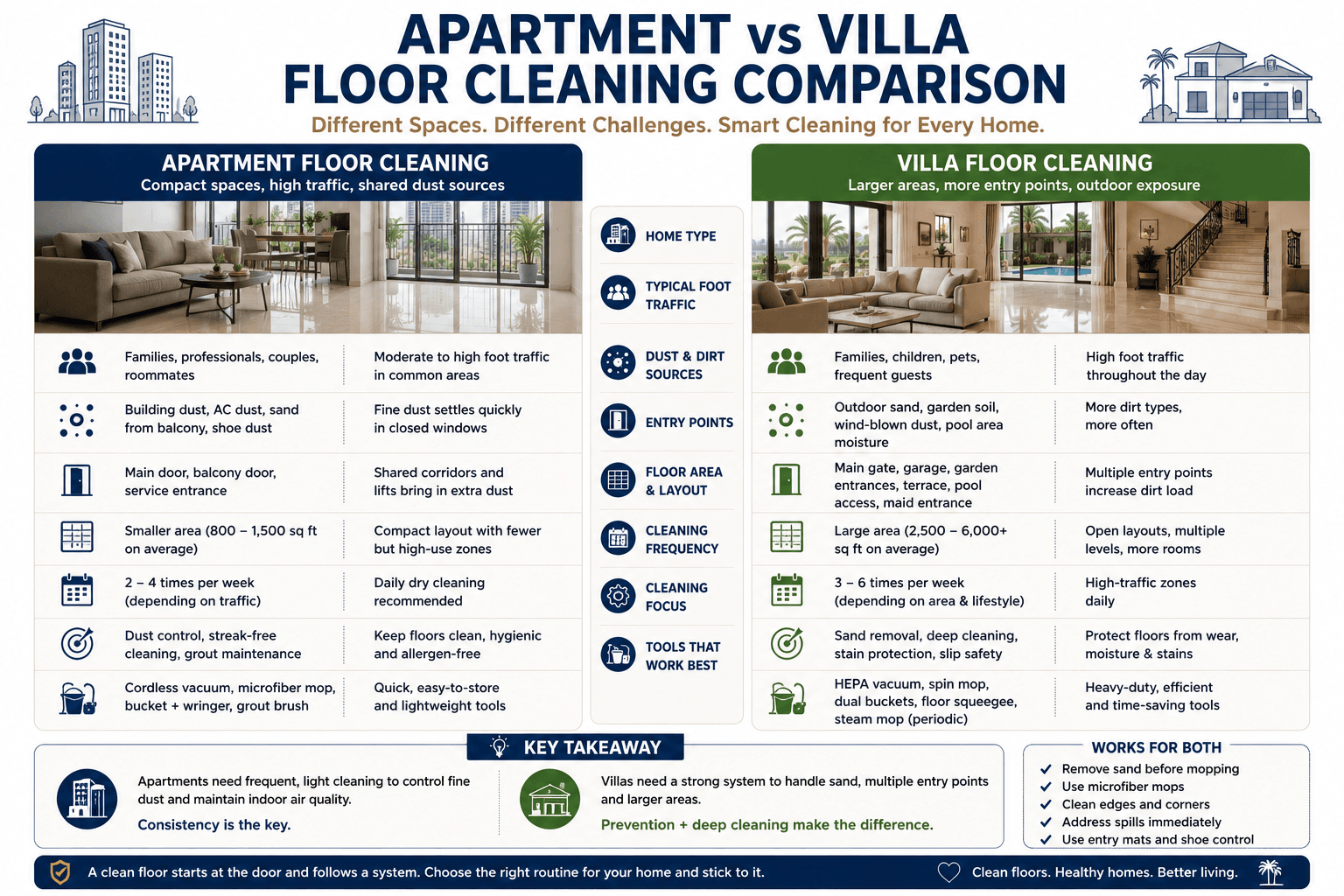
Apartment and villa floors face the same desert conditions, but the scale, layout and contamination routes differ enough to justify distinct strategies.
Apartment Floor Cleaning Strategy
Apartment floor cleaning in the UAE is shaped by limited space, balcony exposure and high-rise contamination patterns.
Balcony dust is often the dominant issue, since balconies are exposed to wind and act as the main outdoor interface. Limited storage means cleaning tools must be compact and multipurpose. High-rise units can experience significant fine dust infiltration through balcony doors and small gaps, even with windows closed.
A practical apartment approach focuses on a strong entryway and balcony defense, frequent light dry removal in main living zones, and a compact tool set. The small apartment cleaning setup guide addresses storage-constrained homes, and the daily cleaning routine for UAE apartments provides a repeatable schedule.
Villa Floor Cleaning Strategy
Villa floor cleaning involves larger areas and more contamination entry points than apartments.
Villas have larger floor areas that take longer to clean, staircases that collect dust and require careful handling, garden and outdoor areas that introduce additional sand and soil, and multiple entrances that each act as a contamination route. Coordinating cleaning across several rooms and levels benefits from a zoned routine.
A villa strategy typically divides the home into zones, prioritizes high-traffic and entrance areas, and addresses staircases and multiple entries with dedicated mats and shoe control. The villa cleaning systems guide expands on managing larger homes.
Cleaning Frequency Guide
Cleaning frequency should reflect how heavily each area is used and how exposed it is to dust and sand. The matrix below offers a general guideline for UAE homes. Homes near construction sites, busy roads or open desert may need more frequent attention.
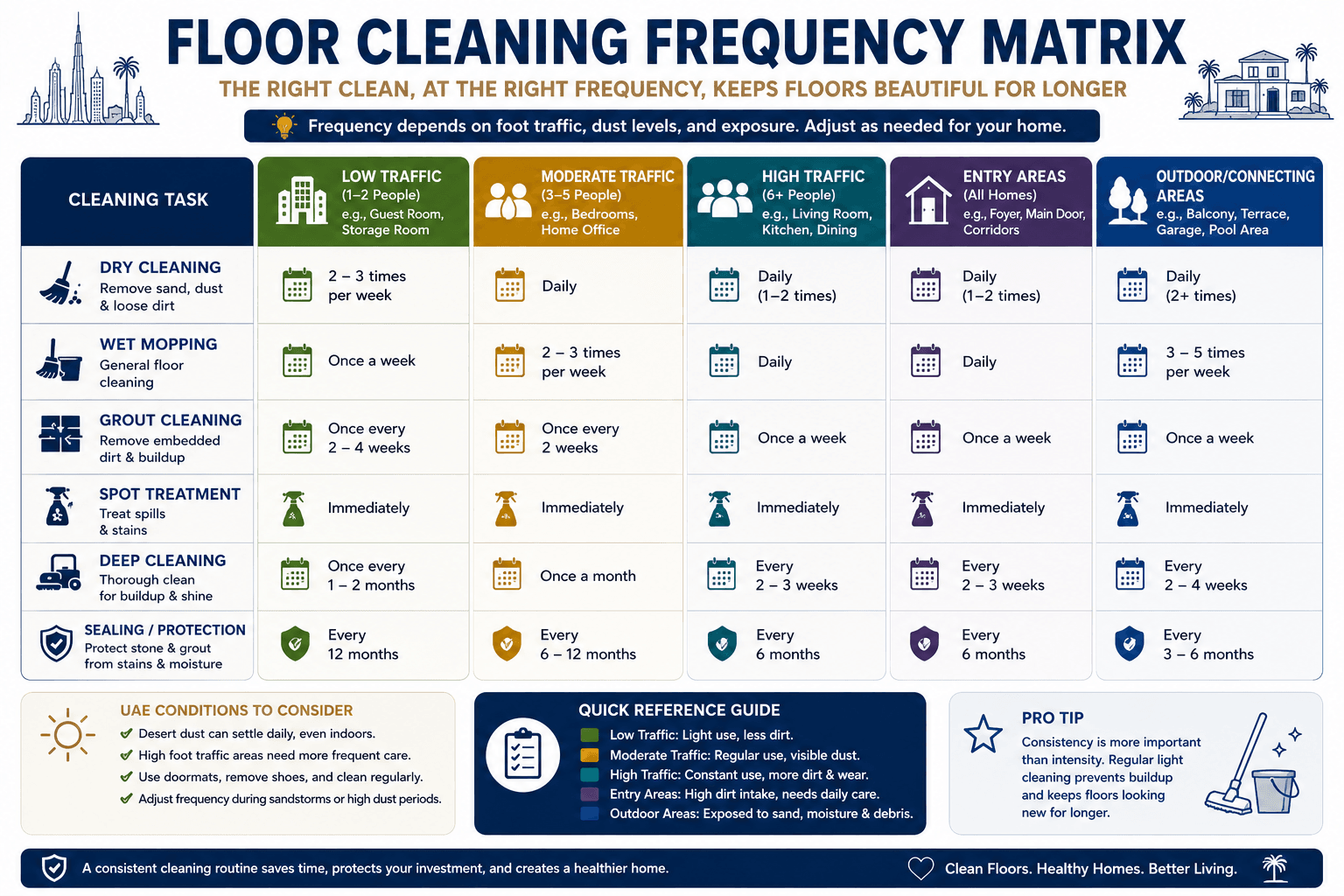
| Area | Daily | Weekly | Monthly | Quarterly |
|---|---|---|---|---|
| Living room | Light dry removal | Full mop | Edge and skirting clean | Deep grout attention |
| Bedrooms | Spot tidy as needed | Dry removal and mop | Under-bed and edge clean | Deep clean |
| Kitchen | Dry removal and spot clean | Degrease and mop | Behind and under appliances | Deep grout and grease clean |
| Bathrooms | Quick wipe and dry | Full wash and disinfect | Behind toilet and corners | Deep grout and mineral treatment |
| Balcony | Threshold check | Sand removal and wash | Drain and corner clean | Deep clean |
| Hallways | Dry removal | Mop | Edge and skirting clean | Deep clean |
| Staircases | Spot tidy | Dry removal and damp wipe | Edge and corner clean | Deep clean |
High-Risk Tile Areas Often Missed
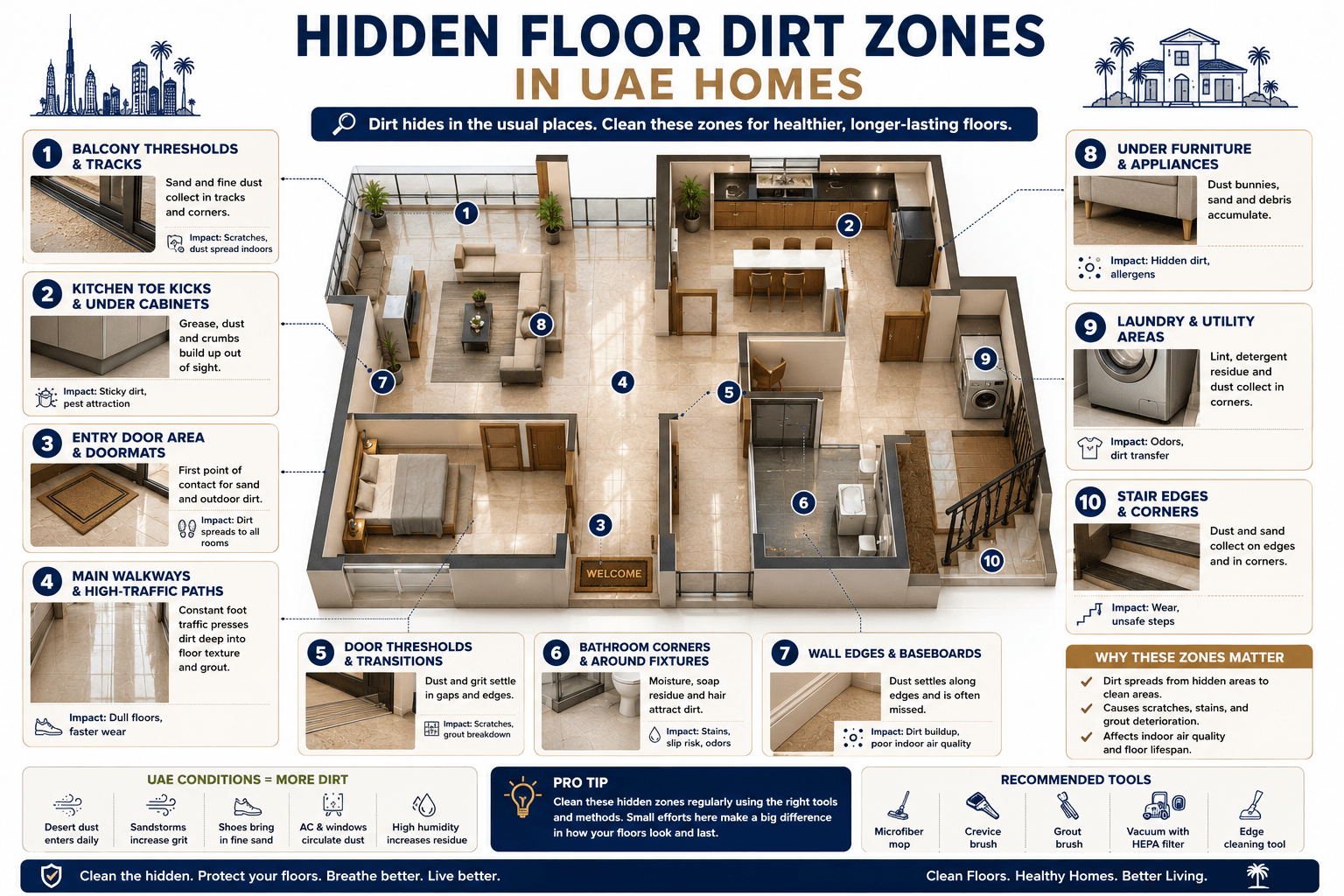
Several floor zones are routinely overlooked during normal cleaning, yet they collect a disproportionate amount of dust and sand. Targeting these areas prevents hidden buildup from spreading back across cleaned floors.
Door tracks, especially balcony sliding-door tracks, trap large quantities of sand and benefit from regular vacuuming. Balcony thresholds accumulate sand that is then tracked indoors. The area under beds collects fine dust that is easily disturbed by airflow. Behind toilets is a common spot for dust, hair and residue to gather unseen. Spaces under and behind appliances such as fridges and washing machines hold dust and, in kitchens, grease film. Room corners gather dust that a standard mop pass misses, and laundry areas accumulate lint combined with fine dust. Periodic attention to these zones keeps the overall floor cleaner with less effort.
Mistakes That Damage Floors
Many floor problems in UAE homes are caused by cleaning methods rather than dirt itself. Avoiding the following mistakes protects floor finishes and improves results.
Using abrasive pads on glazed tile, polished porcelain, marble or vinyl can scratch and dull the surface permanently. Over-wetting floors can seep into grout and damage laminate, and on marble it can contribute to staining. Using incorrect chemicals, particularly acidic cleaners on marble and natural stone, can etch and discolor the surface. Skipping vacuuming or dry removal before mopping turns loose sand into abrasive grit and muddy streaks. Ignoring grout allows dust and sand to embed and darken over time, which is much harder to reverse. Leaving spills, especially acidic or staining ones, allows them to set and attract more dust. Correcting these habits often improves floor appearance more than any product change.
How Sandstorms Affect Floors
Sandstorms deposit a significant layer of fine dust and sand throughout a home, including on floors, even when windows and doors are kept closed. Fine particles penetrate gaps and settle on every horizontal surface, and floors near balconies, doors and windows are usually affected first and most heavily.
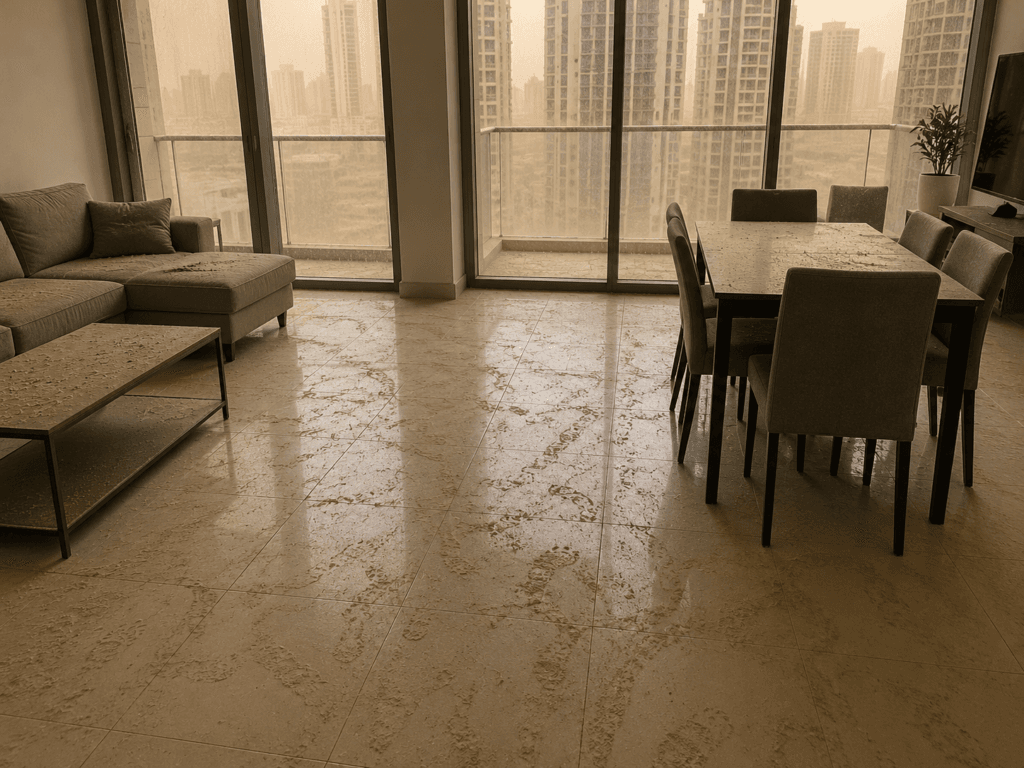
The immediate response is to resist the urge to mop straight away. Wet cleaning a sand-covered floor drives grit into grout and across the surface. The correct sequence is dry removal first: vacuum or carefully sweep the bulk of the sand, then perform a second dry pass to capture fine residue, and only then move to damp mopping with clean water. Mop water should be changed frequently, since it becomes saturated with fine particles quickly.
A sensible priority order is to clean entry points and balcony thresholds first, then high-traffic living areas, then bedrooms and less-used spaces, finishing with edges, corners and missed zones. For a full step-by-step recovery process covering surfaces beyond floors, the post-sandstorm cleaning guide provides a complete protocol.
Floor-Specific Cleaning Methods
While the five-layer system applies broadly, each floor type benefits from small adjustments. The workflows below summarize a safe sequence for each common UAE floor material.
Ceramic tile workflow. Dry remove sand and dust, damp mop with clean water and a mild neutral cleaner, give periodic attention to grout with a soft brush, and dry or allow to air dry. Avoid abrasive pads on the glazed surface.
Porcelain workflow. Dry remove debris thoroughly to protect polished finishes, damp mop with a neutral pH cleaner, wipe streaks on glossy surfaces with a clean microfiber pass, and keep grout maintained. Consistent dry removal prevents micro-scratching from sand.
Marble workflow. Dry remove dust gently to avoid scratching, clean with clean water and a pH-neutral stone-safe cleaner only, blot spills immediately, and avoid all acidic and abrasive products. Buff dry to prevent water marks where needed.
Laminate workflow. Use dry removal as the primary method, follow with a well-wrung, barely damp mop, wipe any spills immediately, and avoid pooling water and steam cleaning. Keep moisture exposure to a minimum.
Vinyl workflow. Dry remove grit to protect the wear layer, damp mop with a neutral cleaner, avoid harsh chemicals that can dull the finish, and avoid leaving standing water at seams. A damp, not wet, approach is sufficient.
For homes that prefer machine assistance over manual mopping, the considerations in the best hard floor cleaners UAE guide are relevant once dry removal is complete.
How to Clean Tile Grout in UAE Homes
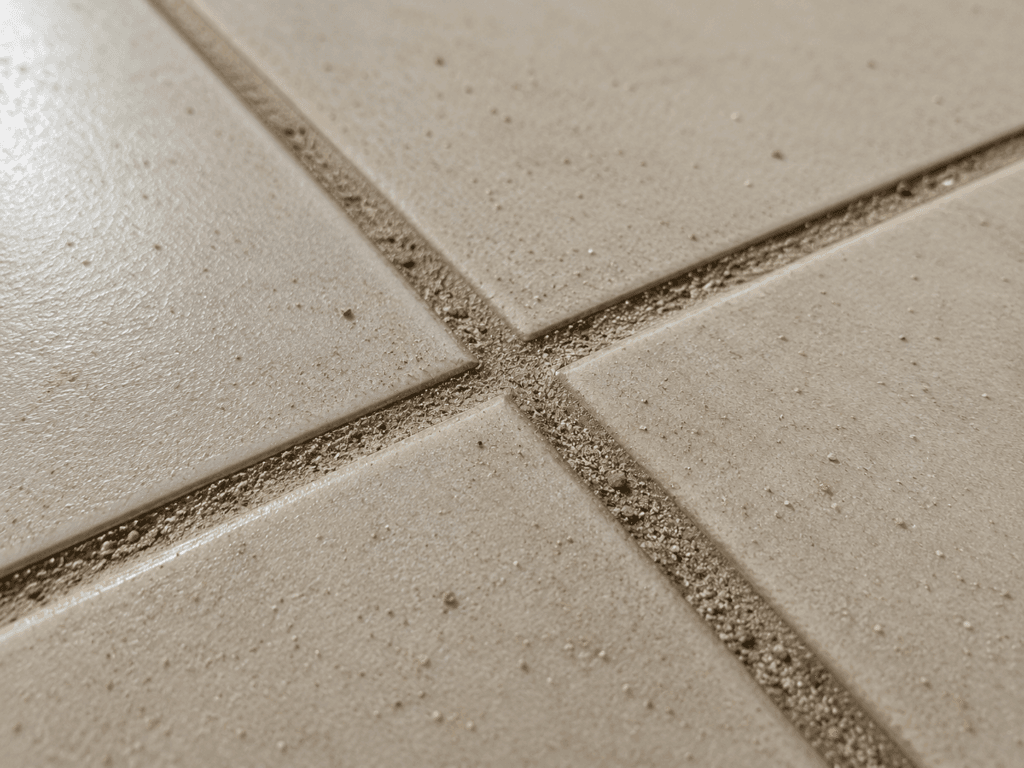
Grout is the weak point of almost every tiled floor in the UAE. Because it sits slightly below the tile surface and is porous, it traps the fine dust and sand that the local climate produces in abundance, and it discolors faster than the tile around it.
Why Grout Gets Dirty Faster in the UAE
Several local factors accelerate grout discoloration. Fine dust settles into the recessed grout lines and is difficult to lift with a flat mop. Bathroom humidity keeps grout damp for longer, which can support discoloration and, in poorly ventilated rooms, mildew. Kitchen grease migrates into grout near cooking areas and binds dust into a darker film. Sand abrasion gradually wears at the grout surface, opening it up to hold more particles. The result is that grout lines often look dirty even when the tile faces appear clean.
Step-by-Step Grout Cleaning Process
A consistent process keeps grout from reaching the point where it needs aggressive treatment.
- Dry remove all loose dust and sand from the floor first, so cleaning does not push grit deeper into the grout.
- Apply a suitable grout-appropriate cleaner to the lines. On standard tile, a mild alkaline or dedicated grout cleaner is common. Around marble or other natural stone, avoid acidic grout cleaners and choose a stone-safe product.
- Allow the cleaner a short dwell time so it can loosen embedded soiling, following the product label.
- Agitate the grout lines with a soft grout brush or an old toothbrush, working along the line rather than across it.
- Wipe away the loosened residue with a clean, damp microfiber cloth, rinsing frequently so soil is removed rather than spread.
- Rinse the area with clean water and dry, particularly in bathrooms, to limit moisture sitting in the grout.
When Grout Needs Deep Cleaning
Routine cleaning maintains grout, but periodic deep cleaning is needed when lines look persistently dark despite normal mopping, when bathroom grout shows discoloration from humidity, or after a heavy dust period such as a sandstorm season. Deep cleaning typically means a longer dwell time, more thorough brushing, and attention to high-traffic and high-moisture zones. Resealing grout after a deep clean can help slow future staining on porous lines.
When Regrouting Becomes Necessary
Cleaning has limits. If grout is cracked, crumbling, missing in sections, or stained so deeply that repeated cleaning no longer restores it, regrouting or professional restoration may be the practical option. Persistent recurring mildew that returns quickly after cleaning can also indicate a moisture problem behind the grout rather than a surface stain, which is worth investigating before repeated cleaning attempts.
Seasonal Floor Cleaning Adjustments

UAE conditions shift through the year, and floor cleaning routines can be adjusted accordingly. The broader seasonal cleaning guide places floor care within a full-home calendar.
Spring Sandstorm Season
Spring commonly brings increased dust and sandstorm activity. During this period, dry removal becomes more frequent and important, entry mats and balcony management take priority, and floors near balconies and doors may need attention more than once a day. Keeping balcony doors closed during dusty conditions reduces sand migration onto floors.
Summer AC Season
In summer, windows stay closed and AC runs almost continuously. Fine dust circulated by the AC system settles on floors, so maintaining AC filters becomes directly relevant to floor cleanliness. The AC filter cleaning guide explains the maintenance involved. Regular light dry removal keeps the circulated dust from building up.
Humidity Periods
During high-humidity periods, often overlapping with summer in coastal areas, fine dust can bind with moisture and form sticky deposits that are harder to lift. Floors may require slightly more thorough damp cleaning, and bathrooms and kitchens need attention to prevent grout discoloration. Humidity management across the home is covered in the humidity and mold prevention guide.
Winter Ventilation Season
Cooler winter months allow more natural ventilation with open windows and balcony doors, which can introduce outdoor dust and sand. Floor routines can shift toward managing the dust that enters during ventilation, with continued use of entry mats and regular dry removal.
Floor Cleaning Checklist
The following checklist consolidates the system into a repeatable routine for UAE homes.
Daily
- Perform light dry removal of sand and dust in high-traffic areas.
- Check and clean the balcony threshold.
- Spot clean any spills immediately.
- Wipe and dry bathroom floors after use.
Weekly
- Complete full dry removal across all rooms.
- Damp mop floors with clean water and a suitable cleaner.
- Wipe skirting boards and door tracks.
- Wash balcony floors and remove accumulated sand.
- Clean under accessible furniture.
Monthly
- Clean edges, corners and under beds.
- Address behind toilets and under or behind appliances.
- Give grout lines targeted attention.
- Clean staircases thoroughly, including edges.
Quarterly
- Perform a deep clean of all floors and grout.
- Treat mineral deposits on tile using surface-appropriate products.
- Inspect and refresh entry mats.
- Review and reset the prevention system, including shoe control.
Free Download: UAE Floors and Tiles Cleaning Checklist (PDF)

A printable version of this checklist is available as a free PDF download, formatted for fridge or cupboard use and organized by daily, weekly, monthly and quarterly tasks.
Floor Type Comparison Table
The table below compares common UAE floor types across the factors most relevant to local conditions. Ratings are general guidelines and can vary by product grade and finish.
| Floor Type | Cleaning Difficulty | Dust Visibility | Water Resistance | Maintenance Level | UAE Suitability |
|---|---|---|---|---|---|
| Ceramic tile | Low | Moderate | High | Low to moderate | High |
| Porcelain tile | Low to moderate | Moderate to high on gloss | Very high | Low to moderate | High |
| Marble | High | High | Moderate | High | Moderate, needs careful care |
| Vinyl and SPC | Low | Moderate | High | Low | High |
| Laminate | Moderate | Moderate | Low | Moderate | Moderate, moisture sensitive |
UAE Floor Cleaning Challenges by Emirate
Floor cleaning pressures vary across the UAE because local environment, proximity to the coast and the pace of construction differ from one emirate to another. The points below are general observations rather than fixed rules, since conditions also vary by community and building.
Dubai
Dubai combines extensive ongoing construction with dense high-rise living. Construction dust adds to the natural desert load, and balcony contamination is a common issue in apartment communities such as Marina, JBR, Downtown and Business Bay. A strong entryway and balcony defense is usually the highest-impact habit here.
Abu Dhabi
Coastal areas of Abu Dhabi combine desert dust with higher humidity and, in some locations, salt residue carried on the air. Humidity can make settled dust stickier and can affect grout in bathrooms and kitchens, so damp cleaning technique and drying matter more in these conditions.
Sharjah
Some Sharjah communities sit closer to open desert and more exposed land, which can mean higher dust exposure and faster floor soiling. More frequent dry removal and consistent entry-mat use are often warranted in these areas.
Northern Emirates
In the Northern Emirates, including areas of Ras Al Khaimah, Ajman, Umm Al Quwain and Fujairah, sand and wind exposure can be significant, particularly in communities near open terrain or the coast. Routines that emphasize dry removal, entry control and balcony management tend to perform best.
Expert Recommendations for UAE Homes
The right approach depends on home size and layout. The recommendations below adapt the floor cleaning system to common UAE living situations.
Studio apartments. Focus on a compact, multipurpose tool set due to limited storage, prioritize a strong entryway mat and shoe control, and perform quick daily dry removal in the single main living area. Because the space is small, brief frequent cleaning keeps floors consistently presentable. The small apartment cleaning setup guide is directly relevant.
One to two bedroom apartments. Establish a clear entry and balcony defense, perform daily light dry removal in living areas and a weekly full mop, and rotate edge and corner cleaning through the month. Balcony threshold management is often the single most effective habit in these homes.
Family apartments. Higher foot traffic from families means more frequent dry removal and attention to kitchen grease and spill spots. A zoned routine, where different areas are cleaned on different days, helps maintain consistency. A repeatable family schedule is outlined in the cleaning routine for families guide.
Villas. Divide the home into zones and prioritize entrances, staircases and high-traffic areas. Use dedicated mats at each entrance, manage garden-related sand, and schedule deep cleaning of larger floor areas across the week rather than all at once. The villa cleaning systems guide supports larger homes.
Related UAE Cleaning Guides
For a complete approach to managing dust, sand and indoor air alongside floor care, these CleanLivingUAE guides connect directly to the topics covered here:
- Fine Dust in Apartments
- Balcony Dust Problems
- Post-Sandstorm Cleaning
- AC Filter Cleaning
- Small Apartment Cleaning Setup
- Villa Cleaning Systems
- Humidity and Mold Prevention
- Best Hard Floor Cleaners
Conclusion
Floors and tiles cleaning in UAE homes is most effective when treated as a system rather than a single task. Local conditions, including desert dust, sand, AC-circulated particles, humidity and heavy indoor foot traffic, mean that the order of cleaning matters as much as the frequency. The five-layer approach of dry removal, edge cleaning, wet cleaning, spot treatment and prevention addresses each type of contamination in the correct sequence and avoids the common mistakes that damage floors or simply move dirt around.
Matching the method to the floor type protects finishes, particularly on marble and laminate, while consistent prevention through entry mats, shoe control and balcony management reduces how much cleaning is needed in the first place. Adjusting routines by room, by season and by local conditions keeps floors and tiles cleaning UAE homes consistently manageable throughout the year. With a repeatable system in place, floors and tiles in apartments and villas can be maintained efficiently despite the demanding desert environment.
Next Steps
Floor cleaning works best when combined with a complete home dust-control strategy. For additional guidance, explore:
- Fine Dust in Apartments UAE
- Balcony Dust Problems UAE
- Post-Sandstorm Cleaning Guide
- AC Filter Cleaning Guide
- Small Apartment Cleaning Setup
- Villa Cleaning Systems UAE
Together, these guides form the CleanLivingUAE framework for managing dust, sand and indoor cleanliness throughout the year.
FAQs
How often should floors be cleaned in UAE homes?
High-traffic areas usually benefit from light daily dry removal and a weekly full mop, while edges, corners and hidden zones can be addressed monthly. Homes near construction, busy roads or open desert often need more frequent cleaning due to higher dust and sand exposure.
Should sand be vacuumed or swept first?
Removing sand before any wet cleaning is essential. Vacuuming is generally more effective for fine dust and sand, while a soft broom or microfiber dust mop can handle coarser debris. Wet mopping over loose sand turns it into abrasive grit and muddy streaks.
Why do UAE floors get dusty again so quickly?
Fine desert dust stays suspended in the air for long periods and settles continuously, and air conditioning can circulate dust throughout closed homes. Combined with sand tracked in on shoes and through balcony doors, this causes floors to show dust again soon after cleaning. A structured floors and tiles cleaning UAE routine addresses each of these factors in sequence.
What is the safest way to clean marble floors in the UAE?
Marble should be cleaned with gentle dry dust removal, soft mops, clean water and pH-neutral cleaners made for natural stone. Acidic products such as vinegar and lemon, along with abrasive pads, should be avoided because they can etch and dull the surface.
Can the same cleaner be used on all floor types?
A neutral pH cleaner suits most tile and vinyl floors, but marble and other natural stone require stone-safe neutral products, and laminate needs minimal moisture. Using the wrong cleaner, particularly acidic products on stone, can cause lasting damage.
Can I use vinegar to clean floor tiles in the UAE?
Vinegar is sometimes used on sealed ceramic or porcelain tile, but it should never be used on marble or other natural stone, since its acidity can etch and dull the surface. It can also gradually attack grout. For mixed or stone floors, a neutral pH cleaner is the safer general choice.
How should floors be cleaned after a sandstorm?
Perform thorough dry removal first by vacuuming or carefully sweeping the sand, then a second dry pass for fine residue, and only afterward damp mop with clean water that is changed frequently. Clean entry points and high-traffic areas before less-used spaces.
How do you clean dirty or darkened tile grout?
Dry remove loose dust first, apply a surface-appropriate grout cleaner, allow a short dwell time, agitate the lines with a soft brush, then wipe with a clean damp cloth and rinse. Avoid acidic grout cleaners on or near marble and other natural stone.
How often should grout be deep cleaned in Dubai apartments?
As a general guideline, grout in high-traffic and high-moisture areas such as kitchens and bathrooms benefits from a deep clean roughly every one to three months, while lower-traffic rooms may need it less often. Dusty periods, sandstorm seasons and humidity can shorten this interval, so darkening lines are the practical signal to deep clean.
Is steam cleaning suitable for UAE floors?
Steam cleaning is commonly discouraged for laminate and some natural stone due to moisture and heat sensitivity. Sealed tile may tolerate it better, but checking the manufacturer guidance for the specific floor type is advisable before using steam.
How can sand entering an apartment be reduced?
A combination of an outdoor coarse mat, an indoor absorbent mat, a shoe-removal zone near the entrance, and regular cleaning of balcony thresholds significantly reduces the sand reaching interior floors. Keeping balcony doors closed during dusty conditions also helps.
Does AC affect how dusty floors get?
Air conditioning can circulate fine dust throughout a home when filters are not maintained, and that dust settles on floors. Keeping AC filters clean reduces the amount of circulated dust that ends up on floor surfaces over time.
Sources
Air quality context for the UAE, including the role of windblown desert dust and particulate matter, is drawn from the UAE Ministry of Climate Change and Environment and the air quality information published on the official UAE Government platform. General background on particulate matter and indoor air is informed by the World Health Organization air quality guidance. Marble and natural stone care guidance, including the use of pH-neutral cleaners and avoidance of acidic and abrasive products, reflects the consumer care recommendations of the Natural Stone Institute.