Introduction
Finding the best limescale removal solutions UAE residents can rely on is a practical necessity for apartment and villa owners alike. The best limescale removal solutions UAE homeowners use combine the right acid-based chemistry with surface-specific application – whether that is a limescale remover for showerheads, a kettle descaler, or a hard water scale remover for appliances.
Many UAE residential water supplies fall within the hard to very hard range, with mineral content varying by emirate, building infrastructure, and water source. Hard water conditions contribute significantly to limescale formation in homes, accelerating mineral buildup on showerheads, faucets, kettles, coffee machines, washing machines, and bathroom fixtures at a rate significantly faster than most European or North American households experience.
This guide covers the best limescale removal solutions available in the UAE in 2026 – including specific product recommendations, natural descaling methods, comparison tables, maintenance schedules, and prevention strategies suited to local water and living conditions.
QUICK ANSWER
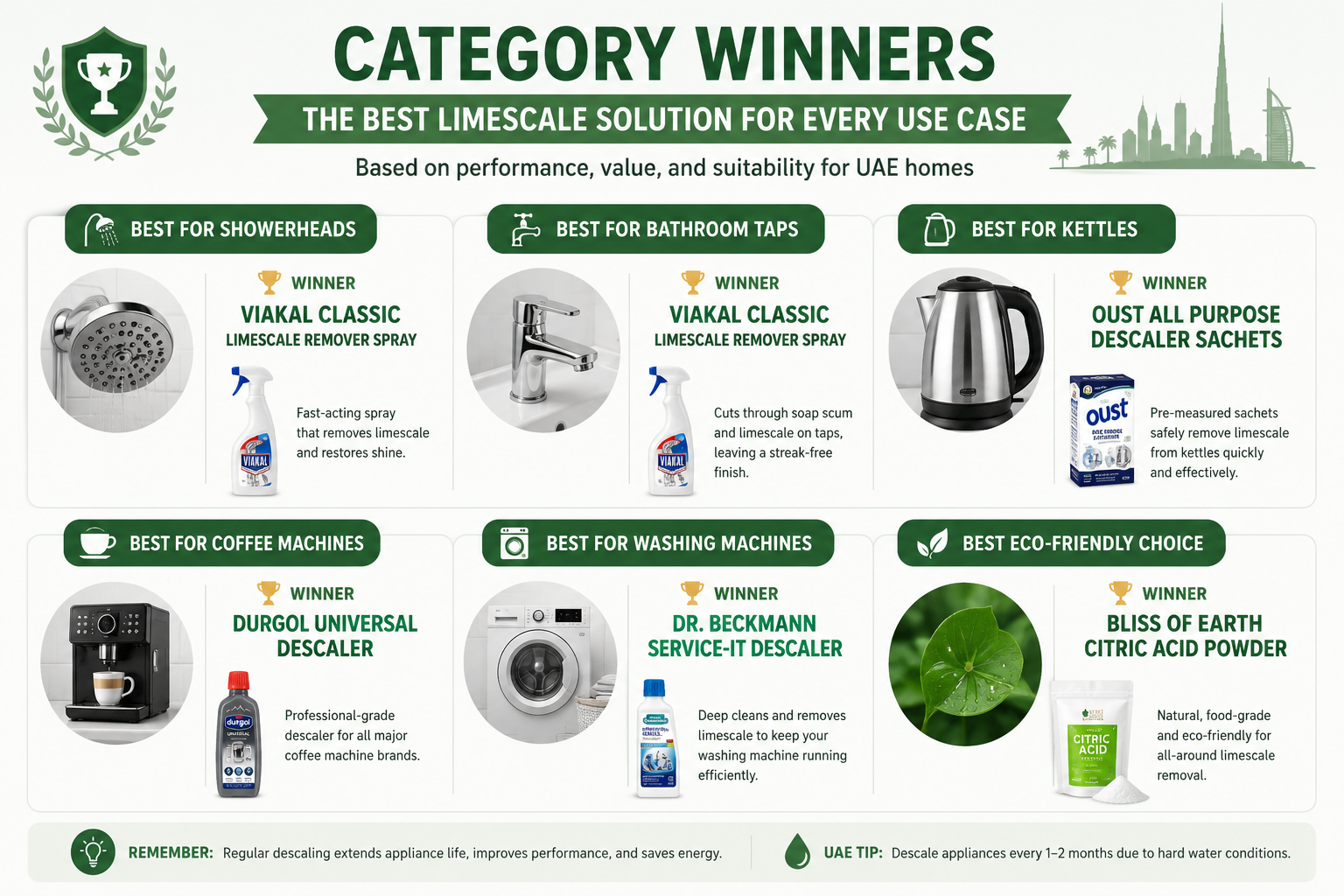
For most UAE homes, food-grade citric acid powder is the most versatile and cost-effective limescale removal solution - safe for showerheads, kettles, faucets, and appliances. For bathroom fixtures with heavier buildup, a commercial lactic acid spray such as Viakal removes deposits faster. For coffee machines, Durgol Universal Descaler is the most widely recommended appliance-specific option.
What Is The Best Limescale Removal Solution In The UAE?
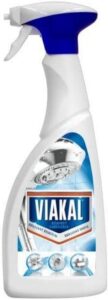
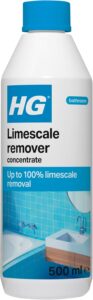
For most UAE homes, a food-grade citric acid descaler is the most versatile and cost-effective limescale removal solution – effective on showerheads, kettles, faucets, and most appliances. For bathroom fixtures with heavy buildup, a commercial lactic acid spray such as Viakal or HG Professional Limescale Remover delivers faster results with less soaking time.
Quick Comparison: Top Limescale Removal Solutions UAE
Some products below may include affiliate links. Prices and availability on Amazon.ae may change; verify current listings before purchase.
| Product | Best For | Type | Price (AED) | Eco | Safe |
|---|---|---|---|---|---|
| Viakal Classic | Bathroom fixtures | Spray | 130-150 | ✖ | ✖ |
| HG Professional | Heavy buildup | Liquid | 75-90 | ✖ | ✖ |
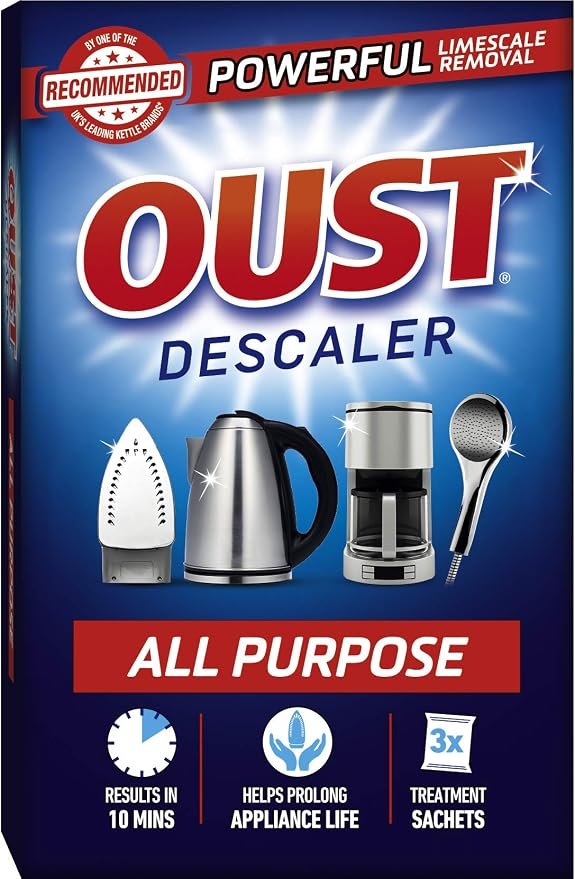
| Oust Sachets | Kettles | Powder | 90-100 | ◐ | ✔ |
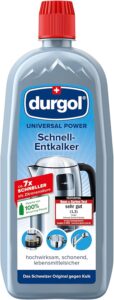
| Durgol Universal | Coffee machines | Liquid | 240-260 | ✖ | ✔ |
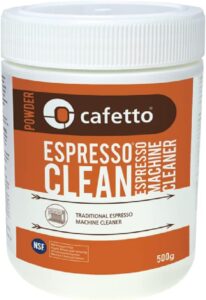
| Cafetto Espresso | Espresso machines | Powder | 130-150 | ✖ | ✔ |
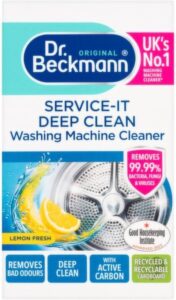
| Dr. Beckmann | Washing machines | Powder | 30-50 | ◐ | ✔ |
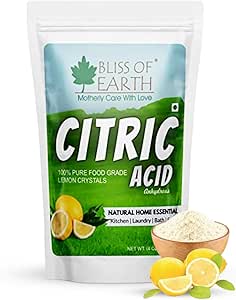
| Citric Acid Powder | All-round use | Bulk powder | 20-40 | ✔ | ✔ |
What Is Limescale?
Limescale is a hard, chalky deposit formed primarily from calcium carbonate and magnesium compounds. It precipitates out of water when dissolved minerals are left behind as water evaporates or is heated.
In chemical terms, limescale forms when calcium bicarbonate in water breaks down under heat or evaporation, releasing calcium carbonate as a solid deposit. This process accelerates significantly in areas with high water hardness – which firmly includes the UAE.
Limescale appears white, off-white, or pale grey. On metal surfaces such as faucets and showerheads, it presents as a rough, crusty coating. Inside appliances such as kettles and coffee machines, it forms a flaky internal layer that reduces heating efficiency and affects water taste.
Why Limescale Is a Serious Problem in UAE Homes
UAE tap water comes from two main sources: groundwater drawn from limestone and dolomite aquifers, which is naturally high in dissolved calcium and magnesium, and desalinated seawater blended with treated groundwater to meet demand. While desalination removes many impurities, the blending process reintroduces mineral content to restore palatability, resulting in water that remains exceptionally hard.
Additional factors that worsen limescale buildup in UAE homes include:
- High ambient temperatures accelerating mineral precipitation on heated surfaces and in appliances
- Frequent hot water use for showers, dishwashers, and washing machines
- Continuous air conditioning creating condensation on bathroom surfaces
- Sealed apartment units with limited natural ventilation, slowing surface drying
For UAE residents, limescale is not a seasonal concern. It is a year-round maintenance challenge that intensifies during summer months when water temperatures rise and indoor AC use peaks.
Limescale vs Hard Water Stains: What Is the Difference?
These two terms are often used interchangeably but describe different stages of the same process.
Hard water stains are the lighter, cloudy or spotted marks left on glass and smooth surfaces when hard water dries. They are typically found on shower glass panels, mirrors, and polished tiles and can often be removed with mild acidic cleaners.
Limescale is the more advanced mineral deposit that forms when hard water evaporation or heating continues over time without intervention. It bonds firmly to surfaces, requiring stronger acidic treatments, longer contact times, or mechanical scrubbing to remove effectively.
This guide focuses specifically on limescale removal – the crusty, calcified buildup found on faucets, showerheads, inside kettles and appliances, and around bathroom fixtures. For shower glass stain removal, see the Hard Water Stains UAE guide which covers that topic in detail.
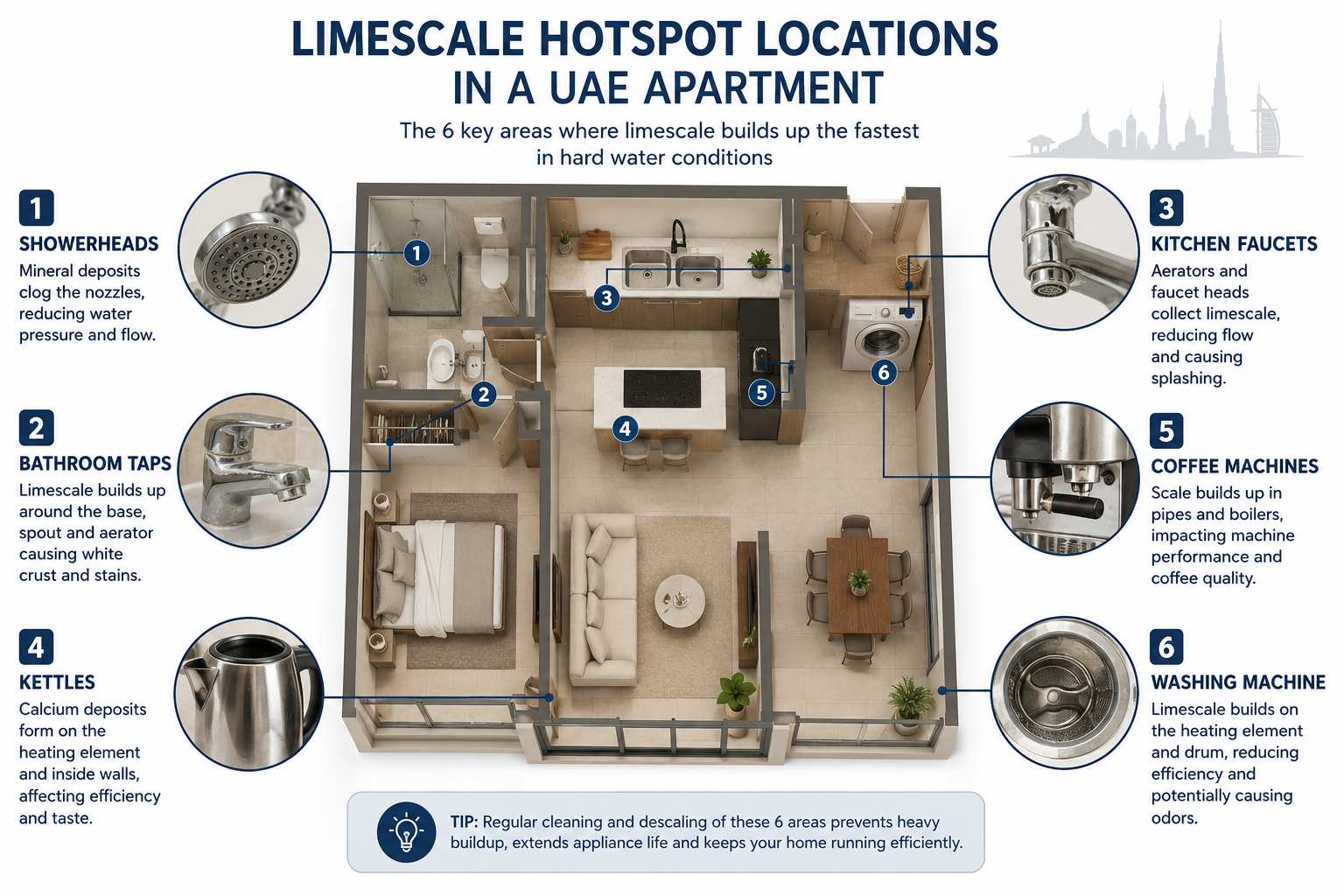
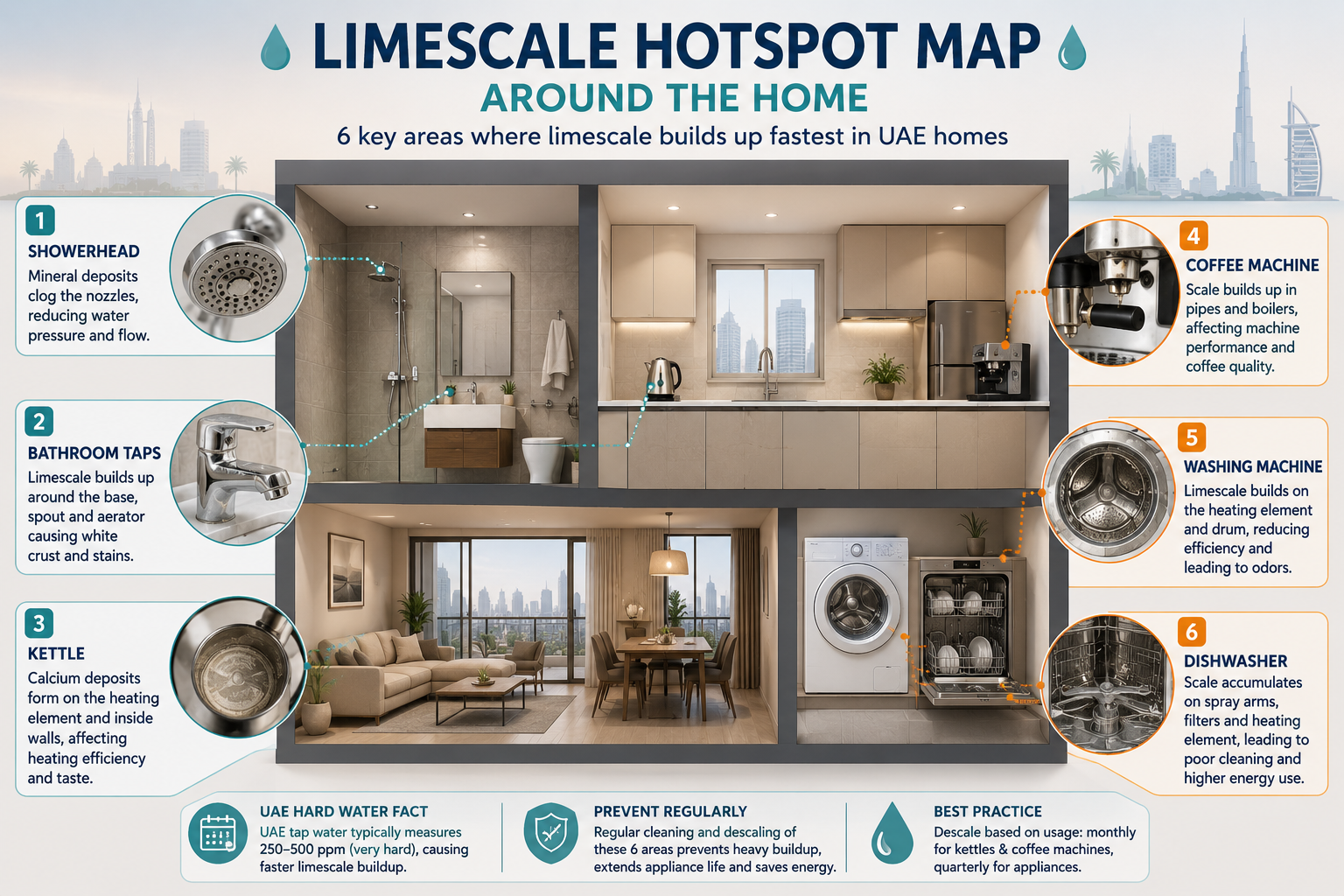
Where Limescale Builds Up Most Often


Showerheads
Showerheads are among the most affected fixtures in UAE homes. Water exits through small nozzle holes under pressure, and mineral residue accumulates inside the head and around each nozzle opening. Partial or fully blocked nozzles are one of the earliest signs of limescale buildup. Water pressure drops noticeably as mineral deposits restrict flow. In UAE conditions, visible nozzle crust can form within two to three weeks of the last cleaning.
Bathroom Taps
The base of bathroom taps, around the spout, and underneath the faucet head accumulate limescale quickly. Visible white or grey crust forms at the waterline – the point where water drips or splashes and then evaporates. In UAE conditions, this crust can develop within one to two weeks without intervention.
Kitchen Faucets
Kitchen faucets face similar buildup to bathroom taps, with the aerator screen at the faucet tip being particularly vulnerable. A blocked aerator reduces water flow and changes the spray pattern. Aerator descaling is one of the most commonly overlooked maintenance tasks in UAE kitchens.
Kettles
Inside the kettle, limescale forms on the heating element as water is repeatedly boiled and evaporated. A white, flaky internal coating is the most visible sign. Significant limescale accumulation reduces heating efficiency, increases energy consumption, and affects the taste of boiled water. Given UAE water hardness, kettles used daily can develop visible buildup within three to four weeks.
Coffee Machines
Automatic and semi-automatic coffee machines are particularly vulnerable because water passes through narrow internal tubes under pressure and heat. Limescale builds inside boilers, tubing, and heating elements. Most manufacturers recommend descaling every one to three months in hard water areas – a schedule that UAE residents should treat as a minimum, not a guideline.
Washing Machines
Drum seals, heating elements, and internal hoses all accumulate limescale in washing machines operating with UAE tap water. Unlike visible fixtures, washing machine limescale is largely hidden but reduces heating efficiency and can shorten appliance lifespan significantly if unaddressed.
Dishwashers
Dishwasher spray arms contain small holes that can become partially blocked by limescale, reducing cleaning efficiency. The internal walls, heating element, and filter area are also commonly affected. Most dishwashers include a salt reservoir designed to soften wash water, but in UAE hard water conditions this alone is often insufficient without additional descaling treatment.
How To Choose the Best Limescale Removal Solutions UAE
With a wide range of products available across Amazon.ae, UAE supermarkets, and hardware stores, choosing the right descaler requires matching the product to the surface and appliance type.
Surface Compatibility
Different surfaces require different acid strengths and formulations. Stainless steel, chrome, ceramic, and plastic each react differently to acidic descalers. Strong acids that work well on stainless steel fixtures can damage chrome plating if left too long. Always confirm surface compatibility before applying any product.
Acid Strength and Active Ingredient
Most commercial descalers use one of several active acids:
- Citric acid – moderate strength, widely available, generally safe for most surfaces and internal appliance use
- Lactic acid – effective mid-strength option common in bathroom descalers
- Phosphoric acid – stronger option used in professional formulations
- Sulfamic acid – commonly used in appliance descalers for effectiveness at moderate concentrations
- Hydrochloric acid – the strongest commonly available option, effective on stubborn buildup but requiring careful handling and surface verification
For routine UAE home maintenance, citric acid and lactic acid products cover most needs. Stronger formulations are appropriate for severe buildup or appliances with long periods between descaling cycles.
Safety and Handling
All acid-based descalers require standard precautions: gloves, ventilation, and avoidance of contact with eyes and skin. Products intended for appliance interiors should be food-safe or clearly rated for that purpose. Products used in bathrooms should be stored away from children.
Scent and Ventilation
Many descalers have a strong chemical odour. In sealed UAE apartments with limited natural ventilation, scent can be a practical consideration. Running AC exhaust fans or opening windows where possible during application is advisable regardless of product type.
Eco-Friendliness
Biodegradable descalers based on citric or lactic acid are available and perform well for regular maintenance. For residents preferring to reduce chemical output, these products offer effective results for light to moderate buildup with a lower environmental impact.
Appliance Suitability
Appliance manufacturers typically specify descaler types compatible with their products. Using a bathroom tile descaler inside a coffee machine may void the warranty or damage internal components. Where manufacturer guidelines exist, following them is the recommended approach.
Top 7 Limescale Removal Solutions UAE

The following are the most widely available and consistently recommended limescale removal solutions in the UAE in 2026. Each product is available or searchable on Amazon.ae. Availability and pricing may change; verify current listings before purchase.
Ratings below reflect a composite assessment based on UAE marketplace availability, user reviews on Amazon.ae, descaling effectiveness on hard water deposits, ease of use, and suitability for UAE water conditions.
BEST for Bathroom Fixtures
Key features
- Lactic acid formula removes calcium and magnesium deposits
- Spray format clings to vertical surfaces
- Widely available across the UAE
- Effective for routine hard water maintenance
Best for:
Bathroom fixtures, taps, showerheads, ceramic tiles
Price Range
AED 130-150
PROS
- ✓Ready to use
- ✓No mixing required
- ✓Fast-acting on light to moderate buildup
- ✓Effective on chrome and porcelain
CONS
- ✕Not suitable for appliances
- ✕Strong scent
- ✕Less effective on severe buildup
BEST for Heavy Limescale Buildup
Key features
- High-concentration phosphoric acid formula
- Designed for heavy-duty descaling
- Effective on deep-set mineral deposits
- Can be diluted for routine cleaning
PROS
- ✓Extremely effective on stubborn scale
- ✓Strong professional formula
- ✓Good value per use
CONS
- ✕Requires careful handling
- ✕Strong odour
- ✕Not suitable for food-contact appliances
PROS
- ✓Easy to use
- ✓Appliance safe
- ✓Low odour
- ✓Economical multipacks
CONS
- ✕Multiple treatments may be needed
- ✕Less effective on severe buildup
- ✕Not ideal for premium espresso machines
Best for:
Coffee machines, espresso makers, bean-to-cup systems
Price Range
AED 240-260
PROS
- ✓Highly effective
- ✓Broad machine compatibility
- ✓No aftertaste after rinsing
- ✓Widely available
CONS
- ✕Expensive
- ✕Higher cost per use
- ✕Some manufacturers recommend their own descalers
Best for:
Semi-automatic and automatic espresso machines
Price Range
AED 130-150
PROS
- ✓Food-safe certified
- ✓Excellent espresso machine performance
- ✓Long shelf life
- ✓Available on Amazon.ae
CONS
- ✕Requires mixing
- ✕Not compatible with every warranty requirement
- ✕Less common in local stores
Best for:
Washing machines, drum maintenance, heating elements
Price Range
AED 30-50
PROS
- ✓Easy application
- ✓Cleans and descales simultaneously
- ✓Widely available
- ✓Affordable
CONS
- ✕Less powerful than dedicated descalers
- ✕May require additional treatment for severe buildup
- ✕Limited use outside washing machines
PROS
- ✓Lowest cost per use
- ✓Appliance safe
- ✓Eco-friendly
- ✓Low odour
- ✓Highly versatile
CONS
- ✕Requires measuring and mixing
- ✕Less convenient than sprays
- ✕Less effective on extreme buildup without repeated treatments
Which Limescale Remover Is Best for Your Situation?
| Situation | Recommended Product |
|---|---|
| Best Overall | Bliss of Earth Citric Acid Powder |
| Best Bathroom Product | Viakal Classic Limescale Remover Spray |
| Best for Heavy Buildup | HG Professional Limescale Remover |
| Best for Kettles | Oust All Purpose Descaler Sachets |
| Best for Coffee Machines | Durgol Universal Descaler |
| Best for Espresso Machines | Cafetto Espresso Clean Descaler |
| Best for Washing Machines | Dr. Beckmann Service-It Descaler |
| Best Budget Choice | Bliss of Earth Citric Acid Powder |
| Best Eco-Friendly Choice | Bliss of Earth Citric Acid Powder |
| Best for Apartment Residents | Citric Acid Powder + Viakal Spray |
| Best for Villa Owners | HG Professional + Durgol + Citric Acid Powder |
Product Type Comparison
| Product Type | Cost | Strength | Appliance Safe | Ease of Use |
|---|---|---|---|---|
| Citric Acid Powder | Low | Medium | Yes | Medium |
| Spray Descaler | Medium | Medium | No | High |
| Professional Concentrated Descaler | Medium-High | High | No | Medium |
| Appliance-Specific Descaler | Medium | High | Yes | High |

Natural Limescale Removal Methods

Natural alternatives are among the best limescale removal solutions UAE residents can use for routine maintenance – particularly for light to moderate buildup. They are not always sufficient for severe or long-established deposits but can replace commercial products in many regular cleaning contexts.
White Vinegar
White vinegar contains acetic acid at approximately 5% concentration, which dissolves calcium carbonate effectively for most standard surface applications. It is widely available across UAE supermarkets at low cost and is safe for most metal fixtures, ceramic surfaces, and appliance interiors when used correctly.
Effective uses include soaking removable showerheads, cleaning tap aerators, and kettle descaling. The strong smell is the primary drawback in sealed UAE apartments. Distilled white vinegar is the appropriate type to use – not malt or coloured vinegar.
Important limitation: Never use white vinegar or any acidic cleaner on natural stone surfaces including marble, travertine, or limestone. The acid will etch and permanently damage the surface.
Citric Acid
Citric acid is consistently the most effective natural descaling agent for UAE conditions. It is stronger than acetic acid at equivalent concentrations, less strongly scented than vinegar, and available in food-grade powder form from UAE supermarkets, pharmacies, and Amazon.ae.
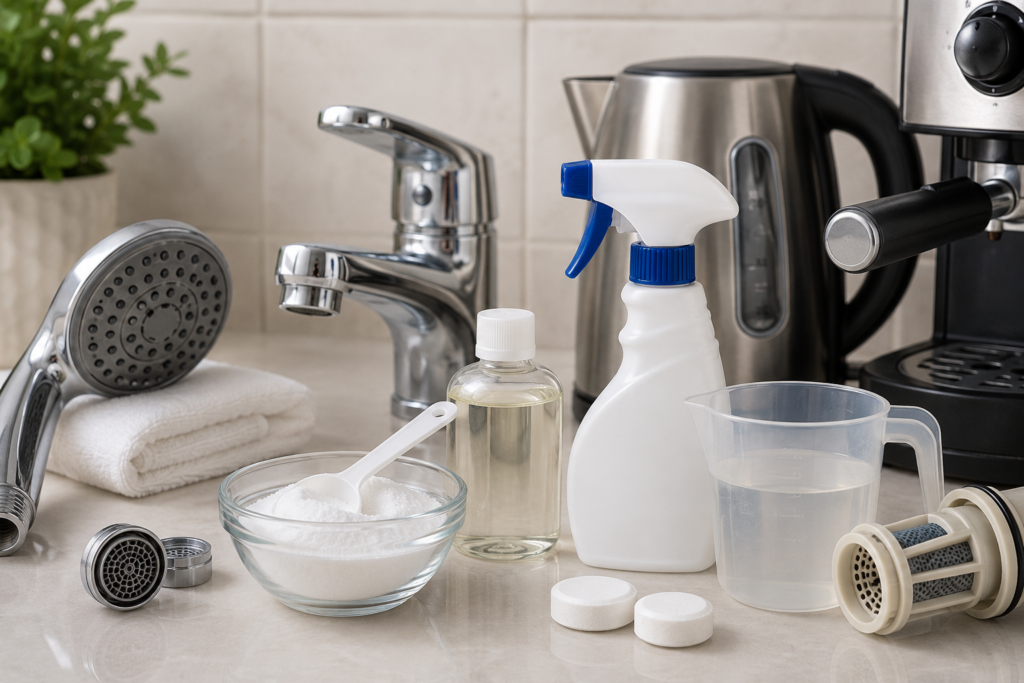
A standard working solution for surface application is 1 to 2 tablespoons of citric acid dissolved in 500ml of warm water. For soaking showerheads or tap aerators, a stronger solution of 2 to 4 tablespoons per 500ml is appropriate for heavier buildup. Citric acid is safe for use inside kettles, coffee machines, and most standard appliances where manufacturer guidelines permit.
Baking Soda (Limitations)
Baking soda is alkaline and does not dissolve calcium carbonate, which requires an acidic treatment. It has very limited effectiveness as a standalone limescale remover. Its mild abrasive texture can assist with scrubbing loosened deposits after acid treatment, but using baking soda alone on limescale will produce minimal results and is not recommended.
Lemon Juice
Fresh lemon juice contains citric acid at natural concentrations and can function as a mild descaling agent for light surface deposits on faucets and fixtures. It is less concentrated than dissolved citric acid powder, making it less practical for significant buildup. Lemon juice is useful for quick surface maintenance between deeper cleaning cycles, particularly on chrome faucets where it can be applied briefly and wiped away.
Natural vs Commercial Descaler Comparison
| Factor | Citric Acid Powder | White Vinegar | Commercial Spray | Appliance Sachet |
|---|---|---|---|---|
| Effectiveness, light buildup | High | High | High | High |
| Effectiveness, heavy buildup | Moderate | Moderate | High | Moderate |
| Appliance safe | Yes, food grade | Yes | No | Yes |
| Eco-friendly | Yes | Yes | Partial | Partial |
| Cost, UAE | Very low | Very low | Moderate | Moderate |
| Availability | Supermarkets, Amazon.ae | Supermarkets | Supermarkets | Amazon.ae |
| Odour | Low | Strong | Moderate | Low |
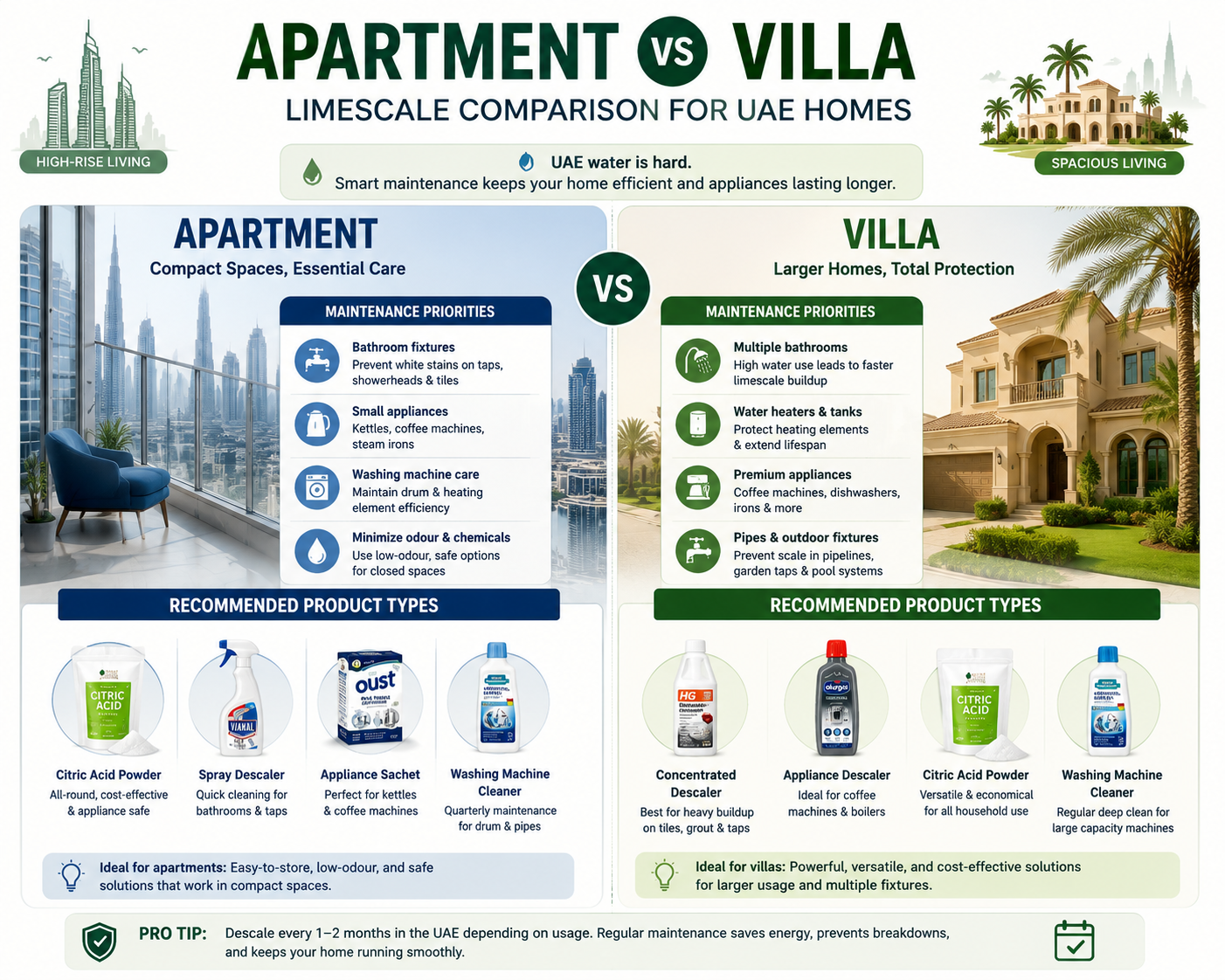
Apartment vs Villa Limescale Challenges UAE
Limescale management differs in important ways between UAE apartments and villas. Understanding these differences helps prioritise which products and approaches to invest in.

| Factor | UAE Apartment | UAE Villa |
|---|---|---|
| Number of fixtures | Typically 1-2 bathrooms and 1 kitchen | Multiple bathrooms, outdoor taps, and garden fixtures |
| Maintenance responsibility | Tenant handles fixtures; building manages main plumbing | Owner or tenant responsible for all systems |
| Showerhead type | Fixed or handheld standard fittings | Rain showers and multiple heads are common |
| Descaling frequency | Monthly for high-use fixtures | Monthly to quarterly depending on fixture count |
| Water softener viability | Limited – landlord approval may be required | Feasible – under-sink and whole-house options are viable |
| Natural ventilation | Limited; AC-reliant; slower surface drying | Better cross-ventilation; faster surface drying |
| Primary risk areas | Shower, kettle, coffee machine, washing machine | Apartment areas plus pool equipment and outdoor taps |
| Budget approach | Bulk citric acid plus 1-2 spray products | Bulk descaler plus appliance-specific products |
| Best product mix | Citric acid powder + Viakal spray | HG Professional + Durgol + Citric Acid |
Best for Apartment Residents
UAE apartment residents benefit most from a two-product approach: a ready-to-use bathroom spray such as Viakal for fixtures, combined with bulk food-grade citric acid powder for kettles, showerhead soaking, and appliance descaling. This covers all standard use cases at minimal cost and storage footprint.
Best for Villa Owners
UAE villa owners managing multiple bathrooms, outdoor fixtures, and a wider range of appliances benefit from maintaining a broader product inventory – HG Professional Limescale Remover for heavy-duty bathroom work, Durgol or Cafetto for coffee machines, Dr. Beckmann for washing machines, and bulk citric acid for routine maintenance across all remaining fixtures.
When a Water Softener Makes Sense in UAE Homes
Water softeners use ion exchange to replace calcium and magnesium ions with sodium ions, significantly reducing water hardness at the point of entry. For UAE homes with persistent limescale problems, a water softener is the most effective long-term prevention measure available – addressing the root cause rather than the symptom.
For Apartment Renters
Whole-house softener installation is not feasible in most UAE rental apartments without landlord approval and building management agreement. Under-sink point-of-use softeners are a more practical alternative and can be installed at the kitchen tap without structural modification. For showers, a shower filter (which reduces but does not eliminate mineral content) is the most landlord-friendly option available.
For Villa Owners
UAE villa owners have the option of installing whole-house water softeners that treat all incoming water before it reaches any fixture or appliance. The upfront cost – typically ranging from AED 2,000 to AED 8,000 depending on system size and installation requirements – can be offset by reduced descaling frequency, extended appliance lifespan, and lower maintenance costs over time. Whole-house softener installation is considered a worthwhile investment for villa owners experiencing rapid and persistent limescale accumulation.
Cost Comparison
| Option | Upfront Cost, Approx. | Ongoing Cost | Effectiveness |
|---|---|---|---|
| Bulk citric acid | AED 20-50 per kg | Monthly purchase | Treats symptoms |
| Shower filter | AED 80-200 | Cartridge every 3-6 months | Reduces showerhead scale |
| Under-sink softener | AED 500-1,500 | Salt and resin maintenance | Treats kitchen water |
| Whole-house softener | AED 2,000-8,000+ | Salt and annual service | Full home solution |
How Often Should You Descale in the UAE?
Given UAE water hardness levels, descaling frequencies that apply in European or North American contexts are typically insufficient. The following schedule reflects UAE conditions specifically.


| Fixture or Appliance | Recommended Frequency, UAE | Signs Descaling Is Overdue |
|---|---|---|
| Kettle | Every 3-5 weeks | Visible flaking, reduced efficiency, changed water taste |
| Coffee machine | Every 4-8 weeks | Slower brewing, reduced temperature, machine alert |
| Showerhead | Monthly | Reduced pressure, uneven spray, visible nozzle crust |
| Bathroom taps | Monthly | Visible white crust at base or around spout |
| Kitchen faucet aerator | Monthly to bimonthly | Reduced flow, irregular spray pattern |
| Washing machine | Every 2-3 months | Reduced heating efficiency, drum discolouration, odour |
| Dishwasher | Every 2-3 months | Cloudy dishes, reduced spray arm performance |
| Shower filter cartridge | Every 3-6 months | Reduced flow through filter |
| Water softener | Annual service check | Hardness returning to pre-softener levels |
Monthly
Monthly descaling of showerheads, bathroom taps, and kitchen faucets is the baseline minimum for UAE residents. Running a kettle descaling cycle monthly and visually inspecting appliance interiors for visible buildup should also be standard practice.
Quarterly
Every three months, run a washing machine descaling cycle, descale the dishwasher, deep-clean the coffee machine, and check shower filter cartridges. For villas, quarterly inspection of outdoor taps and garden irrigation connections is advisable.
Annual
Annually, inspect and clean under-sink filters and shower filters, service any installed water softener systems, check appliance heating elements where accessible, and assess whether any fixtures require professional descaling or replacement due to irreversible buildup.
Preventing Limescale Buildup
Descaling removes existing deposits, but preventing buildup reduces how often the best limescale removal solutions UAE residents use are needed in the first place.
Shower Filters
Shower filters attach between the pipe and the showerhead and reduce the mineral content of water before it reaches the fixture. They do not fully soften water but can reduce limescale accumulation rates on showerheads and bath surfaces. Filter cartridges require replacement every three to six months. For UAE apartment residents who cannot install whole-house systems, a shower filter is a practical and landlord-friendly option.
For further guidance on bathroom cleaning and maintenance tools in the UAE, the CleanLivingUAE guide covers equipment selection in detail.
Water Softeners
Under-sink or whole-house water softeners use ion exchange to significantly reduce water hardness. In UAE villas, whole-house softener installation is a viable long-term option. In rental apartments, under-sink units are possible but require landlord awareness before installation.
Drying Fixtures After Use
Wiping down faucets and showerheads with a dry cloth after each use significantly slows limescale formation by preventing mineral-laden water from sitting and evaporating on surfaces. This is one of the most effective and lowest-cost prevention measures available.
Regular Maintenance Rather Than Reactive Cleaning
A light weekly spray with diluted citric acid solution on faucets and showerhead surfaces, followed by rinsing, prevents the accumulation that requires extended soaking and scrubbing when left unaddressed for months. The frequency required in UAE conditions means that scheduled maintenance is substantially less effort than reactive deep cleaning.
For guidance on keeping bathroom tiles and floors free from mineral deposits, see the Floors and Tiles Cleaning UAE guide on CleanLivingUAE.
Tap Aerator Maintenance
Removing and soaking tap aerators in citric acid solution every one to two months prevents the progressive flow restriction that develops from internal limescale accumulation. Aerators are simple to remove by hand or with a cloth for grip, and the soaking process requires minimal effort.
For a broader kitchen maintenance approach, the Kitchen Cleaning UAE guide covers faucet, sink, and appliance upkeep in the context of UAE conditions. Residents managing hard water deposits on windows and glass surfaces alongside limescale will also find the Best Window Cleaning Tools UAE guide a useful companion resource.
Common Limescale Removal Mistakes
Using the Wrong Product on the Wrong Surface
Strong acids such as hydrochloric acid can permanently damage chrome plating, grout, and coloured sealants. Always verify surface compatibility before applying any descaler.
Insufficient Contact Time
Many products require 5 to 30 minutes of contact to dissolve limescale effectively. Rinsing too quickly reduces effectiveness and may require the process to be repeated.
Excessive Contact Time on Chrome
While insufficient contact time reduces results, leaving strong acids on chrome-plated fixtures for too long can strip the finish. Adhere to the contact times specified on the product label.
Using Abrasive Pads on Chrome and Polished Surfaces
Wire wool, steel pads, or rough scouring pads will scratch chrome, stainless steel, and polished fixtures. Use non-abrasive cloths or soft brushes for scrubbing after chemical treatment.
Applying Acidic Products to Natural Stone
Marble, travertine, and limestone surfaces are acid-sensitive. Any acidic descaler – including white vinegar and citric acid – will etch and permanently damage these surfaces. Use pH-neutral stone cleaners on natural stone only.
Not Rinsing Appliances Thoroughly
Residual descaler inside kettles, coffee machines, or washing machines can contaminate subsequent use. Always follow the full rinsing cycle as specified by the product instructions.
Ignoring Manufacturer Guidance for Appliances
Using a household tile descaler in a coffee machine or espresso maker may damage internal components or void the warranty. Appliance-specific or food-safe descalers should always be used inside any appliance that contacts food or beverages.
Allowing Buildup Before Treating
Heavy limescale requires significantly more product, longer contact times, and more mechanical effort than light buildup treated on schedule. The maintenance burden grows substantially when descaling is deferred. In UAE conditions, a two-week delay can mean the difference between a five-minute maintenance clean and a 45-minute removal process.
For full guidance on bathroom cleaning and preventing related issues such as mould in UAE humidity conditions, see the Bathroom Cleaning UAE guide and the CleanLivingUAE resources on humidity and mould prevention.
Free UAE Limescale Prevention Checklist

Download the CleanLivingUAE Limescale Prevention Checklist to keep descaling on schedule throughout the year. Print and attach to the inside of a kitchen cupboard or save to your phone as a recurring reminder.
Weekly Tasks
- Wipe down bathroom taps and faucet bases with a dry cloth after use
- Dry showerhead exterior after final use of the day
- Apply diluted citric acid spray to visible tap buildup and rinse
- Check kitchen faucet aerator for visible crust or flow reduction
Monthly Tasks
- Descale kettle with citric acid solution or dedicated kettle descaler sachet
- Soak showerhead in citric acid or white vinegar solution for 30 to 60 minutes
- Remove and soak tap aerators in descaling solution
- Clean bathroom tap bases with spray descaler and non-abrasive cloth
- Run coffee machine through full descaling cycle
- Inspect washing machine drum seal for discolouration or buildup
- Check shower filter cartridge and replace if flow has reduced
Quarterly Tasks
- Run full washing machine descaling cycle – empty drum, hottest available cycle
- Run dishwasher descaling cycle
- Deep clean coffee machine including external water reservoir and group head
- Inspect outdoor taps and garden connections (villas)
- Replace shower filter cartridge if not replaced in the prior month
- Assess water softener salt level or filter status if installed
FAQs
How often should a showerhead be descaled in a UAE apartment?
In UAE conditions, monthly descaling is the appropriate minimum. Showerheads in high-use bathrooms or buildings with very high water hardness may benefit from descaling every two to three weeks. Reduced water pressure or uneven spray from individual nozzles are reliable indicators that descaling is needed.
Can white vinegar damage a showerhead?
White vinegar is generally safe for chrome and plastic showerheads when used at standard household concentration and contact times of 30 to 60 minutes. Extended soaking beyond several hours at full strength may affect some finishes. White vinegar should never be used on gold-plated, brushed nickel, or specialty-coated fixtures without confirming compatibility with the manufacturer.
What is the fastest way to remove heavy limescale from a tap?
For heavy buildup on tap bases, apply a commercial gel descaler with lactic or phosphoric acid base, cover with cling film to retain contact for 15 to 30 minutes, then scrub with a non-abrasive brush or toothbrush and rinse thoroughly. Repeat if needed. This method is more effective than spray products alone for established deposits.
Are limescale removers safe to use around children and pets?
Most commercial descalers require ventilation during application and should not come into contact with skin or eyes. Products must be rinsed thoroughly before surfaces or appliances are used normally. Citric acid and eco-formulation descalers carry lower hazard ratings and are a preferred option in households with young children. All descaling products should be stored securely away from children regardless of formulation.
Can limescale cause permanent damage to appliances?
Yes. Limescale accumulation on heating elements in kettles, coffee machines, and washing machines reduces thermal efficiency and can cause overheating and premature element failure. In coffee machines, limescale can block internal tubing, damaging pumps and boilers. Regular descaling on the schedule appropriate for UAE water conditions prevents this damage and meaningfully extends appliance lifespan.
Is it worth installing a water softener in a UAE rental apartment?
In rental apartments, whole-house softener installation is not typically practical without landlord agreement. Under-sink softeners and shower filters are more accessible options. These do not eliminate limescale entirely but reduce accumulation rates meaningfully. For villa owners or long-term residents, whole-house softener installation is a worthwhile investment for reducing maintenance burden across all fixtures and appliances.
What surfaces should never be treated with a limescale remover?
Natural stone surfaces including marble, travertine, and limestone should never be treated with acid-based descalers, as they will etch and permanently damage the surface. Use pH-neutral stone cleaners on these surfaces only. Gold-plated, unlacquered brass, and certain specialty fixture finishes may also be damaged by acidic products. Confirm surface compatibility before applying any descaler.
Can limescale be removed from inside a washing machine drum?
Yes. Running a dedicated washing machine descaler through a hot, empty cycle effectively treats limescale on the drum interior, heating element, and internal hoses. Products such as Dr. Beckmann Service-It are available on Amazon.ae for this purpose. A maintenance descaling cycle every two to three months is appropriate for UAE conditions.
Does hard water in the UAE void appliance warranties?
Most appliance manufacturers include descaling maintenance requirements in their warranty terms. Failure to descale on the recommended schedule may be cited in warranty disputes relating to limescale-related damage. Following manufacturer-recommended descaling intervals and using approved descaling products is the appropriate approach to maintain warranty compliance.
Is citric acid safe to use inside a kettle or coffee machine?
Food-grade citric acid is safe for use inside kettles and most coffee machines when rinsing instructions are followed correctly. Run two to three full cycles of fresh water through the kettle or machine after any descaling treatment to ensure no residue remains. Some coffee machine manufacturers specify alternative descalers in their guidelines – checking the appliance manual before using any third-party product is recommended.
Recommended Limescale Solution by User Type
| User Type | Recommended Solution |
|---|---|
| Budget apartment renter | Bliss of Earth Citric Acid Powder |
| Apartment family | Viakal Spray + Citric Acid Powder |
| Coffee enthusiast | Durgol Universal Descaler |
| Espresso machine owner | Cafetto Espresso Clean Descaler |
| Villa owner | HG Professional + Durgol + Citric Acid Powder |
| Eco-conscious household | Bliss of Earth Citric Acid Powder |
| Heavy buildup situation | HG Professional Limescale Remover |
| Appliance-first household | Oust Sachets + Dr. Beckmann combination |
Conclusion
The best limescale removal solutions UAE residents need vary by fixture and appliance type, but the core principle is consistent: match the right product to the right surface, maintain a regular descaling schedule, and apply preventive measures that slow accumulation between cleaning cycles.
For UAE apartment residents, a combination of food-grade citric acid powder for kettles and appliances, a dedicated spray descaler such as Viakal for bathroom and kitchen fixtures, and a soaking solution for showerheads covers the full range of household needs at accessible cost. Villa residents with additional fixtures and appliances benefit from the same core approach supplemented by HG Professional for heavy-duty work, Durgol or Cafetto for coffee equipment, and Dr. Beckmann for washing machine maintenance.
The most practical outcome of consistent limescale management is extended appliance lifespan, maintained water flow across all fixtures, and significantly reduced effort at each cleaning cycle compared to allowing buildup to accumulate before treating it.
For related maintenance guidance, the Hard Water Stains UAE guide covers shower glass and mirror stain removal, while the Best Shower Squeegees UAE guide addresses the daily tools that help prevent mineral deposits on glass surfaces.
Keyword Frequency Reference
best limescale removal solutions UAE, limescale remover UAE, best descaler UAE, remove limescale showerhead UAE, limescale cleaner UAE, hard water scale remover UAE, descaling solution UAE, calcium deposit remover UAE, bathroom limescale remover UAE, kettle descaler UAE, showerhead descaler UAE
Sources
This article draws on information from DEWA (Dubai Electricity and Water Authority) on UAE water quality standards and mineral content, WHO Guidelines for Drinking-water Quality on water hardness classification and health context, NSF International on food-safety certification standards for descaling products, product documentation and usage guidance from Viakal, HG, Oust, Durgol, Cafetto, and Dr. Beckmann, and general water chemistry reference material from peer-reviewed sources on calcium carbonate precipitation and its relationship to water temperature and hardness.