Air and Dust Control UAE: 15 Powerful Ways to Improve Indoor Air Quality

By the CleanLivingUAE Editorial Team, published on
June 6, 2026
Air and dust control UAE homes require a structured approach. Learn how to reduce dust, improve indoor air quality, maintain AC systems, and choose the right tools for UAE apartments and villas.
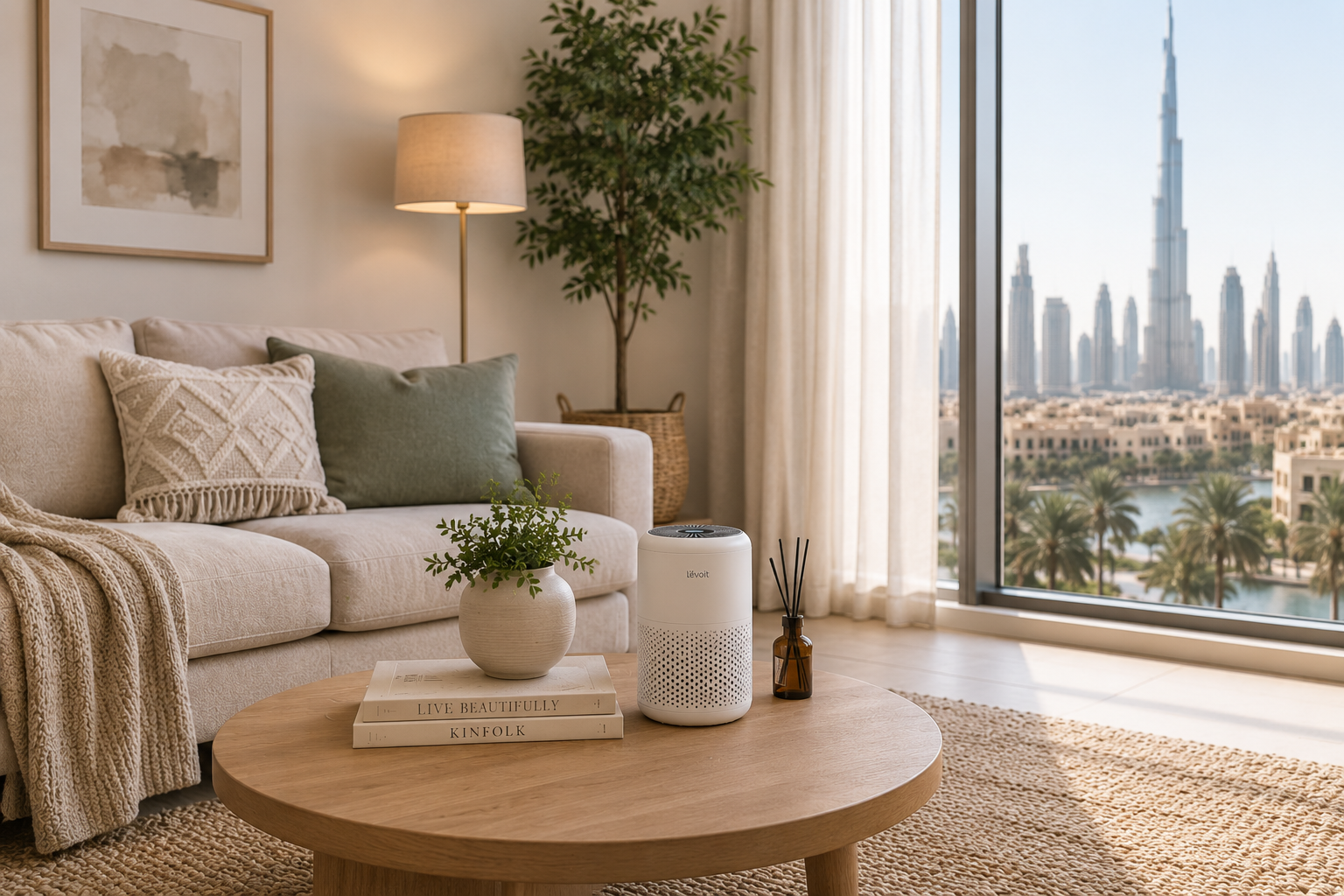
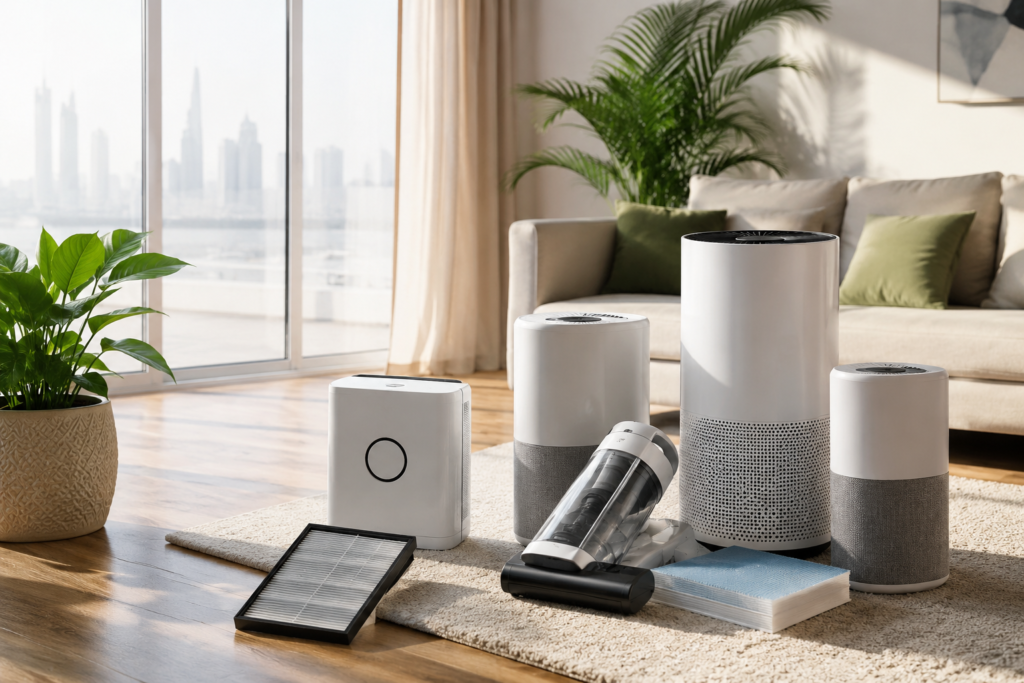
Air and dust control uae-apartment including air purifier, dehumidifier, HEPA filter, and vacuum cleaner.

Air and Dust Control Hub

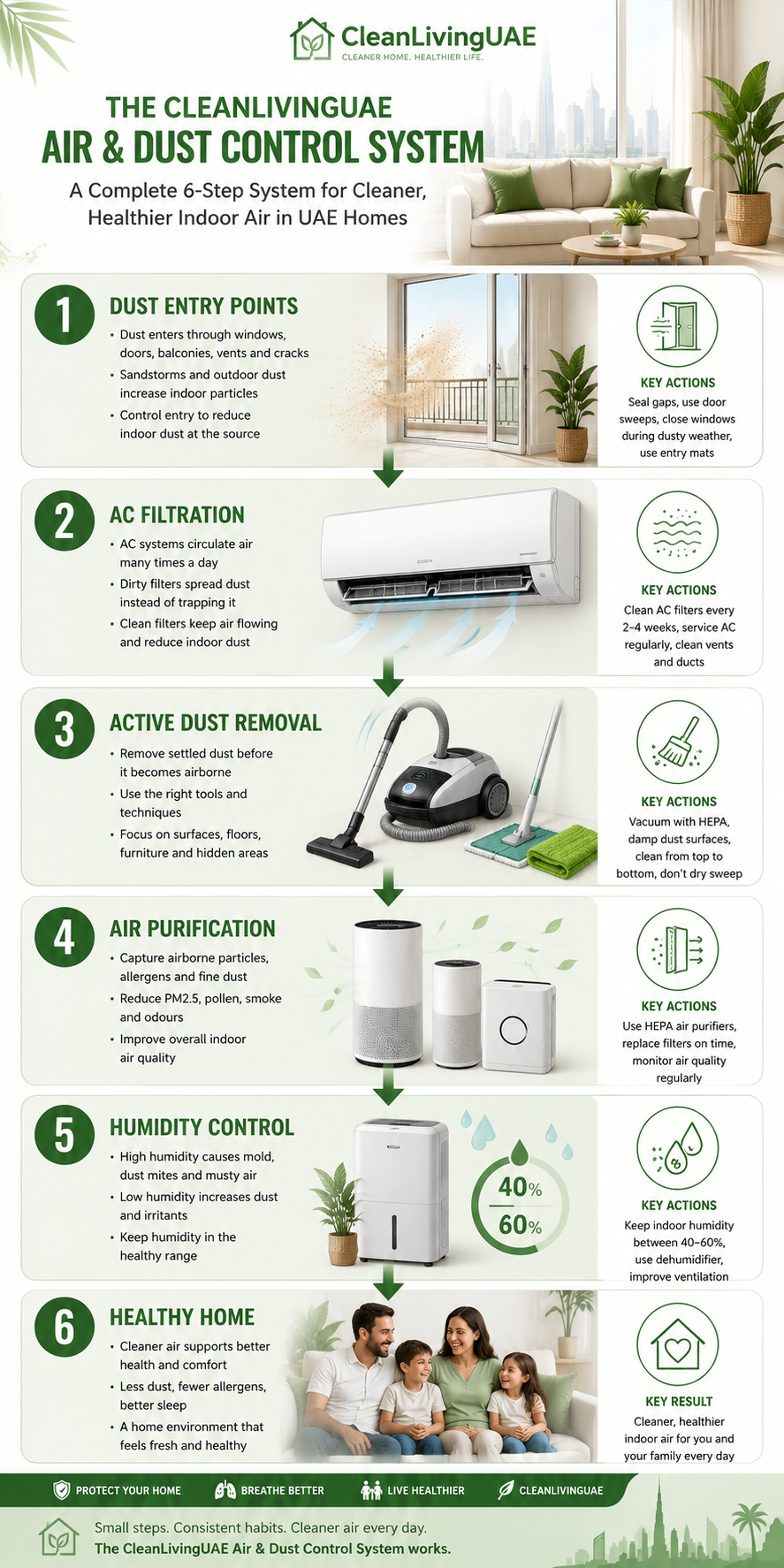
Air and dust control UAE homes require a structured, ongoing approach that addresses the full cycle of how dust enters, circulates, settles, and is removed. Desert dust, seasonal sandstorms, year-round AC dependency, and coastal humidity combine to create indoor air conditions significantly more demanding than most other regions. UAE apartments and villas commonly see dust resettlement within 24 to 48 hours of cleaning, a reliable indicator of ongoing airborne dust circulation rather than surface accumulation alone.

air-and-dust-control-uae-The CleanLivingUAE Air & Dust Control System" showing a vertical flow: Dust Entry Points → AC Filtration → Active Dust Removal → Air Purification → Humidity Control → Healthy Home.

UAE Air Quality at a Glance

ChallengeTypical Condition
Dust Resettlement24-48 hours in most UAE apartments
AC Usage Period8-12 months per year
Sandstorm SeasonMarch-May (peak risk)
Peak HumidityJune-September
AC Filter CleaningEvery 2-4 weeks under normal UAE conditions
Ideal Indoor Humidity40-60%

Quick Navigation

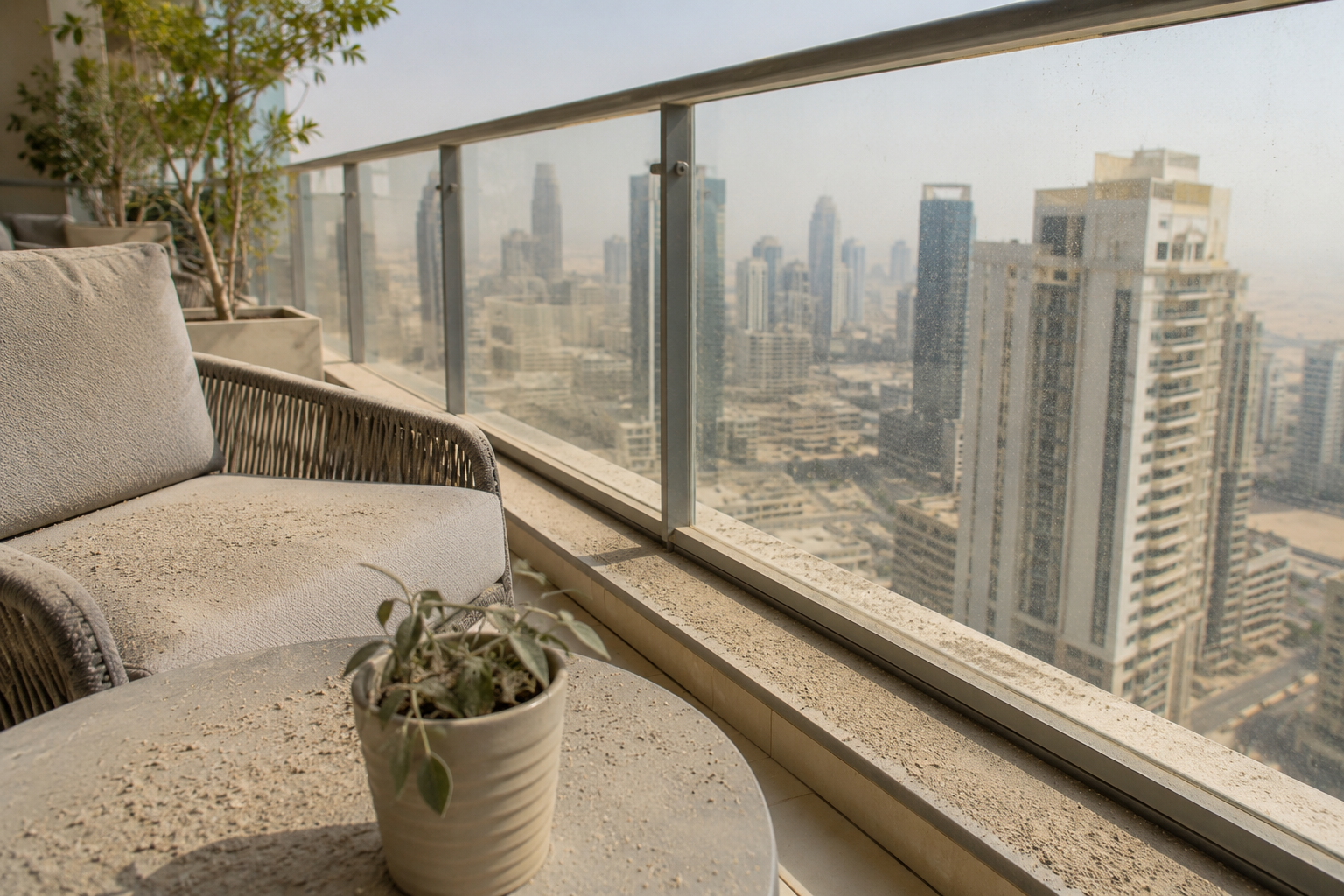
balcony-dust-problems-uae-Dust-covered high-rise apartment balcony in the UAE with outdoor furniture, dusty glass railings, and a hazy Dubai-style skyline in the background during a fine dust and humidity period.
Reduce dust buildup with practical prevention strategies.
Dust Prevention
Tips UAE
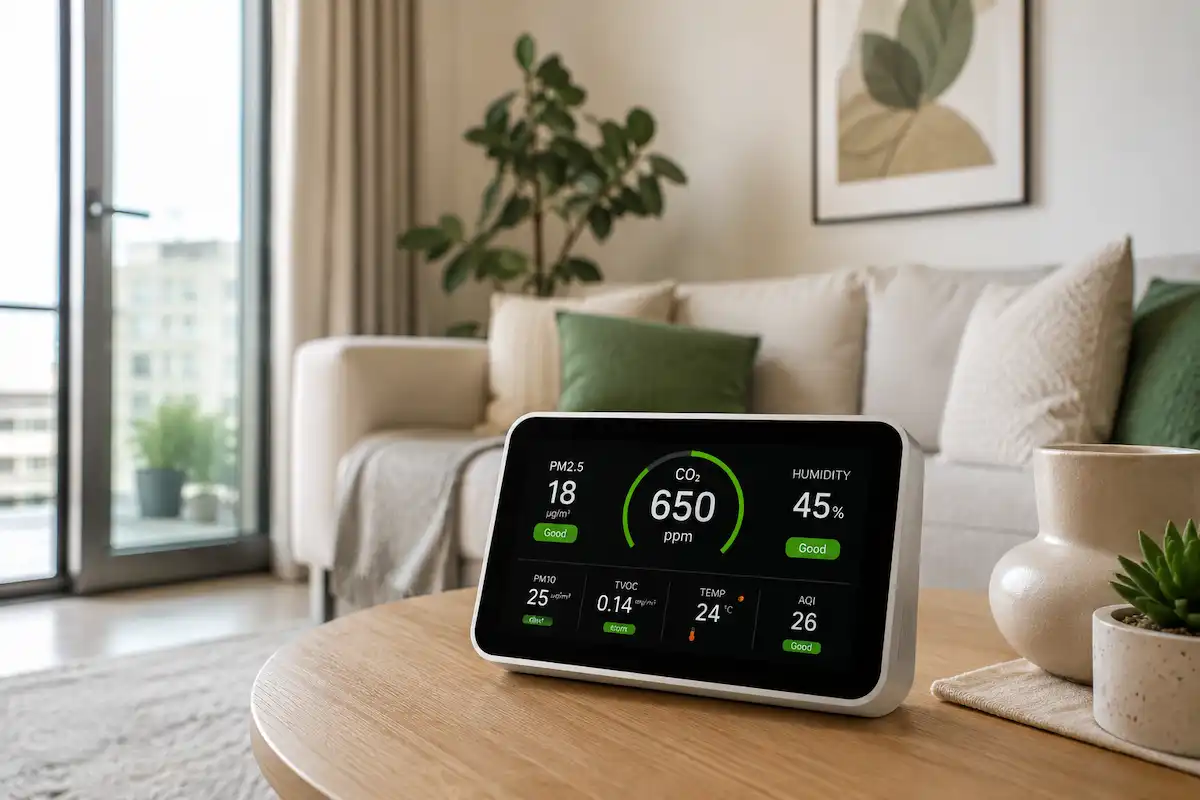
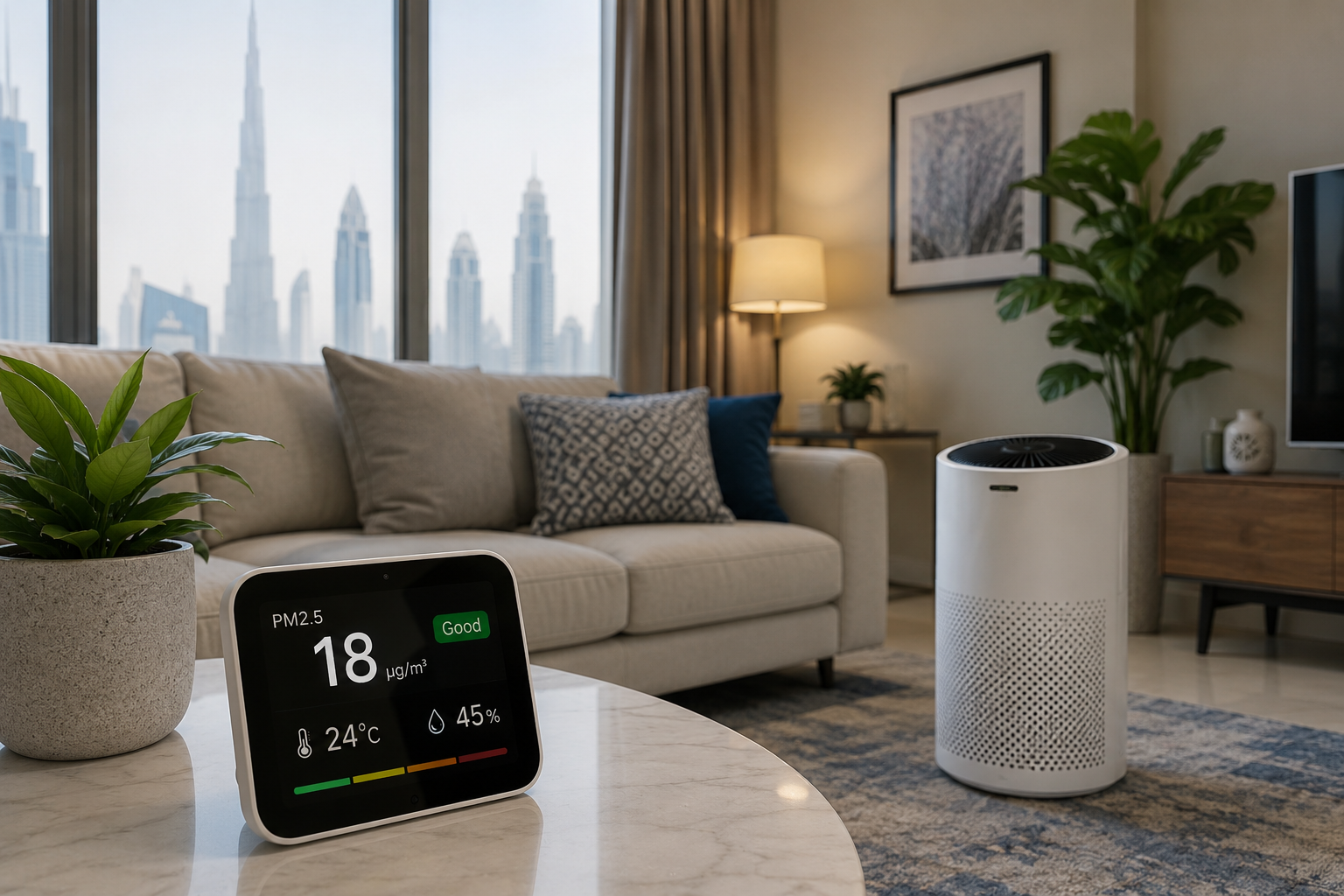
Indoor air quality UAE apartment setup with air purifier, PM2.5 monitor, and modern Dubai living room during dusty outdoor conditions.
Improve indoor air quality for a healthier home environment.
Indoor Air
Quality UAE
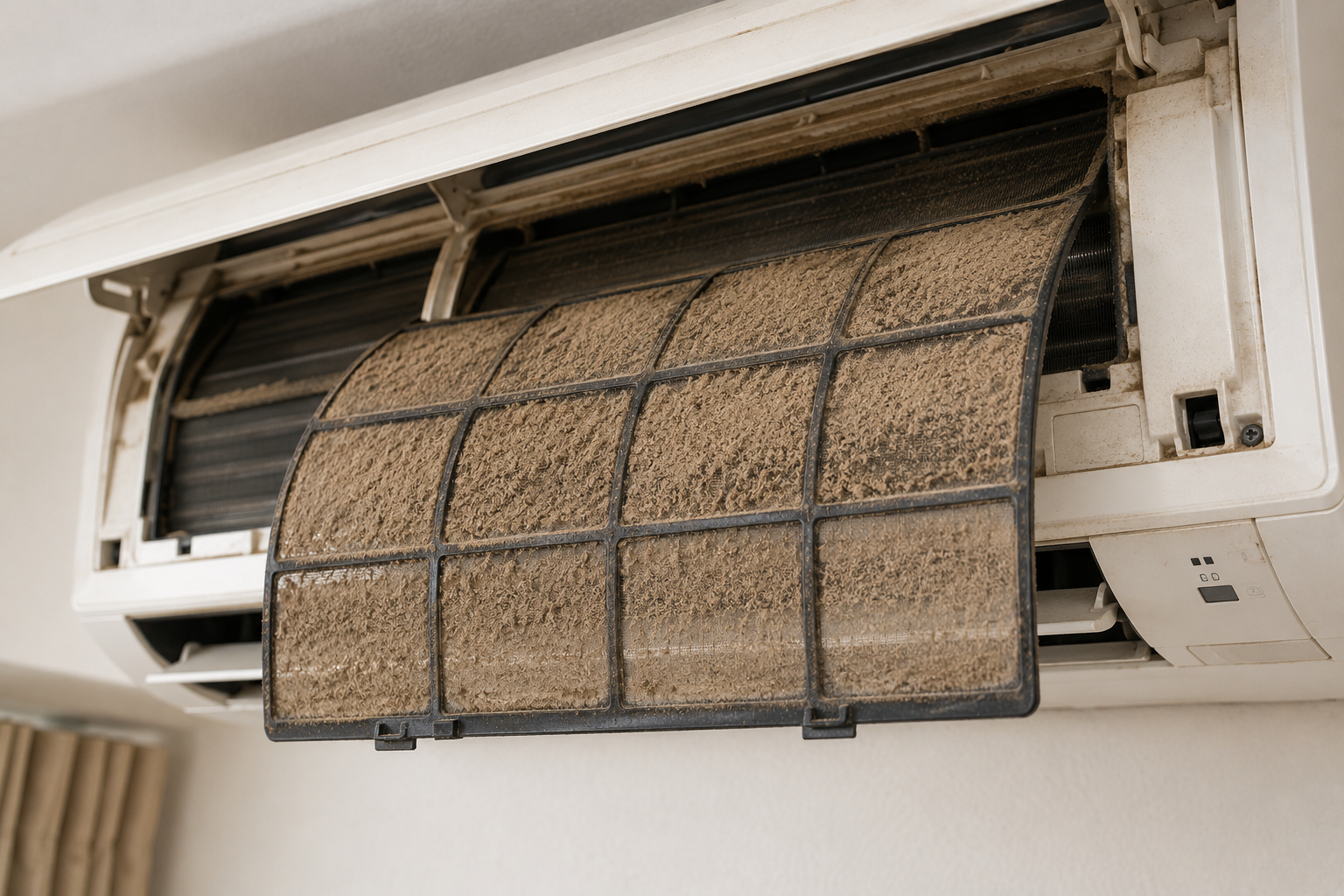
[IMAGE 2 — position here] Description: A split AC filter covered in desert dust after a sandstorm. Alt text: Split AC filter loaded with desert dust after a UAE sandstorm
Identify and fix common AC vent dust problems.
Dusty AC
Vents UAE
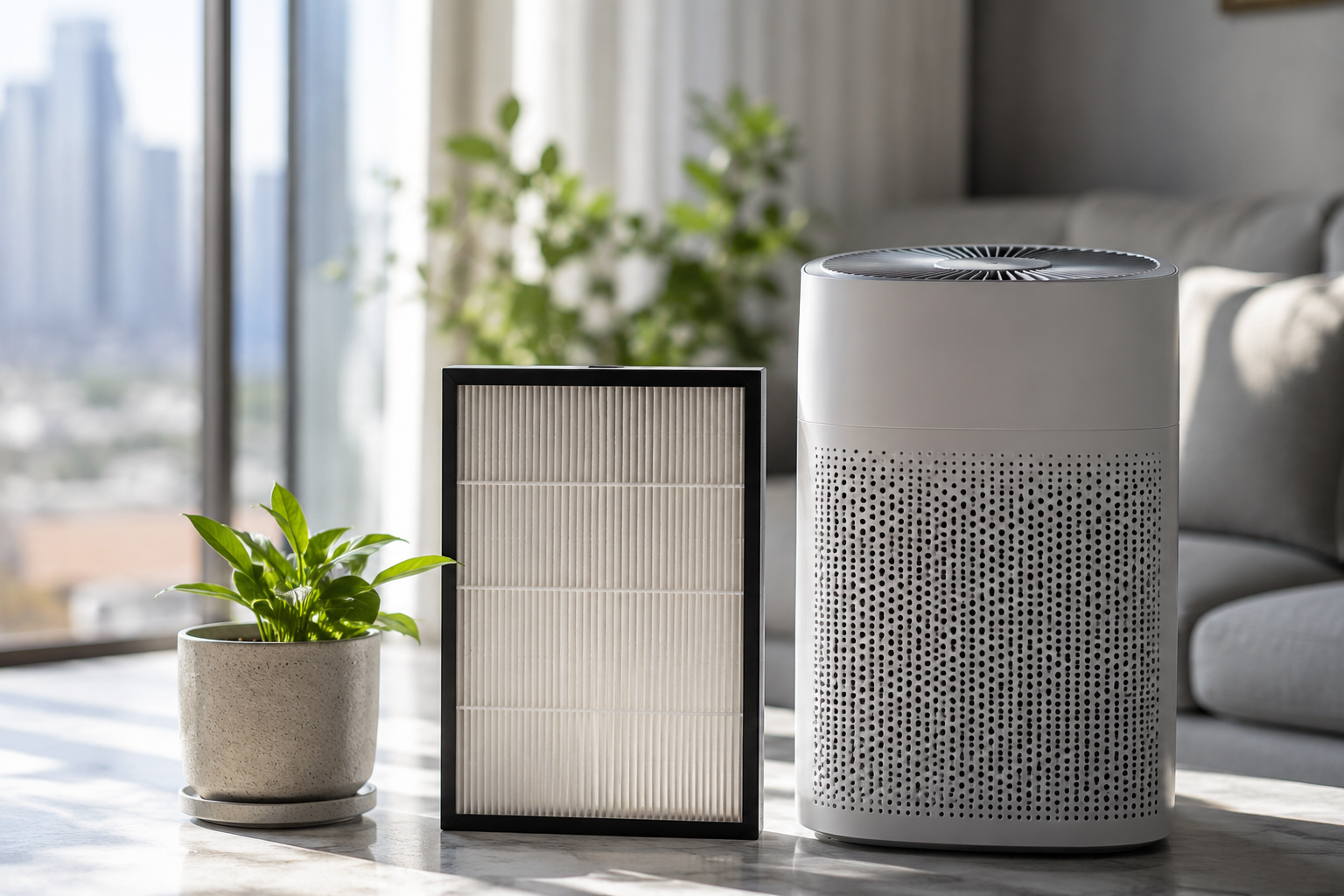
best-air-purifiers-uae-1
Compare top air purifiers for UAE dust conditions.
Best Air
Purifiers UAE
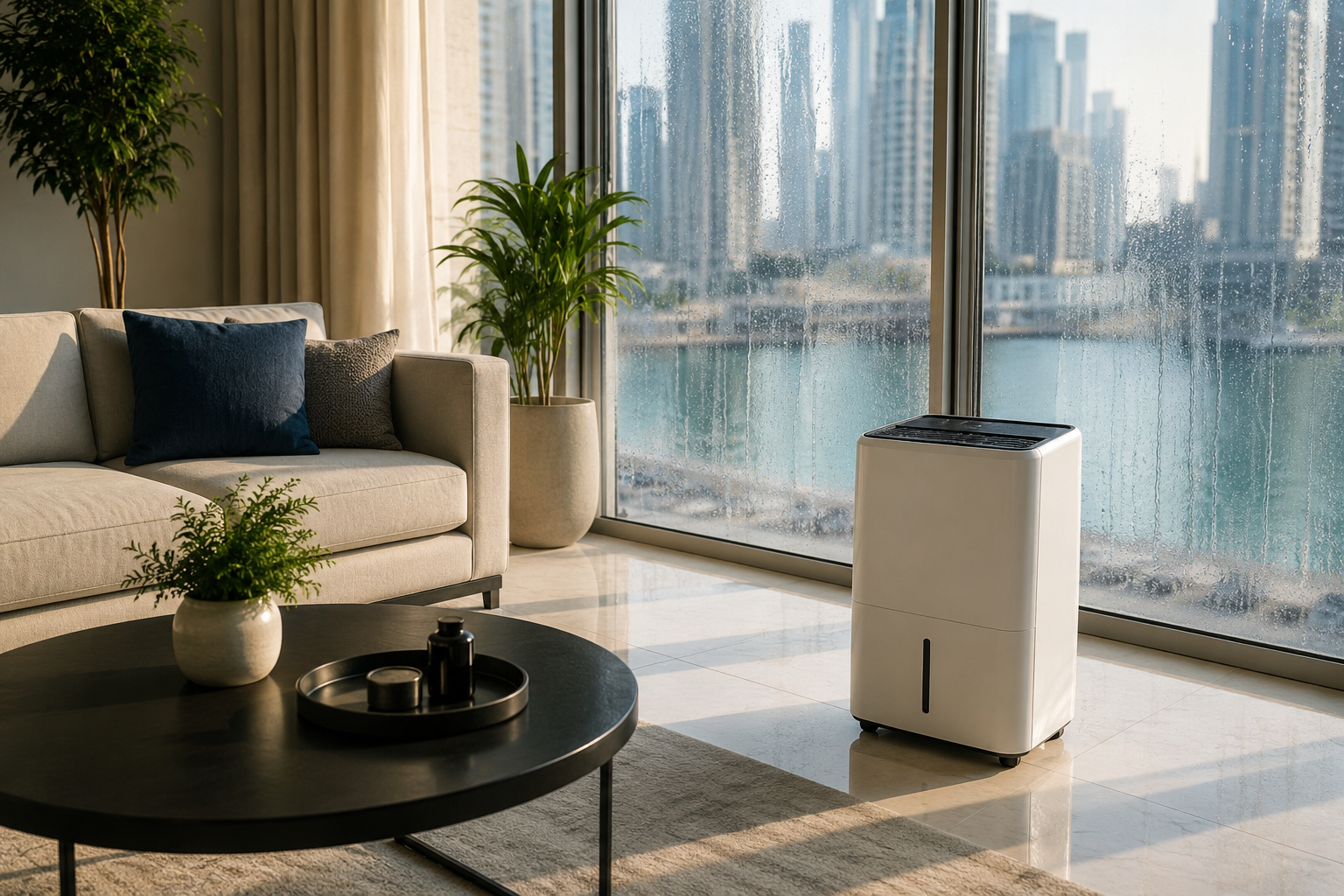
best-dehumidifiers-uae hero image showing a modern UAE apartment living room with condensation on floor-to-ceiling windows and a portable dehumidifier reducing indoor humidity near Dubai waterfront skyline views
Control humidity, condensation, and mold risk.
Best Dehumidifiers
UAE
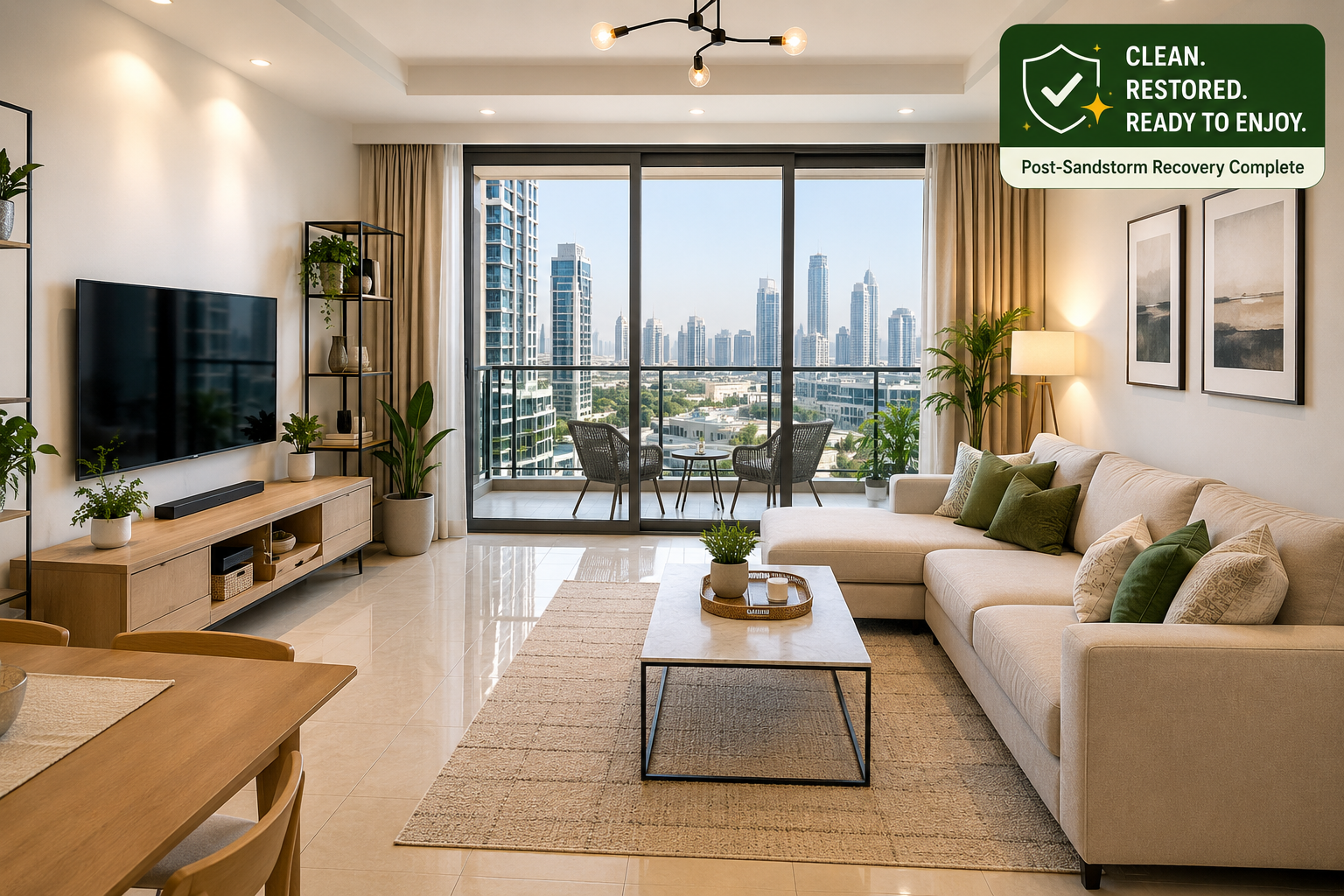
position here] Description: A clean, restored UAE apartment after a full post-sandstorm recovery. Alt text: Clean UAE apartment living room after full post-sandstorm recovery
Recover quickly after UAE sandstorms and dust events.
Post-Sandstorm
Cleaning UAE

Why Air Quality Matters in UAE Homes

UAE indoor air quality is shaped by a distinct set of environmental pressures that differ fundamentally from temperate or non-desert climates. Fine desert dust particles remain airborne for extended periods, penetrating AC systems, window seals, and balcony doors. Coastal humidity levels, particularly in areas such as Dubai Marina, JBR, and Abu Dhabi Corniche, support mold spore development and dust mite proliferation when not actively managed.

Understanding the specific drivers of poor air quality helps residents prioritise the control measures that deliver the most meaningful impact under local conditions.

Desert Dust and Sand Infiltration

The UAE’s proximity to desert terrain means fine particulate matter is present in the atmosphere year-round. Dust particles generated by desert winds, active construction sites, and exposed sand surfaces enter homes through gaps around windows and doors, through balcony entrances, and via HVAC intake systems. Particles below 10 microns, known as PM10, are not visible to the naked eye but are consistently present in UAE outdoor and indoor air. Particles below 2.5 microns, known as PM2.5, remain airborne longer and are considered the more significant respiratory health concern.

Sandstorm Events

Seasonal sandstorm events, most common between March and June, dramatically increase outdoor particulate concentrations. Fine sand and dust infiltrate sealed rooms at elevated rates during these events, coating surfaces, infiltrating AC systems, and settling into soft furnishings within hours. Post-sandstorm cleanup requirements are substantially higher than routine dust maintenance. A full cleanup protocol is covered at Post-Sandstorm Cleaning UAE.

AC Systems as Dust Circulation Vectors

UAE homes rely on air conditioning for the majority of the year. Split AC units, central ducted systems, and cassette units all draw air through filters before recirculating it into the room. When filters are not cleaned at appropriate intervals, they restrict airflow and in advanced cases begin releasing accumulated dust particles back into the indoor environment. AC vents and duct interiors also accumulate dust over time, becoming secondary dust sources even when surface filters are maintained. The full filter maintenance guide is available at AC Filter Cleaning Guide UAE.

Humidity and Its Role in Air Quality

Coastal UAE locations experience high relative humidity, particularly between June and September. Elevated humidity supports mold spore development, increases dust mite populations in mattresses and upholstery, and causes dust particles to bind with moisture, forming heavier deposits on surfaces and inside AC coils. Humidity management is an integral part of any air and dust control strategy in UAE homes, particularly in ground-floor or lower-level apartments. Further guidance is available at Humidity and Mold Prevention UAE Homes.

Internal Dust Sources

Beyond environmental infiltration, indoor activities generate dust continuously. Fabric textiles including curtains, upholstered furniture, bedding, and rugs shed fibres that contribute to airborne particulate levels. Pet dander adds allergen-carrying particles. Human skin cells and hair are consistent contributors to household dust composition regardless of outdoor conditions.

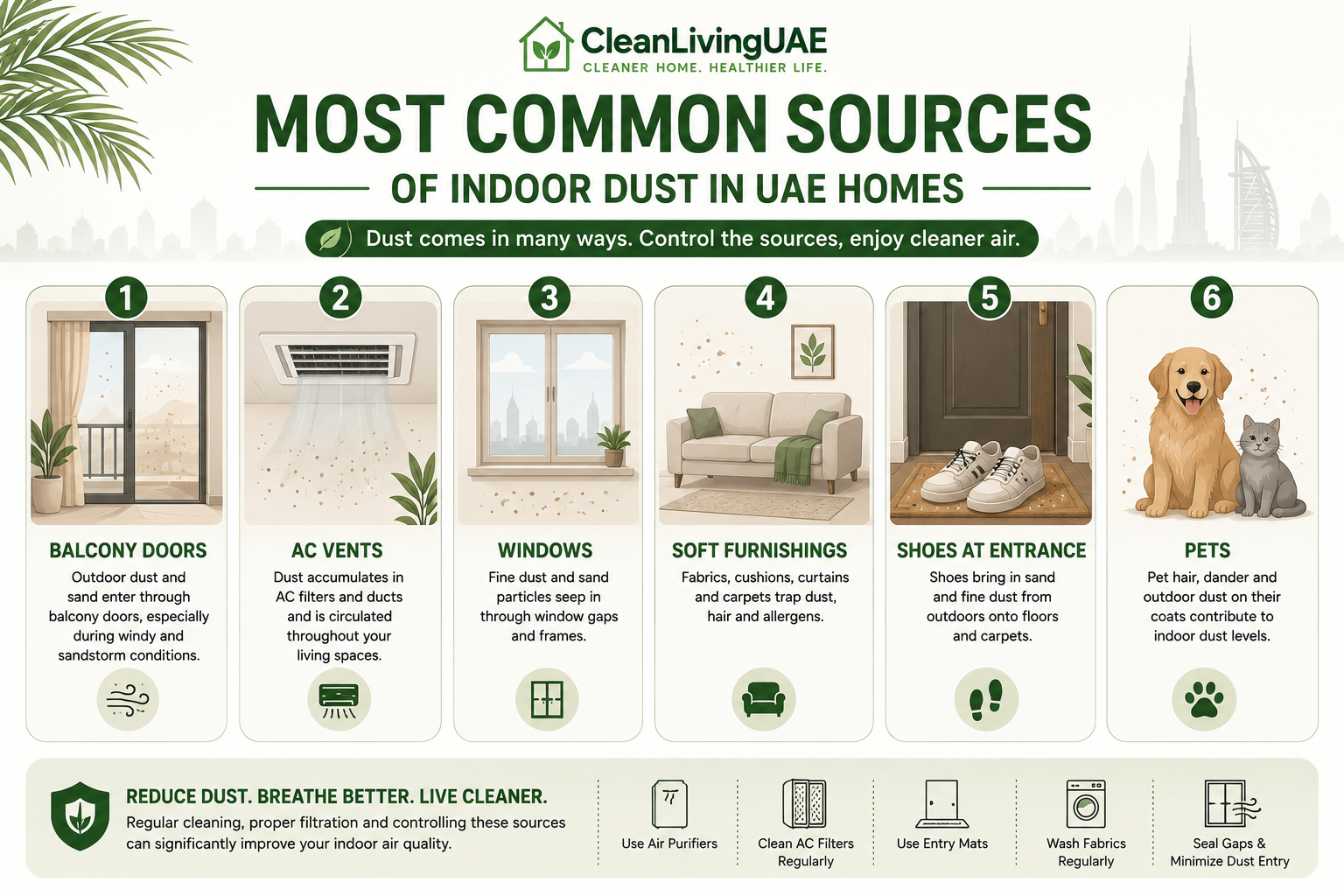
Most Common Sources of Indoor Dust in UAE Homes" - icon-based graphic showing: balcony doors, AC vents, windows, soft furnishings, shoes at entrance, pets.

Common Air and Dust Problems in UAE Homes

The following problems are the most frequently reported by UAE residents seeking air and dust control UAE solutions. Each is linked to a dedicated guide where available.

Why Dust Builds Up in UAE Homes covers the root causes in detail.

Fine Dust Settling Daily

Many UAE residents observe that surfaces require dusting every one to two days even in apartments with windows kept closed. This pattern is commonly associated with AC circulation distributing particles already present in the home, dust entering through brief balcony door openings, and inadequate filtration at the AC unit. The concentrated nature of single-room AC systems in apartments means recirculation cycles are frequent and thorough.

Dusty AC Vents

Visible dust accumulation around AC vent louvres and on vent covers is a common indicator that the AC filter requires cleaning or that internal duct dust has accumulated. Vents showing grey or brown dust rings on surrounding walls or ceilings are often described as a sign of advanced filter blockage or duct dust release. Specific guidance is available at Dusty AC Vents UAE.

Persistent Dust After Sandstorms

Post-sandstorm dust takes longer to resolve than routine daily dust because particle sizes are smaller and infiltration volumes are substantially higher. Surfaces, AC systems, and soft furnishings require a structured, sequential cleanup approach. See Post-Sandstorm Cleaning UAE for the full protocol and Dust After Sandstorms UAE for context on what to expect.

Humidity-Driven Mold and Musty Odours

UAE apartments in coastal areas, particularly those with limited ventilation or on lower floors, often experience musty odours, surface condensation, and visible mold patches in bathrooms, behind furniture, and inside wardrobes. These conditions are directly linked to indoor air quality and are addressed through humidity control tools and regular inspection routines.

Fine Dust in High-Rise Apartments

High-rise apartments present a specific challenge: balcony-to-living-room dust infiltration, reduced ability to ventilate naturally, and single AC units serving large open-plan spaces. These constraints mean that fine dust from balcony openings or AC circulation has fewer exit routes and concentrates more readily. A dedicated guide is available at Fine Dust in Apartments UAE.

Hidden Air Quality Problems in UAE Homes

Some of the most significant sources of poor indoor air quality are not immediately visible during routine cleaning. Effective air and dust control UAE homes requires addressing these hidden problem areas as well as the more obvious dust accumulation points. These areas are commonly overlooked and can undermine the effectiveness of standard dust control routines.

Dirty AC Coils

The evaporator coil inside a split AC unit accumulates dust, mold, and biological deposits over time. Unlike the washable filter panel, coil contamination typically requires professional cleaning. A heavily fouled coil reduces cooling efficiency, increases energy consumption, and can release fine particles and mold spores into the airstream during operation.

Dust Behind and Beneath Furniture

The space behind large furniture items, including sofas, wardrobes, and beds, accumulates significant dust deposits that standard cleaning routines rarely reach. These areas act as dust reservoirs that are disturbed and redistributed into the airstream whenever furniture is moved or when AC airflow patterns shift.

Mattresses and Upholstered Furniture

Mattresses and upholstered sofas are among the densest dust mite habitats in any home. In UAE humidity conditions above 60 percent, dust mite populations in these surfaces can increase substantially. Allergen particles shed by dust mites are small enough to become airborne during use, contributing to airborne allergen concentrations that a surface cleaning routine alone does not address.

Curtains and Soft Furnishings

Curtains, particularly those near balcony doors, accumulate fine desert dust over time and release it into the airstream when opened or moved. Fabric blinds, rugs, and decorative cushions follow the same pattern. Regular laundering of these items is an important but often deferred part of a complete air quality management approach.

Wardrobes and Storage Areas

Enclosed wardrobes in UAE homes are prone to elevated humidity due to limited air circulation. This creates conditions for musty odours, fabric mildew, and in some cases, surface mold on walls behind or beside the wardrobe. Desiccant products placed inside wardrobes help maintain lower humidity in these enclosed spaces.

Bathroom Exhaust Fans

Bathroom exhaust fans accumulate dust on the fan grille and internal blades over time. A partially blocked exhaust fan reduces the rate at which humid air is extracted from the bathroom, contributing to sustained elevated humidity levels and increasing the likelihood of surface mold development on tiles, grout, and caulking.

Split photograph showing a clean AC vent versus a dust-ringed vent with halo marks on the surrounding wall. Embed near the Dusty AC Vents subsection.

The Air and Dust Control UAE System: 5 Stages

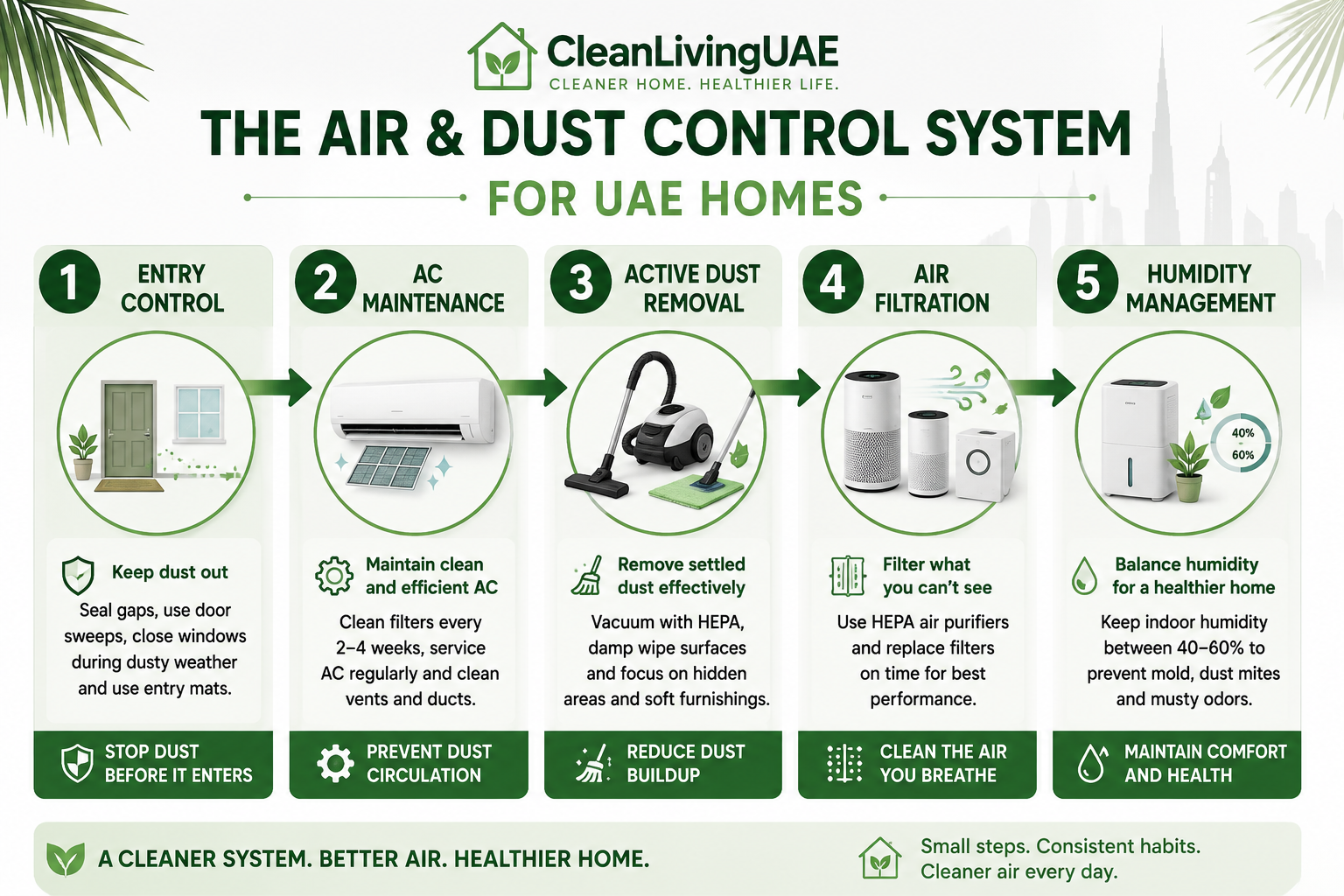
A structured approach to air and dust control UAE homes can follow addresses five sequential stages. Each stage builds on the one before it for maximum effectiveness. Residents who apply all five stages consistently report substantially lower rates of dust resettlement and improved indoor air quality compared to reactive cleaning alone.

Horizontal 5-step flow diagram - "The Air & Dust Control System for UAE Homes": Stage 1 Entry Control → Stage 2 AC Maintenance → Stage 3 Active Dust Removal → Stage 4 Air Filtration → Stage 5 Humidity Management.

Stage 1 – Entry Control

Reducing the volume of dust entering the home is the most efficient starting point. Entry mats at all exterior doorways, including balcony doors, trap sand and coarse dust particles before they are carried indoors. Shoe removal at the entrance significantly reduces outdoor particulates tracked across floor surfaces. Sealing gaps around windows and external door frames with weather stripping reduces infiltration during sandstorm conditions. For entry mat selection guidance suited to UAE sand loads, see Best Entry Mats UAE.

Stage 2 – AC Maintenance

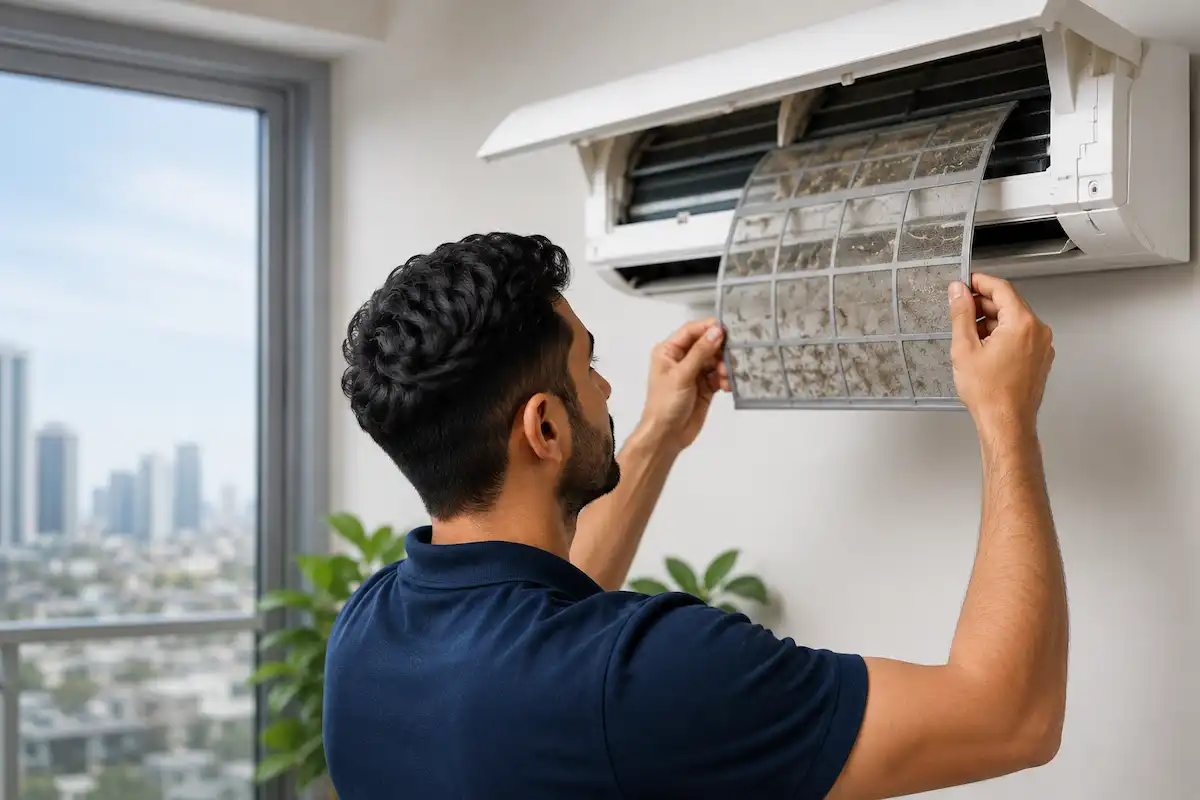
In UAE conditions, AC filter cleaning every two to four weeks during active use months is broadly considered the single highest-impact maintenance action for indoor air quality. Most split AC units have accessible washable filters that can be removed, rinsed under running water, dried, and replaced within minutes. Keeping AC vent covers clean by wiping with a damp microfiber cloth weekly prevents surface dust from being re-drawn into the unit. See How Often to Clean AC Filters UAE for detailed scheduling guidance.

Stage 3 – Active Dust Removal

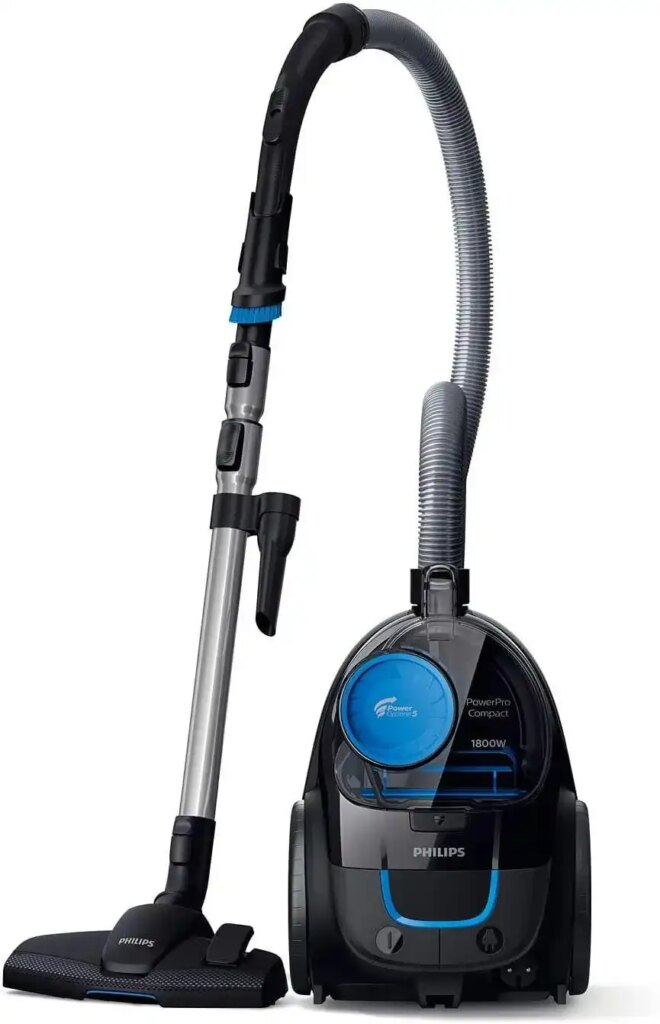
The majority of UAE apartments have tiled or marble floors, which allow fine particles to become airborne again when disturbed by sweeping or dry mopping. A vacuum cleaner with HEPA filtration is broadly considered the most effective primary tool for floor dust removal because it captures fine particles rather than redistributing them. Microfiber cloths used damp are effective for surface wiping because the material traps particles rather than spreading them. Top-to-bottom cleaning sequences prevent recontamination of lower surfaces. For vacuum selection, see Best HEPA Vacuums UAE and Best Vacuum Cleaner for Sand UAE.

Stage 4 – Air Filtration

Air purifiers with HEPA-grade filters capture particles as small as 0.3 microns, including fine desert dust, PM2.5 particles, dust mite allergens, mold spores, and pet dander. In UAE apartment conditions, a purifier positioned in the bedroom or primary living space and run continuously on low or auto mode provides a sustained reduction in airborne particle concentration. Air quality monitors placed in the same room allow residents to assess whether the unit is maintaining acceptable particle levels, particularly during sandstorm events. See Best Air Purifiers UAE and Best Air Quality Monitors UAE.

Stage 5 – Humidity Management

Maintaining indoor relative humidity between 40 and 60 percent is broadly considered optimal for both respiratory comfort and dust mite population control. UAE coastal homes during summer months commonly reach indoor humidity levels above 65 percent when AC systems are not operating at full capacity. Dehumidifiers assist in spaces that the AC system does not effectively dehumidify, including storage rooms, wardrobes, and bathrooms. For product guidance see Best Dehumidifiers UAE.

Essential Air and Dust Control Actions

The following six actions represent the highest-impact starting points for UAE residents establishing or reviewing an air and dust control UAE routine. Effective air and dust control UAE apartments and villas share the same five core principles, even where the scale of the challenge differs. For the complete step-by-step system, see Dust Prevention Tips UAE and How to Reduce Dust in Dubai Homes.

  • Clean AC filters every two to four weeks during active use months, more frequently during sandstorm season
  • Use a HEPA-rated vacuum cleaner for floor cleaning rather than sweeping or dry mopping
  • Wipe surfaces with a damp microfiber cloth in a top-to-bottom sequence
  • Position an air purifier in the bedroom or primary living space and run continuously on low or auto mode
  • Place entry mats at all exterior entry points including the main door and balcony threshold
  • Maintain indoor humidity between 40 and 60 percent using the AC system and dehumidifier where required

Recommended Air and Dust Control Tools

Some product mentions below may include affiliate links.
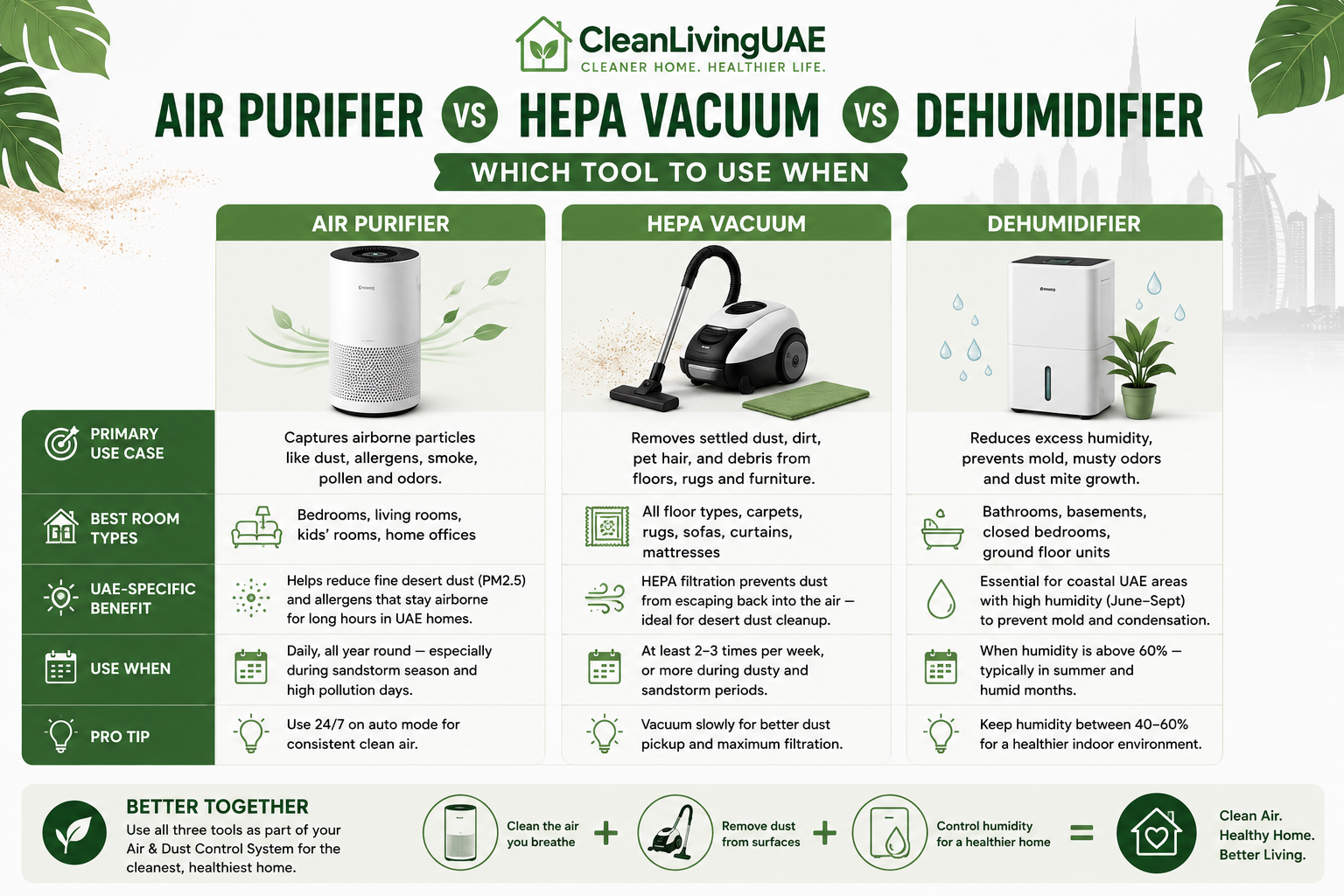
Selecting the right tools is central to any air and dust control UAE strategy. The table below maps each tool category to its primary function and relevance for UAE apartment and villa environments.

Air Purifier vs HEPA Vacuum vs Dehumidifier - Which Tool to Use When" - three-column visual showing the primary use case, room type, and UAE-specific benefit of each tool.

ToolPrimary FunctionApartmentVilla
HEPA Vacuum CleanerRemoves settled fine dust from floors and surfacesHighHigh
Air Purifier (HEPA)Captures airborne particles continuouslyHighMedium-High
Air Quality MonitorMeasures PM2.5, PM10, humidity, and VOCsHighHigh
DehumidifierReduces excess indoor humidityMedium-HighHigh
Entry Mat (Sand-Rated)Traps sand and coarse dust at entry pointsHighHigh
Microfiber ClothsTraps fine particles during surface wipingHighHigh

Apartment vs Villa: Air and Dust Control Differences
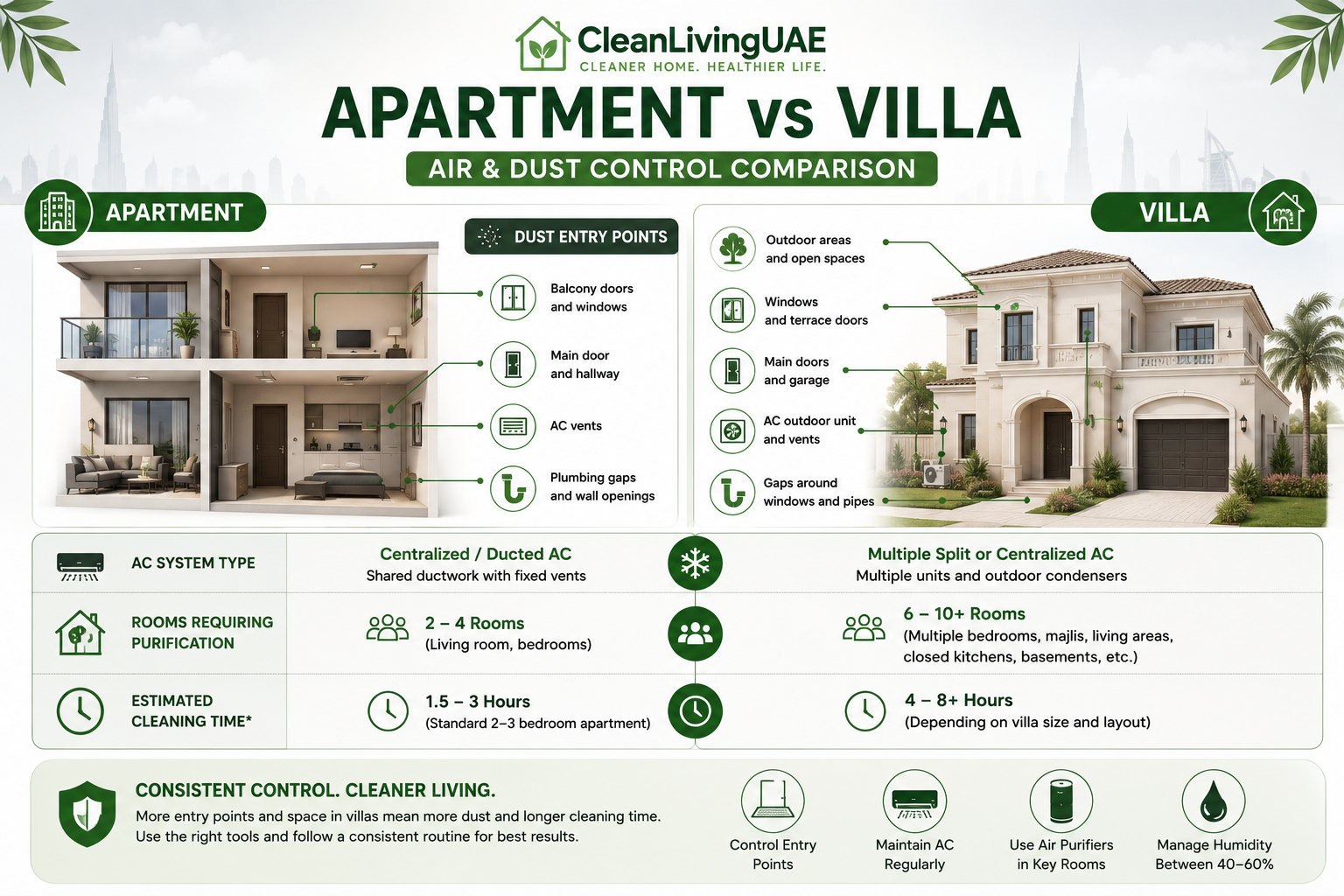
Side-by-side apartment vs villa comparison graphic showing dust entry points, AC system type, number of rooms requiring purification, and estimated cleaning time.

FactorUAE ApartmentUAE Villa
Dust Entry PointsBalcony door, front entrance, AC intakeMultiple doors, garden access, garage, windows
AC System TypeOne or two split unitsMultiple split units or central ducted AC
Air Purifier CoverageOne unit per main room often sufficientMultiple units across rooms and floors
Humidity ManagementSingle dehumidifier or desiccant unitsMultiple dehumidifiers may be required
Post-Sandstorm DustLower volume, concentrated in fewer roomsHigher volume across larger indoor and outdoor areas
Cleaning Time15-30 minutes per standard routine30-90 minutes depending on villa size

Seasonal Air and Dust Control Calendar for UAE
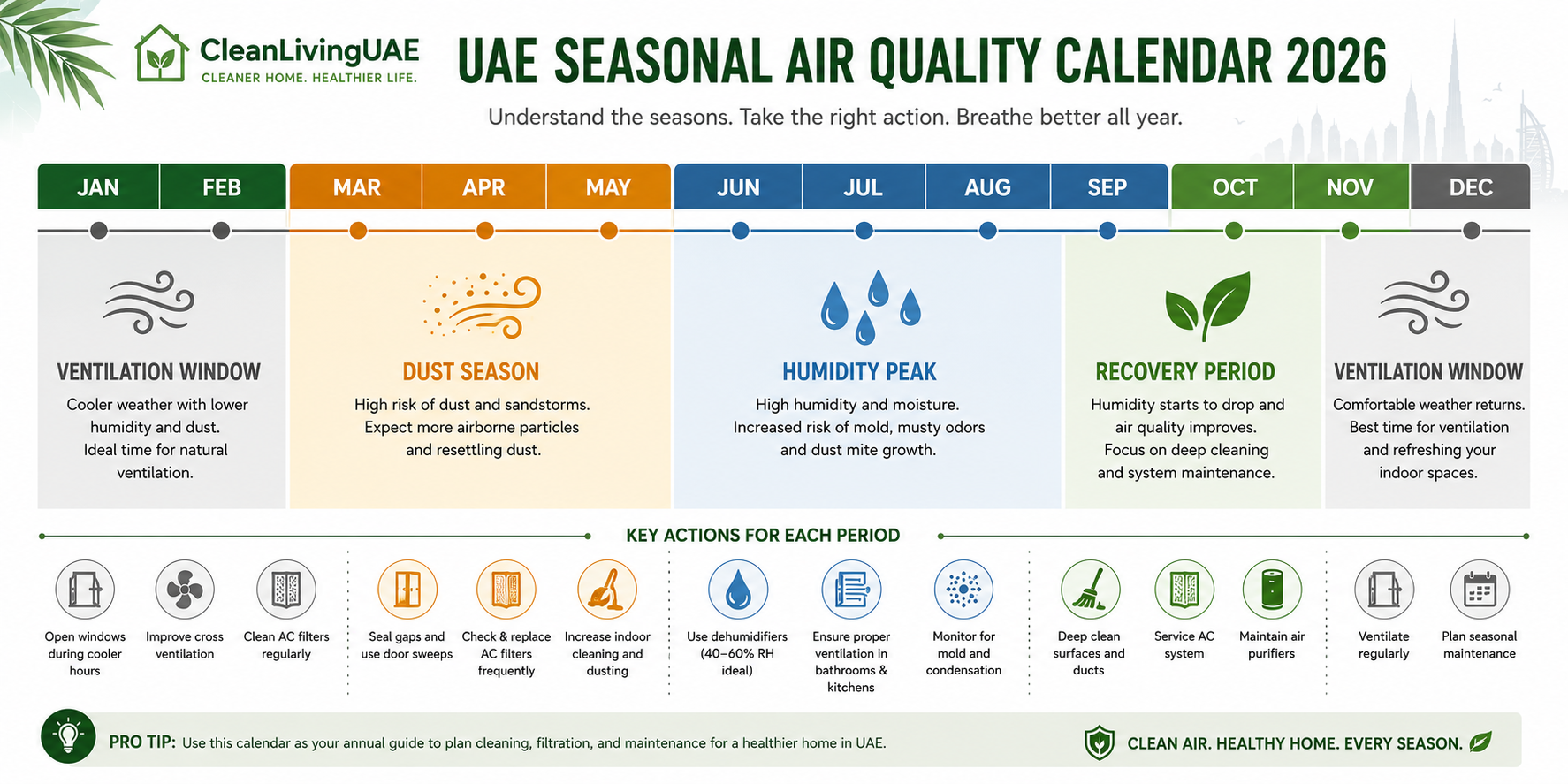
UAE Seasonal Air Quality Calendar 2026" - 12-month horizontal timeline with colour-coded bands showing dust season (March-May, amber), humidity peak (June-September, blue), recovery period (October-November, green), and ventilation window (December-February, grey).

PeriodMonthsPrimary ChallengePriority Actions
Pre-Sandstorm TransitionMar-MayRising dust levels, sandstorms, increased AC useClean AC filters, inspect window seals, install entry mats, service air purifier filters
Peak Heat & HumidityJun-SepHigh humidity, mold risk, dust mites, continuous AC operationClean AC filters every 2 weeks, run dehumidifiers, inspect bathrooms and wardrobes, wash bedding regularly
Recovery & Deep CleanOct-NovPost-summer AC wear, duct dust buildup, humidity residueSchedule AC inspection, deep clean soft furnishings, replace air purifier filters
Cooler Season & VentilationDec-FebLower humidity and dust, occasional outdoor particle intrusionDeep clean curtains, inspect balconies, launder rugs and soft furnishings

All Air and Dust Control Guides

Air Quality Guides

Dust Control Guides

Downloadable Resource

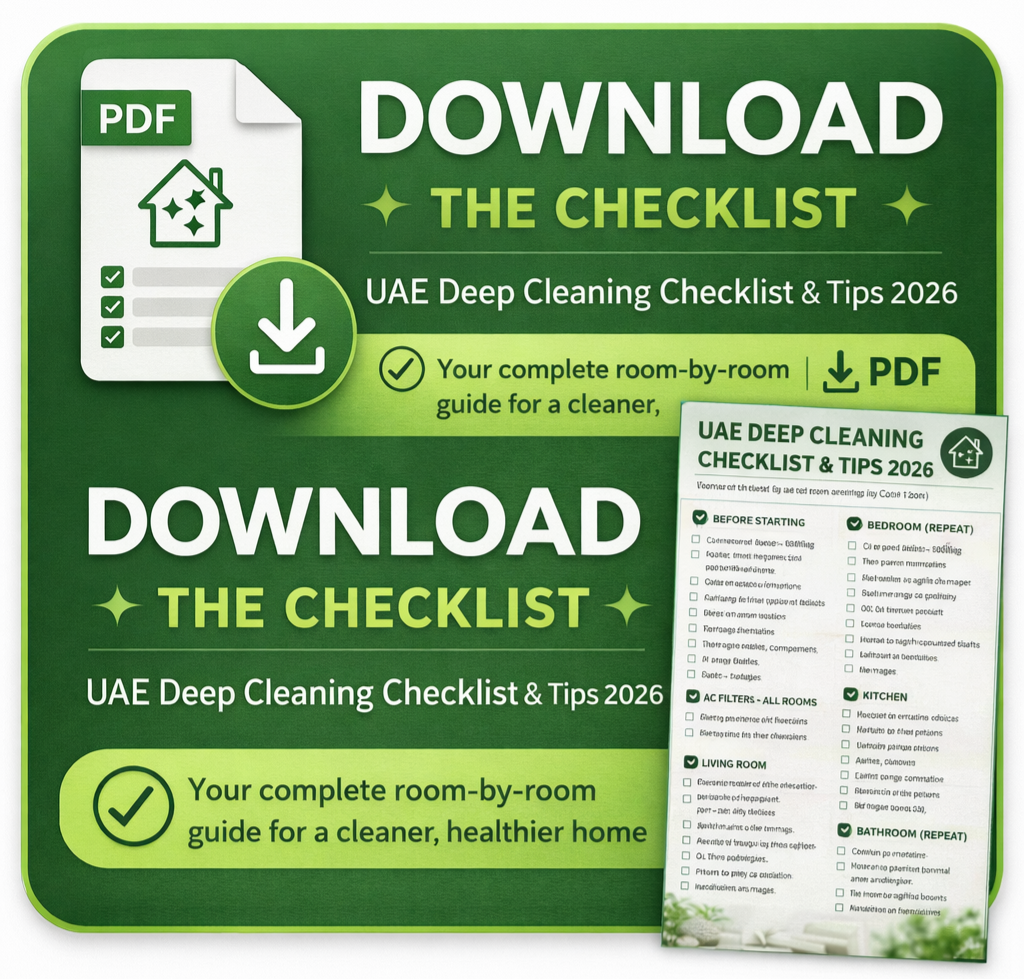
Free Air & Dust Control Planner UAE (PDF)

The downloadable planner includes a monthly AC filter tracker, dust prevention checklist, air purifier maintenance log, humidity monitoring sheet, and seasonal air quality calendar aligned to UAE weather conditions.air-and-dust-control-uae-button

Related CleanLivingUAE Hubs


Build Your Air and Dust Control UAE System

Whether living in a studio apartment, family apartment, or large villa, improving indoor air quality starts with controlling dust entry, maintaining AC systems, removing settled dust effectively, filtering airborne particles, and managing humidity levels throughout the year. Air and dust control UAE conditions make each of these steps more demanding than in most other climates, but a structured approach addresses them systematically rather than reactively.

Explore the guides and product reviews above to build an air and dust control UAE system suited to your home type, budget, and the specific air quality challenges most relevant to your location.

Frequently Asked Questions

How often should AC filters be cleaned in UAE homes?

Under standard UAE dust conditions, cleaning washable AC filters every two to four weeks during active use months is broadly recommended. During sandstorm season or in homes near active construction, intervals of every one to two weeks are commonly found more effective. Filters left uncleaned beyond four weeks under high-dust conditions can restrict airflow and may release accumulated dust back into the room.

Do air purifiers make a measurable difference to indoor air quality in UAE apartments?

Air purifiers with HEPA-grade filters capture particles as small as 0.3 microns, including fine desert dust, PM2.5 particles, dust mite allergens, and mold spores. Many UAE apartment residents report a noticeable reduction in visible surface dust settlement and improved respiratory comfort when running an air purifier continuously in the bedroom or living area. Effectiveness is directly related to the purifier’s CADR rating relative to the room size.

What is the most common cause of rapid dust build-up in UAE apartments?

Rapid dust build-up is most commonly associated with inadequate AC filter maintenance and dust entering through balcony doors. When AC filters are partially blocked, airflow patterns shift and particles already present in the home are redistributed rather than drawn through the filter. Balcony doors are frequently cited as the primary point of fresh dust infiltration, particularly during windy conditions and sandstorm events.

Is a HEPA vacuum necessary or will a standard vacuum work for UAE dust?

Standard vacuum cleaners without HEPA filtration can capture visible dust and debris but may exhaust fine particles back into the room through the exhaust. HEPA-rated vacuums contain a filter rated to capture at least 99.97 percent of particles at 0.3 microns, which is substantially more effective for the fine particulate matter common in UAE homes. For residents with dust allergies or respiratory conditions, HEPA filtration is particularly relevant.

What is the correct humidity range for UAE homes to minimise dust mite and mold risk?

Maintaining indoor relative humidity between 40 and 60 percent is broadly considered optimal for limiting both dust mite population growth and mold spore germination. Dust mite populations increase substantially above 60 percent humidity. In UAE coastal areas during summer months, indoor humidity without active dehumidification can exceed 65 to 70 percent, creating conditions favourable to both dust mite and mold activity.

Can entry mats significantly reduce indoor dust levels in UAE homes?

Entry mats positioned at exterior doors, including balcony thresholds, trap sand and coarse dust particles from footwear before they are carried onto interior floor surfaces. When combined with shoe removal at the entrance, entry mats contribute to a measurable reduction in the volume of coarse particulate matter introduced into the home. Their effectiveness for very fine airborne particles is limited; they are most useful as a first-line barrier measure alongside AC maintenance and air filtration.

How does humidity affect dust behaviour in UAE homes?

High humidity causes fine dust particles to absorb moisture, making them heavier and causing them to settle more quickly onto surfaces. While this temporarily reduces airborne concentration, it creates harder-to-remove deposits on surfaces, AC coils, and duct interiors. High humidity also allows settled dust to support microbial growth, including mold and bacteria, that would not occur in dry dust conditions.

What is the difference between PM2.5 and PM10 and why does it matter for UAE residents?

PM10 refers to particles with a diameter of 10 microns or less, including coarse desert dust and sand fragments. PM2.5 refers to particles 2.5 microns or smaller, including fine desert dust fractions and allergen carriers that remain airborne longer and penetrate more deeply into the respiratory system. UAE desert air contains elevated concentrations of both categories. Air quality monitors displaying both PM2.5 and PM10 readings provide the most comprehensive picture of indoor air conditions.

Should windows be opened for ventilation in UAE homes?

Ventilation through open windows can temporarily dilute accumulated VOCs and CO2. However, in UAE conditions, opening windows during dusty periods, sandstorm events, or near active construction sites introduces fine particulate matter and can rapidly increase indoor dust levels. The cooler months from December to February generally offer the best conditions for brief window ventilation. For the majority of the year, maintained AC systems combined with air purifier filtration is considered the more practical approach.

How does AC duct cleaning differ from AC filter cleaning in UAE homes?

AC filter cleaning refers to removing, rinsing, and replacing the washable filter panel in the indoor unit of a split AC system, a routine task most residents can carry out themselves. AC duct cleaning refers to professional cleaning of internal ductwork in centrally ducted systems, requiring specialist equipment to remove accumulated dust and biological deposits from inside the ducts. In UAE villas and larger apartments with ducted AC, duct cleaning is typically recommended every one to two years or as specified by building management.

Sources

Information in this article draws on publicly available guidance from the UAE Ministry of Climate Change and Environment on outdoor particulate matter standards, the World Health Organization air quality guidelines on PM2.5 and PM10 exposure thresholds, and technical documentation from major HEPA air purifier manufacturers on filtration efficiency ratings. UAE-specific dust and humidity conditions referenced throughout this article are consistent with data published by the National Centre of Meteorology UAE. Competitor content reviewed for gap analysis includes service and informational content published by ServiceMarket, Bayut, Dubizzle, The National, and The Healthy Home UAE.

Why Trust CleanLivingUAE?

CleanLivingUAE product guides focus on UAE home conditions, including desert dust, sand, humidity, hard water, tile floors, apartment storage, and villa cleaning needs. Recommendations are based on product specifications, Amazon.ae availability, buyer-use cases, surface suitability, and editorial review.

Some product mentions may include affiliate links.

Best Cleaning Tools for UAE Homes

Explore tools designed for desert dust and sandy conditions.

why-dust-builds-up-uae-best-tools
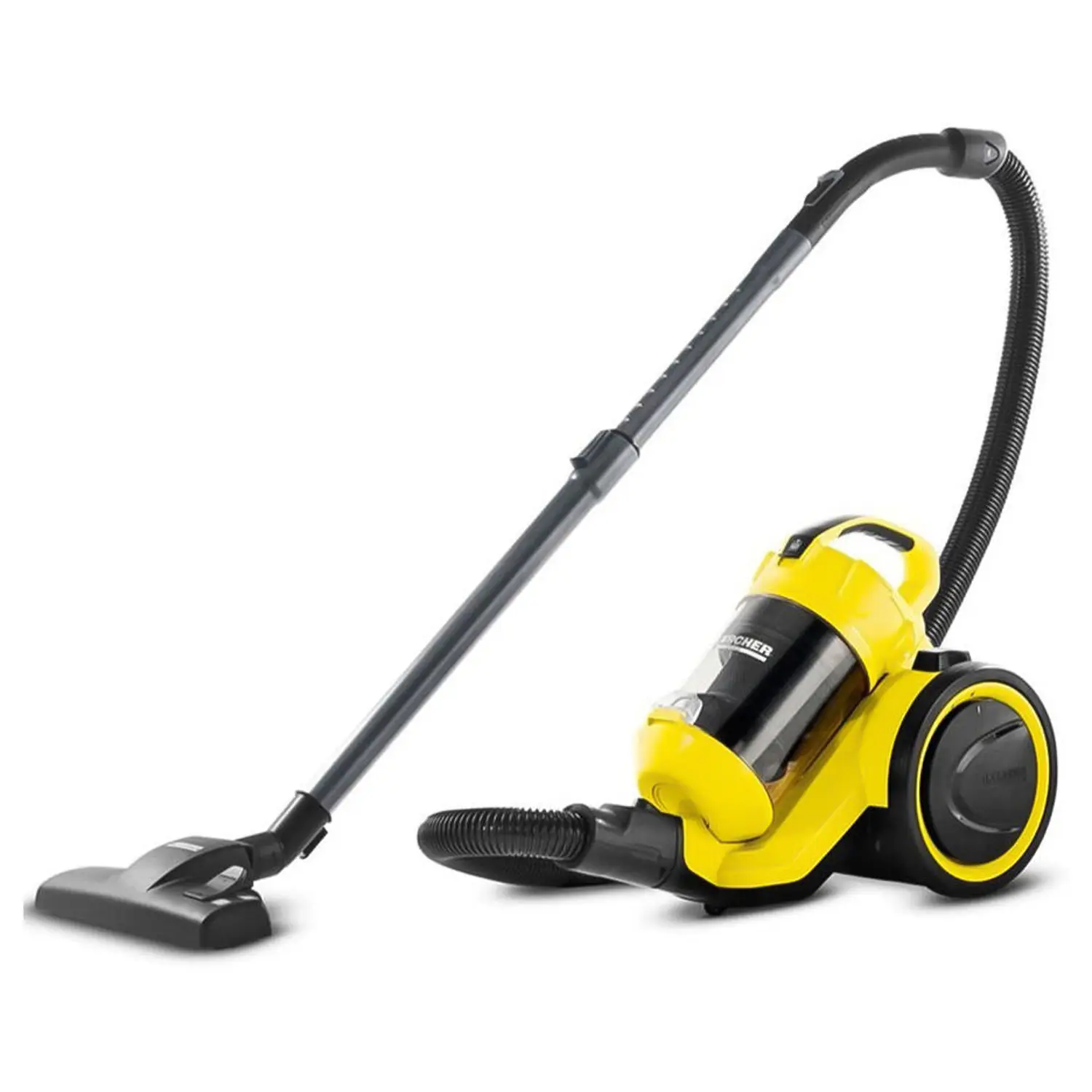
Kärcher VC 3 Premium Vacuum Cleaner
Best value under AED 500
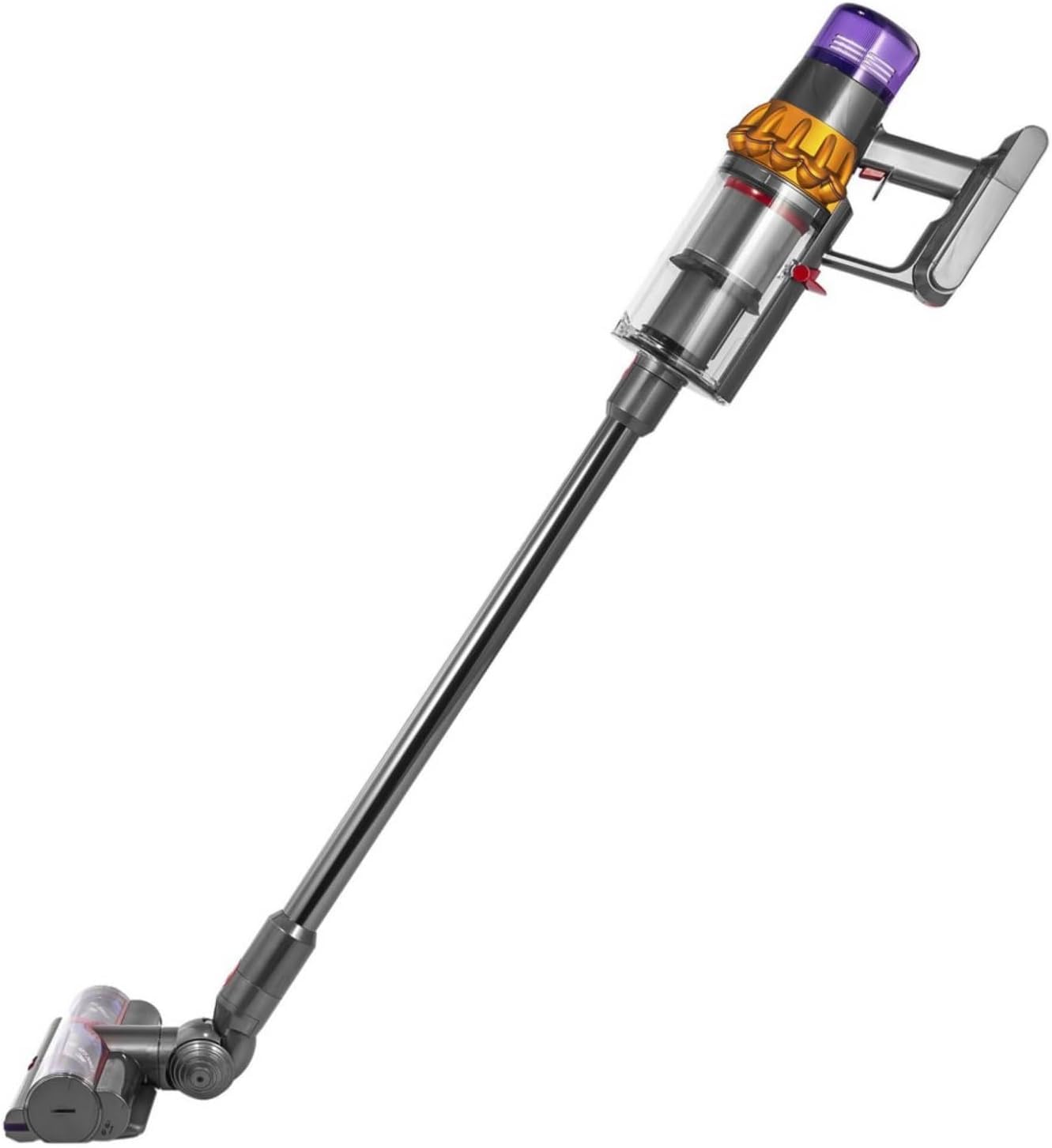
DYSON V15 Detect Absolute
Premium cordless option
Black+Decker Steam Mop
Good for regular tile cleaning
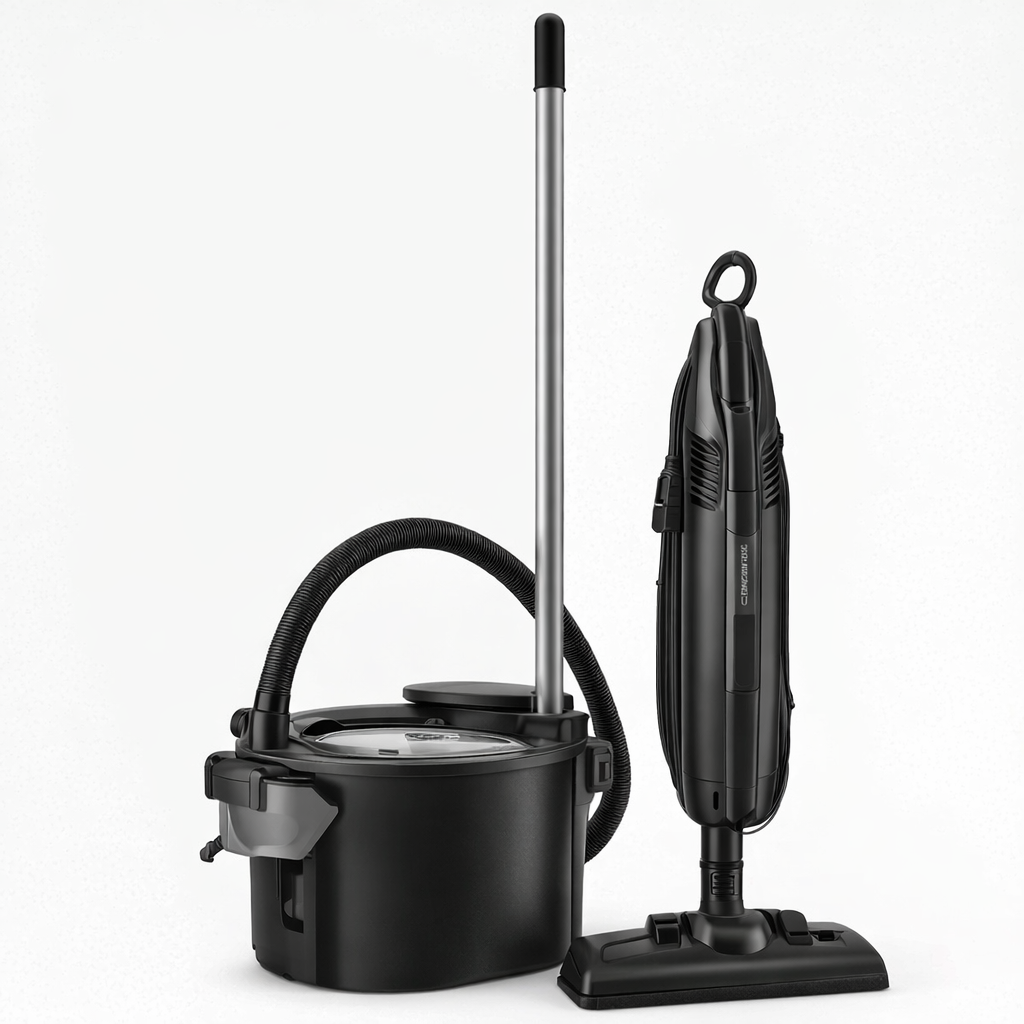
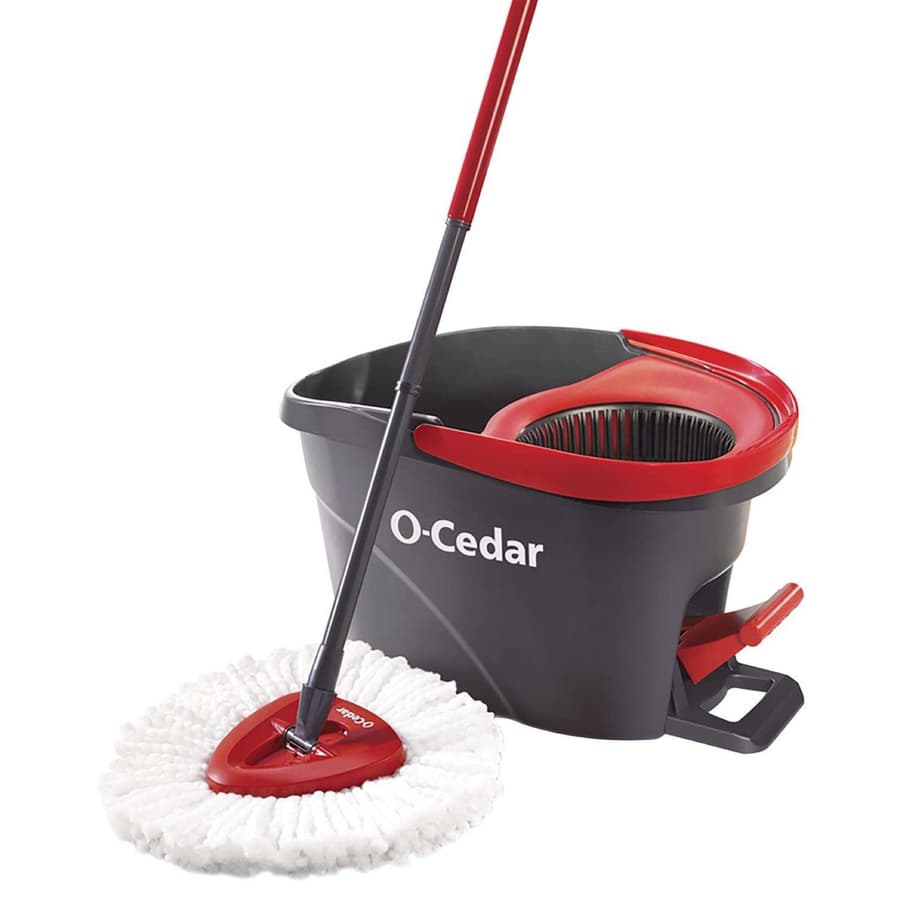
O-Cedar EasyWring Spin Mop
High-quality microfiber head commonly used globally and in UAE

Product Review Methodology

CleanLivingUAE product guides follow a separate review process for evaluating cleaning tools and product recommendations for UAE homes. This includes UAE-specific factors such as dust, sand, hard water, humidity, surface compatibility, apartment storage, and villa cleaning needs.

On How We Review the Cleaning Products, Clck the button below:

Facebook
LinkedIn
Pinterest
Threads
X
Reddit
Telegram
ABOUT-UAE