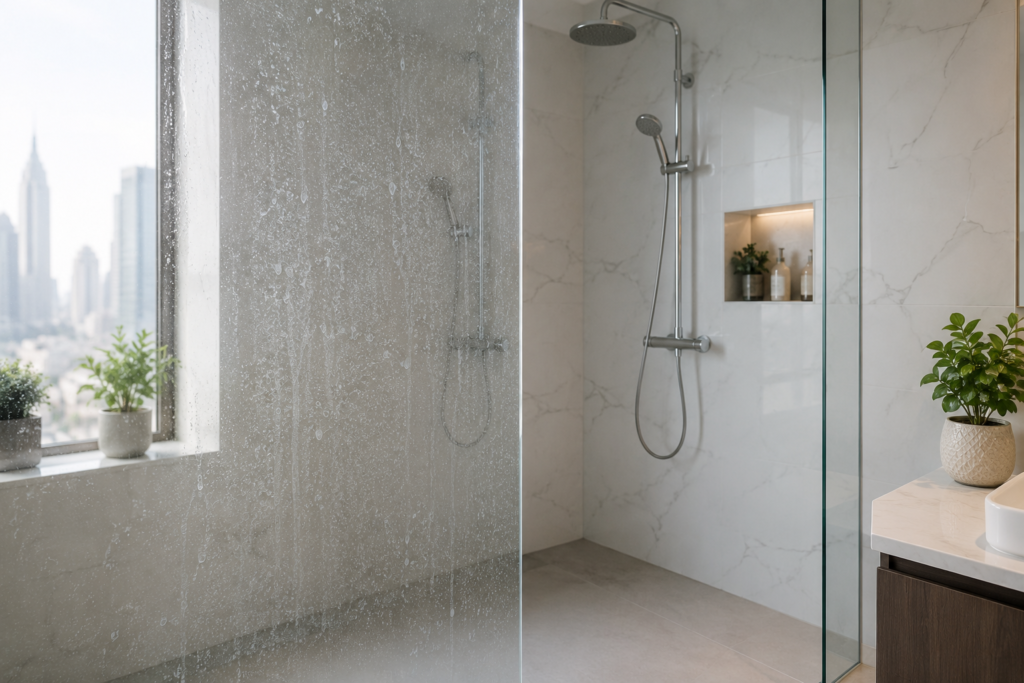
Key UAE Insight: Many UAE residents assume hard water stains indicate poor water quality. In reality, hard water deposits are caused by harmless minerals left behind after water evaporates. The issue is aesthetic and maintenance-related, not a sign of unsafe water. UAE tap water meets national drinking water standards; the mineral content responsible for staining is a byproduct of the remineralisation process applied after desalination.
Unlike many cleaning problems that can be resolved with a general-purpose product, hard water stains in UAE homes require an understanding of what causes them, which surfaces are most vulnerable, and which removal methods are appropriate for each material. This guide covers all of those areas in practical detail, including removal methods for shower glass, tiles, and fixtures, a prevention schedule adapted to UAE conditions, and a comparison of water softening options available to apartment tenants and villa owners.
The information below applies to apartments, villas, and any UAE property supplied with municipal tap water. All methods described are DIY-compatible and do not require professional cleaning services.
Hard water stains are one of the most common problems covered in the CleanLivingUAE Bathroom Cleaning UAE guides. Readers dealing with shower glass clouding, tile deposits, and faucet scale will also find relevant product guidance in the Best Shower Squeegees UAE and Best Bathroom Cleaning Tools UAE resources.
What Are Hard Water Stains?
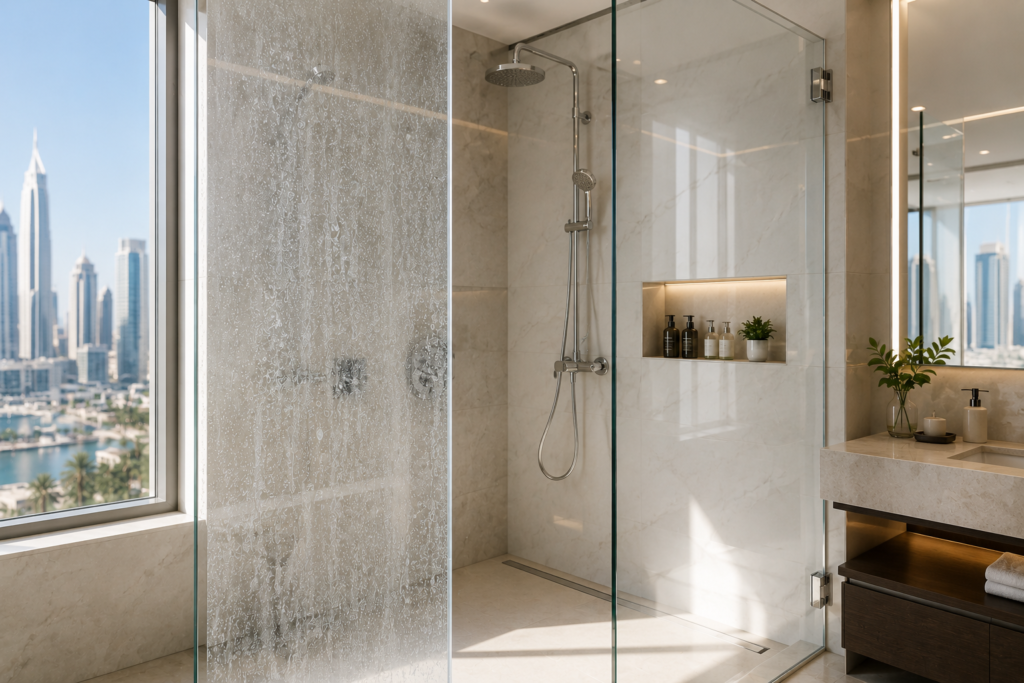
Hard water stains – also referred to as mineral deposits, limescale, or water spots – form when water containing dissolved minerals evaporates and leaves those minerals behind on a surface. The minerals most commonly responsible are calcium carbonate and magnesium, both of which are present in UAE tap water.
When water sits on a surface and then evaporates, the water disappears but the minerals remain. Over repeated cycles, these deposits accumulate into visible white or grey marks. On glass surfaces, this process leads to clouding and etching. On tiles and grout, it creates a dull, chalky film. On metal fixtures, it forms a crust around nozzles, bases, and seams.
The hardness of water is typically measured in milligrams of calcium carbonate per litre (mg/L). Water above 120 mg/L is generally classified as hard; water above 180 mg/L is classified as very hard. UAE tap water commonly falls in the moderate-to-hard range, with localised variation between emirates and between building water storage systems.
Hard water stains are not a sign of a dirty home. They form regardless of cleaning frequency and require targeted treatment to remove effectively – Have a look at the Best limescale removal solutions UAE.
Why Hard Water Stains Are Common in UAE Homes
Desalinated Water Minerals
The majority of the UAE’s municipal water supply originates from seawater desalination plants. Desalination removes salt effectively, but the resulting water is then remineralised before distribution to prevent corrosion of pipes. This remineralisation process reintroduces calcium and magnesium salts, which contribute directly to hard water stains UAE bathroom surfaces accumulate over time.
The mineral content of desalinated water can vary between supply zones and between individual buildings, particularly in older developments where internal storage tanks and distribution systems may alter water chemistry before it reaches a tap.
Heat and Evaporation
Ambient temperatures in the UAE – regularly exceeding 40 degrees Celsius outdoors, and elevated indoors even with air conditioning – accelerate the evaporation of water from surfaces. Faster evaporation means mineral deposits form more quickly and in greater concentration. A water droplet that might take an hour to evaporate in a cooler climate may evaporate within minutes during a UAE summer, leaving its mineral content behind in a smaller, more concentrated deposit.
Shower glass and bathroom tiles are particularly affected because water is applied to them daily in large volumes, and evaporation conditions are consistently present throughout the year.
Glass Shower Enclosures
Frameless and semi-frameless shower enclosures are standard in many UAE apartments and villas, particularly in newer developments. While visually appealing, glass shower panels provide an ideal surface for hard water staining. Glass is smooth and non-porous, which means water sheets across it and pools at any horizontal or low-gradient surface before evaporating. The resulting mineral deposits are highly visible against the transparency of the glass.
Tempered glass used in shower enclosures can also develop micro-etching over time if hard water deposits are left untreated. Once etching occurs, the glass surface becomes permanently altered at a microscopic level, making complete restoration with DIY methods difficult.
Bathroom Ventilation Challenges
Many UAE apartment bathrooms – particularly in older buildings and in mid-range developments – have limited natural ventilation. Exhaust fans may be undersized relative to the bathroom volume, or they may vent into shared ducting that reduces their effectiveness. Without adequate ventilation, steam from showers lingers in the bathroom, condenses on cool surfaces such as mirrors and tiles, and then evaporates slowly, depositing minerals across a wider surface area.
Bathrooms with poor ventilation also retain higher ambient humidity, which slows the evaporation of individual water droplets. This can cause minerals to spread further across a surface before the water fully evaporates, increasing the area affected by each shower.
How to Identify Hard Water Stains
White Chalky Deposits
The most recognisable sign of hard water staining is a white or off-white powdery residue on surfaces that have been in regular contact with water. This is most visible on dark tiles, chrome fixtures, and the base of taps. The deposit is often powdery when dry but may feel slightly gritty when rubbed. In early stages it wipes away easily. At advanced stages it forms a hard crust that resists wiping and requires acidic treatment.
Cloudy Shower Glass
Shower glass that appears clean when wet but develops a cloudy or hazy appearance once dry is typically affected by early-stage hard water staining. As deposits accumulate over weeks and months, the glass may develop a permanent milky appearance that persists even when wet. This is a sign that mineral deposits have begun to fill microscopic pores in the glass surface, or that light etching has occurred.
Faucet Build-Up
Calcium deposits commonly accumulate around the base of taps, along the spout, and around aerator threads. The aerator – the small mesh fitting at the tip of a tap – is particularly susceptible because water passes through it and then drips, leaving minerals behind as it evaporates. Restricted water flow from a tap is often caused by aerator blockage from mineral build-up.
Tile and Grout Deposits
Hard water deposits on bathroom tiles appear as a dull film or haze across the tile surface, most visible when light hits the tiles at an angle. Grout lines are particularly vulnerable because grout is porous and absorbs minerals alongside water. Over time, grout that was originally white or light grey may take on a yellowed or chalky appearance from mineral accumulation, even in the absence of mould.
| Symptom | Surface | Severity | Recommended Action |
|---|---|---|---|
| Fine white film | Shower glass, tiles | Early | Regular acidic wipe-down using vinegar or citric acid solution. |
| Cloudy glass when dry | Shower enclosure | Moderate | Treat with vinegar or citric acid and allow sufficient dwell time. |
| Hard white crust | Taps, fixtures, tile base | Moderate-Heavy | Use an acidic soak or commercial descaler designed for mineral deposits. |
| Restricted tap flow | Tap aerator | Heavy | Remove aerator and soak in vinegar or citric acid solution. |
| Permanent glass haze | Shower glass | Severe | Use a glass restoration product or seek professional assessment. |
| Yellowed grout | Tile grout | Moderate | Apply a grout-safe acidic cleaner and scrub with a grout brush. |
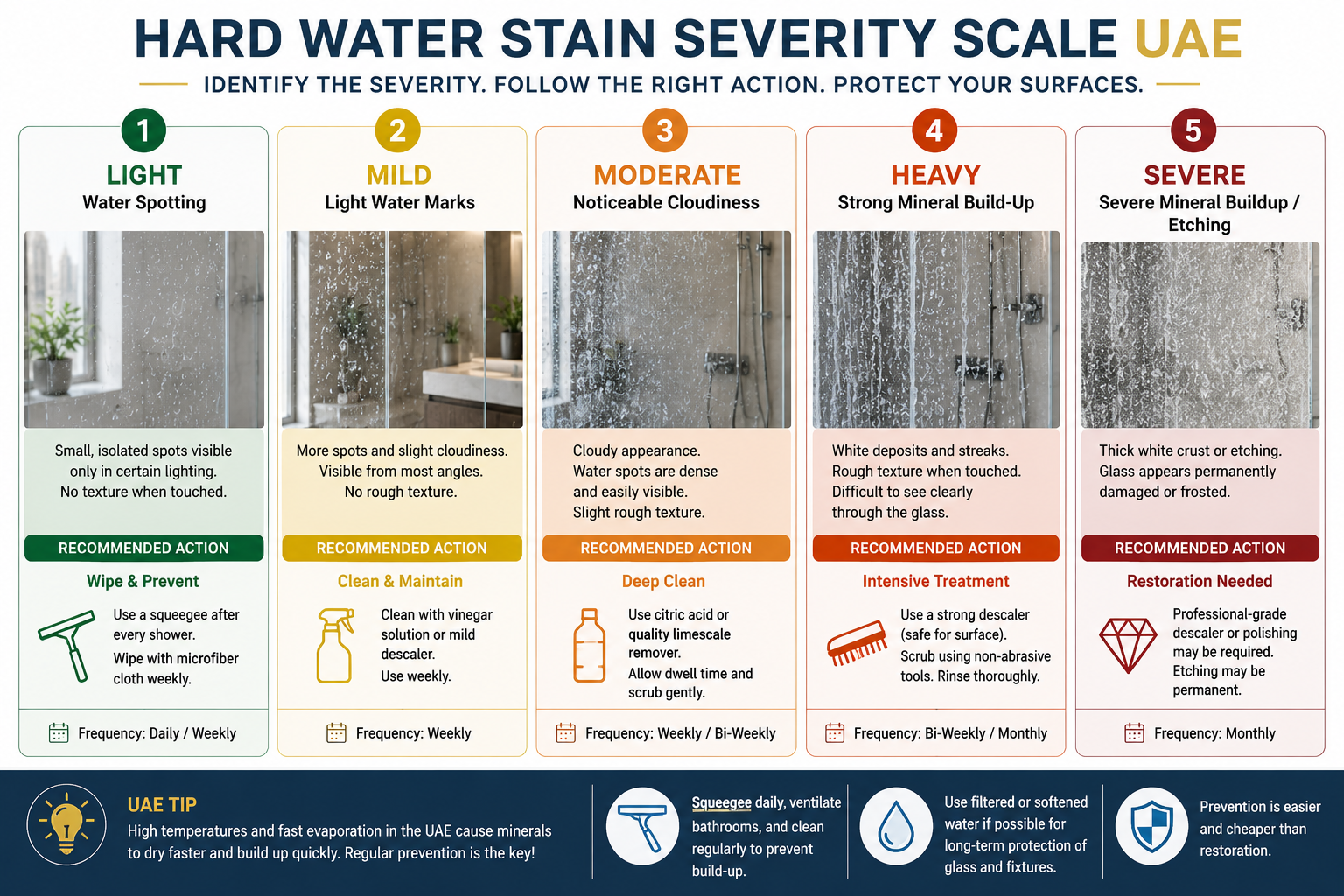
| Severity | Appearance | Recommended Cleaning Method |
|---|---|---|
| Light | Water spots, faint film | Diluted white vinegar, 50/50 spray |
| Moderate | Cloudy glass, visible scale on chrome | Citric acid solution, 2-3 tbsp per 500 ml |
| Heavy | White crust, restricted tap flow | Commercial acid-based descaler |
| Severe | Permanent glass haze, deep etching | Commercial glass restorer or professional assessment |
Hard Water Stains vs Soap Scum: Key Differences
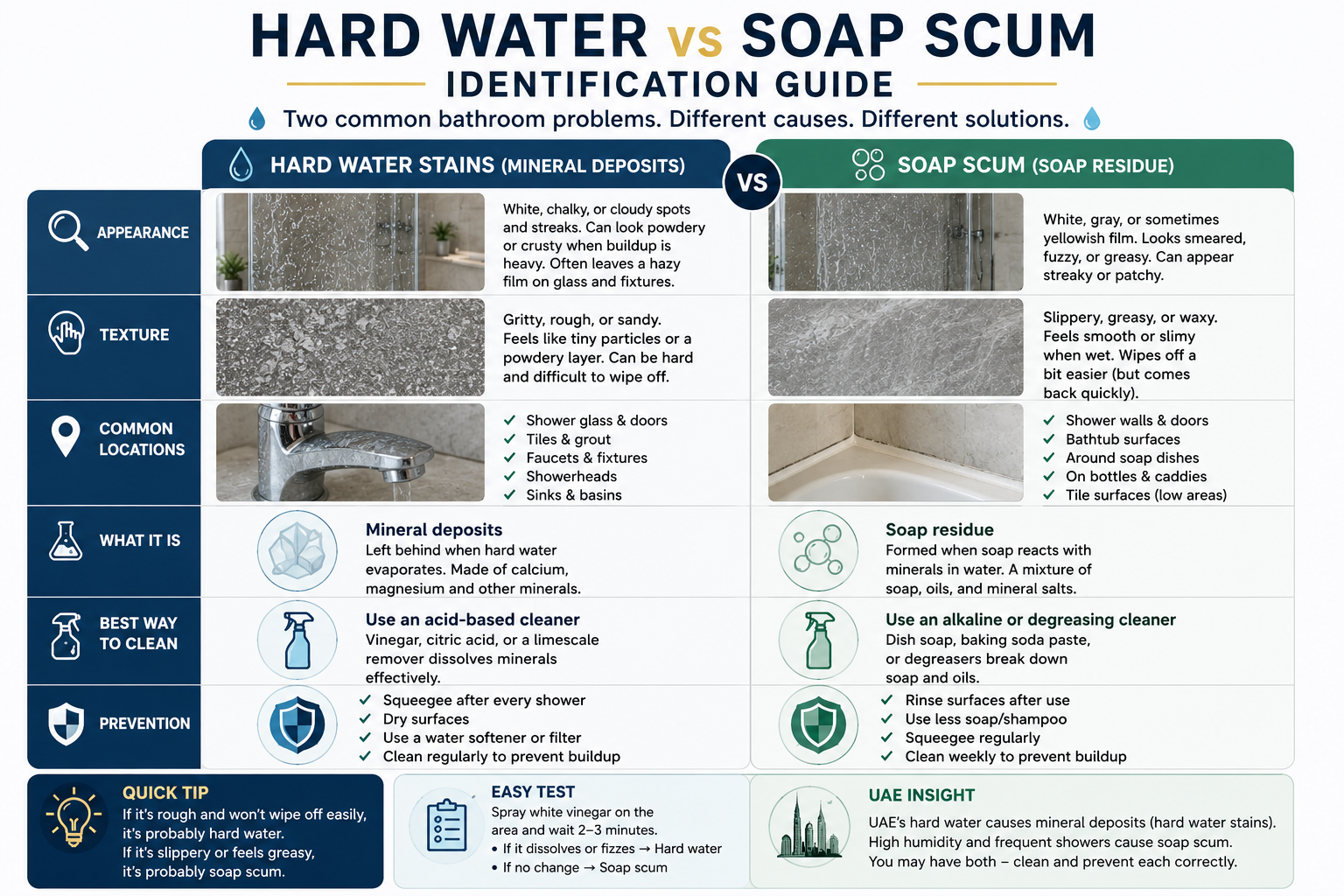
Hard water stains and soap scum are frequently confused, and this confusion leads to using the wrong cleaning product. Understanding the difference prevents wasted effort and potential surface damage.
Hard water stains are caused by inorganic mineral deposits – specifically calcium and magnesium – left behind when water evaporates. They appear white or grey, feel chalky or gritty, and form wherever water contacts a surface and then dries. They are most common on shower glass, chrome fixtures, and the lower sections of bathroom tiles. Acid-based cleaners dissolve the mineral bonds and are the correct solution.
Soap scum is an organic residue created when the fatty acids in soap or body wash react with the calcium and magnesium minerals in water. The resulting compound adheres to surfaces as a white-grey film that feels waxy or greasy rather than gritty. Soap scum is most common on bath surrounds, shower trays, and lower tile areas where product rinse-down concentrates. Alkaline or degreasing cleaners are more effective against soap scum than acids.
In UAE homes, both problems frequently occur together, particularly in bathrooms without squeegee use after each shower. When both are present, treating with an acidic product first dissolves the mineral component; a follow-up with a general bathroom cleaner addresses remaining soap residue.
| Factor | Hard Water Stains | Soap Scum |
|---|---|---|
| Cause | Mineral deposits, calcium and magnesium | Soap residue reacting with water minerals |
| Appearance | White, chalky, gritty deposits | White-grey, waxy, greasy film |
| Location | Glass, chrome fixtures, and water-contact surfaces | Bath surrounds, shower trays, and lower tiles |
| Texture When Rubbed | Gritty or powdery | Slippery, greasy, or waxy |
| Cleaning Agent | Acid-based cleaners, such as vinegar or citric acid | Degreaser or alkaline bathroom cleaner |
| Prevention | Squeegee and dry surfaces after use | Rinse surfaces thoroughly after showering |
Areas Most Affected in UAE Homes
![[INFOGRAPHIC: Most Common Hard Water Stain Locations in UAE Homes - Bathroom cutaway showing shower glass, faucets, tiles, sinks, toilet bowls, and mirrors ranked by severity.]](https://cleanlivinguae.com/wp-content/uploads/2026/06/hard-water-stains-uae-5.png)
![[INFOGRAPHIC: Bathroom Surface Risk Ranking UAE - Numbered ranking from 1 (Shower Glass) through 6 (Mirrors) showing deposit speed and cleaning priority for each.]](https://cleanlivinguae.com/wp-content/uploads/2026/06/hard-water-stains-uae-6.png)
| Surface | Why It Is Affected | Typical Appearance | Cleaning Priority |
|---|---|---|---|
| Shower glass | Daily water exposure and rapid evaporation | Cloudy appearance and hazy film | High |
| Chrome taps and fixtures | Constant water contact and slow-drying bases | White crust and dull finish | High |
| Bathroom tiles | Splash zones and porous grout absorption | Hazy film and chalky residue | Medium-High |
| Toilet bowl | Continuous contact with standing water | Brown-white ring at the waterline | Medium |
| Kitchen sink | Frequent water use and mineral evaporation | White spots and basin film | Medium |
| Glass partitions | Regular splash and steam exposure | Streaking and cloudiness | Medium |
| Showerhead nozzles | Mineral deposits blocking spray openings | Uneven spray pattern and crust buildup | Medium |
| Bathroom mirrors | Steam condensation and occasional splashing | White spots and edge deposits | Lower |
Shower Glass
Shower glass is the surface most visibly and consistently affected by hard water staining in UAE bathrooms. Daily showers deposit water across the entire panel, and without squeegee use, water pools at the base and edges before evaporating slowly. The result is concentrated mineral deposits at the areas where water tends to collect. On frameless shower panels – common in UAE apartments built after 2010 – the full surface area is exposed with no edge seal to limit water spread.
Bathroom Tiles
Wall tiles in shower zones and splash areas accumulate mineral film from water droplets and steam condensation. Larger-format tiles, common in contemporary UAE bathrooms, often make the film more visible because there is less grout to break up the surface. Polished porcelain tiles show water spots more clearly than matte finishes.
Chrome Fixtures
Polished chrome taps, showerheads, towel rails, and toilet flush handles are highly susceptible to hard water marking because the polished surface provides a high-contrast background against which even light mineral deposits become visible. Chrome is relatively durable with appropriate acidic cleaning, but prolonged exposure to undiluted acids can affect the plating.
Kitchen Sinks
Stainless steel kitchen sinks accumulate water spots and calcium deposits around the drain, in the basin, and where the tap drips. The marks are often most visible after the sink dries following washing up or rinsing. In UAE kitchens with granite or stone counters, spilled water from the tap can also leave deposits on stone surfaces.
Glass Partitions
Many UAE apartments and villas feature glass partitions between bathroom areas or as shower screens without full enclosures. These are subject to the same mineral deposit patterns as full shower enclosures but may be overlooked during regular cleaning if they are not directly inside the shower zone.
Toilet Bowls
The waterline inside a toilet bowl is a consistent contact point for mineral-rich water. Over time, a brown, orange, or white ring forms at the waterline. This is a combination of calcium carbonate and, in some cases, iron minerals. The ring does not indicate a hygiene failure; it forms in any toilet supplied with hard water.
How to Remove Hard Water Stains from Shower Glass
[IMAGE: Before-and-after shower glass cleaning comparison showing cloudy panel restored to clarity.]
Step 1: Assess the severity of the staining. Light film or spotting can be treated with household vinegar or citric acid. Moderate cloudiness requires a longer contact time or a commercial descaling product. Severe etching may not be fully reversible with DIY methods.
Step 2: Prepare the cleaning solution. For moderate staining, mix equal parts white vinegar and water in a spray bottle. For heavier deposits, use undiluted white vinegar or a citric acid solution made from 2 to 3 tablespoons of citric acid powder dissolved in 500 ml of warm water.
Step 3: Apply the solution to the dry glass. Spray generously and ensure full coverage of the stained area. Avoid spraying onto unsealed stone countertops or natural stone tiles adjacent to the shower, as acidic solutions can damage stone.
Step 4: Allow the solution to dwell. Light staining requires 5 to 10 minutes of contact time. Moderate to heavy staining benefits from 20 to 30 minutes. For severe build-up, soak paper towels or cotton pads in the solution and press them against the glass so the acid remains in contact rather than running off.
Step 5: Scrub using a non-scratch pad. A white or green non-scratch scouring pad, or a microfibre cloth, is appropriate for shower glass. Do not use steel wool, metal scrapers, or abrasive brushes on tempered shower glass, as these will cause permanent scratching.
Step 6: Rinse thoroughly with clean water. Remove all traces of the acidic solution to prevent residue from forming a new layer of deposits when it dries.
Step 7: Dry immediately. Use a clean microfibre cloth or a rubber squeegee to remove all water from the glass surface.
Step 8: Repeat if necessary. Heavy staining may require two or three treatment cycles before the glass returns to clarity. Allow the glass to dry completely between sessions before re-applying the solution.
Step 9: Apply a glass protectant. After achieving a clean result, applying a hydrophobic glass treatment causes water to bead and run off the glass rather than spreading and evaporating in place. This significantly slows the re-formation of deposits.
How to Remove Hard Water Stains from Tiles
Step 1: Identify the tile material. Acidic cleaning solutions are appropriate for ceramic and porcelain tiles but must not be used on natural stone surfaces such as marble, limestone, or travertine. Natural stone tiles require pH-neutral cleaning products.
Step 2: For ceramic or porcelain tiles, apply a citric acid solution or diluted white vinegar directly to the affected surface using a spray bottle for even distribution.
Step 3: Allow 10 to 20 minutes of dwell time. For tiles with significant build-up this can be extended to 30 minutes. Re-spray if the solution appears to dry out during the dwell period.
Step 4: Scrub the tile surface using a stiff-bristled brush or a non-scratch scouring pad. For grout lines, use a grout brush or an old toothbrush to work the acidic solution into the porous surface.
Step 5: Rinse thoroughly. Use a shower head or a damp cloth to remove all cleaning solution residue from the tiles and grout. Acid left in grout can degrade the material over time.
Step 6: Dry the tiles. A clean microfibre cloth or a squeegee is effective for tile surfaces. Check the grout lines for any remaining film once dry.
Step 7: For natural stone tiles, use a commercial descaler specifically formulated for stone, or consult a stone care specialist. Avoid any product containing hydrochloric acid or high concentrations of vinegar on marble or limestone.
How to Remove Hard Water Stains from Faucets and Fixtures
Step 1: For chrome taps and fixtures, soak a cloth or paper towel in undiluted white vinegar and wrap it around the affected area. Secure with a rubber band if necessary to maintain contact. Leave for 30 to 60 minutes.
Step 2: For tap aerators, unscrew the aerator fitting from the tap spout. Soak the aerator in a small bowl of white vinegar or citric acid solution for 1 to 2 hours, or overnight for heavy scale. Use an old toothbrush to scrub the mesh before rinsing.
Step 3: For showerheads, fill a plastic bag with undiluted white vinegar or a citric acid solution. Submerge the showerhead in the bag and secure it with a rubber band so the nozzle plate is fully immersed. Leave for 1 to 2 hours, then scrub the nozzles with a brush before removing the bag and running the shower briefly to flush any remaining deposits.
Step 4: For chrome fixtures showing light surface deposits, a paste made from bicarbonate of soda and water applied with a soft cloth can gently abrade and lift mineral film without damaging the chrome plating.
Step 5: Polish dry with a microfibre cloth after rinsing to restore the chrome finish and prevent immediate re-spotting.
Note: Brass, brushed gold, matte black, and other specialist fixture finishes may react differently to acidic cleaners. Consult the fixture manufacturer’s care instructions before applying vinegar or citric acid to non-standard finishes.
Natural Hard Water Stain Removal Methods
White Vinegar
White vinegar is one of the most widely used home remedies for hard water staining. It contains acetic acid, which dissolves calcium carbonate deposits by reacting with the mineral and converting it into a soluble form that can be rinsed away. Distilled white vinegar with an acidity of 5% is the standard concentration for cleaning use.
White vinegar is effective on light to moderate hard water deposits on glass, chrome, ceramic tiles, and stainless steel. It is less effective on very heavy or long-standing scale, where a higher concentration of acid or a commercial descaler is more appropriate. It must not be used on natural stone, as even mild acid can etch the surface.
Citric Acid
Citric acid powder dissolved in water produces a cleaning solution that is more concentrated than standard white vinegar and often more effective on moderate to heavy mineral build-up. A solution of 2 to 3 tablespoons per 500 ml of warm water is a common starting point, with higher concentrations used for very stubborn deposits.
Citric acid is widely available in UAE supermarkets and online stores as a kitchen ingredient. It has a less pronounced odour than vinegar, which many users prefer for bathroom use. The same surface restrictions apply: safe for glass, chrome, ceramic, and stainless steel; not appropriate for natural stone.
Lemon Juice
Freshly squeezed or bottled lemon juice contains citric acid at lower concentrations than commercial citric acid powder. It is suitable for light surface deposits and for maintenance use between deep-cleaning sessions. Lemon juice is effective applied directly to chrome fixtures and rubbed with a cloth, then rinsed and dried.
Lemon juice is less cost-effective than citric acid powder for large areas or heavy deposits. Its primary advantage is availability – it is a household item that requires no specialist sourcing.
Commercial Products That Work
Some product mentions in this section may include affiliate links.
Several categories of commercial cleaning product are effective against hard water deposits in UAE bathrooms.
Acid-based descalers typically contain hydrochloric acid, phosphoric acid, or sulphamic acid. These are effective on heavy scale and are commonly used on toilets, tiles, and grouted surfaces. They require careful use on chrome fixtures because prolonged contact with strong acid can affect chrome plating. They must never be used on natural stone.
Bathroom spray descalers formulated for daily or weekly use contain milder acids – typically citric acid or lactic acid – at concentrations safe for regular application on glass and chrome. These are suitable for maintenance cleaning once heavy deposits have been removed.
Glass polish products specifically designed for shower glass typically combine a mild abrasive with a chemical agent that removes light etching and mineral film. These are appropriate when cloudiness persists after acidic cleaning, suggesting that some degree of etching has occurred.
Toilet descalers are formulated as thick gels or concentrated liquids that cling to the bowl surface and the waterline, with contact times of 15 minutes to several hours.
Hydrophobic glass sealants – sold under various trade names as shower glass protectants, nano-coatings, or water repellents – are applied after cleaning to create a surface layer that causes water to bead and run off. Typical reapplication intervals range from one to three months.
Stone-safe descalers are pH-neutral or near-neutral formulations designed specifically for marble, travertine, and limestone surfaces. These are essential for UAE villas with natural stone bathrooms.
| Method | Best For | Stain Severity | Surface Compatibility | Cost |
|---|---|---|---|---|
| White vinegar, 5% | Glass, chrome, ceramic tiles | Light-Moderate | Not safe on natural stone | Very Low |
| Citric acid powder | Glass, chrome, grout, fixtures | Moderate-Heavy | Not safe on natural stone | Low |
| Lemon juice | Chrome and glass spot treatment | Light | Not safe on natural stone | Low-Medium |
| Bicarbonate paste | Chrome and stainless steel | Light | Avoid on soft metals | Very Low |
| Commercial descaler | Toilets, grout, heavy fixtures | Heavy | Follow product instructions | Medium |
| Commercial glass restorer | Severely clouded shower glass | Severe | Glass only | Medium-High |
| Stone-safe descaler | Marble, limestone, travertine | Any Severity | Safe for natural stone | Medium-High |
Can Hard Water Damage Bathroom Fixtures?
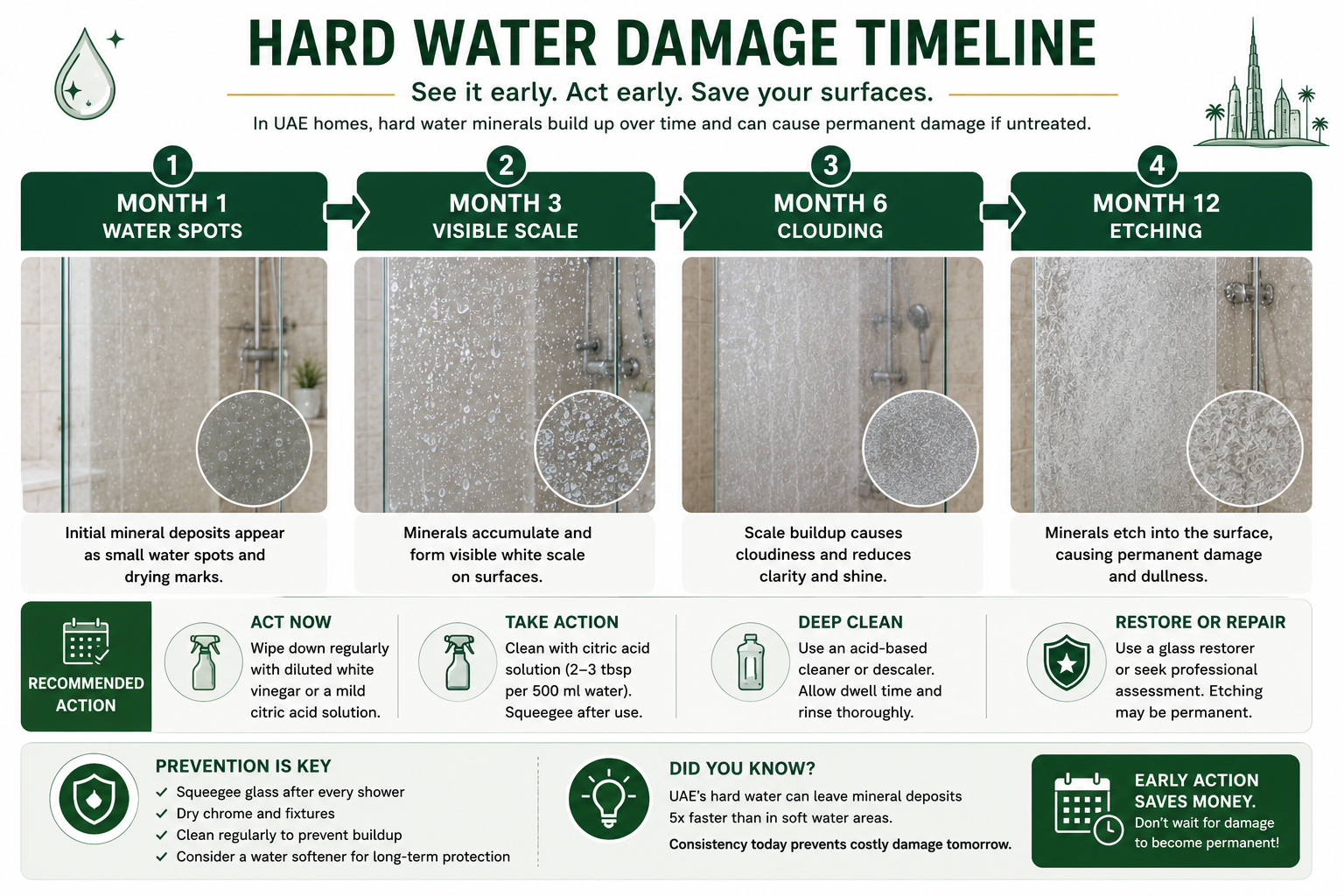
Beyond surface appearance, untreated hard water deposits can cause functional damage to bathroom fixtures over time. This is a relevant consideration for UAE property owners and long-term tenants, where replacement costs for quality fixtures are significant.
Showerheads
Mineral deposits block the individual spray nozzles of a showerhead progressively. Initially, this causes uneven spray distribution. As blockage increases, water pressure appears to drop at the showerhead and spray direction becomes erratic. Plastic nozzle components in some showerhead designs can crack under the mechanical stress of scale build-up if left untreated for extended periods.
Mixer Valves and Taps
Ceramic disc cartridges inside mixer taps – the standard mechanism in modern UAE bathroom fixtures – are vulnerable to damage from mineral particles that enter the cartridge when a tap is opened and closed repeatedly. Over time this can cause taps to drip, become stiff, or lose pressure control. Cartridge replacement is the typical repair, and the cost varies significantly depending on fixture brand and model availability in the UAE.
Water Heaters
UAE apartment water heaters – typically electric storage heaters – accumulate scale on their internal heating elements when hard water is heated. Calcium carbonate precipitates out of solution more readily at higher temperatures, meaning the inside of a water heater is a high-rate scale formation environment. Scale-coated heating elements require more energy to reach target temperature, increasing electricity consumption. Severe scaling reduces heater lifespan. This is not a DIY cleaning scenario but is relevant context for understanding the cost implications of hard water.
Bidet Sprays
Bidet sprays and handheld shower hoses common in UAE bathrooms accumulate mineral deposits at connection points and at the spray nozzle. The connections are particularly susceptible because water repeatedly contacts the thread seals, which can become brittle over time where mineral deposits are not periodically removed.
Glass Shower Enclosure Seals
Silicone seals around shower enclosures are not damaged by mineral deposits directly, but mineral build-up on the glass immediately adjacent to seals is harder to clean without risk of damaging the seal material. Allowing deposits to accumulate at seal lines can also create conditions where mould develops underneath the mineral layer, hidden from routine inspection.
Common Mistakes That Make Hard Water Stains Worse
Allowing water to air-dry on surfaces after every shower is the primary driver of accelerating hard water stains UAE residents see re-forming within days of cleaning. A 30-second squeegee pass on shower glass after each use removes the majority of water before it can evaporate and deposit minerals.
Using regular glass cleaners on hard water stains is ineffective and can compound the problem. Standard glass cleaners are not acidic and do not dissolve calcium deposits. They clean organic marks and fingerprints but leave mineral deposits in place, sometimes spreading them across the glass surface.
Scrubbing dry deposits with abrasive pads before wetting or pre-treating them causes scratching on glass and polished surfaces. Mineral deposits that have dried hard should be softened first with an acidic solution before any mechanical scrubbing.
Rinsing tiles or glass and leaving them wet after cleaning creates a new cycle of mineral deposit formation. Every cleaning session should end with thorough drying.
Using neat bleach on hard water stains has no effect on mineral deposits. Bleach is an oxidising agent effective against organic staining, mould, and bacteria, but it does not dissolve calcium carbonate. Applying bleach to hard water stains adds chemical exposure without any benefit to the mineral deposit itself.
Ignoring build-up until it becomes severe significantly increases the effort and time required for removal. Light deposits that form over one to two weeks are removed in minutes with a routine acidic wipe. Deposits allowed to build up over months require sustained treatment and may cause permanent surface changes.
Not rinsing acidic cleaning solutions completely from surfaces can cause residue to dry and form new deposits. Acid solutions should always be rinsed off thoroughly with clean water after the required dwell time.
Apartment vs Villa Hard Water Maintenance Comparison
![[INFOGRAPHIC: Apartment vs Villa Hard Water Maintenance Comparison UAE - Side-by-side comparison showing affected surfaces, cleaning frequency, maintenance effort, and recommended tools.]](https://cleanlivinguae.com/wp-content/uploads/2026/06/hard-water-stains-uae-8.png)
| Factor | UAE Apartment | UAE Villa |
|---|---|---|
| Number of bathrooms | Typically 1-2 | Typically 3-5+ |
| Shower type | Often enclosed frameless glass panels | Mix of enclosed, walk-in, and wet-room designs |
| Ventilation quality | Often limited, relying on exhaust fans | Usually better, with windows more commonly available |
| Water storage | Building rooftop tank may influence mineral content | Individual tank or direct municipal supply |
| Maintenance responsibility | Tenant typically maintains surfaces while building manages water supply | Owner or tenant generally responsible for all maintenance |
| Natural stone presence | Less common | More common in higher-specification villas |
| Pool and outdoor surfaces | Not applicable | Pool surrounds and outdoor showers vulnerable to scale buildup |
| Water softener installation | Usually not possible in rented apartments | Possible with ownership or landlord approval |
| Cleaning frequency needed | Weekly maintenance and monthly treatment | Weekly maintenance per bathroom and quarterly deep cleaning |
| Tool storage | Limited storage – compact tool selection recommended | More storage space – full cleaning kit practical |
Key considerations for UAE apartments
Rooftop storage tanks in apartment buildings can concentrate minerals if tanks are not cleaned on a regular schedule, potentially making water hardness higher than the municipal supply at the point of entry. Tenants in apartments cannot typically install whole-house water softeners, which means surface-level prevention and regular cleaning are the primary tools available.
Key considerations for UAE villas
Villa owners have the option of installing a whole-house water softener or a point-of-use system. Outdoor showers and pool surrounds in UAE villas are also subject to rapid mineral build-up due to direct sun exposure accelerating evaporation.
Water Softeners for UAE Homes
![[INFOGRAPHIC: Water Softener Decision Guide UAE - Flowchart: Apartment - Shower Filter or Point-of-Use Filter. Villa - Whole-House Softener or Point-of-Use Filter.]](https://cleanlivinguae.com/wp-content/uploads/2026/06/hard-water-stains-uae-9.png)
Water softening addresses hard water staining at the source by reducing the mineral content of water before it reaches surfaces. The practical options available in the UAE differ significantly between apartment tenants and villa owners.
Whole-House Water Softeners
Whole-house softeners connect to the main water supply line before it distributes to all outlets in a property. They use an ion exchange process in which calcium and magnesium ions in the water are replaced with sodium ions, producing softened water that leaves minimal mineral deposits on surfaces.
These systems are most practical for UAE villa owners with access to the main incoming supply line. Installation requires a plumber, ongoing maintenance involves replenishing salt in a brine tank, and the system produces a small amount of salt-containing wastewater as a byproduct. For villas with multiple bathrooms, a whole-house system is the most comprehensive solution to hard water staining and also reduces scale build-up in water heaters and appliances.
For apartment tenants, installation of a whole-house system is generally not permitted without landlord approval, and the building supply infrastructure may not support it even with permission.
Shower Filters
Inline shower filters attach to the shower arm between the wall connection and the showerhead. They typically use KDF (kinetic degradation fluxion) media, vitamin C, or calcium sulphite to reduce chlorine and, to varying degrees, mineral content in the water passing through the showerhead.
Shower filters are the most accessible option for UAE apartment tenants because they require no plumbing modification – they attach and detach like a standard hose fitting. Their effectiveness against hard water mineral deposits specifically is more limited than full ion-exchange softening, but they may reduce deposit formation rate on shower glass and the showerhead itself. Filter cartridges typically require replacement every three to six months depending on water usage and mineral content.
Point-of-Use Filters
Point-of-use water filtration systems can be installed under a kitchen or bathroom sink to treat water at a single outlet. Reverse osmosis (RO) systems are the most effective point-of-use option and are widely used in UAE homes for drinking water; the same technology reduces mineral content effectively.
Under-sink RO systems require a small amount of space below the sink cabinet, connection to the cold water supply line, and a dedicated dispensing tap. They are appropriate for drinking and cooking water. Using an RO tap for filling a spray bottle used in routine bathroom cleaning – rather than using the shower tap directly – does not provide whole-bathroom protection but may be useful for making cleaning solutions.
Practical Guidance for UAE Residents
For apartment tenants: A shower filter is the most practical option available. Combined with consistent daily squeegeeing, it may meaningfully reduce deposit formation on shower glass. Surface-level prevention and a regular acidic cleaning routine remain the most reliably effective approach.
For villa owners or long-term lease holders with landlord cooperation: A whole-house water softener represents a significant reduction in hard water staining across all surfaces and appliances and may be cost-justified over a multi-year horizon.
Hard Water Stain Prevention System for UAE Homes
![[INFOGRAPHIC: Hard Water Prevention System UAE - Flowchart showing daily squeegee use, weekly cleaning, monthly inspection, and quarterly deep cleaning with tools at each stage.]](https://cleanlivinguae.com/wp-content/uploads/2026/06/hard-water-stains-uae-10.png)
Managing hard water stains UAE homes accumulate requires a tiered prevention schedule rather than reactive cleaning alone. The table below outlines the recommended routine across four time intervals.
| Frequency | Action | Time Required | Tools |
|---|---|---|---|
| After every shower | Squeegee shower glass; wipe taps dry | 1-2 minutes | Rubber squeegee, dry cloth |
| Weekly | Spray and wipe glass, tiles, and fixtures with diluted citric acid or vinegar | 10-15 minutes per bathroom | Spray bottle, microfibre cloth, non-scratch pad |
| Monthly | Soak aerators; treat toilet bowl; inspect grout | 20-30 minutes | Vinegar soak, grout brush, toilet descaler |
| Quarterly | Deep clean all surfaces; re-apply glass protectant; check showerhead | 60-90 minutes per bathroom | Commercial descaler, glass polish, hydrophobic sealant |
Daily Actions
After each shower or bath, squeegee the shower glass from top to bottom. This single action removes the majority of water from the glass before it can evaporate and deposit minerals. A squeegee stored inside the shower enclosure makes this easy to integrate into the post-shower routine. Wipe tap spouts and fixture bases with a dry cloth or microfibre to remove standing water.
Weekly Actions
Apply a diluted citric acid solution or diluted white vinegar to shower glass, tiles, and chrome fixtures. Allow 5 to 10 minutes of dwell time before wiping with a non-scratch microfibre cloth. Rinse surfaces and dry with a clean cloth. This weekly treatment prevents the accumulation of deposits that would otherwise require more intensive treatment.
Monthly Actions
Remove and soak tap aerators in citric acid solution. Treat the toilet bowl waterline with a dedicated toilet descaler or a citric acid solution left to dwell for 30 to 60 minutes before scrubbing. Inspect grout lines for accumulation and treat with a grout brush and citric acid solution if necessary. Check showerhead spray coverage for signs of nozzle blockage.
Quarterly Actions
Conduct a full bathroom deep clean, including application of a commercial descaler to any surfaces with heavy build-up. After completing the deep clean and drying all surfaces, apply a hydrophobic glass sealant to shower panels. Re-inspect all fixture seals, grout, and tile surfaces. Note any areas where staining re-forms quickly between cleaning sessions, as this may indicate higher-than-average mineral concentration in the water supply to that area.
Seasonal Hard Water Maintenance Calendar UAE
![[INFOGRAPHIC: Seasonal Hard Water Maintenance Calendar UAE - 12-month calendar highlighting humidity season, deep cleaning periods, and inspection schedules aligned to UAE weather patterns.]](https://cleanlivinguae.com/wp-content/uploads/2026/06/hard-water-stains-uae-11.png)
January to March: Cooler temperatures and lower humidity reduce the speed of evaporation compared to summer months. This is the ideal period for deep cleaning bathroom glass and applying hydrophobic sealants, as lower ambient temperatures give products more time to cure without rapid evaporation. Sandstorm season increases dust content in the air, which can affect bathroom ventilation quality if windows are opened during storms.
April to May: Temperatures begin rising rapidly. Evaporation from wet bathroom surfaces accelerates noticeably. This is a practical time to review and reinforce the daily squeegee habit before peak summer conditions arrive, and to complete a full bathroom descaling session before humidity rises.
June to September: Peak summer conditions with temperatures regularly above 40 degrees Celsius and – particularly in coastal areas including Dubai, Abu Dhabi, Sharjah, and Ajman – high humidity. The combination of high temperature and humidity in bathrooms without adequate ventilation creates conditions where mineral-laden condensation forms widely across bathroom surfaces. Weekly acidic cleaning should be maintained without interruption during this period.
October to December: Temperatures moderate and humidity decreases. This is another strong window for deep cleaning and glass sealant application. The end of the year is a practical time for the quarterly deep-clean cycle and an assessment of any glass etching or grout deterioration that has developed over the summer period.
Does Hard Water Vary Between UAE Emirates?
Water hardness in the UAE is not uniform. Variation exists between emirates, between supply zones within the same emirate, and between individual buildings depending on their water storage infrastructure. Understanding this variation helps residents calibrate their expectations and cleaning frequency.
Dubai
Dubai’s water supply is managed by the Dubai Electricity and Water Authority (DEWA) and is sourced almost entirely from desalination plants. The treated water distributed through the municipal network falls within a moderate hardness range. However, water hardness as experienced at the tap in any given Dubai apartment or villa can be meaningfully affected by the condition and cleaning schedule of the building’s rooftop storage tank. Buildings with infrequently cleaned tanks may have noticeably higher effective mineral content reaching individual taps than the municipal supply would suggest.
Dubai apartments in high-rise towers – particularly in areas such as Dubai Marina, JBR, Downtown Dubai, Business Bay, and Jumeirah Lake Towers – are particularly dependent on rooftop tanks due to building height. Residents in these developments commonly report rapid hard water deposit formation on shower glass and fixtures.
Abu Dhabi
Abu Dhabi’s water supply is provided by the Abu Dhabi Distribution Company (ADDC) and originates from desalination facilities operated under the Abu Dhabi Department of Energy framework. Water hardness in Abu Dhabi is generally in a similar moderate range to Dubai. The emirate’s extensive villa and compound housing stock means that a higher proportion of residents have more direct supply configurations, though rooftop tank storage is still prevalent in apartment buildings on Reem Island, Al Raha Beach, and in central Abu Dhabi.
Sharjah and Ajman
Sharjah and Ajman are supplied by the Sharjah Electricity and Water Authority (SEWA) and draw from desalination sources in the region. Water hardness levels in these emirates are broadly comparable to Dubai and Abu Dhabi. Sharjah in particular has a large proportion of older residential buildings where tank maintenance schedules may vary significantly between buildings and landlords, potentially contributing to higher-than-average mineral content at the tap in some developments.
Northern Emirates (Ras Al Khaimah, Fujairah, Umm Al Quwain)
The northern emirates draw water from a mix of desalination and groundwater sources. Groundwater in the UAE – where still used as a supplementary supply – can carry higher natural mineral content than desalinated water, and this may result in higher effective water hardness in some supply zones. Residents in the northern emirates, particularly those in older buildings or properties with private well supplements, may experience more aggressive hard water staining than those in purely desalination-supplied developments.
Villa Tank Systems
Many UAE villas and older developments use private storage tanks that are filled from the municipal supply and then distributed internally. The condition, material, and cleaning frequency of these tanks can significantly alter the mineral content of water reaching internal fixtures. In some cases, mineral sediment that has accumulated in a poorly maintained tank re-enters the water supply and accelerates staining on shower glass, tiles, and fixtures throughout the property. Villa owners and property managers in the UAE are advised to schedule tank cleaning at least annually.
Practical Implication
Because water hardness varies by location and building, the cleaning frequency guidance in this article represents a baseline rather than a universal prescription. Residents who notice unusually rapid deposit formation – for example, visible mineral film on shower glass within 48 hours of cleaning – may be experiencing above-average water hardness and may benefit from a more frequent weekly cleaning cycle or from investigating the condition of their building or villa storage tank.
Best Tools for Removing Hard Water Stains UAE
Some product mentions in this section may include affiliate links.
The right tools significantly affect the ease and effectiveness of hard water stain removal and prevention. The following categories cover everything needed for a complete UAE bathroom hard water maintenance routine.
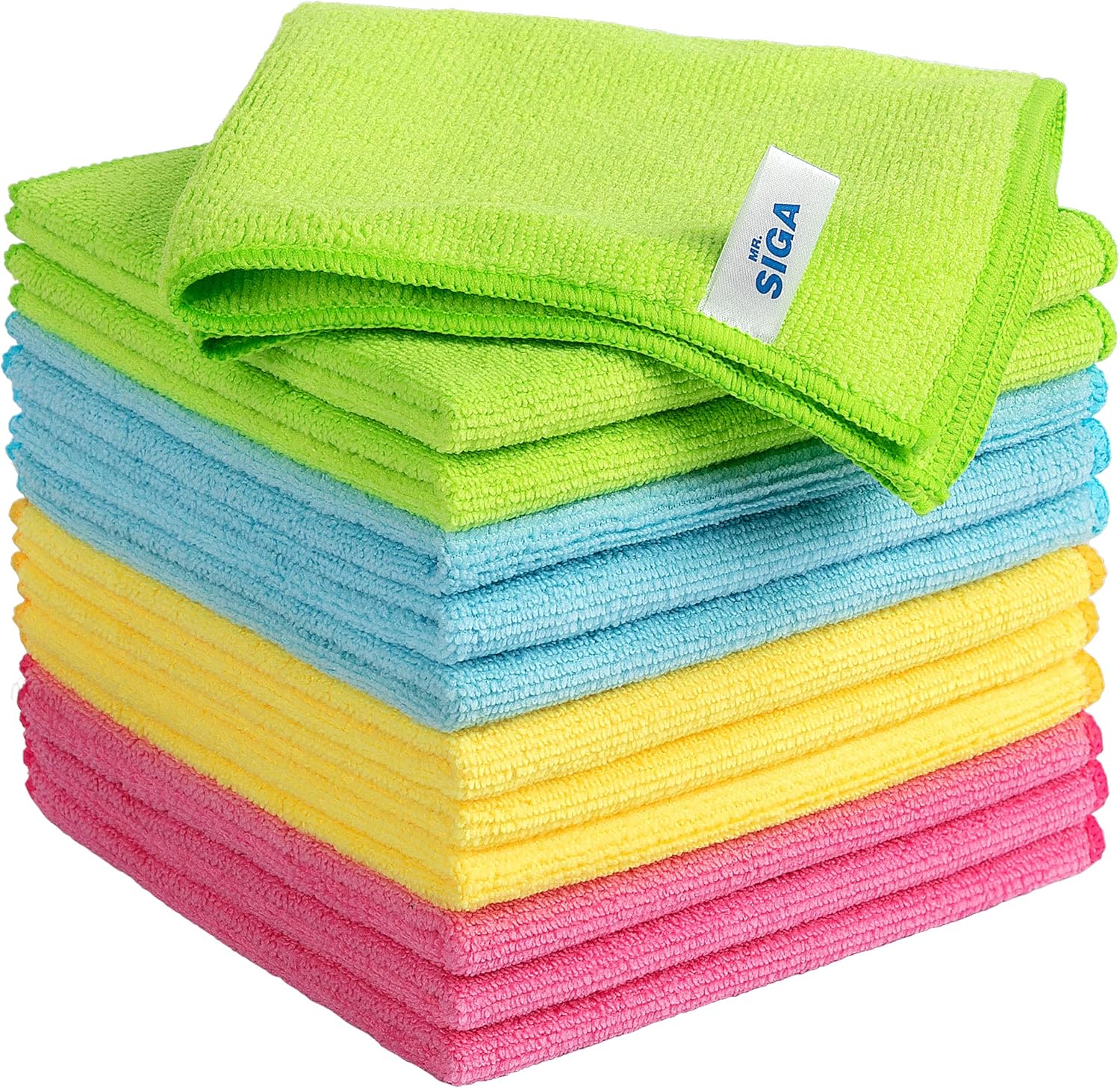
Microfiber Cloths for
Fine Dust Removal
Microfiber cloths help trap fine UAE dust instead of spreading it across surfaces. Separate cloths for dry dusting and wet cleaning improve cleaning efficiency.
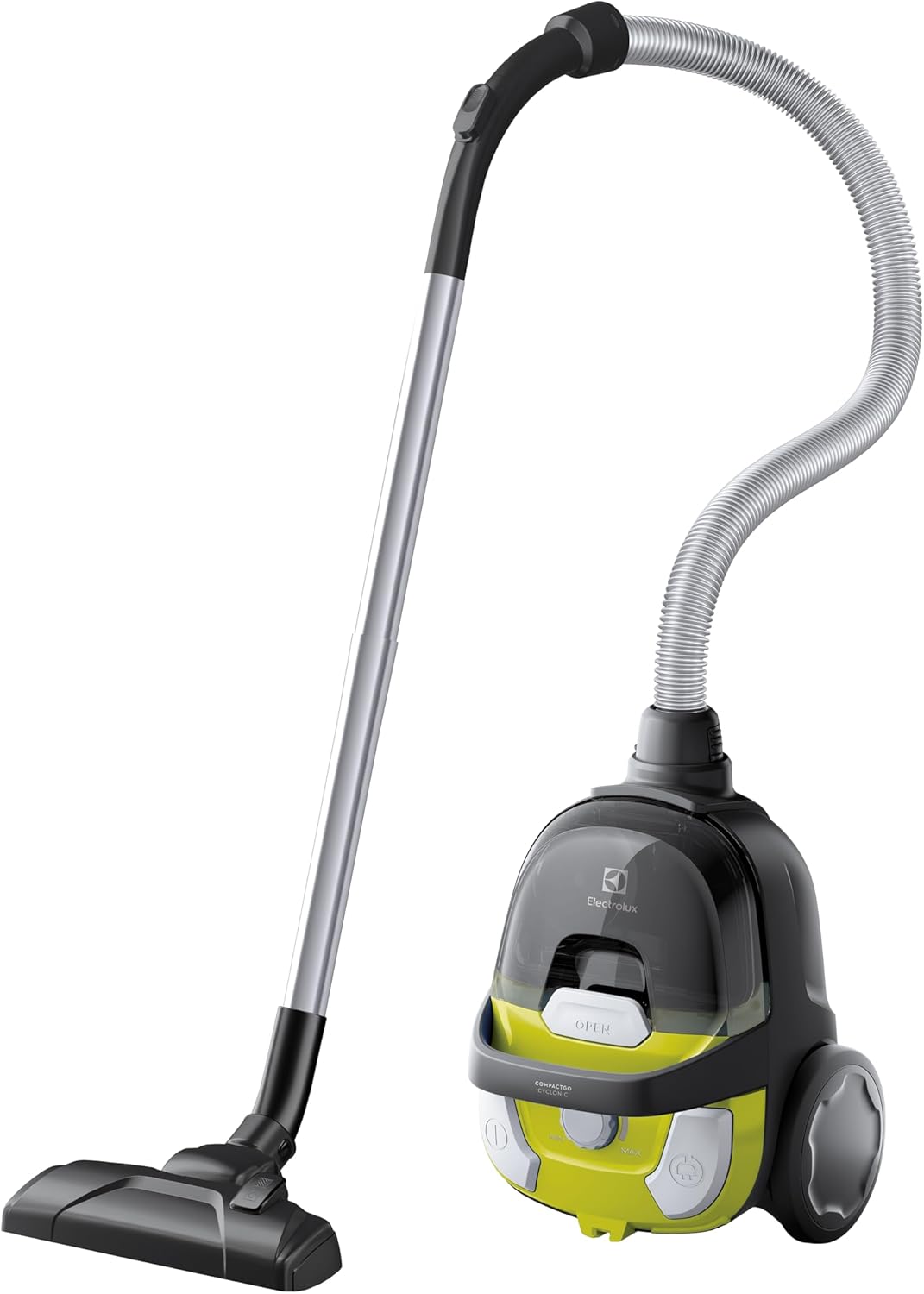
HEPA Vacuum Cleaners for
UAE Dust Control
HEPA vacuum cleaners capture fine dust and sand particles commonly found in UAE homes. They are effective for tile, marble, rugs, and upholstery.
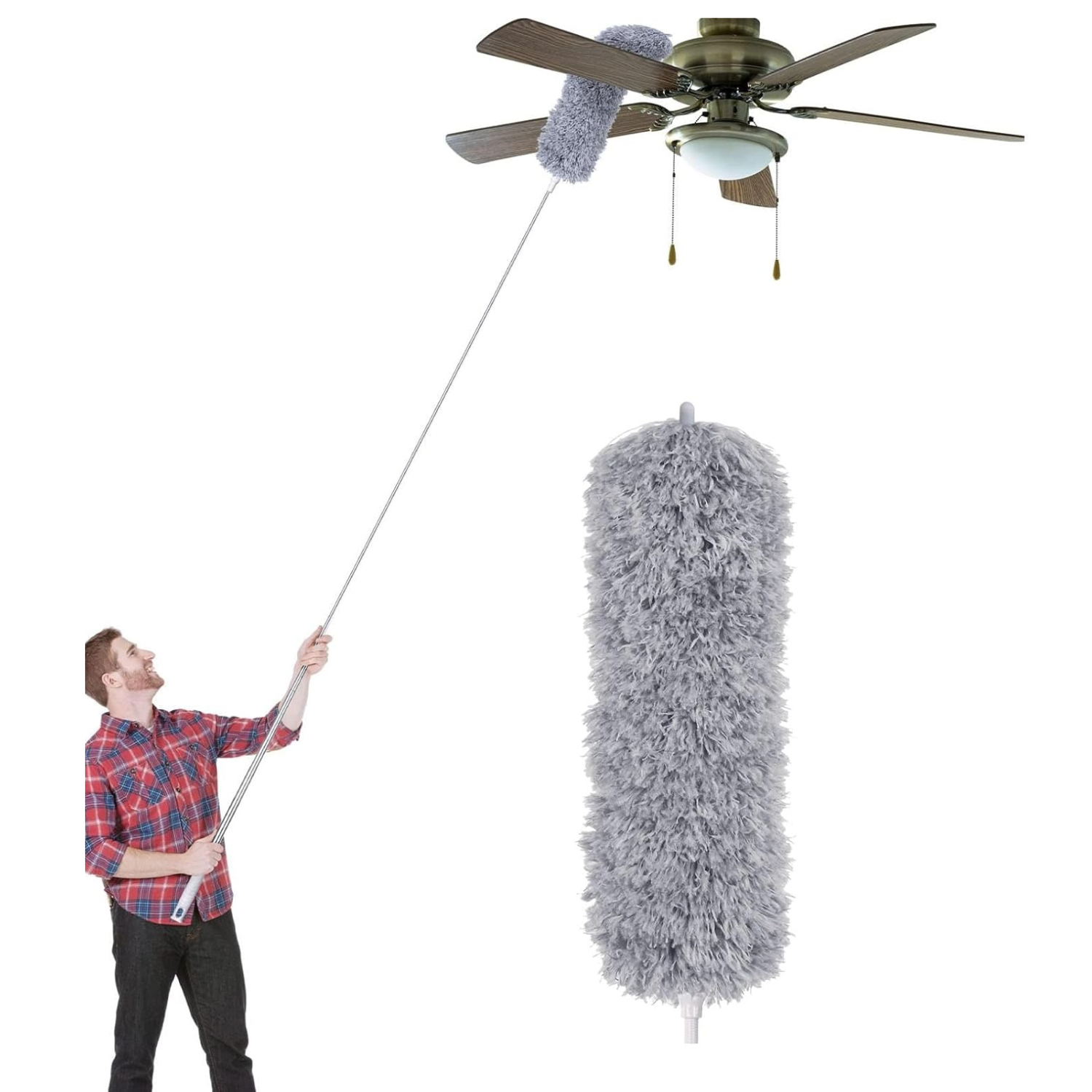
Dusting Tools for
Dust Removal
Electrostatic extendable dusters trap fine particles without spreading them, making them well suited to UAE homes with tall ceilings and hard-to-reach surfaces.
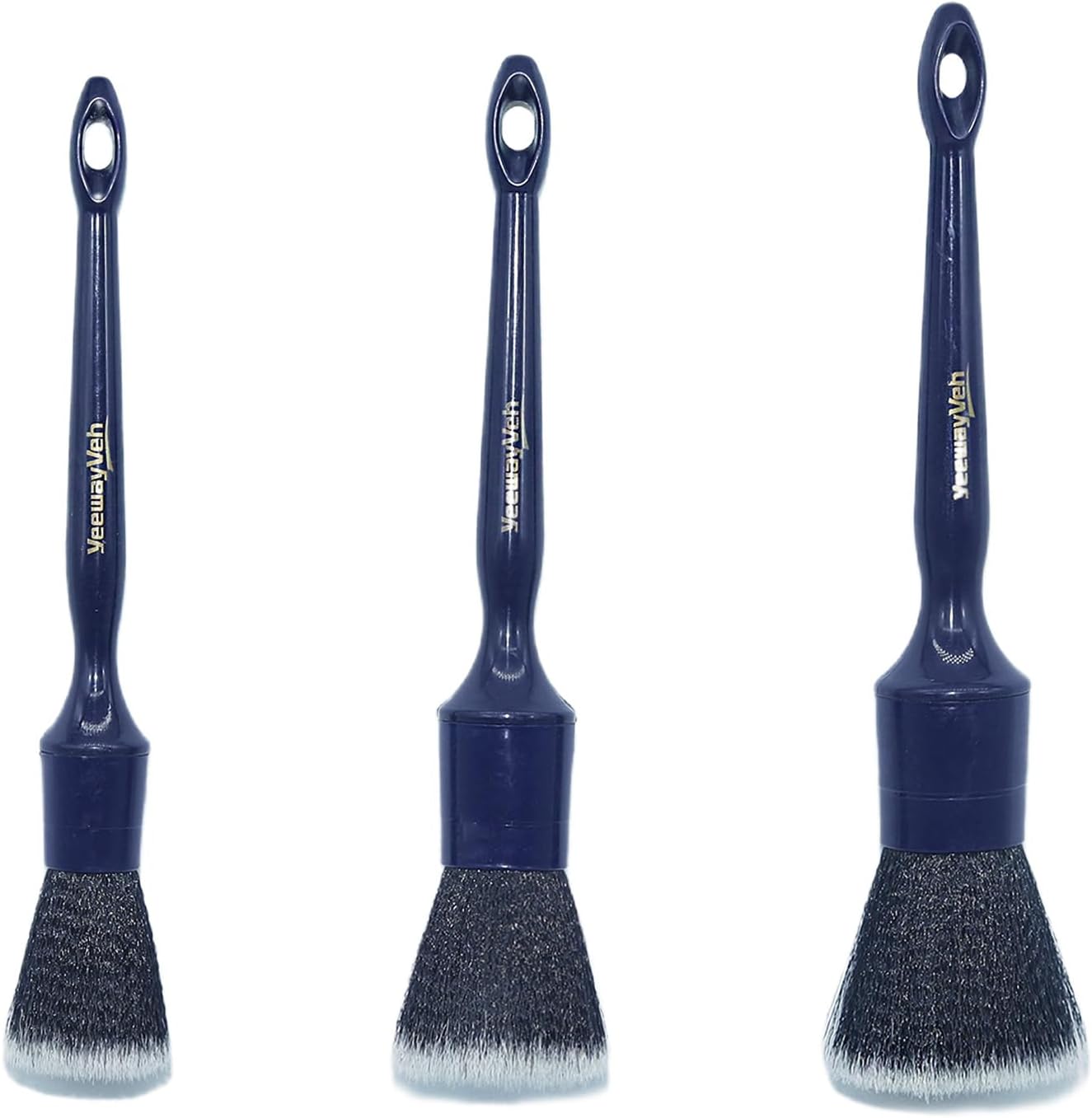
AC Vent Brushes for
Dust Accumulation
Narrow-profile brushes fit between AC louvre slats to remove dust buildup between professional filter services, without damaging the unit.
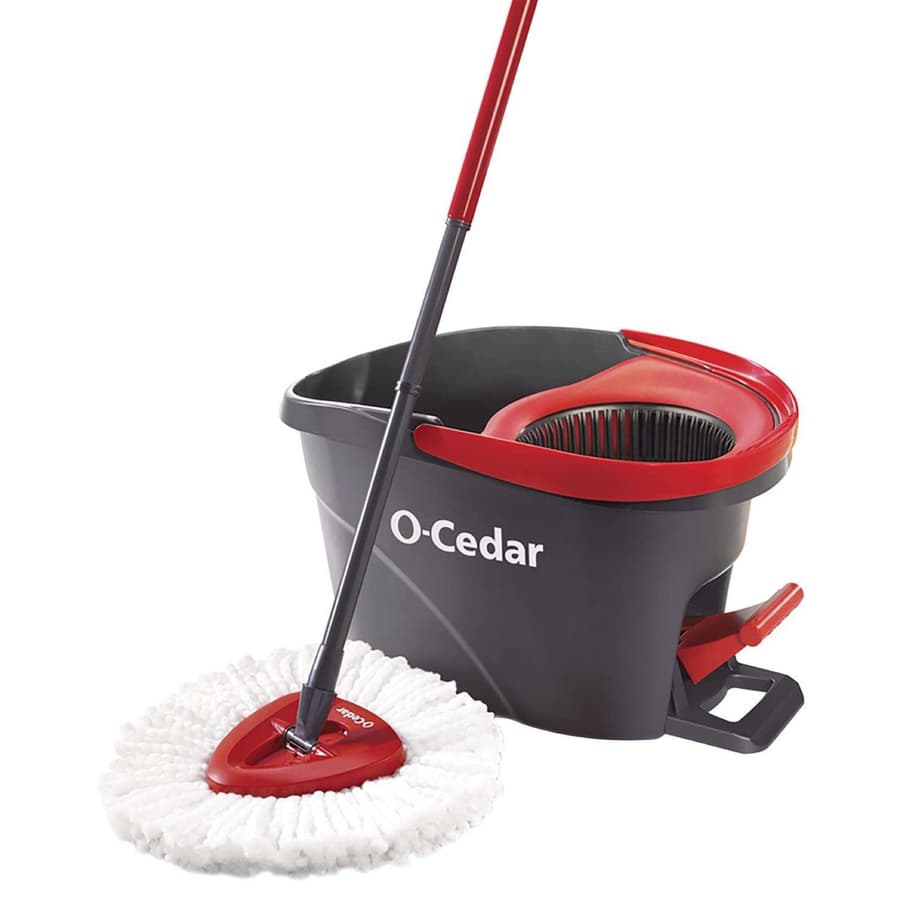
Spin Mops and Floor Mops
for post-cleaning
Spin mops with microfiber heads capture residual fine particles on hard floors when used after vacuuming that it may have missed.
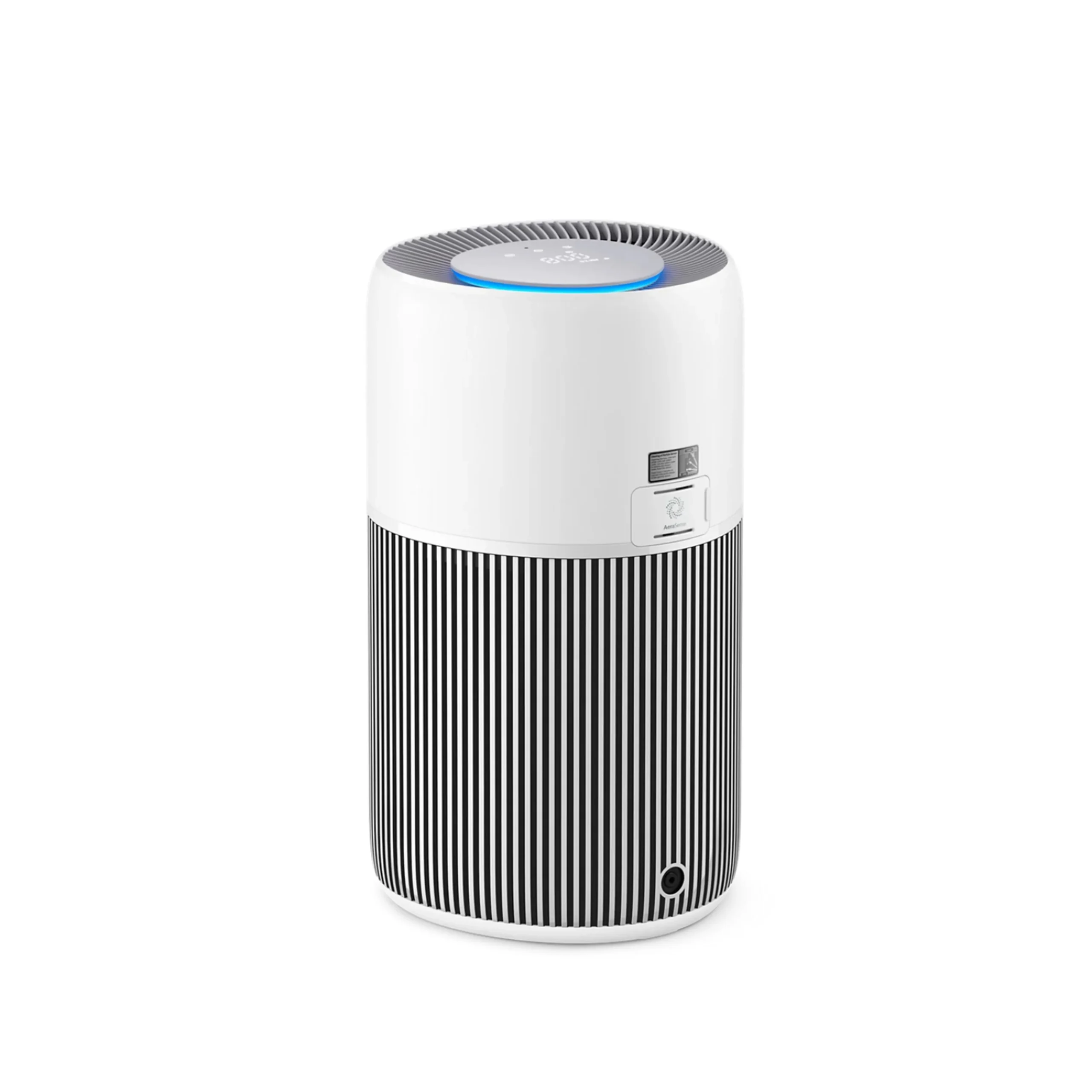
Air Purifiers for Managing
Fine Indoor Dust
HEPA air purifiers help reduce airborne dust and fine sand during dusty periods. Bedrooms and living rooms are the most common placement areas in UAE homes.
Rubber squeegee: A squeegee stored inside the shower enclosure is the single most cost-effective tool for reducing hard water deposit formation. Straight-blade models with a handle length of 30 to 45 cm are effective for standard UAE shower panel sizes. For a full guide to current UAE-available models, see the Best Shower Squeegees UAE roundup.
Microfibre cloths: Fine-weave microfibre cloths clean glass and chrome without scratching. For shower glass maintenance, cloths dedicated solely to bathroom use avoid transferring residues from other surfaces. For UAE-tested product recommendations, see the Best Microfiber Cloths UAE roundup.
Non-scratch scouring pads: White or light-coloured non-scratch pads are appropriate for moderate deposit removal on ceramic tiles and chrome. Green non-scratch pads offer slightly more abrasion and are suitable for tile surfaces but should be used cautiously on glass.
Grout brush: A stiff-bristled narrow brush designed for grout lines improves the effectiveness of acidic cleaning solutions on porous grout surfaces.
Spray bottles: Clearly labelled spray bottles for premixed citric acid solution and diluted vinegar solution allow for consistent concentration and convenient application.
Steam cleaner: Steam cleaners can be effective for loosening moderate mineral deposits on tiles and grout without chemical input, making them a useful complement to acidic treatment for bathroom deep cleans. For UAE-available options, see the Best Steam Cleaners UAE roundup.
Hydrophobic glass sealant: Applied quarterly after deep cleaning, this product category significantly reduces the rate of mineral deposit re-formation on shower glass.
For a comprehensive overview of bathroom cleaning tools available in the UAE with current pricing on Amazon.ae, see the Best Bathroom Cleaning Tools UAE guide. For cleaning hard mineral deposits from floor surfaces, the Best Hard Floor Cleaners UAE guide covers relevant floor-specific tools and products.
![[INFOGRAPHIC: Hard Water Stain Removal Decision Tree - Flowchart helping readers choose cleaning methods based on deposit severity and surface material type.]](https://cleanlivinguae.com/wp-content/uploads/2026/06/hard-water-stains-uae-12.png)
- Hard Water Inspection Checklist
- Shower Glass Maintenance Calendar
- Monthly Bathroom Audit Sheet
- Annual Hard Water Prevention Planner]
Key Takeaways
- Hard water stains UAE homes experience are primarily caused by the mineral content of desalinated tap water combined with high evaporation rates driven by heat and limited ventilation.
- Shower glass, chrome fixtures, bathroom tiles, and toilet bowls are the most commonly affected surfaces in UAE apartments and villas.
- Hard water stains and soap scum are different problems requiring different cleaning agents. Acids dissolve mineral deposits; degreasers address soap scum.
- White vinegar, citric acid, and citric acid-based commercial products are effective for removing calcium carbonate deposits from most surfaces. Natural stone requires pH-neutral or stone-safe alternatives.
- Untreated hard water deposits can cause functional damage to showerheads, mixer taps, water heater elements, and shower enclosure seals over time, beyond surface appearance alone.
- Daily squeegeeing of shower glass after each use is the most effective single action for slowing deposit formation.
- Apartments present constraints that villas do not, including limited ventilation, rooftop tank water storage, and restrictions on water softener installation. Shower filters are the most practical softening option for apartment tenants.
- Glass etching caused by long-standing untreated deposits is not fully reversible through standard DIY cleaning. Prevention and early treatment are substantially more effective than restoration of severely etched surfaces.
Frequently Asked Questions
Can hard water stains permanently damage shower glass in UAE homes?
Yes, if left untreated over an extended period. Mineral deposits that remain on glass cause a process known as etching, where the calcium salts gradually alter the surface of the glass at a microscopic level. Light etching makes glass appear permanently hazy even when clean. Severe etching is not reversible with standard cleaning products. This is why early treatment and prevention are more effective than attempting to restore heavily stained glass.
How often should shower glass be cleaned in a UAE apartment?
A daily squeegee after each shower removes most water before it evaporates. A weekly acidic spray-and-wipe treatment addresses any residual mineral film. A monthly deeper treatment with citric acid solution and a non-scratch pad handles any build-up that the weekly routine misses. A quarterly application of hydrophobic glass sealant slows re-formation of deposits.
What is the difference between hard water stains and soap scum?
Hard water stains are inorganic mineral deposits that feel chalky or gritty and are dissolved by acidic cleaners. Soap scum is an organic residue formed when soap reacts with water minerals; it feels waxy or greasy and responds better to alkaline or degreasing cleaners. Both often occur together in UAE bathrooms and may require sequential treatment with different cleaning agents.
Is UAE tap water safe to drink, and does it cause hard water stains?
UAE municipal tap water meets drinking water safety standards set by relevant authorities. However, it contains dissolved minerals from the remineralisation process applied after desalination, and these minerals are responsible for hard water staining on surfaces. The safety of the water for consumption is a separate question from its effect on bathroom surfaces.
What is the fastest way to remove hard water stains from a UAE shower?
For light to moderate deposits, undiluted white vinegar applied to dry glass and left for 20 to 30 minutes, followed by scrubbing with a non-scratch pad and thorough rinsing, produces visible results quickly. For heavy deposits, citric acid solution at a concentration of 3 tablespoons per 500 ml of warm water provides stronger dissolving action. Severe deposits typically require multiple treatment sessions.
Can vinegar damage bathroom tiles in a UAE home?
White vinegar is safe for ceramic and porcelain tiles. It is not appropriate for natural stone tiles including marble, travertine, and limestone, which are common in UAE villa bathrooms. Acidic cleaners etch natural stone and dull the surface permanently. If tile material is uncertain, test on a small, inconspicuous area first.
Why do hard water stains come back so quickly after cleaning in UAE homes?
The speed at which deposits re-form depends on the mineral content of the water, the frequency of surface wetting, the rate of evaporation, and whether any protective surface treatment is in place. UAE conditions – high mineral content, rapid evaporation, and daily shower use – mean that deposits will re-form on untreated surfaces within days. A hydrophobic glass sealant and a consistent daily squeegee habit are the most effective measures for slowing re-formation.
Can a water softener be installed in a UAE apartment?
Whole-house water softeners require connection to the main water supply, which is generally not possible in rented apartments without landlord approval. Inline shower filters are a practical alternative for apartment tenants. They attach directly to the shower arm without any plumbing modification and can reduce deposit formation on shower glass and the showerhead itself.
Does the building water tank affect hard water staining in UAE apartments?
Yes, it can. Apartment buildings in the UAE typically store water in rooftop tanks. If these tanks are not cleaned on a regular schedule, mineral sediment can accumulate and increase the effective mineral content of water reaching individual apartments. Tenants who notice unusually rapid deposit formation may wish to raise tank cleaning frequency with building management.
What is the white ring in my toilet bowl, and how is it removed?
The ring at the waterline in a toilet bowl is caused by calcium carbonate and other minerals depositing at the point where the water surface meets the bowl. It does not indicate a hygiene problem. It is removed using a dedicated toilet descaler applied to the waterline area and left to dwell for 30 to 60 minutes before scrubbing with a toilet brush. Citric acid solution poured into the bowl and left overnight is also effective on moderate rings.
Sources
Information on UAE water supply mineralisation and desalination remineralisation practices is drawn from public guidance published by the Abu Dhabi Department of Energy and the Dubai Electricity and Water Authority (DEWA). Guidance on water hardness classification is based on standards referenced by the World Health Organization’s Guidelines for Drinking-water Quality. Information on calcium carbonate chemistry and descaling methods is consistent with published guidance from NSF International on water treatment and The Water Quality Association. UAE water quality standards and supply regulation frameworks are informed by documentation from the Emirates Authority for Standardization and Metrology (ESMA) and the UAE Ministry of Energy and Infrastructure. Seasonal climate data for the UAE is drawn from UAE National Centre of Meteorology published historical records.