Key Takeaways
- True HEPA captures 99.97% of airborne particles at 0.3 microns under standardised testing conditions
- HEPA-type and HEPA-like labels are not certified HEPA – they do not meet the 99.97% standard
- UAE desert dust includes PM2.5 particles well within the range HEPA filtration is designed to capture
- Split AC filters in UAE apartments are almost never HEPA – they protect the coil, not indoor air quality
- Sealed systems matter as much as the filter itself – an unsealed HEPA device can still leak fine dust
- Manufacturer replacement intervals are typically too long for UAE dust conditions
At a Glance: Is HEPA Recommended?
| Situation | Is HEPA Recommended? |
|---|---|
| Apartment near active construction | Yes |
| Pet-owning household | Yes |
| Standard split AC only, no purifier | HEPA purifier strongly recommended |
| Allergy-sensitive resident | Strongly recommended |
| Low-dust villa, good seals, no pets | Sometimes – assess by room |
| Bedroom regardless of dwelling type | Yes – extended daily exposure |
| Smoker household | Yes |
What Does HEPA Mean?
HEPA stands for High-Efficiency Particulate Air. The standard originated from research conducted during the Second World War, developed to filter radioactive particles in laboratory environments. It was later adopted for commercial and residential use as awareness of indoor air quality and fine particulate health effects grew.
The Core Performance Benchmark
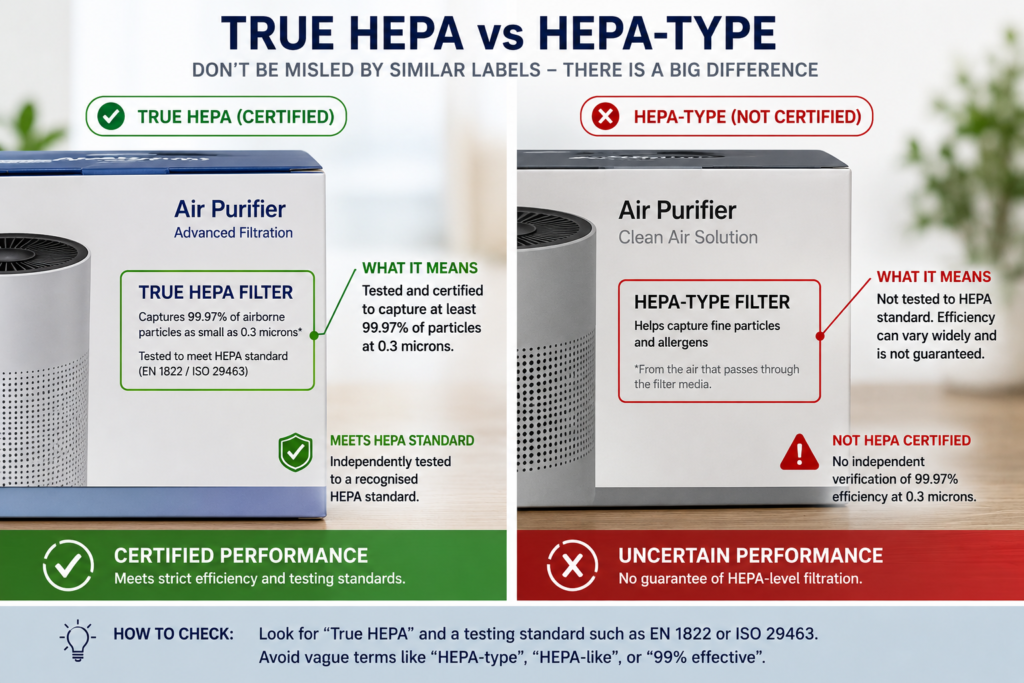
A True HEPA filter is one that has been tested and certified to capture at least 99.97% of airborne particles at 0.3 microns in diameter during a single pass through the filter medium.
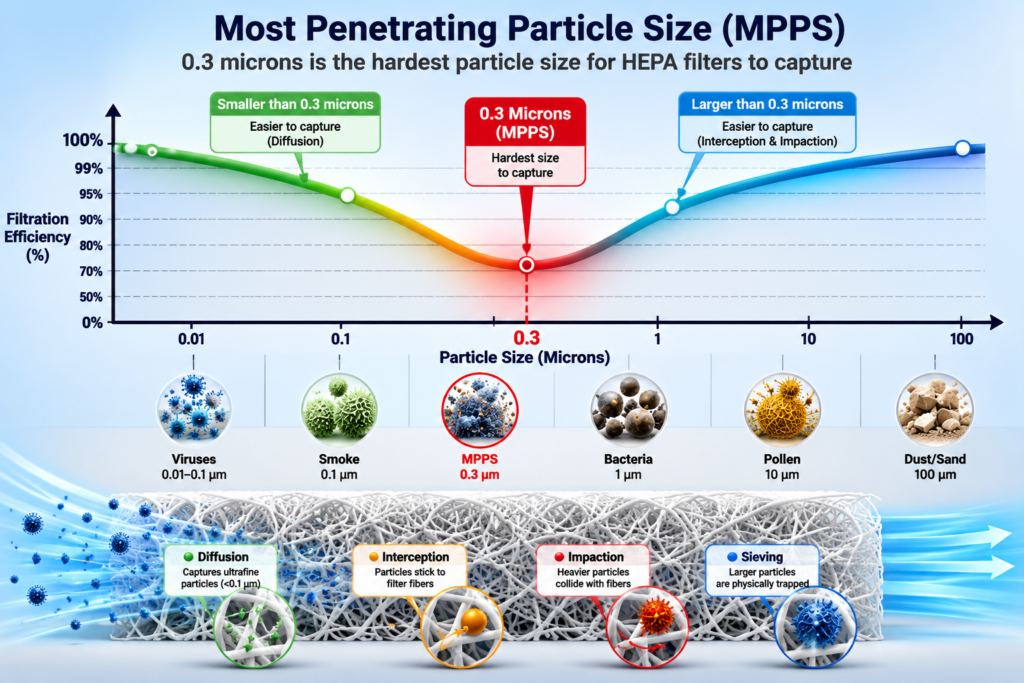
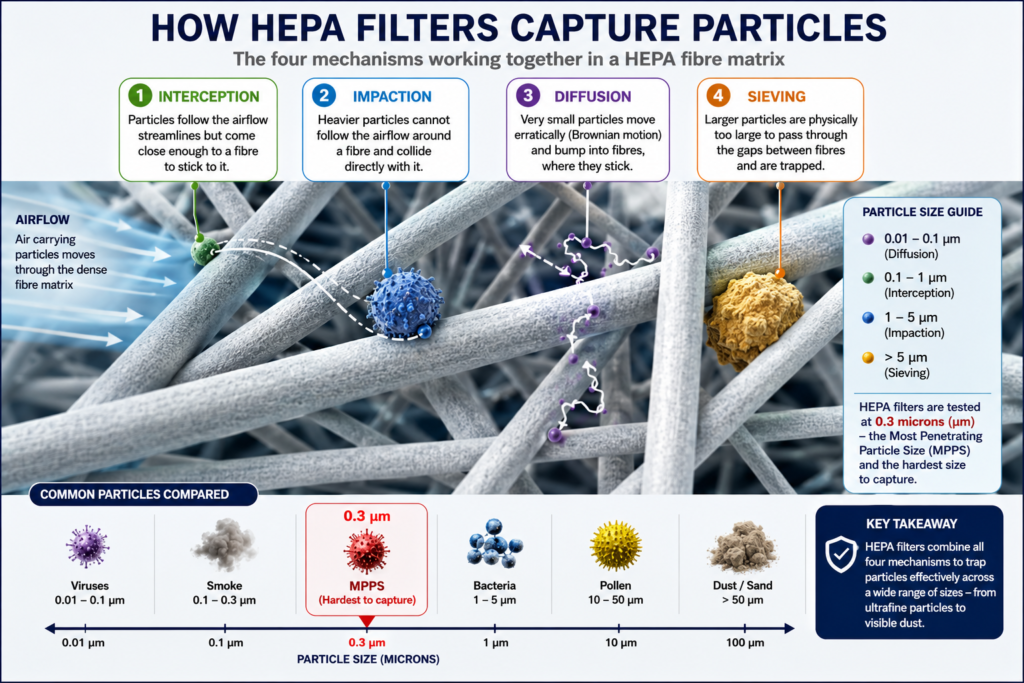
This specific size – 0.3 microns – is described as the Most Penetrating Particle Size (MPPS). It represents the particle diameter that is statistically hardest for a filter to trap, and serves as the test threshold for certification.
- Particles smaller than 0.3 microns are easier to capture due to Brownian motion, where erratic molecular-level movement pushes them into filter fibres
- Particles larger than 0.3 microns are easier to intercept through direct impaction or sieving
- At exactly 0.3 microns, particles are too large to benefit fully from diffusion but too small for reliable impaction
The 99.97% figure means fewer than 3 particles in every 10,000 at this size pass through an intact, properly sealed filter. In environments with continuous fine particulate loading – common in UAE apartments near construction zones or in buildings with ageing AC systems – this level of filtration provides a practical advantage over standard filter alternatives.
How HEPA Filters Actually Work
HEPA filters do not operate like a simple sieve where only particles smaller than the gaps pass through. The filter medium is a dense mat of randomly arranged glass fibres, and particles are captured through four distinct physical mechanisms.
Interception occurs when a particle travelling through an airstream passes close enough to a fibre that it makes contact and adheres. This is the primary mechanism for medium-sized particles.
Impaction happens when a particle with sufficient mass cannot follow the curved airflow path around a fibre and collides directly with it. Heavier and larger particles are captured this way.
Diffusion is responsible for capturing the smallest particles, typically below 0.1 microns. These ultrafine particles move erratically due to molecular collisions rather than following airflow lines, increasing the probability of contact with filter fibres.
Sieving traps particles physically too large to pass through gaps in the fibre matrix, handling coarser dust and visible particulate.
Why This Matters for UAE Dust
Many manufacturers market HEPA as filtering particles “0.3 microns and larger,” which is technically accurate but can be misleading. The filter also captures very small ultrafine particles effectively through diffusion.
The fine desert dust fraction common in UAE homes includes particles well below 0.3 microns that contribute to indoor PM2.5 readings. HEPA filtration addresses this ultrafine fraction in a way that standard filters cannot replicate. According to the US Department of Energy HEPA filter specification, the certified fine-particle filtration benchmark applies specifically at the most penetrating particle size – meaning performance at other sizes is typically higher, not lower.
HEPA vs Regular Filters
| Comparison Factor | True HEPA Filter | Standard Filter |
|---|---|---|
| Filtration efficiency at 0.3 microns | 99.97% minimum | Typically 50-85% |
| Fine dust handling | High – captures PM2.5 and PM1.0 | Limited – misses ultrafine particles |
| Visible sand handling | Handled by pre-filter stage | Generally adequate for coarse sand |
| PM2.5 capture | Effective | Unreliable |
| Pet dander control | Effective | Partial |
| Airflow resistance | Higher – requires more motor power | Lower resistance |
| Maintenance requirement | Scheduled replacement essential | Washable or low-cost replacement |
| Cost | Higher initial and replacement cost | Lower cost |
| Common UAE applications | Quality vacuums, air purifiers | Budget vacuums, split AC units |
The performance gap between HEPA and standard filters becomes most relevant in environments where fine particulate is a persistent concern. In Dubai apartments near construction on major arterial roads, or in older Sharjah buildings with dusty common areas, the difference in captured PM2.5 between a HEPA device and a standard filter device is meaningfully large over time.
HEPA filtration does not increase or reduce room humidity. See air purifier vs humidifier UAE for a clearer comparison of particle filtration and moisture control.
What “True HEPA” Actually Means
Marketing terminology in the filtration industry has created significant confusion across product categories available in the UAE market. Several terms appear on product packaging that imply HEPA-level performance without meeting the standard.
What is a True HEPA filter?
A True HEPA filter is a certified filter that captures at least 99.97% of airborne particles at 0.3 microns under standardised testing conditions. Any label that does not include the word “True” – or an explicit reference to the certified HEPA benchmark – should be verified carefully before purchase.
| Marketing Term | What It Actually Means | Meets HEPA Standard? |
|---|---|---|
| True HEPA | Filter tested and certified to capture 99.97% at 0.3 microns | Yes |
| HEPA-type | Filter inspired by HEPA design but not independently certified | No |
| HEPA-like | Similar construction, unverified efficiency | No |
| Washable HEPA | Often foam or sponge-type filter; washing destroys HEPA media | Rarely – check specifications |
| H13 HEPA | European EN1822 grade capturing 99.95% at MPPS | Yes – exceeds standard |
| H14 HEPA | European EN1822 grade capturing 99.995% at MPPS | Yes – highest residential grade |
The Washable HEPA Problem
The washable HEPA claim deserves particular attention. True HEPA filter media is constructed from glass fibres arranged in a specific density pattern.
Washing this media – even gently – disrupts the fibre arrangement and introduces micro-tears, reducing filtration efficiency significantly. Products marketed as washable HEPA typically use foam or synthetic mesh that captures larger particles but does not replicate the fine-particle capture performance of genuine HEPA media.
Why Sealed Systems Matter
A genuine HEPA filter installed in a device with poor internal sealing is partially ineffective. If airflow bypasses the filter through gaps around the filter housing, a portion of uncleaned air exits the device. This is described as filter leakage and is a common source of performance disappointment with lower-cost products available in the UAE market.
Common HEPA Marketing Myths
Several marketing claims about HEPA filtration appear frequently across UAE retail platforms and product listings. Understanding which claims are inaccurate helps residents make more informed decisions.
“HEPA removes all dust” HEPA captures fine particulate at very high efficiency, but it does not remove 100% of all particles. Coarse sand and debris require pre-filter stages. Gases, odours, and VOCs require activated carbon. HEPA is one component of a complete filtration system, not a standalone solution.
“Washable HEPA lasts forever” True HEPA glass-fibre media cannot be washed without degrading performance. Products marketed as permanently washable HEPA are using a different filter material that does not meet the 99.97% standard.
“HEPA-type equals HEPA” HEPA-type is a marketing term with no standardised performance threshold. A HEPA-type product may capture a portion of fine particles, but it has not been tested or certified to the HEPA standard threshold.
“All HEPA vacuums are sealed systems” Many vacuum cleaners carry genuine HEPA filters but are not sealed internally. Airflow can bypass the filter through housing joins, meaning fine particles escape through the exhaust. Sealed HEPA systems are a separate and more important specification to check.
“Split AC nano filters are HEPA” Some air conditioner models feature filters marketed as “nano,” “plasma,” or “ultra-fine.” These are not tested HEPA-grade filters. They may capture some particles but do not meet the tested HEPA efficiency standard and are not a substitute for standalone HEPA filtration in a vacuum or air purifier.
Why HEPA Matters More in UAE Homes
UAE indoor environments face a combination of particulate challenges that are less common in temperate climates.
Example: A Typical High-Rise Apartment Dust Cycle
Understanding how fine particulate moves through a closed apartment helps clarify why standard filters often fall short.
- Fine desert dust and construction particles enter through balcony gaps and window-frame seals
- The split AC system recirculates indoor air continuously, distributing particles to every room
- Dust settles overnight on tile floors, furniture, and fabric surfaces
- Morning vacuuming with a non-sealed or standard-filter appliance disturbs settled dust and returns fine particles to the air
- Without HEPA exhaust filtration, PM2.5 stays suspended and is recirculated again by the AC
- Over weeks, invisible particulate accumulates in living spaces even in apartments that appear visually clean
This cycle is common across closed high-rise apartments in Dubai, Abu Dhabi, and Sharjah during the months when windows remain shut. HEPA filtration in both the vacuum and an air purifier addresses two separate stages of this cycle.
Desert Dust and PM2.5
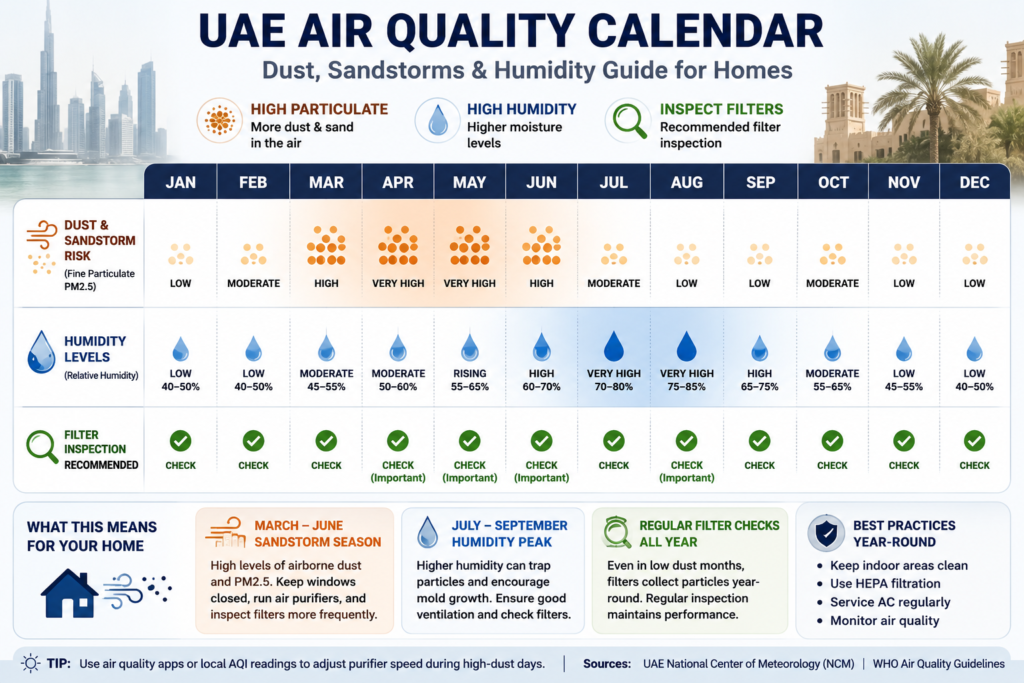
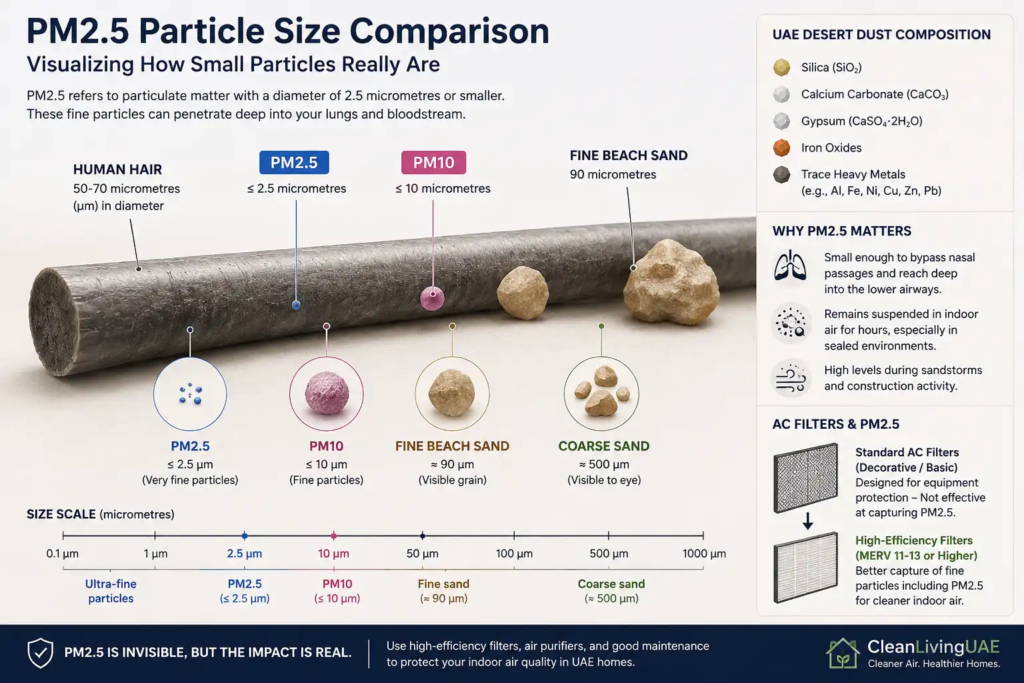
Desert dust in the UAE contains a high proportion of fine silica particles, clay minerals, and calcium carbonate. During sandstorms – which occur with frequency across Dubai, Abu Dhabi, and Sharjah between March and June – outdoor PM10 and PM2.5 levels rise sharply.
Fine particles infiltrate buildings through gaps around window frames, balcony door seals, and HVAC intake points. Unlike visible sand grains that are easy to sweep, PM2.5 particles at 2.5 microns or smaller remain suspended in indoor air for extended periods and are not visible to the naked eye.
WHO indoor air quality guidance identifies PM2.5 as one of the most significant indoor particulate concerns for respiratory health. In high-rise apartments where windows remain closed and AC systems run continuously during summer, these particles recirculate repeatedly through split AC units, accumulating in living spaces over weeks.
Construction and Coastal Conditions
High-rise construction near residential towers in Business Bay, Dubai Marina, Jumeirah Village Circle, and Al Reem Island in Abu Dhabi introduces concrete dust, gypsum particles, and chemical residues that enter adjacent apartments through shared ventilation pathways and balcony gaps.
Coastal humidity, particularly in areas like JBR, Abu Dhabi Corniche, and beachfront Sharjah developments, creates conditions where fine dust particles bind with moisture. This makes them heavier and more likely to accumulate on surfaces in clumped deposits that standard vacuums can disturb back into the air during cleaning.
The combination of desert particulate, construction activity, AC recirculation, and Gulf climate humidity makes these indoor environments particularly well-suited to HEPA-grade filtration in cleaning appliances and air treatment devices.
HEPA Filters in Vacuums
Some product mentions may include affiliate links.
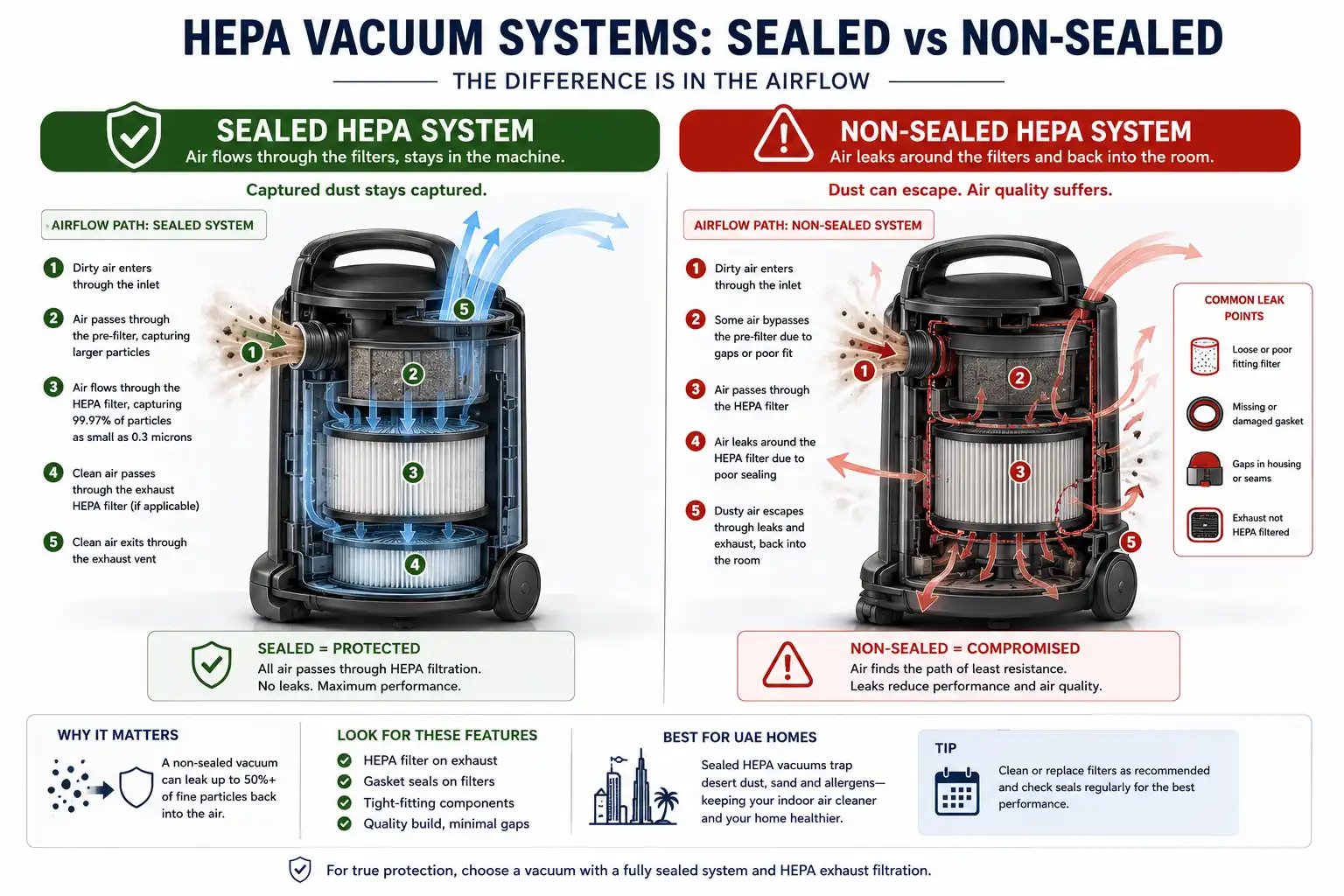
In vacuum cleaners, a HEPA filter is positioned in the exhaust pathway to capture fine particles before air exits the device back into the room. Without effective exhaust filtration, a vacuum collects large debris into its bin while expelling fine dust back into the indoor environment – effectively redistributing the very particles that cause air quality problems.
Sealed vs Non-Sealed Systems
The distinction between sealed and non-sealed HEPA vacuum systems is critical in UAE conditions.
- A sealed system forces all internal airflow through the HEPA filter before exhaust – no bypass routes
- A non-sealed system may include a genuine HEPA filter but allows airflow to bypass it through joins in the housing
In UAE apartments with tile flooring – the dominant floor type in Dubai and Abu Dhabi residential buildings – vacuuming disturbs settled fine dust. Without sealed HEPA exhaust filtration, a portion of this dust becomes airborne again. This explains why some residents report allergy symptoms during vacuuming even with a HEPA-labelled appliance.
Motor pre-filters and post-motor HEPA filters also serve different functions. The pre-filter protects the motor from large debris. The post-motor HEPA filter addresses fine exhaust particulate. High-performing vacuum systems include both stages.
| Vacuum Filtration System | Fine Dust Exhaust Control | Sand Pre-filter | Sealed Airflow | UAE Suitability |
|---|---|---|---|---|
| Sealed True HEPA + pre-filter | High | Yes | Yes | High |
| True HEPA, non-sealed | Moderate | Varies | No | Moderate |
| HEPA-type filter | Low to moderate | Varies | No | Low to moderate |
| Standard foam/mesh filter | Low | Yes | No | Low |
| No filtration | None | Varies | No | Not recommended |
For guidance on selecting vacuums with appropriate filtration for UAE conditions, see the complete guide to HEPA vacuums for UAE homes, the cordless vacuum guide for UAE apartments, and the vacuum cleaner guide for sand and dust.
HEPA Filters in Air Purifiers
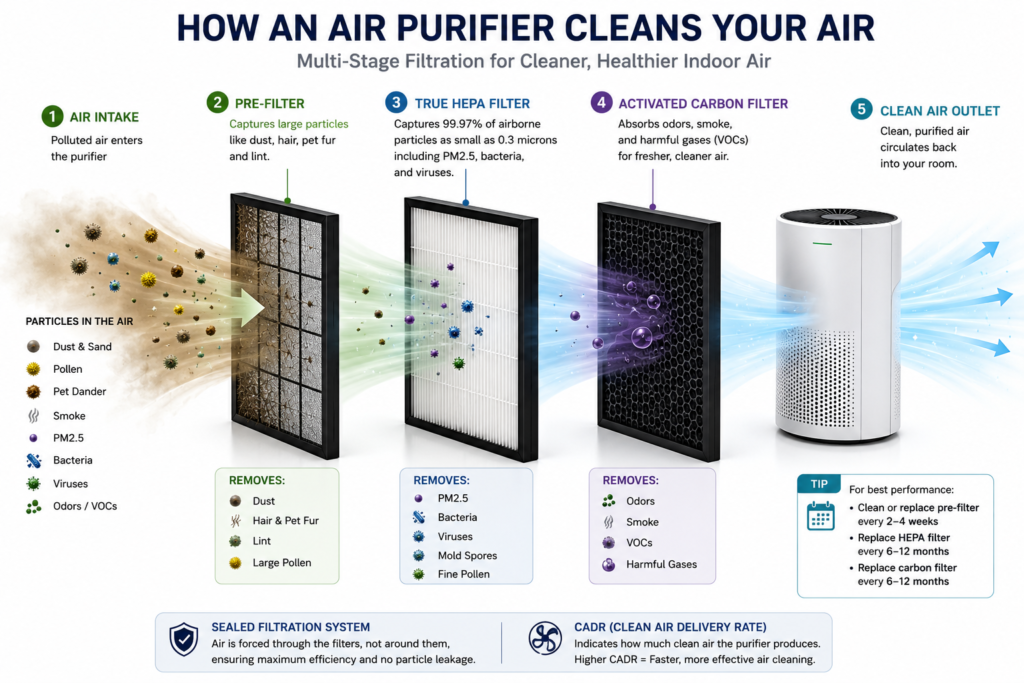
In standalone air purifiers, HEPA filtration is typically one layer within a multi-stage filtration system.
What Is CADR?
CADR (Clean Air Delivery Rate) measures how much filtered air a purifier delivers per unit of time, typically expressed in cubic metres per hour. A device with a higher CADR moves more air through the filter in a given period, translating to more air changes per hour within a room.
For adequate air quality management in a UAE apartment living room of approximately 30-40 square metres, an air purifier generally requires a CADR high enough to achieve 4-5 air changes per hour at a moderate fan setting. Many air purifiers achieve their advertised CADR only at maximum fan speed, where noise output may become unsuitable for bedrooms or continuous overnight use.
Filter Layer Comparison
| Filter Layer | Primary Function | UAE Relevance |
|---|---|---|
| Pre-filter (mesh) | Captures large particles, hair, coarse dust | Extends HEPA filter life in high-dust environments |
| True HEPA layer | Captures fine particles to 0.3 microns at 99.97% | Addresses desert PM2.5 and construction dust |
| Activated carbon layer | Absorbs odours, VOCs, and gaseous pollutants | Addresses traffic VOCs, cooking odours, chemical off-gassing |
| UV-C layer (where present) | Designed to inactivate biological contaminants | Supplementary – effectiveness varies by device design |
Activated carbon should be evaluated alongside HEPA in UAE settings. Desert dust is primarily inorganic particulate, but indoor UAE environments also contain traffic-derived VOCs, building material off-gassing, and cooking emissions that HEPA alone does not address.
For information on selecting air purifiers for UAE conditions, see the detailed air purifier guide explaining CADR sizing for UAE apartments and the indoor air quality overview for UAE residents.
Can HEPA Filters Remove Sand?
Sand particles from UAE deserts vary significantly in size.
- Coarse sand grains visible to the naked eye: 250 microns to over 1,000 microns
- Fine sand fractions: 62 to 250 microns
- Desert dust (the fraction that causes air quality problems): below 10 microns, down to PM2.5 and PM1.0
A True HEPA filter is designed for fine particles and performs at its tested standard for particles at and around 0.3 microns. Coarse sand grains are orders of magnitude larger and would be physically blocked by pre-filters, mesh stages, or basic filtration media long before reaching the HEPA layer.
The Right Tool for Each Problem
Coarse sand management in UAE homes is handled through sweeping, pre-filter stages in vacuums, and entry mat systems at apartment doors. HEPA filtration addresses the fine particulate fraction – specifically PM2.5 and sub-micron particles – that causes respiratory irritation and accumulates invisibly over time.
Multi-stage filtration that combines a coarse pre-filter with a True HEPA layer is the appropriate design for UAE conditions, where both visible sand and invisible fine particulate are present simultaneously.
HEPA Filters and UAE AC Systems
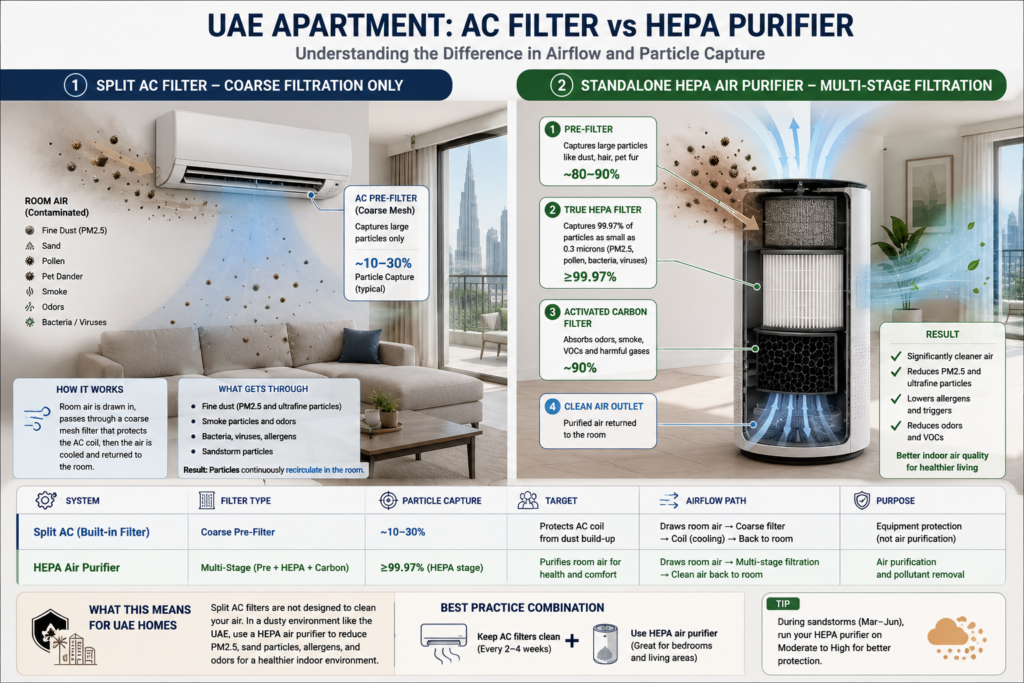
A common question among residents is whether their split AC unit provides HEPA-level filtration. In the vast majority of residential split AC systems installed in apartments and villas across the region, the answer is no.
What Split AC Filters Actually Do
Split AC filters are typically foam mesh, synthetic fibre, or basic electrostatic panels. Their primary design purpose is protecting the internal evaporator coil from large dust accumulation that would restrict airflow and reduce cooling efficiency.
They are not tested or certified to HEPA standards and do not capture fine PM2.5 particles effectively.
Why HEPA Cannot Be Installed in a Split AC
Installing True HEPA media in a residential split AC system is generally not feasible. HEPA media creates significantly higher airflow resistance than standard AC filters. A split AC fan motor is not designed to overcome this resistance – using HEPA media in an AC unit would reduce airflow substantially, impairing cooling performance and potentially stressing the motor.
Ducted Systems and Villas
Ducted AC systems found in UAE villas sometimes allow for higher-grade filtration than split units, due to larger duct cross-sections and more powerful fan assemblies. Some villa systems can accommodate MERV-13 rated filters, which capture fine particles effectively though not to full HEPA standard. Professional assessment is recommended before modifying ducted AC filtration.
For residents seeking HEPA-level air filtration, standalone air purifiers with True HEPA filters are the practical solution. These operate independently of the AC system, allowing proper fine-particle filtration without compromising cooling performance.
HEPA vs MERV: Understanding the Difference
MERV (Minimum Efficiency Reporting Value) is the filtration standard used for HVAC and ducted AC systems. It is a different scale from HEPA and is not directly comparable, but understanding both standards helps residents make the right choice for each application.
| Feature | HEPA | MERV-13 |
|---|---|---|
| Typical use | Portable air purifiers, vacuum cleaners | Ducted HVAC and villa AC systems |
| PM2.5 capture | Very high – 99.97% at 0.3 microns | Moderate to high – approximately 85%+ at 0.3-1 microns |
| Airflow resistance | High – requires a dedicated motor | Lower – compatible with HVAC fan assemblies |
| Split AC compatible | No – motor resistance incompatible | Sometimes – depends on system capacity |
| Gulf climate suitability | Portable devices in apartments and bedrooms | Ducted villa systems where professional assessment confirms compatibility |
HEPA is the appropriate standard for portable devices. MERV-13 is the practical ceiling for most ducted residential systems in the region. Neither is interchangeable with the other.
For guidance on maintaining split AC filters in UAE conditions, see the AC filter cleaning guide for UAE apartments and the guide to how often AC filters should be cleaned in the UAE. For information on fine particulate in apartments, see the fine dust in apartments overview.
Common HEPA Filter Mistakes in UAE Homes
| Mistake | Consequence |
|---|---|
| Never replacing the HEPA filter | Filter becomes saturated; airflow drops; particles bypass blocked media |
| Washing a non-washable HEPA filter | Glass fibre media tears; efficiency falls below certified levels |
| Using an undersized air purifier | Insufficient air changes per hour; PM2.5 levels remain elevated |
| Purchasing HEPA-type products as True HEPA | Actual filtration efficiency significantly lower than expected |
| Poor device placement | Air purifier in a corner recirculates local air; does not clean the room effectively |
| Ignoring pre-filter cleaning | Pre-filter clogs prematurely, blocking airflow to the HEPA stage |
| Ignoring AC maintenance alongside HEPA appliances | AC continues recirculating fine dust that HEPA devices must constantly reprocess |
| Assuming HEPA alone solves all dust problems | Entry points, AC filters, and surface cleaning still require independent management |
Placement deserves particular attention in UAE apartments. An air purifier positioned against a wall in a corner, behind furniture, or inside a closed bedroom while residents occupy the living area will not deliver meaningful air quality improvement to occupied spaces.
Devices perform most effectively when positioned in open areas with unobstructed air intake and exhaust, ideally near the centre of a room or between the main dust source – often a balcony door or AC vent – and the primary seating area.
How Often Should HEPA Filters Be Replaced in the UAE?
Desert conditions accelerate HEPA filter loading compared to manufacturer recommendations, which are typically based on temperate-climate testing in lower-particulate environments.
According to the US Department of Energy HEPA filter specification, filter replacement intervals depend heavily on the volume of airborne particulate in the operating environment. UAE desert conditions place significantly higher demands on filter media than the environments used to set standard replacement guidance.
| Living Situation | Recommended Replacement Frequency | Notes |
|---|---|---|
| Standard UAE apartment, no pets | Every 8-12 months | Check pre-filter monthly during sandstorm season (March-June) |
| UAE villa, multiple rooms | Every 6-10 months | Larger floor area increases total particulate loading |
| Apartment with one or more pets | Every 6-8 months | Pet dander and hair accelerate pre-filter and HEPA saturation |
| Smoker household | Every 4-6 months | Smoke particles and tar load filters significantly faster |
| Coastal apartment (JBR, Marina, Abu Dhabi Corniche) | Every 8-10 months | Humidity-bound dust may load filters unevenly |
| Near active construction | Every 4-6 months | Concrete and gypsum dust loads filters rapidly |
| Sandstorm-heavy area (outer Dubai, Al Ain, Sharjah suburbs) | Every 4-8 months | Inspect after major sandstorm events regardless of schedule |
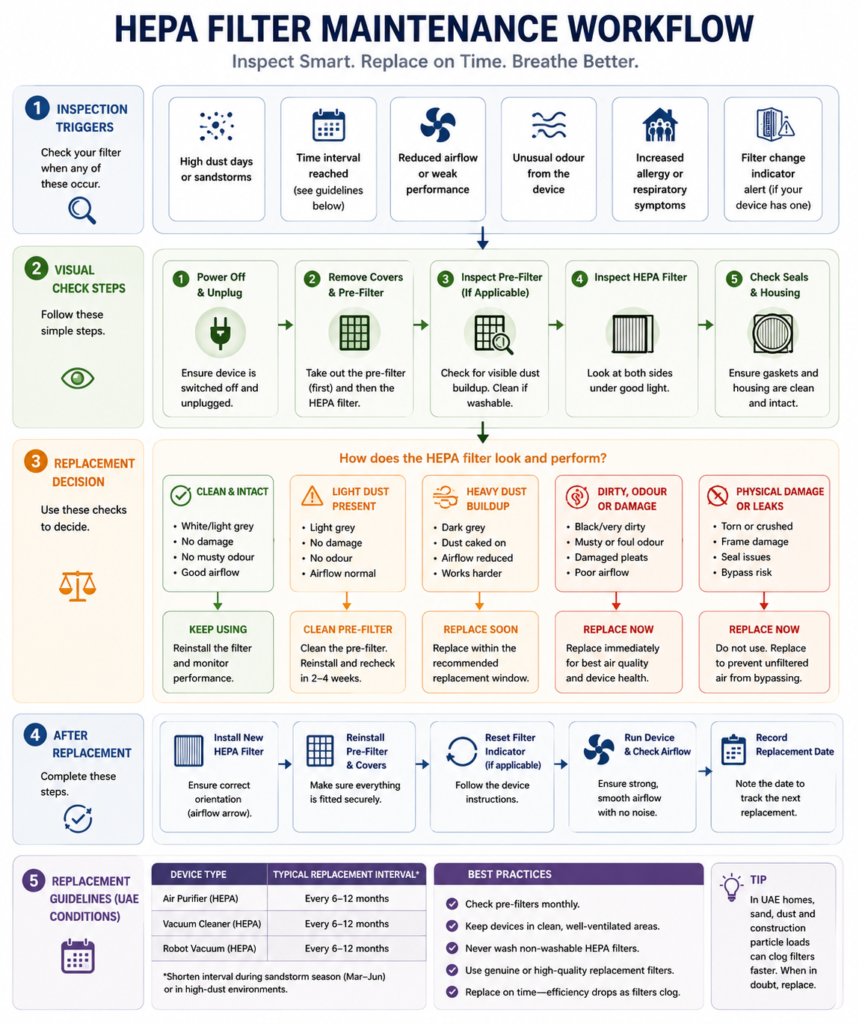
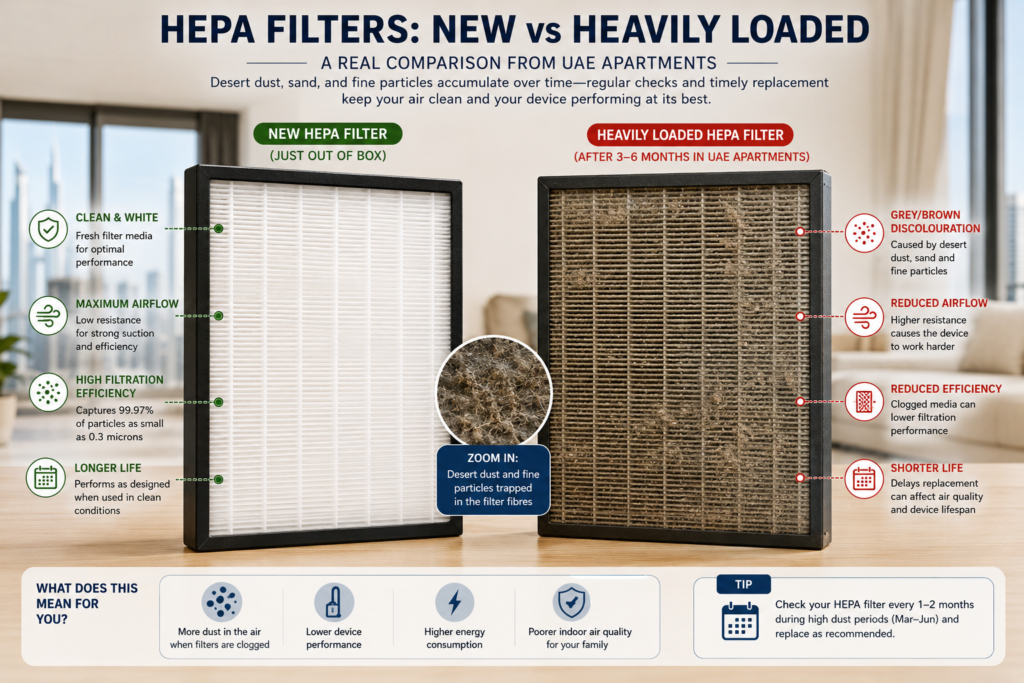
Many modern air purifiers include filter-life indicators based on runtime hours. These indicators are a useful prompt but may not account for UAE-specific particulate loading. Visual inspection – looking for visible discolouration, grey or brown saturation across the filter surface, or persistent odour – provides a more reliable guide than timer-based indicators alone.
HEPA Maintenance Checklist
- Inspect pre-filters monthly – more frequently during sandstorm season (March-June)
- Replace HEPA filters earlier than manufacturer guidance in high-dust or pet households
- Keep air purifier intakes and exhausts fully unobstructed at all times
- Clean split AC filters on a regular schedule – a dirty AC increases the load on standalone HEPA devices
- Check for noticeable airflow reduction or odour during operation as early replacement triggers
- Never wash non-washable HEPA media – replace instead
Signs a HEPA Filter Is No Longer Working Properly
Reduced airflow from the device is one of the earliest indicators. As the filter loads with particles, resistance increases and the volume of air the device can circulate per hour decreases noticeably.
Increased visible dust on surfaces despite regular device use suggests filtration efficiency has declined. If dust accumulation on furniture or tile floors accelerates noticeably, the HEPA filter may no longer be capturing fine particles at its rated efficiency.
Odour retention, where the device begins to emit a musty or dusty smell during operation, indicates the filter medium is saturated. In UAE apartments near kitchens or in humid coastal areas, a saturated HEPA filter can retain moisture and develop microbial activity that produces detectable odour.
Louder device operation than normal during standard fan settings can indicate restricted airflow due to filter loading, causing the motor to work harder to maintain output.
Visible discolouration on the filter surface, where grey or brown dust accumulation covers most of the filter area, is a reliable visual indicator of saturation. A new HEPA filter is typically white or light grey; heavy loading from UAE desert conditions produces progressively darker colouration.
Worsening allergy or respiratory symptoms among household members despite device operation is a commonly reported indicator that the filter is no longer performing adequately. This should be considered alongside the other signs above rather than used in isolation.
Is HEPA Necessary for Every UAE Home?
HEPA filtration provides measurable benefits in UAE conditions but is not equally necessary across all living situations. HEPA may not be necessary in every room, not every household needs premium-grade filtration, and coarse dust problems require cleaning strategies that go beyond filtration.
Standard UAE apartments in high-rise buildings in central Dubai, Abu Dhabi, and Sharjah – where windows remain closed for most of the year and AC systems recirculate indoor air – represent the environment where HEPA filtration offers the clearest practical benefit. Fine particulate has limited pathways to exit the apartment and accumulates over time without active filtration.
Villas with larger floor areas and more ventilation flexibility present a more varied picture. Outdoor-facing rooms near sandy garden areas benefit from HEPA vacuum filtration. Bedrooms, where residents spend extended hours during sleep, represent the highest-priority space for air purifier placement regardless of dwelling type.
Pet-owning households benefit significantly from HEPA filtration across both vacuums and air purifiers. Pet dander particles are irregular in shape and size and are effectively captured by HEPA media in a way that standard filters do not replicate reliably.
Allergy-sensitive residents and those with respiratory conditions commonly associated with dust exposure are the population most likely to notice practical improvement from HEPA filtration, particularly in bedrooms and primary living areas.
Low-dust households – smaller apartments in well-sealed newer buildings with minimal balcony exposure and limited foot traffic – may find the marginal benefit of HEPA over a quality standard filter less pronounced. The decision in these cases often depends on whether allergy sensitivity or pet ownership creates additional filtration requirements.
When HEPA May Be Unnecessary
In low-dust environments with minimal outdoor exposure, good building seals, and no allergy or respiratory concerns among residents, a quality standard filtration system may provide sufficient performance for routine cleaning. Not every room in a home requires a HEPA-equipped device, and not every household needs premium-grade filtration across all appliances. Coarse dust problems – such as tracked sand from a balcony – require cleaning strategies that go beyond filtration, regardless of filter grade.
HEPA is most accurately understood as one component of a broader dust-control approach. Entry mat systems at apartment doors, regular AC filter cleaning, damp-microfiber surface wiping, and balcony door management during dust events each address parts of the particulate challenge that HEPA filtration alone cannot resolve. For broader dust-management guidance, see the complete guide to reducing dust in UAE homes.
Final Verdict
HEPA filters explained accurately reveal a filtration standard with a specific technical meaning that is frequently diluted by marketing terminology across the consumer market in the region.
True HEPA, tested and certified to capture 99.97% of particles at 0.3 microns, offers a meaningful performance difference over standard filters in environments where fine particulate is a persistent concern. In UAE homes, the combination of desert dust, sandstorm seasons, construction activity, AC-recirculated indoor air, and limited natural ventilation during summer months creates conditions where the distinction between True HEPA and HEPA-type products has real practical consequences for indoor air quality.
Filter quality is necessary but not sufficient on its own. Sealed construction, correct device sizing, pre-filter maintenance, and scheduled replacement adjusted for local loading conditions are equally important performance factors.
Understanding what HEPA actually means – rather than accepting marketing claims at face value – is the first step toward making informed decisions about filtration products for apartment and villa living in the region. For most residents, HEPA filtration is most effective when combined with regular AC maintenance, entryway dust control, and consistent cleaning routines.
Frequently Asked Questions
Is HEPA worth it in UAE homes?
For most UAE apartments, particularly those in areas with heavy traffic, construction activity, or high sandstorm exposure, HEPA filtration in vacuums and air purifiers provides measurable improvement over standard filters in capturing fine particulate. Benefit is highest for allergy-sensitive residents and pet owners.
Can HEPA stop sand?
Coarse sand particles are much larger than the particles HEPA is designed to capture and are handled by pre-filter stages before reaching HEPA media. HEPA addresses the fine dust fraction of UAE desert particulate – specifically PM2.5 and particles around 0.3 microns – that standard filters miss.
Are washable HEPA filters real?
Genuine True HEPA filter media is made from glass fibres that cannot be washed without damage to the fibre structure. Products marketed as washable HEPA typically use synthetic foam or mesh that captures large particles but does not meet the 99.97% efficiency standard at 0.3 microns.
Do split ACs use HEPA filters?
Standard residential split AC systems in UAE apartments do not use HEPA filters. The foam or synthetic mesh filters in split AC units are designed to protect the evaporator coil, not to capture fine particulate. HEPA media is incompatible with split AC fan motors due to its high airflow resistance.
How often should HEPA filters be changed in Dubai?
In a standard Dubai apartment without pets, a HEPA filter in an air purifier typically requires replacement every 8-12 months. Near active construction, in pet households, or in areas with heavy sandstorm exposure, replacement every 4-6 months is commonly appropriate. UAE conditions accelerate filter loading compared to manufacturer estimates based on temperate climates.
Does HEPA help with allergies?
HEPA filtration captures airborne allergens including fine dust particles, pet dander, and pollen at high efficiency levels. Many allergy-sensitive residents in UAE apartments report improvement in symptoms when using True HEPA air purifiers in bedrooms and primary living areas, particularly during sandstorm seasons when outdoor particulate infiltration is at its highest.
What is the difference between HEPA and True HEPA?
True HEPA refers to a filter that has been independently tested and certified to capture at least 99.97% of particles at 0.3 microns. Terms such as HEPA-type and HEPA-like indicate filters designed in a similar style but not certified to the 99.97% standard at the MPPS threshold.
Can a HEPA vacuum still leak dust?
Yes. If the vacuum uses a non-sealed design where the internal airflow path allows air to bypass the HEPA filter through housing gaps or joins, fine particles escape through the exhaust. A genuine HEPA filter installed in a non-sealed vacuum will still perform below its rated potential. Sealed HEPA vacuum designs force all exhaust air through the filter medium.
Are HEPA air purifiers effective in UAE apartments?
HEPA air purifiers with adequate CADR for the room size are effective at reducing fine particulate levels in closed UAE apartments. Effectiveness depends on correct device sizing, unobstructed placement in the room, regular pre-filter cleaning, and timely HEPA replacement. A device too small for the room or positioned in a corner provides limited benefit to the overall space.
Does HEPA remove PM2.5?
True HEPA filters capture PM2.5 particles effectively. PM2.5 refers to particles with a diameter of 2.5 microns or smaller – well within the range where HEPA filtration operates through a combination of interception, impaction, and diffusion mechanisms. This is one of the primary reasons HEPA filtration is relevant for UAE indoor air quality, where desert dust and traffic emissions contribute to elevated indoor PM2.5 levels.
Sources
Information in this article draws from established filtration standards including the US Department of Energy HEPA filter specification, which defines the 99.97% at 0.3 microns performance threshold, and the European EN1822 filter classification system covering H13 and H14 grades. UAE ambient air quality context references align with data published by the UAE Ministry of Climate Change and Environment on particulate matter levels and air quality monitoring across UAE cities. General indoor air quality guidance draws from publicly available World Health Organization resources on indoor and outdoor air pollution and fine particulate health effects. UAE-specific AC system maintenance context references guidance published by Saniservice UAE and aligns with general residential AC maintenance information available from UAE-based technical service providers.