Musty Smell From AC in UAE Homes: Causes, Cleaning Steps and When to Get Help
A musty smell from AC is a problem many UAE residents notice, particularly when moisture, dust and frequent cooling combine inside the system. The smell is usually associated with trapped moisture, accumulated dust, possible mould growth or a drainage problem inside the cooling system, rather than a single obvious cause. A brief odour that appears only when the unit first starts can have a different explanation from a smell that continues for as long as the AC is running.

This article outlines the common causes behind a musty smell from AC, which steps residents can reasonably attempt at home, what should be left to a qualified technician, and how to reduce the chances of the smell returning.
Key Takeaways
- A musty AC odour is commonly linked to dust, condensation, a blocked drain or possible mould growth inside the unit.
- A short smell at start-up often differs from an odour that persists throughout operation, though repeated start-up smells should still be monitored.
- Accessible filters and vent grilles can usually be checked by residents, while coils, drain pans, condensate lines, ducts and electrical parts should generally be left to qualified maintenance personnel.
- A burning smell is different from a musty smell and calls for the AC to be switched off and left off until it has been inspected.
- Persistent odours that return after cleaning are a reasonable signal to arrange professional AC maintenance.
What a Musty Smell From AC Usually Means
A musty odour is generally described as damp, stale or earthy, distinct from a sharp chemical smell or an obvious burning smell. It tends to reflect conditions inside the unit rather than a single faulty part. The smell may become more noticeable during humid periods or after the AC has been idle, which can point towards moisture-related conditions rather than a purely mechanical fault. This does not rule out mechanical issues entirely, and residents who notice reduced cooling, unusual noise or visible leaking alongside the smell should treat that as a separate concern requiring closer inspection.
Common Causes of a Musty Smell From AC in UAE Homes
Dirty AC Filter
A dirty AC filter is one of the most likely causes to check first, because restricted airflow can allow moisture to remain inside the system for longer than usual. In UAE homes, fine desert dust entering through doors, windows and balconies can build up on filters more quickly than in less dusty climates, particularly during dusty or windy periods and in homes with frequent outdoor-air entry.
There is no single universal interval for cleaning or replacing an AC filter. The appropriate schedule varies by system and dust exposure, as explained in the guide on how often to clean AC filters in UAE homes. Washable filters are typically rinsed and dried according to the manufacturer’s instructions, while some disposable filters are designed to be replaced rather than cleaned. Checking the filter periodically and comparing its condition against the manufacturer’s recommendations is a reasonable starting point.
Damp Evaporator Coil
The evaporator coil cools naturally by removing heat and moisture from indoor air, which means condensation on the coil is a normal part of how an AC works. Problems arise when dirt, dust or debris on the coil surface trap that moisture rather than allowing it to drain away efficiently. This combination of retained moisture and accumulated residue is commonly associated with a damp or musty odour. Because the coil is an internal component connected to refrigerant lines and electrical parts, it is not something residents are advised to dismantle, chemically treat or clean directly at home.
Blocked or Dirty Condensate Drain
The condensate drain carries water produced during cooling away from the indoor unit. When this drain becomes partially blocked by dust, residue or other debris, water may remain inside the system longer than intended, which is often associated with a stale smell. Signs of a drainage issue include dripping near the indoor unit, visible water marks on walls or ceilings, or a tray that appears frequently full. Because clearing a blocked condensate drain can involve accessing internal components, this task is generally better suited to maintenance personnel with the appropriate tools.
Mould or Microbial Growth
Where dust and moisture remain together for extended periods, conditions can become suitable for mould or other microbial growth on internal AC surfaces. This is one possible explanation for a persistent odour, though not every musty smell indicates active mould, and a smell alone is not sufficient to confirm this without a closer inspection. Visible mould, discolouration around vents, or a smell that does not improve after basic cleaning are reasonable indicators that further investigation may be needed.
Dark marks on a vent grille do not confirm that the entire duct system is contaminated. Surface dust, condensation staining and mould can look similar, so widespread duct cleaning should not be arranged without an inspection confirming it is needed. Broader mould and humidity conditions in UAE homes are covered in the guide to humidity and mould prevention in UAE homes.
Dirty Vents or Grilles
Dust settling on accessible vent covers and grilles can contribute to a stale smell, particularly in homes where dusting is infrequent or where the AC runs for long hours. Wiping the visible grille with a slightly damp microfibre cloth can help with surface dust, but this does not clean the ductwork or internal components behind the grille, which remain out of reach for most residents. Readers dealing with visibly dusty vents may also find the guide on dusty AC vents in UAE homes useful.
Dirty Drain Pan
The drain pan collects condensation before it exits through the condensate drain. If water is retained longer than expected, or if residue or organic buildup develops in the pan, a stale or damp smell can develop. This is closely related to condensate drain issues and is often addressed at the same time during professional servicing.
AC Switched Off for a Long Period
A musty smell from AC may become noticeable after the unit has been idle for an extended period, such as during travel, a vacant apartment or a period of reduced cooling use. Standing moisture and reduced airflow during this time can create conditions that produce a temporary odour once the unit restarts. In some cases, the smell fades after the system has been running briefly. However, a repeated or persistent start-up odour can indicate moisture or residue that requires cleaning or inspection.
High Indoor Humidity
Coastal humidity across much of the UAE means that cooling alone does not always reduce indoor humidity to comfortable levels, especially where doors are opened frequently, wet laundry is dried indoors, bathroom ventilation is limited, the unit is oversized for the room, airflow is restricted, or the AC cycles on and off too quickly to dehumidify effectively.
Persistently humid indoor air can make a damp smell more noticeable and can also support dampness in furniture, curtains and wardrobes near the AC. Determining whether a unit is oversized requires professional assessment rather than judging it from room temperature alone. This overlaps with broader indoor air quality in UAE homes, including ventilation and airflow. Air purifiers and dehumidifiers address different indoor-air problems. The CleanLivingUAE guide to air purifiers versus dehumidifiers in UAE homes explains when each device may be useful.
Odours Entering From Another Source
An AC does not always create the smell it is distributing. Odours from bathroom drains, kitchen activity, cigarette smoke, damp furniture, wardrobes, false ceilings, shared ducting or building corridors can be drawn into the airflow and circulated through the home, making the AC seem like the source. Checking whether the smell is present away from any vent, and whether it changes in intensity near other areas of the home, can help clarify where it is originating.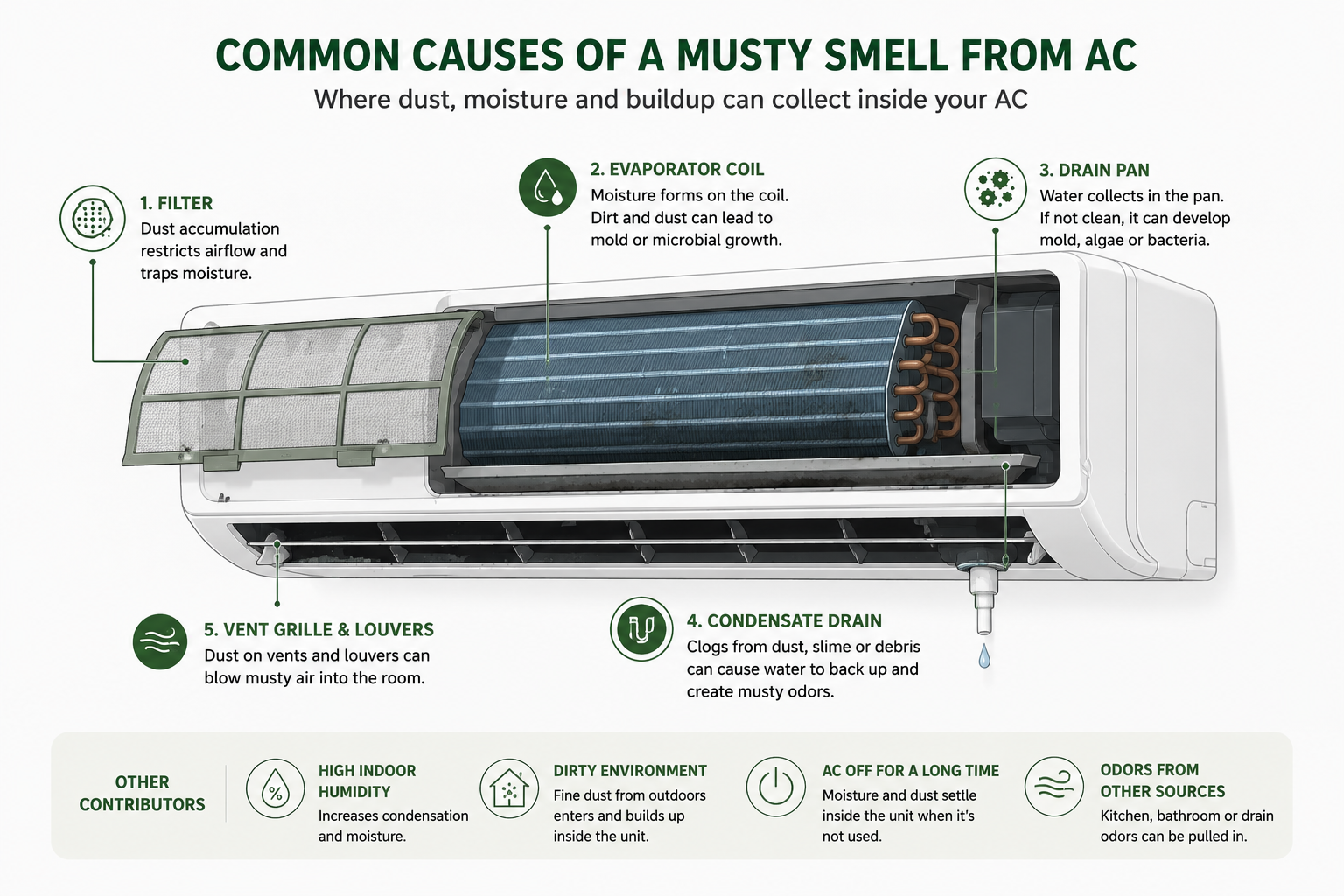
Why the Smell May Be Stronger When the AC First Turns On
A short burst of odour may occur when the AC is first switched on and can be related to condensation or dust that settled inside the unit while it was off, rather than an ongoing problem. If the smell fades within a few minutes and does not return, it may be related to temporary moisture or settled dust. However, repeated start-up odours should still be monitored, since they may indicate residue or moisture building up inside the unit rather than clearing on their own. A smell that persists throughout operation, intensifies over time, or is accompanied by other symptoms such as reduced airflow warrants closer attention.
How to Identify Where the Smell Is Coming From
- Check whether the smell is present only near AC vents or throughout the room generally.
- Compare the smell with the AC switched off completely for a short period.
- Check whether only one room or vent is affected, or whether the smell appears throughout the home.
- Look for any visible moisture, staining or water marks near the indoor unit.
- Rule out nearby sources such as bathrooms, kitchens, wardrobes or damp furniture.
Safe Cleaning Steps UAE Residents Can Try
The following steps apply only where the filter and grille are designed for safe resident access. Follow the manufacturer instructions and building guidance for the specific system, particularly for ceiling fan coil units and centrally managed apartment systems. These steps are not a substitute for professional servicing and are limited to accessible filters, grilles and surrounding surfaces.
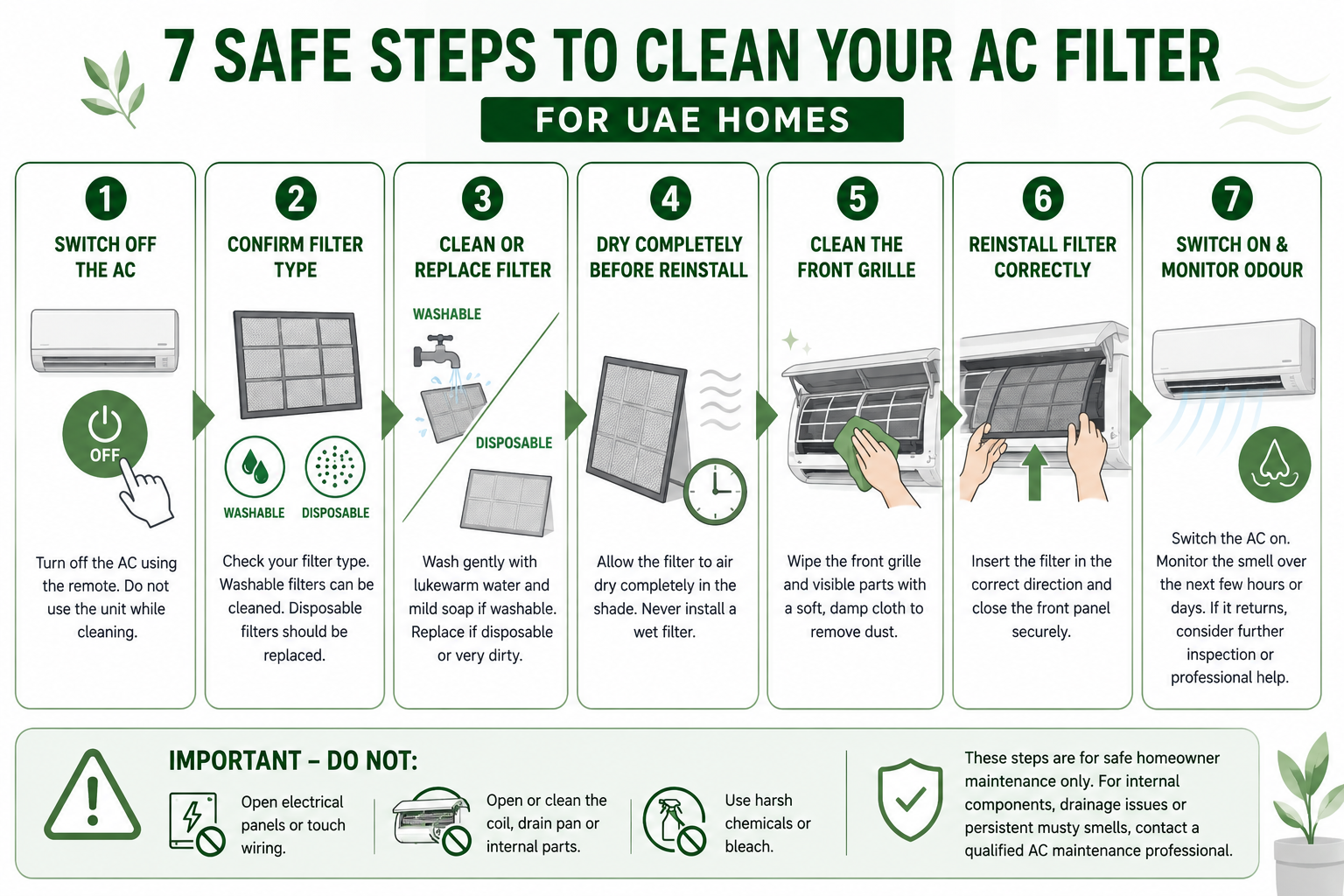
- Switch the AC off completely and allow the unit to sit for a few minutes before starting.
- Check whether the smell is stronger near the vent, the filter area, or the room in general.
- Remove the filter only if manufacturer instructions allow resident access, and confirm whether it is washable or disposable.
- Clean a reusable filter according to the manufacturer’s instructions, or replace a disposable filter with the correct type.
- Allow a washable filter to dry completely before reinstalling it, since a damp filter can reintroduce moisture-related odours.
- Wipe accessible vent grilles with a slightly damp microfibre cloth and vacuum loose dust from the outer surface and surrounding area, without pushing the vacuum nozzle, brush or other tools into the duct or internal AC opening.
- Check and monitor: Look for visible water leakage or staining. Use bathroom and kitchen extraction fans where humidity may be contributing, then monitor whether the smell returns over the following days.
What Not to Clean or Dismantle Yourself
Certain components and actions are best left to qualified professionals due to the risk of damage, incomplete cleaning, or safety concerns:
- Do not spray perfume or air freshener directly into AC vents, as this masks rather than resolves the underlying cause.
- Do not pour bleach or any chemical directly into the AC unit or drainage system.
- Do not mix cleaning chemicals of any kind near the unit.
- Do not open electrical panels or access electrical components.
- Do not attempt to remove or clean the evaporator coil.
- Do not open refrigerant lines under any circumstance.
- Do not attempt to deep-clean ductwork without appropriate equipment.
- Do not use an unverified chemical fogging treatment inside the home.
Filters must be allowed to dry completely before reinstallation, since reinstalling a damp filter can reintroduce the same moisture-related conditions that contribute to musty odours.
Comparison Table: Smell or Symptom and Recommended Action
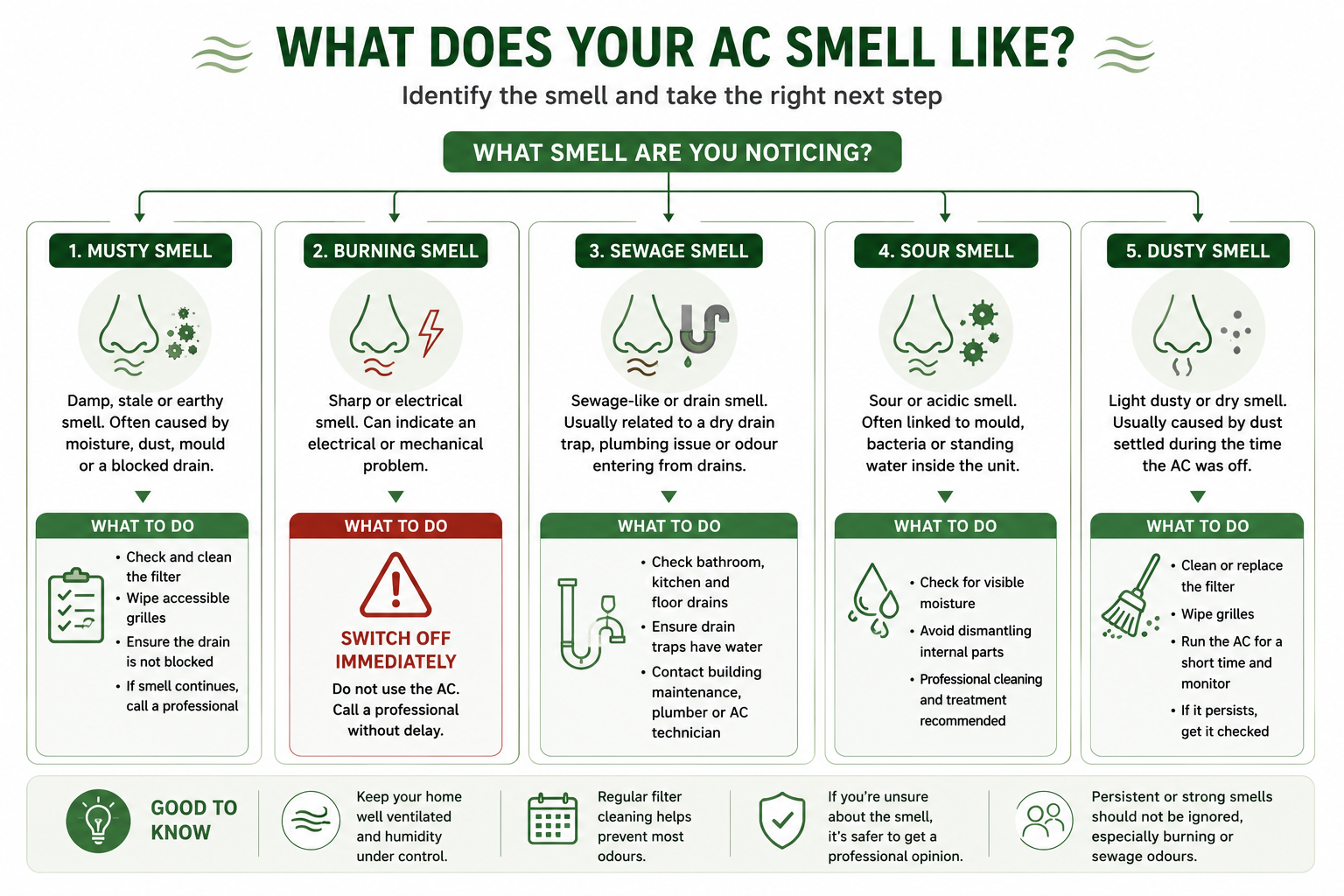
| Smell or Symptom | Possible Cause | Safe Homeowner Action | Professional Help Needed? |
|---|---|---|---|
| Mild dusty smell when first switched on | Dust or condensation settled during idle period | Monitor briefly. Switch it off and arrange inspection if the smell persists, worsens or appears with leaking, weak airflow or unusual noise. | Not usually for a brief one-off dusty smell, but arrange inspection if it repeats or persists. |
| Persistent musty smell throughout operation | Dirty filter, damp coil or blocked drain | Clean or check the filter and wipe accessible grilles. | Often, if the smell continues after cleaning. |
| Sour or damp smell | Possible microbial growth or standing water | Check for visible moisture and avoid dismantling internal parts. | Yes, for inspection and treatment. |
| Sewage-like smell | Dry drain trap, plumbing issue, condensate drain or odour entering through shared spaces | Check whether the smell is stronger near bathroom, kitchen or floor drains. | Contact building maintenance, a plumber or an AC technician depending on the source. |
| Burning smell | Possible electrical or mechanical issue | Switch the AC off immediately. | Yes, without delay. |
| Smell with visible water leaking | Blocked condensate drain or drain pan issue | Switch off the unit and use absorbent towels only where this avoids contact with the unit, wiring or electrical fittings. | Yes, promptly. |
| Smell from one vent only | Localised dust, blockage or duct issue | Check and clean that specific grille if accessible. | Often, if the smell does not resolve. |
| Smell throughout the home | Central system issue or humidity-related cause | Check filters and ventilation across rooms. | Often, particularly for shared or central systems. |
A burning smell is different from a musty smell and should always be treated as a priority. If a burning smell is noticed, switch the AC off using its normal control and do not restart it. Contact building maintenance or a qualified technician promptly. Do not open electrical panels or attempt to inspect wiring.
When to Call an AC Maintenance Professional
The following situations are reasonable indicators that a qualified AC maintenance professional should be contacted, rather than continuing with home cleaning attempts:
- The odour persists after filter and grille cleaning have been carried out.
- Mould is visible inside the unit or around the vents.
- Water is leaking from the AC.
- The condensate drain appears blocked.
- Cooling performance has noticeably reduced.
- Airflow feels weaker than usual.
- The circuit breaker trips repeatedly.
- A burning or electrical smell is present.
- Unusual noise is coming from the indoor unit.
- Symptoms began shortly after recent maintenance work.
- The smell returns quickly after cleaning.
- The smell is present across several vents or rooms rather than one localised area.
- The fan coil, coil, blower or duct components are not accessible for inspection.
Persistent damp or mouldy odours should not be ignored, particularly where there is visible moisture, suspected mould or ongoing respiratory discomfort. A musty smell from AC does not necessarily mean the air is unsafe, and this article does not diagnose health conditions. Readers experiencing ongoing symptoms are encouraged to seek advice from a qualified medical professional rather than relying on cleaning steps alone.
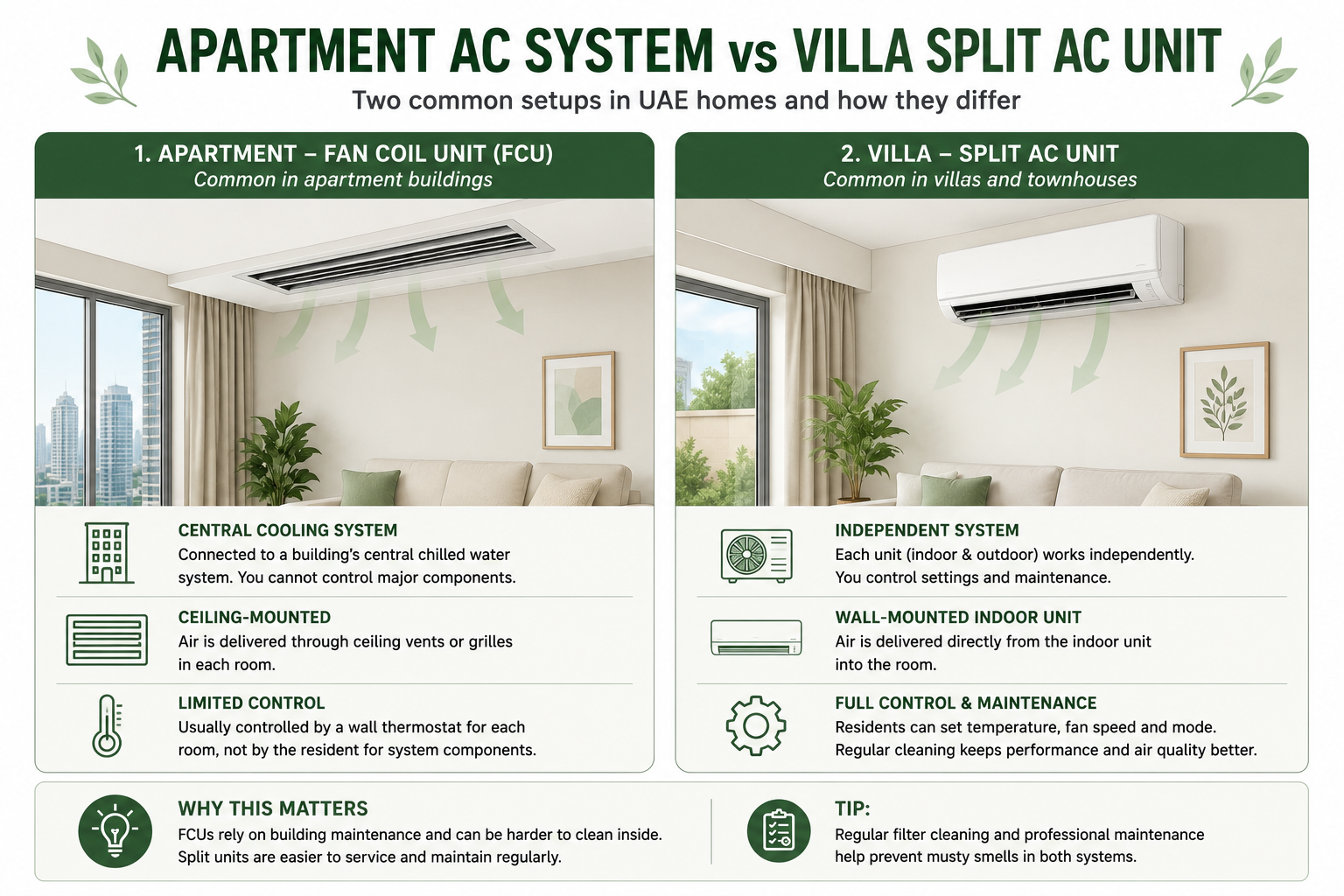
Apartment AC Systems Versus Villa Split AC Units
Apartments
Many UAE apartments, particularly in larger residential towers, use central chilled-water systems with fan coil units rather than individual split units. These systems often involve shared ducting and condensation drains connected to building-wide plumbing. Access to these components is often controlled by building management or facilities teams. Residents may therefore need to report persistent odours before arranging independent work.
Tenants should check their tenancy agreement or building rules before arranging invasive AC work. In some buildings, fan coil units, shared ducts and condensate drainage may be maintained by the landlord, facilities-management team or district-cooling provider, though this varies by building and community and should not be assumed without checking the relevant agreement.
Villas
Villas and smaller homes in the UAE commonly use split AC units, with one or more indoor units connected to an outdoor condenser. Maintenance responsibility in this setup typically rests with the homeowner or tenant rather than shared building management. Because each indoor unit operates somewhat independently, it is possible for an odour to affect one room while other rooms with separate units remain unaffected, which can help narrow down where the underlying issue is located.
Not all UAE buildings use the same AC configuration, and the specific setup, along with who is responsible for maintenance, can vary by building, community and tenancy agreement.
Musty Smell, Burning Smell or Sewage Smell: What Is the Difference?
A musty smell is generally described as damp, stale or earthy, and is most often linked to moisture and dust conditions inside the unit. A burning smell is sharper and often associated with electrical or mechanical issues, and calls for the AC to be switched off immediately rather than investigated further while running. A sewage-like smell is more often related to a nearby drain or plumbing issue than the AC itself, though the AC may circulate it through the home. Distinguishing between these smell types can help residents decide how urgently to respond and whether the issue is likely to involve the AC directly or another part of the home.
How to Prevent a Musty AC Smell From Returning
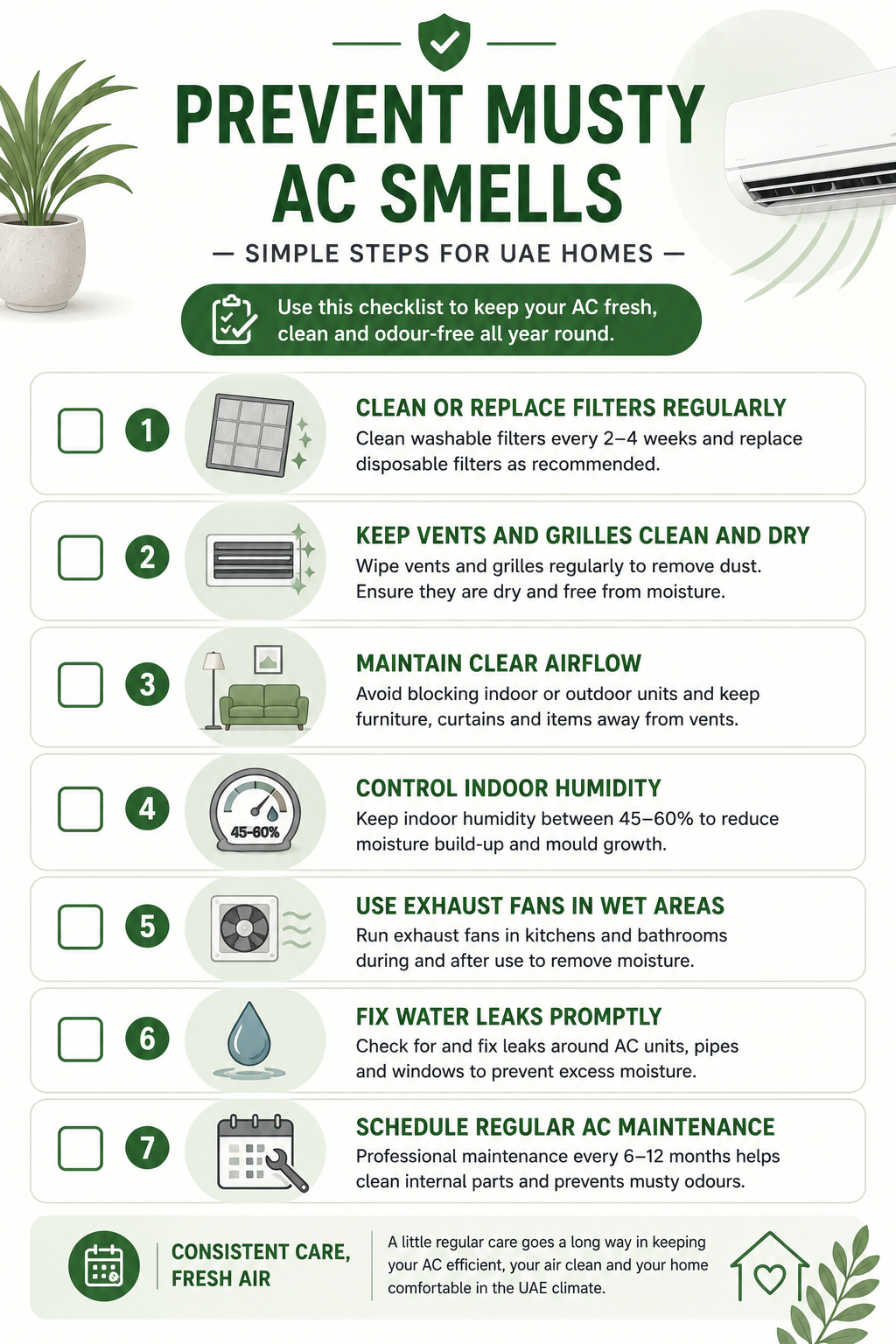
- Check filters on a regular schedule appropriate to the specific unit and dust exposure.
- Replace filters that are damaged, discoloured or beyond effective cleaning.
- Keep supply and return vents unobstructed by furniture or curtains.
- Monitor and manage indoor humidity where practical.
- Use bathroom exhaust fans during and after showers.
- Avoid drying large amounts of laundry in closed, poorly ventilated rooms.
- Address any visible leaks or water marks promptly.
- Clean dusty vent surfaces as part of a regular cleaning routine.
- Arrange periodic professional AC servicing appropriate to the system type.
- Fine desert dust can enter through balconies, windows and entrances, particularly during windy conditions. The guide to fine dust in UAE apartments explains where this dust tends to settle and how to manage it, alongside general dust prevention tips for UAE homes.
- Avoid overcooling rooms beyond what is needed for comfort.
- Air out rooms when outdoor air quality and temperature are suitable for doing so.
- Check wardrobes, curtains and upholstered furniture for separate sources of damp odour unrelated to the AC.
Tools That May Help With Routine Prevention
Some product mentions may include affiliate links.
Items that may support the steps above include replacement AC filters suited to the specific unit model, microfibre cloths for wiping accessible surfaces, and a hygrometer for monitoring indoor humidity. A dehumidifier may help in rooms with persistent humidity issues. A HEPA air purifier may support general particulate filtration, but it will not clean an AC coil, drain or internal source of odour. If minor surface water appears near the unit, switch the AC off and use absorbent towels only where this can be done without touching the unit, wiring or electrical fittings, then arrange maintenance promptly. Product compatibility and availability should be verified with the manufacturer or retailer before purchase.
Final Checklist
- Identify whether the smell is brief at start-up or continuous during operation.
- Check and clean an accessible filter according to manufacturer instructions.
- Allow a washable filter to dry fully before reinstalling.
- Wipe accessible vent grilles and vacuum surrounding surface dust without inserting tools into the duct.
- Check for any visible leaking, staining or standing water.
- Rule out nearby odour sources such as bathrooms, kitchens or damp furniture.
- Monitor indoor humidity and use exhaust fans where relevant.
- Contact a qualified AC professional if the smell persists, returns quickly, or is accompanied by leaking, reduced cooling, unusual noise or a burning smell.
Final Thoughts
A musty smell from AC should not automatically be assumed to be mould, but it should not be ignored when it persists or returns repeatedly. Checking an accessible filter, cleaning external grilles and looking for visible moisture can help identify simple causes, while internal coils, drain pans, condensate lines, electrical parts and ductwork are best left to qualified maintenance personnel. Controlling indoor humidity and reducing the amount of fine dust entering the home may also help prevent the odour from returning.
Frequently Asked Questions
Why does my AC smell musty when I first turn it on?
A brief musty smell at start-up is commonly linked to condensation or dust that settled inside the unit while it was switched off. This often fades once the unit has been running for a few minutes, though it is worth monitoring if it keeps happening.
Can a dirty AC filter cause a musty smell?
Yes, a dirty filter can restrict airflow and allow moisture to linger inside the unit, which is commonly associated with musty odours. Cleaning or replacing the filter according to manufacturer guidance often helps.
Does a musty AC smell always mean mould?
Not necessarily. A musty smell can result from moisture, dust or a drainage issue without confirmed mould growth. Visible mould or a smell that persists after basic cleaning warrants closer inspection.
Can an air purifier remove an AC smell?
An air purifier with a HEPA filter may help with general indoor air quality, but it does not address the underlying cause of a smell coming from inside the AC unit itself.
Can a dehumidifier help with a musty AC smell?
A dehumidifier may help reduce indoor humidity that contributes to musty conditions, but it does not resolve issues located inside the AC, such as a blocked drain or damp coil.
Is it safe to spray air freshener into an AC vent?
This is not recommended, as it masks the smell rather than addressing the underlying cause and may not be safe for the unit’s internal components.
How often should AC filters be cleaned in the UAE?
There is no single universal interval. Frequency depends on the filter type, the specific unit, local dust exposure, presence of pets, and manufacturer guidance.
Why does only one AC vent smell?
A smell limited to one vent may point to localised dust, a blockage, or a duct-related issue specific to that area, rather than a system-wide problem.
Can a blocked AC drain cause a bad smell?
Yes, a blocked or slow condensate drain can allow water to sit longer than intended, which is commonly associated with a stale or musty odour.
When should an AC technician inspect the unit?
A technician should be contacted if the musty smell from AC persists after basic cleaning, if there is visible mould or leaking, if cooling or airflow has reduced, or if a burning smell, unusual noise or repeated breaker trips occur.
Sources
- Trane – guidance on common AC odours and possible causes: trane.com
- Bryant – air-conditioner smell troubleshooting guidance: bryant.com
- This Old House – overview of musty AC smells: thisoldhouse.com
- Daikin Middle East and Africa – UAE indoor-air-quality guidance: daikinmea.com
These sources informed general background on AC odour causes and UAE indoor air quality considerations. Not every UAE-specific statement in this article is drawn directly from these sources; some UAE-specific guidance is based on established HVAC principles considered in the context of common local housing and climate conditions.