Why Humidity Builds Up in UAE Homes
The UAE sits along the Arabian Gulf and Gulf of Oman coastlines, making ambient outdoor humidity consistently higher than many residents assume. During summer months, outdoor relative humidity can exceed 90% in the early morning hours along coastal areas, according to UAE National Centre of Meteorology data.
Sealed Buildings and Limited Ventilation
Modern UAE residential buildings are designed for thermal efficiency. Windows remain closed for most of the year due to extreme heat, creating sealed indoor environments where cooking, showering, breathing, and laundry drying moisture has limited opportunity to escape. In high-rise apartments, natural cross-ventilation is often structurally unavailable.
Constant AC Operation
AC systems that are not properly maintained can both redistribute humidity and contribute to it. When units cool warm humid air, condensation forms on the evaporator coil. A blocked drainage line or overcooled thermostat causes this moisture to accumulate inside the unit rather than draining correctly – creating conditions for mold growth within the AC system itself.
Temperature Differential and Condensation
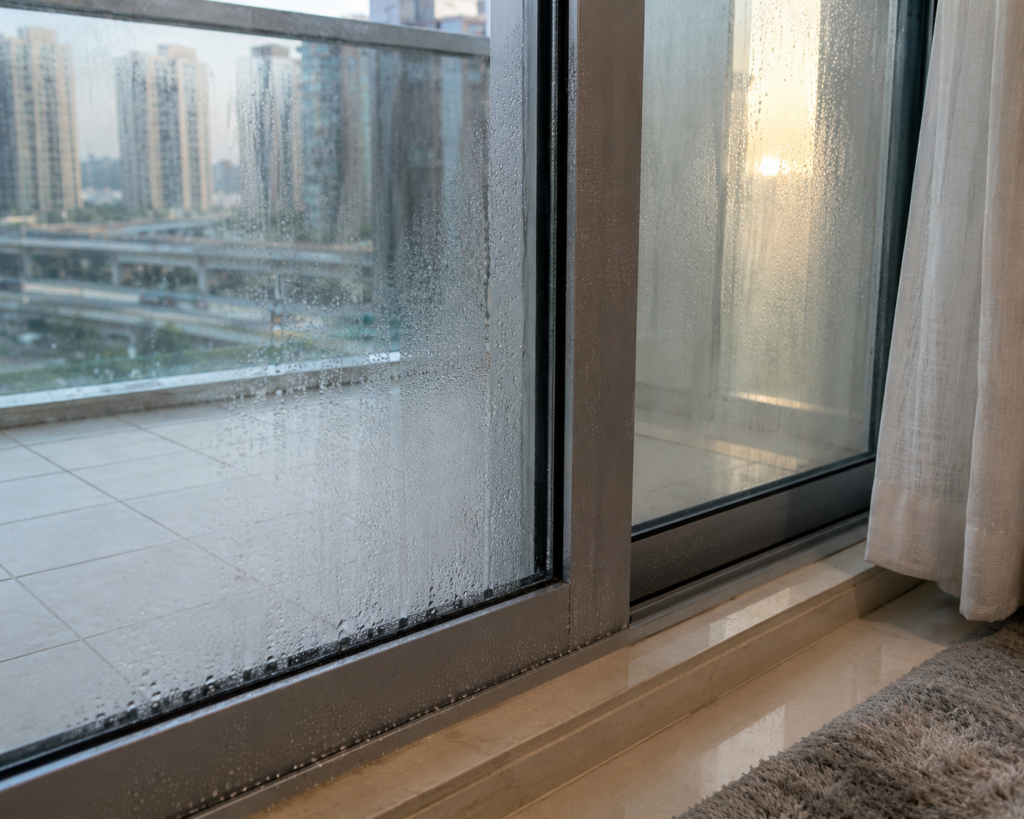
During peak summer months, the gap between outdoor air above 40°C and indoor surfaces cooled to 22-24°C by AC produces condensation on windows, exterior-facing walls, and poorly insulated areas. This temperature differential is a primary driver of window frame and wall condensation in UAE apartments. Balcony door frames are a common first location where residents notice this effect.
A damp smell near an AC vent does not automatically confirm mould, but repeated odours can indicate retained moisture, a dirty filter or a drainage problem. The guide to musty AC smells in UAE homes explains how to narrow down the source.
Apartment vs. Villa Differences
Apartments develop more concentrated humidity problems due to smaller floor areas, limited exterior walls, and strata-managed AC schedules that residents cannot always control. Villas offer more ventilation options and greater maintenance control – but larger floor areas create more potential mold zones if moisture is not actively managed.
Ideal Indoor Humidity Levels for UAE Homes
| Humidity Level | Indoor Comfort | Mold Risk | Recommendation |
|---|---|---|---|
| Below 30% | Dry and irritating to airways | Very low | Unusual in UAE coastal zones |
| 30% – 40% | Slightly dry | Low | Acceptable in UAE interior areas during winter |
| 40% – 60% | Comfortable | Low to moderate | Target range for UAE homes year-round |
| 60% – 70% | Noticeably humid | Moderate to high | Improve ventilation immediately |
| Above 70% | Uncomfortable and sticky | High | Mold growth becomes more likely if humidity stays high |
In UAE coastal homes during summer, targeting the lower end of this range (40% to 50%) is more protective. Outdoor humidity spikes can drive indoor levels upward quickly when ventilation or AC maintenance is neglected. The World Health Organization recommends maintaining indoor relative humidity below 65% to limit mold and dust mite growth.
Recommended Humidity by Room Type
| Room | Target Humidity Range | Key Risk If Exceeded |
|---|---|---|
| Bedroom | 40% – 50% | Mattress moisture and wardrobe condensation |
| Bathroom | Below 60% | Grout mold, ceiling mold, and silicone deterioration |
| Wardrobe | 40% – 50% | Fabric mold and back-panel condensation |
| Living room | 40% – 55% | Wall condensation behind furniture |
| Kitchen | Below 55% | Cabinet undersides, grout, and ceiling moisture |
| Laundry area | Below 55% | Ceiling mold, wall corners, and drain overflow |
Typical UAE Home Humidity Readings by Season
Based on commonly observed indoor conditions in UAE apartments and villas, the following ranges are typical when no active moisture intervention is in place.
| Condition | Typical Observed Indoor Humidity |
|---|---|
| Summer coastal apartment with no active control | 60% – 75% |
| Winter apartment with windows opened daily | 40% – 55% |
| Bathroom immediately after a shower | 70% – 90% |
| Bedroom with AC running overnight | 45% – 60% |
| Laundry drying room with no fan | 65% – 80% |
| Wardrobe on exterior wall in summer | 55% – 70% |
These ranges illustrate why consistent ventilation and AC maintenance matter in UAE homes. A bathroom at 80% relative humidity for extended periods after each shower creates conditions where mold can begin developing on grout and ceiling surfaces within days.
How Mold Develops in UAE Apartments and Villas
Mold requires three conditions to grow: moisture, a surface to colonize, and warmth. All three are consistently present in UAE homes during summer months. Mold commonly appears:
- On bathroom ceiling corners and grout lines
- Inside wardrobes and on the back panels of cabinets placed against exterior walls
- Around AC vent surrounds and filter housings
- Behind washing machines and under kitchen sinks
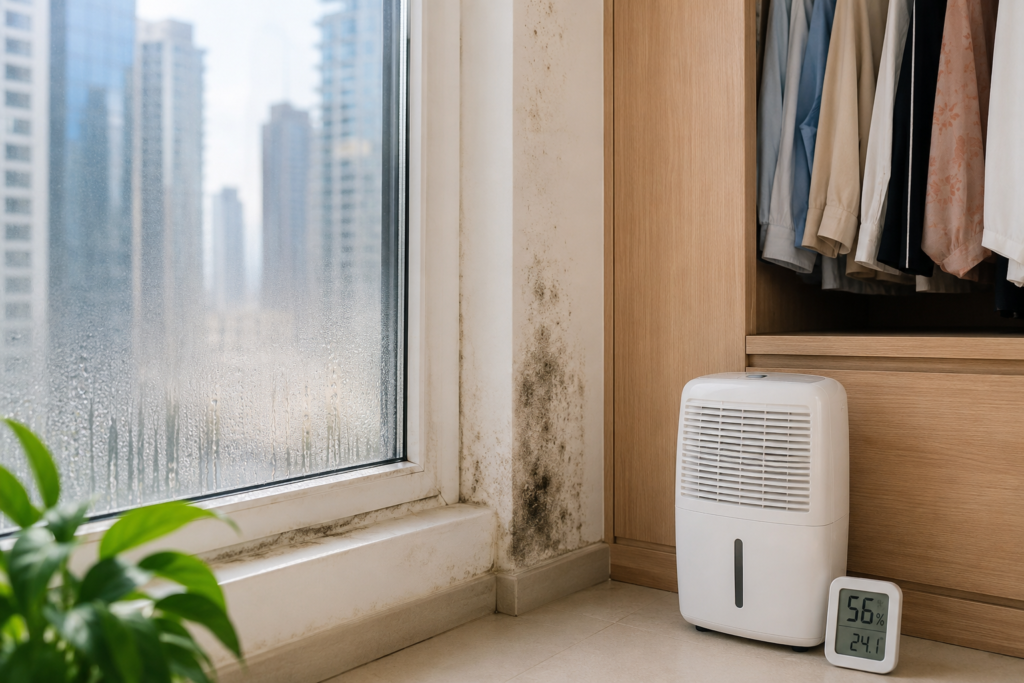
- On balcony door frames, window seals, and rubber gaskets
- In shoe cabinets and storage areas with poor airflow
The fine dust common across all UAE emirates can settle on surfaces and retain moisture, creating a substrate that supports mold colonization even in areas that appear visually clean.
Note: Recurring or widespread mold affecting structural surfaces, soft furnishings, or areas larger than approximately 1 square meter should be assessed by a qualified professional. Self-cleaning is appropriate for surface-level mold on hard, non-porous materials only.
Common Signs of a Humidity Problem
- Condensation on windows or mirrors that does not clear within 30 minutes of AC running
- A persistent musty or earthy odor in rooms, wardrobes, or storage areas
- Visible dark spots on walls, ceilings, grouting, or silicone seals
- Warping or swelling of wooden furniture, doors, or skirting boards
- Allergy-like symptoms such as persistent sneezing or congestion that improve when outside
- White powdery deposits (efflorescence) on tiles or walls near balcony doors
- Peeling paint or wallpaper, particularly on exterior-facing walls
Most Common Mold Areas in UAE Homes
Bathrooms
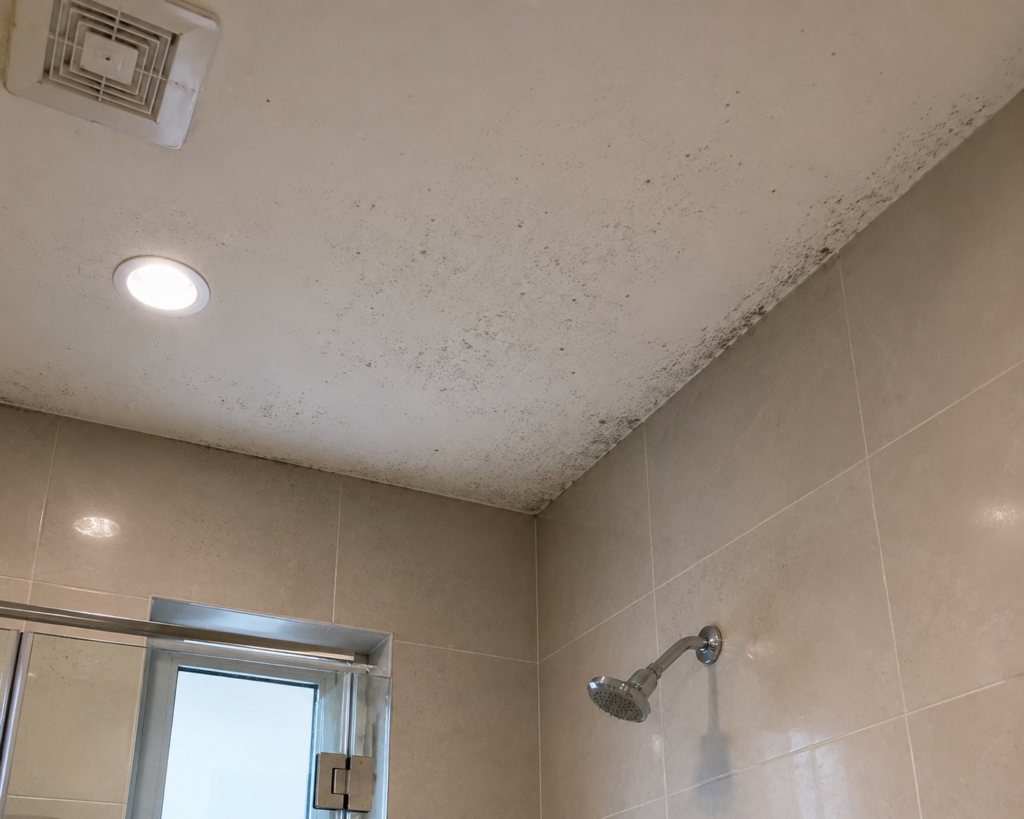
Hot showers generate rapid steam in compact spaces. Grout lines, ceiling corners, behind toilets, under-sink cabinets, and silicone sealing around shower trays are the most common initiation points. In UAE bathrooms without mechanical extraction, steam settles on every surface. Bathroom ceiling spots that appear or grow after summer months are commonly reported in UAE coastal apartments.
Wardrobes
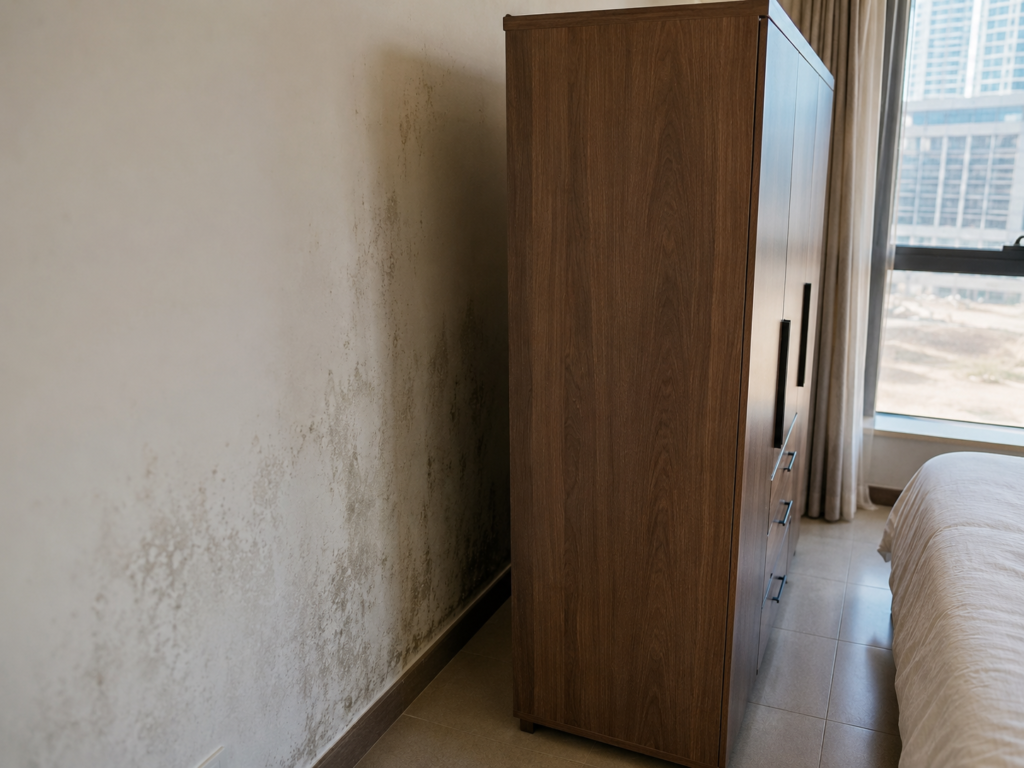
Wardrobes positioned against exterior-facing walls stay cooler than room air, creating condensation on the wall surface behind them. Over time, moisture transfers to clothing and the wardrobe’s back panel – promoting mold in the corner joints. A persistent musty smell from clothing after returning from a summer holiday away from home is often the first sign residents notice.
Behind Furniture
Sofas, beds, and shelving units placed directly against exterior walls trap a dead-air zone where condensation forms on the wall surface. This is among the most frequently overlooked mold locations in UAE apartments – and typically discovered only when furniture is moved.
AC Vents and Units
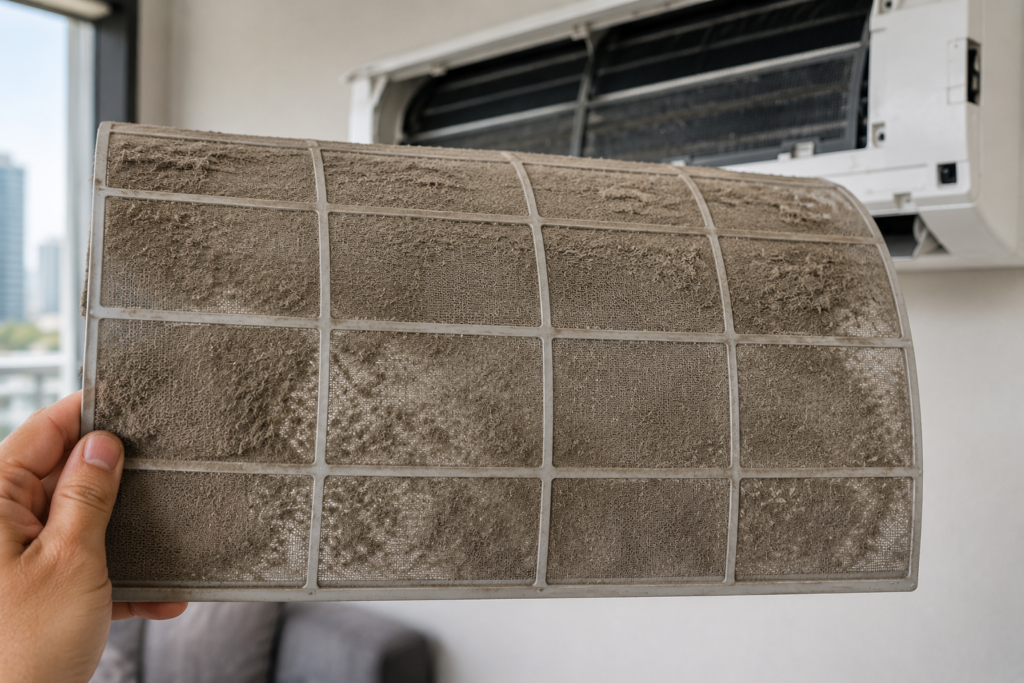
Blocked AC drainage allows condensation to accumulate inside the unit. Mold developing on the evaporator coil or internal housing then distributes spores through the room every time the unit operates. A musty smell on startup is the most common observable indicator.
Kitchens
Enclosed UAE apartment kitchens with underpowered or absent extractor fans accumulate cooking steam on walls, cabinet undersides, and ceiling areas. Hard water deposits from UAE tap water create porous surface irregularities on tiles and grout where mold can establish more easily.
Moisture around a refrigerator door seal can contribute to residue and unpleasant smells, although the odour source is often food or a hidden spill. See the guide to checking hidden fridge smell sources for appliance-specific steps.
Laundry Areas
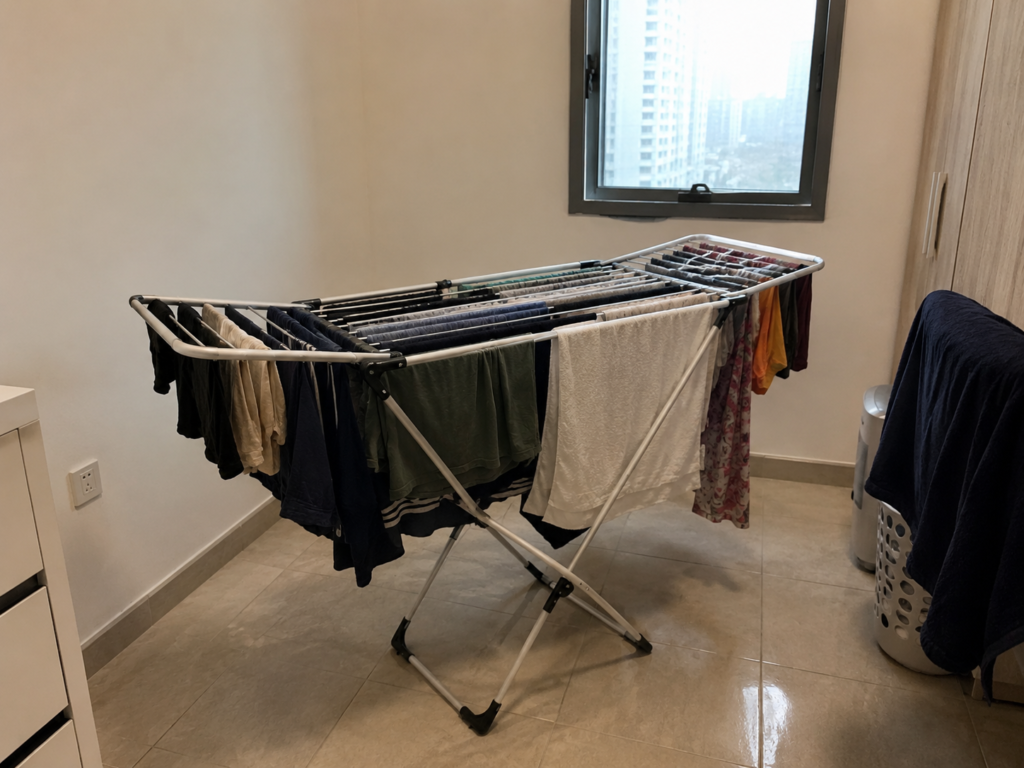
Indoor laundry drying raises local humidity significantly. Without mechanical ventilation, laundry rooms and bathrooms used for drying develop mold in wall corners and on ceilings above drying racks.
Window Frames
Condensation collects in the track channels of sliding windows overnight, particularly on lower floors and in coastal buildings. Hard water mineral deposits mixed with moisture create persistent mold conditions even with regular surface cleaning.
11 Practical Ways for Humidity and Mold Prevention UAE Homes
Some product mentions may include affiliate links.
1. Improve Bathroom Ventilation
Run a bathroom exhaust fan for at least 20 to 30 minutes after each shower. If the existing fan is underpowered, installing a higher-capacity extraction unit makes a measurable difference. In UAE winter months, opening a bathroom window partially during and after showering is the most effective low-cost intervention.
2. Clean AC Filters Regularly
Clogged AC filters reduce airflow across the evaporator coil, causing the coil to drop below its designed temperature and increasing condensation. In UAE homes, filters commonly require cleaning every two to four weeks during summer. For step-by-step procedures, the AC Filter Cleaning Guide UAE covers filter removal, washing, and reinstallation for split units.
3. Maintain Airflow Behind Furniture
Move sofas, beds, wardrobes, and shelving at least 5 to 10 centimetres away from exterior walls. This eliminates the cold dead-air zone where condensation forms. In UAE apartments where space is limited, even a small gap reduces wall moisture accumulation.
4. Avoid Drying Laundry Indoors Without Ventilation
When indoor drying is unavoidable, run the bathroom exhaust fan or a portable fan in the same room. Drying laundry in a room with a window slightly open during cooler months limits the humidity impact considerably compared to drying in a sealed bedroom.
5. Use Exhaust Fans Consistently
Kitchen extractors and bathroom exhaust fans are most effective when run during all cooking and showering – not only when visible steam is produced. Consistent use removes moisture before it settles on surfaces.
6. Wipe Condensation Immediately
Condensation on windows, cold pipes, and AC unit housings should be wiped dry as soon as noticed. In UAE summer humidity conditions, standing water on any surface is sufficient to initiate mold growth within 24 to 48 hours. Keeping a microfiber cloth near known condensation zones – balcony door frames, window sills, and AC unit bases – makes this a quick daily habit.
7. Reduce Clutter in Humid Spaces
Items packed tightly into bathrooms, under-sink cabinets, and wardrobes restrict airflow and create moisture traps. Reducing stored items in high-humidity zones improves air circulation and reduces the number of surfaces where mold can establish.
8. Keep Wardrobes Ventilated
Leaving wardrobe doors slightly ajar or using louvred wardrobe doors allows air movement inside and prevents moisture from accumulating on the back wall. Humidity-absorbing sachets inside wardrobes are a low-effort supplementary measure, particularly useful in lower-floor bedrooms and villa basement storage.
9. Monitor Indoor Humidity Levels
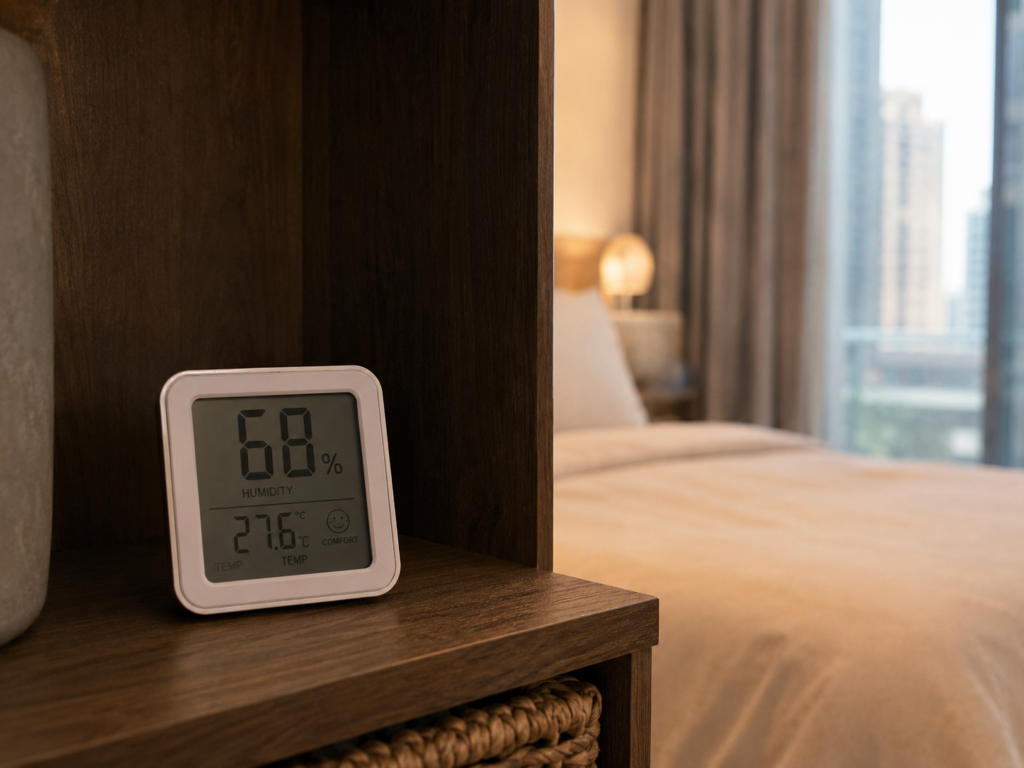
A basic digital hygrometer placed in the bedroom and living area provides consistent readings for identifying rising moisture before mold develops. Readings above 60% on a sustained basis indicate that ventilation or AC maintenance action is required. Hygrometers are widely available at UAE hardware retailers and through Amazon.ae.
10. Control Bathroom Moisture After Showers
Wiping down shower walls and glass with a squeegee after each use removes standing water before it evaporates into the room. Hanging towels flat rather than in a pile accelerates drying. Inspecting and resealing shower tray silicone annually prevents water infiltrating behind tiles. For deep tile and grout maintenance, a steam cleaner can be effective on established mineral and mold buildup.
11. Address AC Drainage Problems Quickly
A blocked AC drainage pipe causes the condensation tray to overflow inside the unit or leak directly into the wall. Visible dripping from a unit, water marks below a unit on a wall, or pooling near the indoor unit should be reported to building maintenance promptly. In rented UAE apartments, AC drainage maintenance typically falls under landlord or building management responsibility under RERA and Abu Dhabi ADRA frameworks, though residents should verify this against their tenancy agreement.
Bathroom Mold Prevention UAE
Effective condensation control in UAE bathrooms combines daily habits with periodic maintenance tasks.
Grout Cleaning and Resealing
Grout is the primary mold establishment point in UAE bathrooms. Cleaning with a grout brush using dilute white vinegar or a pH-neutral cleaner removes surface mold and prevents deeper infiltration. Applying a penetrating grout sealer annually fills microscopic pores, making grout less hospitable to moisture retention.
Shower Ventilation Habits
Starting the exhaust fan before turning on the shower removes moisture before it saturates the room. If no exhaust fan exists, keeping the bathroom door open with a portable fan drawing air out provides partial ventilation. In UAE winter months, briefly opening a window during showering is the most effective natural option.
Silicone Sealant Inspection
The silicone bead around baths, shower trays, and vanity units can crack or separate over time. Inspecting every six months and replacing when gaps or discolouration appear prevents water penetrating behind tiles where mold cannot be reached or dried. For tile and marble surface care, the How to Remove Sand from Floors UAE guide covers compatible descaling approaches.
Hard Water and Exhaust Fan Maintenance
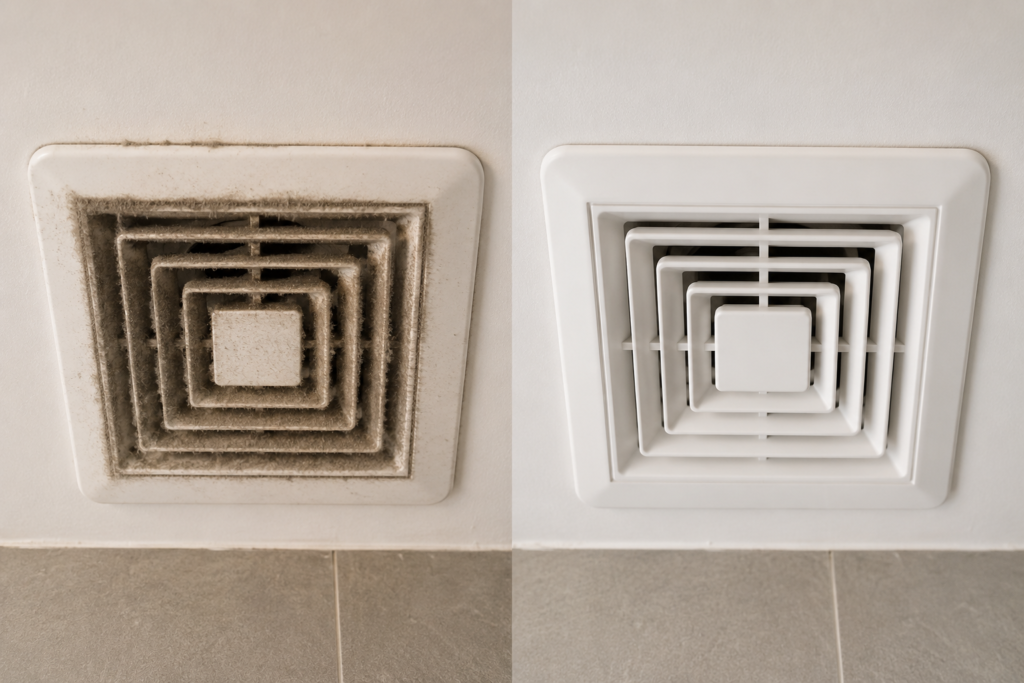
UAE tap water leaves calcium and magnesium deposits on tiles and grout – creating rough surfaces where moisture clings longer. Regular descaling with dilute citric acid reduces this buildup. For persistent mineral deposits on tile surfaces, a HEPA vacuum run before wet cleaning helps remove loose debris before descaling. Bathroom exhaust fans in UAE apartments accumulate dust rapidly and should be cleaned monthly to maintain extraction performance.
AC and Humidity Problems in UAE Apartments
AC units are not dehumidifiers by design. Dehumidification is a byproduct of cooling, and this process creates moisture problems when maintenance is neglected.
Dirty Filters and Overcooling
A clogged filter drops the evaporator coil below its designed temperature, producing excess condensation that overflows the drainage capacity. Setting thermostats very low (below 20°C) compounds this by widening the temperature gap between cooled air and room surfaces. Maintaining settings at 22°C to 24°C reduces condensation generation while preserving comfort.
Blocked Drainage and Mouldy Smells
AC drainage lines accumulate dust, biological growth, and hard water scale. Periodic flushing with clean water prevents blockages. A musty smell when the unit first starts indicates mold on the evaporator coil or blower wheel – accessible surfaces can be wiped, but coil mold requires professional cleaning. Running the unit on fan-only mode for 30 to 60 minutes at day’s end helps dry internal components between servicing.
Humidity Imbalance Between Rooms
Running AC only in bedrooms while living areas remain unventilated causes humid air to migrate toward cooled zones, producing condensation on interior surfaces. Ceiling fans or portable fans circulating air between rooms reduce localised moisture concentration. For broader indoor air management, the Indoor Air Quality UAE guide covers airflow, pollutants, and ventilation strategies.
Wardrobe and Bedroom Moisture Prevention
Wardrobes on Exterior Walls
Wardrobes on external walls develop condensation on the back panel due to the temperature differential between the cooled room and the warmer building envelope. Moisture absorbs into clothing and MDF construction over time, eventually warping the back panel and establishing mold in corner joints. A common scenario in UAE apartments: residents return after a summer holiday to find clothing smells musty and the back panel of the wardrobe has darkened. Maintaining a gap behind the wardrobe and using louvred doors are the two most effective preventive measures.
Clothing and Mattress Care
Store only fully dry clothing in UAE wardrobes – even slightly damp items introduce enough moisture to affect adjacent garments. Seasonal clothing stored in sealed breathable bags reduces mold risk when items are not in use. For mattresses, rotating monthly, using a breathable protector, and leaving the bed unmade for 30 minutes in the morning allows accumulated body moisture to evaporate before bedding is closed again.
Apartment vs. Villa Humidity Problems UAE
| Factor | Apartment | Villa |
|---|---|---|
| Natural ventilation | Limited; windows often face shared areas | Greater; cross-ventilation is possible in cooler months |
| Outdoor exposure | Balcony is the primary outdoor zone | Multiple outdoor areas; garden moisture can affect the ground floor |
| Humidity buildup speed | Faster due to smaller volume and concentrated sources | Slower overall, though specific rooms can behave similarly |
| Airflow between rooms | Often poor in sealed layouts | Better; corridor layouts allow more air movement |
| AC system control | Often strata-managed or building-managed | Individual units with more owner or tenant control |
| Most common mold areas | Bathrooms, wardrobes on external walls, and window frames | Ground floor bathrooms, utility rooms, and covered outdoor areas |
| Maintenance responsibility | Split between tenant, landlord, and building management | Typically full owner or tenant responsibility |
Signs You May Need a Dehumidifier
The following observable conditions suggest that ventilation habits alone may be insufficient for controlling moisture in UAE homes:
- Condensation appears on windows or balcony door frames every morning regardless of AC settings
- Wardrobe contents consistently smell damp despite leaving doors ajar
- Bathroom moisture persists more than 30 minutes after showering with extraction running
- A sticky or heavy indoor feeling is present throughout the day even with AC operating
- Mold returns to bathroom grout or window frames within two weeks of cleaning
- Hygrometer readings consistently exceed 65% in the bedroom or living area
Where these signs are present, a portable dehumidifier used in the most affected room can supplement ventilation during peak humidity months. The Best Dehumidifiers for UAE Homes guide covers capacity, placement, and energy considerations for UAE apartments and villas.
Supportive Tools for Moisture Prevention
Some product mentions may include affiliate links.
- Hygrometer – measures indoor relative humidity; useful in bedrooms and bathrooms for identifying spikes before mold develops
- Portable dehumidifier – supplementary measure for high-moisture zones during UAE summer; not a replacement for ventilation or AC maintenance
- Humidity indicator sachets – low-cost option for wardrobes and enclosed cabinets to signal elevated moisture conditions
- Microfiber cloths – the most practical daily-use tool for wiping condensation from windows, AC housings, and bathroom surfaces
- Air purifier with HEPA filtration – addresses airborne mold spores once in circulation, but does not reduce moisture at the source; see Best Air Purifiers UAE 2026 for UAE-suited models
- Steam cleaner – useful for deep-cleaning bathroom grout and tile where surface mold has established; see Best Steam Cleaners UAE 2026 for compact options suited to UAE apartments
Common Humidity Mistakes UAE Residents Make
| Mistake | Why It Causes Problems | Correct Approach |
|---|---|---|
| Switching off AC entirely when away in summer | Indoor temperatures can exceed 40°C. Rapid recooling may generate condensation on surfaces. | Set AC to 26°C – 28°C instead of switching it off completely. |
| Pushing furniture against exterior walls | Traps dead air and allows condensation to form behind furniture. | Keep a 5 – 10 cm gap behind furniture placed on exterior walls. |
| Never opening windows during winter | Misses one of the lowest-cost ventilation opportunities of the year. | Open windows daily from November to February when outdoor humidity is lower. |
| Ignoring bathroom moisture after showers | Persistent surface moisture is a common cause of bathroom mold in UAE homes. | Run the exhaust fan consistently and squeegee shower walls after each use. |
| Not checking AC drainage monthly | A blocked drain can overflow inside the unit, with water damage hidden for months. | Inspect the area below indoor AC units monthly for dripping or moisture marks. |
| Drying laundry in a sealed room | Wet laundry releases moisture, and sealed rooms concentrate humidity quickly. | Run an exhaust fan or portable fan during indoor laundry drying. |
Tools That Support Humidity and Mold Prevention
Some product mentions may include affiliate links.
The most useful tools depend on the room. Bathrooms usually need condensation control tools, wardrobes need moisture absorbers, and larger villas may need stronger dehumidification support.
Hygrometers
A hygrometer measures relative humidity and temperature. Digital models with wall mounting or portable designs are suitable for monitoring bathrooms, wardrobes, laundry rooms, and living spaces. Checking readings in multiple rooms provides a more accurate picture of overall indoor humidity.
Dehumidifiers
Portable dehumidifiers extract moisture from room air. Units are typically rated by extraction capacity in liters per 24 hours. For UAE apartments, models in the 10 to 20 liter per day range are commonly used for single-room or small-area applications. Larger villa spaces or storage rooms may benefit from higher-capacity units.
For product comparisons, see the guide to best dehumidifiers for UAE homes.
Moisture Absorbers
Smaller passive moisture-absorbing units use silica gel or calcium chloride crystals to reduce humidity in enclosed spaces such as wardrobes, shoe cabinets, and under-sink areas. Rechargeable versions are more economical for ongoing use.
Squeegees and Microfiber Cloths
Removing condensation from shower walls, mirrors, and tiled surfaces promptly using a squeegee or dry microfiber cloth is a practical low-cost prevention measure. Microfiber materials trap moisture effectively without spreading it. For Squeegees, please see the guide to Best Shower Squeegees and for microfiber cloths, please see the guide to Best Microfiber Cloths.
Bathroom Exhaust Fan Maintenance Tools
Maintaining a clear exhaust fan grille improves bathroom ventilation. Soft brushes or compressed air can be used to clear dust from grille covers. Internal cleaning of exhaust fan motors should be handled by a qualified maintenance technician.
For related cleaning equipment, see the guide to best bathroom cleaning tools for UAE homes.
Mold Removal Products
For surface mold on hard, non-porous materials such as bathroom tiles, grout, and hard plastic, appropriate cleaning products formulated for mold removal are available. These should be used with ventilation and appropriate protective measures.
For related cleaning equipment, see the guides to best bathroom cleaning tools for UAE homes and best steam cleaners UAE.
Steam Cleaners
Steam cleaners apply high-temperature vapor to bathroom grout, silicone seals, and tiled surfaces. High temperatures are effective at treating surface mold on hard materials. Steam cleaning is not appropriate for soft furnishings, painted surfaces, or structural mold.
For steam cleaner comparisons, see the guide to best steam cleaners UAE.
Quick Emergency Moisture Reset for UAE Apartments
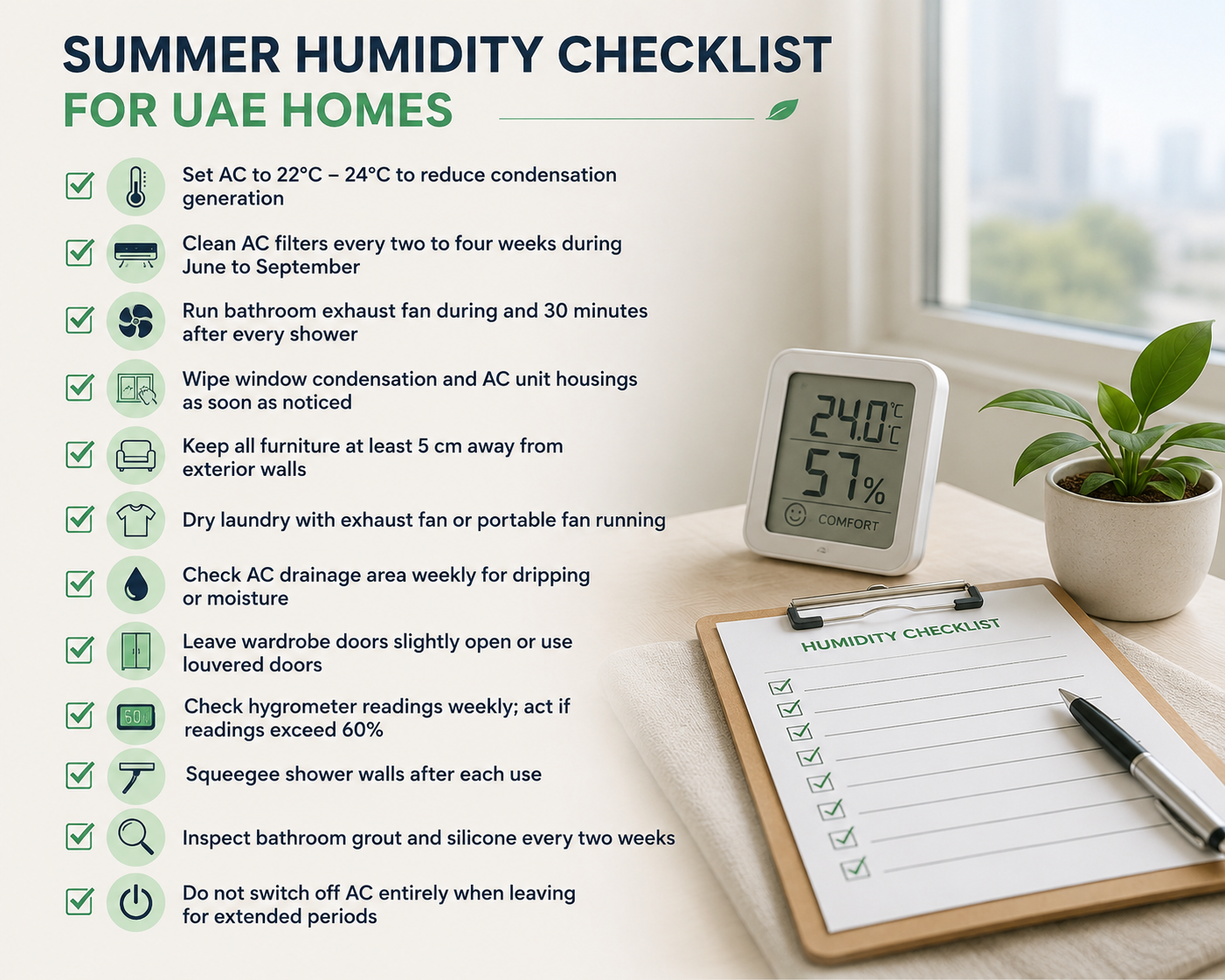
When indoor moisture has built up noticeably – musty smells, condensation on balcony door frames, or a sticky indoor feeling – apply this sequence.
Step 1 – Ventilation: Open all windows for 10 to 15 minutes if outdoor temperature allows (most effective in winter or before 7am in summer). Run all exhaust fans simultaneously.
Step 2 – Condensation wipe-down: Wipe all visible condensation from window frames, sills, wall corners, and behind furniture using a dry microfiber cloth. Prioritise bathrooms and kitchens.
Step 3 – AC filter inspection: Remove all AC filters, check for dust blockage, wash under cold water if clogged, allow to dry fully, and reinstall. A clogged filter is a primary driver of moisture accumulation in UAE apartments.
Step 4 – Bathroom drying: Wipe shower walls, squeegee glass, hang towels flat, and run the exhaust fan for 30 minutes.
Step 5 – Airflow improvement: Move all furniture 5 cm away from exterior walls. Open all internal room doors to allow air to circulate rather than remaining trapped room by room.
Seasonal Moisture Timeline for UAE Homes
| Season | Main Problem | Recommended Action |
|---|---|---|
| Summer (June – September) | Peak coastal humidity, AC condensation, and overcooling risk | Clean AC filters every 2-4 weeks, set AC to 22-24°C, and check drainage monthly |
| Autumn transition (October – November) | Interiors retain summer moisture buildup | Begin opening windows progressively and inspect wardrobes and bathrooms |
| Winter (December – February) | Temperature swings can cause occasional condensation | Use natural ventilation daily, deep clean grout, and check window frame seals |
| Sandstorm season (March – May) | Sealed windows, stagnant air, and heavier AC use | Run AC with clean filters, inspect drainage, and check door and window seals |
| Coastal spikes (year-round) | Overnight humidity above 85% can make morning condensation common | Wipe windows and sills daily and monitor indoor humidity with a hygrometer |
When to Call a Professional
Self-managed prevention and surface cleaning is suitable for most household humidity and mold situations in UAE homes. Professional assessment or intervention is recommended in the following situations:
- Mold covering an area larger than approximately 1 square meter
- Mold that returns within a few weeks of cleaning, indicating an ongoing moisture source
- Mold affecting soft furnishings, mattresses, drywall, or structural surfaces
- Visible water damage, staining, or dampness spreading through walls or ceilings
- AC units leaking or dripping water internally despite filter cleaning
- Strong persistent musty odors with no visible mold source identified
- Any mold in properties with children, elderly occupants, or individuals with respiratory conditions
In UAE rental properties, landlords and building management are typically responsible for structural moisture issues. Tenants should document and report signs of structural dampness, persistent mold on exterior-facing walls, and AC drainage failures to building management.
For broader context on indoor air health in UAE homes, see the indoor air quality UAE guide.
Conclusion
Humidity and mold prevention in UAE homes requires consistent attention across all seasons, with particular focus during the June to September peak humidity period. Apartments in coastal emirates face higher baseline humidity levels, while villa residents in all seven emirates need to monitor larger exposed areas and multiple AC systems. The combination of regular AC maintenance, targeted dehumidification, prompt condensation removal, and scheduled cleaning of high-risk areas such as bathrooms and wardrobes provides effective long-term protection. Where mold is extensive, recurring, or affecting porous materials, professional assessment is the appropriate course of action.
For more UAE cleaning guides, see the Cleaning Guides UAE hub. For better humidity and air control, start with best dehumidifiers UAE, best air purifiers UAE, indoor air quality UAE, and the main Air and Dust Control UAE hub.
FAQs
What is the ideal indoor humidity level for UAE homes?
A relative humidity level between 40% and 60% is the generally recommended range for UAE homes. During summer months in coastal areas, targeting 40% to 50% is more protective given the higher baseline outdoor humidity that infiltrates buildings. The World Health Organization recommends keeping indoor humidity below 65% to limit mold and dust mite growth.
Why does mold keep coming back in my UAE bathroom even after cleaning?
Recurring mold indicates that the moisture source has not been resolved. Common causes include inadequate exhaust ventilation, cracked or missing silicone sealant allowing water infiltration behind tiles, and an exhaust fan too underpowered or dusty to remove steam effectively. Fixing the ventilation and sealing moisture entry points is more effective than repeated surface cleaning.
Does turning off the AC when leaving home cause humidity problems in UAE?
Switching off AC entirely during UAE summer causes indoor temperatures to exceed 40°C. When AC is turned back on, the rapid cooling of hot humid air generates condensation on all surfaces simultaneously. Setting AC to 26°C to 28°C while away prevents this humidity spike rather than switching off completely.
How often should AC filters be cleaned to prevent humidity problems?
In UAE conditions, AC filters require cleaning every two to four weeks during summer (June to September) when dust loads are highest. Sandstorm periods in particular deposit significant particulate on filter surfaces within days – the Why Dust Builds Up UAE guide explains how desert dust accumulation affects indoor air systems. Clean filters maintain proper airflow across the evaporator coil, reducing excess condensation production and limiting the conditions where mold can develop inside the unit.
What causes condensation on apartment windows in Dubai?
Window condensation results from the temperature difference between cooled interior air and warmer exterior-facing glass. Warm humid outdoor air contacts the cooled glass and water vapour condenses on it. This is most common on coastal properties and lower-floor apartments. Not setting AC too low, and wiping condensation immediately when noticed, are the primary corrective actions.
Is mold inside AC units common in UAE homes?
Mold inside split AC units is a common finding in UAE homes where units are not cleaned regularly or have blocked drainage lines. A musty smell on startup is the most consistent indicator. Washing the filter and wiping accessible surfaces is within resident maintenance scope, but mold on the evaporator coil requires professional cleaning.
Can drying laundry indoors cause mold in UAE apartments?
Wet laundry releases substantial moisture into indoor air. In a sealed UAE apartment without active ventilation, this raises relative humidity noticeably and can contribute to mold on nearby walls and surfaces. Running a bathroom exhaust fan or portable fan while laundry dries indoors reduces the humidity impact significantly.
What areas of a UAE villa are most prone to mold?
Ground floor bathrooms, utility and laundry rooms, covered outdoor areas that trap humidity, and rooms on the shaded north-facing side of the villa are the most common mold-prone zones. Ground-level rooms are particularly susceptible in coastal areas of Abu Dhabi, Ajman, and Fujairah due to proximity to ambient ground moisture.
How can wardrobe mold be prevented in a UAE apartment?
Maintaining a gap of at least 5 to 10 centimetres between the wardrobe and any exterior-facing wall allows air to circulate and prevents condensation buildup on the wall behind it. Using louvred wardrobe doors or leaving doors slightly ajar improves internal airflow. Storing only fully dry clothing and placing humidity-absorbing sachets inside the wardrobe are effective supplementary habits.
When should UAE residents call a professional for mold problems?
Professional assessment is appropriate when mold returns repeatedly after cleaning and ventilation improvements, when mold staining penetrates wall plaster or returns through fresh paint, when a persistent musty smell comes from all AC outlets simultaneously, or when unexplained water marks appear on walls or ceilings without a visible source.
Sources
This article draws on general guidance regarding mold prevention, indoor humidity management, and dampness control from recognized public health and environmental sources, including the World Health Organization, UAE Ministry of Climate Change and Environment, and Dubai Municipality environmental health resources.
- World Health Organization – indoor air quality and dampness guidance
- UAE Ministry of Climate Change and Environment – climate and environmental health resources
- Dubai Municipality – public health and environmental guidance
- General AC manufacturer maintenance guidance for filter cleaning, drainage checks, and ventilation support