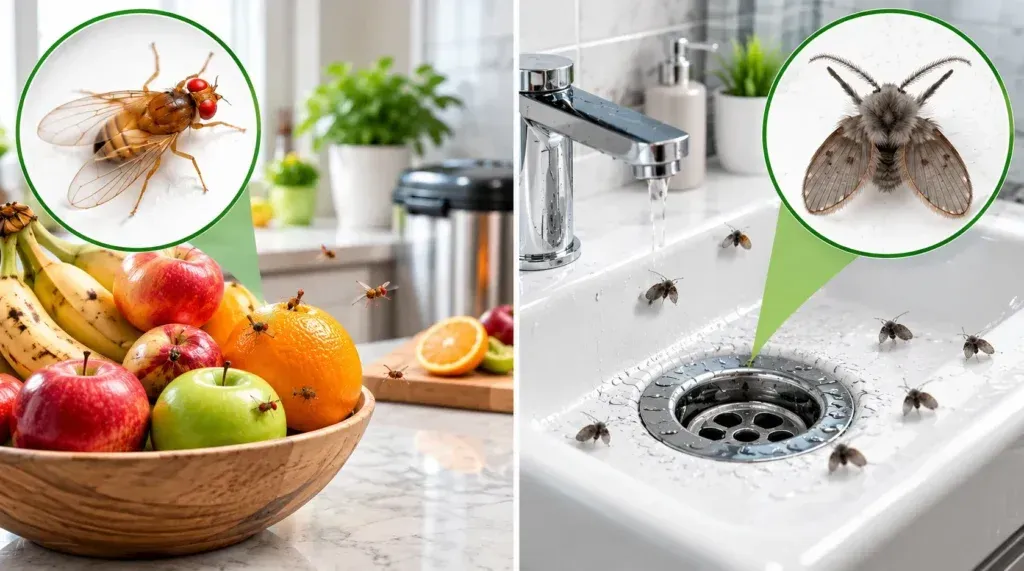
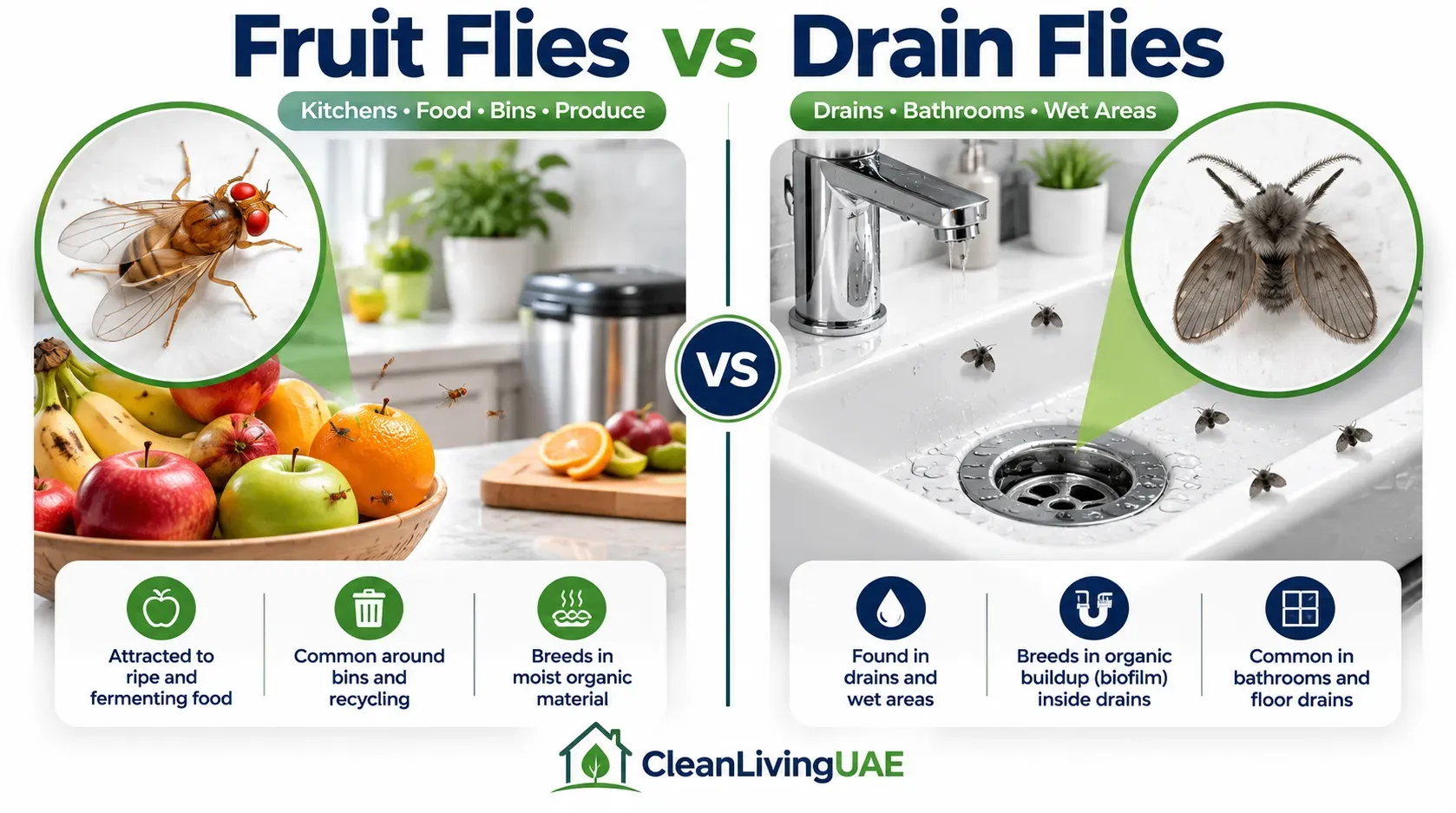
Tiny flies around a kitchen sink, bathroom drain or fruit bowl in a UAE home are usually fruit flies or drain flies. The two look similar at a glance, but they breed in different places, so the correct treatment depends on identifying where the flies are developing rather than only killing the adults that are visible.
In UAE homes, small flies may appear around kitchen sinks, bathroom drains, floor drains, bins and food-storage areas. The important first step is not assuming every tiny fly has the same source. Fruit flies are commonly associated with fermenting organic material, while drain flies develop in wet organic buildup such as the film that can accumulate inside drains.
This guide explains how to tell fruit flies from drain flies, how to find the source, how to get rid of drain flies and fruit flies with cleaning methods that address the cause, and when professional pest control may be the sensible next step.
Fruit Flies vs Drain Flies – Quick Identification
The table below summarises the features most commonly used to tell the two flies apart. No single feature confirms identification on its own, so it is more reliable to combine appearance, behaviour and location.
Scroll sideways to see the full table.
| Feature | Fruit Fly | Drain Fly |
|---|---|---|
| General appearance | Small, rounded fly, around 2 to 3 mm long | Small, fuzzy, moth-like fly, commonly around 2 to 5 mm long |
| Typical colour | Tan or yellowish-brown body, often with a darker abdomen; many species have red eyes | Grey, brownish or dark, with a dusty, hairy look |
| Wings | Clear wings held flat over the body | Broad, hairy wings held roof-like over the body when resting |
| Flight behaviour | Hovers and flies steadily around food and bins | Weak, short, jerky flights; often rests on walls near drains |
| Common location | Kitchens, fruit bowls, bins, recycling, drink areas | Bathrooms, kitchen sinks, floor drains, shower drains |
| Typical breeding material | Fermenting fruit and vegetables, drink residue, moist food waste, damp organic film | Organic sludge and biofilm in drains and other persistently wet organic buildup |
| Often seen around | Produce, bins, empty bottles and cans, sinks | Drain openings, bathroom walls, tiles near showers and basins |
| Main control approach | Remove and clean fermenting material; use traps to reduce adults | Physically clean the biofilm from the drain; use traps to monitor |
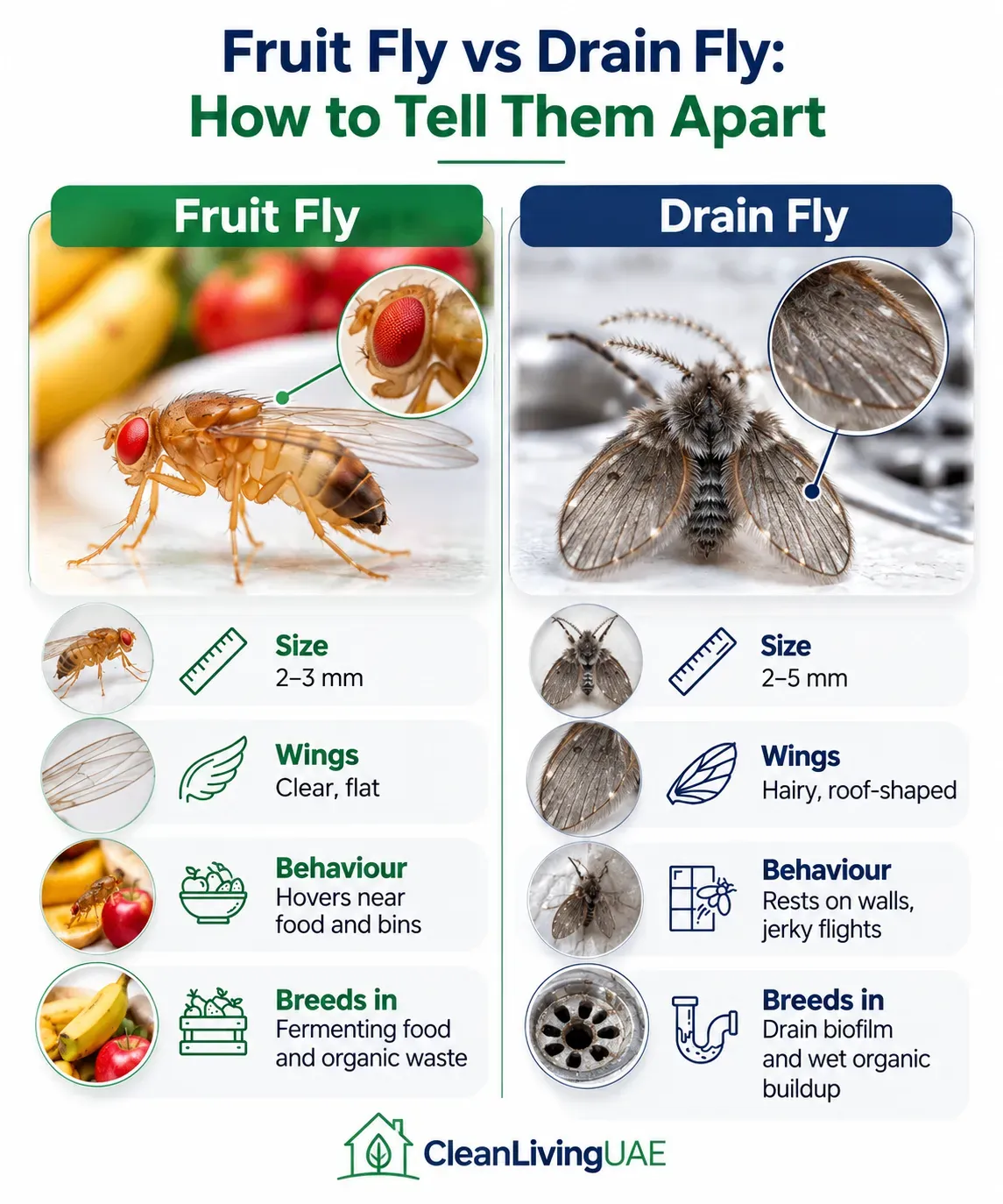
Colour can vary with lighting and species, so a dark fly near a drain is not automatically a drain fly, and a pale fly near fruit is not automatically a fruit fly.
What Are Fruit Flies?
Fruit flies are small flies, typically 2 to 3 mm long, that are strongly attracted to ripe and fermenting food. They are often described as tan or brownish with red eyes and a darker rear section. Indoors, they are commonly associated with produce that is overripe, damaged or starting to ferment.
What Causes Fruit Flies?
Fruit flies are caused by a suitable breeding source, not by fruit itself. They do not appear spontaneously from produce. Adults enter from outside or arrive on produce as eggs or larvae, then lay eggs on moist, fermenting material. Development from egg to adult can take about a week in suitable conditions.
Common household breeding sources include:
- Overripe or damaged fruit and vegetables, including bananas, tomatoes and stored potatoes or onions
- Rubbish bins and bin liners with food residue
- Recycling containers holding unrinsed bottles, cans and juice cartons
- Spilled juice, soft drinks or other sugary liquids under appliances or cabinets
- Food residue in sink areas, garbage disposal units and drains
- Damp mops, sponges and cleaning cloths with a film of fermenting material
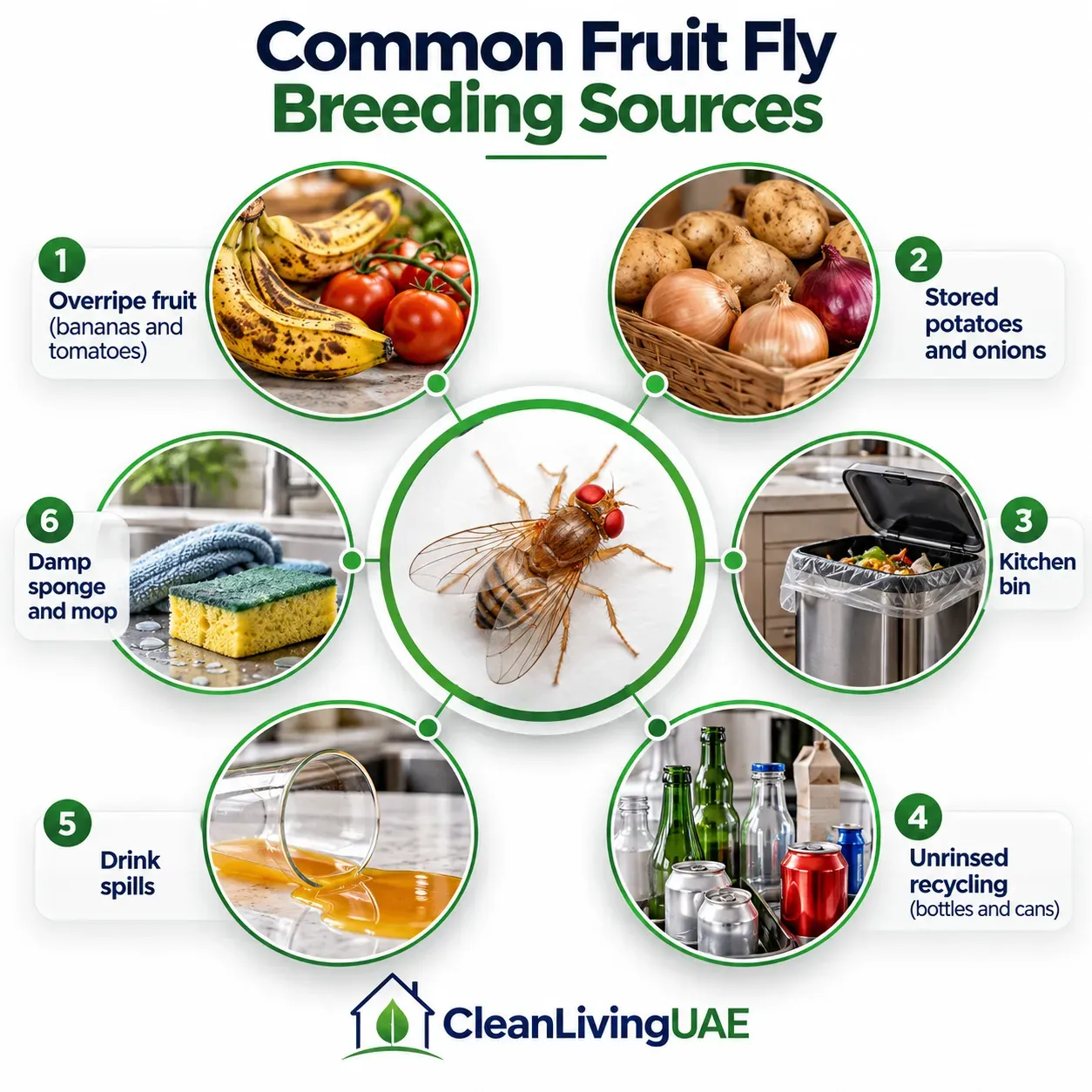
Extension guidance notes that any location with a moist film of fermenting organic material can support fruit fly larvae. This includes drains, which is one reason fruit flies and drain flies are easily confused.
What Are Drain Flies?
What Is a Drain Fly?
A drain fly is a small, fuzzy fly, commonly called a moth fly, that breeds in the organic film inside drains and other wet, decaying organic matter. Adults are weak fliers that often rest on walls near sinks and showers. They do not bite, and their larvae feed on the sludge lining drain pipes.
Drain flies are also known as moth flies, sewer flies, filter flies and sink flies. Their bodies and wings are covered in fine hairs, which gives them a soft, moth-like appearance. When resting, they hold their wings over the body in a roof-like shape.
Where Drain Fly Larvae Develop
Drain fly larvae live in the gelatinous layer of organic material that builds up where water, hair, soap residue, grease and food particles collect. Common locations include:
- Bathroom basin drains and shower drains
- Kitchen sink drains
- Floor drains in bathrooms, laundry areas and kitchens
- Overflow openings in basins
- Rarely used drains where water sits and organic film accumulates
- Other persistently damp organic buildup, such as areas around leaks or condensate lines
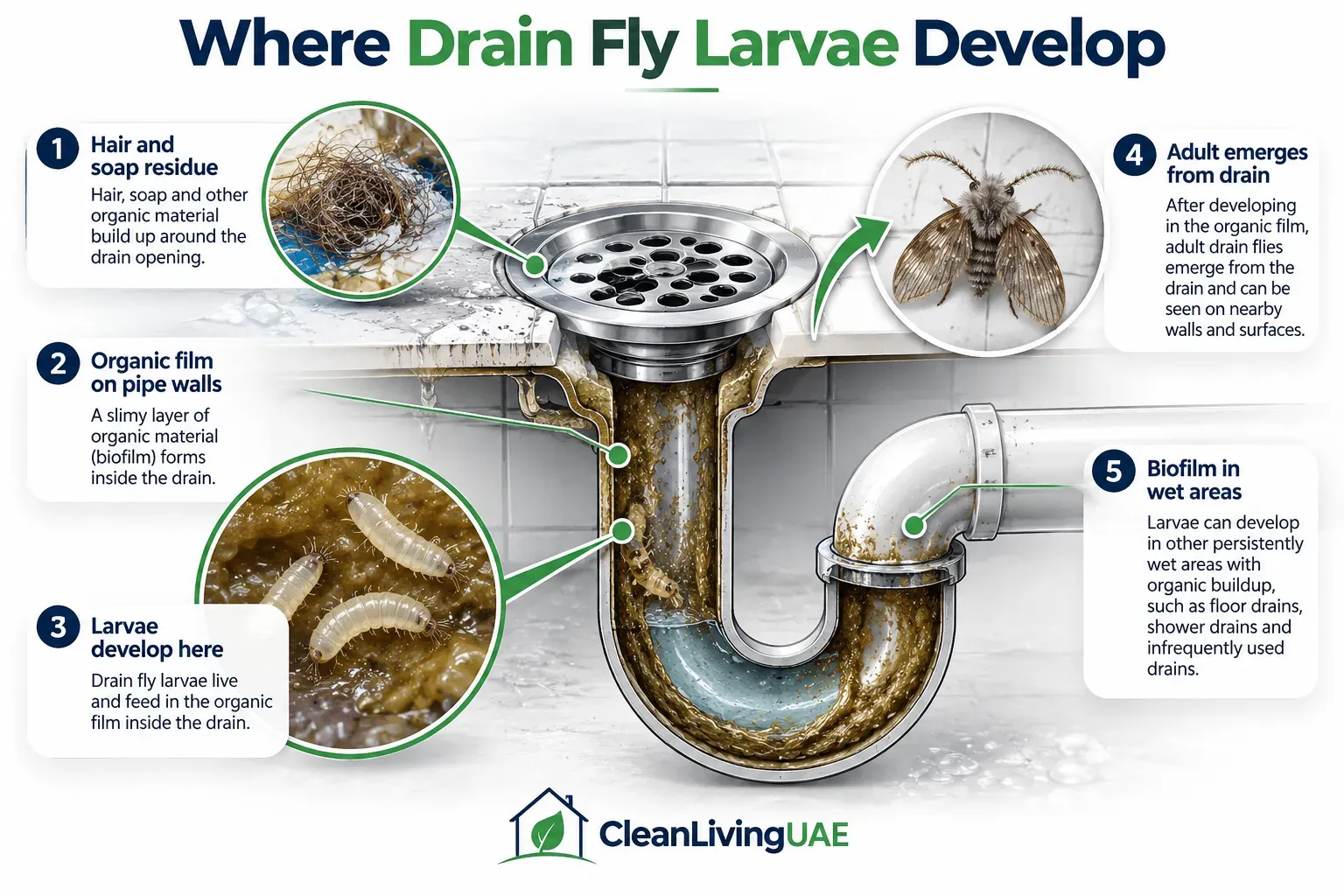
The life cycle can be completed in roughly 8 to 24 days depending on temperature, according to university extension sources.
Seeing drain flies near a particular drain is evidence worth investigating, but it does not prove that drain is the source. Adults can move short distances, and the breeding site may be a different drain, a leak behind a wall or another damp area nearby.
Fruit Flies vs Drain Flies – What’s the Difference?
A practical identification process uses several clues together rather than relying on any one feature.
- Appearance. Look closely at a resting fly. Fruit flies look like tiny, smooth houseflies, often with red eyes. Drain flies look fuzzy and moth-like, with broad wings folded like a roof.
- Behaviour. Fruit flies tend to hover around food, drinks and bins. Drain flies tend to sit on walls and tiles and make short, jerky hops when disturbed.
- Where adults gather. Clusters around produce, bins and recycling suggest fruit flies. Adults resting on bathroom walls or around drain openings suggest drain flies.
- Potential breeding source. Check whether there is fermenting food nearby or whether the nearest likely source is a drain or damp area.
- Source investigation. Remove obvious food sources first. If flies continue, test drains and damp areas to see where adults are emerging.
If identification remains uncertain, a clear photo of a resting fly taken close up can help a pest-control professional or an extension resource confirm the species.
Fruit Flies in Drain Areas? They May Actually Be Drain Flies
Many residents describe any tiny fly in a kitchen or bathroom as a fruit fly. When the flies seem to be coming from a sink or shower drain, there is a reasonable chance they are drain flies instead, particularly if they look fuzzy and rest on walls.
The distinction matters because the treatment is different. Removing fruit from the counter will not stop drain flies, and scrubbing a drain will not stop fruit flies breeding in a forgotten bag of potatoes.
Can Fruit Flies Live in Drains?
Yes. Fruit flies can breed in drains and garbage disposal units when a moist film of fermenting food residue builds up. This means fruit flies in drain areas are possible, and location alone is not enough to identify the fly. Appearance and behaviour should be checked as well.
In practice, the cleaning approach for a drain source is similar for both flies: the organic buildup must be physically removed. Identification still matters because it shows whether other sources, such as produce and bins, also need attention.
How to Get Rid of Fruit Flies
How Do You Get Rid of Fruit Flies?
To get rid of fruit flies, find and remove every fermenting food source, clean residue from bins, recycling, sinks and spills, and store produce properly. Traps can then catch remaining adults. Traps or sprays alone rarely solve an established problem, because eggs and larvae continue developing in the breeding material.
A step-by-step approach:
- Identify the breeding material. Check where adult flies cluster and inspect nearby food and waste.
- Inspect fruit and vegetables. Look for soft spots, splits, mould or fermenting smells, including in stored potatoes and onions.
- Dispose of spoiled produce. Seal it in a bag and take it out of the home rather than leaving it in the kitchen bin.
- Clean spills. Wipe sticky residue from counters, shelves and the inside of cupboards.
- Clean underneath appliances where relevant. Spilled juice or food under a fridge, dishwasher or cooker can go unnoticed.
- Rinse recycling. Rinse bottles, cans and cartons before placing them in recycling containers.
- Clean rubbish bins. Wash the bin itself, not only the liner, and empty kitchen bins frequently.
- Inspect beverage residue. Check drink stations, bottle storage and coffee areas for drips and residue.
- Clean sink areas. Scrub the sink, drain opening, strainer and garbage disposal where fitted.
- Store produce appropriately. Refrigerate ripe fruit where suitable and avoid keeping large quantities at room temperature.
- Use traps to reduce and monitor adults. Traps help show whether activity is falling once sources have been removed.
Kitchen routines that reduce food residue also reduce fruit fly breeding sites. The kitchen cleaning guide for UAE homes covers daily and weekly habits that support this.
Does Apple Cider Vinegar Get Rid of Fruit Flies?
Apple cider vinegar can attract and catch adult fruit flies, but it does not get rid of an infestation by itself. Fruit flies are drawn to the smell of fermentation, which vinegar imitates. A trap reduces the number of adults, while eggs and larvae in the breeding source continue to develop until that source is removed.
What a Vinegar Trap Can and Cannot Do
A vinegar trap can:
- Catch some adult fruit flies
- Show whether fly activity is increasing or decreasing
- Help identify which area of the kitchen has the most activity
A vinegar trap cannot:
- Remove eggs and larvae in fermenting produce, bins or drains
- Solve an infestation if a breeding source remains
- Reliably catch drain flies, which are not typically attracted to the same bait
Simple DIY Fruit Fly Trap
- Pour a small amount of apple cider vinegar into a jar or glass.
- Add one drop of washing-up liquid to break the surface tension.
- Cover the top with a paper funnel or with cling film pierced with a few small holes.
- Place it near where flies gather, away from children and pets.
- Replace the liquid every few days and continue removing breeding sources.
How to Get Rid of Drain Flies
How Do You Get Rid of Drain Flies?
To get rid of drain flies, identify which drain is producing them, then physically scrub out the organic film where the larvae live using a stiff drain brush, followed by an appropriate drain cleaner used according to its label. Killing adult flies alone does not stop new ones emerging from the drain.
A practical eight-step process:
- Identify which drain or wet area is producing flies. Use the observation and cover tests described later in this guide.
- Inspect accessible drain components safely. Remove drain covers, strainers and hair catchers that lift out easily. Wear gloves.
- Remove accumulated organic material where accessible. Pull out hair, soap residue and sludge from drain openings, covers and the first section of the pipe.
- Mechanically clean accessible drain surfaces. Use a long, stiff-bristled drain brush to scrub the inside walls of the pipe as far as it can safely reach. Scrubbing is the step most commonly missed and the one extension sources emphasise.
- Use an appropriate drain-cleaning product according to its label. Enzyme or bacterial drain cleaners are often used to help break down remaining organic film. Follow the label directions and never combine products.
- Keep the area clean. Repeat brushing and flushing regularly, particularly for drains that collect hair and soap.
- Monitor adult fly activity. A few adults may still appear for a week or two as already-developed insects emerge. Sticky traps near the drain help track whether numbers are falling.
- Investigate plumbing or sanitation problems if activity persists. Slow drainage, broken pipes, leaks under floors or cracked drain seals can hold organic matter out of reach.
The objective throughout is to remove the material where larvae develop rather than only killing visible adults. Removing traps from under sinks or dismantling pipework should only be done by someone competent to do so. In rented apartments, building maintenance or the landlord is usually the appropriate contact for plumbing work.
Why Do Drain Flies Keep Coming Back?
Drain flies keep coming back when the organic film inside the drain is not fully removed or when a second breeding source exists. Pouring liquids down a drain often leaves much of the biofilm intact. Leaks, broken pipes and rarely used drains can also continue producing flies until they are found and fixed.
How to Get Rid of Drain Flies in Bathroom Drains and Wet Areas
Bathrooms are a common place to notice drain flies because drains and other persistently damp areas can accumulate the organic material their larvae develop in. Learning how to get rid of drain flies in bathroom areas mostly comes down to checking every wet opening, not only the most obvious one.
Areas to Check in the Bathroom
- Shower drains. Hair and soap scum build up under the cover and in the first section of pipe.
- Basin drains. Toothpaste, soap and hair collect around the pop-up plug and inside the pipe.
- Floor drains. Common in UAE bathrooms and wet areas, floor drains can collect hair, lint and fine dust that combine with moisture into organic sludge.
- Overflow openings. Basin overflow channels can hold stagnant water and biofilm and are easy to overlook.
- Rarely used drains. Guest bathrooms and drains in unused rooms may dry out or accumulate film without regular flushing.
- Persistent moisture and leaks. Damp grout, leaking seals and wet areas behind toilets or vanity units can hold organic buildup.
Bathroom Cleaning Steps
- Remove and scrub shower and floor drain covers and hair catchers.
- Brush inside each drain and the basin overflow with a narrow drain brush.
- Flush with warm water after scrubbing.
- Apply a drain cleaner suited to the pipe material, following the label.
- Run water through rarely used drains at least weekly.
- Report leaks, slow drainage or damaged drain seals to building maintenance.
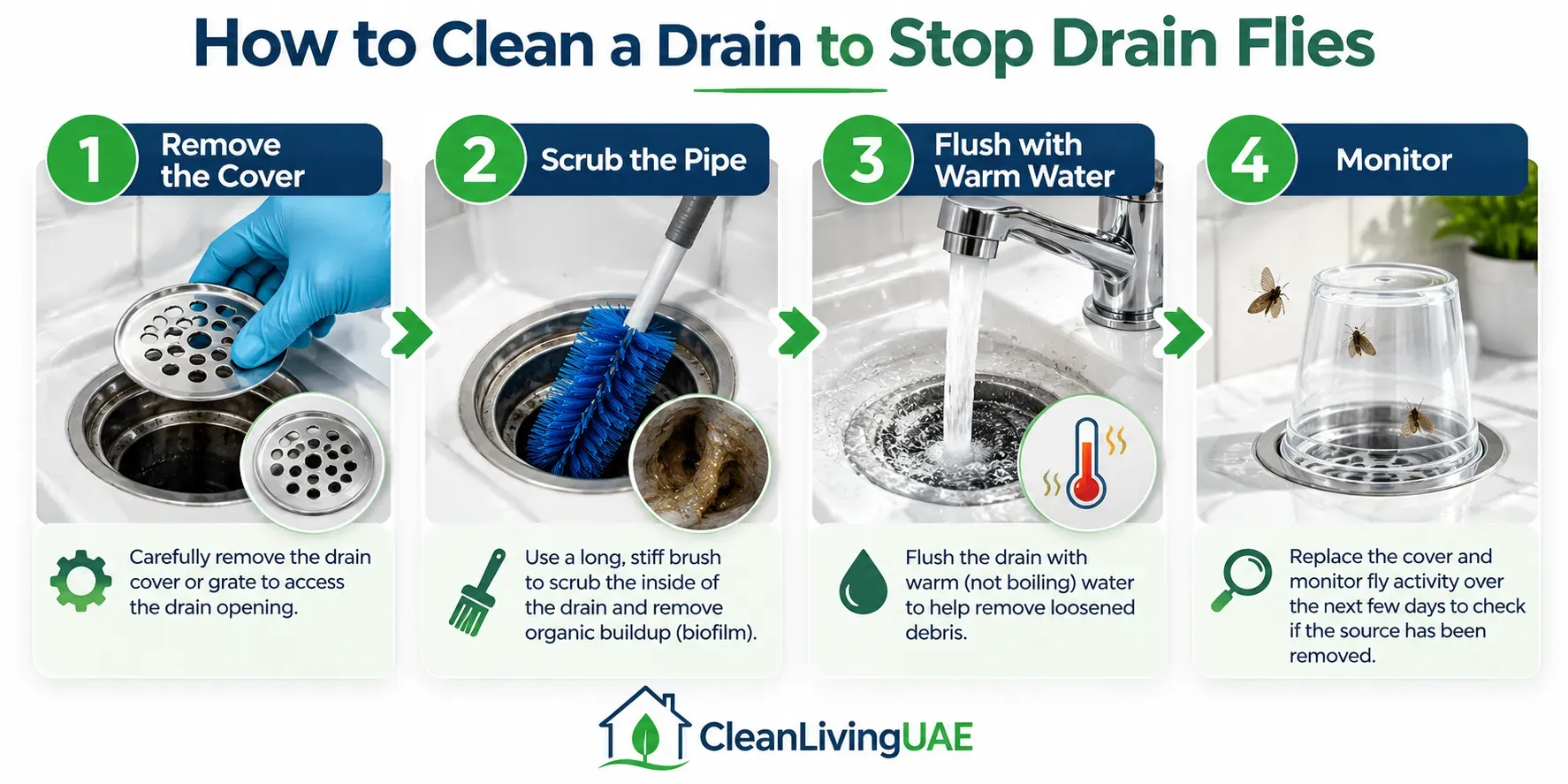
The bathroom cleaning guide for UAE homes covers routine care that reduces buildup in these areas, and the guide to humidity and mould prevention in UAE homes covers moisture control in bathrooms.
Tiny Flies in the Kitchen – What Should You Check?
Tiny flies in the kitchen can come from food sources, drain sources or both. Checking in order from most likely fruit-fly sources to most likely drain-fly sources usually narrows it down.
Scroll sideways to see the full table.
| Area to Check | More Commonly Associated With | What to Look For |
|---|---|---|
| Fruit bowls | Fruit flies | Overripe, split or soft produce |
| Stored potatoes and onions | Fruit flies | Soft, rotting or leaking items at the bottom of bags or baskets |
| Kitchen bins | Fruit flies | Residue in the bin itself, not only in the liner |
| Recycling | Fruit flies | Unrinsed bottles, cans and cartons |
| Drink residue | Fruit flies | Sticky spills around fridges, bottle storage and drink stations |
| Sink and drain areas | Both | Slime in the strainer, drain opening and garbage disposal |
| Damp cleaning materials | Both | Sour-smelling mops, sponges and cloths |
| Hidden food residue | Fruit flies | Spills under appliances, in cupboard corners and behind the cooker |
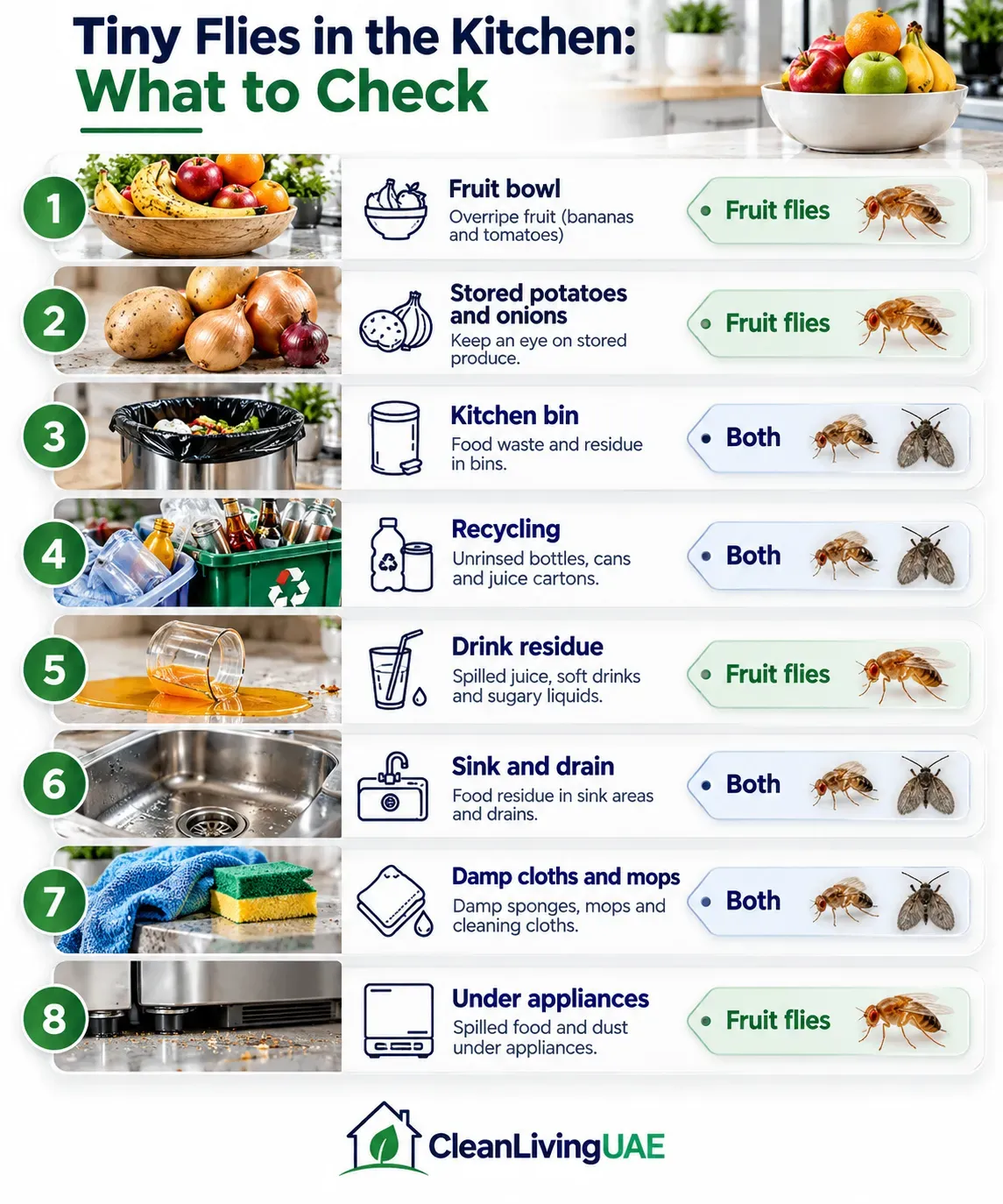
Small flies are often noticed around sink areas. If produce and bins have been cleaned and flies continue gathering at the sink, investigate the drain as a possible breeding source.
Tiny Flies in the Bathroom – What Should You Check?
Tiny flies in the bathroom are more likely to come from a drain or damp organic buildup than from food. Check:
- Shower, basin and floor drains
- Basin overflow openings
- Damp organic buildup around seals, grout and behind fixtures
- Leaks under basins or behind toilets
- Standing moisture that does not dry between uses
Not every small bathroom fly is a drain fly. Fungus gnats, which are delicate, dark, mosquito-like flies that breed in moist potting soil, are sometimes found in bathrooms that contain indoor plants. Fruit flies can also be found in bathrooms if there is a food or drink source nearby. Location alone does not confirm identification, so appearance and behaviour should also be checked.
Do Boiling Water, Baking Soda or Vinegar Kill Drain Flies?
Boiling water, baking soda and vinegar may affect some adults or larvae temporarily, but they do not reliably remove the organic film where drain flies breed. University extension guidance describes pouring boiling water or bleach down a drain as a common misconception that provides, at best, short-term control.
It helps to separate four different outcomes:
- Temporarily affecting adults or larvae. Hot liquids can kill some insects on contact, but larvae deeper in the biofilm may survive.
- Flushing a drain. Moving water through the pipe helps clear loose debris but leaves much of the film attached to pipe walls.
- Removing organic biofilm. This generally requires physical scrubbing with a brush, sometimes supported by a suitable drain cleaner.
- Solving the breeding source. This happens only when the film is removed and any leak or plumbing fault is fixed.
The fizzing reaction from baking soda and vinegar is often shared online as a drain fly remedy, but there is limited evidence that it removes biofilm effectively. It should not be treated as a substitute for scrubbing.
Boiling water also carries practical risks. Very hot water may not be suitable for some pipe materials, fittings and sealants, and it can cause scalds. Warm tap water after mechanical cleaning is a more cautious option. Where the pipe material is unknown, building maintenance can advise.
Does Bleach Get Rid of Drain Flies?
Bleach is not considered a reliable drain-fly solution because pouring it down a drain does not remove the organic film where larvae develop. Physical removal of that buildup is the more important control step.
Chemical Safety Warning
Never mix bleach with:
- Vinegar or other acids
- Ammonia or ammonia-based cleaners
- Other drain cleaners
- Any other household cleaning chemical
Mixing bleach with acids can release chlorine gas, and mixing it with ammonia can release chloramine gases. Both can cause serious breathing problems. Bleach can also remain in drain traps after use, so avoid pouring a different product into the same drain shortly afterwards. Always read product labels, use one product at a time and keep bathrooms and kitchens ventilated while cleaning.
How to Find Where Drain Flies Are Coming From
Finding the exact source saves time and avoids cleaning the wrong drain. Practical, safe inspection methods include:
- Observe adult activity. Note which drain or area has the most flies at different times of day.
- Check walls near drains. Drain flies commonly rest on tiles and walls close to where they emerge.
- Look into drain openings. Use a torch to check for dark, slimy buildup under covers and inside pipes.
- Check floor drains. These are easy to overlook, especially in laundry areas and secondary bathrooms.
- Check infrequently used wet areas. Guest bathrooms, utility sinks, maid’s room bathrooms and drains in storage areas can all hold stagnant film.
The Drain Cover Test
A simple cover test can indicate whether flies are emerging from a specific drain:
- Choose a time when the drain will not be used, such as overnight.
- Cover the drain opening with a clear plastic cup or container coated inside with petroleum jelly or cooking oil, or lay a strip of clear tape sticky side down across part of the opening.
- Leave it in place overnight or for up to a day.
- Check for flies stuck to the inside of the cup or on the tape.
- Remove the cover before using the drain again and clean away any residue.
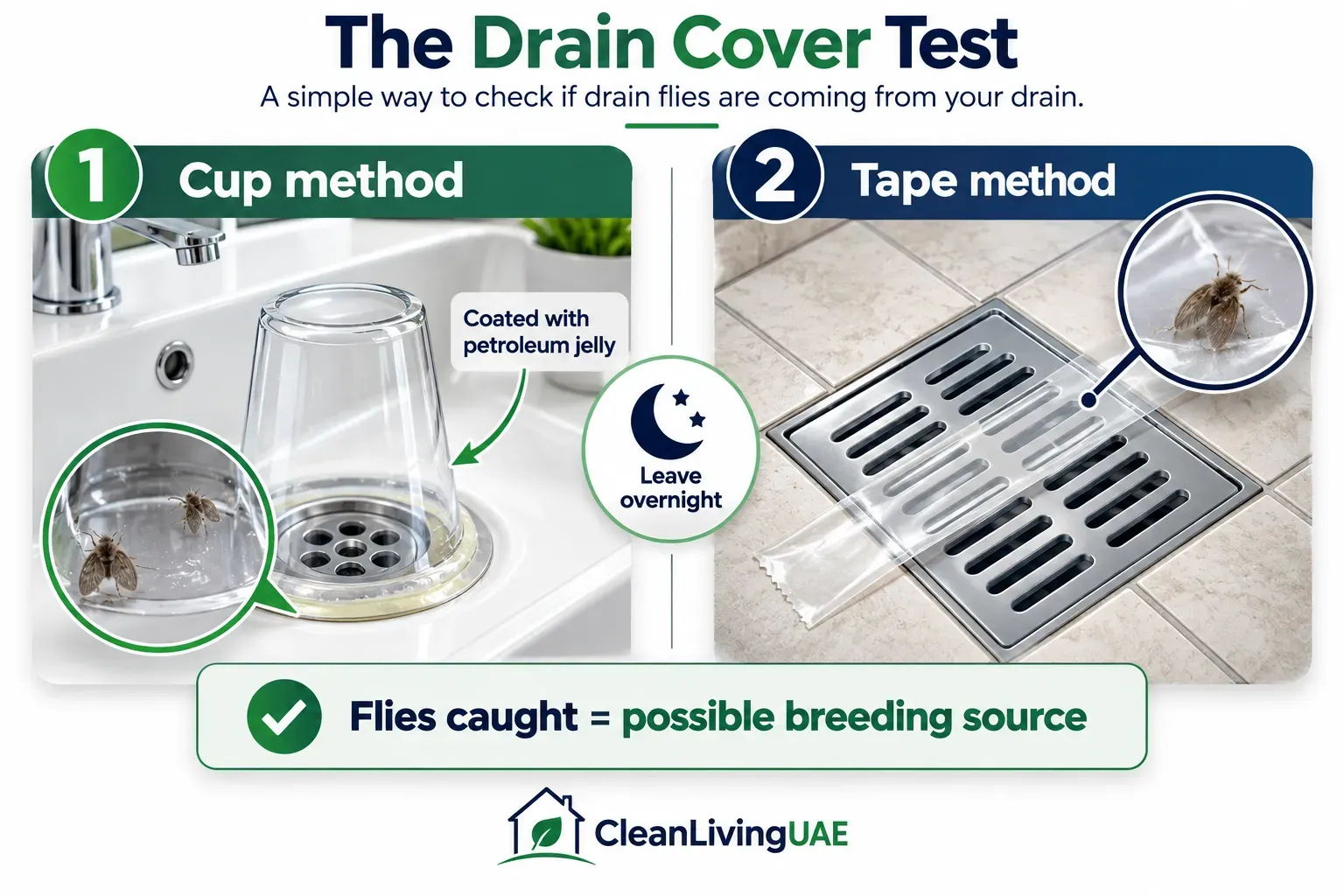
Repeat the test on each suspected drain. Flies caught on the cover suggest that drain is a breeding source, but the test is an indication rather than definitive proof. No catch after one night does not always rule a drain out, so repeating the test is useful.
How to Prevent Fruit Flies and Drain Flies
Prevention focuses on removing the conditions each fly needs to breed.
Preventing Fruit Flies
- Buy produce in quantities that can be used before it overripens.
- Refrigerate ripe fruit where suitable.
- Check stored potatoes and onions regularly and remove any soft items.
- Rinse bottles, cans and cartons before recycling.
- Empty kitchen bins frequently and wash them regularly, especially when bins are kept in warm utility areas.
- Wipe up drink and food spills promptly, including under appliances.
- Replace or wash sponges and cloths regularly and let mops dry fully.
Preventing Drain Flies
- Brush and flush kitchen and bathroom drains as part of a regular cleaning routine.
- Clean under shower and floor drain covers where hair and soap collect.
- Use hair catchers in showers and basins and empty them often.
- Run water through rarely used drains weekly so they do not dry out or collect film.
- Report leaks, slow drainage and damaged drain seals promptly.
- Keep bathrooms ventilated so surfaces dry between uses.
For households managing other insects at the same time, related guides cover preventing cockroaches in UAE apartments and mosquito prevention in Dubai homes, both of which also rely on reducing moisture and food residue.
Tools That Support Fruit Fly and Drain Fly Control
Some product mentions may include affiliate links.
Tools and products are most useful once the breeding source has been identified. The main categories are:
Scroll sideways to see the full table.
| Tool Type | Main Use | Limitation |
|---|---|---|
| Long, stiff drain brush | Scrubbing biofilm from inside drain pipes | Reach is limited to the accessible section of pipe |
| Enzyme or bacterial drain cleaner | Helping break down remaining organic film after scrubbing | Works gradually; not a substitute for physical cleaning |
| Fruit fly trap (bait-based) | Catching and monitoring adult fruit flies | Does not remove eggs or larvae in breeding material |
| Sticky or glue traps | Monitoring adult flies near drains and bins | Catches adults only; placement matters |
| Drain hair catchers | Reducing hair and debris entering shower and basin drains | Needs regular emptying |
For a comparison of electric fly killers, glue traps and other fly control options available in the UAE, see the guide to the best fly killers and traps in the UAE. A general cleaning brushes guide for UAE homes and the bathroom cleaning tools guide also cover tools for drains, grout and tight spaces.
When Should You Call Pest Control for Fruit Flies or Drain Flies?
Most fruit fly and drain fly problems in homes can be resolved by finding and cleaning the source. Professional pest control, or a plumber, may be appropriate when:
- The infestation continues after all obvious breeding sources have been removed and cleaned
- The source cannot be located despite inspecting produce, bins and drains
- An inaccessible plumbing issue is suspected, such as a broken pipe or a leak under a floor
- Flies return repeatedly after cleaning
- The property is a commercial kitchen or food-handling environment
- Fly activity is extensive across several rooms
In apartment buildings, a problem that originates in shared drainage or a neighbouring unit may need to be reported to building management. In Dubai, the Dubai Municipality Public Health Pest Control Section can be contacted on 800900 for public-health pest queries, and other emirates have their own municipal services.
Need professional help? CleanLivingUAE can help residents compare pest-control options in the UAE.
For other household pests, related guides cover cockroach killers for UAE homes, mosquito killers for UAE homes and separate guides to bed bugs in the UAE, silverfish control and rat and mouse traps.
Frequently Asked Questions
How do I know if I have fruit flies or drain flies?
Fruit flies look like tiny, smooth houseflies, often with red eyes, and gather around food, bins and drinks. Drain flies look fuzzy and moth-like, rest on walls near drains and fly in short, jerky hops. Check appearance, behaviour and location together.
Why do I have tiny flies around my sink?
Tiny flies around a sink may be coming from food residue nearby or organic buildup inside the drain. Check produce, bins and recycling, then inspect the drain if activity continues.
How do I get rid of fruit flies quickly?
The quickest route is to remove every fermenting food source, clean bins, recycling and spills, and set traps for remaining adults. Adults usually decline over the following days once breeding sources are gone, although eggs already laid may still produce some flies.
How do I get rid of drain flies?
Scrub the inside of the affected drain with a stiff drain brush to remove the organic film, then use a suitable drain cleaner according to its label. Repeat regularly, keep the drain flowing and report leaks or slow drainage if flies persist.
Why do drain flies keep coming back?
Drain flies return when biofilm remains in the drain, when another drain or damp area is also breeding them, or when a plumbing fault holds organic matter out of reach. Pouring liquids alone often leaves the breeding material in place.
Can fruit flies live in drains?
Yes. Fruit flies can breed in drains and garbage disposal units where fermenting food residue builds up. Because both fruit flies and drain flies can use drains, location alone is not enough to identify which fly is present.
Does vinegar kill fruit flies?
Vinegar attracts adult fruit flies, and a vinegar trap with a drop of washing-up liquid can catch them. It does not remove eggs or larvae in breeding material, so source removal is still needed.
Does bleach kill drain flies?
Bleach is not considered a reliable drain fly treatment because pouring it down a drain does not remove the organic film where larvae develop. Physical removal of that buildup matters more. Never mix bleach with vinegar, acids, ammonia or other cleaners.
Are drain flies harmful?
Drain flies do not bite or sting. Because they develop in drains and sewage-related areas, extension sources note they could carry microbes onto surfaces, and large numbers may contribute to allergy symptoms in some people. They are mainly a sanitation indicator.
When should I call pest control?
Consider pest control or a plumber when flies persist after all obvious sources are cleaned, the source cannot be found, a hidden plumbing fault is suspected, or the property is a food-handling business. In apartments, report shared drainage problems to building management.
Sources
Information in this guide is based on the University of California Statewide IPM Program guidance on moth or drain flies, UC IPM guidance on fruit flies, UC IPM Pest Notes on fungus gnats, the University of Kentucky Entomology fact sheet on fruit flies, The Ohio State University CFAES fact sheet on drain flies (moth flies), the Washington State Department of Health guidance on the dangers of mixing bleach with cleaners and the Dubai Municipality Public Health Pest Control Section.