TDS Meters and Tap Water Testing in UAE Homes
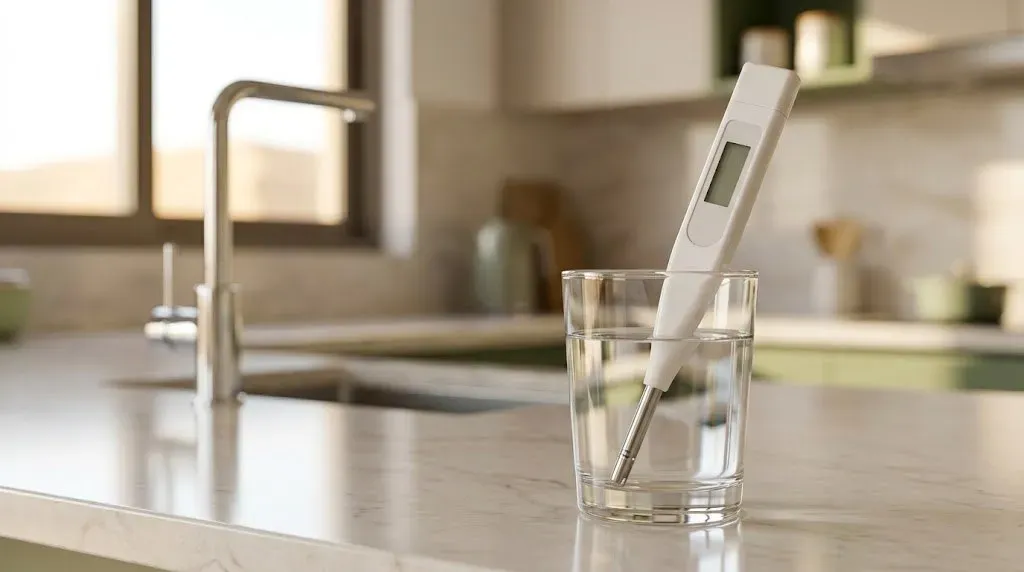
A TDS meter is a small, low-cost tool that estimates how much dissolved material is present in water. In UAE homes, most drinking water starts as desalinated seawater, then passes through building storage tanks and apartment pipework that can run warm in summer heat. A TDS meter gives residents a simple way to check tap water, compare it with filtered or reverse osmosis (RO) water, and notice when a reading changes. It is a useful household check, not a complete water-safety test.
This TDS meter UAE guide covers both sides of the topic: which TDS meter makes sense to buy in the UAE in 2026, and how to test and interpret the TDS of tap, filtered and RO water correctly, from Abu Dhabi and Dubai to Sharjah, Ajman, Ras Al Khaimah, Fujairah and Umm Al Quwain.
Best TDS Meter UAE 2026 – Quick Comparison
Some product mentions may include affiliate links.
All five meters had a new-condition offer on Amazon.ae that was shipped by Amazon.ae from within the UAE (third-party sellers, fulfilled by Amazon) when checked on 26 September 2026. Prices, sellers and delivery estimates can change. Specifications come from manufacturer documentation where available. No product was physically tested by CleanLivingUAE.
On mobile, scroll sideways to see the full comparison.
| TDS Meter | Best For | Range | Accuracy | EC | Temperature | Calibration | Approx. UAE Price | Amazon.ae |
|---|---|---|---|---|---|---|---|---|
| HM Digital AP-1 | Most households | 0-5,000 ppm | ±2% | No | Yes, with ATC | Push-button, digital | AED 70-75 | View on Amazon.ae |
| HM Digital DM-1 | RO system monitoring | 0-9,000 ppm (maker) | ±2% | No | Not stated | Factory set; analog | AED 80-85 | View on Amazon.ae |
| INKBIRD ITDS-01 | Low-cost EC and TDS | 0-4,995 ppm | ±2% (TDS) | Yes | Yes (ATC not stated) | Coefficient setting | AED 85-90 | View on Amazon.ae |
| Hanna HI98301 DiST 1 | Documented calibration | 0-2,000 ppm | ±2% full scale | No | Yes, with ATC | Automatic, 1,382 ppm | AED 470-480 | View on Amazon.ae |
| Xiaomi Mi TDS Pen | Budget pick, specs limited | Not verified | Not verified | No | Not verified | Not verified | AED 40-50 | View on Amazon.ae |
ATC means automatic temperature compensation. “Not verified” means the specification could not be confirmed from manufacturer documentation.
TDS Meter Reviews
Finding the best TDS meter UAE households can use depends on the job. Each meter below had a new offer shipped by Amazon.ae from within the UAE when checked and covers a different need. Specifications are quoted from manufacturer pages unless stated otherwise.
01
HM Digital AP-1 AquaPro
most households checking tap, filtered and RO water
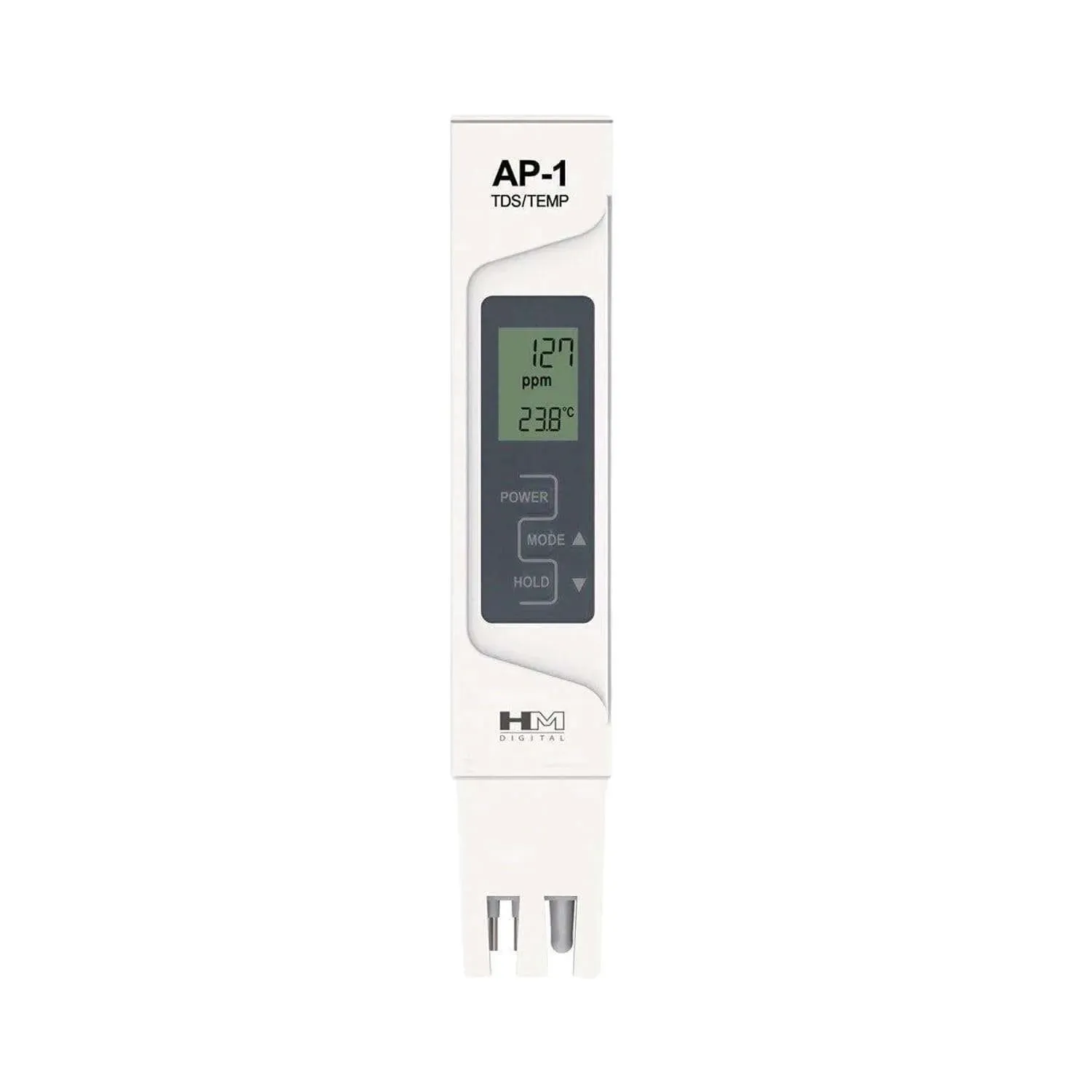
The HM Digital AP-1 is a slim digital TDS meter that shows TDS and water temperature together. According to the manufacturer, it uses an average NaCl conversion factor of 0.5, and its magnetic body allows storage on a fridge.
Manufacturer specifications
- Measurement range: 0-5,000 ppm (mg/L)
- Claimed accuracy: ±2%
- Resolution: 1 ppm
- EC measurement: no (TDS only)
- Temperature: yes, 0-80°C, 0.1° resolution
- Automatic temperature compensation: yes (compensation range not stated)
- Calibration: digital, push button
- Battery: 1 x 3V CR2032 button cell (included)
- Waterproof rating: water-resistant housing; no IP rating published
Best for:
Most households checking tap, filtered and RO water
Approx. price
AED 70-75 on Amazon.ae
Advantages
- Range covers tap, filtered and RO water
- Temperature display and ATC suit warm UAE tap water
Limitations
- The Amazon.ae listing is brief and had no customer ratings yet
- No stated IP rating, so the meter should not be submerged
Buying notes
Checked 26 September 2026: AED 70.00, listed as “HM Digital AP 1 TDS Meter (White)”, sold by AQUA FINE and fulfilled by Amazon.ae, in stock with next-day delivery.
Source: Amazon.ae product listing, HM Digital AP-1 product page. Product details, seller, stock and price can change.
02
HM Digital DM-1 In-Line Dual TDS Monitor
continuous monitoring of an under-sink RO system
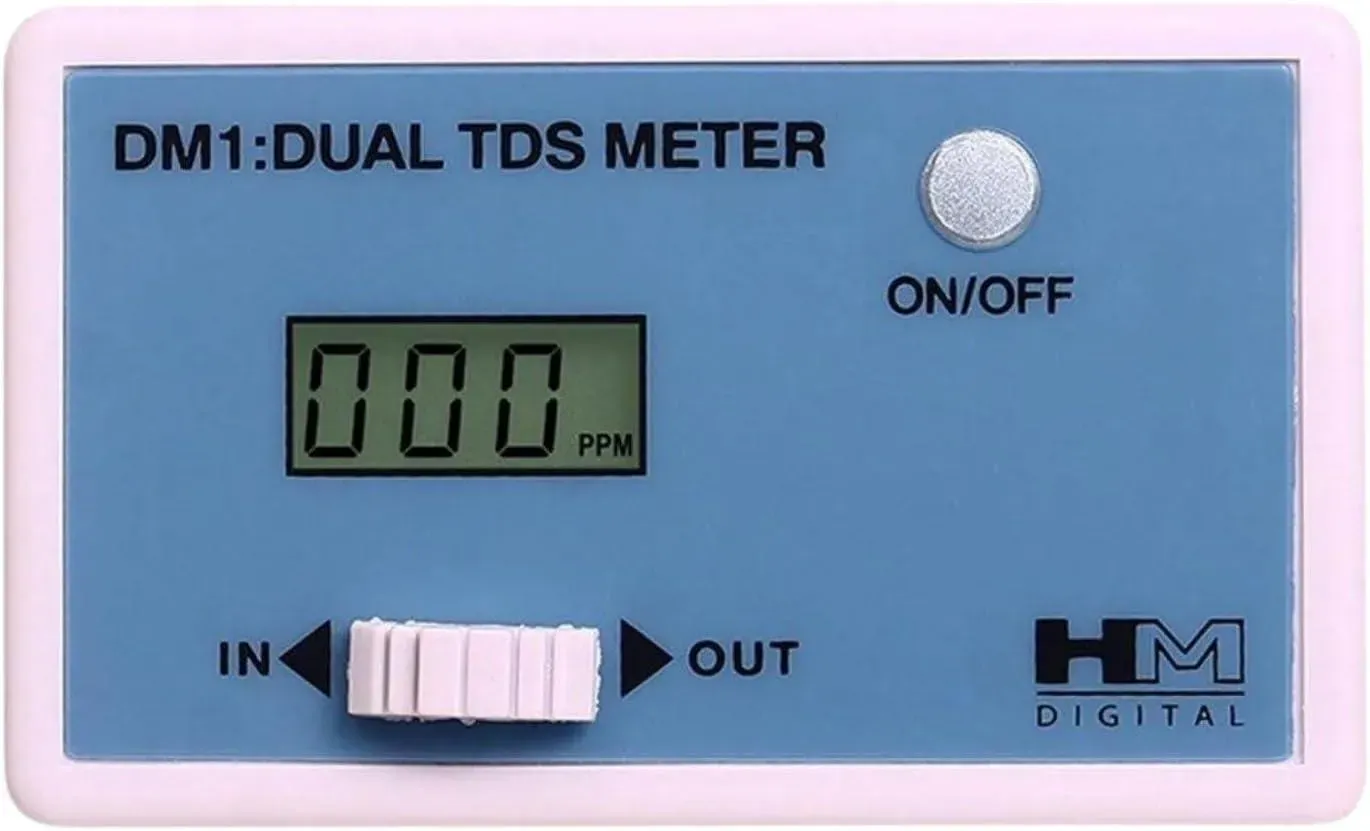
The DM-1 is a TDS meter for RO water that stays connected to the system. One probe sits on the feed-water line entering the RO unit and one on the product-water line leaving it, so both readings can be compared at any time.
Manufacturer specifications
- Measurement range: 0-9,000 ppm (the Amazon.ae listing title states 0-9,990 ppm)
- Claimed accuracy: ±2%
- Resolution: 1 ppm below 1,000 ppm; 10 ppm above
- EC measurement: no
- Temperature: not measured
- Automatic temperature compensation: not stated by the manufacturer
- Calibration: analog; factory calibrated with a 342 ppm NaCl solution
- Battery: 2 x 1.5V LR44
- Waterproof rating: not stated
- Fittings: two 1/4 inch T-fittings included; 0.6 m cable
Best for:
Continuous monitoring of an under-sink RO system
Approx. price
AED 80-85 on Amazon.ae
Advantages
- Shows feed and product TDS side by side
- Makes RO rejection-rate checks straightforward
Limitations
- Requires cutting into RO tubing, which may need an installer and, for tenants, landlord approval
- Not suitable for testing a glass of water
Buying notes
Checked 26 September 2026: AED 82.00, sold by Realgoal AE, fulfilled by Amazon, only 2 left in stock, 2,678 ratings.
Source: Amazon.ae product listing, HM Digital DM-1 product page. Product details, seller, stock and price can change.
03
INKBIRD ITDS-01 3-in-1 Water Quality Tester
low-cost EC and TDS readings
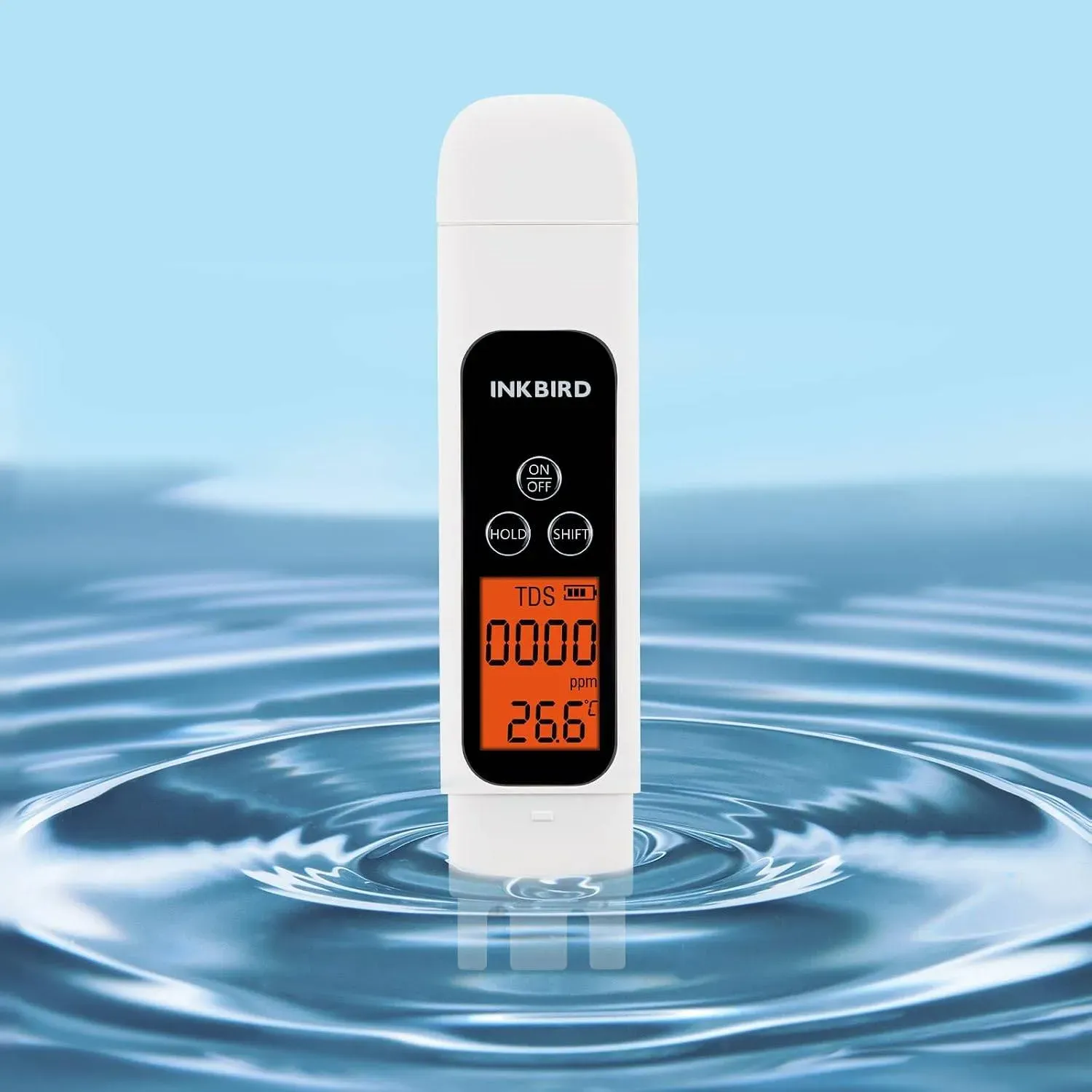
The INKBIRD ITDS-01 combines a TDS meter and EC tester in one pen with a backlit screen. It is sold on Amazon.ae by INKBIRD’s own store.
Manufacturer specifications
- Measurement range: TDS 0-4,995 ppm; EC 0-9,990 µS/cm
- Claimed accuracy: TDS ±2%; EC ±4%
- Resolution: not stated by the manufacturer
- EC measurement: yes
- Temperature: yes, 0-80°C, ±0.5°C
- Automatic temperature compensation: not stated by the manufacturer
- Calibration: coefficient adjustment (50-150%) using the device buttons, according to INKBIRD’s community support page, which also notes the setting does not persist after a restart
- Battery: 2 x AAA (not included, according to INKBIRD)
- Waterproof rating: not stated
Advantages
- EC and TDS on one screen at a low price
- Backlit display and widely available AAA batteries
Limitations
- ATC and resolution are not stated by the manufacturer
- Calibration is a coefficient setting, not calibration against a standard solution
Buying notes
Checked 26 September 2026: AED 87.99, sold by Inkbird Direct, fulfilled by Amazon, in stock with next-day delivery, 294 ratings.
Source: Amazon.ae product listing, INKBIRD ITDS-01 product page. Product details, seller, stock and price can change.
04
Hanna Instruments HI98301 DiST 1
documented calibration and detailed manufacturer specifications
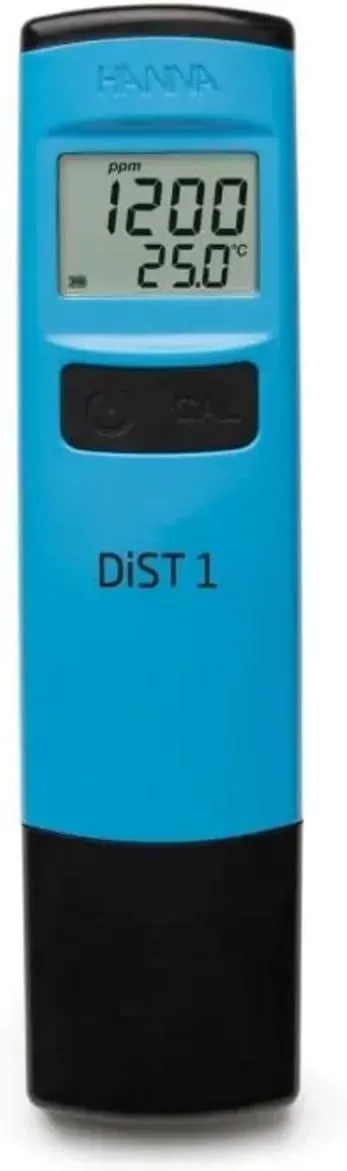
Hanna Instruments makes laboratory and field water-testing equipment. The DiST 1 is its pocket TDS tester, which Hanna states uses a graphite sensor and one-point automatic calibration.
Manufacturer specifications
- Measurement range: 0-2,000 mg/L (ppm)
- Claimed accuracy: ±2% of full scale
- Resolution: 1 ppm
- EC measurement: no (TDS only, conversion factor 0.5)
- Temperature: yes, 0.0-50.0°C, ±0.5°C
- Automatic temperature compensation: yes, 0-50°C
- Calibration: automatic, one point at 1,382 ppm
- Battery: CR2032 3V, about 250 hours of continuous use
- Waterproof rating: described as waterproof; no IP rating found on the product page reviewed
Best for:
Documented calibration and detailed manufacturer specifications
Approx. price
AED 470-480 on Amazon.ae
Advantages
- Detailed manufacturer documentation
- Automatic calibration and a stability indicator
Limitations
- Highest price in this guide by a wide margin
- ±2% of full scale is roughly ±40 ppm across the range, which matters most for low readings such as RO water
Buying notes
Checked 26 September 2026: AED 475.00, sold by Geo Alpha General Trading LLC, delivered by Amazon.ae, AED 10 delivery, no customer ratings shown.
Source: Amazon.ae product listing, Hanna HI98301 product page. Product details, seller, stock and price can change.
05
Xiaomi Mi TDS Pen
budget pick, with specification limitations
The Xiaomi Mi TDS Pen is one of the most widely listed budget TDS testers in the UAE, often sold as a water quality tester. Official Xiaomi specifications could not be accessed for this guide.
Specifications: range, accuracy, resolution, temperature measurement, ATC, calibration method, battery type and water resistance could not be verified. Reseller listings state both 0-999 ppm and 0-9,990 ppm as the range. No EC reading is listed.
The Amazon.ae listing states that the pen can “detect” heavy metals and other impurities. A TDS pen cannot identify individual substances; it gives one combined estimate of dissolved ions.

Best for:
Budget pick, with specification limitations
Approx. price
AED 40-50 on Amazon.ae
Advantages
- Lowest price in this guide
- Simple to use for basic comparisons
Limitations
- Specifications and calibration method not verified
- Listing wording overstates what a TDS pen can do
Buying notes
Checked 26 September 2026: AED 45.00, sold by Prime Lifestyle UAE, fulfilled by Amazon, in stock, 490 ratings.
Source: Amazon.ae product listing. Product details, seller, stock and price can change.
What Is TDS in Water?
Total dissolved solids (TDS) is the combined amount of inorganic salts and small amounts of organic matter dissolved in water. The World Health Organization (WHO) describes the main constituents as calcium, magnesium, potassium, sodium, bicarbonates, chlorides and sulfates.
These substances are dissolved, not floating, so they cannot be seen and are not removed by a simple sediment filter. Most of them exist in water as charged particles called ions.
ppm and mg/L
TDS is usually shown in parts per million (ppm) or milligrams per litre (mg/L). For fresh drinking water, the two units are treated as equivalent, so a reading of 150 ppm is generally read as about 150 mg/L. Regulations, including those in Abu Dhabi, use mg/L, while most consumer meters display ppm.
Why TDS varies in UAE homes
Much of the UAE’s drinking water is produced by desalination, which removes most dissolved salts. Utilities then adjust the water before distribution. The reading at a kitchen tap can also be influenced by the building’s storage tanks, pipework and any filters fitted in the home, so readings may differ between buildings and even between taps in the same apartment.
What Does a TDS Meter Actually Measure?
A consumer TDS meter does not weigh dissolved solids. It passes a small electrical current between two metal probes and measures electrical conductivity (EC). Dissolved ions carry current, so water with more ions conducts electricity more readily.
The meter then converts conductivity into an estimated TDS value using a conversion factor:
Estimated TDS (ppm) = EC (µS/cm) x conversion factor
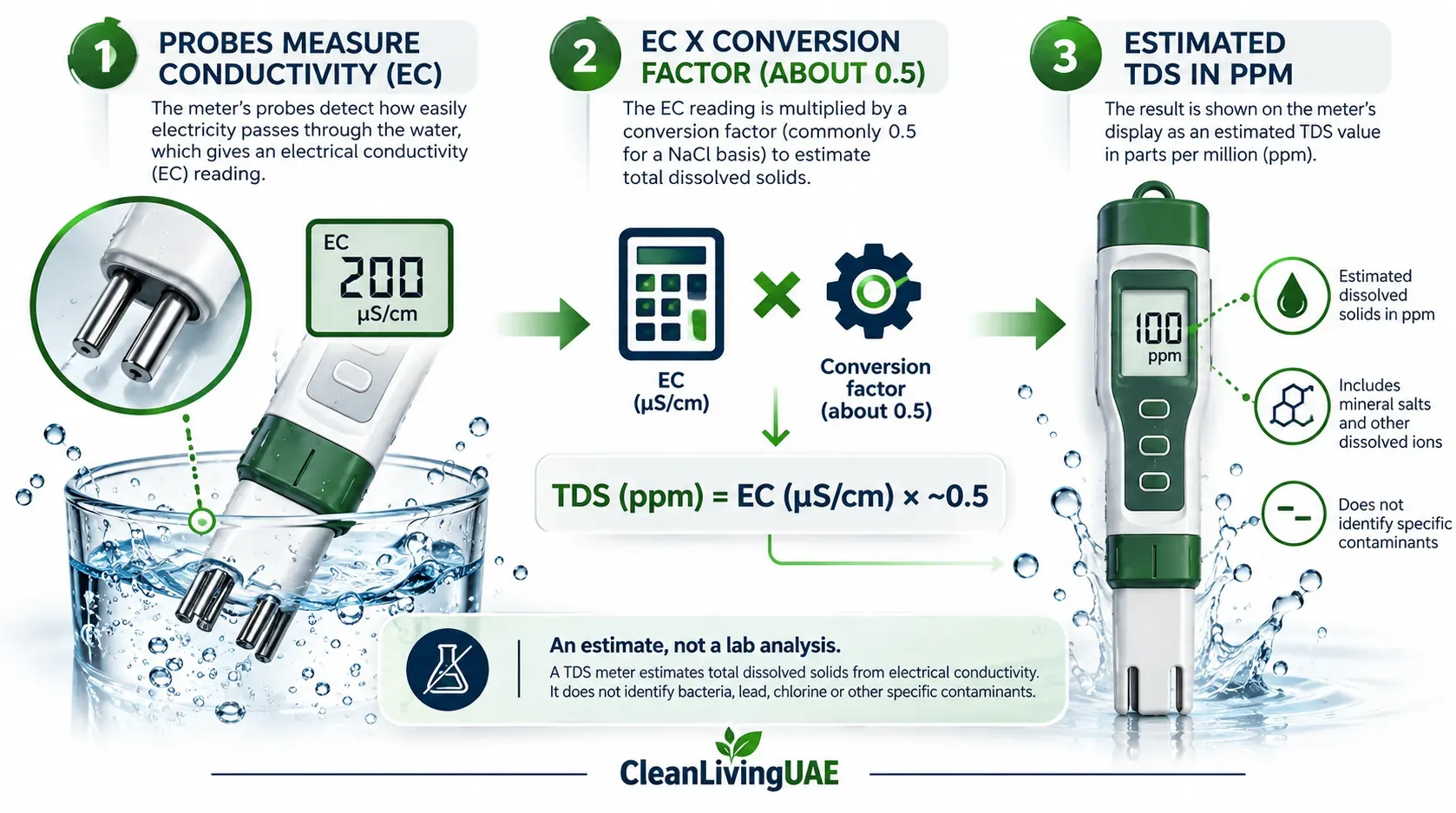
Many consumer meters, including the HM Digital AP-1 and Hanna DiST 1, use a factor of about 0.5 based on sodium chloride. Other scales, such as a 0.7 factor, assume a different mix of minerals.
Why two meters can give different readings
Small differences between meters are common. The main reasons include:
- Different conversion factors, such as 0.5 or 0.7
- Different accuracy ratings and calibration states
- Temperature, because conductivity rises as water warms
- Low battery or dirty, scratched probes
- Air bubbles on the probe or a reading taken before it stabilised
Because the conversion factor assumes a mineral mix, a TDS meter gives an estimate rather than a laboratory measurement. Using the same meter for all comparisons reduces this problem.
How to Test Tap Water With a TDS Meter
Knowing how to check TDS in water correctly matters more than the meter itself. The steps below apply to most handheld pens used as a TDS meter for tap water or a TDS meter for drinking water; always follow the meter’s own instructions.
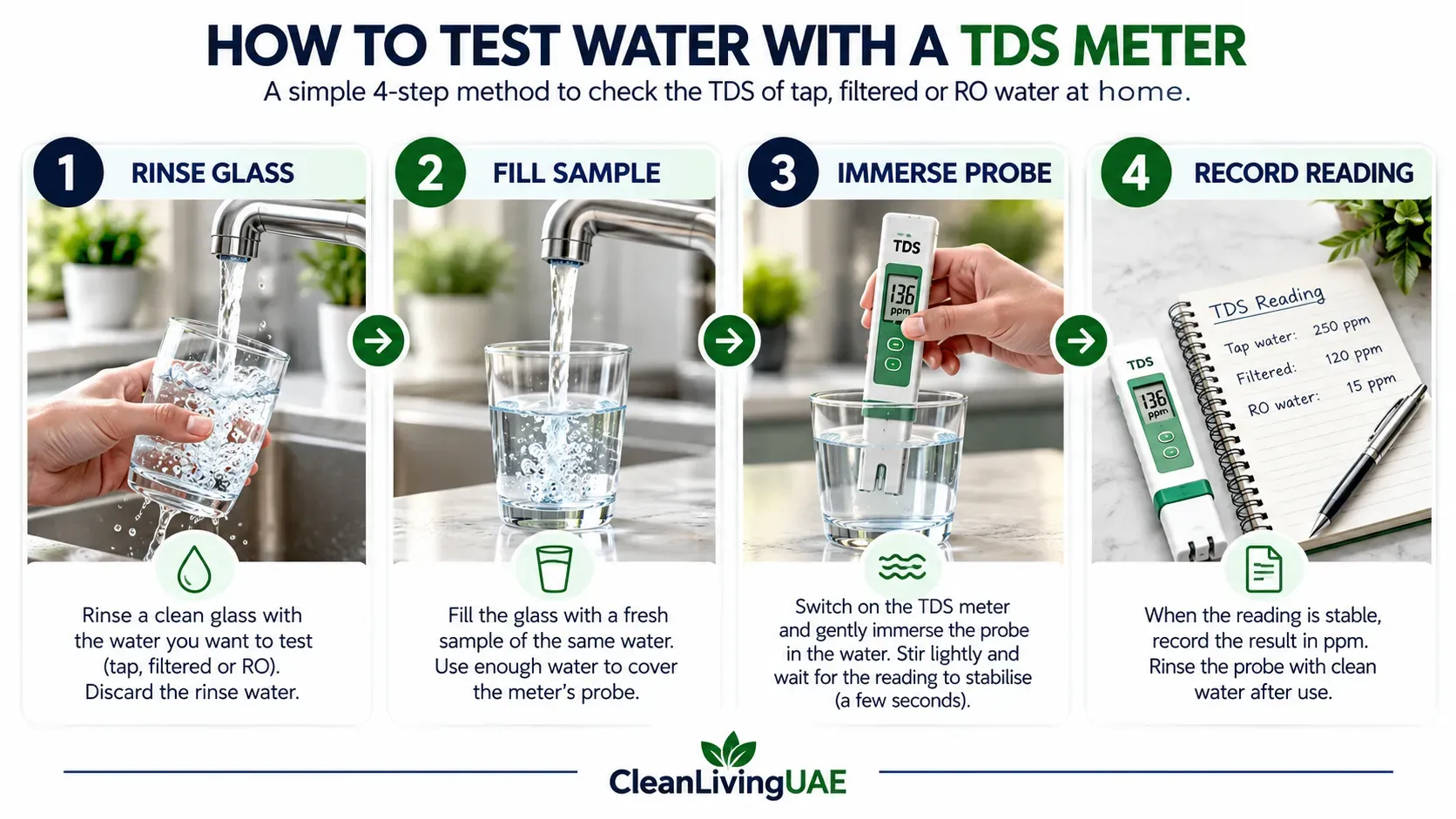
- Use a clean glass. Plastic or glass is fine, as long as it has no soap or residue.
- Rinse the glass with the water being tested, then empty it.
- Collect a fresh sample. Running the tap for a few seconds first helps avoid water that has been sitting in the pipe.
- Remove the protective cap and switch on the meter.
- Immerse the probes to the correct depth. Do not submerge the meter beyond the maximum immersion level shown in the manual, especially models without a stated waterproof rating.
- Stir gently to release air bubbles, then allow the reading to stabilise. Meters with ATC may take a few seconds to adjust to the water temperature.
- Record the result, together with the date, time, water source and temperature if the meter shows it.
- Rinse the probe with clean water, shake off excess drops, switch the meter off and replace the cap.
Manufacturer-specific cautions
- The AP-1 and DiST 1 list ATC, but INKBIRD does not state ATC for the ITDS-01, so testing samples at a similar temperature matters more with that meter. In UAE summers, water from rooftop tanks can arrive warm.
- The HM Digital DM-1 is an in-line monitor and is not designed for glass testing.
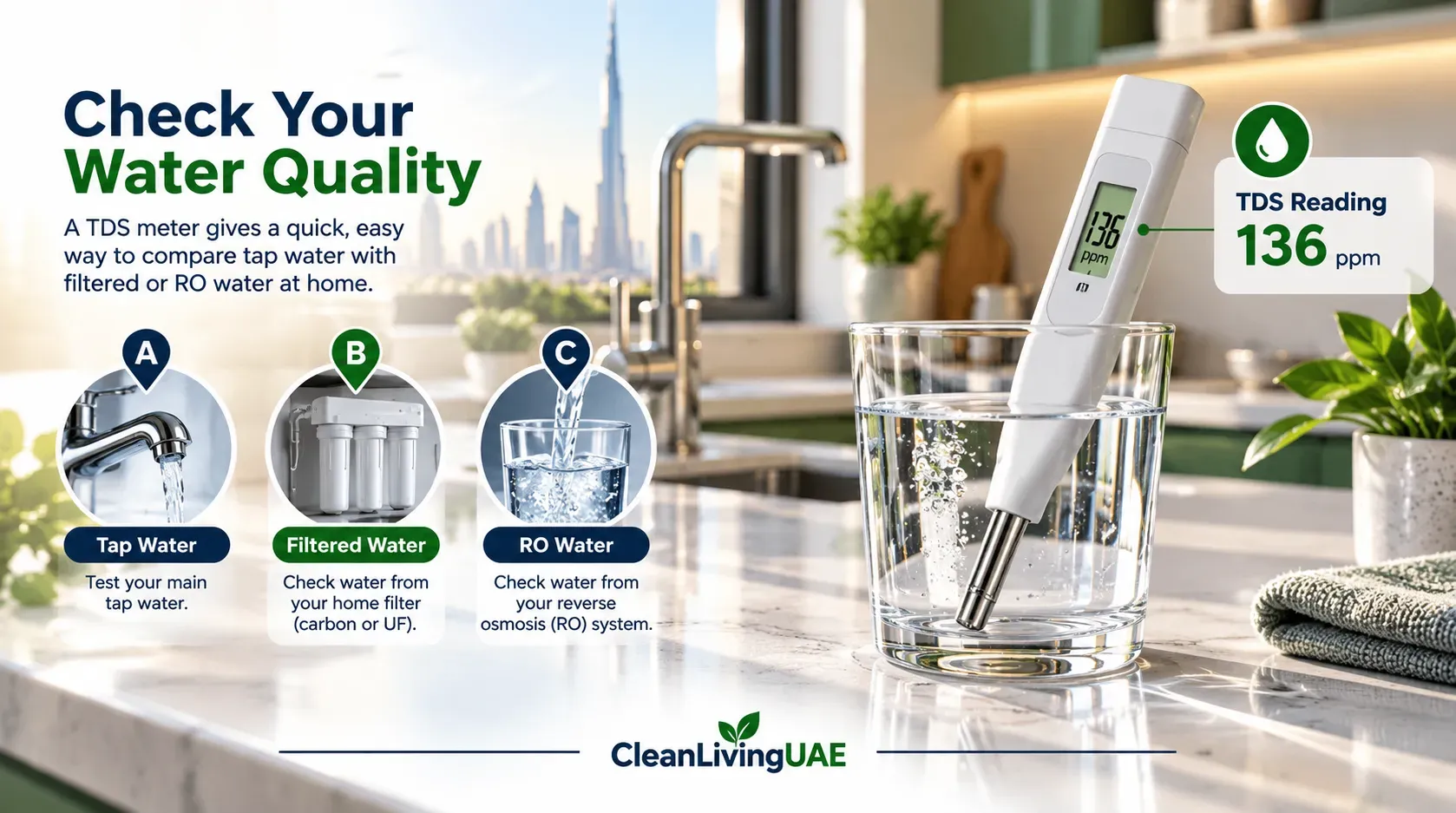
Test Your UAE Tap Water in 5 Minutes
A single TDS ppm number says little on its own. Comparing samples from the same home, with the same meter, on the same day, is far more informative.
Prepare three clean glasses:
- Sample A – unfiltered tap water from the kitchen tap
- Sample B – filtered drinking water (tap filter, jug or countertop filter)
- Sample C – RO water, if an RO system is installed
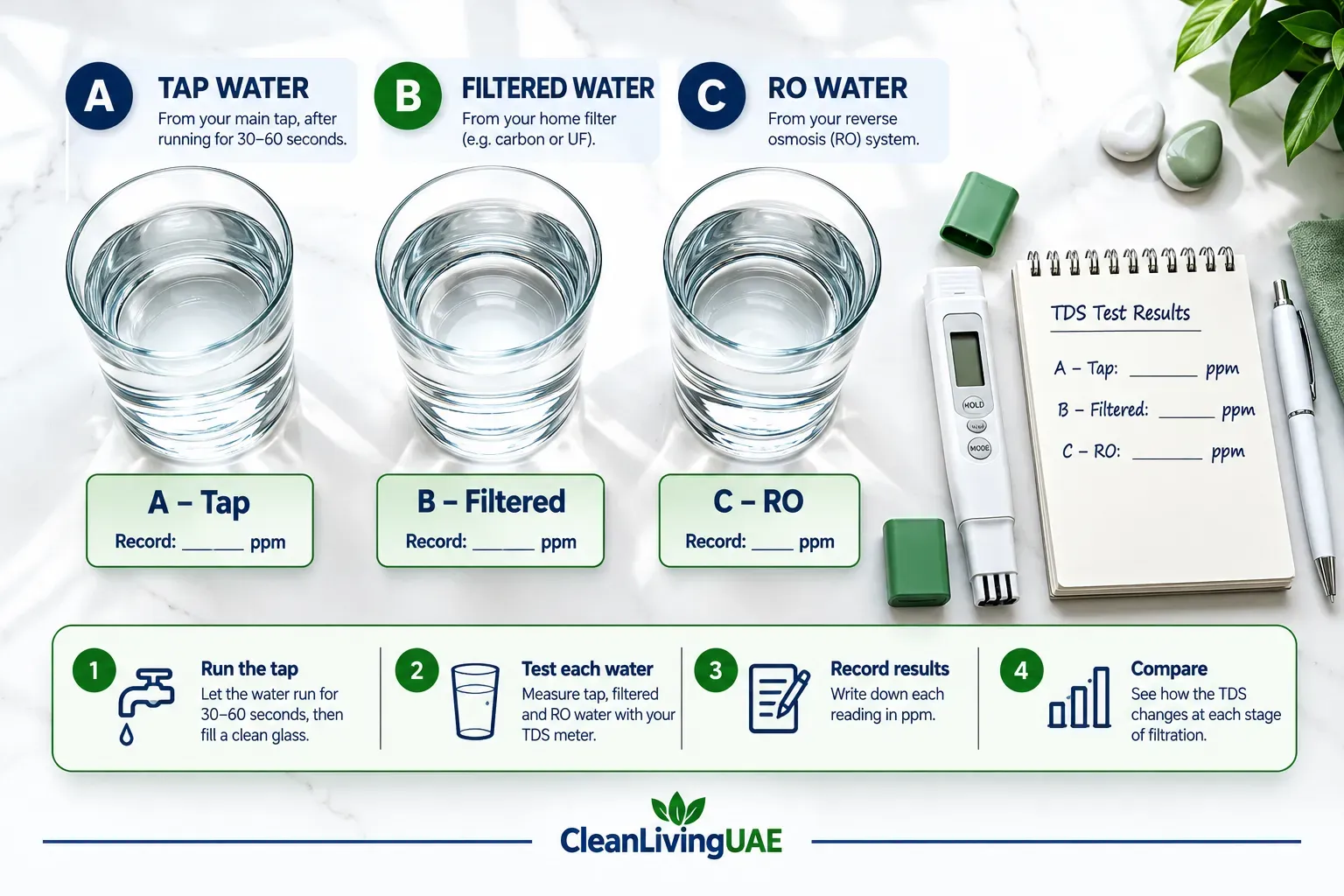
Test each sample using the steps above, rinsing the probe between samples. Record the results in a simple table and repeat the test every few weeks, or after changing a filter cartridge.
On mobile, scroll sideways to see the full table.
| Water Source | TDS Reading | What to Record |
|---|---|---|
| Sample A – tap water | ___ ppm | Date, time, tap used, water temperature |
| Sample B – filtered water | ___ ppm | Filter type, cartridge age |
| Sample C – RO water | ___ ppm | RO model, last filter or membrane change |
What to look for:
- A sudden change in tap water TDS compared with earlier readings
- RO water TDS that gradually rises toward the tap-water reading
- Filtered water TDS that is higher than tap water, which may point to a filter or remineralisation stage adding minerals
Any unexplained change is a reason to look more closely, not proof of a problem.
What Is a Good TDS Level for Drinking Water in the UAE?
There is no single “good” TDS level in drinking water that confirms it is safe. TDS is one regulated parameter among many, and water quality in the UAE is assessed by the relevant authorities against a much wider set of parameters.
The Abu Dhabi regulatory reference
The Abu Dhabi Department of Energy (DoE) Water Quality Regulations 2025 list Total Dissolved Solids with a maximum of 600 mg/L. The regulations also state that licensees shall always target a minimum TDS concentration above 100 mg/L.
These figures apply to regulated water supplied by licensees in Abu Dhabi, sampled at designated points alongside many microbiological, chemical and physical parameters. They should not be read as a rule that “100-600 ppm means household water is safe.” Other emirates have their own utilities and regulatory frameworks, so the Abu Dhabi figures should not be assumed to represent every emirate.
What international bodies say
- The WHO states that reliable data on possible health effects of TDS in drinking water are not available, and it proposes no health-based guideline value. It notes that high TDS may be objectionable to consumers.
- In the United States, the Environmental Protection Agency (EPA) lists a non-enforceable secondary standard of 500 mg/L for TDS, based on aesthetic effects such as taste, deposits and staining rather than health.
Taste, minerals and safety are separate questions
- Taste: very low or very high TDS can change how water tastes. Preferences vary between people.
- Mineral content: TDS includes calcium and magnesium, but also sodium, chloride and other ions. It does not show the balance between them.
- Safety: depends on microbiological, chemical and physical quality, including contaminants that a TDS meter cannot detect.
No authoritative source reviewed supports labels such as “excellent” or “ideal” for household TDS bands, so this guide does not use them.
Does High TDS Mean UAE Tap Water Is Unsafe?
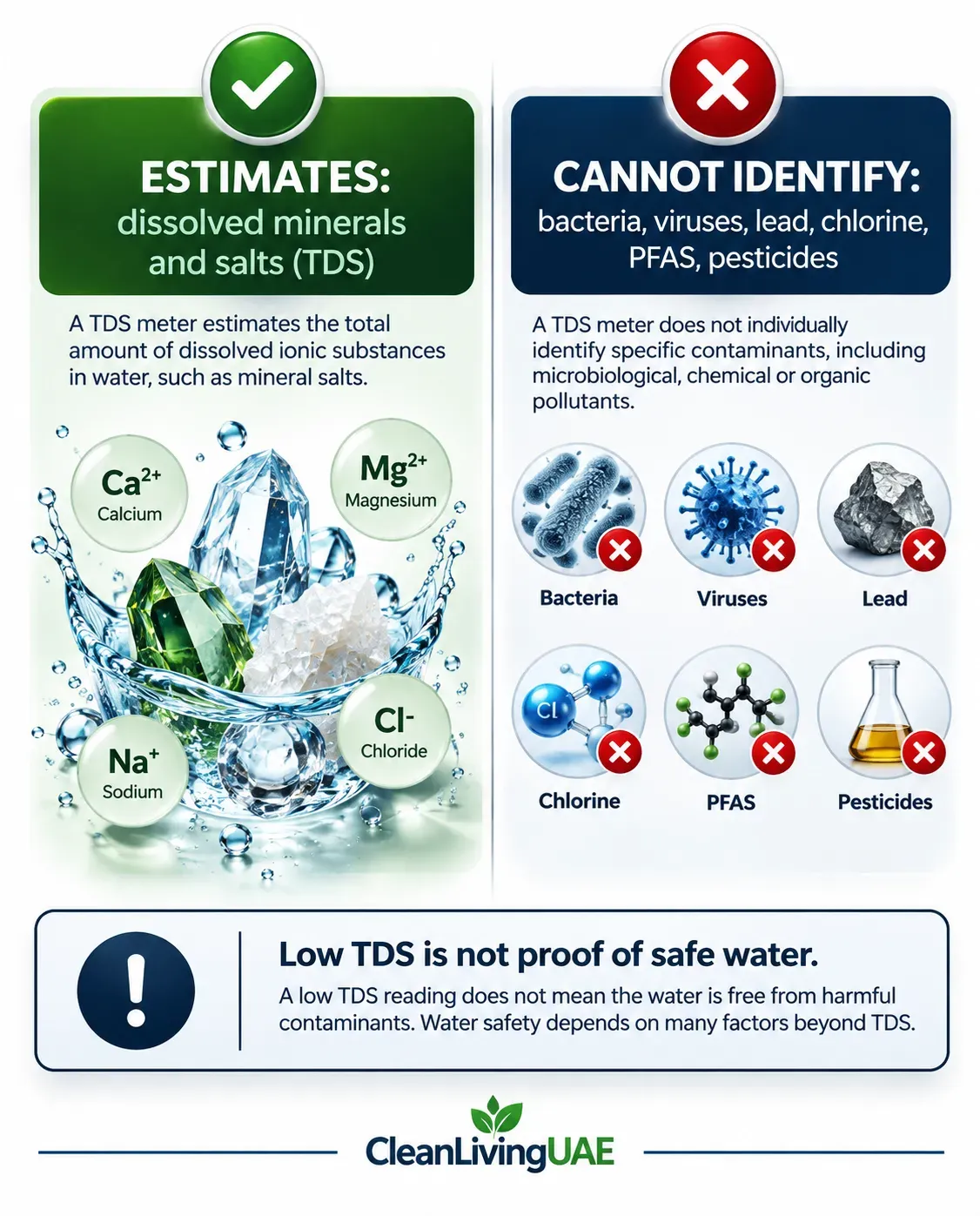
Not necessarily. A higher TDS reading shows more dissolved ions, which are often harmless minerals such as calcium, magnesium and bicarbonate. It does not show which substances are present.
Equally, a low reading is not proof of safe water. Bacteria, viruses and many chemical contaminants contribute little or nothing to conductivity, so water can have a low TDS and still be contaminated.
Dubai Electricity and Water Authority (DEWA) states that its supply meets international standards, including WHO guidelines, and has said that internal networks and storage tanks after the meter are the responsibility of building owners and maintenance companies. In practice, questions about tap water in apartments often relate to the building’s tanks and pipework rather than the municipal supply. Confirming water safety requires laboratory testing for the relevant parameters.
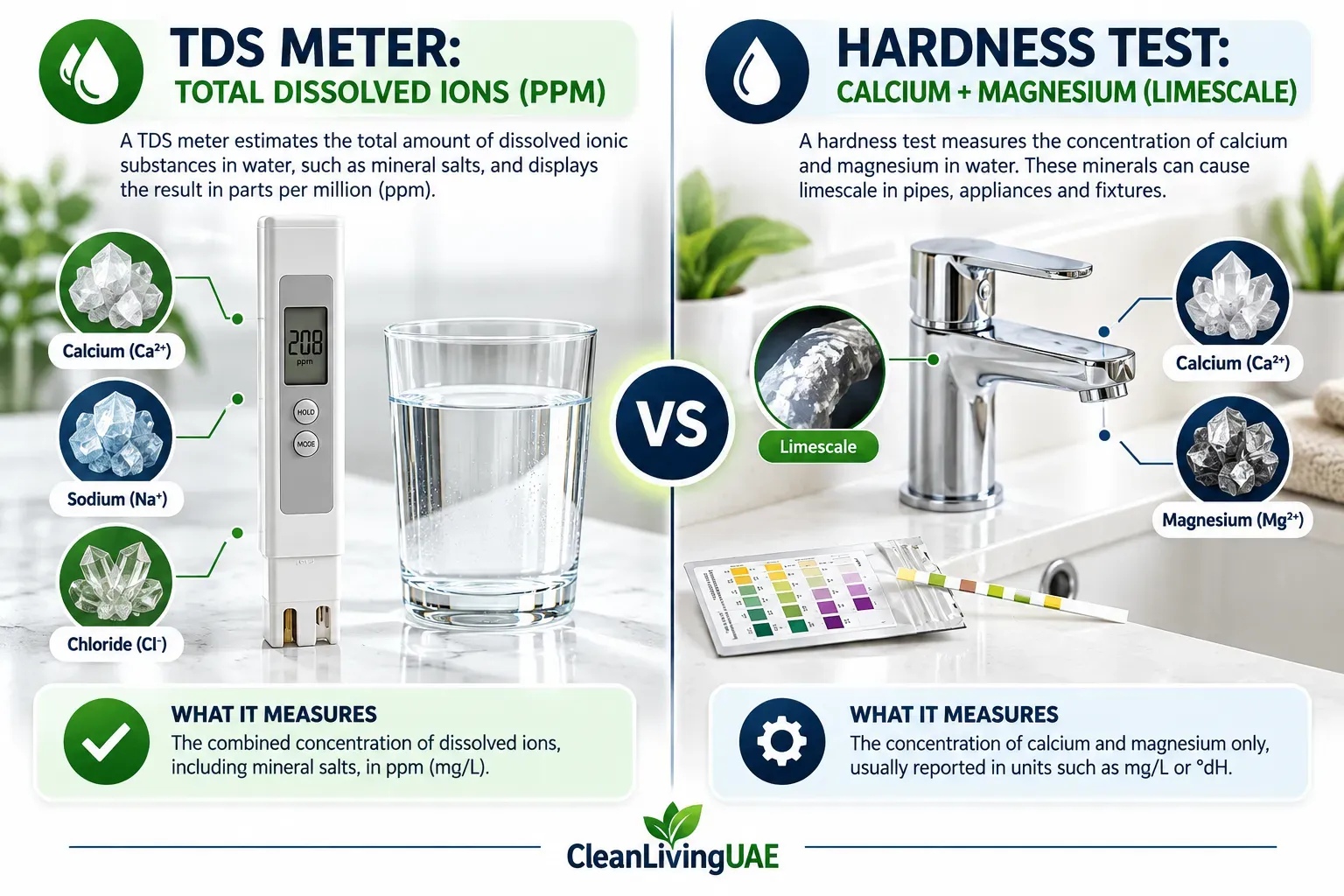
Does a TDS Meter Measure Water Hardness?
No. TDS and hardness are different measurements.
- Hardness mainly refers to dissolved calcium and magnesium, usually expressed as mg/L as calcium carbonate (CaCO3).
- TDS includes calcium and magnesium, but also sodium, potassium, chloride, sulfate and other ions.
Two water samples can have similar TDS readings but very different hardness. This is the core difference in any TDS meter vs water hardness test comparison. For UAE households dealing with white residue on taps, glass shower screens and kettles, a dedicated hardness test (test strips or a drop-count titration kit) gives a more relevant answer. The Abu Dhabi DoE regulations list separate limits for total hardness and calcium hardness, which shows they are treated as distinct parameters.
TDS Meter vs Water Hardness Test
On mobile, scroll sideways to see the full table.
| Feature | TDS Meter | Water Hardness Test |
|---|---|---|
| What it measures | Estimated total dissolved ions | Calcium and magnesium |
| Typical unit | ppm or mg/L | mg/L as CaCO3, gpg or °dH |
| Best use | Comparing tap, filtered and RO water | Assessing limescale and softener needs |
| Detects limescale risk directly? | No | Yes, more directly |
| Determines drinking-water safety? | No | No |
| Typical home use | Pen meter, seconds per test | Strips or drop kit |
For limescale problems, see the guides to hard water stains in UAE homes and limescale removal solutions.
TDS Before and After a Water Filter
Different filtration technologies affect TDS differently, so a TDS meter is a fair test for an RO system but not for every filter. Cartridge condition also affects readings; the water filter cartridge guide covers replacement intervals for common systems.
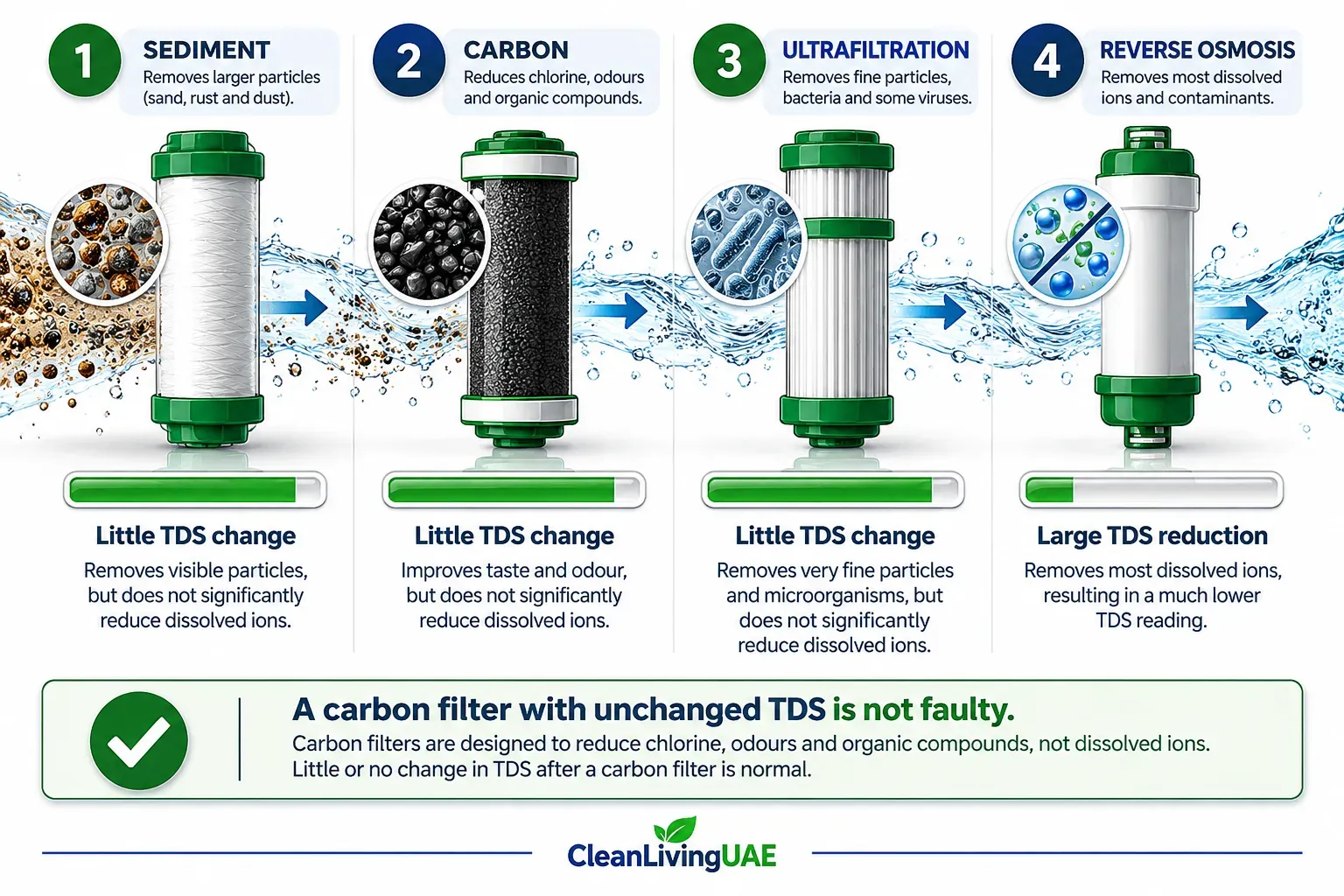
Sediment filtration
Sediment filters trap sand, rust and other particles. Dissolved ions pass through, so TDS usually changes very little.
Activated carbon
Activated carbon is commonly associated with reducing chlorine taste and odour and many organic compounds. It is not designed to remove dissolved mineral salts, so TDS often stays almost the same. An unchanged reading after a carbon filter does not mean the filter is faulty.
Tap and faucet filters
Most tap-mounted filters combine carbon with ion exchange or fine membranes and target taste, odour, particles and certain metals rather than overall dissolved solids. The tap and faucet water filters guide for UAE renters explains what these filters are designed to reduce.
Ultrafiltration
Ultrafiltration membranes remove very small particles, and some manufacturers claim reductions in certain microorganisms. Dissolved ions are generally small enough to pass through, so TDS changes little.
Reverse osmosis
RO forces water through a semi-permeable membrane that rejects a large share of dissolved ions, so it generally produces a much larger TDS reduction than other household filters. Many units add minerals back through a remineralisation stage, which raises the TDS of the final water. Readers comparing systems can see the RO and under-sink water purifier guide and the wider best home water filters in the UAE comparison.
Water softeners
Ion-exchange softeners swap calcium and magnesium for other ions, usually sodium, rather than removing dissolved solids. TDS may change relatively little even when hardness falls, so a hardness test is the better check. The water softener guide for the UAE covers this in more detail.
How to Use a TDS Meter to Check an RO System
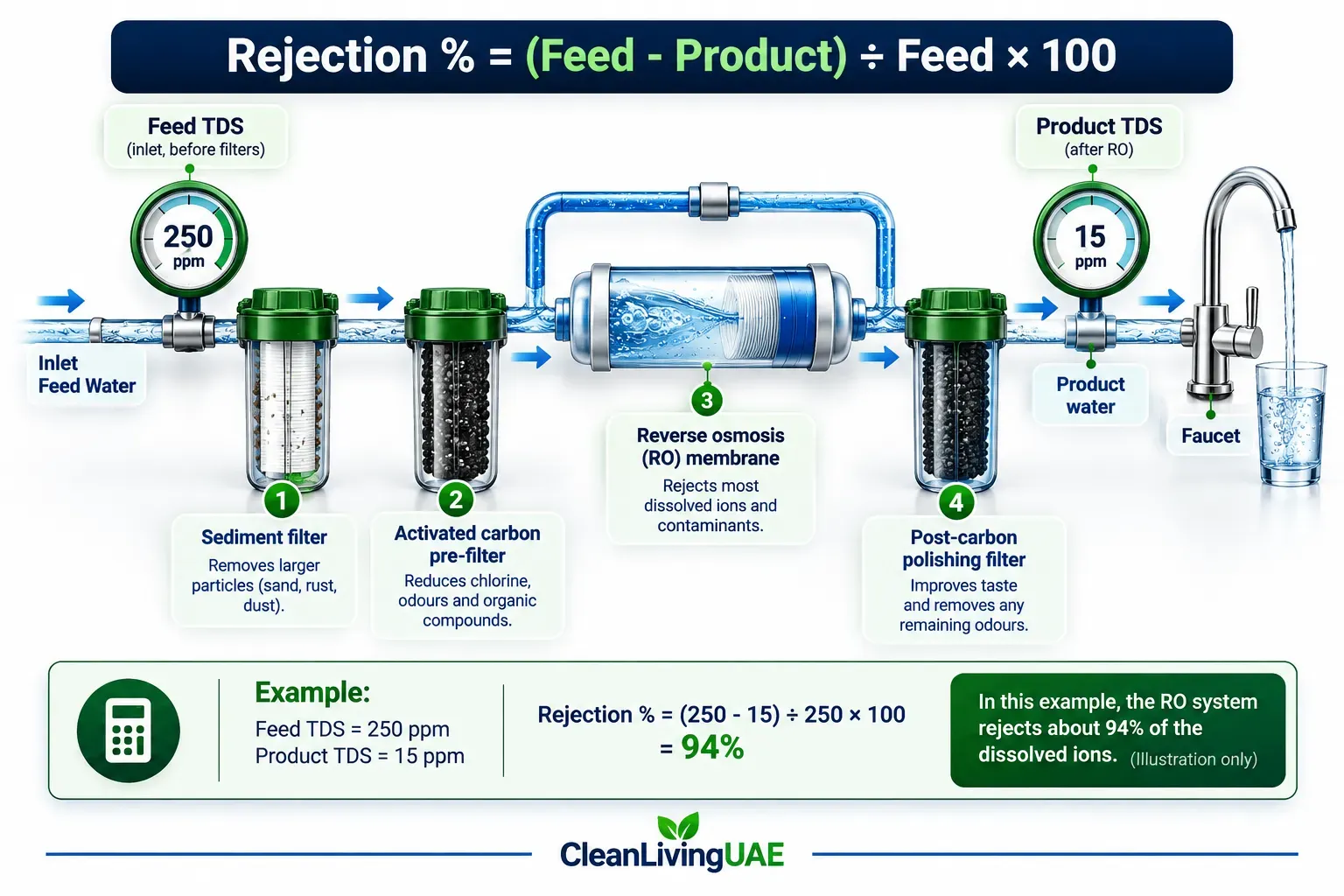
Comparing feed-water TDS (water entering the RO system) with product-water TDS (water leaving the membrane) shows how much of the dissolved load the membrane is rejecting.
TDS rejection % = [(feed TDS – product TDS) ÷ feed TDS] x 100
Hypothetical example, not a UAE expected reading: if feed water reads 250 ppm and product water reads 15 ppm, the calculation is [(250 – 15) ÷ 250] x 100 = 94% rejection.
Practical points:
- Test feed and product water with the same meter, on the same day, at a similar temperature.
- If the system has a remineralisation stage, the tap reading reflects added minerals. Check the manufacturer’s instructions for where to sample.
- Track the percentage over time. A steady decline is often described as a sign that a membrane or pre-filter needs attention. Follow the manufacturer’s replacement guidance.
- An in-line monitor such as the HM Digital DM-1 shows feed and product readings continuously.
When a TDS Meter Is Not Enough
A TDS meter is a screening and comparison tool. Professional laboratory testing through an accredited laboratory, or advice from the relevant water utility or municipality, may be more appropriate in these situations:
- Unusual taste, smell or colour: can have many causes that TDS cannot identify.
- Suspected contamination: for example after plumbing work, flooding or a nearby leak.
- Building water-tank concerns: sediment, poor tank maintenance or irregular cleaning. Building management is usually the first point of contact. Villas with sediment or taste problems at several outlets may need a whole house water filter rather than a point-of-use system.
- Microbiological concerns: bacteria and viruses require microbiological testing.
- Heavy metals: lead, copper, arsenic and other metals require specific tests.
- Specific chemical contamination: pesticides, PFAS and other chemicals require targeted laboratory analysis.
Any health concern related to drinking water should be discussed with a healthcare professional and the relevant authority. No meter result should be treated as a safety guarantee.
How to Choose a TDS Meter in the UAE
- Accuracy: look for a published figure and check whether it is a percentage of the reading or of full scale.
- Range: 0-2,000 ppm covers most household drinking water.
- Calibration: check whether the meter can be recalibrated and which standard solution it needs.
- Temperature: ATC and a temperature display help where tap water temperature changes between seasons.
- EC measurement: useful for users who want the underlying conductivity rather than a converted number.
- Build and power: water resistance is rarely rated on budget pens; replaceable LR44, CR2032 or AAA batteries are widely available.
- Documentation and availability: published manuals, a local seller and the delivery estimate matter more than listing claims.
- Price: a well-documented TDS water tester in the AED 70-90 range covers most household needs.
TDS Meter Maintenance and Calibration
Probe rinsing
Rinse the probe with clean water after every test. Mineral film or residue on the electrodes can affect later readings.
Storage
Dry the probe, replace the cap and store the meter away from direct sun and heat. In the UAE, avoid leaving meters in cars or on balconies during summer.
Calibration
Calibration frequency depends on the meter and how often it is used, so follow the manufacturer’s instructions. Each meter’s calibration method is listed in its review above. Use fresh calibration solution and do not pour used solution back into the bottle.
Battery replacement
Replace batteries when the low-battery indicator appears or readings become unstable. Use the battery type stated in the manual.
Avoiding probe contamination
- Do not test soapy, oily or very hot liquids unless the manual allows it.
- Do not touch the electrodes with fingers.
- Do not submerge the meter beyond the stated immersion level.
Final Verdict
- Basic household checking: HM Digital AP-1.
- RO monitoring: HM Digital DM-1, for homes with an existing under-sink RO system.
- EC and TDS on a budget: INKBIRD ITDS-01, noting that ATC is not stated.
- Documented calibration: Hanna HI98301 DiST 1, for users willing to pay more.
- Budget users: Xiaomi Mi TDS Pen, with unverified specifications.
For most readers, how a meter is used matters more than the differences between well-documented models: test consistently, compare samples and remember that TDS alone does not establish water safety. Households that prefer bottled water can compare top- and bottom-loading water dispensers in the UAE.
Frequently Asked Questions
What is a TDS meter?
A TDS meter is a handheld or in-line device that measures electrical conductivity and converts it into an estimated total dissolved solids reading in ppm or mg/L.
What is a good TDS level for drinking water in the UAE?
No single number confirms safe water. The Abu Dhabi DoE Water Quality Regulations 2025 set a 600 mg/L maximum and a target minimum above 100 mg/L for regulated supply, but safety depends on many other parameters.
How do I test my tap water with a TDS meter?
Rinse a clean glass with the water, collect a fresh sample, immerse the probe to the correct depth, wait for the reading to stabilise, record it and rinse the probe.
Does a TDS meter tell me whether water is safe to drink?
No. It estimates dissolved ions only. It cannot identify bacteria, viruses, lead, chlorine, PFAS or other specific contaminants.
Does a TDS meter measure water hardness?
No. Hardness refers mainly to calcium and magnesium, while TDS includes many other ions. A hardness test kit gives a more relevant result for limescale.
Why is my filtered-water TDS almost the same as tap water?
Carbon, sediment, tap and ultrafiltration filters are not designed to remove dissolved salts, so little change is expected. This does not mean the filter is faulty.
Should RO water have lower TDS?
Generally yes, because RO membranes reject a large share of dissolved ions. A remineralisation stage, if fitted, will raise the final reading.
How accurate are cheap TDS meters?
It varies. Some budget pens publish no verifiable accuracy figure. Meters with stated accuracy, such as ±2%, are easier to rely on for consistent comparisons.
How often should a TDS meter be calibrated?
There is no universal schedule. Follow the manufacturer’s instructions and check calibration if readings look inconsistent or after heavy use.
Can a TDS meter detect chlorine or bacteria?
No. Free chlorine and microorganisms are not identified by a TDS meter. Chlorine needs a dedicated chlorine test, and bacteria require microbiological laboratory testing.
Sources
Regulatory and technical information comes from the Abu Dhabi Department of Energy Water Quality Regulations 2025, the World Health Organization chemical fact sheet on total dissolved solids, the US Environmental Protection Agency secondary drinking water standards, the Dubai Electricity and Water Authority and a Gulf News report on DEWA’s position on internal networks and tanks. Product specifications come from HM Digital’s product pages for the AP-1 and DM-1, INKBIRD’s ITDS-01 product page and community calibration guidance, and Hanna Instruments’ HI98301 DiST 1 page. Prices, sellers and availability come from Amazon.ae listings checked on 26 September 2026.