11 Effective Fixes for Balcony Dust in UAE Apartments
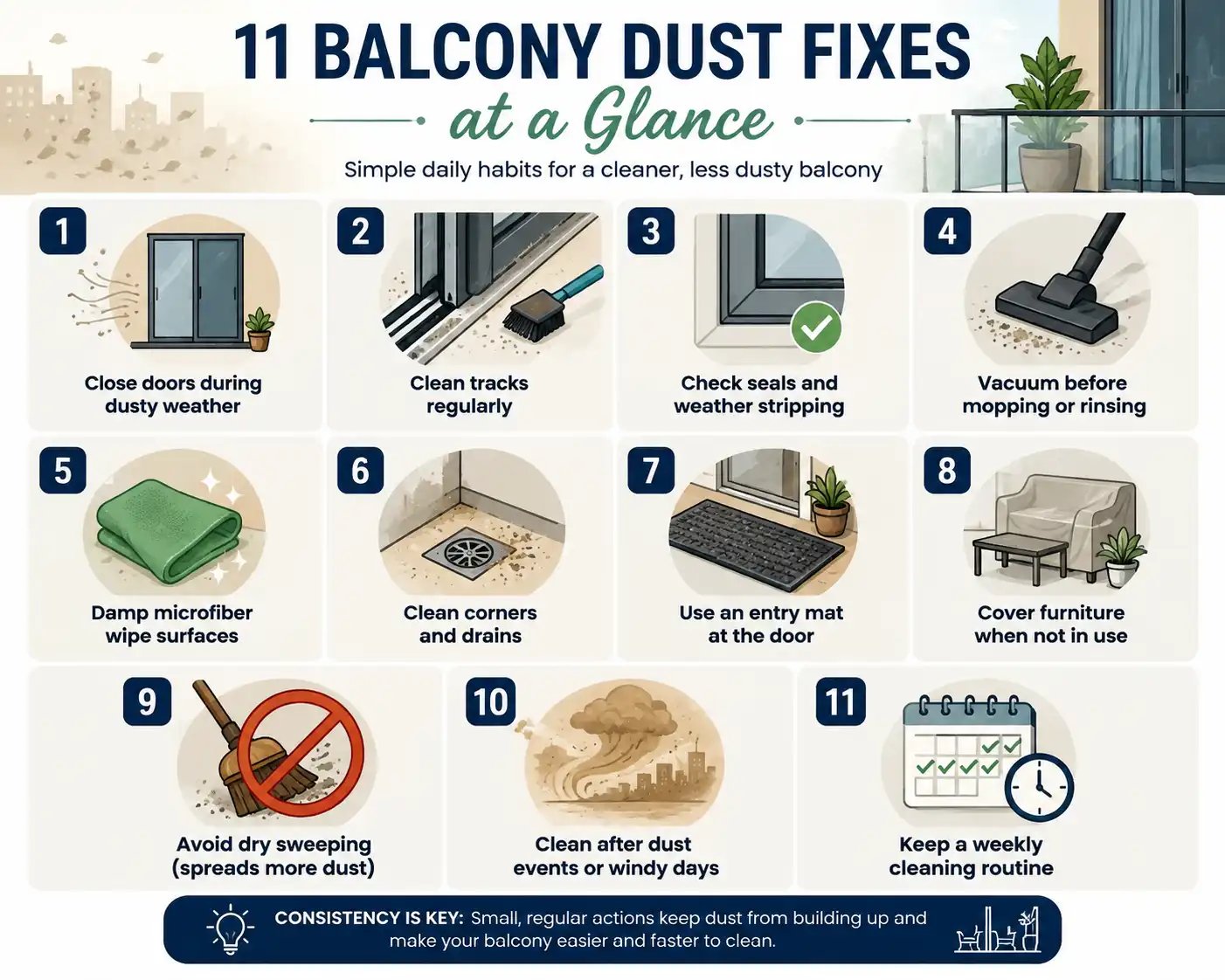
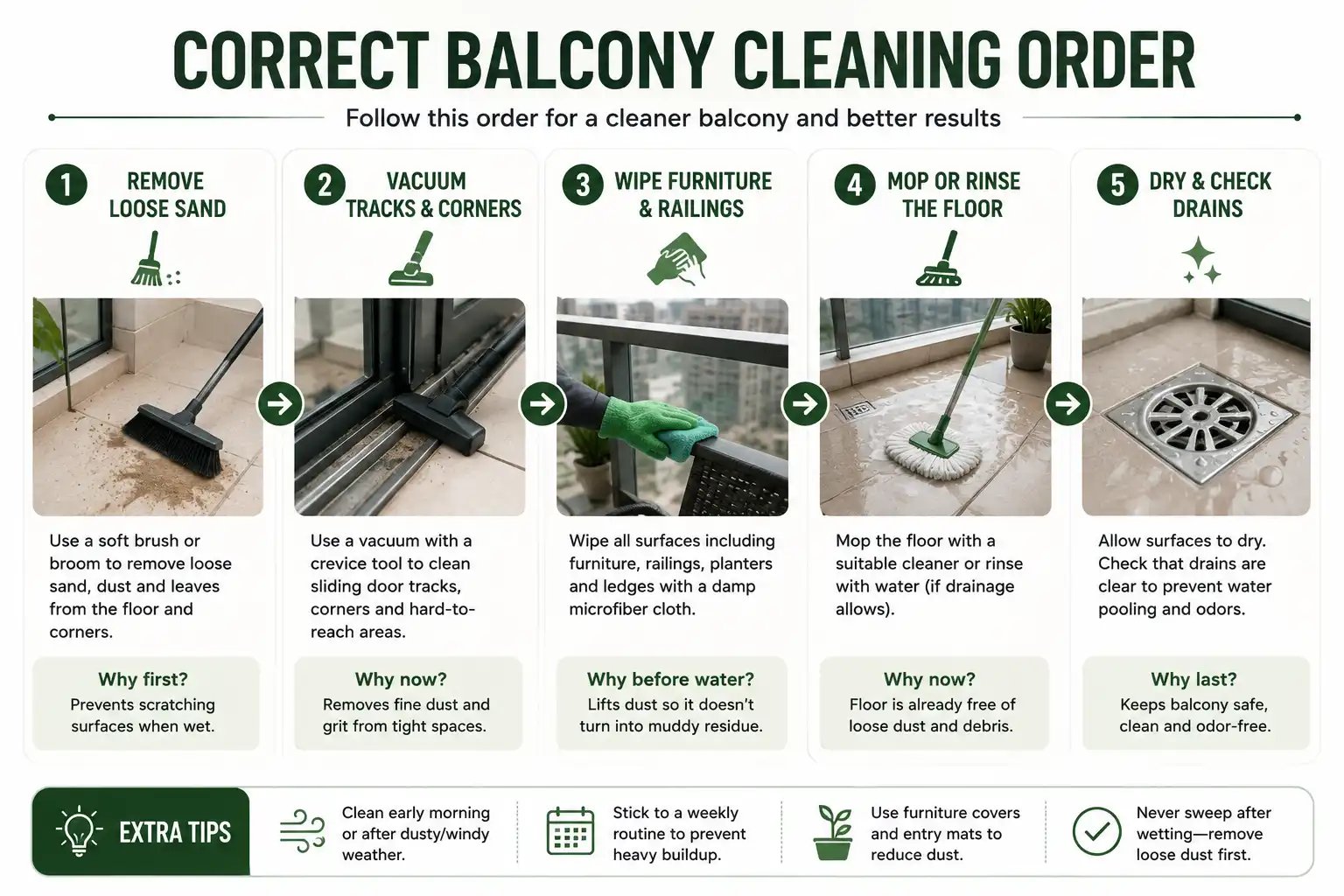
Limit how long balcony doors stay open when outdoor conditions are dusty or windy. This reduces the amount of fine dust that can move directly into the apartment.
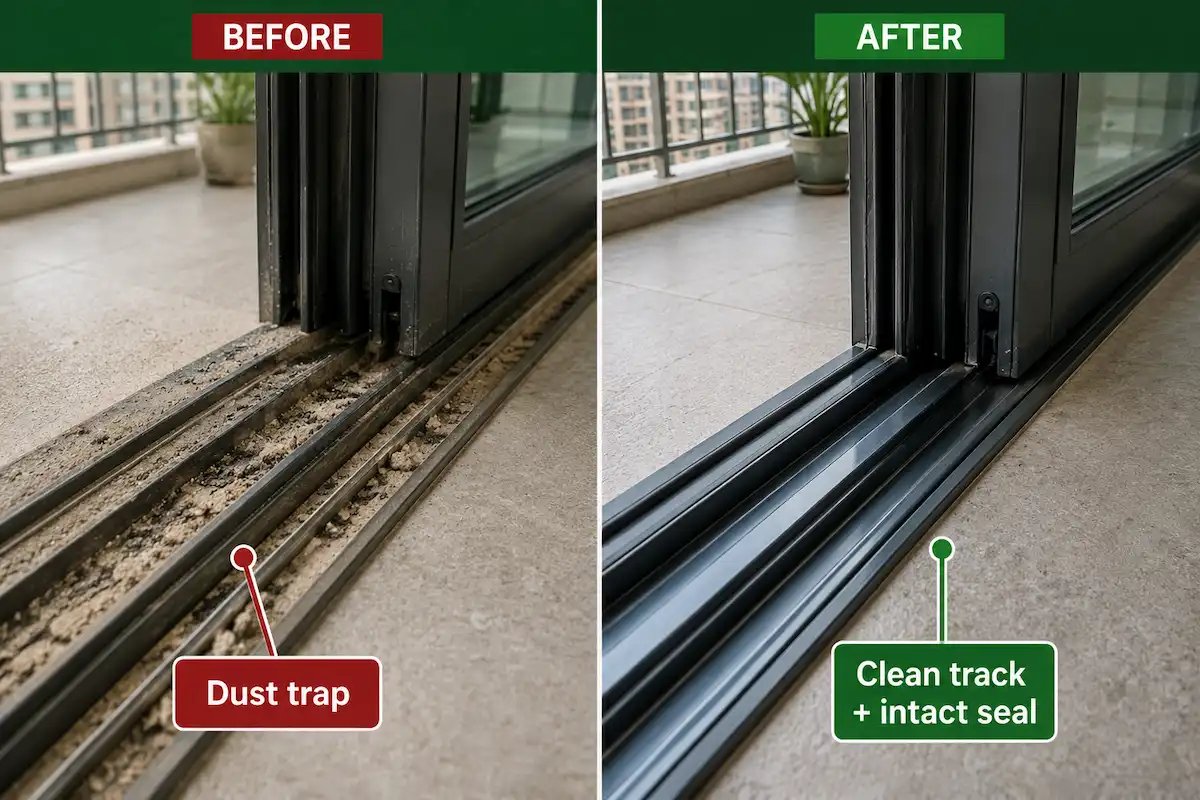
Dust and sand collect quickly in sliding-door tracks. Vacuum loose debris first, then wipe the track with a damp microfiber cloth to prevent buildup from being carried indoors.
Inspect the edges of balcony doors for worn, loose or missing seals. Replacing damaged weather stripping can help reduce dust entering through small gaps when the door is closed.
Remove loose dust and sand before adding water. Vacuuming first helps prevent fine particles from turning into muddy residue on tiles, grout and door tracks.
A lightly damp microfiber cloth is useful for picking up fine dust from railings, tables, chairs and other balcony surfaces without spreading as much loose dust into the air.
Balcony corners, drainage channels and wall edges can trap dust that later spreads back across the floor. Include these areas in routine cleaning rather than focusing only on the open floor.
A suitable mat just inside the balcony entrance can help catch sand and grit from shoes before it reaches the rest of the apartment. Clean the mat regularly so it does not become another dust source.
A suitable entry mat for UAE homes just inside the balcony entrance can help catch sand and grit from shoes before it reaches the rest of the apartment. Clean the mat regularly so it does not become another dust source.
Furniture cushions, tables and decorative items collect dust quickly. Using washable covers or storing smaller items indoors can reduce the number of surfaces that need frequent cleaning.
Dry sweeping can lift fine particles back into the air. For light dust, vacuuming followed by damp wiping or mopping is usually a more controlled approach.
After particularly dusty or windy weather, remove heavier deposits before they are repeatedly tracked through the balcony door or compacted into sliding tracks and grout lines.
A consistent routine is easier than waiting for heavy buildup. Vacuum or remove loose dust, clean the door tracks, wipe exposed surfaces and mop the floor as needed based on how quickly dust returns.
Quick Signs Your Balcony Has Excessive Dust Exposure
- Visible dust layer returns within 24 to 48 hours of cleaning
- Grit and compacted particles in sliding door tracks
- Dust on laundry after outdoor drying
- Cushions contaminated within days without covers
- Sticky, adhesive dust on tiles and glass during humid months
For a complete guide to indoor dust buildup, see Why Dust Builds Up in UAE Homes.
Why Balcony Dust Problems Are Worse in the UAE
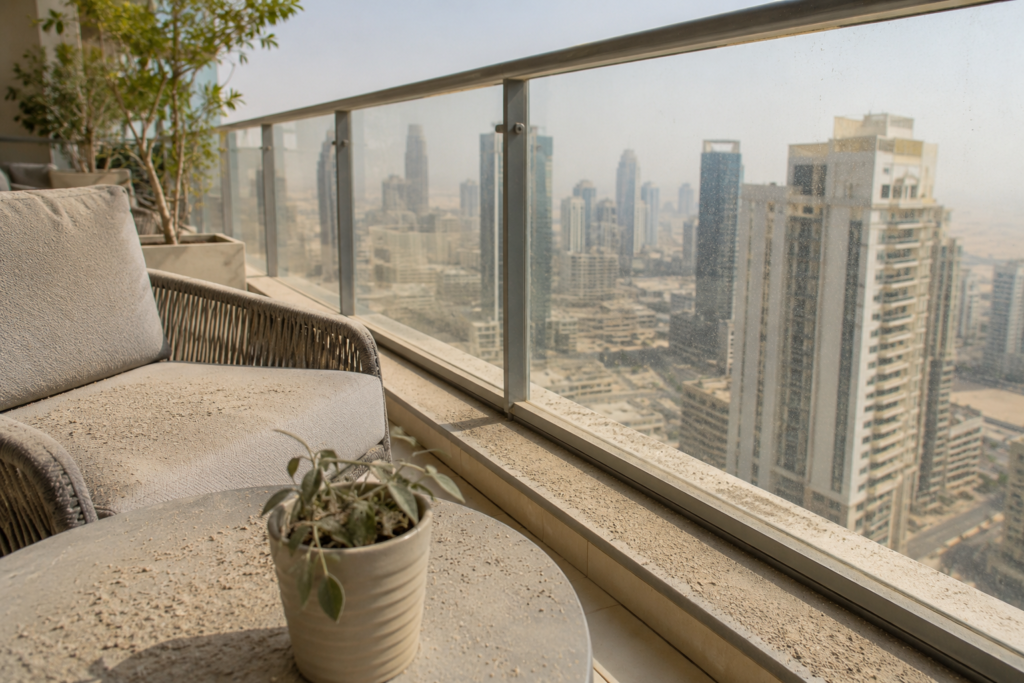
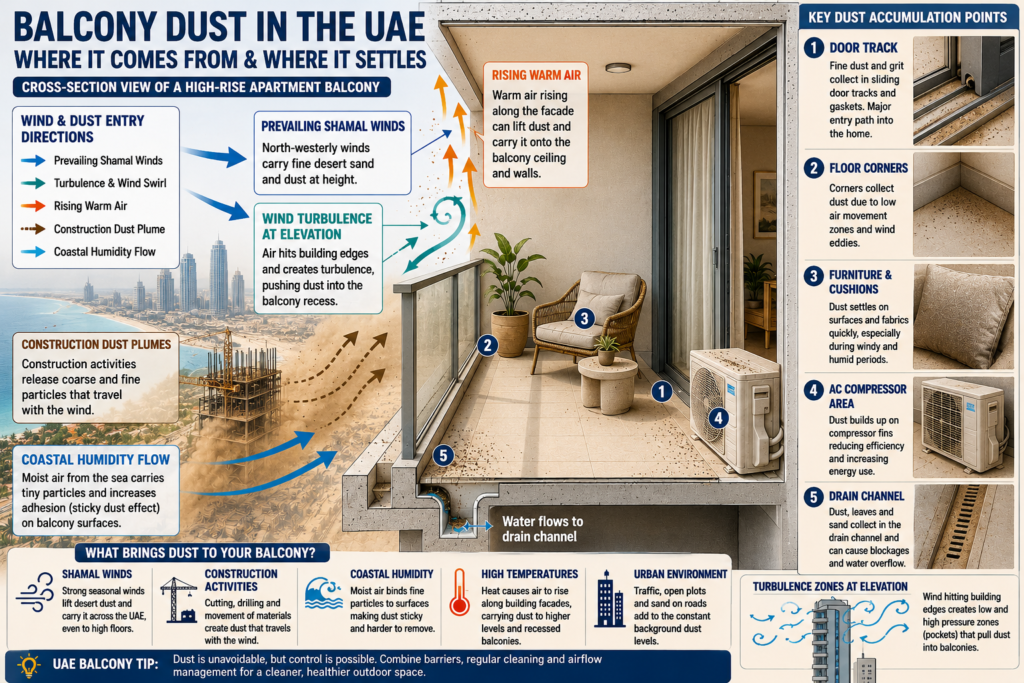
UAE balconies are exposed to a combination of desert dust, wind, construction activity and frequent outdoor-to-indoor airflow. Fine particles can settle quickly on balcony floors, furniture, railings and sliding-door tracks, especially after windy or dusty weather.
Desert Dust and Sand
Fine desert dust can remain airborne and settle on exposed surfaces throughout the year. Higher-floor apartments are not exempt, as wind can carry particles around building facades and into recessed balcony areas.
For homes dealing with frequent sand and grit, our vacuum cleaner guide for UAE sand and desert dust compares suitable options for regular floor cleaning.
High-Rise Wind and Building Design
Wind patterns around towers can push dust into balcony corners, door tracks and drainage channels. Balconies facing prevailing winds or exposed corners may accumulate dust faster than more sheltered units.
Construction Activity
Homes near active construction may experience additional dust and grit on balcony surfaces. This can increase how often floors, tracks and outdoor furniture need cleaning.
The practical solution is not to eliminate outdoor dust completely, but to reduce how much enters the apartment through regular balcony cleaning, clean door tracks, effective seals and sensible use of balcony doors during dusty conditions.
Fine Desert Dust vs Construction Dust: Key Differences
| Property | Fine Desert Dust | Construction Dust |
|---|---|---|
| Particle size | Very fine; often under 10 microns | Coarser; visible grit is common |
| Composition | Silica, calcium carbonate, mineral salts | Concrete powder, gypsum, aggregate |
| pH | Near neutral | Often alkaline |
| Adhesion in humidity | High – binds strongly to surfaces | Moderate – less affected by moisture |
| Surface damage risk | Mineral deposit marks on tile and glass | Surface etching on tiles and railings over time |
| Primary cleaning method | Damp microfiber wiping or rinsing | Rinsing or scrubbing; may require grout attention |
| Affected floor range | All floors, including upper levels | Primarily lower floors and units near active sites |

Coastal Humidity Trapping Fine Dust
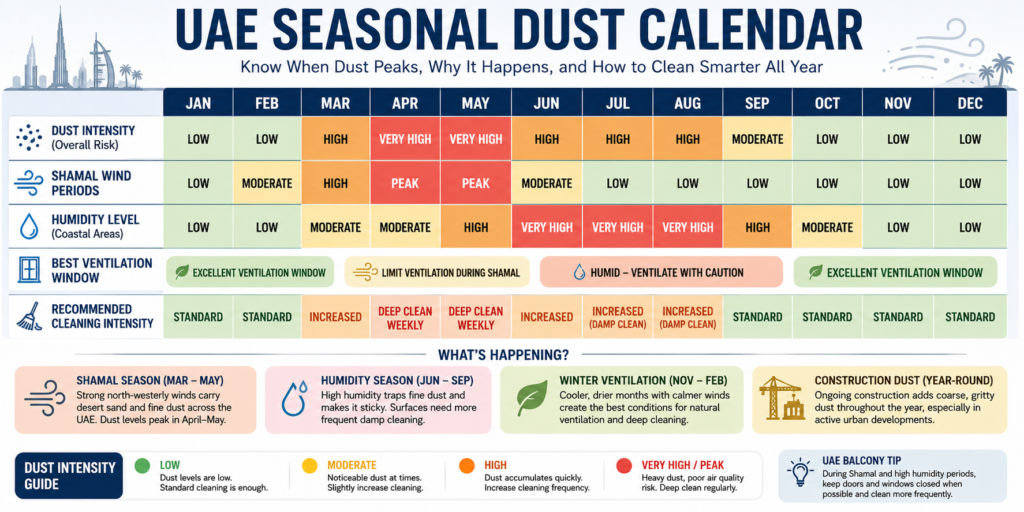
In coastal UAE cities including Dubai, Abu Dhabi, and Sharjah, high ambient humidity – frequently exceeding 70 to 80 percent during summer months – causes fine dust particles to absorb moisture and adhere more strongly to surfaces.
This is sometimes described as the “sticky dust” effect. Particles that would otherwise be easily brushed away in dry conditions bind firmly to tiles, glass railings, and furniture surfaces when humidity is elevated. Dry sweeping becomes less effective. Rinsing or damp wiping is required to achieve a properly clean surface. Dust left during the humidity season often leaves mineral residue marks after drying.
UAE Balcony Tip: During summer and early autumn, switch from dry sweeping to damp microfiber cleaning. Fine dust adheres to moisture on tile and glass during the humidity season, meaning dry tools redistribute particles rather than remove them.
Seasonal Shamal Wind Periods
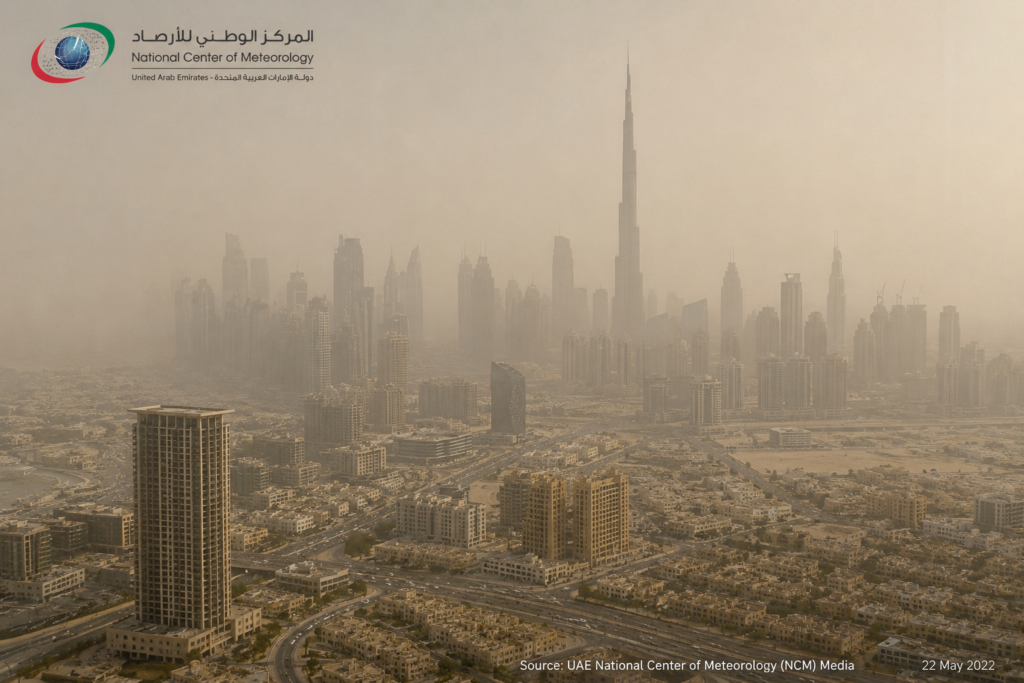
The Shamal – a northwesterly wind system – is the most significant seasonal dust driver in the UAE and the wider Gulf region. Shamal events typically intensify between late spring and early summer, generating sustained winds that carry large volumes of fine desert sand and dust across the region.
Lower-intensity Shamal winds can deposit significant quantities of fine particulate matter without any visible wall of sand. Residents often return to find balcony surfaces coated in a pale layer after a Shamal period even without having noticed an obvious dust event.
For specific guidance on post-sandstorm cleaning, see the After Sandstorm Cleaning Checklist UAE.
Common Balcony Dust Accumulation Zones
Dust does not build up evenly across a balcony. In UAE apartments, the areas below usually need the most attention because they trap sand, fine dust or debris more easily.
Sliding Door Tracks
Sliding-door tracks collect sand and fine dust quickly. Vacuum or brush out loose debris regularly so buildup does not interfere with the track or door seal.
Floor Corners and Edges
Dust often gathers in sheltered corners, along wall edges and behind furniture. Include these areas when vacuuming rather than cleaning only the open floor.
Outdoor Furniture
Cushions, chair frames and tables collect dust between uses. Vacuum fabric surfaces and wipe hard furniture with a damp microfiber cloth as needed.
AC Outdoor Unit Area
Dust can accumulate around and beneath an outdoor AC unit. Keep the surrounding area clear and avoid blocking airflow around the unit.
Plant Pots and Decorative Items
Dust collects around pot bases, rims and decorative objects. Moving these items occasionally makes it easier to clean the floor underneath.
Drain Channels
Keep balcony drains and channels clear of sand, leaves and other debris so water can drain properly during rinsing or rainfall.

How Balcony Dust Re-Enters UAE Homes
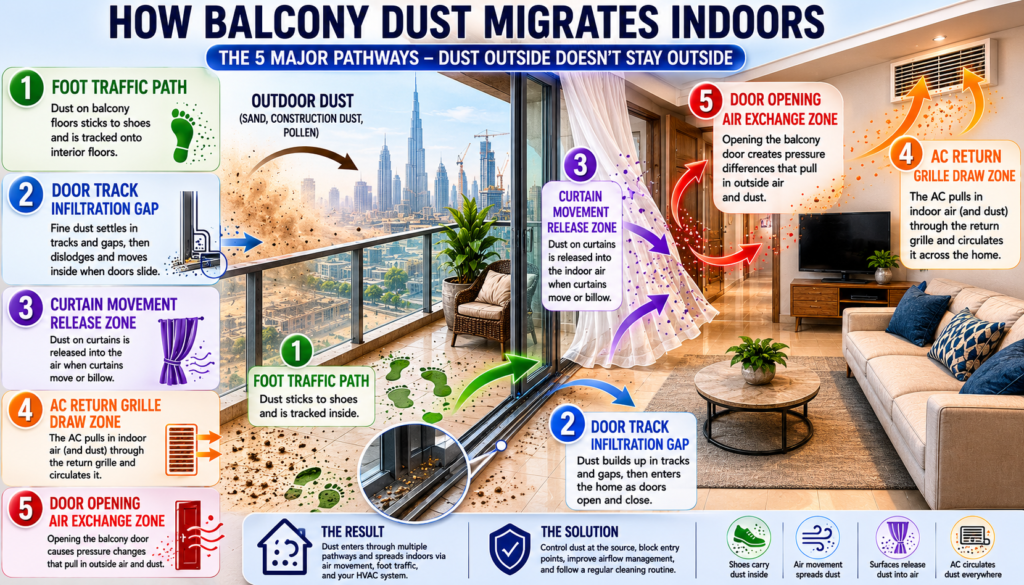
Balcony dust does not simply remain on outdoor surfaces. Multiple pathways allow outdoor particulate matter to migrate indoors, contributing to the overall indoor dust load and affecting air quality, surface cleanliness, and AC filter efficiency.
Main balcony dust transfer pathways:
- Door opening cycles
- Negative indoor air pressure via AC recirculation
- Foot traffic transfer from balcony to interior floors
- Curtain and fabric movement releasing trapped particles
- Door track leakage when doors are closed
Door Opening Cycles
Every time a sliding or hinged balcony door is opened, a volume of outdoor air carrying suspended dust enters the home. In UAE conditions where outdoor dust concentrations are elevated, each door opening cycle can introduce a meaningful quantity of particulate matter. This effect is amplified during Shamal periods or when outdoor dust levels are visibly elevated.
Negative Indoor Air Pressure
Homes with active AC systems operating in recirculation mode can develop slightly lower internal air pressure than the outdoor environment. This pressure differential draws outdoor air through gaps around door frames, window seals, and balcony door tracks, carrying dust particles with it.
The track channels of sliding balcony doors are a particularly direct pathway for this infiltration.
Foot Traffic Transfer
Dust that has settled on balcony floor surfaces is transferred indoors by foot contact. Residents walking barefoot or in slippers from balcony to interior floors deposit fine particles on indoor flooring with each step.
The volume transferred by a single person walking across a dusty balcony is small but accumulates meaningfully over repeated daily cycles. A balcony entry mat positioned at the transition point reduces this transfer significantly.
Curtain and Fabric Contamination
Curtains or blinds that extend to or through a balcony door opening collect dust on their outer surfaces when disturbed by air movement. Each time curtains move – whether by AC airflow, door opening, or manual adjustment – they release a proportion of trapped dust back into the indoor air.
Curtains serving balcony doors accumulate outdoor particulate matter at a higher rate than interior curtains and benefit from more frequent laundering.
AC Recirculation Impact
In apartments where the AC return air grille is positioned near a balcony door, the AC system can draw outdoor particulate matter into its air handling cycle. This accelerates dust accumulation on AC filters, increases replacement frequency, and can distribute coarser sand particles from the balcony through the indoor air supply.
Keeping the balcony door area clean and maintaining AC filter condition reduces this interaction.
UAE Balcony Tip: If the AC return grille is positioned near the balcony door, keep that floor zone swept and the door threshold mat shaken regularly. Dust concentrated near the grille is drawn directly into the AC air cycle with each recirculation pass.
For guidance on AC filter maintenance in UAE apartments, see the AC Filter Cleaning UAE Apartment Guide.
Health and Lifestyle Effects of Balcony Dust
Balcony dust accumulation has practical consequences beyond surface appearance. In UAE conditions, the particulate matter on balconies includes fine mineral dust, urban pollutants, and biological material that collectively affect health, clothing, and home usability.
Respiratory Irritation
Fine dust particles that enter homes from balcony surfaces are small enough to reach the lower airways when inhaled. Particulate matter classified as PM10 and PM2.5 – the size ranges most relevant to desert dust – is associated with respiratory irritation and worsened symptoms in individuals with pre-existing conditions including asthma and rhinitis, per WHO air quality guidance.
Residents who regularly ventilate their homes through balcony doors during high-dust periods are exposed to higher levels of these particles than those who keep doors closed and rely on filtered AC air.
Allergy Symptoms
Desert dust in the UAE carries allergens including pollen, fungal spores, and biological material transported on sand particles. Balcony dust that re-enters the home contributes to indoor allergen loading.
Many users report that eye irritation, sneezing, and nasal congestion worsen during Shamal periods, commonly associated with the increased outdoor dust levels that deposit on balconies and migrate indoors.
Fine Dust on Drying Clothes
Laundry dried on a balcony during periods of elevated dust concentration can accumulate a layer of fine particulate matter on fabric surfaces. This dust is not always visible but can cause skin irritation for individuals with sensitive skin.
During high-dust events, drying laundry indoors or in a covered location away from direct outdoor air exposure is often a more practical option.
Furniture Deterioration
Dust that accumulates on balcony furniture surfaces contains abrasive mineral particles. When furniture is used – sitting on cushions, placing items on tables, moving chairs across tile floors – this abrasive particulate causes surface micro-scratches and accelerates wear on finishes, fabric, and tile grouting over time.
Reduced Balcony Usability
Persistent dust accumulation on balcony surfaces makes the space less comfortable to use. Dusty floor tiles, coated furniture, and dirty railings reduce the value of the outdoor living space. This is a common complaint among UAE apartment residents who invested in balcony furnishing but find that maintenance demands make the space feel impractical.
Dust Contamination During Ventilation
During cooler months – particularly November through February – UAE residents frequently open balcony doors to ventilate their homes and reduce reliance on air conditioning. A dusty balcony near an open door becomes a direct source of indoor contamination during these natural ventilation periods, accelerating indoor dust accumulation on surfaces and floors.
Best Balcony Dust Prevention Strategies for UAE Homes
Preventing balcony dust problems entirely is not achievable given UAE environmental conditions. A layered approach, however, significantly reduces both outdoor accumulation and indoor transfer. The most effective systems combine physical barriers, regular maintenance, and storage practices that reduce dust-attracting surface area.

Entry Barrier Systems
The most effective single intervention for reducing balcony-to-indoor dust transfer is an entry barrier at the balcony door threshold. A flat, low-profile mat with a textured or fibre surface placed immediately inside the balcony door captures dust and sand from foot surfaces before it reaches indoor flooring.
A second mat placed on the balcony side captures coarser particles before they reach the threshold area. For doors with recessed tracks, a brush seal or draught excluder reduces the passive infiltration of fine dust through the track channel when the door is closed.
For a full guide to entry mat selection for UAE conditions, see Best Entry Mats for Dust in UAE Homes.
Balcony Mat Placement
A removable outdoor mat placed in the main balcony floor area reduces direct contact between foot surfaces and dusty tile. It can also be removed for shaking and rinsing independently of the full floor cleaning process.
Mats made from rubber-backed synthetic fibre or coir are commonly used in UAE balcony conditions. Smooth-surfaced mats with minimal fibre depth are easier to clean and dry more quickly after rinsing.
Furniture Covers
Outdoor furniture covers are one of the most practical and cost-effective tools for reducing dust accumulation on balcony seating and tables. Covers prevent dust from settling on fabric cushions and horizontal surfaces, eliminating the need to clean these items before each use.
In UAE conditions, covers should be made from breathable fabric to prevent moisture accumulation during the humidity season, which can cause mould growth on cushions beneath impermeable covers.
Microfiber Dust Control Methods
Microfiber cloths and flat microfiber mops are particularly effective for balcony surface cleaning in UAE conditions because they trap fine particles rather than redistributing them. A lightly dampened microfiber cloth on railings, furniture surfaces, and door frames captures the adhesive fine dust that accumulates during the humidity season.
For microfiber product options suited to UAE conditions, see Best Microfiber Cloths for Dust UAE.
Scheduled Balcony Rinsing
Regular rinsing of the balcony floor with a hose or bucket of water removes accumulated fine dust and prevents it from being resuspended by foot traffic or wind. Rinsing should direct water toward the drain channel, not toward the interior door or neighbouring balconies.
In buildings where water use is regulated or balcony rinsing is restricted, a damp mop achieves a similar result with less water. Many UAE residential communities have building rules about balcony rinsing – these should be observed.
Managing Balcony Airflow
Strategic placement of furniture and planters can reduce the direct wind path across a balcony surface during Shamal periods. Glass or mesh privacy screens fitted to balcony railings reduce wind penetration and are used in some UAE buildings for this purpose, though these are typically subject to building management approval.
Reducing Dust Transfer Indoors
The following practices, applied consistently, reduce the volume of balcony dust that enters the home:
- Minimise balcony door opening frequency during visible dust events or Shamal conditions
- Keep a pair of indoor slippers near the balcony door and change footwear before entering
- Clean the balcony floor before opening doors for natural ventilation
- Close the balcony door before running the AC in recirculation mode
- Wipe down the door track area regularly to prevent accumulated track dust from entering on the door roller mechanism
Balcony Storage Strategies
Items stored on a balcony accumulate dust on their surfaces and create additional areas that require cleaning. Cardboard boxes and fabric storage bags should not be stored on UAE balconies as they absorb humidity, accumulate dust, and can attract insects.
Sealed plastic containers with fitted lids are a more suitable option for balcony storage where required. Reducing the number of items stored outdoors limits dust-attracting surface area.
UAE Balcony Tip: Count every item stored on the balcony as an additional cleaning task. Each surface – pot rim, furniture leg, storage box lid – accumulates a dust layer that must be wiped before it transfers indoors. The fewer items, the faster each cleaning session.
Best Cleaning Tools for Balcony Dust Control
Effective balcony cleaning in UAE conditions requires tools suited to the specific combination of fine mineral dust, compacted corner accumulation, adhesive humidity-bound particles, and hard tile or concrete surfaces. Have a look at the Best Balcony Cleaning Tools UAE.
Microfiber Cloths for
Fine Dust Removal
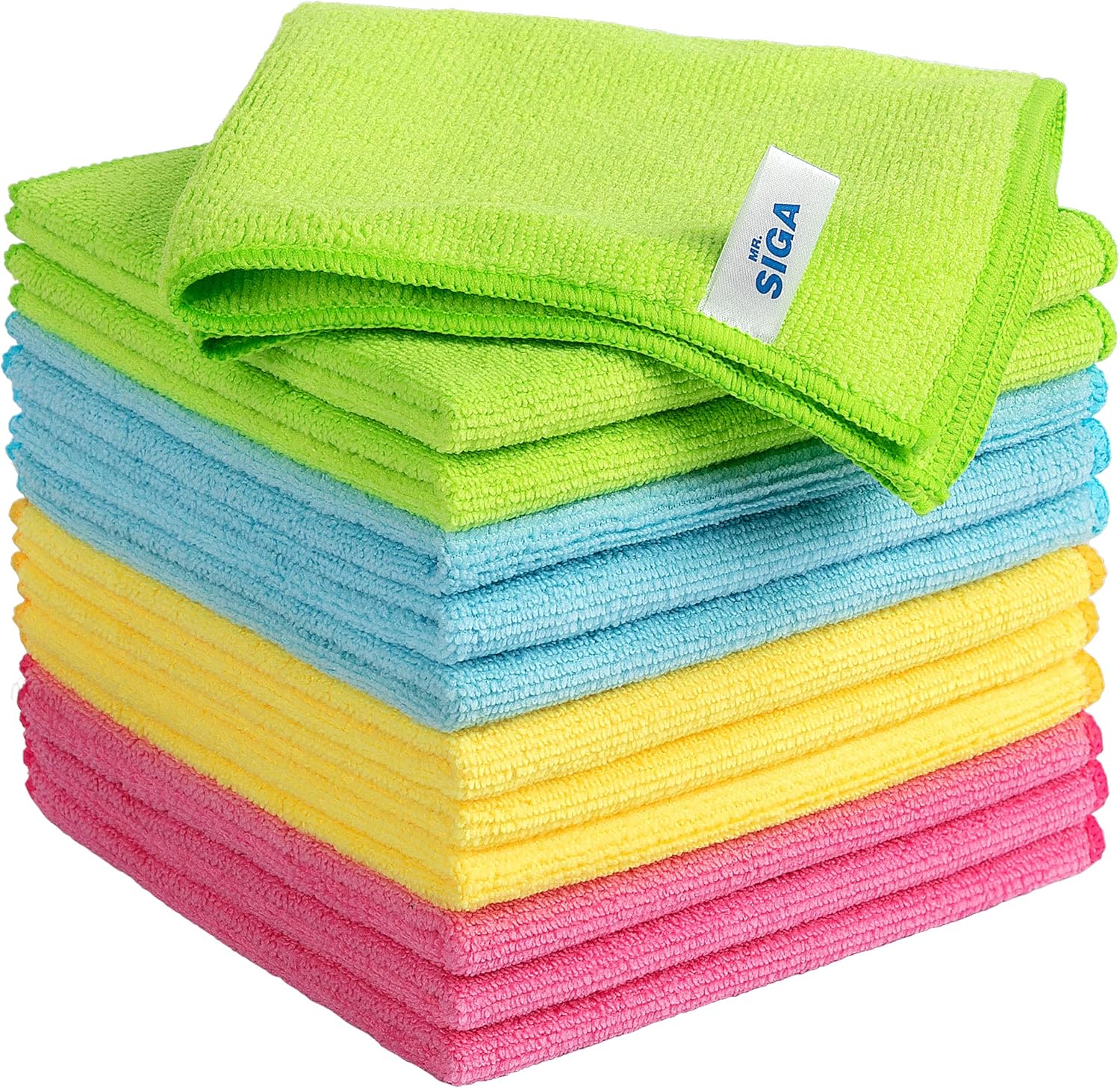
Microfiber cloths help trap fine UAE dust instead of spreading it across surfaces. Separate cloths for dry dusting and wet cleaning improve cleaning efficiency.
HEPA Vacuum Cleaners for
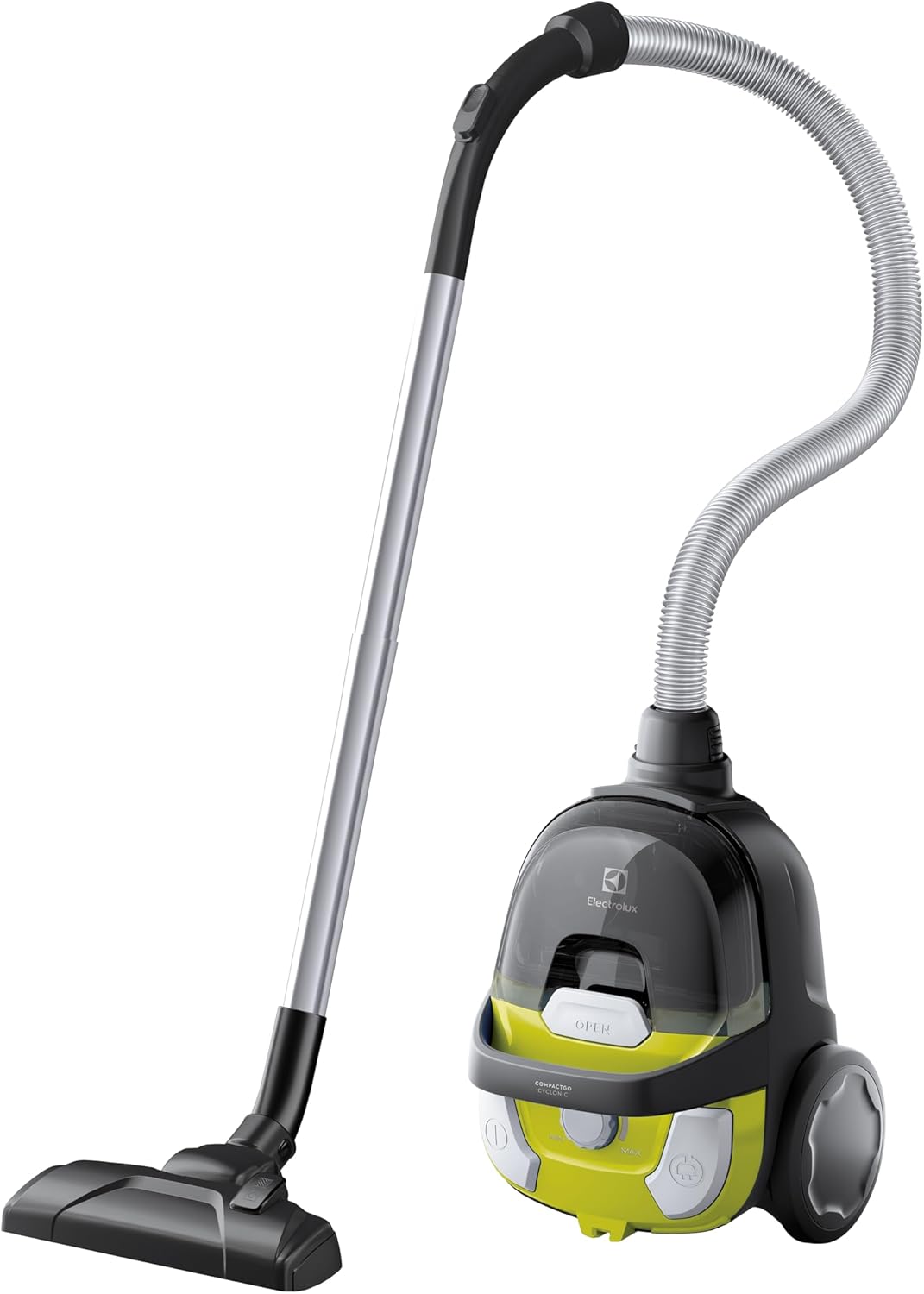
UAE Dust Control
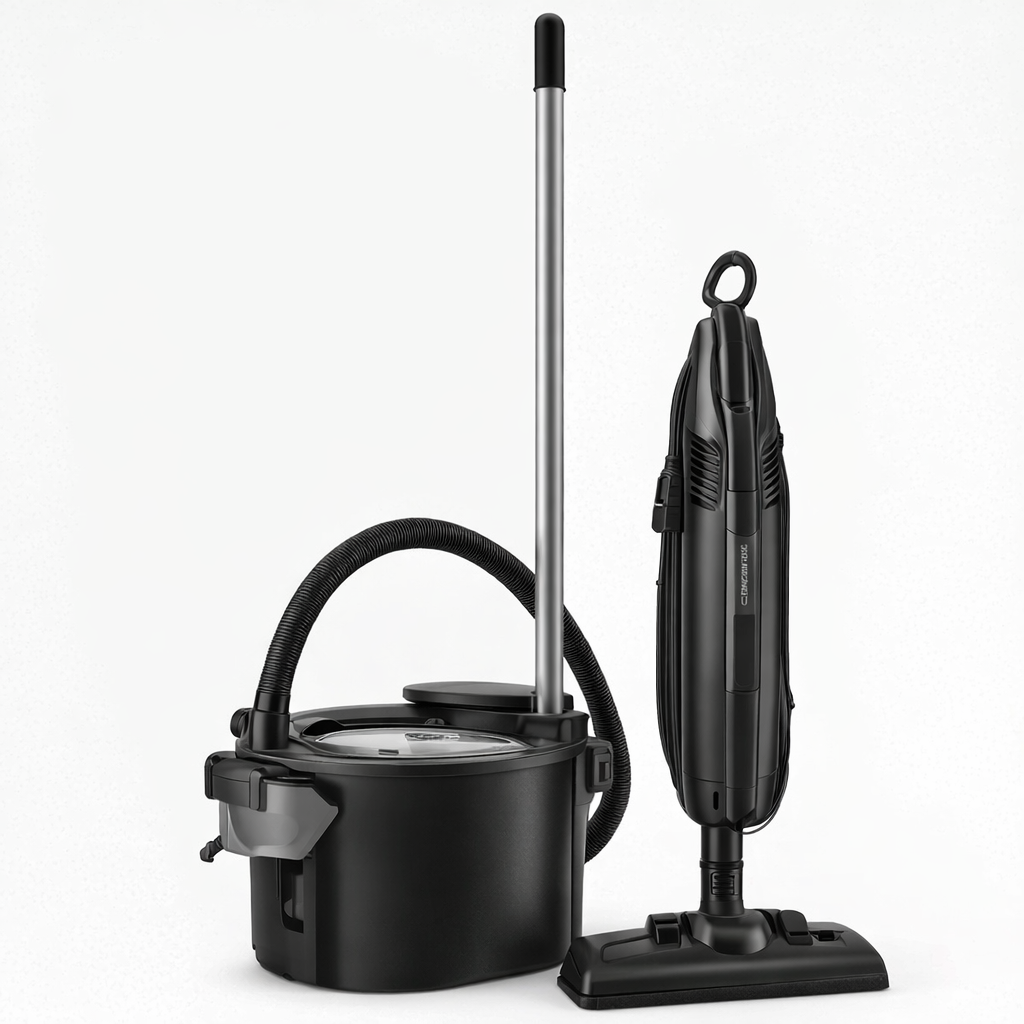
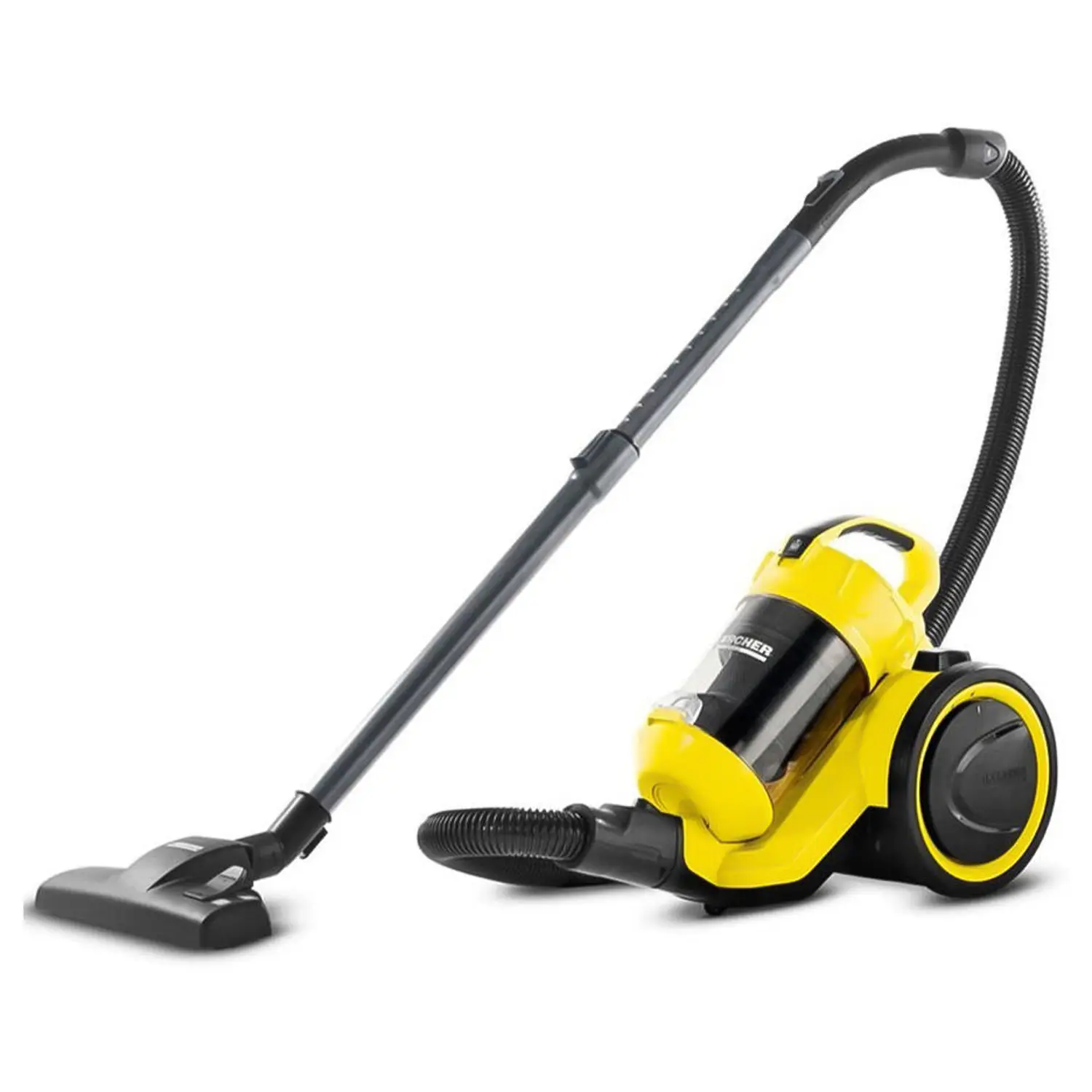
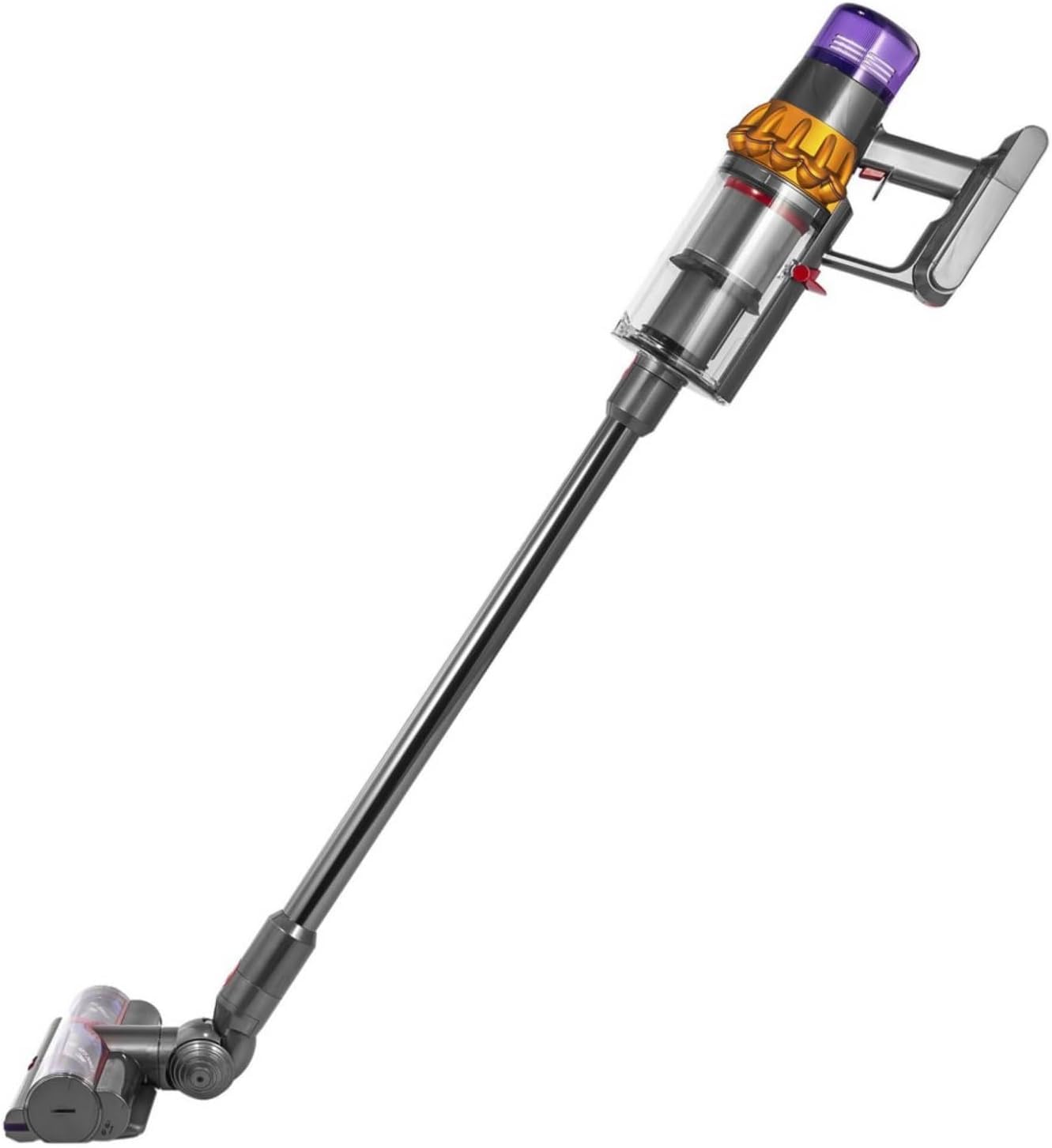
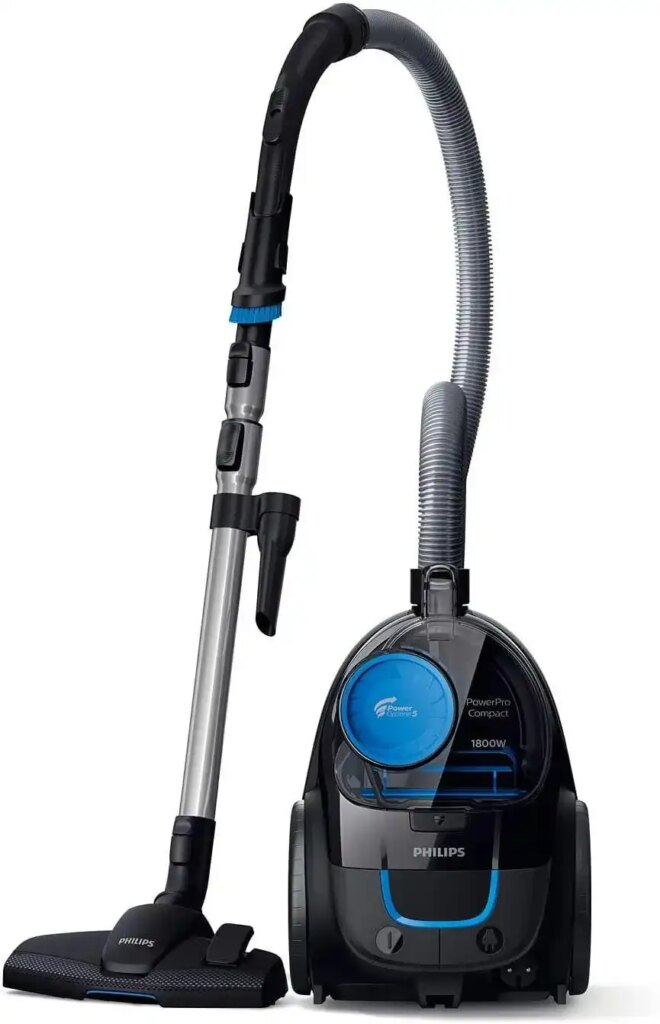
HEPA vacuum cleaners capture fine dust and sand particles commonly found in UAE homes. They are effective for tile, marble, rugs, and upholstery.
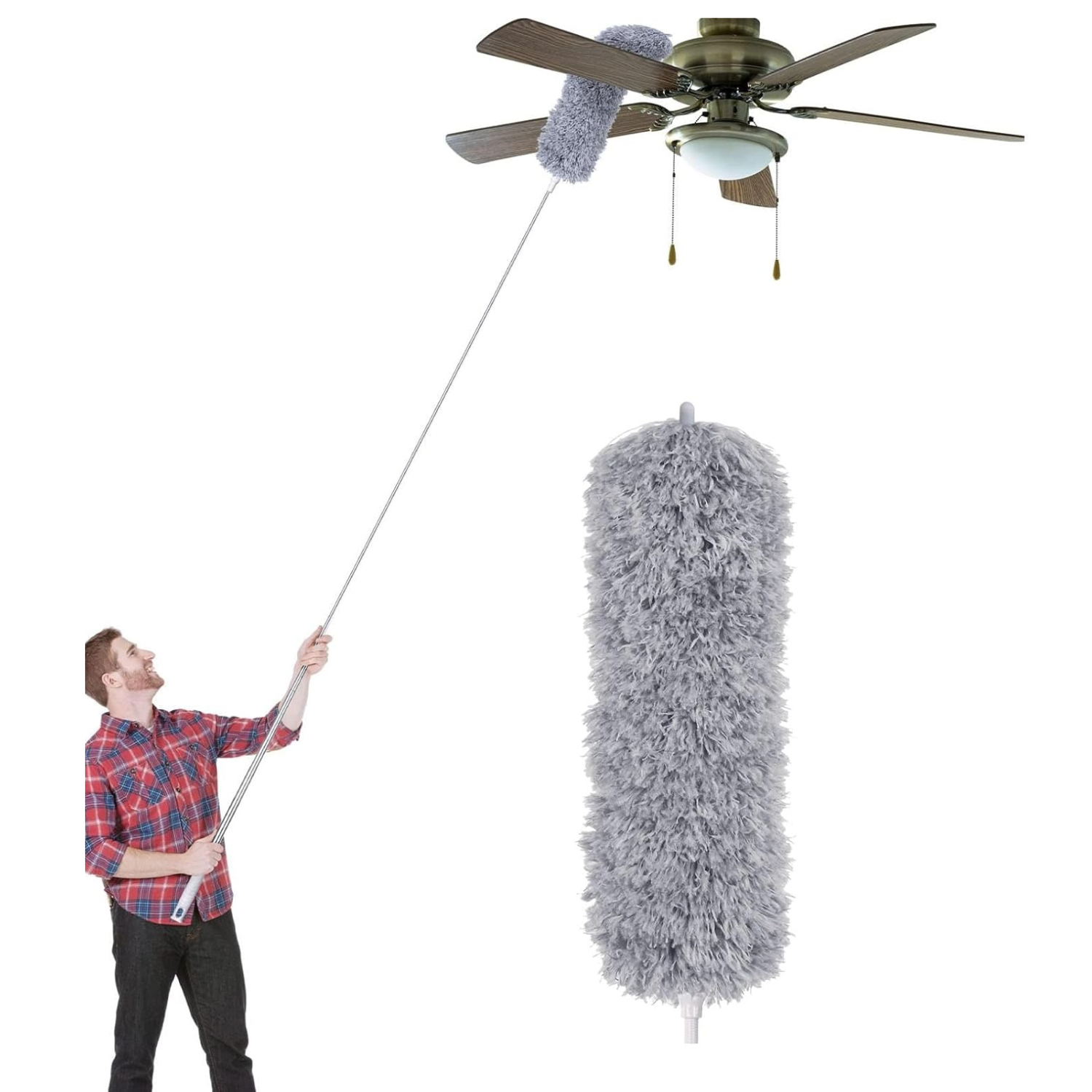
Dusting Tools for
Dust Removal
Electrostatic extendable dusters trap fine particles without spreading them, making them well suited to UAE homes with tall ceilings and hard-to-reach surfaces.
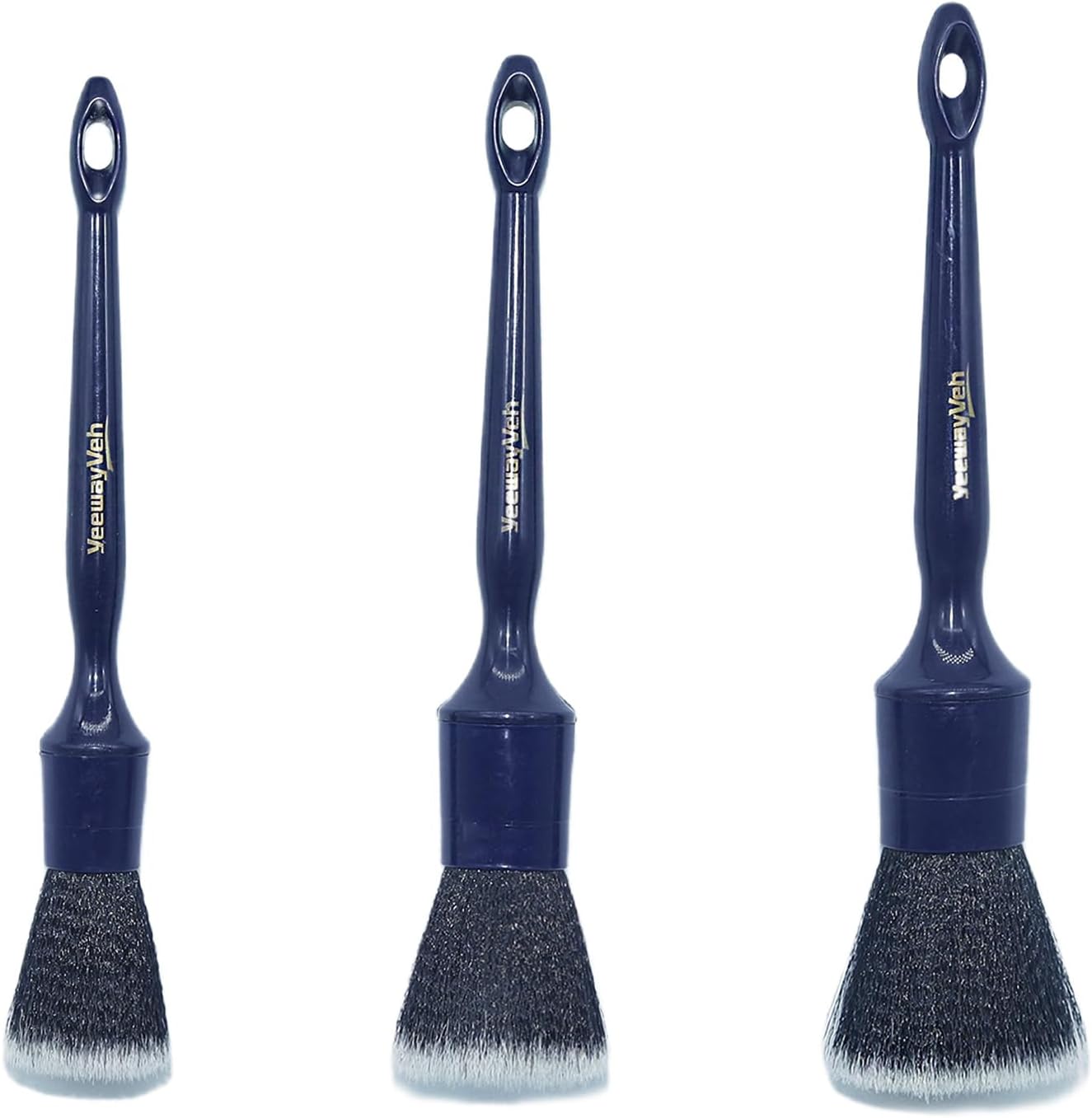
AC Vent Brushes for
Dust Accumulation
Narrow-profile brushes fit between AC louvre slats to remove dust buildup between professional filter services, without damaging the unit.

Spin Mops and Floor Mops
for post-cleaning
Spin mops with microfiber heads capture residual fine particles on hard floors when used after vacuuming that it may have missed.
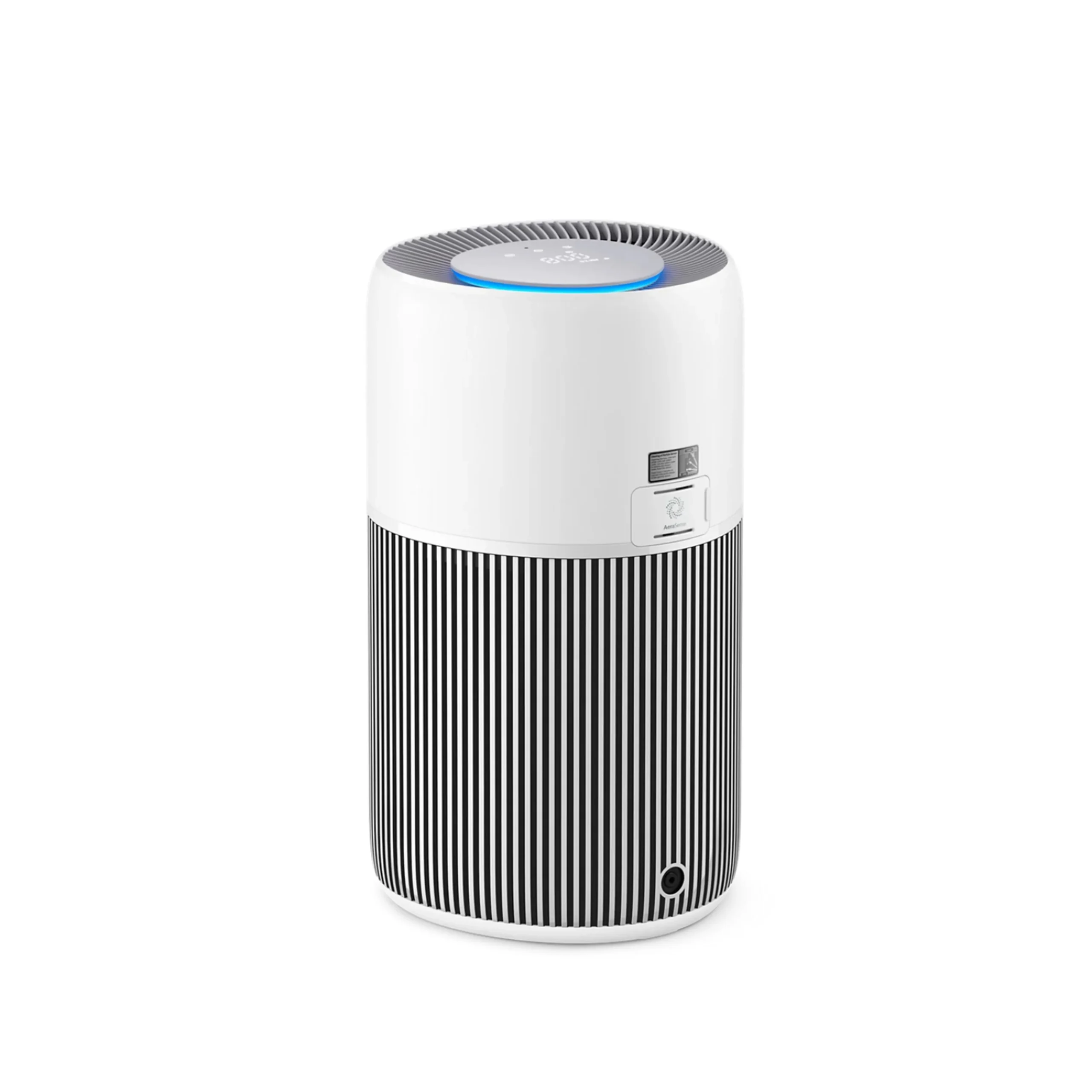
Air Purifiers for Managing
Fine Indoor Dust
HEPA air purifiers help reduce airborne dust and fine sand during dusty periods. Bedrooms and living rooms are the most common placement areas in UAE homes.
HEPA vacuums used with floor attachments remove loose dust from balcony tiles and corners before rinsing, reducing the quantity of dust resuspended into the air. A vacuum pass before any sweeping or rinsing is particularly useful when dust accumulation is heavy.
Outdoor brooms with soft bristles are suitable for sweeping loose dust toward the drain in dry conditions. Stiff bristle brooms can scatter fine dust rather than collecting it. Brooms with rubber edge seals perform better in corners and along wall bases.
Microfiber cloths and flat microfiber mops are the most effective tools for removing the adhesive fine dust layer that adheres to surfaces during humid conditions. A damp microfiber mop used after an initial dry pass picks up the fine particulate layer that a broom cannot capture.
Handheld vacuums with brush attachments are practical for cleaning furniture surfaces, door tracks, and the areas around AC compressor units without deploying a full-size vacuum on the balcony.
Hose spray tools with adjustable nozzles allow controlled rinsing of the balcony floor, directing water efficiently toward the drain. A jet setting helps to clear compacted dust from drain channels and corners.
Telescopic dusters are useful for reaching ceiling corners, overhead railing tops, and the upper surfaces of fixed structures without a ladder. Microfiber-headed telescopic dusters capture particles rather than scattering them.
Rubber squeegees are used after rinsing to direct water efficiently toward the drain and accelerate drying of the balcony floor surface. A squeegee reduces standing water time that, in combination with residual dust, can leave mineral deposit marks on tiles.
Balcony Cleaning Schedule for UAE Homes
A practical cleaning schedule for UAE balconies accounts for the continuous nature of dust deposition and the seasonal intensity variations associated with Shamal periods, the humidity season, and cooler ventilation months.
| Task | Frequency | Purpose |
|---|---|---|
| Wipe door tracks and threshold area | Every 2-3 days | Prevent indoor dust infiltration through track channels |
| Shake or brush entry mats | Daily during high-dust periods; 2-3 times per week otherwise | Maintain barrier effectiveness at the door threshold |
| Wipe furniture surfaces and railings | Weekly | Remove surface dust before it compacts or transfers to clothing |
| Sweep or vacuum balcony floor | Weekly; twice weekly during Shamal season | Remove loose particulate accumulation from floors and corners |
| Rinse balcony floor | Every 2-4 weeks; after any visible dust event | Remove adhesive fine dust layers and clear drain channels |
| Clean AC compressor area | Monthly | Reduce dust accumulation near intake areas and outdoor units |
| Clean ceiling corners and fixed structures | Monthly | Remove cobweb-bound dust from overhead surfaces |
| Clear drain channels | Monthly; before rainfall season in November | Prevent drain blockage, standing water, and residue marks |
| Full balcony clean including furniture and covers | Quarterly | Reset surfaces, including washing covers, mats, and outdoor furniture |
| Post-sandstorm full clean | Within 24 hours of any sandstorm event | Remove heavy accumulation before it compacts or migrates indoors |
Apartment vs Villa Balcony Dust Problems
Balcony dust in Dubai apartments is particularly pronounced in high-rise developments near active construction zones – Dubai Marina, Business Bay, Downtown Dubai, and JLT all have ongoing development activity that contributes elevated fine particle levels beyond the standard desert dust baseline.
The nature of balcony dust problems differs meaningfully between apartments and villas in the UAE, primarily because of wind exposure, balcony size, and maintenance responsibility.
| Factor | Apartment Balcony | Villa Balcony / Terrace |
|---|---|---|
| Wind exposure | Higher at elevation; corner units are most exposed | Lower at ground level; varies by orientation |
| Sand accumulation rate | Fine particulate dominant; coarser sand is less common above ground | Mix of fine dust and coarser sand; higher sand volume near ground |
| Maintenance frequency required | High – fine dust redeposits rapidly at elevation | High – coarser accumulation requires more effort to clear |
| Outdoor airflow | Stronger; wind tunnel effects between towers are common | More moderate; often screened by boundary walls and landscaping |
| Furniture exposure | Limited by smaller balcony footprint; less furniture usually | Larger furniture sets; more surface area accumulates dust |
| Drainage issues | Single drain point; blockage usually has limited consequences | Larger surface area; multiple drain points; higher blockage risk |
| Responsibility for cleaning | Resident handles own balcony; building manages common areas | Owner or tenant handles the full outdoor area |
| Construction dust exposure | Variable – depends on proximity and height relative to active sites | Often higher in developing villa communities with ongoing site activity |
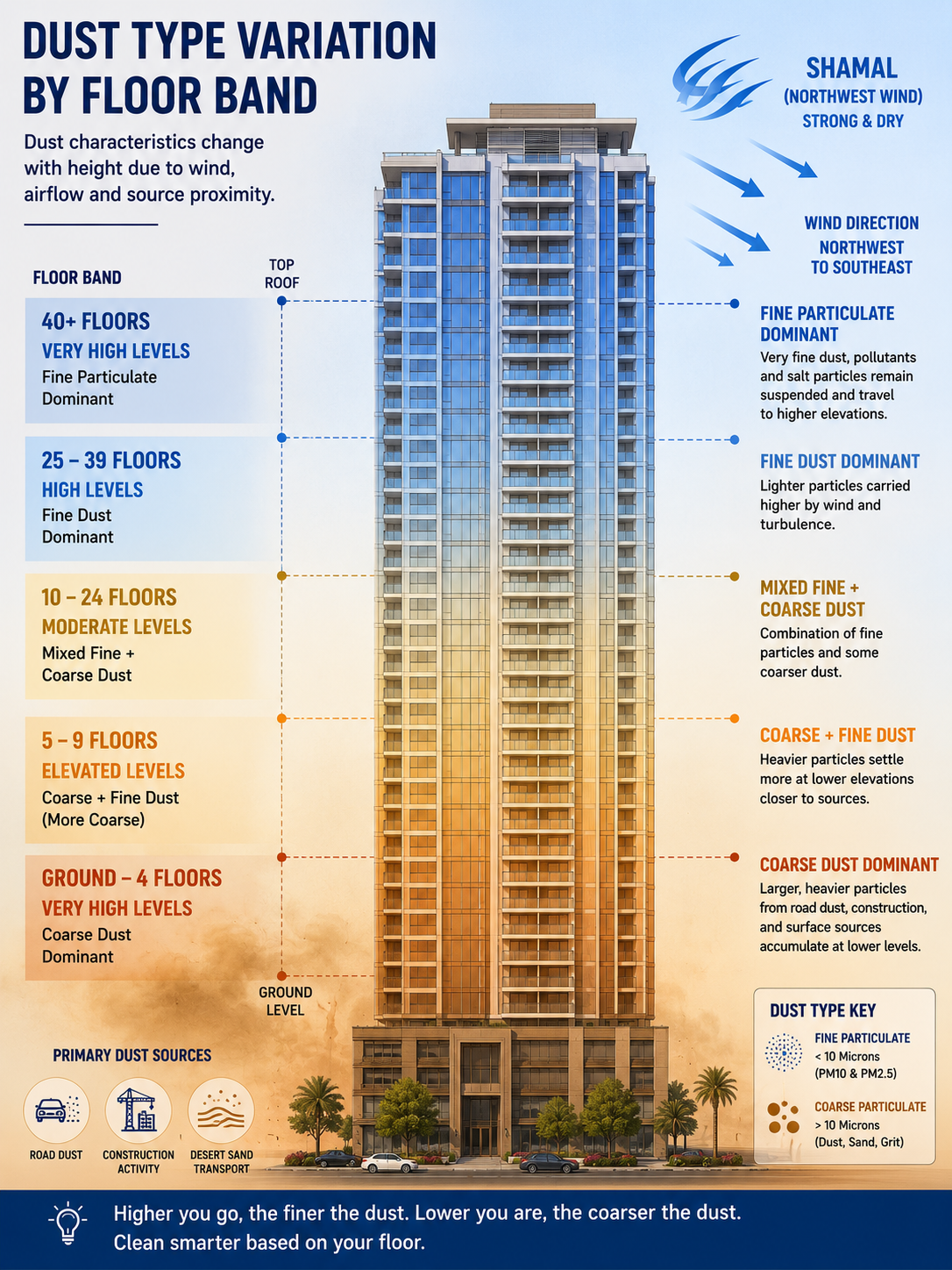
Balcony Dust Severity by Floor Height
Floor height has a measurable effect on the type and behaviour of dust that accumulates on a UAE apartment balcony. Lower floors are closer to ground-level sand and road dust. Upper floors face sustained fine particulate carried by wind at elevation.
| Floor Range | Typical Dust Pattern | Primary Source |
|---|---|---|
| Ground to 5th floor | Coarser sand, road dust, and construction material | Ground-level wind, vehicle movement, and nearby sites |
| 6th to 15th floor | Mixed particulate – coarser and fine dust combined | Variable wind, construction plumes, and desert particulate |
| 16th to 25th floor | Predominantly fine suspended particulate | Elevated wind channels and Shamal-carried desert dust |
| 26th floor and above | Fine mineral dust dominant; rapid redeposition after cleaning | Sustained upper-floor wind exposure and desert particulate at altitude |
Residents on higher floors often find that balcony surfaces appear cleaner visually but accumulate a thin, adhesive fine dust layer that is harder to remove than the coarser sand more visible on lower floors.
Post-Sandstorm Balcony Recovery Checklist
After a sandstorm or significant Shamal dust event, balcony surfaces require a specific recovery sequence. The order of tasks matters – cleaning from the wrong starting point spreads dust further rather than removing it.
- Keep balcony doors fully closed until the visible dust event has passed
- Vacuum or dry-wipe sliding door tracks before opening the door to begin cleaning
- Vacuum the balcony floor surface before any sweeping to minimise dust resuspension
- Damp-wipe all railings, furniture surfaces, and ledges using a microfiber cloth
- Remove and shake furniture covers before wiping cushions and seating surfaces
- Clear the drain channel of accumulated sand and dust
- Clean the AC compressor area around intake grilles
- Rinse the full balcony floor, directing water toward the drain
- Dry the threshold area and door track before reopening the balcony door to the interior
- Wipe the interior door frame and threshold mat before resuming normal indoor foot traffic
For a full sandstorm cleaning guide covering the whole home, see the After Sandstorm Cleaning Checklist UAE.
Common Mistakes That Make Balcony Dust Worse
Several routine practices either increase dust infiltration indoors or make outdoor accumulation worse over time.
Dry sweeping on a dusty balcony without a prior vacuum pass resuspends fine particles into the air, a portion of which drift indoors through the open balcony door. In UAE conditions, dry sweeping alone during dusty periods is often counterproductive without at least closing interior doors and windows first.
Leaving cushions exposed between uses guarantees that fabric surfaces accumulate the maximum possible dust load. Even a single day without covers in Shamal conditions can result in cushions that require cleaning before use.
Ignoring door tracks is a frequently observed maintenance gap. Track channels accumulate compact, fine dust that bypasses the door seal when the door slides. Many residents clean the balcony floor without addressing track cleaning, allowing this concentrated indoor dust pathway to remain active.
Opening balcony doors during visible dust events or Shamal wind conditions introduces outdoor particulate directly into the indoor environment. During these periods, AC ventilation with a clean filter is a more effective and lower-dust option for managing indoor air freshness.
Storing cardboard boxes, paper materials, or fabric items outdoors on a UAE balcony accelerates dust accumulation on these surfaces, introduces moisture absorption risk during the humidity season, and creates difficult-to-clean dust traps. Items stored outdoors should be in sealed hard-surface containers.
Infrequent rinsing allows fine adhesive dust to bind to tile surfaces during humid periods, progressively making the surface harder to clean with each cleaning cycle. Regular rinsing – even when the balcony does not appear heavily soiled – prevents this progressive adhesion.
Professional Balcony Cleaning Services in the UAE
For some UAE residents, professional balcony cleaning services offer a practical solution to accumulated dust, particularly after Shamal season, at tenancy change, or for high-rise properties where safety concerns make certain tasks impractical without specialist equipment.
Professional cleaning is worth considering when:
- Dust has compacted in grout lines or tile recesses beyond what routine tools can clear
- Biological growth such as mould or algae is present on balcony surfaces
- The balcony has not been cleaned for an extended period and requires a full reset
- High-rise elevation creates safety concerns for leaning over railings with cleaning equipment
High-rise balcony cleaning at significant elevation introduces safety considerations distinct from low-rise situations. Residents in towers should be aware of building management policies on balcony water use and external cleaning activity before attempting any high-reach cleaning tasks.
Pressure washing is effective for removing compacted dust and mould from tile surfaces but carries specific risks: potential damage to grout, displacement of water toward interior thresholds, and high-pressure delivery to railing fixings that can loosen components over repeated applications. A controlled hose rinse is suitable for most routine cleaning; pressure washing is better reserved for periodic deep cleaning rather than routine maintenance.
Facade dust – the accumulation of sand and mineral particulate on exterior wall surfaces adjacent to a balcony – is typically managed by building management and professional rope-access or scaffold-based contractors. This is outside the responsibility of individual residents and should be reported to building management if excessive.
How Balcony Design Affects Dust Accumulation
The structural design of a balcony has a direct influence on how much dust accumulates and how efficiently it can be cleaned.
Glass Railings
Glass panel railings are common in newer UAE residential developments and create a more enclosed balcony microclimate that partially reduces direct wind-driven dust deposition on the floor. However, glass surfaces themselves accumulate a visible dusty layer that is aesthetically prominent and requires frequent wiping. The adhesion of fine dust to glass is more pronounced during the humidity season when particles bind to moisture on the glass surface.
Solid Concrete Barriers
Solid concrete or masonry balcony walls provide the most effective physical barrier against wind-driven dust deposition on the balcony floor. The sheltered floor zone behind a solid wall accumulates less dust than an open or railed balcony in equivalent conditions. However, solid barriers reduce natural light and airflow to the interior, and the top surfaces of the wall themselves accumulate a concentrated dust layer.
Mesh Screens
Perforated metal or mesh screens fitted to balcony railings reduce wind velocity across the balcony surface and thereby reduce dust deposition rates. These are increasingly used in UAE developments near desert or construction zones. Mesh screens require periodic cleaning on the windward face, but the net effect on balcony floor cleanliness is generally positive.
Covered Balconies
Balconies with overhead roof structures or pergolas accumulate less direct overhead dust deposition from vertical settling. The reduction in wind-driven deposition from the sides is minimal unless side screening is also present. Covered balconies provide some protection for furniture from direct UV degradation.
Corner-Unit Airflow Exposure
Balconies on the corner of a residential tower are exposed to wind from two directions rather than one. This multi-directional exposure increases the rate and area of dust deposition compared to mid-floor balconies facing a single direction. Corner-unit residents generally find that their balconies require more frequent cleaning than equivalent units on the interior sections of the same floor.
Balcony Flooring Materials and Dust Resistance
The choice of balcony flooring material affects how quickly dust accumulates and how easily it can be cleaned. This is a practical consideration for UAE residents renovating or furnishing a balcony.
| Material | Dust Accumulation | Ease of Cleaning | Notes for UAE Conditions |
|---|---|---|---|
| Textured porcelain tile | Moderate | Moderate – texture traps fine dust in grooves | Very durable; handles humidity and heat well; grout lines require attention |
| Smooth matte tile | Low to moderate | Good – flat surface cleans easily | Popular choice; mineral deposit marks may show after rinsing in hard water areas |
| Composite decking | Moderate | Moderate – grooves accumulate fine dust | UV-resistant options are available; check manufacturer guidance for UAE heat |
| Natural stone | Moderate to high | Moderate – porous surface absorbs fine particles | Requires sealing to reduce dust and moisture absorption |
| Artificial grass | High | Difficult – fibres trap dust deeply | Not ideal for UAE balconies; dust and humidity can create hygiene issues over time |
| Rubber tiles | Low | Good – smooth surface rinses easily | Practical for utility balconies; less suited to formal living areas |

Seasonal Balcony Dust Patterns in the UAE
Understanding how balcony dust problems vary across the UAE calendar year allows residents to anticipate high-demand periods and adjust cleaning frequency before accumulation becomes problematic.
Summer Dust Buildup
From approximately June through September, UAE summer conditions combine elevated temperatures, high humidity, and reduced wind events. Dust deposition rates are generally lower than during Shamal season, but the adhesive effect of humidity causes particles that do settle to bind more firmly to surfaces.
Dust accumulated during summer is often harder to remove than the loose fine deposits of the spring Shamal season. Monthly rinsing is particularly important during summer to prevent mineral bonding on tiles.
Humidity Season
The UAE humidity season overlaps substantially with summer but extends into late May and October in coastal areas. During this period, the interaction between fine dust and surface moisture is most pronounced. AC compressor areas and drain channels should be monitored more frequently as biological growth – including mould and algae – can begin on surfaces that remain consistently damp with combined moisture and dust.
Winter Ventilation Months
From November through February, reduced temperatures make it practical for many UAE residents to open balcony doors for extended ventilation. Outdoor air quality during these months is generally improved, and dust deposition rates are typically lower.
However, this is the period during which balcony-to-indoor dust transfer via air movement and foot traffic is highest, due to increased door opening frequency. Maintaining a clean balcony and an effective entry mat system is particularly valuable during winter ventilation months.
Sandstorm Transition Periods
The transition from winter to spring – broadly from March through May – is the highest-risk period for severe balcony dust events in the UAE. This period coincides with the onset of Shamal conditions and historically accounts for the majority of significant sandstorm events.
Pre-season preparation, including checking and replacing door seals, clearing drain channels, and positioning furniture covers, reduces the recovery effort required after each event.
UAE Balcony Tip: In late February, carry out a pre-Shamal season balcony audit. Check door track condition, test drain channel flow, replace any worn brush seals, and stock furniture covers. A 30-minute pre-season check prevents multiple reactive deep cleans through March and April.
For more detail on UAE dust patterns and their causes, see Why Dust Builds Up in UAE Homes.
Final Thoughts
Balcony dust problems are a normal part of living in many UAE apartments, especially in homes exposed to desert dust, wind and nearby construction. The goal is not to eliminate outdoor dust completely, but to reduce how quickly it builds up and how much of it reaches the inside of your home.
The most practical approach is to combine simple prevention with regular cleaning. Keep balcony doors closed during dusty conditions, maintain door tracks and seals, cover outdoor furniture when it is not in use, and remove loose sand and dust before it becomes heavily compacted.
A consistent routine usually makes balcony cleaning easier over time. Smaller, more frequent cleanups are generally simpler than waiting for heavy buildup.
For a complete indoor cleaning routine suited to UAE apartment conditions, see the Weekly Cleaning Checklist UAE.
Frequently Asked Questions
How often should a balcony be cleaned in UAE apartments?
Cleaning frequency depends on how exposed the balcony is to wind, dust and nearby construction. A light vacuum or sweep whenever visible dust builds up, followed by occasional damp cleaning, is usually more practical than following a fixed schedule.
Why does my balcony get dusty again so quickly after cleaning?
Balconies are continuously exposed to outdoor dust, wind and airborne particles. Homes near construction sites, busy roads or more exposed building facades may see dust return faster than sheltered balconies.
Is it better to sweep or vacuum a dusty balcony?
Vacuuming can be useful for removing fine dust and loose sand without pushing as much debris around. If sweeping is used, follow with damp wiping or mopping to collect the finer residue left behind.
Can balcony dust cause health problems?
Outdoor dust can contain fine particles that may irritate the eyes, nose or respiratory system, particularly for people who are sensitive to dust. If dust exposure causes persistent symptoms, seek advice from a qualified healthcare professional.
How can I stop balcony dust from entering my apartment?
Keep balcony doors closed during dusty or windy conditions, clean sliding-door tracks, check door seals or weather stripping, and use an entry mat near the balcony door. Regular balcony cleaning also reduces the amount of dust available to be tracked indoors.
What is the best way to clean balcony dust after a dusty or windy day?
Start by removing loose sand and dust with a vacuum or suitable brush. Clean door tracks and corners, then wipe exposed surfaces and mop the floor if needed. Avoid adding water before removing heavy loose dust, as this can create muddy residue.
How do I clean dust from sliding balcony door tracks?
Vacuum or brush out loose sand and debris first. Then wipe the track with a damp microfiber cloth. If dirt is packed into narrow corners, use a small detailing brush or similar tool that will not damage the track.
Do weather strips help reduce balcony dust?
They can help if dust is entering through gaps around the balcony door. Check the existing seals for wear, looseness or damage, and use weather stripping that is suitable for the door type. It should not interfere with normal opening, closing or drainage.
Should I wash or rinse my balcony floor with water?
Water can be useful after loose dust and sand have been removed, but first check the balcony drainage and building rules. Avoid washing large amounts of dust directly into drains, and use a floor-cleaning method suitable for the balcony surface.
What areas of a balcony collect the most dust?
Sliding-door tracks, floor corners, wall edges, drainage channels, areas around outdoor furniture, plant pots and spaces near outdoor AC units often collect dust more quickly than open floor areas. These spots should be included in routine cleaning.
Balcony Dust Problems UAE: Summary Comparison Table
| Category | Apartment Balcony | Villa Balcony / Terrace | Notes |
|---|---|---|---|
| Primary dust cause | Fine desert particulate; wind-driven deposition at elevation | Fine dust plus coarser sand; proximity to ground increases sand contact | Both are affected by Shamal events and construction activity |
| Key health risk | Fine particulate infiltration into indoor air through door gaps | Coarser particles on outdoor surfaces; higher resuspension from foot traffic | Fine particles are most relevant to respiratory health |
| Most effective prevention | Door threshold mat, track seals, and furniture covers | Furniture covers, regular rinsing, and drainage maintenance | Both benefit from scheduled maintenance rather than reactive cleaning |
| Recommended cleaning frequency | Weekly sweep or vacuum; monthly rinse; post-sandstorm clean | Weekly sweep; bimonthly rinse; post-sandstorm clean | Increase to twice weekly during Shamal season for both |
| Highest-risk season | March to May, Shamal season | March to May, Shamal season | Both are also affected by summer adhesive dust during humidity season |
| Seasonal impact – summer | Adhesive fine dust layer; humidity bonding to tile and glass | Adhesive dust; larger surface area requires more cleaning effort | Damp cleaning is more effective than dry sweeping in summer |
| Seasonal impact – winter | Increased door-opening; higher indoor transfer risk | Increased outdoor use; higher foot traffic transfer | Cleaner outdoor air, but more frequent door openings increase transfer |
| Professional cleaning need | Periodic; especially post-Shamal season or at tenancy change | Annual or biannual; larger areas make professional deep cleaning more practical | More relevant for high-rise safety or large surface areas |
Sources
Information on UAE particulate matter, PM2.5 classifications, and outdoor air quality thresholds is drawn from the World Health Organization Air Quality Guidelines; seasonal wind and dust event patterns for the UAE and Gulf region are referenced from the UAE National Center of Meteorology; Dubai-specific air quality monitoring and environmental data is published by Dubai Municipality Environment Department; and information on UAE indoor air quality and residential dust exposure in relation to health outcomes is informed by guidance from the UAE Ministry of Climate Change and Environment.