How to Remove Fridge Smells in Hot UAE Weather
Knowing how to remove fridge smells in hot UAE weather starts with identifying the cause: spoiled food, unnoticed spills, blocked drainage areas, dirty door seals or food warming up during transport or a power interruption.
Many UAE households notice this issue more often because chilled groceries can warm quickly between the supermarket and home, particularly when left in a hot car, a lift lobby or a building corridor for even a short period. This does not mean UAE heat directly makes a correctly functioning, closed refrigerator smell on its own. In most cases, the true source is food residue, leaked liquids or a maintenance issue rather than the outdoor temperature alone.
This guide explains how to remove fridge smells in hot UAE weather using a structured, safe cleaning process, and outlines how to prevent the problem from returning in apartments and villas across the UAE.
Why Fridge Smells Can Become a Problem in UAE Homes
Several everyday factors are commonly associated with fridge odours in UAE households, particularly during warmer months.
Food can warm during the short journey from the supermarket to home, especially when groceries are left in a hot vehicle rather than carried indoors promptly. Power cuts or a refrigerator being accidentally switched off at the wall can also allow food to sit at an unsafe temperature. Frequent door opening, overloaded shelves that restrict cold-air circulation, and strong-smelling foods such as fish, garlic, onions and curry are also frequently reported causes.
Other common contributors include:
- Leaking containers and forgotten food left at the back of drawers
- Condensation and moisture build-up around door seals
- Dirty drip trays or blocked drainage channels
- Incorrect temperature settings
- A failing appliance or a damaged door seal that lets warm air inside
Unpleasant fridge smells are generally caused by spoiled food, leaked liquids, trapped moisture, contaminated packaging or an appliance maintenance problem. Understanding the underlying cause is the first step toward a lasting solution.
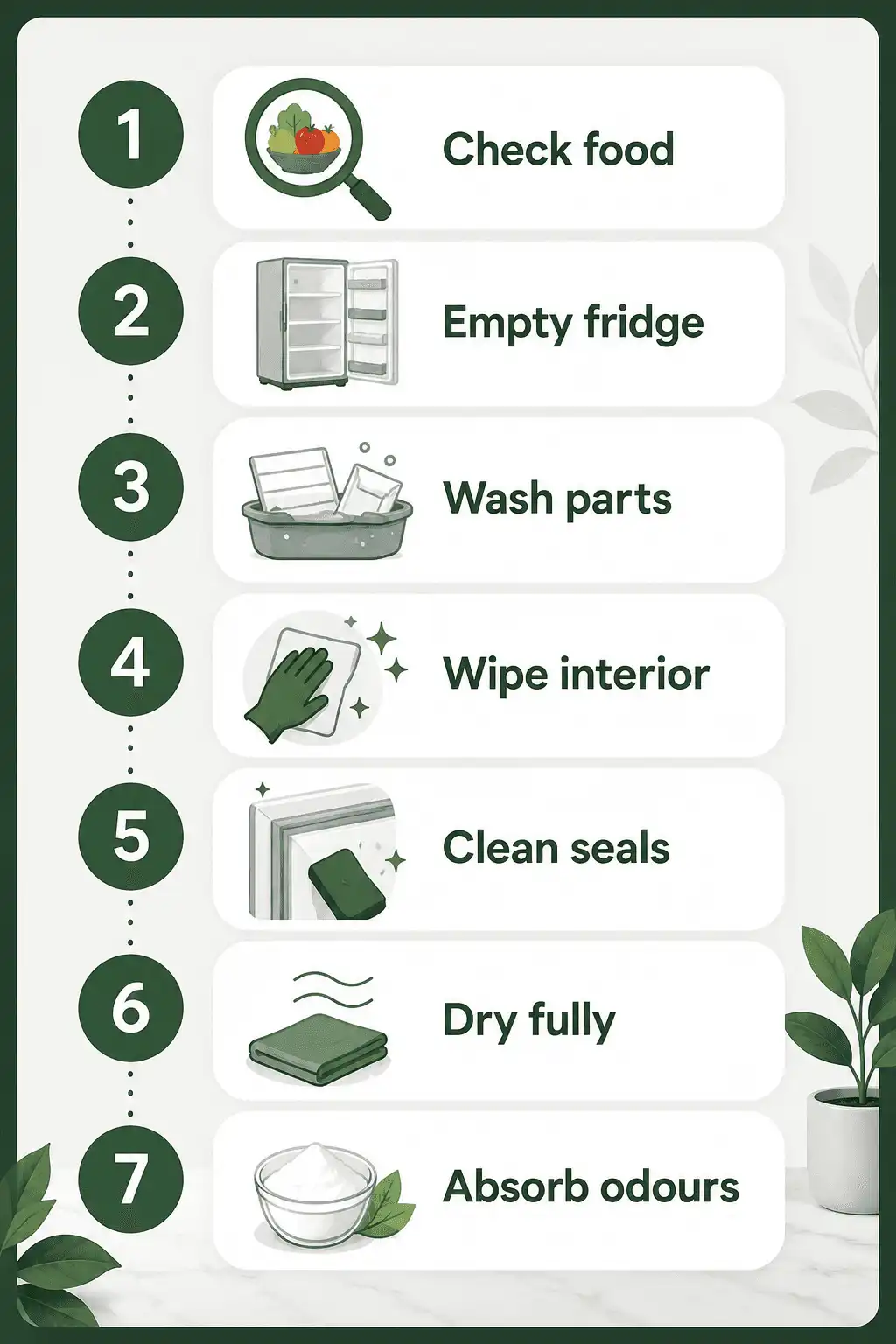
How to Remove Fridge Smells in Hot UAE Weather: 7 Steps
The following process is designed to work through the problem in a logical order, from immediate food safety checks through to long-term odour control.
Step 1: Check the Temperature and Food Safety
Check the appliance display or use a refrigerator thermometer. For household food storage, aim for approximately 4°C or below, while following the refrigerator manufacturer’s instructions. Chilled-food guidance used by UAE food-safety authorities generally places cold storage at 5°C or below, while frozen food is commonly stored at -18°C or below.
Do not taste suspicious food to check whether it is safe. Discard anything showing visible spoilage, leakage, an unusual texture or an unexplained smell.
An unopened refrigerator can generally keep food cold for up to four hours during a power interruption, according to FoodSafety.gov’s power-outage guidance. Keep the door closed as much as possible. If the interruption lasts longer than four hours, discard refrigerated perishable foods such as meat, poultry, fish, eggs, milk and leftovers unless reliable temperature monitoring confirms they remained at 4°C or below. Never taste food to determine whether it is safe.
Step 2: Empty the Fridge and Inspect Every Item
- Check expiry and use-by dates
- Inspect containers from underneath, since leaks are often missed from a standing position
- Pay close attention to vegetables, dairy products, meat, seafood and leftovers
- Check condiment jars for residue around the lid
- Place safe chilled food in a cool box with ice packs while cleaning
- Avoid leaving perishable items at room temperature for extended periods, particularly during UAE summer conditions
Step 3: Remove Shelves, Drawers and Loose Parts
Where appropriate and safe, switch off or unplug the refrigerator before removing shelves and drawers, following the manufacturer’s instructions. Allow cold glass shelves to reach room temperature gradually before washing them, since placing cold glass directly into hot water may cause cracking.
Wash removable parts separately using warm water and a mild washing-up liquid, then rinse and dry completely before setting them aside.
Step 4: Clean the Interior Safely
A simple solution of mild washing-up liquid and warm water is generally sufficient for interior cleaning. For a wider approach to worktops, appliances and food-storage areas, follow the kitchen cleaning routine for UAE homes.
Diluted white vinegar may help loosen some residue and reduce lingering household odours, but it should not be presented as a disinfectant. Check the appliance manual first, never mix vinegar with bleach, and wipe the surface again with clean water where appropriate.
Avoid abrasive sponges, strong fragrances and excessive amounts of water. Cleaning liquid should not be sprayed directly into vents, controls or any electrical components.
When wiping the interior, cover the following areas:
- Walls and ceiling
- Shelf supports
- Door compartments
- Drawer runners
- Corners
- Interior light area
- Around vents, without pushing liquid inside
Step 5: Clean the Door Seal, Drain and Drip Tray
Food residue often becomes trapped inside the folds of the door seal. Seals can usually be cleaned gently with mild soapy water and should be dried thoroughly afterwards. While cleaning, check for cracks, looseness or any deformation in the seal.
The drain hole should only be checked where it is accessible and where the manufacturer’s instructions permit this. Sharp objects should never be pushed into the drain. The drip tray can be checked when it is user-accessible; where the tray, drain or other internal components cannot be reached safely, a qualified technician should be contacted instead.
Step 6: Dry and Ventilate the Fridge
Once cleaning is complete, dry all interior surfaces with a clean cloth. With the fridge switched off and empty, the door can be left open briefly to allow full ventilation. Shelves and drawers should be completely dry before being replaced.
The refrigerator can then be restarted according to the manufacturer’s instructions, and should be allowed to reach a safe internal temperature before perishable food is returned. The door should never be left open where children or pets could become trapped or injured.
Step 7: Add an Odour Absorber After Cleaning
An odour absorber should only be used after the actual source of the smell has been removed, since it is not a substitute for cleaning. Commonly used options include an open container of baking soda, activated-charcoal fridge absorbers and manufacturer-approved refrigerator deodorisers.
Dry coffee grounds are sometimes used as a temporary household method, although they may introduce their own smell. Lemon is best considered a temporary fragrance rather than a reliable long-term solution to the underlying cause. Any absorber should be positioned securely so that it cannot spill or come into contact with food.
Comparison of Fridge Odour Removal Methods
Some product mentions may include affiliate links.
| Method | Best Used For | Main Limitation | Important Precaution |
|---|---|---|---|
| Mild washing-up liquid | Routine cleaning of shelves, drawers and interior surfaces | Does not absorb lingering odours | Use a small amount and wipe away residue |
| Diluted white vinegar | Optional treatment for some lingering residue or odour | Not a disinfectant and may leave its own smell temporarily | Check the manual and never mix with bleach |
| Baking soda | Passive odour absorption after cleaning | Does not remove spoiled food or spills | Keep it stable, open and away from direct food contact |
| Activated charcoal | Longer-term passive odour control | Requires replacement or reactivation depending on the product | Follow the manufacturer’s instructions |
| Lemon | Temporary fresh scent | Can spoil and does not remove the source | Remove it promptly and clean any juice spills |
| Fridge deodoriser | Convenient ongoing odour control | Performance and replacement intervals vary | Use only as directed and keep away from unpackaged food |
How to Remove Specific Fridge Smells
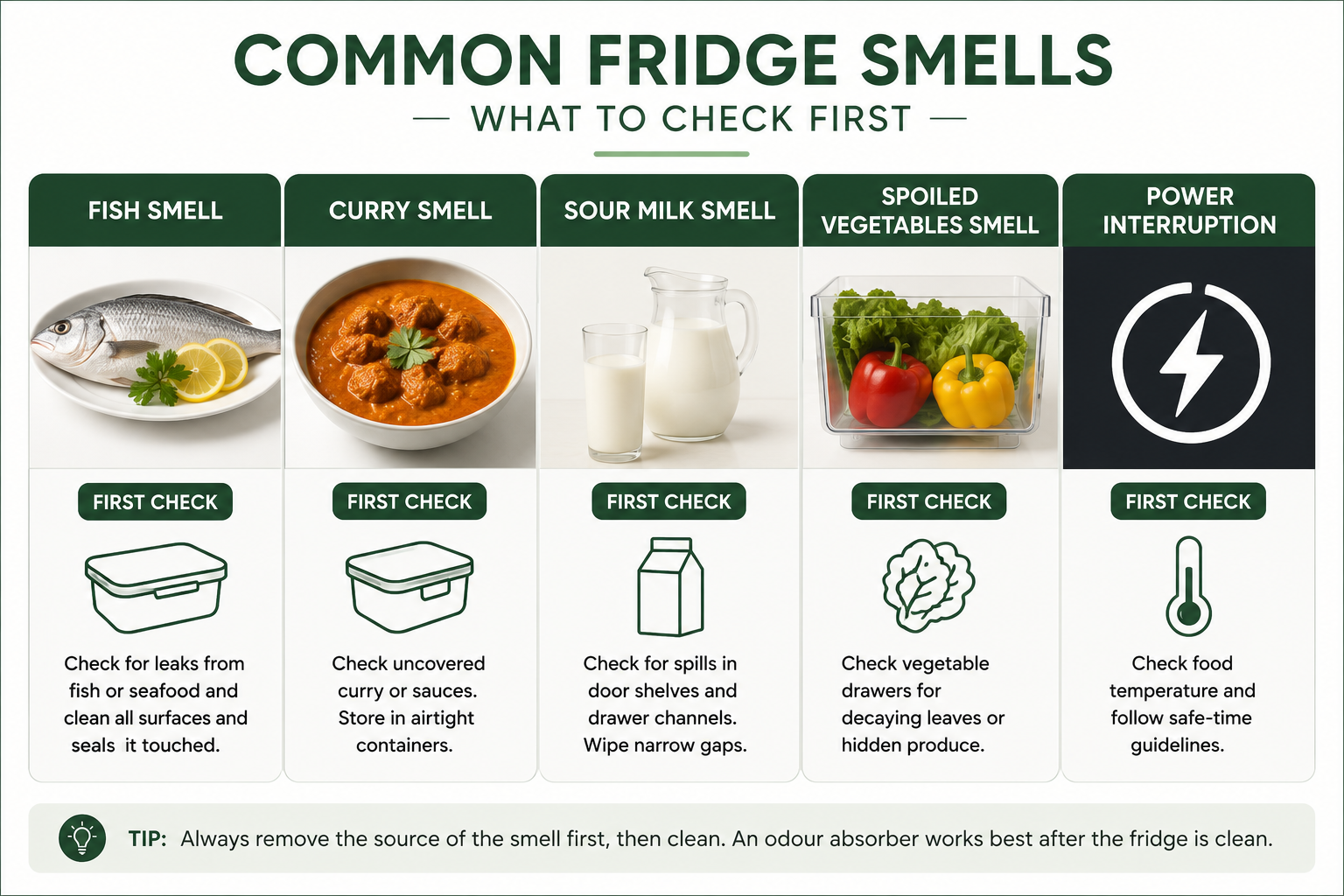
Rotten Food Smell
A rotten food smell is often linked to items forgotten inside drawers, packaging seams that have started to leak, or drainage areas that have not been checked recently. Inspecting these areas closely, rather than only the visible shelves, tends to locate the source more reliably.
Fish or Seafood Smell
Fish and seafood liquids can travel into drawer runners, door seals and shelf edges. All contacted surfaces should be cleaned, and any packaging that has been in contact with leaking fish or seafood should be discarded safely rather than reused.
Curry, Garlic or Onion Smell
Aromatic foods such as curry, garlic and onion are best stored in tightly sealed containers to limit odour transfer. Any spills should be cleaned promptly, and an odour absorber can be introduced once the fridge interior has been cleaned.
Sour Milk Smell
Spilled milk can travel into narrow gaps, door shelves and drawer channels. These areas should be cleaned carefully, without flooding parts of the appliance that are not designed to be accessed.
Fridge Smell After a Power Cut
During a power interruption, the fridge door should be kept closed as much as possible to preserve the internal temperature. An unopened refrigerator can generally keep food cold for up to four hours. If the interruption lasts longer than four hours, refrigerated perishable foods such as meat, poultry, fish, eggs, milk and leftovers should typically be discarded unless reliable temperature monitoring confirms they stayed at 4°C or below. Once power returns, these items should be inspected carefully rather than judged on appearance or smell alone.
Chemical or Burning Smell
A chemical or burning smell is different from a food-related odour and should be treated as a potential appliance fault. The refrigerator should be switched off where it is safe to do so, and damaged wiring or hot components should not be touched. Building maintenance, a landlord, the appliance manufacturer or a qualified technician should be contacted. Any sign of smoke, sparking or an electrical hazard requires urgent attention, and DIY electrical repair is not advisable.
Why the Fridge Still Smells After Cleaning
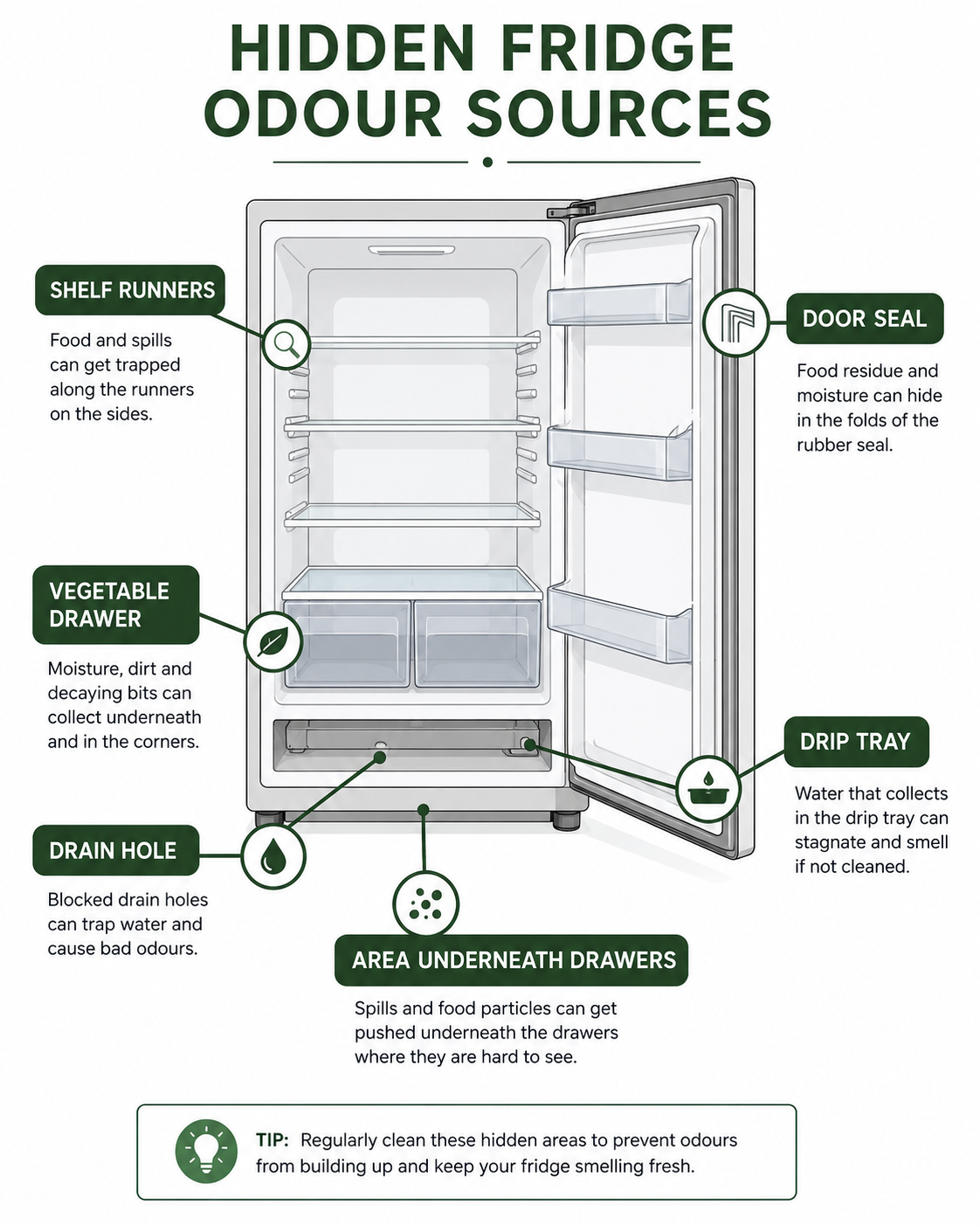
A lingering smell after a full clean is often linked to one of the following:
- A spill left underneath a drawer
- Residue trapped inside the door seal
- A blocked drain
- A dirty drip tray
- Contaminated packaging that has been returned to the fridge
- An uncovered, strong-smelling food item
- Moisture or mould in a hidden internal area
- A damaged door seal allowing warm, humid air inside
- Reduced cooling performance
- An appliance fault
- Odour originating from behind or underneath the fridge
- Odour absorbed into damaged plastic components over time
Repeating the main cleaning steps can help when a missed spill or residue is the likely cause. When the smell returns quickly after a thorough clean, or appears linked to cooling performance, professional inspection is usually the more appropriate next step.
How to Prevent Fridge Smells in UAE Weather
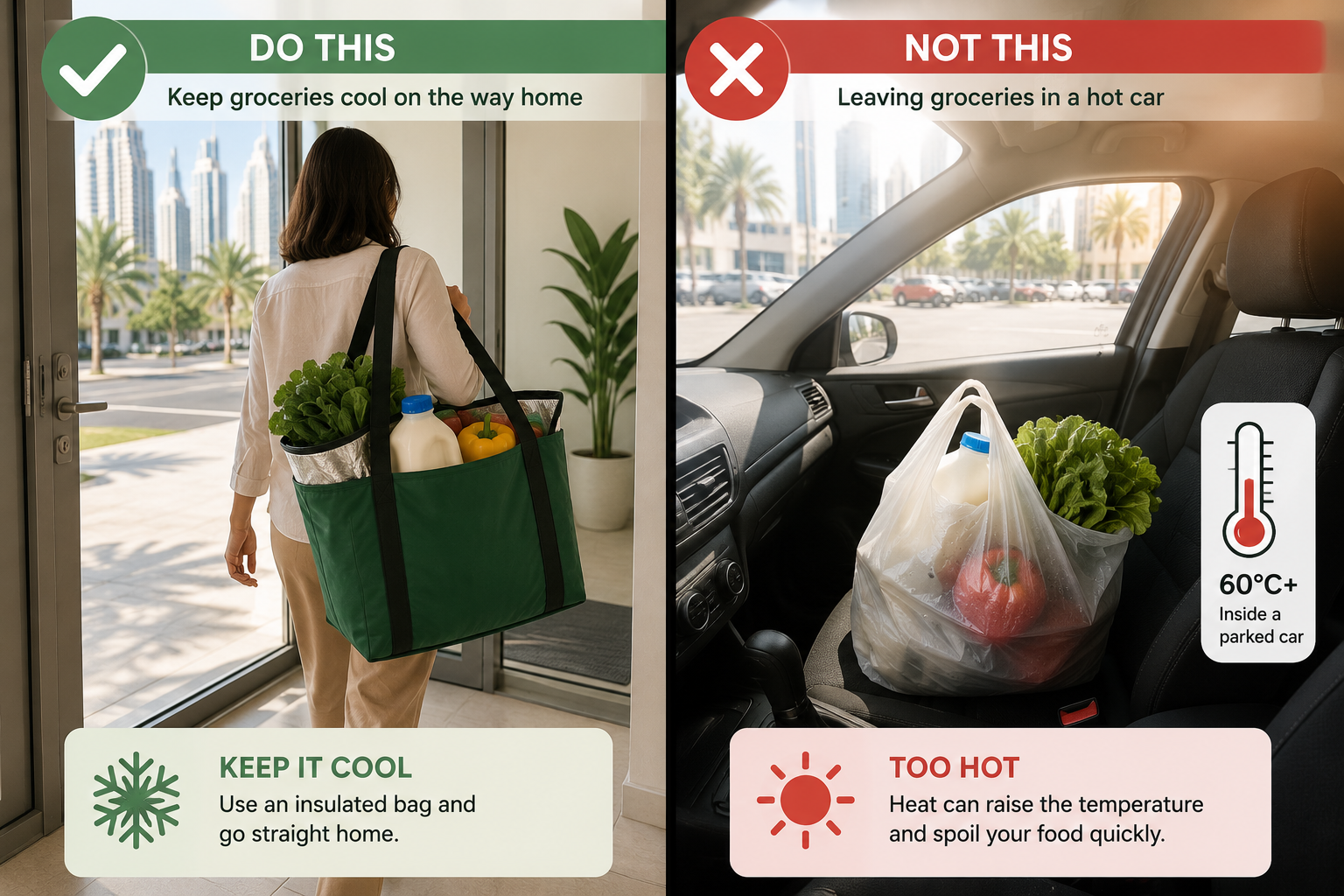
- Use insulated grocery bags for chilled and frozen products
- Make the supermarket the final stop before returning home
- Avoid leaving groceries inside a parked vehicle
- Refrigerate perishable items promptly after arriving home
- Store leftovers in sealed containers
- Label leftovers with the preparation date
- Wipe spills as soon as they happen
- Check vegetable drawers on a weekly basis
- Avoid blocking internal air vents with packed shelves
- Keep the fridge at the manufacturer-recommended temperature
- Check that the door closes and seals properly
- Clean the door seal on a regular basis
- Inspect food before travel or an extended holiday
- Ask someone to check the appliance during a longer absence where appropriate
- Consider a temperature alarm or monitoring device for a second refrigerator or an infrequently checked property
These steps are intended to be practical for apartments, villas and periods of travel across the UAE.
Fridge Cleaning Schedule for UAE Homes
Refrigerator cleaning can be added to the regular tasks in the weekly cleaning checklist for UAE homes, particularly when checking leftovers and wiping visible spills.
| Task | Suggested Frequency | Why It Helps |
|---|---|---|
| Check leftovers and produce | Weekly | Reduces the chance of forgotten spoiled food |
| Wipe visible spills | As they occur | Prevents residue from settling into surfaces |
| Inspect door seals | Monthly | Identifies wear before warm air enters the fridge |
| Clean drawers | Every 2 to 4 weeks | Removes trapped liquid and food particles |
| Clean shelves | Every 2 to 4 weeks | Limits residue build-up on frequently used surfaces |
| Check temperature | Monthly, or after any power interruption | Confirms the appliance is operating within a safe range |
| Inspect drain and drip tray where accessible | Every 1 to 2 months | Helps prevent blockages linked to lingering odours |
| Deep-clean the interior | Every 2 to 3 months | Addresses residue that routine wiping may miss |
Cleaning frequency should increase after any spill, food leakage, power interruption or spoiled-food incident. A deeper seasonal reset can be paired with the broader deep cleaning guide for UAE homes.
When to Call a Refrigerator Technician
Professional help is generally recommended when:
- The fridge cannot maintain a safe temperature
- The compressor runs continuously
- The appliance feels unusually hot
- Water repeatedly collects inside
- The drain blocks on a recurring basis
- The seal is damaged
- The smell appears electrical, chemical or burnt
- Mould is present inside inaccessible components
- The smell returns immediately after thorough cleaning
- There are unusual sounds, sparking or smoke
Tenants may need to contact their landlord, property manager or building maintenance team first, depending on the terms of the rental agreement. When moving into a previously occupied property, inspect and clean the refrigerator before storing food. The moving into a Dubai apartment cleaning guide covers other areas worth checking before unpacking.
Common Mistakes to Avoid
- Masking smells with fragrance without removing the spoiled food source
- Mixing vinegar and bleach or other chlorine-based products
- Spraying liquid cleaner into air vents or electrical components
- Using abrasive cleaners that can scratch interior surfaces
- Washing cold glass shelves with very hot water
- Returning food before the fridge has cooled to a safe temperature
- Leaving perishable items out for an extended period during cleaning
- Using excessive fragrance products near stored food
- Ignoring a fridge that consistently feels warm
- Attempting electrical repairs without the appropriate qualifications
Frequently Asked Questions
What is the fastest way to remove a bad smell from a fridge?
The fastest safe approach is to remove any spoiled food, check for hidden spills, clean the interior and removable parts with mild washing-up liquid, dry the appliance completely, and only then add an odour absorber such as baking soda.
Does baking soda really remove fridge smells?
Baking soda is commonly used to absorb lingering odours once the original source has been cleaned away. It is generally considered a supporting step rather than a replacement for identifying and removing the actual cause of the smell.
Can vinegar be used to clean the inside of a refrigerator?
Diluted white vinegar is sometimes used to loosen residue and reduce lingering odours, but it is not a disinfectant. It should never be mixed with bleach or other chlorine-based products, and the appliance manual should be checked first.
How long should baking soda stay in the fridge?
Replace baking soda when it no longer controls odours, becomes damp or reaches the replacement period shown on the packaging. Many purpose-made fridge products provide a specific replacement interval rather than a fixed universal timeframe.
Why does the fridge smell even after it has been cleaned?
A lingering smell often points to a missed spill under a drawer, residue inside the door seal, a blocked drain, a dirty drip tray, or an appliance issue such as a damaged seal or reduced cooling performance.
How can fish smell be removed from a fridge?
Fish liquid can travel into drawer runners, seals and shelf edges, so all contacted surfaces should be cleaned thoroughly. Any packaging that has leaked should be discarded rather than reused.
What should be done after a fridge power cut in the UAE?
An unopened refrigerator can generally keep food cold for up to four hours. Beyond that, refrigerated perishables should typically be discarded unless reliable temperature monitoring confirms they stayed at 4°C or below. Once power returns, meat, seafood, dairy products and leftovers should be inspected carefully rather than judged on appearance or smell alone.
Can lemon remove refrigerator odours?
Lemon can provide a temporary fragrance but is not considered a reliable solution for removing the underlying source of a fridge smell. Cleaning the affected area remains the more effective step.
Is a bad fridge smell a sign that the appliance is broken?
Not always. Most fridge smells are linked to food residue, spills or trapped moisture rather than a fault. However, a smell that returns quickly after thorough cleaning, or is chemical or burning in nature, can indicate an appliance issue that needs inspection.
How often should a refrigerator be cleaned in a UAE home?
A general guide is a light check weekly, more thorough cleaning of drawers and shelves every two to four weeks, and a deeper interior clean every two to three months, with additional cleaning after any spill or power interruption.
Conclusion
Fridge smells in hot UAE weather are usually resolved by following the correct order: remove the source, clean every affected surface, inspect the seals and accessible drainage areas, dry the appliance thoroughly and allow it to return to a safe temperature before replacing perishable food.
An odour absorber such as baking soda or activated charcoal may help with remaining smells, but it should only be used after the source has been removed. Arrange professional inspection when the fridge does not cool properly, the smell returns immediately, or there is a chemical, burning or electrical odour.
Sources
- FoodSafety.gov – Food Safety During a Power Outage
- Abu Dhabi Agriculture and Food Safety Authority (ADAFSA) – food hygiene and cold-storage guidance
- Dubai Municipality – Consumer food-safety guidance
- Refrigerator manufacturer care and cleaning instructions