Silverfish Insect in UAE Homes: How to Identify and Get Rid of Them (2026)
A silverfish insect is a small, wingless, silver-grey insect that UAE residents most often notice in bathrooms, kitchens, wardrobes and storage areas. In 2026, as in previous years, the first sighting usually happens at night, when a silverfish darts across a bathroom tile or out of a cupboard. Silverfish are commonly associated with dark, humid spaces and with materials that contain starches or cellulose, such as paper, cardboard, glue and some dry foods. In UAE apartments and villas, localised indoor moisture from bathrooms, plumbing, condensation or poorly ventilated storage can create favourable conditions for silverfish even when the rest of the home feels dry.
Quick Answer
Silverfish are nuisance and property pests, not a recognised health threat. They do not bite people and are not known to spread disease. Moisture is the main factor: bathrooms, under-sink cabinets, cupboards, wardrobes and storage areas with leaks, condensation or poor airflow can support them. Control usually combines fixing moisture sources, removing paper and cardboard clutter, sealing gaps and targeted treatment. Recurring or widespread infestations may justify professional pest control.
What Is a Silverfish Insect?
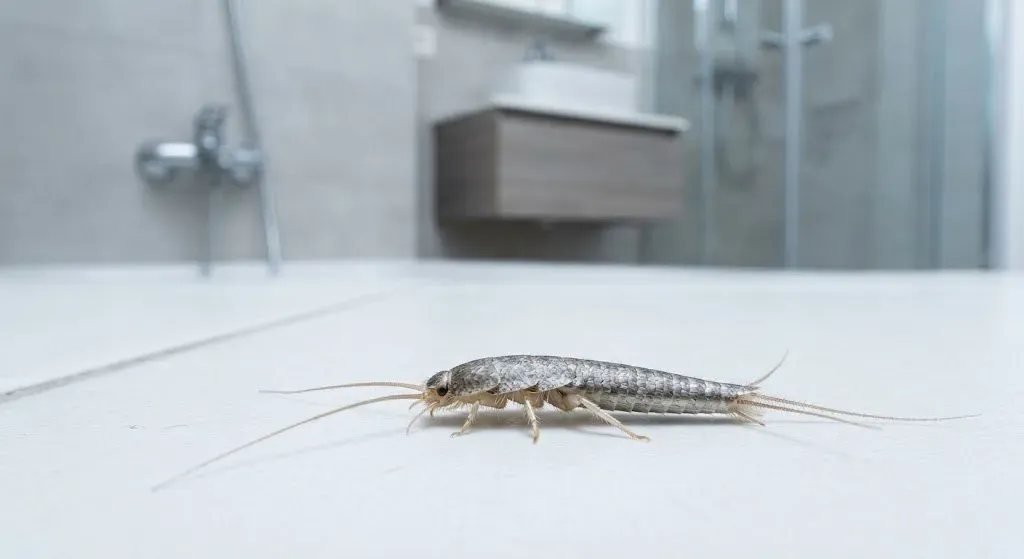
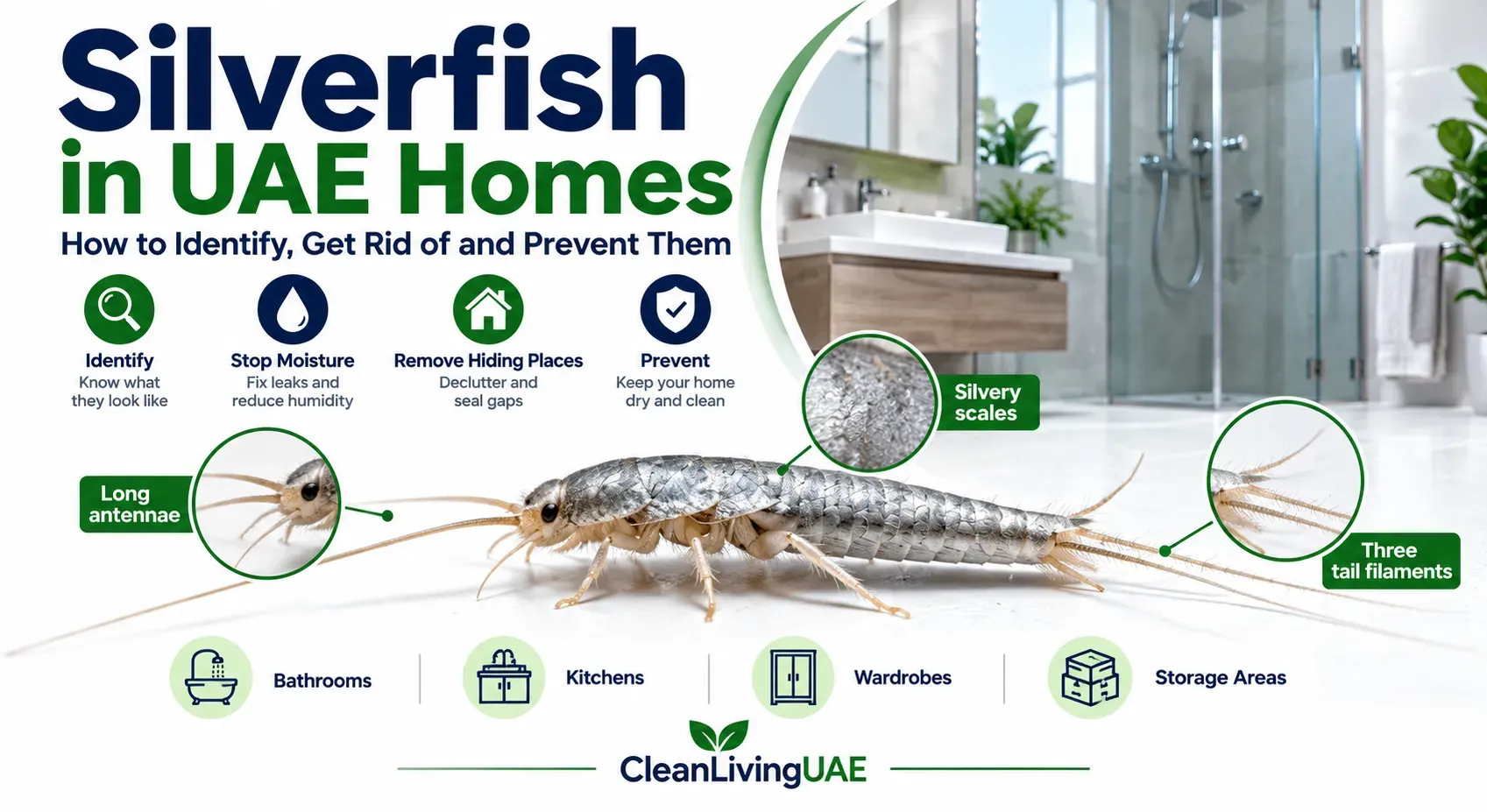
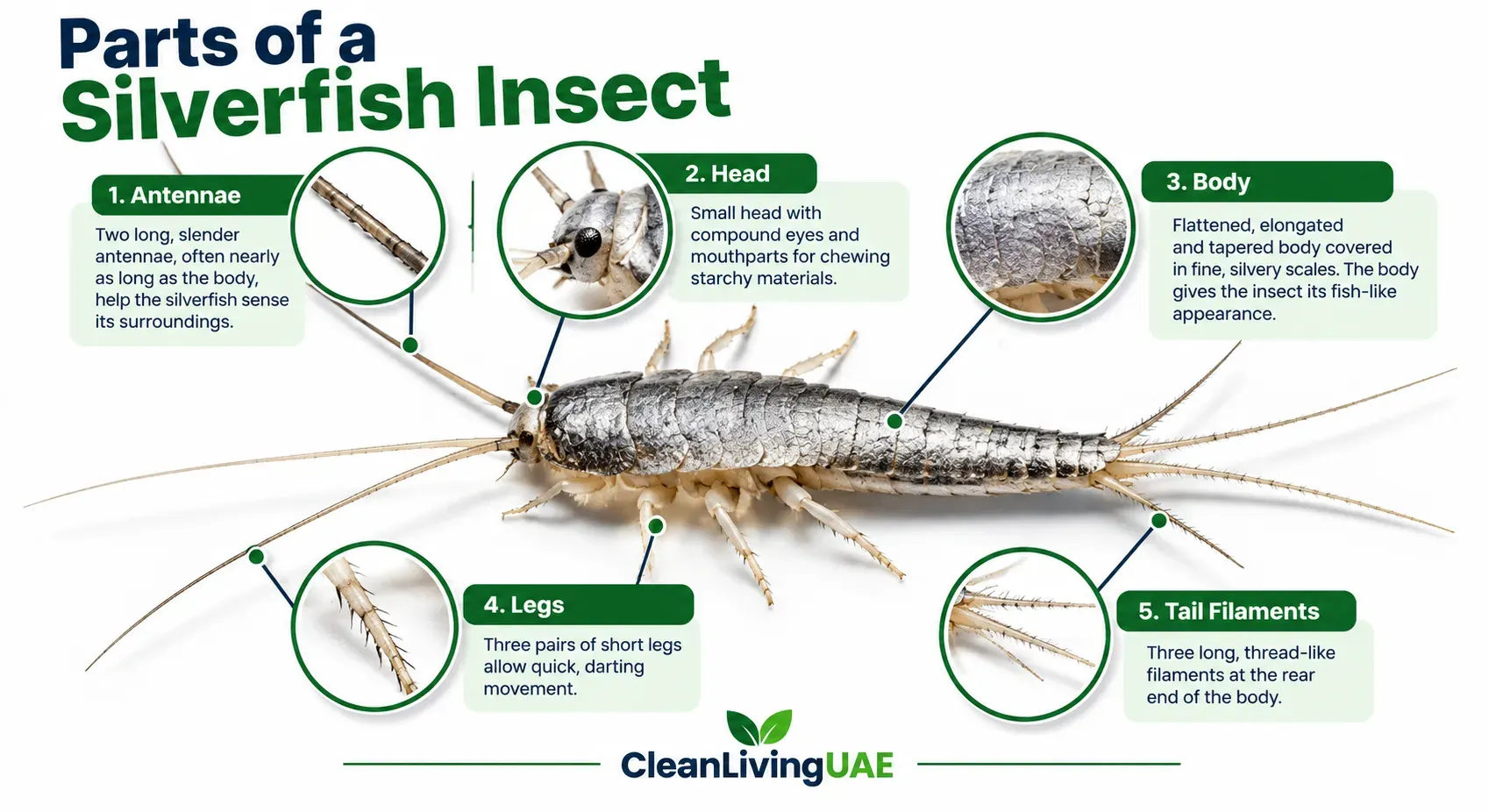
A silverfish insect (Lepisma saccharinum) is a primitive, wingless household insect with a flattened, tapered body covered in fine silvery scales. It has two long antennae at the front and three long, thread-like filaments at the rear. It is active at night, runs quickly with a fish-like wriggle and hides in cracks during the day.
Entomology sources describe the following key features:
- Body shape: flat and elongated, broad near the head and tapering towards the rear, which gives the insect its fish-like outline.
- Colour: silvery to grey, created by tiny scales. Newly hatched young are whitish and darken as they moult.
- Wings: none at any life stage.
- Antennae: two slender antennae, often nearly as long as the body.
- Tail filaments: three long, antenna-like appendages at the tip of the abdomen.
- Behaviour: nocturnal and fast-moving. When a hiding place is disturbed, silverfish typically dart away to find new cover.
Silverfish are also unusual because they continue to moult after reaching adulthood. Entomology sources indicate that adults can live for several years and can survive for months without feeding, which partly explains why removing visible insects rarely solves the problem on its own.
How to Identify Silverfish in Your UAE Home
Silverfish are usually identified by three features together: a tapered, silvery body, two long antennae and three long tail filaments. The table below summarises what to look for.
| Feature | Silverfish |
|---|---|
| Appearance | Flat, elongated, carrot-shaped body, broad at the head and tapering to the rear |
| Approximate size | Adults roughly 8-19 mm long (about 1/3 to 3/4 inch), excluding antennae and tail filaments |
| Colour | Silvery to grey with a slightly metallic sheen; young silverfish are paler |
| Wings | None |
| Antennae | Two slender antennae, often close to body length |
| Tail filaments | Three long, thread-like filaments at the rear |
| Movement | Fast, darting run with a side-to-side, fish-like wriggle |
| Common hiding areas | Bathrooms, under sinks, kitchen cupboards, laundry areas, wardrobes, bookshelves, cardboard boxes, behind skirting |
| Activity | Mostly nocturnal; hides in cracks and undisturbed spaces during the day |
Silverfish vs Similar Household Insects
A few other household insects are sometimes confused with silverfish:
- Firebrats: a close relative with a similar body shape and three tail filaments, but generally duller and more mottled grey. Firebrats prefer hot places, typically above about 32°C, such as areas near water heaters, ovens and hot-water pipes, and tolerate drier air than silverfish. Control steps are broadly similar.
- Cockroach nymphs: young cockroaches are oval rather than tapered, usually brown, and have two short rear appendages instead of three long filaments. They do not have silvery scales. Cockroach problems are covered separately in the guide to cockroach control options in the UAE.
- Booklice: much smaller, often only 1-2 mm, pale and soft-bodied, with no scales or tail filaments. Booklice are commonly associated with damp paper and mould growth rather than starch feeding.
If identification is uncertain, a clear photograph or an insect caught on a sticky trap can help a licensed pest-control professional confirm the species.
Are Silverfish Dangerous?
Silverfish are not considered dangerous to people. They do not bite or sting, are not poisonous and are not known to transmit disease. Entomology sources describe them as primarily a nuisance pest. The main concerns in homes are damage to stored paper and textiles and contamination of dry food.
Do silverfish bite humans?
No. Silverfish have small mouthparts suited to scraping and chewing materials such as paper and starch. They are not known to bite people and usually run from any disturbance.
Are silverfish poisonous?
No. Silverfish have no venom and are not poisonous to touch. Texas A&M entomology resources describe them as medically harmless.
Do silverfish spread disease?
Silverfish are not recognised as carriers of human disease. They can, however, contaminate stored dry food, which is a reason to discard affected packages rather than a sign of a health emergency.
Are silverfish dangerous to pets?
Silverfish are not known to bite or harm cats, dogs or other household pets. In practice, the greater risk to pets usually comes from pest-control products. Any treatment should be applied only as directed on the label, with pets kept away from treated areas for the period stated.
Why Are Silverfish Found in UAE Homes?
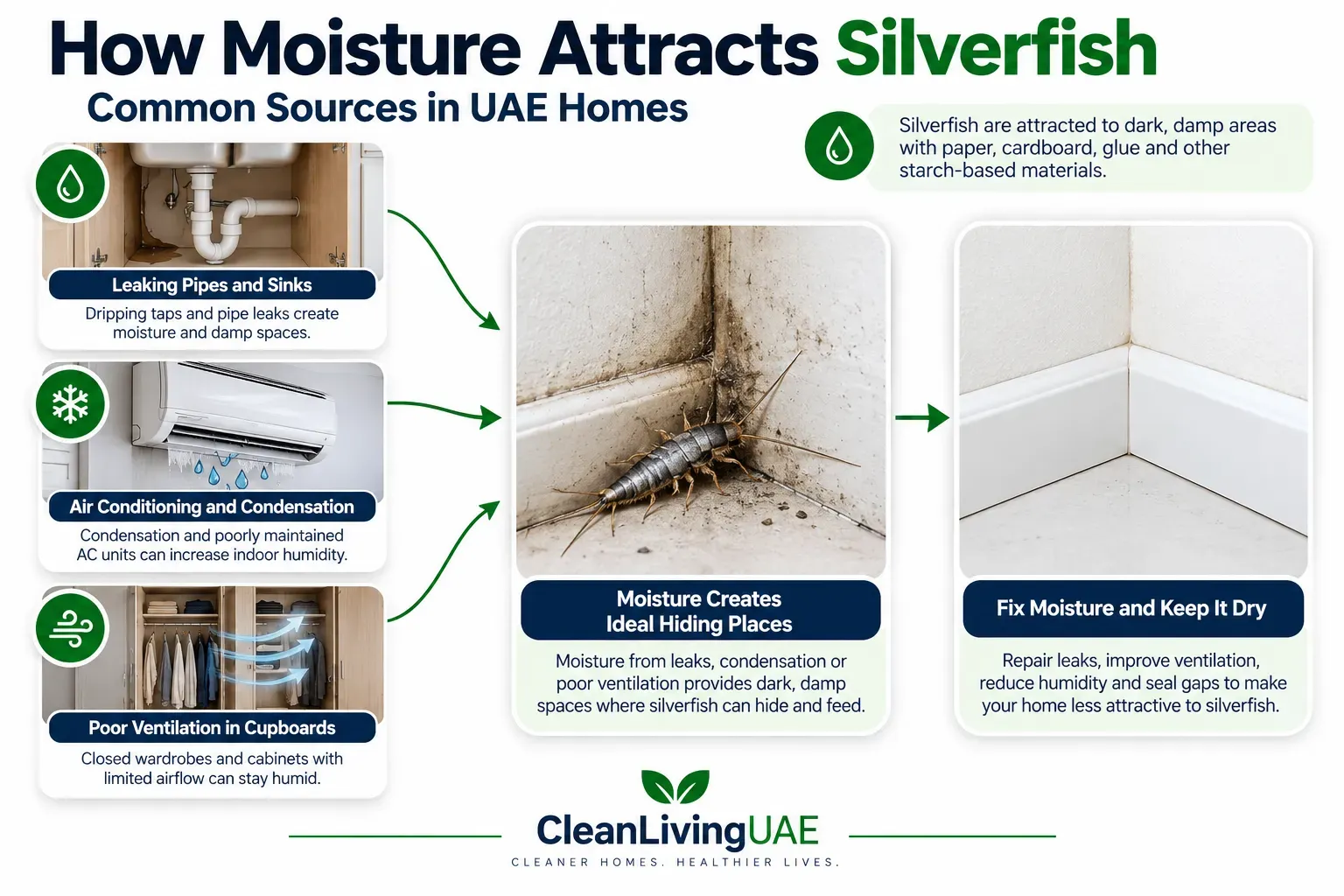
Silverfish are usually found in UAE homes because a specific area stays damp, dark and undisturbed while offering starch-based food such as paper or cardboard. Plumbing leaks, bathroom humidity, condensation and poorly ventilated storage are the most common contributors. Entomology sources indicate that silverfish prefer relative humidity of roughly 75-95%.
In UAE homes, localised indoor moisture can provide favourable conditions for silverfish even when the rest of the property is air-conditioned and feels dry.
Indoor Moisture and Humidity
Humidity is the single most important factor. Silverfish lose moisture easily and depend on damp microclimates. In a home that is generally dry, a single damp cupboard, a leaking waste pipe or a bathroom that never fully dries can still provide suitable conditions. This is why silverfish can appear in otherwise clean, well-kept homes: their presence is linked to moisture, not to a lack of cleaning.
Bathrooms, Plumbing and Under-Sink Cabinets
Bathrooms combine daily moisture from showers with gaps around pipes, drains and vanity units. Bathrooms without windows rely entirely on extractor fans, and where extraction is weak or unused, humidity can remain high for hours after showering. Slow leaks under basins and kitchen sinks, which often go unnoticed behind stored products, create similar conditions.
Air Conditioning and Condensation
Air conditioning does not create silverfish. In most homes, air conditioning actually removes moisture from indoor air. However, the water it removes has to drain away. A blocked or leaking condensate drain, water collecting near a fan coil unit, or condensation forming on chilled pipes and poorly insulated ducts can create localised damp spots in ceilings, cupboards and utility areas. These damp spots, rather than the air conditioning itself, may contribute to conditions that favour silverfish. Regular maintenance, as covered in the AC filter cleaning guide for UAE homes, helps keep units draining and operating as intended.
Storage, Cardboard and Paper
Cardboard boxes, stored books, documents and wallpaper adhesive all contain materials that silverfish feed on. Belongings kept in closed storerooms, spare rooms or wardrobes, and cardboard boxes left unopened after a house move, can go undisturbed for long periods. Entomology sources note that silverfish commonly arrive in homes inside boxes, old books, papers and furniture, then settle where conditions suit them.
Apartments and Villas Across the Emirates
Conditions vary between emirates and between buildings. Coastal areas, including much of Dubai, Abu Dhabi, Sharjah, Ajman, Umm Al Quwain, Ras Al Khaimah and Fujairah, can experience high outdoor humidity at certain times of year, while inland areas are often drier. In practice, the indoor factors below usually matter more than location:
- the condition of plumbing, drains and AC condensate lines
- how well bathrooms, kitchens and laundry areas are ventilated
- whether storage rooms and wardrobes receive any airflow
- the amount of cardboard, paper and fabric stored long term
- whether the property is newly built, as entomology sources note silverfish can be found where building materials are still drying out
- whether the home was left closed for long periods, for example during summer travel, allowing small leaks to go unnoticed
Where Do Silverfish Hide?
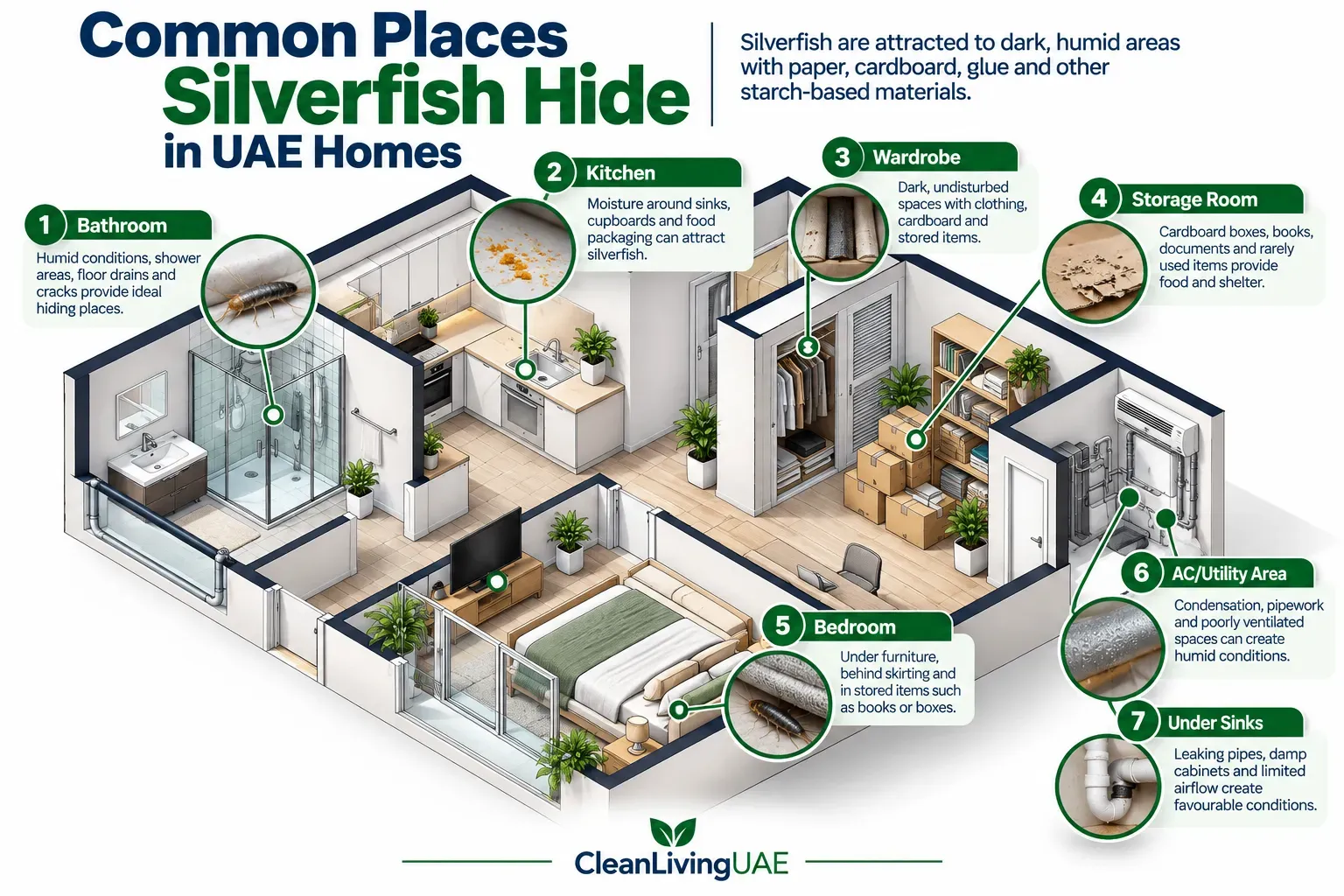
Silverfish hide in dark, humid, undisturbed places close to a food source. The table below lists common locations in UAE apartments and villas.
| Location | Why Silverfish May Be Found There | What to Check |
|---|---|---|
| Bathroom | Daily shower moisture, gaps around fixtures, limited ventilation in internal bathrooms | Extractor fan performance, grout and silicone gaps, damp mats and towels |
| Kitchen | Moisture around sinks and dishwashers, dry food packaging, gaps under cabinets | Pantry packaging, cabinet bases, the area behind appliances |
| Under sinks | Slow leaks, condensation on pipes, dark enclosed space | Drips from traps and joints, swollen cabinet boards, damp stored items |
| Wardrobe | Limited airflow, stored fabrics, starch in clothing, cardboard boxes | Rear corners, shelves against external or bathroom walls, stored boxes |
| Storeroom | Closed doors, little ventilation, long-term cardboard and paper storage | Floor-level boxes, dampness on walls, signs of feeding on labels |
| Bookshelves | Paper, book bindings and glue as food; undisturbed spaces behind books | Irregular feeding marks on pages and spines, shelves near damp walls |
| Cardboard boxes | Cellulose and glue as food, corrugated layers as shelter | Boxes stored on floors, soft or stained cardboard, insects inside flaps |
| Laundry area | Washer and dryer moisture, wet clothes, detergent and starch residues | Hose connections, gaps behind machines, damp floor edges |
| Around plumbing | Pipes provide moisture and routes between rooms through wall gaps | Pipe penetrations, access panels, gaps behind toilets and basins |
| AC and utility areas | Condensate drainage, dark enclosed cupboards, water heaters | Drain pans and lines, damp ceiling tiles, pooling water, stored items nearby |
Seeing silverfish at night is common because they are nocturnal. They typically leave hiding places after dark to search for food and retreat when lights are switched on. Silverfish found in a bathtub or washbasin have usually fallen in and are unable to climb the smooth sides, rather than necessarily having come up through the drain.
What Do Silverfish Eat?
Silverfish prefer foods high in carbohydrates and protein, especially starches, sugars and cellulose-based materials. According to Ohio State University entomology resources, they have been observed feeding on paper, glue, book bindings, wallpaper paste, photographs, starch in clothing, cotton, linen, rayon, wheat flour, cereals, dried meats, leather and dead insects.
In a typical UAE home, the most relevant food sources include:
- paper, printed documents and books, including bindings and glue
- cardboard boxes and packaging
- wallpaper and the paste behind it
- photographs and paper-based keepsakes
- natural and some synthetic fabrics, particularly starched clothing
- flour, cereals, rolled oats and other dry pantry products
- spilled starch-based cosmetic powders, which Ohio State notes can support infestations in bathroom carpets
Because silverfish can survive for months without feeding, removing food sources helps but works best alongside moisture control.
What Damage Can Silverfish Cause?
Silverfish cause surface damage to materials, not structural damage to buildings. They do not damage concrete, blockwork or steel. The damage is limited to what they feed on and usually builds up slowly over time.
Items that may be affected include:
- Books: grazed pages, damaged spines and weakened bindings
- Documents: feeding marks on stored paperwork, such as contracts, certificates and printed records
- Cardboard: surface grazing and holes, particularly in boxes stored for long periods
- Photographs: damage to paper prints and the adhesives in albums
- Wallpaper: feeding on the surface and the paste behind it, sometimes causing peeling patches
- Clothing and textiles: small holes or thinned areas, especially in stored, starched or natural-fibre items
- Dry food packaging: damaged paper or cardboard packaging and contaminated contents
Signs of a Silverfish Infestation
One silverfish does not automatically indicate an infestation. Silverfish often arrive in boxes, books or furniture, and a single insect may have been carried in recently. The following signs suggest an established silverfish infestation:
- repeated sightings over several weeks, especially at night
- silverfish seen in more than one room
- small, pale young silverfish, which suggest breeding nearby
- shed skins in cupboards, drawers or storage boxes, as silverfish moult throughout life
- irregular feeding marks, thin patches or small holes in paper, labels, wallpaper or book covers
- small holes in stored clothing or fabrics
- regular catches on sticky traps placed in the same area
Entomology sources note that silverfish populations tend to grow slowly, so a large infestation usually indicates conditions that have persisted for some time.
How to Get Rid of Silverfish in UAE Homes
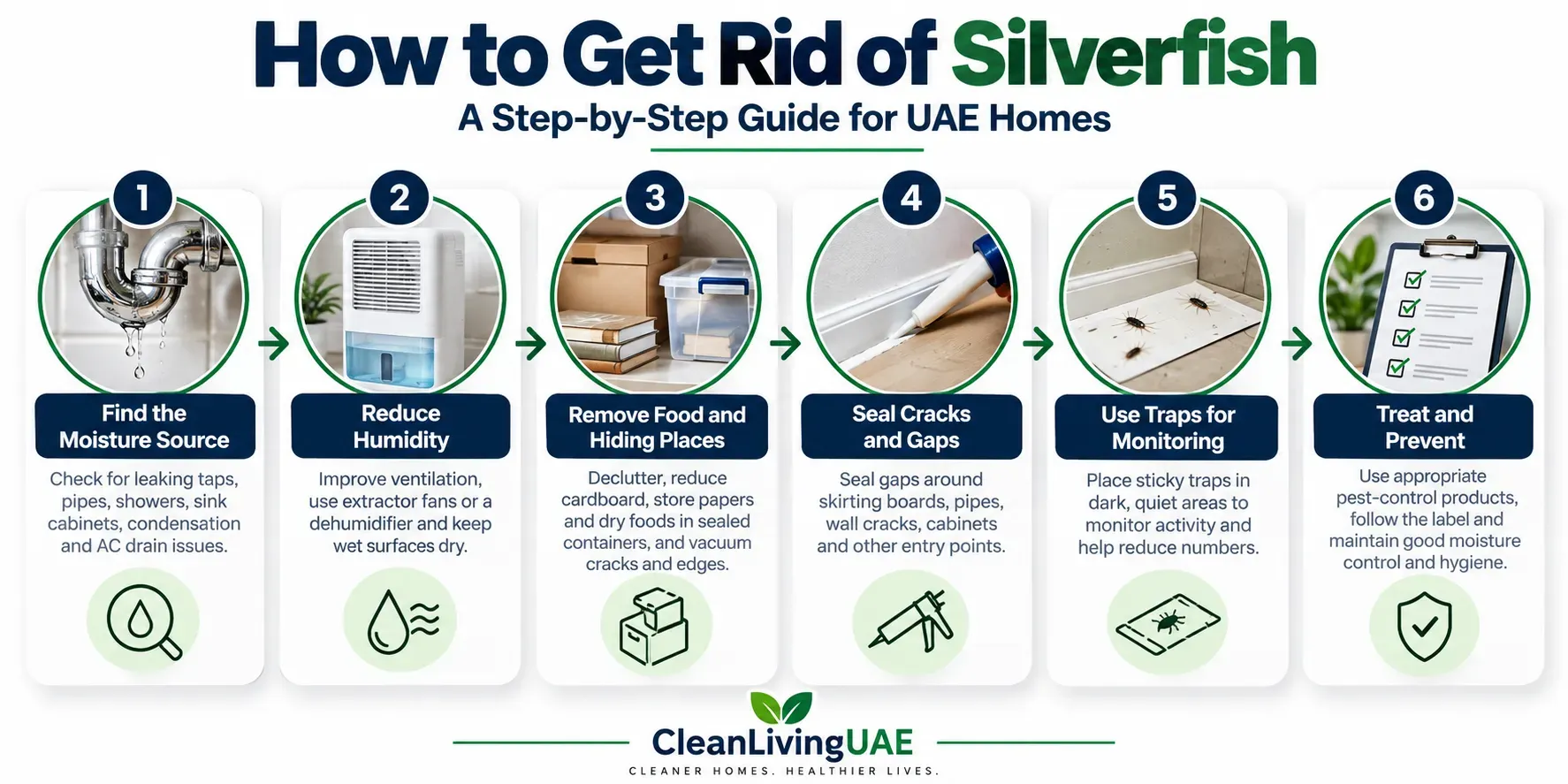
Getting rid of silverfish usually requires removing the conditions that support them rather than only killing visible insects. The most effective sequence is to find and fix moisture sources, reduce humidity, remove food and hiding places, seal gaps, monitor with sticky traps and use appropriate treatments or professional pest control where needed.
Step 1 – Find the Moisture Source
Start by identifying where the damp conditions come from. Check:
- leaking taps, mixers and shower valves
- pipe joints, waste traps and flexible hoses under sinks
- sink and vanity cabinets for swollen boards, water marks or damp smells
- shower areas, including failed grout and silicone that allows water behind tiles
- condensation on cold-water pipes and chilled-water lines
- AC condensate drains, drip trays and nearby ceiling or cupboard surfaces
- damp cupboards, particularly those against bathroom walls
- poorly ventilated storerooms and wardrobes
In rented properties, leaks and AC drainage faults are often the responsibility of the landlord or building management, depending on the tenancy agreement. Reporting them early can prevent a small moisture issue from becoming a recurring pest problem.
Step 2 – Reduce Indoor Humidity
Once leaks are repaired, reduce humidity in the affected areas:
- run bathroom extractor fans during showers and for a period afterwards
- wipe or squeegee wet surfaces, and dry bath mats and towels outside the bathroom where possible
- keep AC units maintained so they drain correctly and continue to remove moisture
- leave wardrobe and storeroom doors open periodically to allow airflow
- use a dehumidifier in enclosed spaces that remain damp
- monitor humidity with a hygrometer or an air quality monitor that displays humidity
As a general indoor guideline, the US Environmental Protection Agency recommends keeping indoor relative humidity below 60%, ideally between 30% and 50%, to limit mould growth. This range sits well below the conditions silverfish are reported to prefer. Further guidance is available in the article on humidity and mould prevention in UAE homes.
Step 3 – Remove Food and Hiding Places
- reduce cardboard storage, especially boxes kept on floors or in damp rooms
- move books, documents and keepsakes into sealed plastic containers with tight-fitting lids
- declutter old newspapers, magazines and paper stacks
- store flour, cereals, oats and similar products in sealed containers
- vacuum along skirting boards, cabinet bases, shelf edges and wardrobe corners using a crevice tool
- wash stored fabrics that show signs of feeding, following the care label
Step 4 – Seal Cracks and Gaps
Sealing reduces hiding places and movement routes between rooms. Areas to check include:
- gaps along skirting boards
- openings around pipe penetrations under sinks and behind toilets
- wall gaps near access panels and fixtures
- gaps at the back and base of kitchen and vanity cabinets
- cracked grout and failed silicone in wet areas
A suitable sealant or silicone can be used on small gaps. In rented homes, it is advisable to check with the landlord or building management before making alterations.
Some product mentions may include affiliate links.
Step 5 – Use Silverfish Traps for Monitoring
Sticky traps are primarily a monitoring tool, although they can also help reduce small populations. They show where silverfish are active and whether numbers are falling over time.
- place traps along skirting boards, inside under-sink cabinets, behind toilets and in wardrobe corners
- position them flat against walls and edges, where silverfish tend to travel
- keep traps out of reach of children and pets
- date each trap and check it weekly
- note which traps catch the most insects, as this often points to the nearest hiding place or moisture source
Step 6 – Consider Appropriate Pest-Control Products
Ohio State University entomology guidance notes that insecticides are generally not needed for silverfish management and are usually reserved for heavier infestations. Where products are used, they are typically applied to cracks, crevices and other hiding places rather than sprayed across open surfaces.
In the UAE, pesticides must be registered with the Ministry of Climate Change and Environment (MOCCAE), and the trade in unregistered pesticides is prohibited. Residents should use only household products legally sold in the UAE for the intended use and follow the label exactly.
UAE Pest-Control Safety Note
- Use only appropriate pest-control products legally marketed in the UAE for household use.
- Read and follow the label directions, including dosage, placement and ventilation.
- Never mix pesticides unless the manufacturer explicitly instructs it.
- Keep treatments away from children, pets and food, as required by the label.
- Use professional pest control when an infestation requires treatment beyond safe DIY measures.
Integrated pest management principles prioritise moisture reduction, sanitation, exclusion and monitoring before chemical use, and limit chemical treatment to what is necessary.
Step 7 – Call Professional Pest Control When Necessary
A professional inspection may make sense when:
- silverfish keep returning despite moisture control and decluttering
- several rooms are affected
- insects appear to be coming from wall voids, ceilings or other inaccessible areas
- a persistent moisture problem cannot be traced
- sightings continue after several weeks of prevention measures
- it is unclear which insect is present
In Dubai, Dubai Municipality regulates public-health pest-control companies and publishes information on approved providers. Other emirates have their own municipal authorities, and MOCCAE has issued a unified federal guide setting technical requirements for public-health pest-control firms. Requirements and procedures can differ between emirates, so it is advisable to confirm that any company is licensed by the relevant local authority, ask which products will be used and request clear preparation and follow-up instructions.
Does a Dehumidifier Help With Silverfish?
A dehumidifier can help by making damp areas less favourable for silverfish, but it will not usually eliminate an established infestation on its own. Silverfish can survive for months, and some hide in wall voids or cabinets that a dehumidifier may not fully dry. Fixing leaks and condensation comes first.
Humidity control, whether through better ventilation, AC maintenance or a dehumidifier, may be particularly useful in:
- enclosed storerooms and spare rooms used for storage
- walk-in wardrobes and rooms without windows
- laundry areas that stay damp after washing
- ground-floor villa rooms that feel persistently humid
- homes where humidity readings stay high even with the AC running
A dehumidifier is less likely to solve the problem when the moisture comes from a leaking pipe, a blocked AC drain or water behind tiles. In those cases it treats the symptom rather than the cause. Measuring humidity before and after helps show whether it is making a difference. For comparisons of suitable models, see the guide to dehumidifiers for UAE homes.
Silverfish in the Bathroom – What Should You Do?
Finding silverfish in bathroom areas usually points to excess moisture combined with gaps around fixtures. The solution is to dry the room faster, repair leaks and remove hiding places, then monitor to confirm the problem is reducing.
- Inspect taps, shower valves, basin waste pipes and the toilet cistern for leaks.
- Improve extraction by running the fan during and after showers and checking that it actually draws air.
- Dry wet surfaces, mats and towels rather than leaving them damp overnight.
- Inspect the vanity or sink cabinet for drips, swollen boards and damp stored items.
- Check pipe penetrations behind the toilet and under the basin for gaps.
- Remove cardboard packaging, paper and tissue stock from damp cabinets.
- Monitor cracks, grout lines and skirting with sticky traps.
- Consider professional treatment if silverfish persist after moisture issues are fixed.
For tools suited to humid bathrooms, see the guide to bathroom cleaning tools for hard water and humidity.
Silverfish in Kitchens and Pantries
Silverfish in the kitchen are usually drawn by moisture around sinks and appliances, together with dry food and paper packaging. Common contributing factors include:
- slow leaks under the sink or behind the dishwasher and washing machine
- cardboard food packaging stored for long periods
- flour, cereals, oats and similar products kept in opened packets
- crumbs and spilled dry food at the back of shelves
- gaps beneath and behind base cabinets
For food safety, discard any dry food that shows insects, feeding damage or contamination, and move remaining products into sealed containers. Clean shelves before restocking. Pest-control products should not be applied inside food cupboards or on food-preparation surfaces unless the label specifically permits it. Wider kitchen hygiene steps are covered in the kitchen cleaning guide for UAE homes.
Silverfish in Wardrobes, Books and Storage Boxes
Wardrobes and storage areas are common silverfish locations in UAE homes because they are closed, dark and often filled with paper, cardboard and fabric. Rooms used only for storage may receive little airflow, and wardrobes built against bathroom walls can stay slightly damp. Books, documents and photographs stored in cardboard boxes provide both food and shelter.
Useful measures include:
- opening wardrobes and storerooms regularly to improve airflow
- keeping stored items off the floor and away from damp walls
- replacing cardboard boxes with sealed plastic containers
- checking stored clothing, particularly natural fibres and starched items, for small holes
- placing moisture absorbers or silica gel packs inside sealed containers where appropriate
Protecting Important Documents and Belongings
- Store passport copies, contracts, certificates and records in sealed plastic folders or boxes.
- Keep digital scans of important documents as a backup.
- Store photographs in sealed, archival-quality containers where possible.
- Keep document boxes on shelves rather than on the floor.
- Avoid storing paper in bathrooms, under sinks or against damp walls.
- Check stored boxes every few months for feeding marks, shed skins or live insects.
How to Prevent Silverfish From Coming Back
Silverfish prevention depends on keeping the conditions described above under control: repaired leaks, working bathroom extraction and AC drainage, sealed storage instead of cardboard, and periodic checks of undisturbed areas. The points below cover differences between apartments and villas.
Additional Points for Apartments
- Report leaks, AC drainage faults and damp ceilings to building management promptly.
- Pay attention to shared walls and service shafts, as silverfish may move along pipework.
- Check windowless bathrooms and enclosed utility cupboards, where moisture can linger.
Additional Points for Villas
- Check ground-floor rooms, outdoor storerooms and maid’s rooms for damp and stored cardboard.
- Look for irrigation or garden water collecting against external walls.
- Seal gaps around external doors, pipe entries and utility connections.
DIY Silverfish Control vs Professional Pest Control
DIY silverfish control is usually suitable for small, localised problems with an identifiable moisture source. Professional silverfish pest control may be more appropriate for widespread, hidden or recurring infestations. The comparison below summarises the main differences.
| Factor | DIY Control | Professional Pest Control |
|---|---|---|
| Small or occasional problem | Often sufficient when combined with moisture control | Usually not necessary |
| Cost | Generally lower; mainly repairs, containers, traps and possibly a dehumidifier | Higher; varies by company, property size and treatment scope |
| Moisture correction | Resident or landlord repairs leaks and improves ventilation | May identify moisture issues, but repairs usually remain the owner’s or landlord’s responsibility |
| Hidden infestation | Limited access to wall voids and ceilings | Better equipped to inspect and treat hard-to-reach areas |
| Multiple rooms | Harder to manage consistently | Better suited to coordinated treatment across the property |
| Chemical treatment | Limited to household products used strictly according to the label | Licensed technicians using products approved for professional use |
| Follow-up | Self-monitoring with sticky traps | Follow-up visits may be included, depending on the service |
| Best suited for | Localised problems with a clear, fixable cause | Persistent, widespread or unidentified infestations |
Silverfish Prevention Checklist for UAE Homes
Weekly
- Dry bathroom surfaces and run extraction after showers.
- Check sticky traps.
Monthly
- Check under sinks for drips.
- Vacuum skirting, cabinet bases and wardrobe corners.
Every Few Months
- Inspect AC condensate drains and filters.
- Check stored boxes and documents for feeding marks.
- Reseal cracked grout and small gaps.
Final Thoughts
Controlling silverfish usually depends on changing the conditions that support them, particularly moisture, hiding places and accessible food materials, rather than simply killing the insects that are visible. In most UAE homes, this means tracing leaks and condensation, improving ventilation and reducing paper and cardboard storage.
A simple sequence to follow is: Inspect → Dry → Declutter → Seal → Monitor → Treat if necessary.
Frequently Asked Questions
What causes silverfish in UAE homes?
Silverfish in UAE homes are usually caused by localised moisture from plumbing leaks, bathroom humidity, AC condensate problems or poorly ventilated storage, combined with food sources such as paper, cardboard and dry pantry products.
Why do I have silverfish in my bathroom?
Bathrooms provide regular moisture from showers, gaps around pipes and fixtures, and often limited ventilation. Silverfish in the bathroom usually indicate humidity that is not being cleared quickly enough or a nearby leak.
Are silverfish dangerous?
Silverfish are not considered dangerous to people. They do not bite or sting, are not poisonous and are not known to spread disease. The main concerns are damage to paper, textiles and stored food.
Do silverfish bite?
No. Silverfish are not known to bite humans or pets. Their mouthparts are suited to scraping and chewing materials such as paper and starch.
How do I get rid of silverfish permanently?
No method can guarantee permanent removal, but long-term control is most likely when leaks are fixed, humidity is reduced, cardboard and paper clutter is removed, gaps are sealed and activity is monitored with sticky traps.
Does air conditioning cause silverfish?
No. Air conditioning generally removes moisture from indoor air. However, blocked or leaking condensate drains and condensation on chilled pipes can create damp spots that may favour silverfish.
Will a dehumidifier get rid of silverfish?
A dehumidifier can make damp areas less suitable for silverfish, but it is unlikely to eliminate an established infestation alone. It works best after leaks are repaired and alongside decluttering and monitoring.
What attracts silverfish to bedrooms and wardrobes?
Silverfish in bedrooms and wardrobes are usually attracted by limited airflow, stored clothing, starched fabrics, books and cardboard boxes, particularly where a wardrobe sits against a bathroom or damp wall.
Does seeing one silverfish mean I have an infestation?
Not necessarily. A single silverfish may have arrived in a box, book or piece of furniture. Repeated sightings, young silverfish, shed skins or feeding damage are stronger signs of an infestation.
When should I call pest control for silverfish?
Professional pest control is worth considering when silverfish persist after moisture control, appear in several rooms, seem to come from wall voids or ceilings, or cannot be identified with confidence.
Sources
This guide draws on entomology and government sources, including Silverfish and Firebrats (Ohio State University Extension), Silverfish and Firebrats (University of California Statewide IPM Program), Silverfish (Texas A&M AgriLife Field Guide to Common Texas Insects), A Brief Guide to Mold, Moisture and Your Home (US Environmental Protection Agency), Registration of a Pesticide (UAE Ministry of Climate Change and Environment), Regulating the Use of Pesticides (UAE Ministry of Climate Change and Environment), Unified Municipal Work Guide for Public Health Pest Control Firms (UAE Ministry of Climate Change and Environment) and Dubai Municipality.