Air Purifier vs Dehumidifier UAE: 7 Essential Differences for Healthier Homes
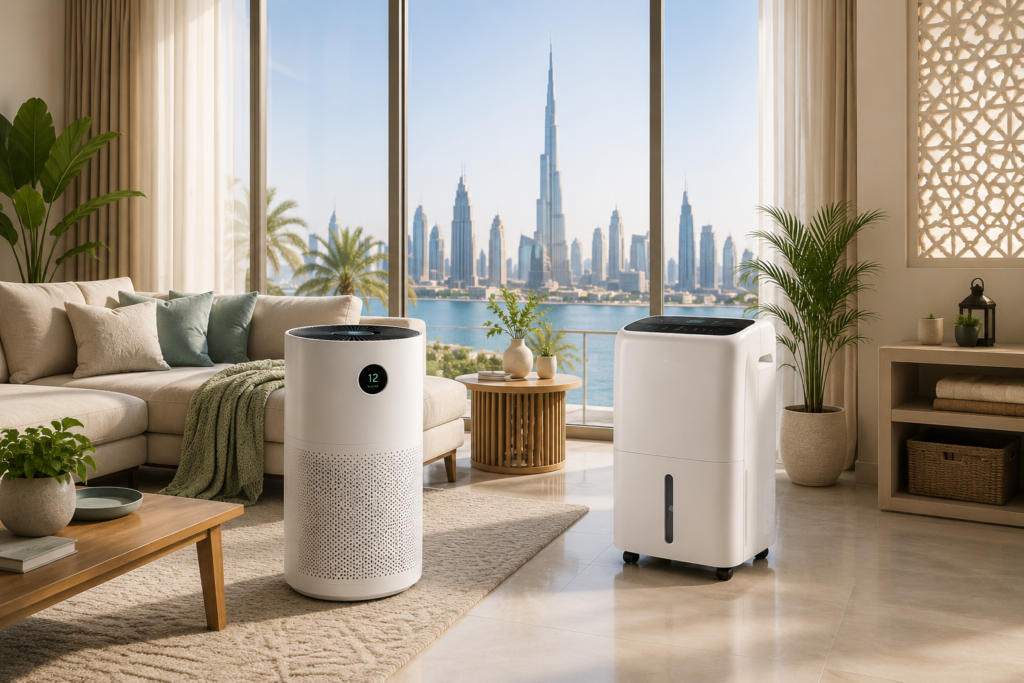
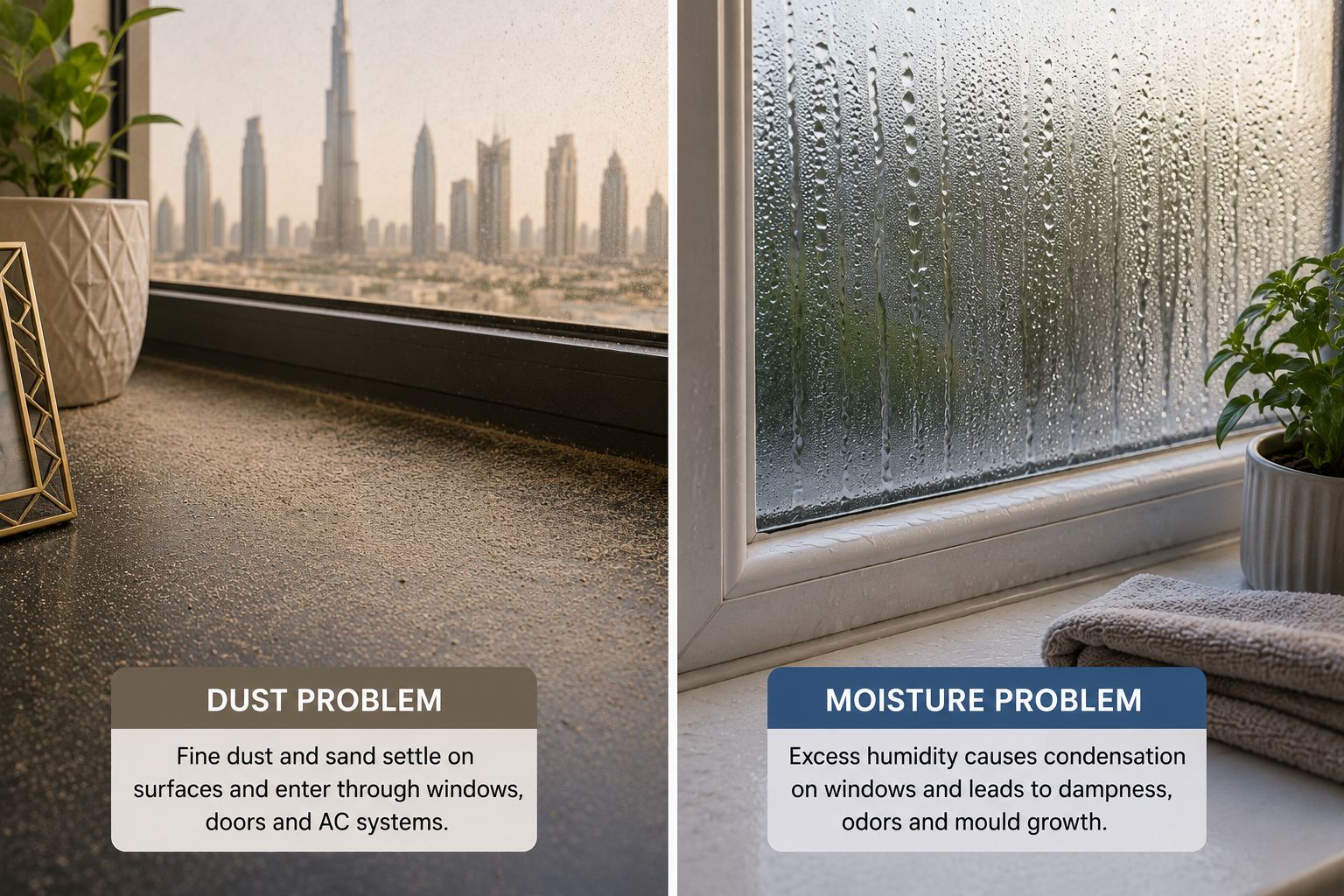
A humidifier serves a different purpose because it adds moisture rather than removing it. See our guide to air purifier vs humidifier for UAE homes if indoor air feels dry but dust is also a concern.UAE homes face two distinct air quality challenges. Desert dust and sand enter through windows, doors and air UAE homes face two distinct air quality challenges. Desert dust and sand enter through windows, doors and air conditioning vents, while coastal humidity in cities such as Dubai, Abu Dhabi and Sharjah can create conditions for excess indoor moisture, particularly during warmer months. An air purifier and a dehumidifier solve different problems: one filters airborne particles, the other reduces moisture. Choosing the right device depends on which issue is actually present in a specific apartment or villa.
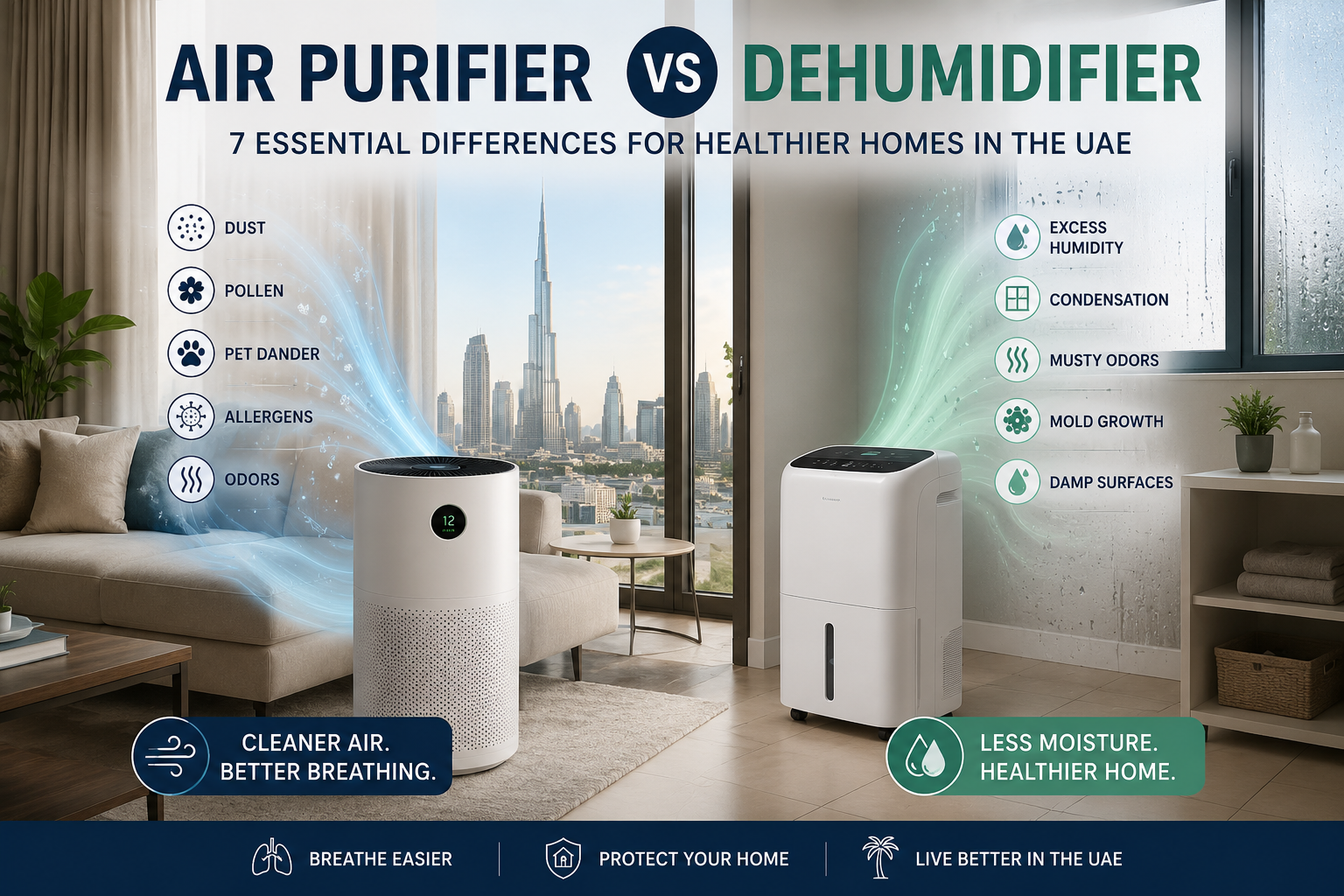
Choose an air purifier when: the main problem is airborne dust, pollen, pet dander or particles entering during sandstorms.
Choose a dehumidifier when: the main problem is condensation, damp smells, elevated humidity or mould-prone surfaces.
Consider both when: dust and excess moisture occur in different rooms or at different times of the year.
What an Air Purifier Does
An air purifier draws air through a filter to capture particles suspended in it. Fine desert dust is a common contributor to indoor dust in UAE homes. It can enter through window gaps, doors and air-conditioning systems, particularly where filters are dirty, poorly fitted or overdue for maintenance. For a fuller explanation of common entry points, see why dust builds up in UAE homes.
Air purifiers fitted with high-efficiency filtration can capture fine airborne particles that pass through the unit, including much of the dust circulating within a room. They are commonly used in bedrooms and living rooms because residents spend substantial time in these areas. The unit should have sufficient clearance around its intake and outlet, according to the manufacturer’s instructions.
An air purifier has no meaningful effect on humidity levels.
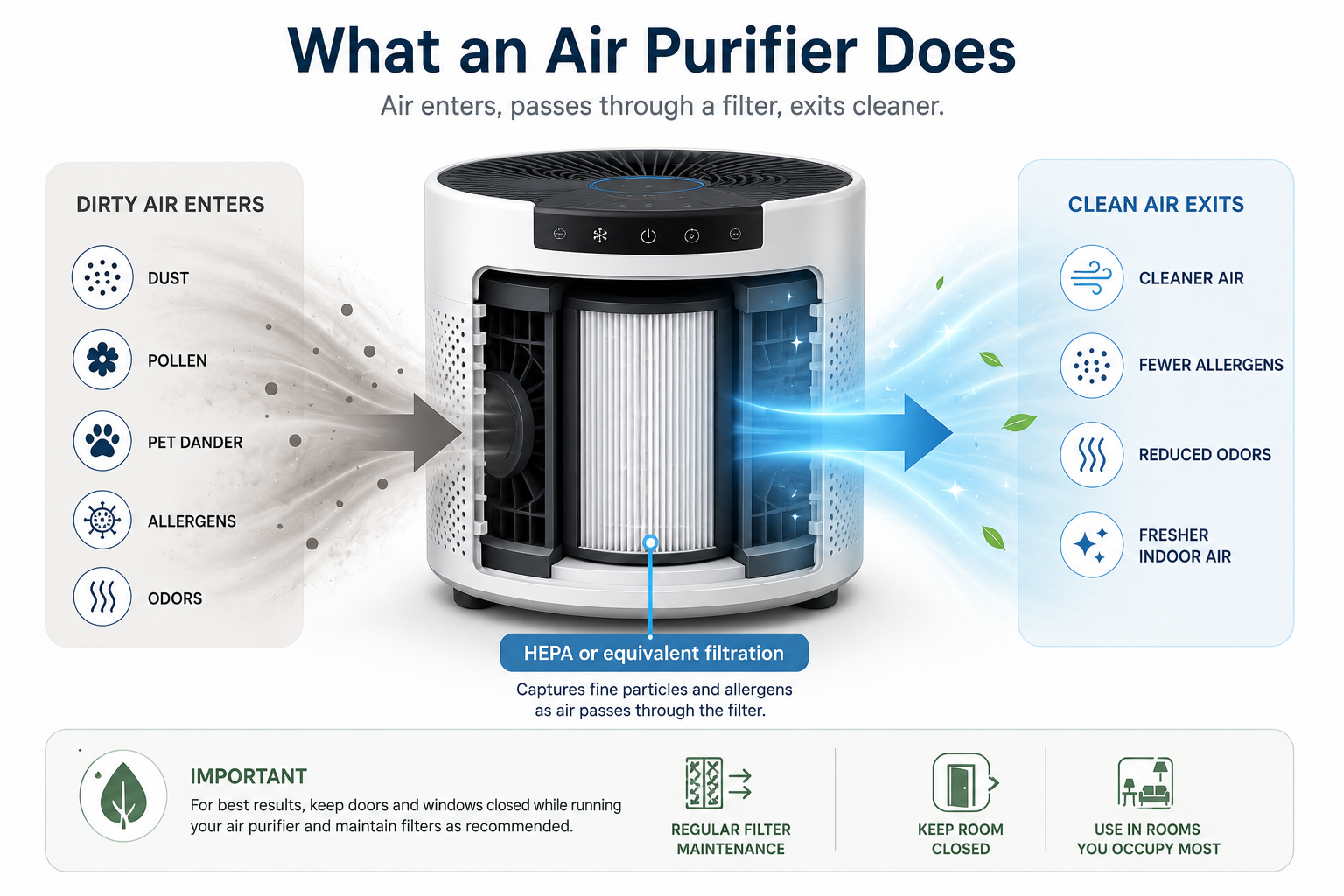
What a Dehumidifier Does
A dehumidifier draws in room air, extracts moisture from it, and releases drier air back into the room. UAE weather forecasts regularly show periods of high relative humidity, particularly in coastal areas and during warmer months, and enclosed homes may retain moisture when ventilation or air-conditioning performance is inadequate. According to the US EPA, keeping indoor relative humidity below 60%, ideally between 30% and 50%, is the primary way to limit the damp conditions that support mould growth on indoor surfaces. Dehumidifiers are commonly used in bathrooms, laundry areas, storage rooms and lower-ventilation apartments where humidity tends to concentrate.
In bathrooms and laundry areas, follow the manufacturer’s electrical safety and placement instructions, and keep the unit away from direct water exposure.
During operation, keep external doors and windows closed where practical so the unit is not continuously processing humid outdoor air.
A dehumidifier has no meaningful effect on airborne dust.

Air Purifier vs Dehumidifier UAE: 7 Key Differences
A humidifier serves a different purpose because it adds moisture rather than removing it. See our guide to air purifier vs humidifier for UAE homes if indoor air feels dry but dust is also a concern.
- Main purpose. An air purifier filters airborne particles. A dehumidifier reduces moisture in the air.
- Type of problem addressed. Air purifiers address dust and airborne allergens; models containing activated carbon may also reduce some household odours and gases. Dehumidifiers address dampness, condensation and mould-supporting conditions.
- Effect on indoor humidity. Air purifiers have no measurable effect on humidity. Dehumidifiers directly lower it.
- Effect on airborne particles. Dehumidifiers do not filter particles. Air purifiers are built specifically for this function.
- Best room placement. Air purifiers suit bedrooms and living rooms with clear airflow around the unit. Dehumidifiers suit bathrooms, laundry rooms and storage areas.
- Maintenance requirements. Air purifiers need periodic filter replacement or cleaning. Dehumidifiers need tank emptying or a continuous drainage setup.
- Seasonal relevance in the UAE. Air purifiers may become especially useful during sandstorms and periods of elevated outdoor dust, though they remain relevant year-round in homes with persistent dust entry. Dehumidifiers may become more relevant during humid months or whenever indoor humidity remains elevated.
Air Purifier vs Dehumidifier UAE – Comparison Table
s full block. It keeps the WordPress table structure and adds horizontal scrolling on smaller screens.
| Factor | Air Purifier | Dehumidifier |
|---|---|---|
| Primary function | Filters airborne particles such as dust, pollen and dander | Removes excess moisture from indoor air |
| Best suited for | Dust, sand, pollen, pet dander and other airborne allergens | Damp rooms, mould-prone areas, musty odours |
| Common UAE placement | Bedrooms and living rooms, with adequate clearance around the unit | Bathrooms, laundry rooms, storage areas, ground-floor units |
| Maintenance | Filter replacement or cleaning | Tank emptying or continuous drainage |
| Effect on humidity | Minimal to none | Direct reduction |
| Effect on airborne dust | Filters airborne dust that passes through the unit | Minimal to none |
| Seasonal relevance | Year-round where dust is persistent, with increased relevance during sandstorms | During humid periods or in consistently damp rooms |
 Which One Does a UAE Home Need?
 Which One Does a UAE Home Need?
| Household situation | Better starting choice |
|---|---|
| Dust returns quickly after cleaning | Air purifier |
| Pollen, pet dander or airborne allergens are the main concern | Air purifier |
| Musty odours or window condensation | Dehumidifier |
| Mould appears inside cabinets or bathrooms | Dehumidifier |
| Both dust and dampness are present | Use both, in the affected rooms |
| Unsure whether humidity is high | Measure with a hygrometer first |
Signs That May Point Toward an Air Purifier
- Visible dust on surfaces shortly after cleaning
- Increased sneezing, congestion or eye irritation indoors
- A home located near construction sites or exposed to frequent sandstorms
- Pet dander or general airborne particles as a recurring concern
Signs That May Point Toward a Dehumidifier
- A persistent musty or damp smell in specific rooms
- Visible condensation on windows, mirrors or AC vents
- Mould spots in bathrooms, behind furniture or inside cabinets
- A home in a coastal area with limited natural ventilation
When Both Devices May Be Useful
Some UAE homes, particularly ground-floor apartments or units with older air conditioning systems, may have both dust exposure and elevated humidity at the same time. In these cases, an air purifier and a dehumidifier address separate problems and can be used in different rooms rather than treated as substitutes for one another. A hygrometer, a small instrument that measures relative humidity, can help confirm whether humidity is actually a factor before purchasing a dehumidifier.
Features to Compare
Air purifiers
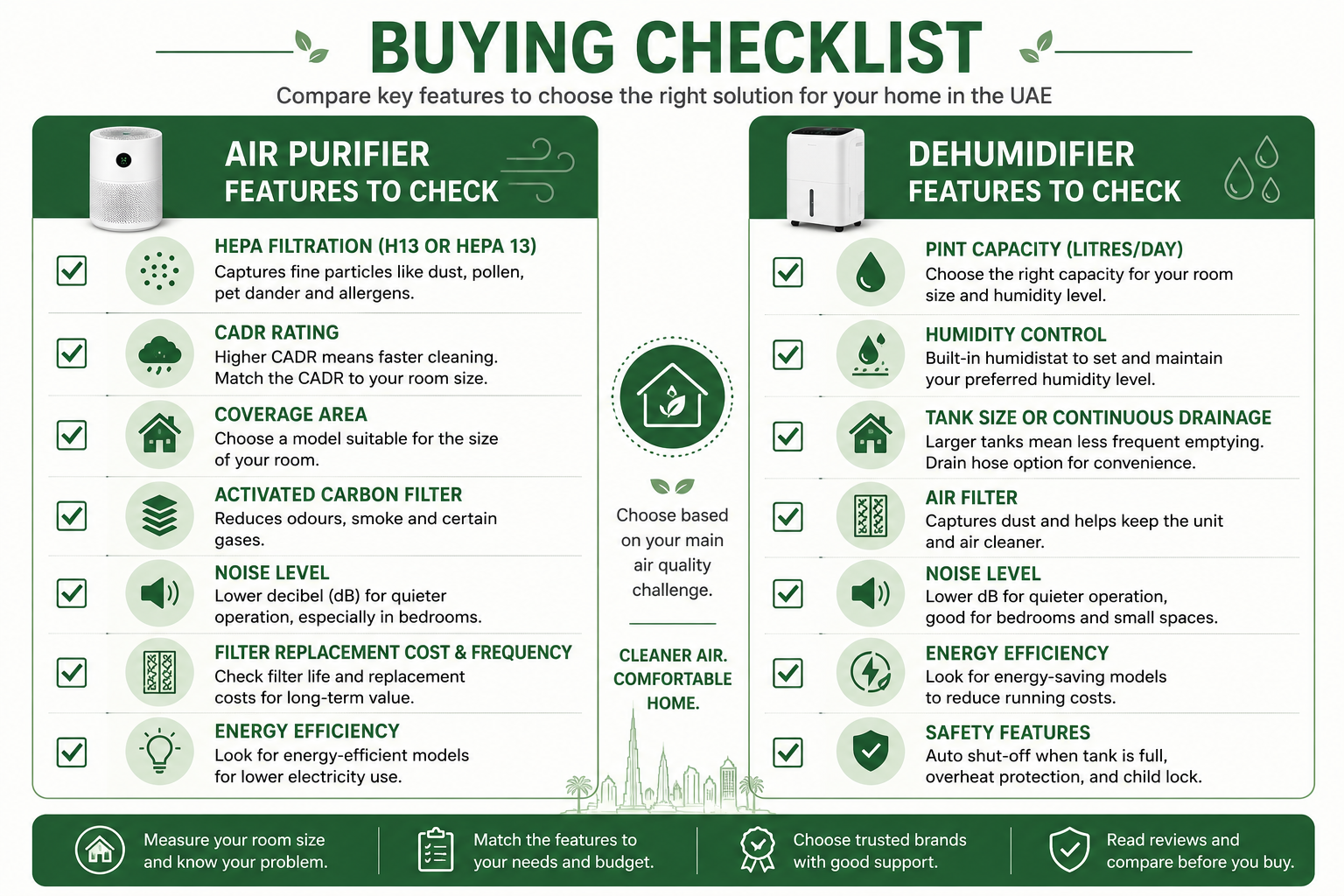
- True HEPA or equivalent high-efficiency filtration, supported by clear manufacturer performance data. The AHAM Verifide programme independently tests and certifies Clean Air Delivery Rate (CADR) for dust, pollen and smoke. AHAM guidance commonly recommends selecting a smoke CADR of at least two-thirds of the room’s floor area in square feet, based on a standard ceiling height. For example, a 300-square-foot room, approximately 28 square metres, would generally require a smoke CADR of around 200 or higher under this rule of thumb.
- Coverage area matched to the specific room, since UAE apartment bedrooms and living rooms vary significantly in size.
- Filter replacement frequency, which may need to be more frequent in homes exposed to regular sandstorms.
- Noise level, particularly relevant for bedroom use overnight.
Dehumidifiers
- Moisture removal capacity, typically measured in litres per day.
- Tank size and auto shut-off features for unattended operation.
- Continuous drainage options for higher-humidity rooms such as bathrooms and laundry areas.
- Compressor versus desiccant type, with compressor units generally suited to warmer indoor temperatures.
For current models, room-size guidance and buying considerations, compare the best air purifiers UAE and best dehumidifiers UAE.
What These Devices Cannot Fix
If the smell appears to come directly from the AC unit, an air purifier or dehumidifier will not replace filter, drain or coil inspection. Start with the guide to musty smells from AC in UAE homes before choosing another appliance.
An air purifier cannot:
- Stop dust from entering through window or door gaps
- Clean settled dust already on floors or furniture
- Repair dirty or poorly sealed AC ducts
- Remove moisture from the air
A dehumidifier cannot:
- Remove airborne dust effectively
- Fix plumbing leaks or structural water sources
- Remove existing mould without proper cleaning and moisture-source control
- Replace bathroom extraction or ventilation
Practical Tips for UAE Households
- Consider room-specific placement rather than relying on a single device for an entire apartment or villa, since dust and humidity issues often affect different areas unevenly.
- Check AC filters regularly, since dirty filters are commonly associated with recirculating dust throughout a home. See the CleanLivingUAE AC filter cleaning guide.
- Monitor humidity with a hygrometer where possible, since UAE coastal humidity varies by season and building type.
- Pair either device with routine cleaning practices. Neither an air purifier nor a dehumidifier replaces regular dusting, vacuuming or surface cleaning.
- For homes dealing with both dust and humidity concerns, review the CleanLivingUAE hub on air and dust control in UAE homes for a system-based approach.
- For humidity and mould concerns specifically, see humidity and mould prevention in UAE homes.
Need help choosing a purifier? View the best air purifiers for UAE homes.
Dealing with persistent humidity? Compare the best dehumidifiers available in the UAE.
Frequently Asked Questions
Can an air purifier also reduce humidity in a UAE apartment?
Standard air purifiers are not designed to reduce humidity. They filter airborne particles that pass through the unit but do not remove moisture from the air.
Can a dehumidifier help with dust problems in UAE homes?
A dehumidifier does not filter dust or airborne particles. Its role is to reduce moisture, so it should not be treated as a substitute for an air purifier or regular cleaning.
Which device is more relevant during UAE sandstorm season?
An air purifier with high-efficiency filtration is generally more relevant during and after sandstorm periods, since it addresses airborne dust rather than humidity.
Is a dehumidifier necessary in a UAE apartment with air conditioning?
Air conditioning can reduce some humidity as a byproduct of cooling, but this varies by system and settings. In bathrooms, laundry areas or ground-floor units, a dedicated dehumidifier may still be relevant.
Do UAE homes typically need both devices?
Some homes affected by both dust exposure and limited ventilation may benefit from using both devices in different rooms rather than relying on one for the entire home.
What size air purifier is suitable for a UAE bedroom?
The AHAM Verifide programme recommends matching a purifier’s smoke CADR to at least two-thirds of the room’s floor area in square feet. Checking the certified smoke CADR value against the room’s actual size is more reliable than relying on general size categories.
How often should dehumidifier tanks be emptied in humid UAE conditions?
This depends on the unit’s capacity and the humidity level of the specific room. Emptying is typically needed more frequently during the summer humidity months compared to cooler, drier periods.
Can mould return even after using a dehumidifier?
Mould can return if the underlying moisture source, such as a leak or persistent condensation, is not addressed. A dehumidifier reduces ambient humidity but does not resolve structural moisture issues.
Are HEPA air purifiers necessary for UAE homes, or will a basic filter work?
True HEPA or equivalent high-efficiency filtration is generally more effective at capturing the fine particle size associated with desert dust than basic filters. Checking the AHAM Verifide-certified smoke CADR rating gives a clearer performance comparison than the filter label alone.
Does closing windows during sandstorms reduce the need for an air purifier?
Closing windows and sealing gaps can reduce dust entry and is a commonly recommended preventive step. It does not eliminate dust that enters through AC systems or is already circulating indoors, which is where an air purifier remains relevant.
Sources
Technical guidance on indoor humidity is based on the US Environmental Protection Agency. Air-cleaner sizing and CADR information is based on the AHAM Verifide programme. Regional humidity context is supported by UAE government weather and environmental information, including guidance published through the National Center of Meteorology.