Air Purifier vs Humidifier: Which Does a UAE Home Need?
The question of air purifier vs humidifier UAE comes up often among residents dealing with desert dust, closed windows and year-round air conditioning. These two appliances are frequently confused, yet they solve different problems. An air purifier removes certain airborne pollutants from the air that passes through it. A humidifier adds moisture to indoor air. Neither device should be chosen based on symptoms alone, such as a dry throat, dusty furniture or a musty smell. Indoor humidity should be measured, and the underlying source of the problem should be identified before any appliance is purchased.
What is the difference between an air purifier and a humidifier? An air purifier draws in room air, passes it through filters that capture dust, pollen, pet dander and some particles, and releases cleaner air back into the room. A humidifier releases water vapour into the air to raise relative humidity. One manages particles, the other manages moisture, and they are not interchangeable.
Air Purifier vs Humidifier: The Main Difference
An air purifier and a humidifier are often placed side by side in UAE electronics stores, which can create the impression that they serve a similar purpose. In practice, they address opposite ends of indoor air management. An air purifier is concerned with what is suspended in the air – dust, pollen, pet dander, smoke particles and some odours. A humidifier is concerned with how much moisture the air contains.
In UAE homes, both particle levels and humidity levels can vary significantly by emirate, building type, floor level and air-conditioning system. A device that works well in one apartment may not be needed at all in another. The table below summarises the core differences.
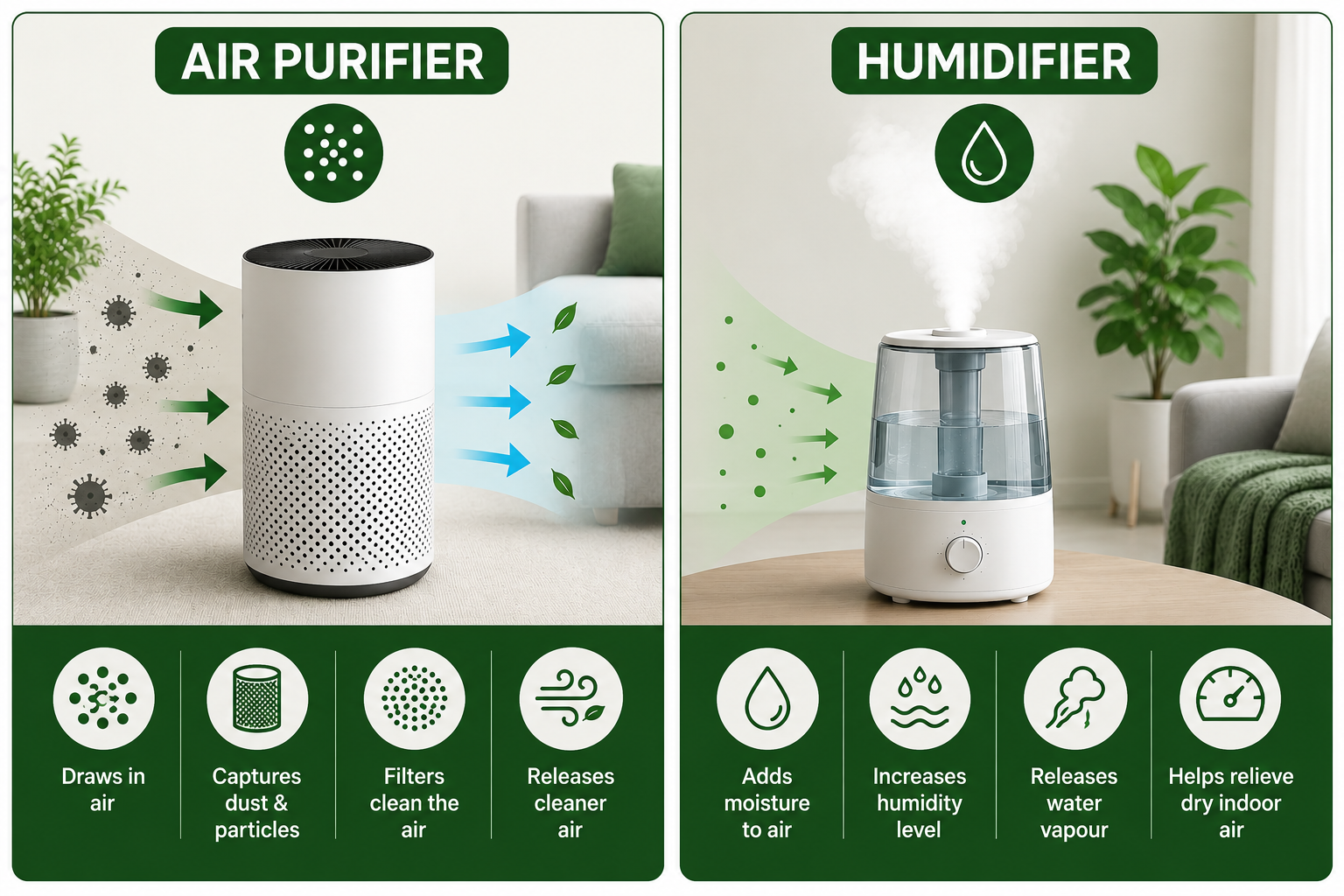
| Feature | Air Purifier | Humidifier |
|---|---|---|
| Main purpose | Reduces certain airborne particles | Adds moisture to indoor air |
| What it changes | Air cleanliness | Relative humidity |
| Best suited for | Dust, pollen, pet dander, smoke | Confirmed low humidity conditions |
| Does it remove dust? | Reduces airborne dust passing through the filter | No |
| Does it add moisture? | No | Yes |
| Effect on humidity | Minimal to none | Increases relative humidity |
| Main maintenance | Filter cleaning and replacement | Regular water tank cleaning |
| Main UAE risk | Undersized unit for room area | Adding moisture where humidity is already high |
| Typical bedroom use | Common where airborne dust or allergens are a concern | Limited, only where dryness is confirmed |
| When not to use it | Rarely restricted, though placement matters | When condensation, dampness or mould is present |
What Does an Air Purifier Do?
An air purifier works by drawing room air through a fan and passing it through one or more filter stages before releasing it back into the room. A pre-filter typically captures larger particles such as hair, fibres and coarse dust, extending the life of the finer filters behind it. A HEPA or high-efficiency particle filter is designed to capture very fine particles, which is relevant given the fine desert dust that circulates in many UAE homes. Some units also include an activated carbon layer, which is intended to reduce certain odours and gases, though its capacity is limited and depends on the amount of carbon used and how often it is replaced.
Coverage and airflow are measured using metrics such as CADR (Clean Air Delivery Rate), and manufacturers typically publish a maximum recommended room size. An air purifier sized for a small bedroom will not perform the same way in an open-plan living and dining area.
An air purifier only affects air that passes through it. It cannot stop dust from entering a home through doors, windows, gaps, shoes or air-conditioning ducts, and it cannot clean dust that has already settled on floors, furniture or shelving. It also cannot correct mould growth, excessive humidity, an AC drainage problem, a building leak or a persistent pollution source. It works alongside cleaning routines and AC maintenance rather than replacing them. For more detail on filtration types, see how HEPA filters work.
What Does a Humidifier Do?
A humidifier releases moisture into the air to raise relative humidity in a room. Evaporative humidifiers pass air over a wet wick or filter, allowing water to evaporate naturally. Ultrasonic humidifiers use high-frequency vibration to break water into a fine mist, which is then dispersed into the room.
Ultrasonic models can disperse mineral content present in tap water as a fine white residue on nearby surfaces, often referred to as white dust. This is more likely to occur where tap water has a higher mineral content, and some manufacturers recommend distilled or demineralised water to reduce this effect. Regular cleaning of the tank and internal components is necessary, since stagnant water can support the growth of bacteria or mould inside the unit itself.
Adding moisture without measuring humidity first can create problems rather than solving them, particularly in rooms that are already humid, poorly ventilated or prone to condensation.
UAE Climate: Why the Decision Is Different Here
The UAE climate does not produce one uniform indoor humidity condition across the country. Coastal areas often experience higher outdoor humidity, while inland conditions may differ according to season, weather patterns and time of day. However, outdoor humidity alone does not determine indoor conditions, because AC operation, ventilation, moisture generation and building design all affect indoor relative humidity. Indoor conditions depend heavily on how a building is constructed, how well it is sealed, and how its air-conditioning system operates.
Heavy year-round use of air conditioning is a defining feature of UAE homes. Air conditioning systems remove moisture from the air as part of the cooling process, and rooms that are cooled aggressively can feel dry even where outdoor humidity is high. This is why some residents report dry skin or a dry throat despite living in a humid coastal climate overall.
Apartments served by centralised chilled-water fan coil systems often behave differently from villas with individual split or ducted units, since air handling, ventilation rates and filter maintenance schedules can vary between building types. Bathrooms, kitchens and laundry areas typically generate more localised moisture, especially where ventilation is limited or clothes are dried indoors.
Because outdoor humidity does not automatically match indoor humidity, and because indoor humidity can vary from room to room within the same home, it should be measured directly rather than assumed from the weather forecast or general reputation of a city. This is one reason why the case for running a humidifier in UAE homes varies so widely between buildings, even within the same neighbourhood.
Do UAE Homes Usually Need a Humidifier?
Many UAE homes may not need a humidifier as a routine appliance, particularly where indoor relative humidity is already moderate or high due to coastal conditions, cooking, bathing or limited ventilation. A humidifier may be worth considering when a hygrometer repeatedly shows genuinely low indoor humidity over several days, the room is heavily air-conditioned, there is no condensation, dampness or mould concern, and the appliance can be cleaned and maintained properly.
Discomfort that is sometimes attributed to dry air can also come from other sources, including direct airflow from an AC unit, general dehydration, airborne dust, a dirty AC filter, poor ventilation, strong fragrances or cleaning chemicals, or a thermostat set to a very low temperature. These factors are worth reviewing before assuming that a humidifier is the solution, and any ongoing physical symptoms are best discussed with a qualified healthcare provider rather than addressed through appliance selection alone.
When an Air Purifier Is the Better Choice
An air purifier is commonly considered relevant in UAE homes affected by fine desert dust that enters through windows, doors and building gaps, residual dust following sandstorms, pet dander in homes with cats or dogs, seasonal pollen, cooking smoke in open-plan kitchens, and particles associated with nearby traffic or construction activity. Bedrooms are a frequent placement choice, since dust exposure overnight is often raised as a concern by allergy sufferers.
It is worth clarifying that an air purifier works mainly on particles suspended in the air at the time they pass through the unit. It does not clean dust that has already settled on floors, furniture, shelving or fabric surfaces, which still requires regular vacuuming and wiping as part of a normal cleaning routine. See fine dust in UAE apartments for related guidance.
When a Humidifier May Be the Better Choice
A humidifier may be appropriate in a narrower set of circumstances, including where indoor humidity has been measured and remains consistently low, where strong air-conditioning use appears to be creating noticeably dry conditions in a specific room, where use is intended for one room rather than an entire home, where use is expected to be seasonal or temporary, and where humidity can be monitored regularly with a hygrometer.
A humidifier should be reduced in output or stopped altogether if condensation appears on nearby windows or surfaces, if a musty smell develops, if damp patches appear, or if measured humidity begins to rise well above a comfortable range. Anyone considering a humidifier for bedroom UAE use specifically should monitor that room individually, since bedroom humidity can differ from the rest of the home depending on AC airflow and ventilation.
Signs You Should Not Add More Humidity
Certain signs suggest that a home does not need additional moisture and may in fact have the opposite problem:
- Condensation forming on windows
- A musty smell around AC vents or in enclosed rooms
- Visible mould on walls, ceilings or wardrobe interiors
- Damp wardrobes or cupboards
- Moist or clammy bathroom walls
- Air that feels sticky rather than dry
- Hygrometer readings that are already in a high range
- Ongoing dust mite or mould concerns
- Laundry being dried indoors without adequate ventilation
Where these signs are present, the more relevant response is usually to investigate the moisture source, improve ventilation, check for leaks, and consider a dehumidifier rather than a humidifier.
Air Purifier vs Humidifier for Common UAE Problems
| Household Problem | Better Starting Option | Why | What Else to Check |
|---|---|---|---|
| Fine dust | Air purifier | Reduces airborne particles | AC filter condition, entry points |
| Sandstorm particles | Air purifier | Targets residual suspended dust | Window and door sealing |
| Dry-feeling throat | Measure humidity first | Cause may not be humidity related | AC temperature, hydration, dust levels |
| Pet dander | Air purifier | Filters airborne dander particles | Vacuuming frequency, grooming |
| Musty smell | Investigate moisture source | Often linked to dampness, not dryness | Ventilation, leaks, AC drainage |
| Window condensation | Do not humidify | Indicates high, not low, humidity | Ventilation and AC settings |
| Cooking smoke | Air purifier with carbon layer | May help with particles and some odour | Kitchen extraction and ventilation |
| Dry bedroom air | Measure with hygrometer | Confirms whether humidity is genuinely low | AC airflow direction and settings |
| Mould concern | Dehumidifier and inspection | Moisture reduction is the relevant response | Leaks, ventilation, humidity readings |
| AC vents collecting dust | AC filter cleaning | Addresses the source rather than symptoms | See why AC vents become dusty |
| Hard water white residue | Review humidifier water type | Mineral content affects ultrasonic units | Distilled or demineralised water use |
| Coastal humidity | Measure before acting | Outdoor humidity does not equal indoor humidity | Ventilation and AC dehumidification |
| Construction dust | Air purifier | Reduces fine particles from nearby sites | Window sealing, entry mats |
| Strong fragrance sensitivity | Air purifier with carbon layer | May reduce some airborne odour compounds | Reduce use of scented products |
Can You Use an Air Purifier and Humidifier Together?
Both appliances can be used together where two separate, confirmed issues exist, such as airborne dust alongside genuinely low measured humidity in the same room. When combining units, the humidifier should not be placed directly beside or above the air purifier, since mist directed into the purifier intake can affect its filters. Both units should be kept away from walls in line with manufacturer spacing instructions, and a humidifier should not be placed near electronics or sensitive equipment.
Humidity should continue to be monitored with a hygrometer even after both appliances are introduced, and each unit should be cleaned separately according to its own manufacturer guidance. Essential oils should not be added to a humidifier unless the specific model is designed for that purpose, since this can affect internal components. Excessive moisture in a room can also affect air purifier filters over time or encourage microbial growth in equipment that is not cleaned regularly.
Air Purifier vs Humidifier vs Dehumidifier
A third appliance is often relevant in UAE homes and is sometimes overlooked in this comparison. An air purifier filters certain airborne pollutants from passing air. A humidifier adds moisture to the air. A dehumidifier removes moisture from the air. A UAE home reporting musty smells, condensation or persistently high humidity readings is more likely to need moisture control than added moisture, which makes a dehumidifier the more relevant appliance in that situation rather than a humidifier.
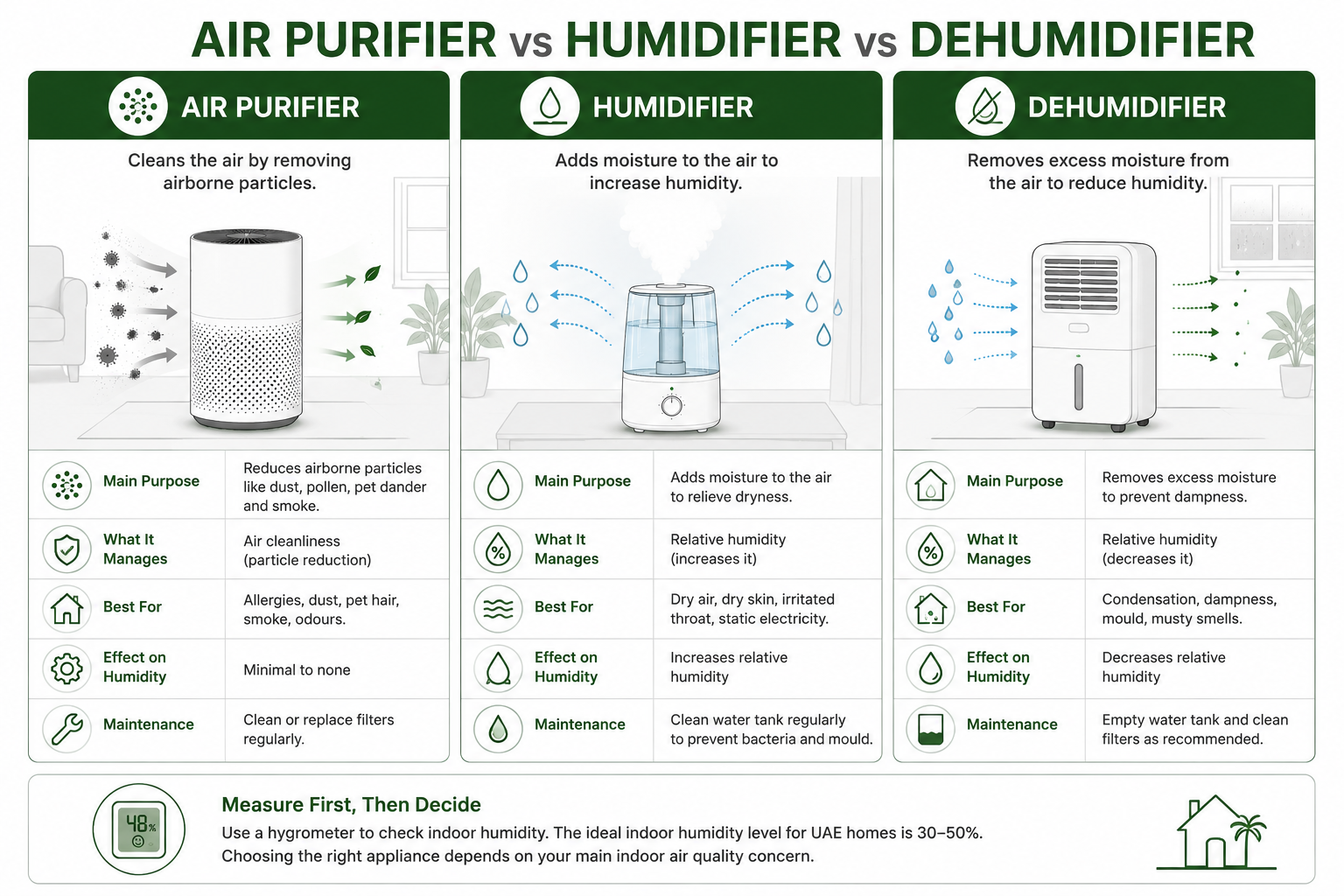
| Appliance | Main Function | Typical UAE Use Case |
|---|---|---|
| Air purifier | Filters airborne particles | Dust, pollen, pet dander, smoke |
| Humidifier | Adds moisture | Confirmed low humidity, dry AC rooms |
| Dehumidifier | Removes moisture | Musty smells, condensation, high humidity |
For a detailed comparison, see air purifier vs dehumidifier for UAE homes.
What Humidity Level Should a UAE Home Aim For?
Many indoor-air authorities recommend keeping indoor relative humidity around 30% to 50% where practical. Humidity above 50% should generally be avoided when using a humidifier, while persistent readings above 60% may increase mould and moisture concerns. Room conditions can still vary by building, season and AC operation, so use a hygrometer and consider condensation, dampness and ventilation alongside the numerical reading.
Readers should use a digital hygrometer, measure several rooms rather than relying on one reading, check readings at different times of day, avoid reacting to a single isolated measurement, and remain alert to condensation or musty smells regardless of what the hygrometer shows. Where health conditions or building-specific advice apply, that guidance should take priority over general figures.
How to Measure Indoor Humidity Correctly
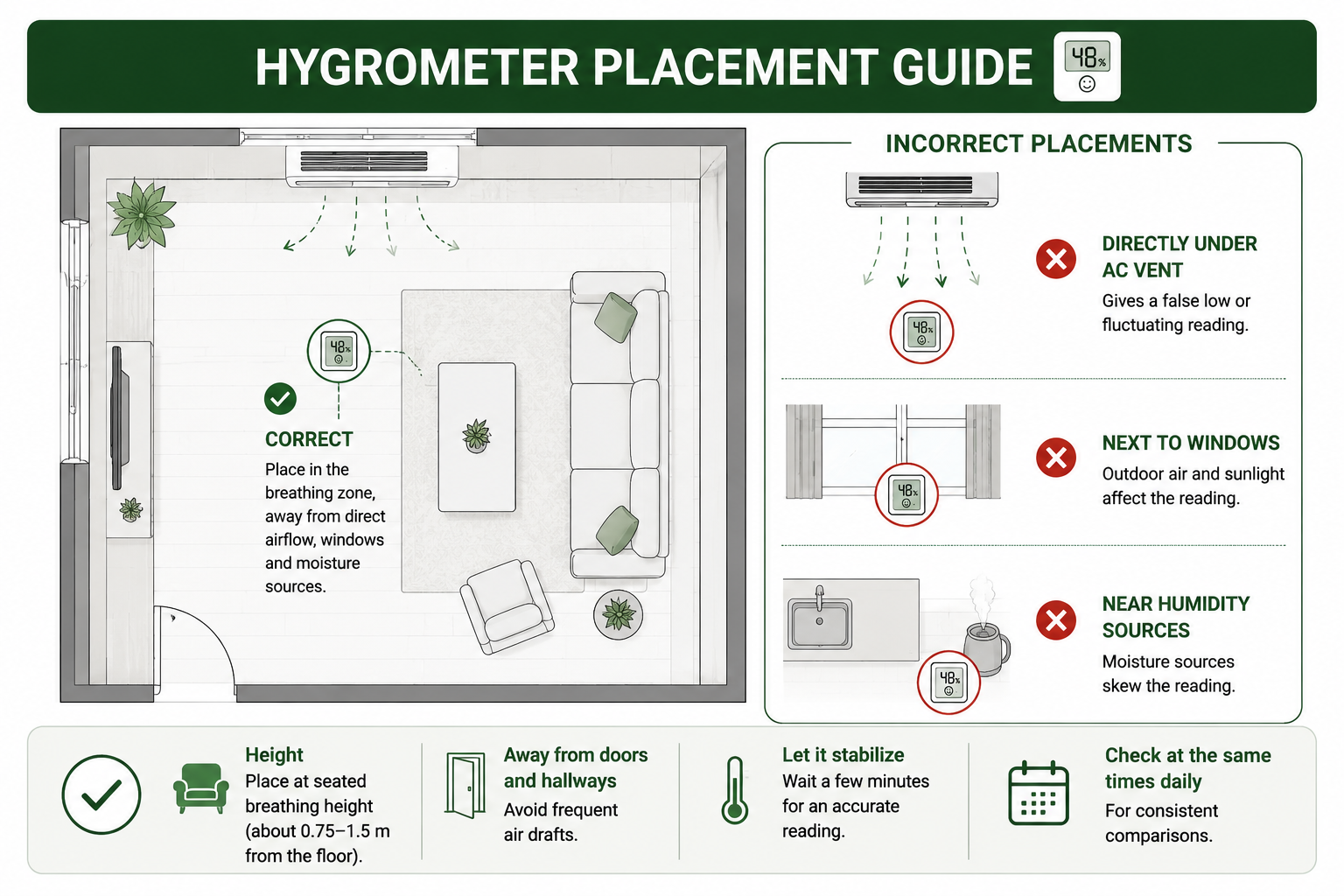
- Place the hygrometer away from direct AC airflow, so the reading reflects general room conditions rather than a cooling draught.
- Keep the device away from kitchens, bathrooms and open windows for the first reading, since these areas can distort results.
- Allow time for the reading to stabilise before recording a value.
- Record readings in the morning and evening to capture daily variation.
- Compare readings across multiple rooms rather than assuming one figure applies throughout the home.
- Repeat this process for several days before drawing a conclusion.
- Use the resulting pattern, rather than a single reading, to decide whether a humidifier or dehumidifier is worth considering.
How to Choose an Air Purifier for a UAE Home
Some product mentions may include affiliate links.
Selecting an air purifier for a UAE home typically involves checking the recommended room size against the actual room area, reviewing the CADR rating where published, and understanding the type of particle filtration used. Replacement filter availability and price within the UAE should be checked before purchase, since ongoing running costs depend on how often filters need replacing. Noise level and energy use are worth comparing, particularly for bedroom use overnight.
An auto mode with a built-in particle sensor can adjust fan speed based on measured air quality, which may reduce unnecessary running at maximum speed. Pre-filters generally require more frequent cleaning than the main filter. Marketing terms such as “HEPA-type” or “HEPA-style” do not always indicate the same filtration standard as true HEPA, so this distinction is worth checking against the manufacturer’s specification sheet. Where odour reduction is a priority, the quantity of activated carbon used affects how much benefit can reasonably be expected. Placement should allow for adequate airflow around the unit rather than positioning it against a wall or behind furniture. For further guidance, see air purifiers for UAE homes.
How to Choose a Humidifier for a UAE Home
A humidifier should be matched to the size of the room it is intended for, rather than purchased in a single generic size for a whole home. Evaporative models generally require less frequent water-quality management than ultrasonic models, though both require regular cleaning. A built-in humidistat allows the unit to maintain a target humidity level rather than running continuously, which reduces the risk of over-humidifying a room.
An easy-to-clean tank design, automatic shut-off when water runs low, acceptable noise levels for bedroom use, and an adequate tank size for the intended run time are practical considerations. Water quality matters, and distilled or demineralised water is sometimes recommended by manufacturers to reduce mineral residue, particularly for ultrasonic units. Replacement wicks or cartridges should be available locally where the model requires them. Decorative humidifiers that are difficult to disassemble and clean are generally best avoided. Warm-mist humidifiers heat water before releasing vapour, which introduces an additional burn risk and requires extra caution in homes with children or pets. See dehumidifiers for UAE homes for a related appliance comparison.
Maintenance: Which Appliance Needs More Attention?
Air Purifier Maintenance
- Vacuum or wash the pre-filter where the manufacturer permits this
- Replace the main filter according to the recommended interval
- Clean particle sensors periodically
- Keep air inlets and outlets clear of obstruction
- Follow the specific maintenance schedule published by the manufacturer
Humidifier Maintenance
- Empty any standing water rather than leaving it in the tank between uses
- Rinse and dry the tank regularly
- Remove mineral scale as it develops
- Disinfect the unit according to manufacturer guidance
- Replace wicks or cartridges on schedule
- Never continue using a unit once visible slime or an unusual odour has developed inside it
Humidifiers generally require more frequent water-contact cleaning than air purifiers, since standing water can support microbial growth if left unattended.
Common Mistakes UAE Residents Should Avoid
- Purchasing a humidifier because a room “feels dry” without measuring humidity first
- Running a humidifier at maximum output overnight without monitoring the effect
- Using UAE tap water in an ultrasonic humidifier without considering mineral residue
- Adding fragrance or essential oils to a standard humidifier not designed for this
- Expecting an air purifier to clean dust that has already settled on surfaces
- Purchasing an air purifier that is undersized for the room
- Blocking the air purifier’s intake with furniture or curtains
- Ignoring AC filters and vents while relying solely on an air purifier
- Running a humidifier in a room that already shows condensation or mould
- Confusing a humidifier with a dehumidifier when purchasing online
- Underestimating the ongoing cost of replacement filters
- Leaving standing water inside a humidifier between uses
Apartment vs Villa Considerations
| Setting | Typical Consideration |
|---|---|
| Smaller closed bedrooms | A correctly sized room appliance may be sufficient, depending on room volume, airflow and manufacturer coverage rating |
| Open-plan living spaces | Larger CADR rating needed for adequate coverage |
| Central or ducted AC | Whole-home humidity may already be influenced by the system |
| Split AC units | Humidity and dust levels can vary noticeably by room |
| Chilled-water fan coil systems | Common in apartments; ventilation rates vary by building |
| Staircases and double-height areas | Single units may not provide even coverage |
| Kitchens open to living rooms | Cooking smoke and odour can spread further |
| Multiple units vs one large unit | Separate room units may provide more consistent room-by-room coverage, particularly when doors remain closed |
| Room-by-room humidity differences | Measurement is recommended in each room rather than assuming uniformity |
An appliance sized and designed for a single room should not be assumed to effectively manage air quality or humidity across an entire multi-room apartment or villa unless it is specifically designed and rated for that purpose.
Decision Checklist: Which Appliance Should You Buy?
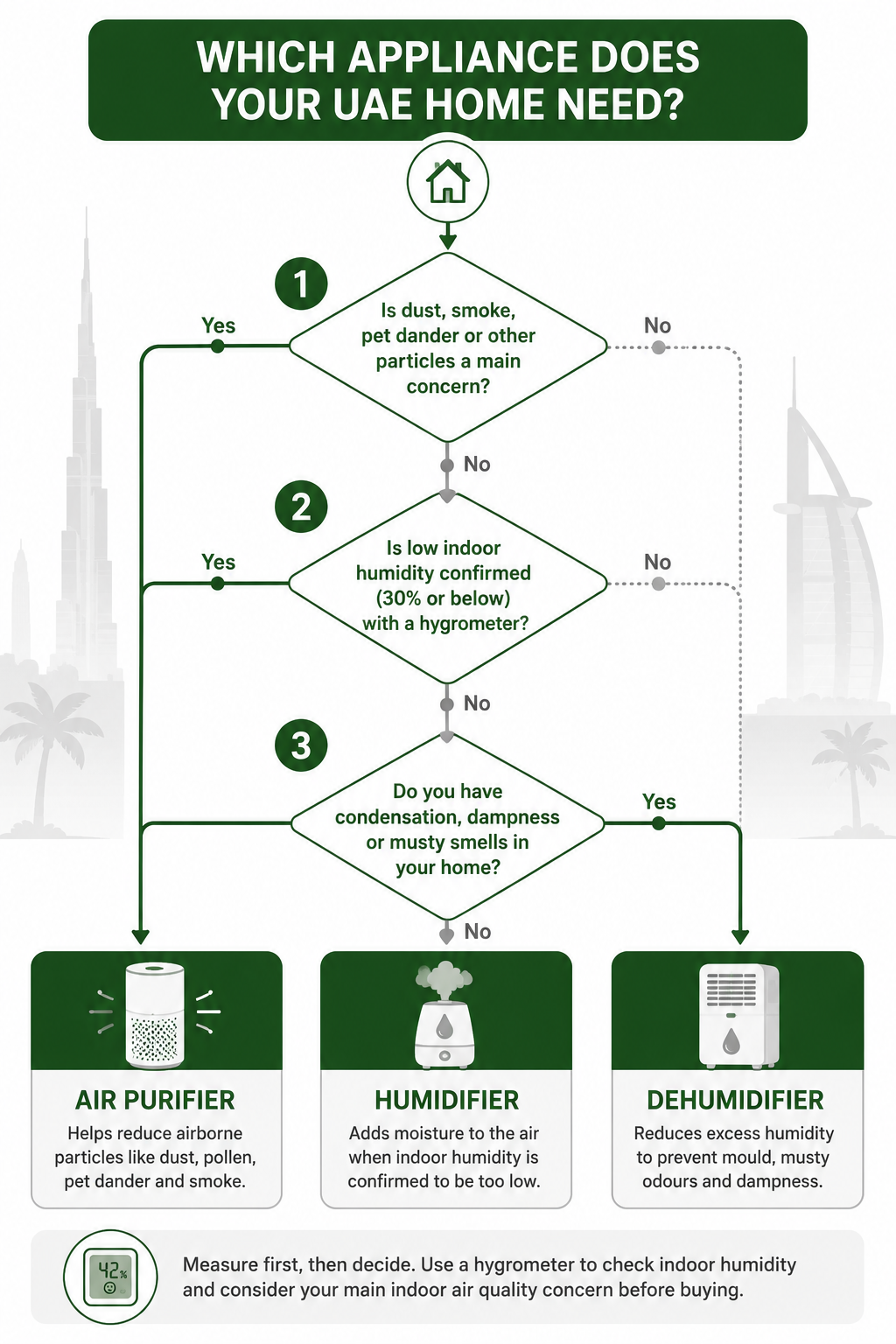
Choose an air purifier when the main issue is airborne dust or particles, when pets, pollen or smoke are a concern, when measured humidity is already within a normal range, when the room has suitable airflow for the unit, and when replacement filters are affordable and available locally.
Consider a humidifier when humidity has been measured and is repeatedly low, when there is no condensation or dampness in the room, when the room can be cleaned and ventilated appropriately, when the appliance can be maintained frequently, and when output can be controlled rather than left running continuously.
Consider a dehumidifier or a moisture inspection when humidity readings are high, when windows show condensation, when a room smells musty, when wardrobes feel damp, when mould appears on any surface, or when a leak or drainage concern is suspected.
Final Verdict: Air Purifier or Humidifier for a UAE Home?
An air purifier is generally the more relevant appliance for UAE homes dealing with airborne dust and particles, given the region’s exposure to fine desert dust and periodic sandstorms. A humidifier is a specialised appliance for confirmed low humidity conditions, rather than a default purchase for every air-conditioned home. Homes that already feel moist or musty should not add further humidity and are better served by investigating the moisture source or considering a dehumidifier. A low-cost hygrometer is a practical first step before purchasing either appliance, and ongoing cleaning, ventilation and AC maintenance remain relevant regardless of which device is chosen. See also indoor air quality in UAE homes for related guidance.
Frequently Asked Questions
Is an air purifier or humidifier better for UAE homes?
This depends on the specific problem being addressed. An air purifier is generally more relevant where airborne dust, pollen, pet dander or smoke is the main concern, which is common given the region’s exposure to fine desert dust. A humidifier is only relevant where indoor humidity has been measured and confirmed to be genuinely low. Neither appliance is universally “better,” since they solve different problems, and the right choice depends on measured room conditions rather than general assumptions.
Do I need a humidifier when using air conditioning?
Not necessarily. Air conditioning can lower indoor humidity in some rooms, which may create a dry feeling, but this varies by system type, room size and ventilation. A hygrometer reading over several days is the most reliable way to confirm whether humidity is genuinely low before considering a humidifier, since many UAE homes remain within a moderate humidity range despite AC use.
Can an air purifier help with desert dust?
An air purifier can reduce airborne dust particles that pass through its filters while it is running, which may help with fine desert dust circulating indoors. It cannot prevent dust from entering through doors, windows or gaps, and it does not clean dust that has already settled on floors or furniture, which still requires regular cleaning.
Can a humidifier make mould worse?
Adding moisture to a room that already has elevated humidity, condensation or existing dampness can contribute to conditions that support mould growth. For this reason, a humidifier is not recommended in rooms showing condensation, musty smells or visible mould. Humidity should be measured and any dampness investigated before a humidifier is introduced.
Can an air purifier and humidifier run at the same time?
Yes, both can run together where two separate issues have been confirmed, such as airborne dust alongside genuinely low humidity. They should be positioned so that humidifier mist does not enter the air purifier’s intake, and humidity should continue to be monitored to avoid over-humidifying the room.
What humidity level is suitable for a UAE bedroom?
Many indoor-air authorities recommend keeping indoor relative humidity around 30% to 50% where practical, with 50% generally treated as an upper limit when using a humidifier. Figures can vary by source and by individual circumstances such as mould sensitivity. A hygrometer should be used to measure the actual bedroom over several days rather than relying on a general figure alone.
Is a humidifier useful in Dubai?
A humidifier may be useful in a Dubai room where a hygrometer repeatedly confirms low indoor humidity. However, many homes may not need one because indoor conditions vary according to AC operation, ventilation, moisture sources and building design.
Does an air purifier reduce dust on furniture?
An air purifier primarily affects dust that is airborne at the time it passes through the unit’s filters. It does not directly clean dust that has already settled on furniture, shelving or floors, which continues to require regular dusting and vacuuming as part of a normal cleaning routine.
Should UAE tap water be used in a humidifier?
Tap water can be used in many evaporative humidifiers, though mineral content may affect performance over time. Ultrasonic humidifiers are more likely to disperse mineral residue, sometimes seen as a white dust on nearby surfaces, so manufacturers may recommend distilled or demineralised water for these models. The specific manufacturer guidance for each unit should be followed.
Do I need a humidifier or dehumidifier?
This depends entirely on measured humidity and the presence of any dampness. A humidifier is only relevant where humidity is confirmed to be low and no condensation or mould is present. A dehumidifier is more relevant where humidity is high, where condensation appears on windows, or where musty smells or dampness are reported. A hygrometer reading is the most reliable way to determine which appliance is appropriate.