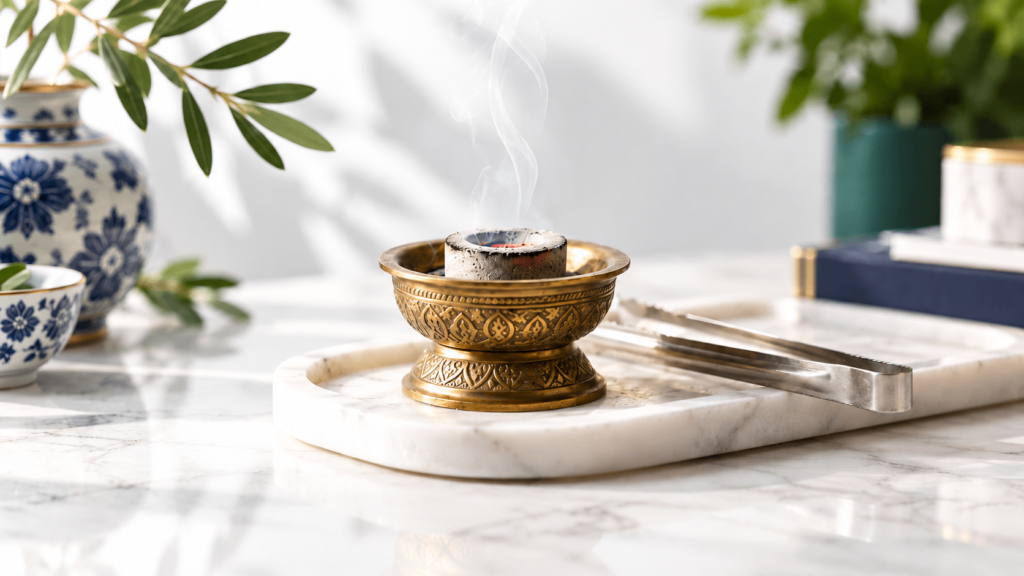
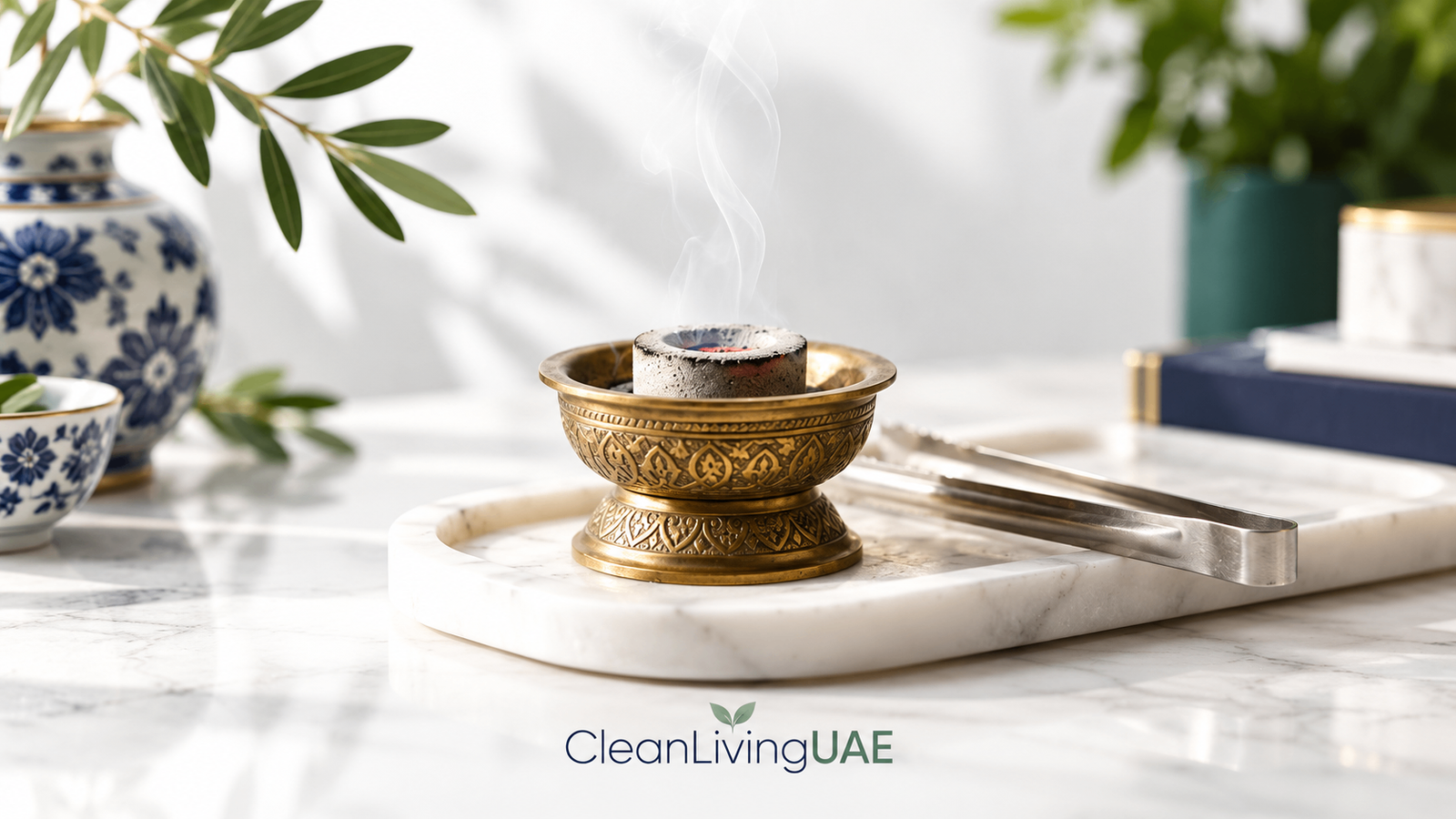
Bakhoor charcoal is the small, purpose-made heat source placed inside a mabkhara so that bakhoor or oud chips release their fragrance. It is not the fragrance itself. Once lit, coal for bakhoor becomes extremely hot and produces combustion gases, including carbon monoxide, and fine particles. That makes safe handling, ventilation and correct disposal just as important as choosing a good blend.
Based on UAE conditions, these points carry extra weight. In homes where windows remain closed for climate control and air conditioning operates for long periods, ventilation becomes particularly relevant when using smoke-producing fragrance methods. Fine dust and sand already settle on surfaces, and oily fragrance residue gives that dust something to cling to. Research from the University of North Carolina, carried out with UAE households in mind, reported that incense is burned weekly in the large majority of UAE homes and that charcoal is commonly used to heat it.
This guide focuses on the practical side: which charcoal for bakhoor is suitable, how to light it, how much bakhoor to add, how to put it out and dispose of it, and how to clean the ash and residue it leaves behind.
What Is Bakhoor Charcoal?
Bakhoor charcoal is a compressed charcoal disc, tablet or block designed to smoulder steadily and give off heat. The fragrance comes from the material placed on top, usually bakhoor (wood chips or pressed blends soaked in perfume oils) or pure oud wood. For a clear breakdown of those two materials, see the guide to the difference between bakhoor and oud.
Common formats sold for incense use include:
- Round discs or tablets, often in sizes around 33 mm and 40 mm, packed in sealed rolls
- Quick-light tablets, which ignite directly from a lighter flame
- Natural charcoal, such as bamboo, wood or coconut-shell charcoal, which usually takes longer to light
Bakhoor charcoal should not be confused with activated charcoal tablets sold as supplements. Those are a different product for a different purpose and are not designed to be burned.
What Type of Charcoal Is Used for Bakhoor?
The safest starting point is charcoal clearly labelled for incense, resin or bakhoor use. The main options are:
- Quick-light incense charcoal: Some quick-light incense charcoals use an ignition accelerant to help them light more easily. Check the product label or manufacturer information for the specific formulation. This format is convenient and widely sold for home use.
- Natural incense charcoal: Bamboo, wood or coconut-shell charcoal sold without an ignition accelerant. It typically needs a longer, sustained flame to ignite.
- Purpose-made bakhoor or mabkhara charcoal: Sold specifically for Arabian incense, usually in the quick-light format.
No single type is universally best. The right choice depends on how often bakhoor is used, how easy lighting needs to be, and what the manufacturer states about intended use.
Which charcoal should be avoided?
BBQ briquettes, cooking charcoal and lumpwood charcoal are designed for outdoor cooking and should not be used for bakhoor indoors. Some charcoal tablets are marketed for both shisha and incense, and these are acceptable when the manufacturer explicitly lists incense use. If a product only mentions shisha or grilling, its suitability for indoor fragrance use is unclear and it is better avoided.
Storage in UAE humidity
Quick-light charcoal is moisture-sensitive. Manufacturers advise storing tablets in a dry place, and retailers note that tablets which absorb humidity may spark weakly or fail to stay lit. In humid coastal summers, keeping opened rolls sealed in their packaging and stored in a closed container helps prevent this.
What You Need Before Lighting Bakhoor Charcoal
A short checklist prevents most problems before they start:
- A mabkhara or incense burner designed to hold burning charcoal, made from metal, stone or heat-resistant ceramic
- Charcoal labelled for incense or bakhoor
- Long metal tongs for holding and moving the charcoal
- A heat-resistant tray or surface under the burner
- A lighter or long match
- A small amount of bakhoor or oud chips, plus a small metal spoon if using loose material
- A way to ventilate the room, such as a window that can be opened
The burner should sit on a stable, level surface, away from curtains, cushions, paper and anything else that can catch fire, and out of reach of children and pets. Improvised containers, such as glass jars, plastic dishes or decorative bowls not designed for high heat, are not suitable.
How to Light Bakhoor Charcoal Safely
The steps below describe how to burn charcoal for bakhoor in a typical home setting. Where the charcoal or burner packaging gives different instructions, those take priority.
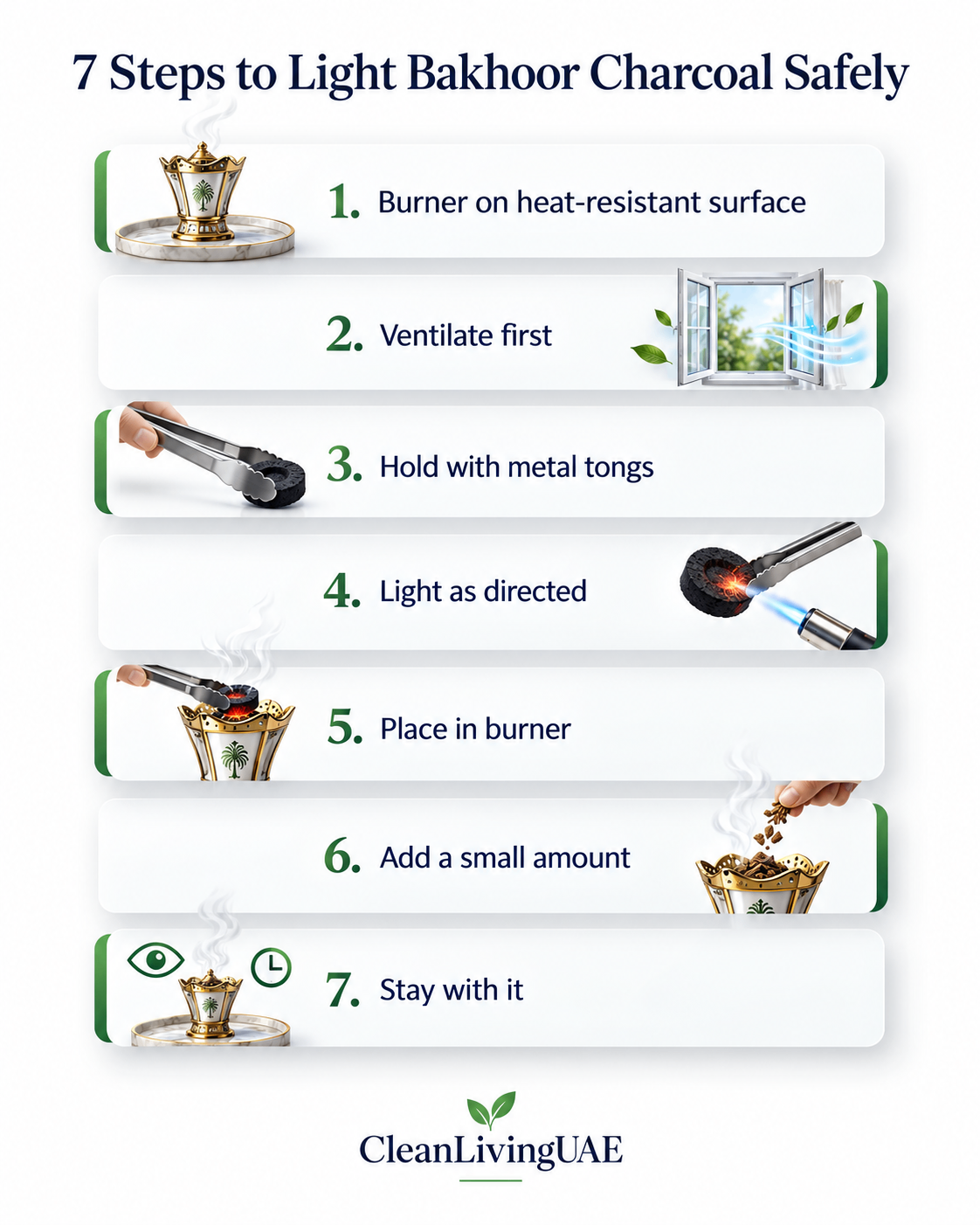
- Position the burner. Place the mabkhara on a stable, heat-resistant surface away from combustible materials.
- Prepare ventilation. Open a window or door where practical before lighting, rather than after the room fills with smoke.
- Hold the charcoal with tongs. Grip one edge of the tablet with metal tongs. Never hold lit or lighting charcoal with bare fingers.
- Light it as directed. Hold the flame to the edge of the tablet. For quick-light charcoal, Three Kings describes holding the flame until sparks have travelled across the tab. Natural charcoal usually needs a longer flame and patience.
- Place it in the burner. Set the lit charcoal securely in the centre of the burner, on its tray, screen or sand bed if it has one.
- Let it settle, then add bakhoor. Wait until the charcoal is fully lit (see the next section), then add a small amount of bakhoor with tongs or a spoon.
- Stay with it until it is out. Never leave burning charcoal unattended. If the mabkhara is carried between rooms, hold it by its handle or base, keep it upright, and do not leave it burning in a room where someone will sleep.
How Do You Know When Bakhoor Charcoal Is Ready?
According to Three Kings, charcoal for incense is ready when a grey, ashy layer covers the red-hot, glowing tablet. Other incense retailers describe the edges turning grey or white as the charcoal heats through.
In practice, the signs commonly described are:
- Sparking has stopped (quick-light charcoal)
- A thin grey or white ash coating has formed over most of the surface
- The charcoal glows steadily rather than flaring
Behaviour varies between brands and charcoal types, so the instructions on the packaging are the best guide. Adding bakhoor before the charcoal is fully lit is commonly associated with more smoke and an uneven burn.
How Much Bakhoor Should You Put on Charcoal?
There is no universal measured amount. A single small piece of bakhoor or a light pinch of chips is a sensible starting point, with more added only if the scent is too faint.
Several factors affect how much is enough:
- Room size: A small bedroom or apartment living area needs far less than a large majlis.
- Ventilation: In a closed room, fragrance and smoke build up faster.
- Blend strength: Heavily oiled bakhoor often releases more scent and more visible smoke.
- Purpose: Scenting clothes or a single room needs less than fragrancing a whole home.
More material does not mean better fragrance. Overloading the charcoal is commonly associated with heavy smoke, a burnt smell and more sticky residue in the burner.
Where Should Bakhoor Sit on the Charcoal?
A common traditional method is to place bakhoor directly on or above the hot charcoal, depending on the burner design. This gives a strong, quick release of fragrance and visible smoke.
Some users prefer gentler, indirect heating:
- Foil liners: Some burner retailers suggest a small foil piece between the charcoal and bakhoor to reduce sticky buildup.
- Mica plates or metal screens: Used in some incense traditions to separate the material from the coal, which slows the release of scent.
- Sand or ash beds: Some burners hold the charcoal on a layer of sand or ash, which helps spread and absorb heat.
None of these is required, and none suits every burner. Accessories should only be used if they fit the mabkhara securely and are designed to sit on burning charcoal.
Quick-Light vs Natural Charcoal
Both types work for bakhoor. The differences are mainly about convenience, smell at ignition and how they behave in a humid climate.
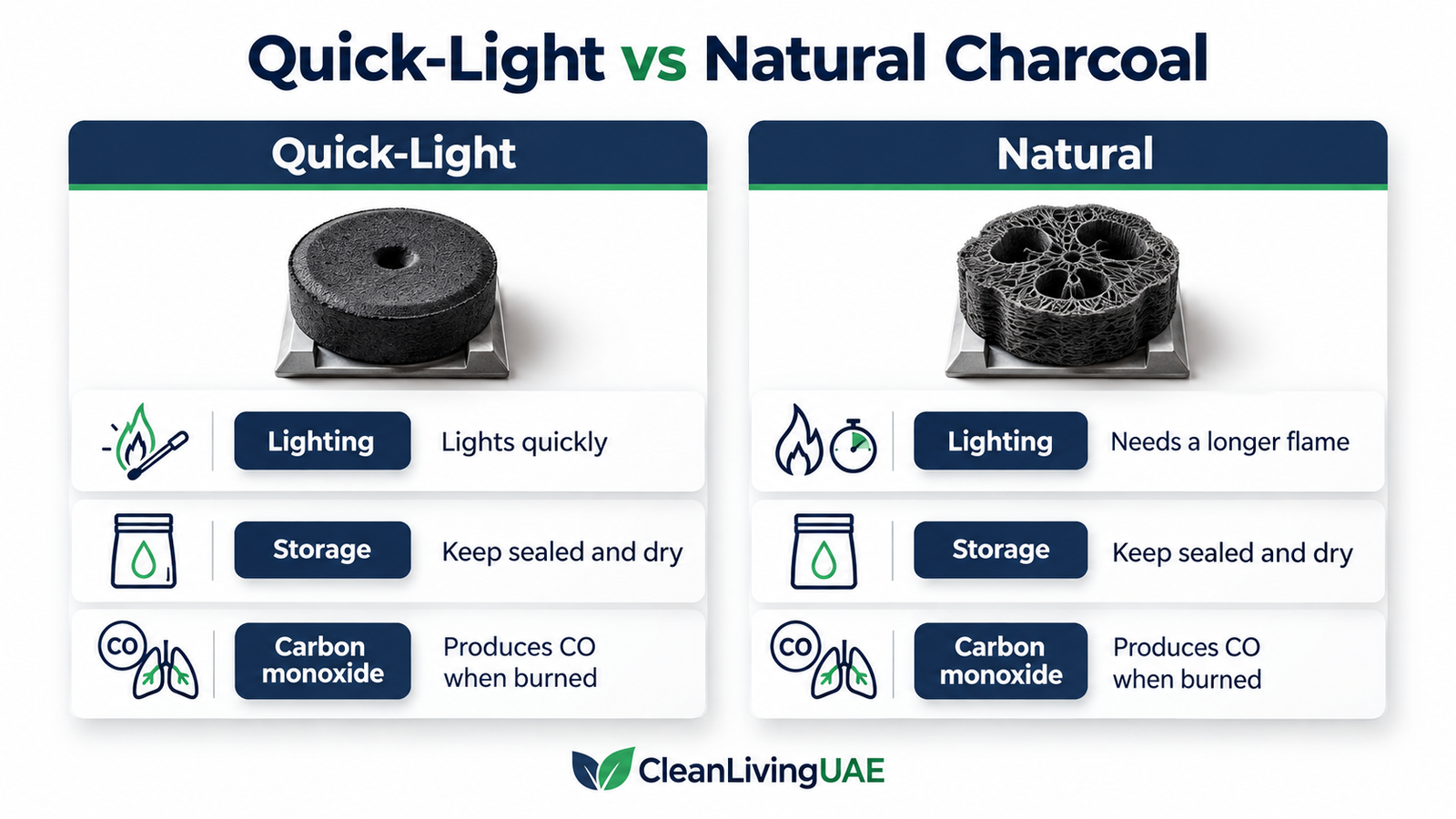
On mobile, scroll sideways to see the full comparison.
| Feature | Quick-Light Charcoal | Natural Charcoal |
|---|---|---|
| Ignition | Lights from a small flame; sparks spread across the tablet | Needs a longer, sustained flame |
| Convenience | High; ready quickly | Lower; more patience needed |
| Smell during ignition | May produce a noticeable ignition odour, depending on formulation | Varies by material and product |
| Carbon monoxide | Produces CO when burned | Produces CO when burned |
| Moisture sensitivity | Absorbs humidity; may fail to light if stored open | Store dry; varies by product |
| Heat duration | Varies by brand and size; check packaging | Varies by brand and size; check packaging |
| Best suited to | Occasional, everyday home use where speed matters | Users who prefer charcoal without an ignition accelerant and do not mind slower lighting |
Neither type avoids carbon monoxide. Choosing between quick-light and natural charcoal does not change the carbon monoxide considerations covered below.
Bakhoor Charcoal vs Electric Burner
An electric burner heats bakhoor on a hot plate instead of a burning coal. This removes charcoal combustion from the room, but it does not make bakhoor emission-free, because the heated fragrance material itself still releases particles and vapours.

On mobile, scroll sideways to see the full comparison.
| Factor | Charcoal | Electric Burner |
|---|---|---|
| Heat source | Burning charcoal tablet | Electric heating plate |
| Charcoal combustion | Yes | None |
| Carbon monoxide from charcoal | Produced throughout the burn | None from the heat source |
| Fragrance emissions | Yes, from heated bakhoor | Yes, from heated bakhoor |
| Ash | Charcoal ash after every use | No charcoal ash; bakhoor residue only |
| Cleaning | Ash removal plus oily residue | Plate residue; never immerse electrical parts |
| Convenience | Lighting, waiting and cooling time | Switch on and adjust heat |
| Traditional experience | Often described as stronger and smokier | Often described as softer and more controlled |
UNC Gillings School of Global Public Health researchers who studied UAE incense reported that larger amounts of charcoal produced larger and longer particle and gas emissions, and suggested electric alternatives to charcoal alongside better ventilation. For households weighing the switch, the guide to the best bakhoor burners in the UAE compares electric and traditional options in more detail.
Does Bakhoor Charcoal Produce Carbon Monoxide?
Yes. All burning charcoal produces carbon monoxide (CO). The US Centers for Disease Control and Prevention (CDC) describes CO as a colourless, odourless gas and states that burning charcoal, whatever its colour, gives off CO. CO forms in larger amounts when combustion is incomplete, which is why low-oxygen conditions matter.
The CDC’s guidance is to never burn charcoal indoors, and the US Consumer Product Safety Commission has noted that opening a window or using a fan does not guarantee carbon monoxide will stay at safe levels. No health authority publishes a safe indoor amount for bakhoor charcoal.
A UAE-focused laboratory study published in Science of the Total Environment found that two common types of UAE incense burned with charcoal emitted particles, CO, nitrogen oxides and formaldehyde in a chamber designed to simulate a living room.
Carbon monoxide is the key limitation of charcoal use indoors. Public-health guidance warns against burning charcoal in enclosed indoor spaces because ventilation does not guarantee safe CO levels. For UAE homes where indoor use is intended, an electric bakhoor burner avoids charcoal combustion entirely and is the more practical option.
Where traditional charcoal use continues, it should follow the charcoal and burner manufacturer’s instructions, any building rules, and genuinely appropriate ventilation. Burning charcoal should never be left in a room where someone is sleeping or in a small enclosed space such as a wardrobe or bathroom. The CDC recommends battery-operated CO alarms near sleeping areas; an alarm can warn of rising CO but does not prevent it.
CO symptoms are often described as flu-like, including headache, dizziness, weakness and nausea. If these appear while charcoal is burning, move to fresh air and seek medical help. For a fuller look at fragrance smoke and health, see the guide to bakhoor smoke and indoor air quality, and the broader overview of indoor air quality in UAE homes.
Bakhoor Charcoal in UAE Apartments
Apartment living changes how charcoal behaves in a home. Common considerations include:
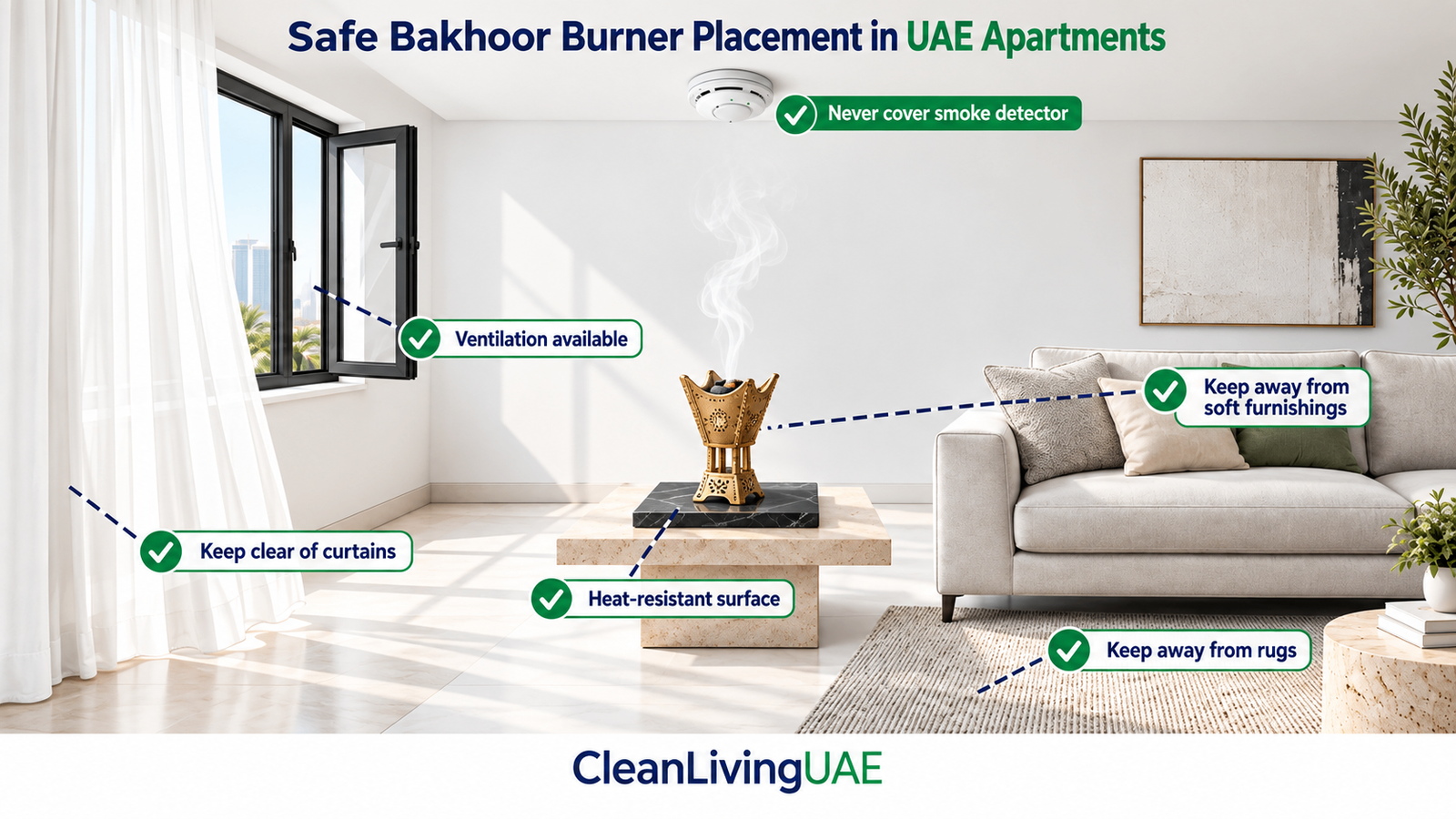
- Smaller rooms: Smoke and gases reach higher concentrations faster in a compact space.
- Closed windows: Where windows stay shut for climate control, fresh air exchange is reduced.
- Air conditioning: Split and central AC units recirculate indoor air and do not remove carbon monoxide.
- Smoke detectors: Heavy smoke can trigger an alarm. In some buildings, detectors are linked to a central fire alarm system; building management can explain how their system responds.
- Shared spaces: Smoke can travel into corridors and neighbouring units through doors and gaps.
- Heat-safe placement: Use only a stable, non-combustible, heat-resistant surface suitable for the burner, and follow the burner manufacturer’s placement instructions.
Never disable, cover or interfere with a smoke detector to burn bakhoor. The US Fire Administration warns that disabling a smoke alarm or removing its battery can be a deadly mistake. If an alarm sounds and the cause is known to be bakhoor smoke, the recommended response is to ventilate the area and use the alarm’s hush button if it has one, not to remove the battery.
How to Reduce Excess Smoke
Most heavy smoke comes from overloading the charcoal or adding bakhoor too early. These habits help:
- Add a small amount of bakhoor and top up gradually
- Avoid piling material onto the charcoal
- Wait until the charcoal is fully lit before adding anything
- Ventilate before and during use, not only afterwards
- Use a burner sized for the charcoal, with good airflow around it
- Space out sessions rather than running long, heavy ones back to back
- Follow the charcoal and burner manufacturer’s instructions
Less visible smoke does not mean no emissions. Carbon monoxide is invisible, and fine particles can remain in the air after the smoke has cleared.
How to Extinguish Bakhoor Charcoal Safely
There is no single extinguishing method that suits every charcoal and burner, so the instructions supplied with both take priority. Many incense-charcoal instructions recommend letting the tablet burn out and cool completely inside the burner.
Key points that apply in most cases:
- Leave it in place. Allow the charcoal to burn out and cool completely in a suitable heat-resistant location, unless the charcoal or burner manufacturer specifies another extinguishing method.
- Do not rely on appearance. Charcoal can stay hot after visible glowing stops, and a grey ash coating can hide heat underneath.
- Never handle it directly. Use metal tongs if the charcoal has to be moved at all.
- Do not improvise with water. Never pour water onto charcoal while it remains inside a hot ceramic or decorative burner.
Never leave the home or go to sleep while charcoal is still burning or warm.
How to Dispose of Used Bakhoor Charcoal
Used charcoal and ash should only be disposed of once they are completely cold. Fire services advise treating all ash as hot, because ash acts as an insulator and coals buried in it can stay hot for an extended time, long enough to ignite nearby materials or melt plastic.
A cautious routine:
- Let the charcoal burn out and cool completely in the burner, on its heat-resistant surface.
- Do not dispose of the remains until they are completely cold throughout.
- Once cold, lift the remains out with tongs or a small scoop, wrap them, and place them in household waste.
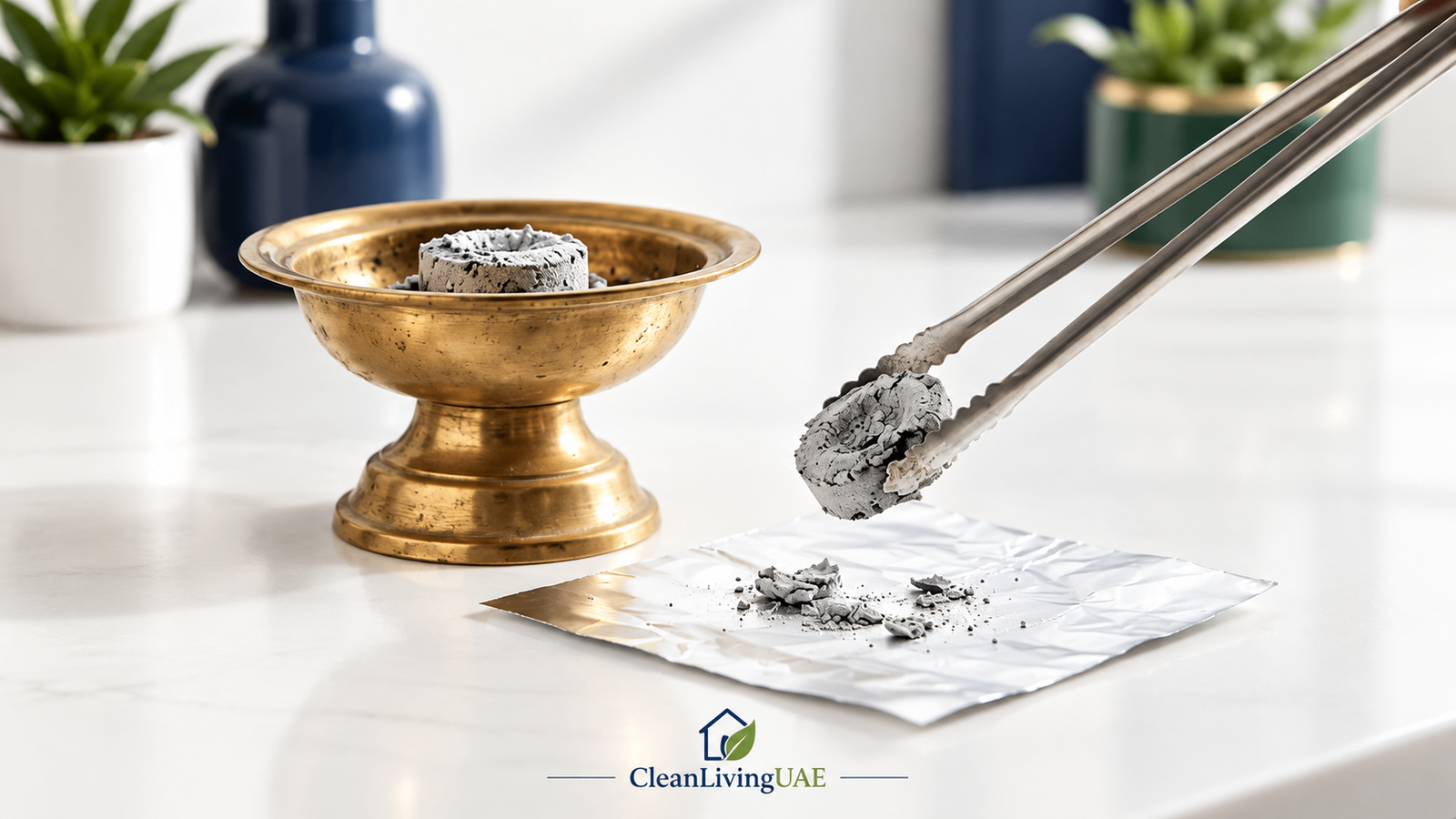
Never put warm charcoal or ash into a plastic bin, paper bag, cardboard box or building waste chute. Where a building or community has its own rules for waste or chute use, those should be followed.
How to Clean Charcoal Ash From a Mabkhara
Regular cleaning keeps the burner working well and stops ash and residue from spreading around the home.
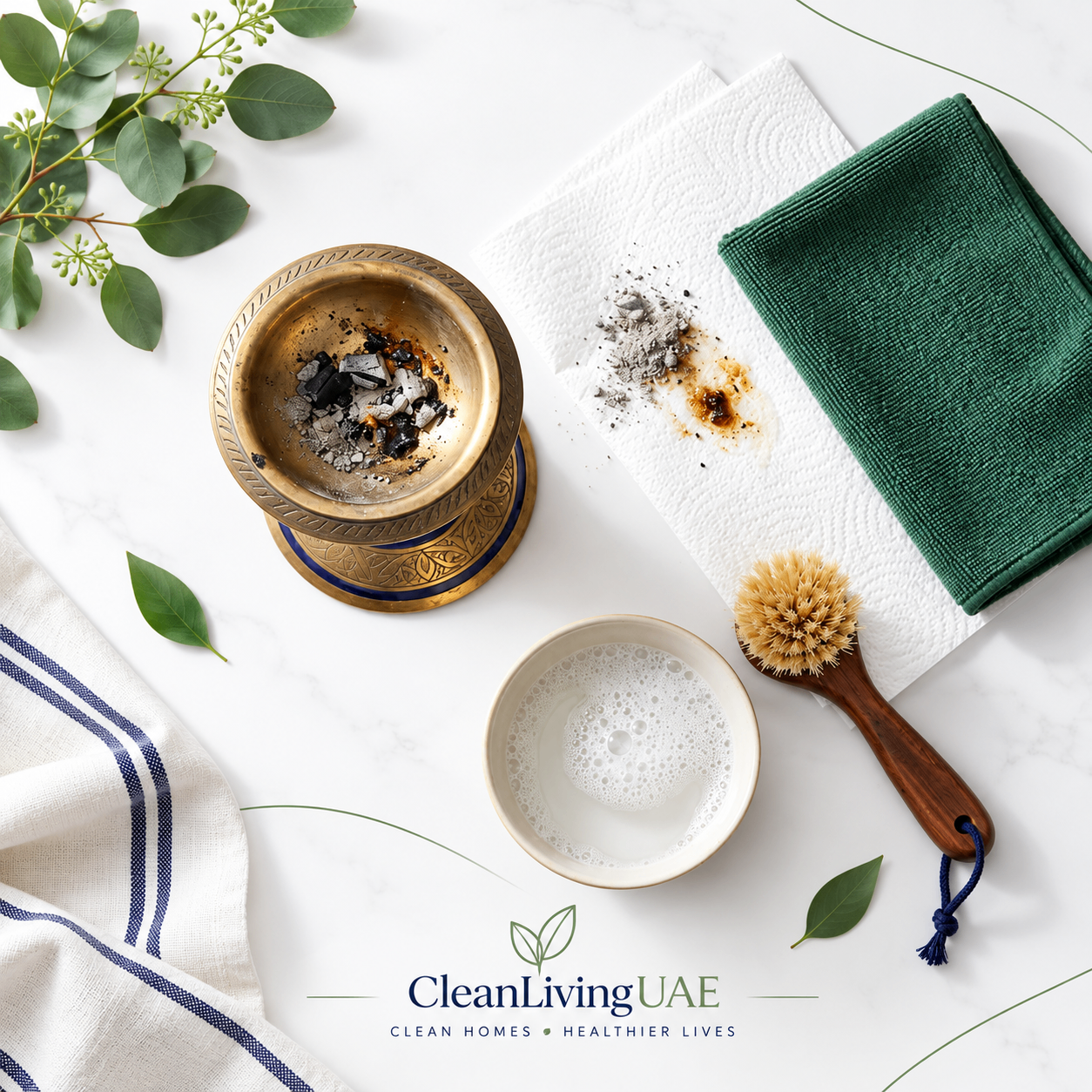
- Wait until the burner is completely cool. Metal mabkharas in particular can stay hot for some time.
- Remove dry ash first. Tip loose ash gently into a lined container or wipe it out with a damp paper towel. Avoid blowing on it or brushing vigorously, which spreads fine ash into the air and onto nearby surfaces.
- Clean according to the material.
- Metal: a soft cloth with mild soapy water; avoid abrasive pads on plated or decorative finishes.
- Ceramic or stone: wipe with a damp cloth; check the maker’s guidance before soaking, as some finishes are porous.
- Wooden exteriors: keep dry and wipe only.
- Treat oily residue separately. Sticky bakhoor residue usually needs warm soapy water and gentle scrubbing once the ash is gone. Removing ash first prevents it from turning into a grey paste.
- Dry fully before the next use.
For electric burners, unplug and cool the unit first, and never soak or immerse any electrical part. A slightly damp microfibre cloth for fine dust also helps pick up stray ash around the burner without pushing it into tile grout.
Does Bakhoor Charcoal Leave Soot on Walls and AC Vents?
It can contribute. Burning charcoal releases fine combustion particles, and heated bakhoor releases oily fragrance compounds. When the same spot is used repeatedly, these can settle on nearby walls, ceilings and fabrics. In UAE homes, airborne dust then sticks to that oily film, which makes dark or yellowish marks more visible over time.
Air conditioning plays a part too. Return grilles draw room air, including fine particles, towards the filter, so vents and filters near the usual burning spot may darken faster. Charcoal is not the only cause of dark deposits: candles, cooking and outdoor dust also contribute.
Regular AC filter cleaning and attention to dusty AC vents help limit buildup, as does moving the burner away from walls and directly under vents. Routine dust and sand cleaning also reduces the dust that sticks to residue.
Final Safety Tips for Bakhoor Charcoal at Home
Choosing the right coal for bakhoor is only part of the picture. Traditional use depends on charcoal made for incense, a heat-safe burner, a small amount of bakhoor, manufacturer instructions, building rules, and patience before disposal. Because burning charcoal always produces carbon monoxide and ventilation cannot guarantee safe levels, an electric burner is the more practical choice for regular indoor use in UAE homes.
Frequently Asked Questions
What type of charcoal is used for bakhoor?
Charcoal discs or tablets labelled for incense, resin or bakhoor use. Quick-light tablets are widely sold for home incense use, while natural bamboo, wood or coconut-shell incense charcoal is another option for those who prefer charcoal without an ignition accelerant.
How do you light bakhoor charcoal?
Hold the tablet with metal tongs and apply a flame to its edge until it ignites, following the packaging instructions. Place it in a heat-safe mabkhara and wait until it is fully lit before adding bakhoor.
How do you know when bakhoor charcoal is ready?
It is generally ready when sparking has stopped and a thin grey ash layer covers the glowing surface. Exact behaviour varies by brand, so the manufacturer’s guidance takes priority.
How much bakhoor should you put on charcoal?
Start with one small piece or a light pinch and add more only if needed. Room size, ventilation and blend strength all affect how much is enough, and overloading tends to increase smoke.
Can you use normal charcoal for bakhoor?
BBQ, cooking and lumpwood charcoal are not designed for indoor incense use and should be avoided. Shisha charcoal is only suitable when the manufacturer explicitly states it can also be used for incense.
Does bakhoor charcoal produce carbon monoxide?
Yes. All burning charcoal produces carbon monoxide, a colourless and odourless gas. Public-health guidance warns against burning charcoal indoors because ventilation does not guarantee safe levels. An electric burner avoids charcoal combustion entirely.
Is charcoal or an electric burner better for bakhoor?
It depends on priorities. Charcoal gives a more traditional, smokier experience, while an electric burner removes charcoal combustion and ash. Heated bakhoor still releases emissions with either method.
Can bakhoor charcoal trigger a smoke detector?
Yes, heavy smoke can trigger smoke detectors. Ventilate the area and use the hush button if available. Never disable, cover or remove the battery from a smoke detector.
How do you extinguish bakhoor charcoal?
Most instructions recommend letting it burn out and cool completely inside the burner on a heat-safe surface. Follow any other method the manufacturer specifies, and never pour water onto charcoal inside a hot ceramic or decorative burner.
How do you dispose of used bakhoor charcoal safely?
Wait until the charcoal and ash are completely cold, then wrap them and place them in household waste. Never put warm ash into plastic bins, paper bags or a building waste chute.
Sources
Safety guidance in this article draws on the Carbon Monoxide Poisoning Basics page from the US Centers for Disease Control and Prevention, the US Consumer Product Safety Commission release on charcoal warning labels and indoor carbon monoxide, the US Fire Administration (FEMA) guidance on smoke alarms, and the Crystal Lakes Fire Protection District guide to fireplace and ash disposal safety. Charcoal lighting and readiness guidance references the manufacturer page for Three Kings charcoal. Research on UAE incense emissions comes from Cohen, Sexton and Yeatts, Hazard assessment of United Arab Emirates (UAE) incense smoke, published in Science of the Total Environment, and its summary by the UNC Gillings School of Global Public Health.