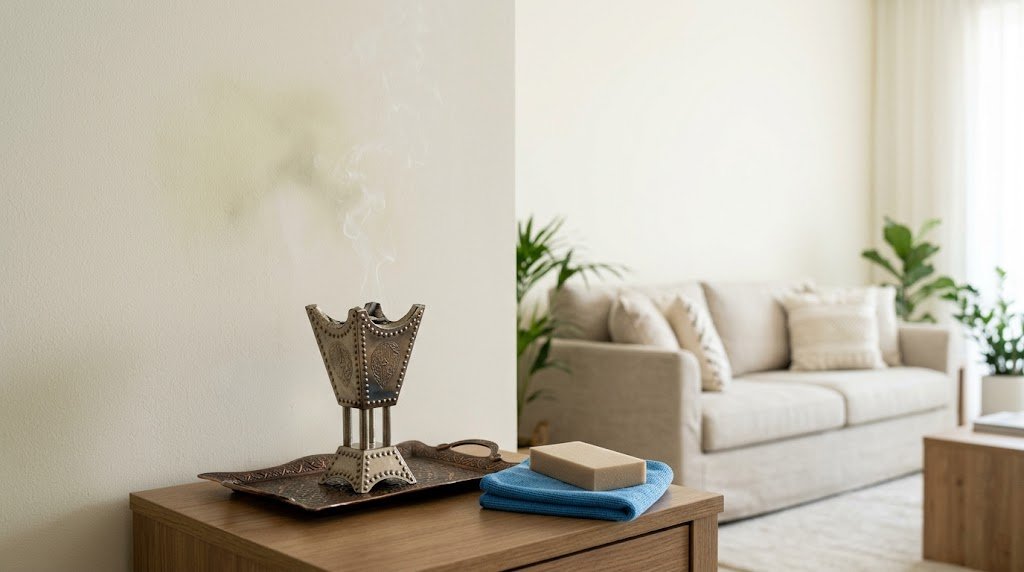

To remove bakhoor residue and soot effectively, it helps to understand what has built up first. Residue tends to collect gradually on walls, ceilings, AC vents and nearby furniture in homes where bakhoor is burned regularly. The residue is rarely a single substance. It is commonly a mix of dry ash from charcoal, fine combustion particles (soot), an oily film associated with heated fragrance oils, and everyday household dust that sticks to that film. Each layer responds to a different cleaning method, which is why a single wet wipe often spreads the mark instead of removing it.
Based on UAE conditions, the problem can compound quickly. Fine dust and sand enter apartments and villas through balcony doors, window gaps and AC systems, while windows often stay closed for much of the year because of the heat. Where ventilation is limited, airborne particles and fragrance compounds may remain indoors longer and settle on nearby surfaces. Areas near burners, return-air grilles and ceilings are commonly associated with the heaviest buildup. Some households may use bakhoor more frequently during gatherings or festive periods, which can increase residue where use is repeated.
This guide explains how to identify the type of residue, how to clean walls without removing paint, how to remove soot safely, and how to handle AC vents, filters, stone, glass and fabrics without damaging them.
Quick Answer
Remove loose ash and dry soot first with a dry soot sponge or soft vacuum brush, without water.
Then clean any remaining oily film with a mild soap solution suited to the surface, after a patch test. Removable AC grilles and filters can usually be cleaned separately. Ducts, coils and inaccessible AC parts should be left to a technician.
Why Does Bakhoor Leave Residue and Soot?
Bakhoor is typically made from wood chips soaked or blended with fragrant oils, resins and perfumes, then heated on charcoal or an electric burner. Heating releases scented smoke, and that smoke carries more than fragrance. Understanding what each component is makes it easier to choose the right cleaning method. For what the smoke itself adds to indoor air, see the guide on whether bakhoor smoke is harmful.
Charcoal Ash
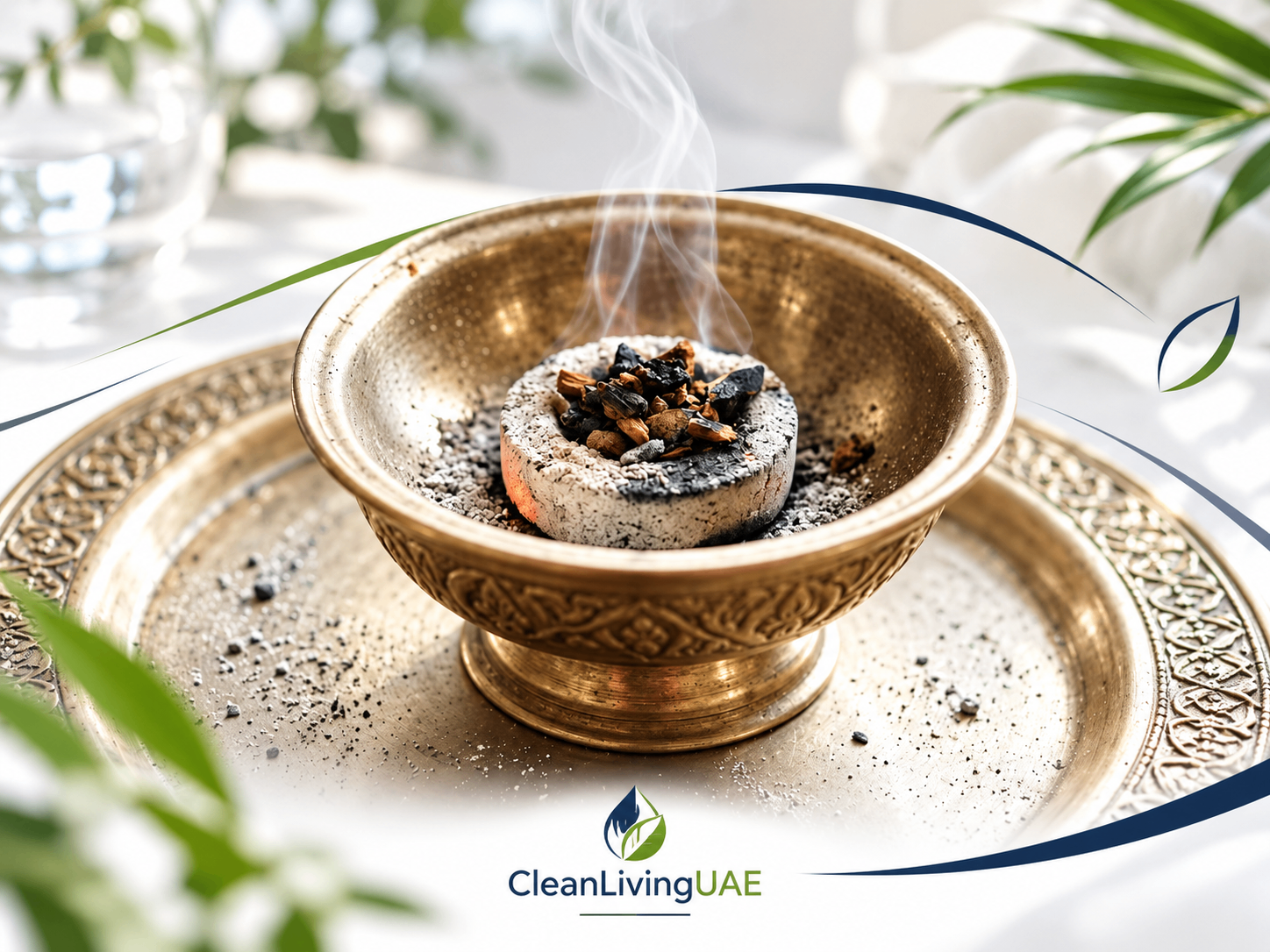
When bakhoor is burned on charcoal, the charcoal itself produces light grey ash. Ash is dry and loose, and it usually settles on the burner, tray, table and floor nearby. Air movement from fans or AC can lift it and spread it a short distance.
Soot and Fine Combustion Particles
Incomplete burning of charcoal and wood chips produces fine dark particles. Research by US Environmental Protection Agency scientists found that burning incense emits fine particulate matter in large quantities compared with other indoor sources. These particles tend to rise with warm smoke and settle on ceilings, upper walls, light fittings and areas near AC return grilles, where room air is drawn in.
Oily Fragrance Film
Much of the bakhoor fragrance comes from oils and resins. When heated, part of this material travels with the smoke and can settle on cooler surfaces as a thin, slightly tacky film. Over time, this film is often described as yellow, amber or brown, particularly on light-coloured paint and ceilings.
Dust Stuck to Oily Film
In UAE homes, fine dust is present on most surfaces. Once an oily film forms, dust clings to it far more readily than to a clean surface, creating a grey-brown layer that is harder to dust away and can look similar to soot. For background on why dust settles so quickly indoors, see why dust builds up in UAE homes.
Other Possible Contributors
Not every dark mark comes from bakhoor. Cooking fumes, candles, scented oil burners, outdoor dust entering through balconies and general dust carried by AC airflow can all create similar marks. Dark streaks around AC diffusers, for example, are often caused by dust and airflow patterns rather than bakhoor alone. Identifying the likely source helps avoid unnecessary or overly aggressive cleaning.
For guidance on burner fuel and how it affects ash and smoke, see the guide to bakhoor charcoal. For the wider air quality picture, see indoor air quality in UAE homes.
What Type of Stain Are You Cleaning?
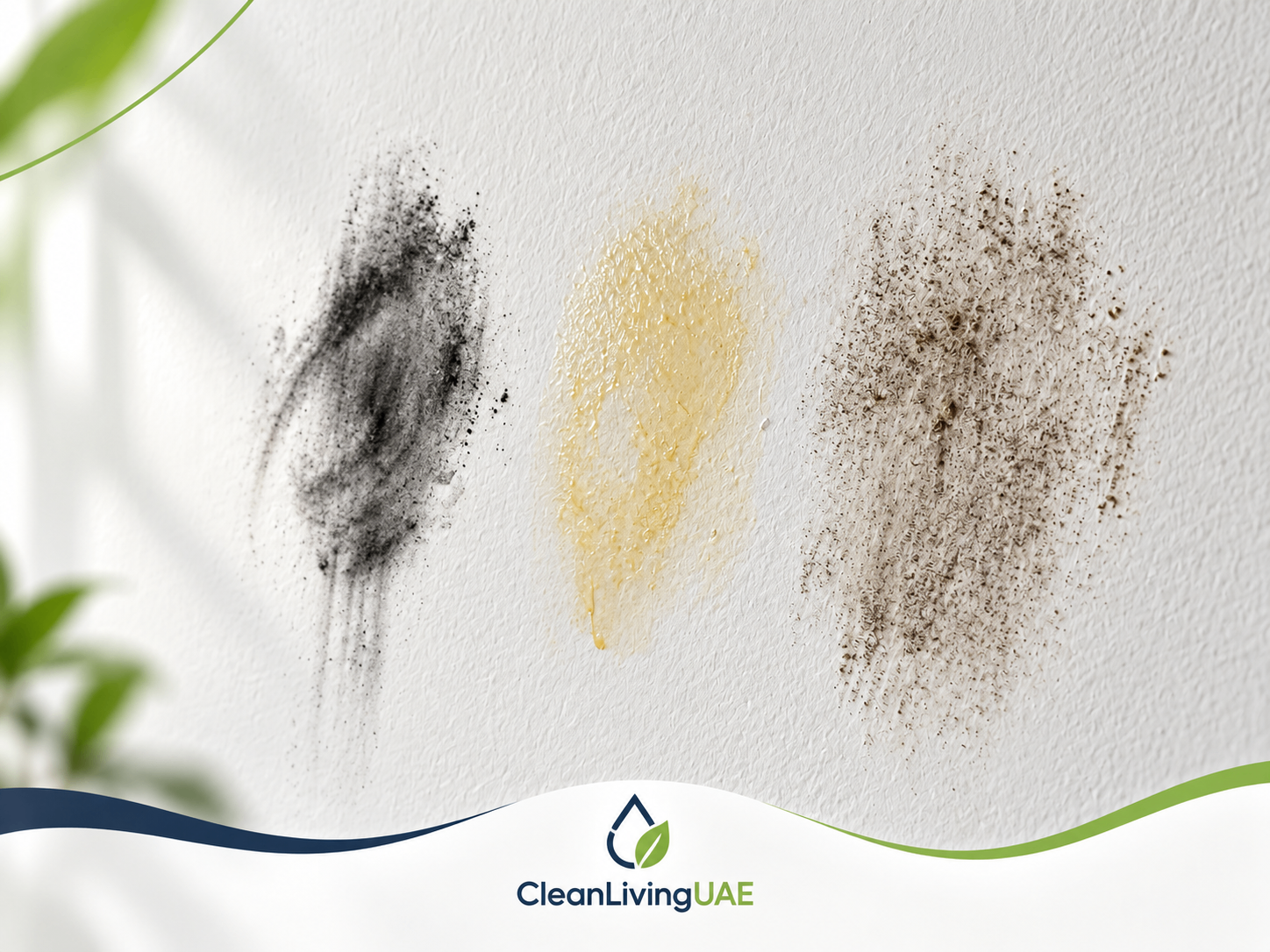
The table below offers a starting point for identification. Appearance can vary by surface, lighting and age of the stain, so it should be treated as a guide rather than a diagnosis.
| Type | Appearance | Likely Source | First Step |
|---|---|---|---|
| Loose grey ash | Light grey powder that wipes or blows away easily | Charcoal ash from the burner, sometimes spread by airflow | Vacuum with a soft brush attachment or dry-wipe, with no water |
| Black soot | Dark grey to black, powdery or smudgy, often in patches above or near the burner | Combustion particles from charcoal and wood chips; candles and cooking can produce similar marks | Use a dry soot sponge or gentle vacuuming; avoid wet wiping first |
| Sticky yellow/brown film | Slightly tacky, yellow or amber tint, often on ceilings and upper walls | Commonly associated with heated fragrance oils and resins; cooking fumes can look similar | Patch test a mild soap solution on a damp, well-wrung cloth |
| Dust stuck to oily film | Grey-brown, slightly fuzzy layer that smears when wiped dry | Household dust clinging to a residue film | Dry dust first, then use a mild soap solution |
| Dark AC vent buildup | Grey or black streaks on and around grilles and diffusers | Dust carried by airflow, sometimes with smoke particles; occasionally mould where condensation forms | Switch off the AC and clean removable grilles separately |
If dark spots around vents look fuzzy or spotty, return quickly after cleaning, or come with a musty smell, mould is a possibility and an AC technician should inspect the unit. The guide on humidity and mould prevention in UAE homes covers the warning signs in more detail.
How to Clean Painted Walls Without Removing Paint
Knowing how to clean walls without removing paint starts with the paint finish, because not all wall paint tolerates moisture or rubbing in the same way. A method that works on a washable finish can leave visible patches on matte paint.
Check the Paint Finish First
- Matte or flat paint is widely used on interior walls and is usually the least washable. Rubbing can create shiny or faded patches.
- Eggshell and satin finishes generally tolerate gentle wiping better, but scrubbing should still be avoided.
- Paints sold as washable, scrubbable or easy-clean are designed for more frequent cleaning. The manufacturer’s product information is the best guide to what each one tolerates.
- Semi-gloss and gloss finishes, often used on doors and trim, are typically the most durable.
If the finish is unknown, building management, the landlord or previous paint records may help. Where there is no information, treating the wall as matte is the safer approach. Fresh paint should be allowed to cure before washing; follow the paint manufacturer’s recommended curing period.
Step-by-Step Method

- Dust or dry-wipe the wall first, working from top to bottom, using a clean microfibre cloth or a vacuum with a soft brush attachment.
- Use a clean, soft microfibre cloth or non-abrasive sponge for the wet stage.
- Prepare a mild soap solution, such as a few drops of mild dish soap in a bowl of warm water.
- Patch test in an inconspicuous area, such as behind furniture. Let it dry fully and check for sheen changes, colour lifting or streaks.
- Wipe gently with a damp, well-wrung cloth in small sections. Avoid spraying cleaner directly onto the wall and keep moisture away from switches and sockets.
- Wipe again with a cloth dampened in clean water, then pat the surface dry with a dry microfibre cloth.
What to Avoid on Painted Walls
- Abrasive pads, scouring creams and stiff brushes
- Melamine foam sponges on matte paint, as they are mildly abrasive and can leave shiny patches
- Bleach as a default cleaner, as it can discolour paint
- Strong solvents, unless the paint manufacturer approves them
- Saturating the wall or leaving water running down the surface
- Mixing different cleaning chemicals
For broader routine wall and room care, the deep cleaning guide for UAE homes covers how wall cleaning fits into a full-house clean.
How to Remove Soot From Walls
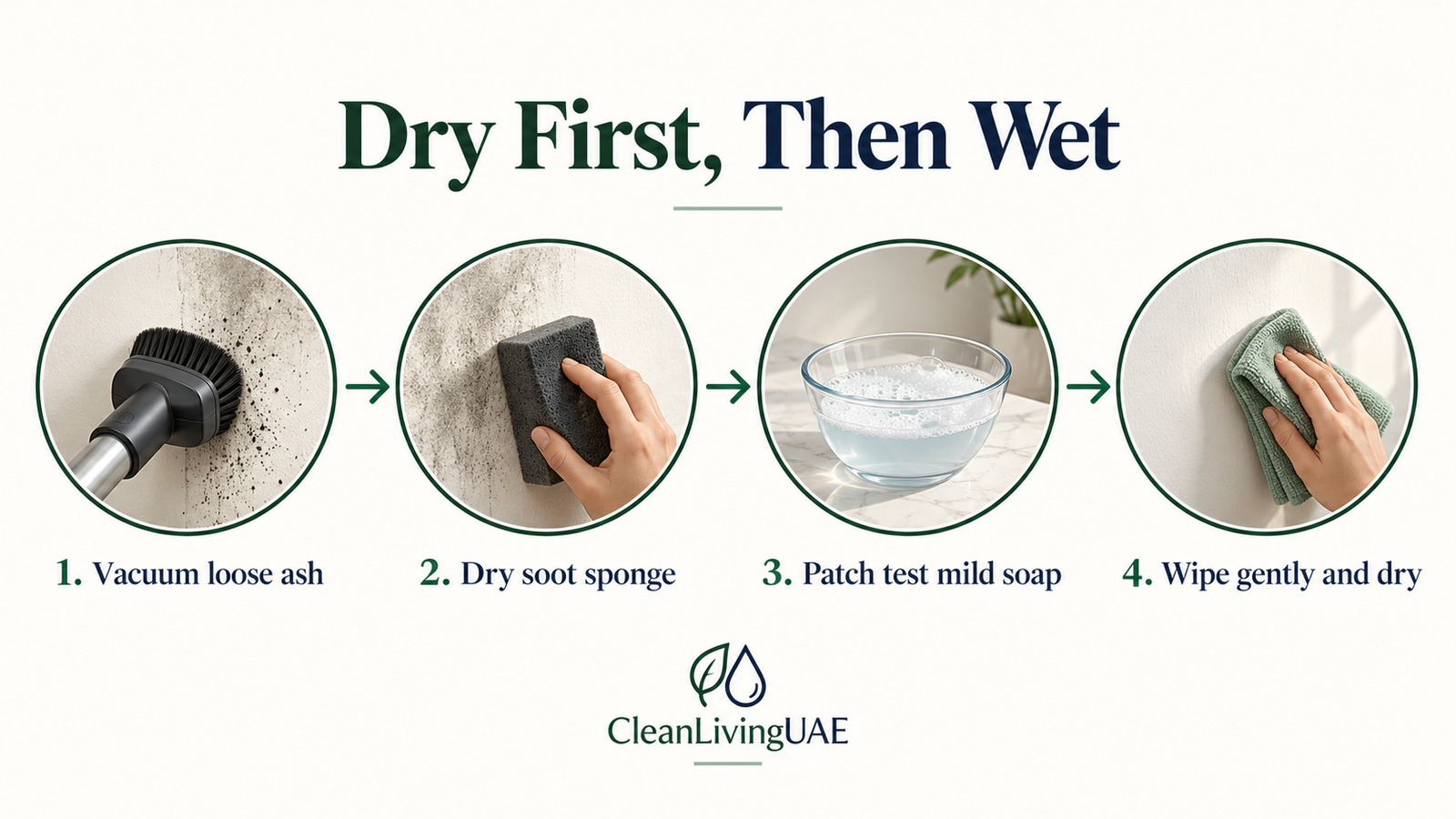
The most important rule when learning how to remove soot from walls is to start dry. Soot particles are fine and partly oily, so a wet cloth applied first tends to smear them into the paint texture and create a larger grey patch. Restoration guidance commonly recommends removing as much soot as possible before any liquid touches the wall.
Step 1: Remove Loose Particles
Lay an old sheet or towel below the area. Vacuum loose particles using a soft brush attachment with light pressure, or hold the nozzle just off the surface. A vacuum with a HEPA filter helps limit fine particles being released back into the room.
Step 2: Use a Dry Soot Sponge
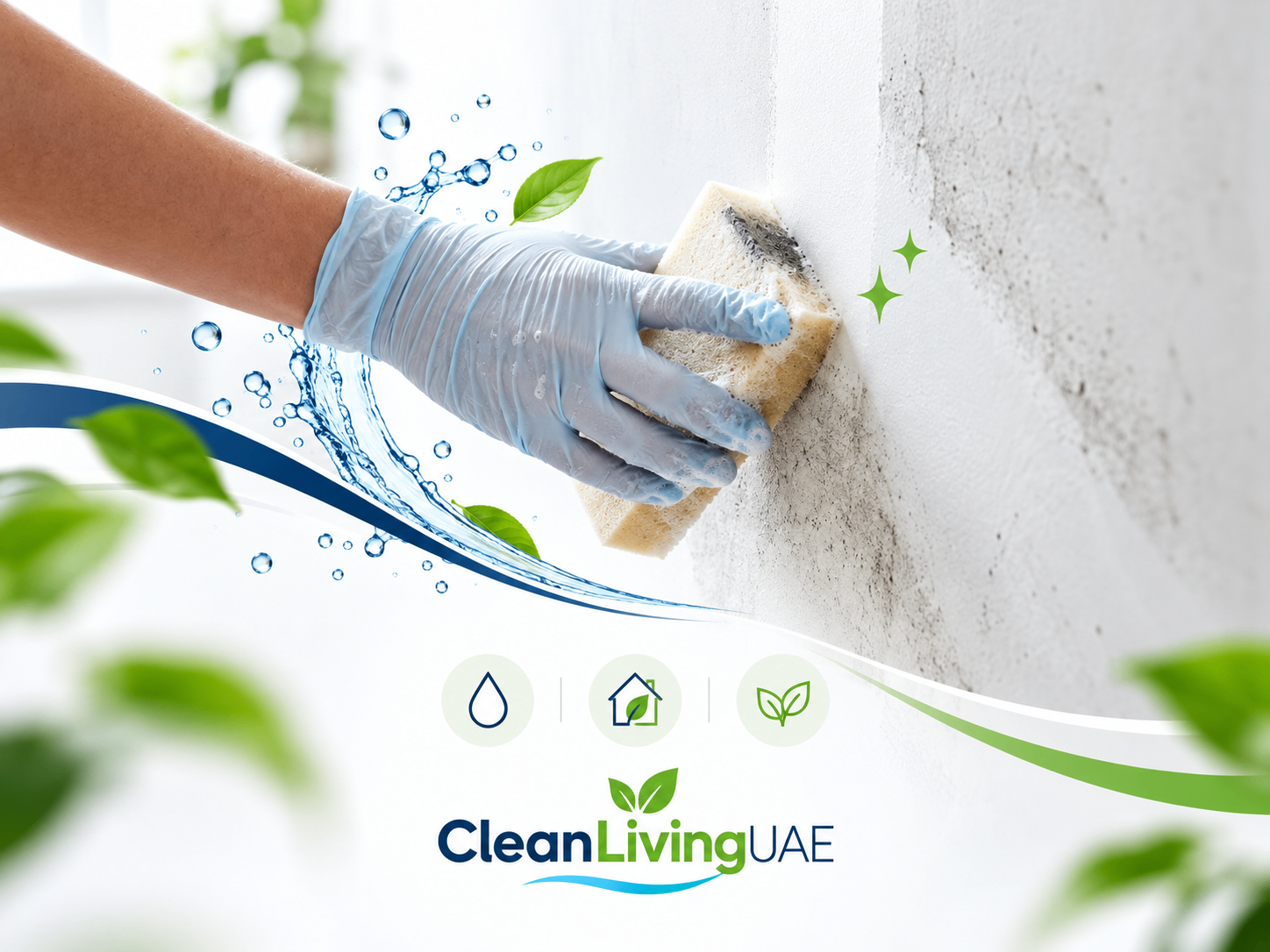
A dry cleaning sponge, also sold as a soot sponge or chemical sponge, is typically made from vulcanised rubber and works in a similar way to an eraser. Manufacturer directions for these sponges commonly specify using them completely dry and wiping in straight, overlapping strokes rather than scrubbing. As the sponge face darkens, turn it to a clean side or follow the product’s instructions for refreshing the surface.
On very soft matte or textured finishes, test the sponge lightly in a hidden area first. These sponges are usually made of natural rubber, so people with a latex allergy may need gloves.
Step 3: Wet Clean Only If Needed
If a grey shadow remains after dry cleaning, use the mild soap method described above, provided the paint passed a patch test. Work in small sections with a damp cloth, not a wet one, and dry each section afterwards.
When Soot Will Not Lift
If marks remain after gentle dry and wet cleaning, the soot may have penetrated the paint film. Further scrubbing is more likely to damage the wall than to remove the stain. In this situation, repainting is often the practical solution, and a stain-blocking primer is commonly recommended first so the discolouration does not show through the new paint. In rented apartments, tenancy terms and building rules should be checked before repainting.
Yellow or Oily Bakhoor Stains on Walls
Yellow stains on walls and ceilings near bakhoor burners usually behave differently from dry soot. Oily residue on walls does not lift with a dry sponge in the same way. It typically needs a mild soap solution to break down the film.
Gentle Cleaning Method
- Dry dust the area to remove loose particles sitting on the film.
- Mix a few drops of mild dish soap into warm water. A small amount of mild dish soap can help loosen oily residue.
- Patch test, then wipe in small sections with a damp, well-wrung microfibre cloth.
- Wipe with clean water and dry the area.
- If yellowing remains, repeat the gentle process on another day rather than increasing pressure or chemical strength.
Avoiding Clean Patches
Cleaning one small spot on a uniformly yellowed wall can leave a lighter patch that stands out. Where residue is spread across the whole wall, cleaning complete sections from corner to corner usually gives a more even result.
When Repainting May Be Needed
If yellowing does not reduce after two or three gentle cleaning attempts, or if the colour appears to sit within the paint rather than on top of it, the staining has likely penetrated the finish. A stain-blocking primer followed by fresh paint is commonly recommended in these cases. Choosing a washable finish for rooms where bakhoor is used regularly can make future cleaning easier.
How to Clean Ceilings Safely
Ceilings often show the heaviest fragrance residue because warm smoke rises. They are also the hardest surface to clean safely, so clear boundaries matter.
- Clean only areas that can be reached safely from a stable step ladder with a platform. Chairs, sofas, tables and stacked furniture are not safe alternatives.
- Ask another person to steady the ladder where possible, and avoid overreaching to the side.
- Switch off lights before cleaning near fittings, and keep moisture away from light fittings and electrical points.
- Do not wet, cover or touch smoke detectors or sprinkler heads, which are common in UAE apartment buildings. Accidental damage to a sprinkler head can trigger a discharge.
- Use dry methods first, such as a dry soot sponge or an extendable microfibre duster.
- Never soak ceiling paint. Some apartments and villas have gypsum board false ceilings, which can be damaged by excess moisture.
- Patch test any damp cleaning in a corner before working on visible areas.
For high or double-height ceilings in villas, or where residue covers a large area, professional cleaning or repainting is usually the safer option.
How to Clean AC Vents in House
With regular AC use during the hotter months, supply diffusers and return-air grilles can collect dust steadily. In homes where bakhoor is used, smoke drawn toward the return grille can add darker residue, which is one reason dirty AC vents are a common complaint. The approach to house AC vent cleaning depends on the system type and on who is responsible for maintenance.
UAE homes may use ducted ceiling systems, linear grilles or wall-mounted split units. In many apartment buildings, AC maintenance is handled by building management or the landlord, so it is worth checking before removing any fixed components.
What Homeowners Can Usually Do
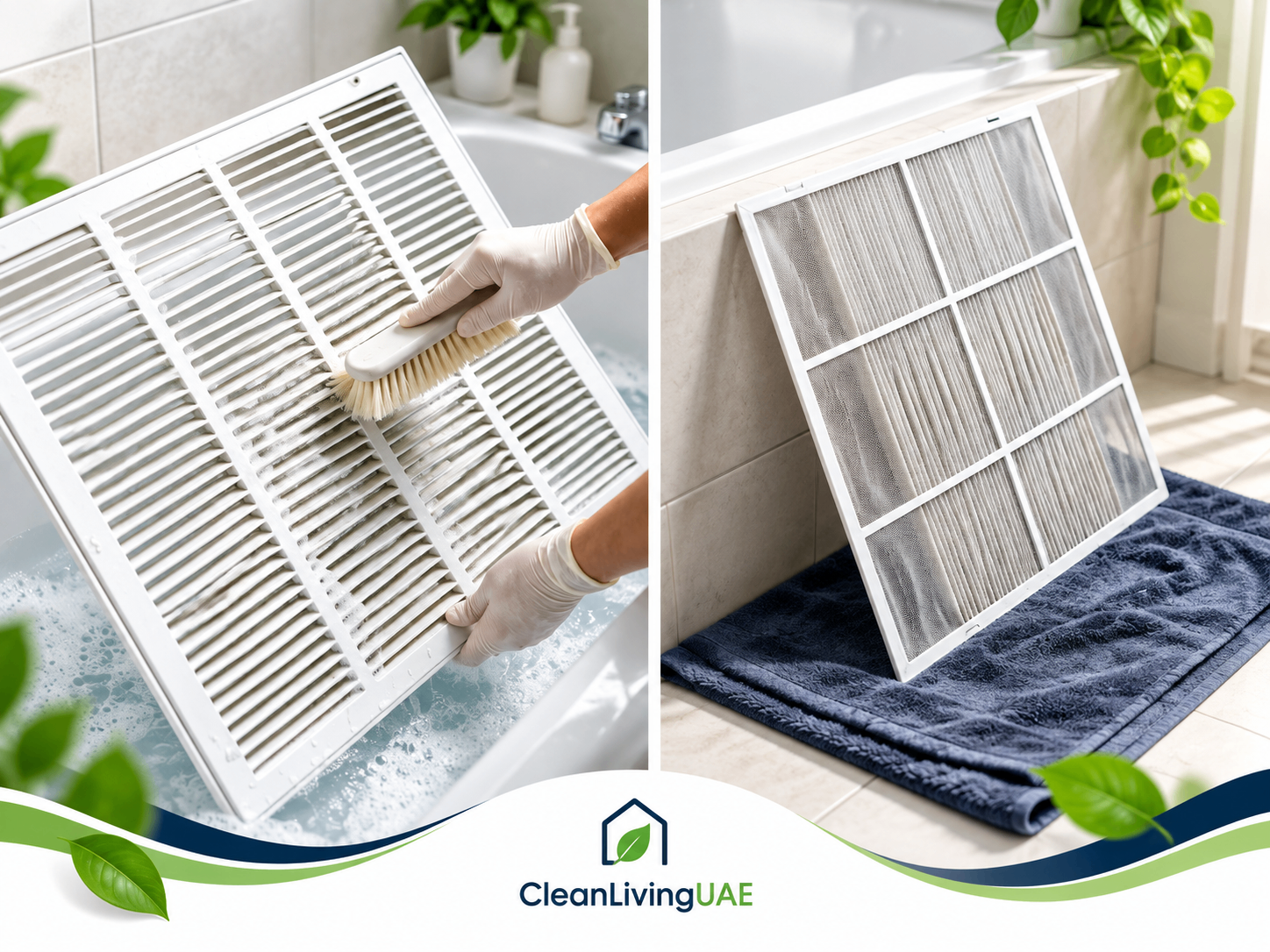
AC vent cleaning at home is generally limited to the parts that are visible and designed to be removed or wiped.
- Switch off the AC at the thermostat before cleaning, and allow any moving louvres to stop.
- Vacuum the grille face with a soft brush attachment to remove loose dust.
- Wipe louvres with a microfibre cloth dampened in mild soap solution and wrung out well.
- Remove grilles only if they are designed to be removable, such as clip-in or hinged return grilles. Support the grille while releasing it and lay a sheet below.
- Wash removable grilles in mild soapy water with a soft brush, rinse, and dry completely before refitting. Metal grilles should be dried thoroughly to limit corrosion.
- Dry-wipe the ceiling paint around diffusers before using any damp cloth, as this area often has dust streaks that smear easily.
Practical tool options are covered in the guide to AC vent cleaning tools for UAE homes, and recurring buildup is explained further in dusty AC vents in the UAE.
What to Leave to a Technician
- Spraying any cleaner into ducts
- Cleaning coils, blower wheels, drain pans or fan coil units
- Accessing ductwork beyond the grille
- Anything involving electrical components, which should never be soaked
- Recurring dark spots, musty odours or water dripping from vents
Based on available information, duct cleaning frequency in the UAE is generally condition-based rather than fixed, and providers commonly reference industry standards such as those of NADCA. A licensed AC technician or building maintenance team can assess whether duct cleaning is needed.
How to Clean AC Filters
Filters in homes where bakhoor is used frequently may collect dust, smoke particles and oily residue over time, sometimes visible as a grey or brown tint.
- Check the AC manual or building guidance. Some filters are washable, while others are disposable and should be replaced instead.
- Switch off the AC before removing the filter.
- Vacuum the dusty side of the filter to remove loose material.
- Rinse under lukewarm water. A small amount of mild detergent can help with oily residue. Avoid hot water and do not scrub the mesh.
- Let the filter dry completely in the shade. AC manufacturers commonly advise against drying filters in direct sunlight or near heat sources, which can warp plastic frames.
- Refit only when fully dry, as a damp filter can encourage mould growth.
For schedules and filter types, see how often to clean AC filters in the UAE and the full AC filter cleaning guide.
How to Clean Tiles, Glass, Marble and Stone
Hard surfaces generally handle residue better than paint, but the right method still depends on the material.
Ceramic and Porcelain Tiles
Dry-wipe or vacuum ash first. Then clean with a mild detergent solution, rinse with clean water and dry. A soft brush helps lift residue from grout lines. More detail is available in the floors and tiles cleaning guide.
Glass and Mirrors
Dry-wipe glass lightly first, because ash and fine sand can be gritty when pressed into the surface. Then clean with a glass cleaner or water with a drop of mild dish soap, and finish with a dry microfibre cloth or squeegee. Window cleaning options are covered in the guide to window cleaning tools for UAE homes.
Marble and Natural Stone
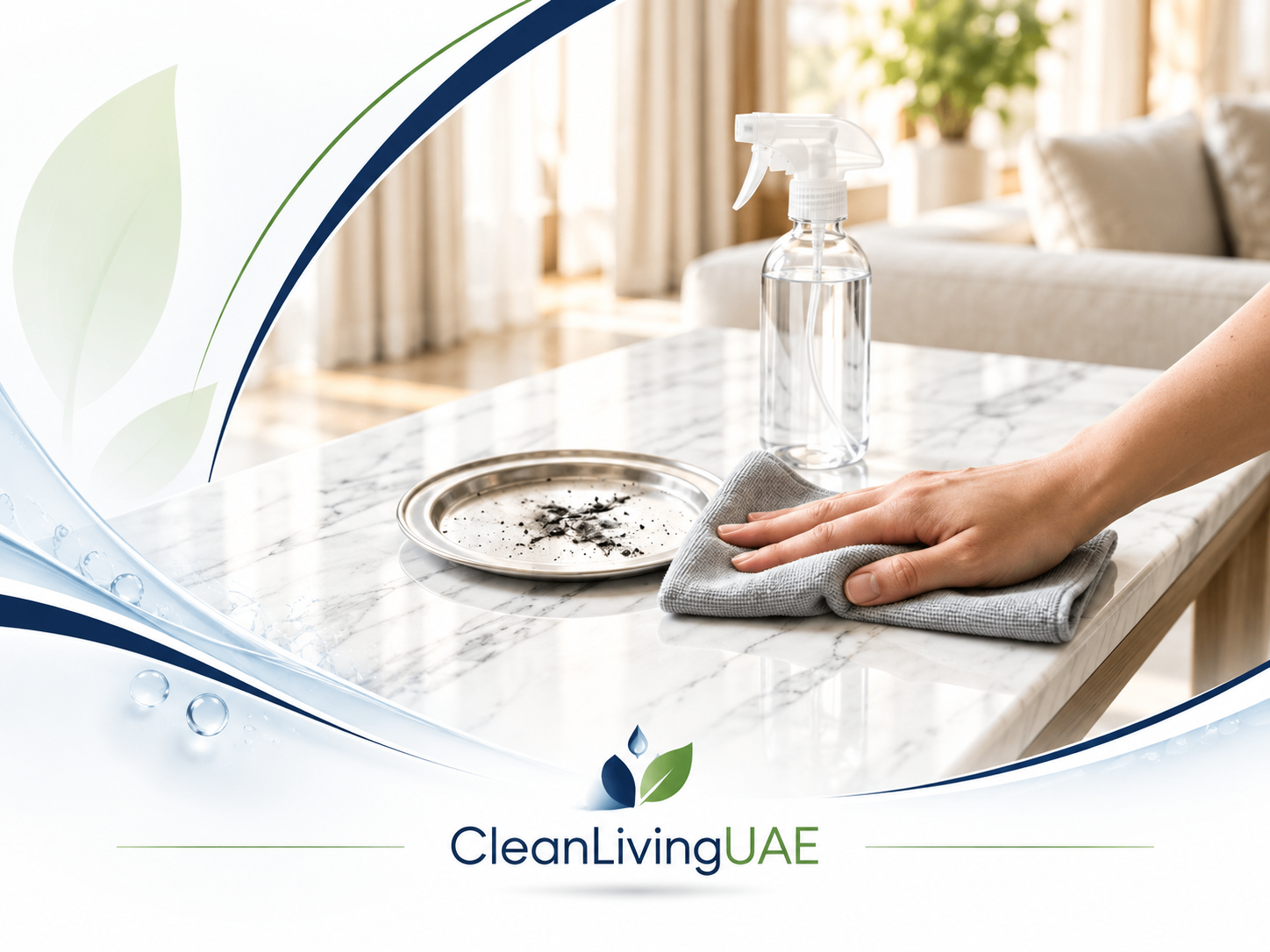
Marble, limestone, travertine and onyx are calcium-based stones that react with acids. Natural Stone Institute care guidance advises against vinegar, lemon juice and acidic cleaners, including many bathroom and grout cleaners, on these stones. Abrasive cleansers can also scratch polished finishes.
- Dry-wipe or vacuum ash and dust first.
- Clean with a pH-neutral stone cleaner or a few drops of mild dish soap in warm water.
- Rinse with clean water and dry thoroughly.
- Use degreasers only after confirming compatibility with the stone cleaner manufacturer, the stone supplier or the installer.
Oily stains that have soaked into marble often need targeted treatment, such as a poultice, and the correct method varies by stone and stain. A stone care specialist is the safer choice for valuable or polished surfaces. Sealed stone generally resists oil absorption better, so checking the sealing condition can help prevent future staining.
How to Clean Furniture, Curtains and Fabrics
Soft furnishings and wood surfaces near burners can hold both residue and smoke odour.
Wooden and Lacquered Furniture
Dry-dust with a microfibre cloth first. If residue remains, wipe with a cloth lightly dampened in mild soap solution and wrung out well, then dry immediately. Avoid soaking wood, and follow the maker’s guidance for antique, oiled or specialty finishes.
Upholstery and Majlis Seating
Vacuum with an upholstery attachment to remove ash and dust. Check the care label or cleaning code before using any liquid, spot test in a hidden area, and avoid overwetting. Delicate or valuable fabrics are usually better handled by a professional upholstery cleaner. Tool options are covered in the guide to upholstery cleaning tools.
Curtains, Cushions and Rugs
Fabrics absorb fragrance and smoke particles over time. Vacuum curtains on a low setting with a brush attachment, then follow the care label: some curtains are machine washable, while others are dry clean only. Make sure washed items are fully dry before rehanging. Rugs and cushions can be vacuumed regularly and cleaned according to their labels.
How to Clean Burner Surroundings
The area directly around the burner usually collects the most ash and residue.
- Wait until the burner and charcoal are completely cold before cleaning. Charcoal can stay hot for a long time after it appears to be out.
- Dispose of ash only when fully cold, using a non-flammable container.
- Unplug electric burners before cleaning, wipe them according to the manufacturer’s instructions, and never immerse them in water.
- Brush ash from metal or ceramic burners, then wash removable bowls in a way that suits the material. Brass, painted and decorative finishes need gentle cleaning without abrasives.
- Use a heat-resistant tray under the burner to protect tables and floors and to contain ash.
- Never cover or disable smoke detectors to prevent alarms during bakhoor use.
Tools That Help Remove Bakhoor Residue and Soot
The tools below are commonly used to remove bakhoor residue and soot from household surfaces. Suitability depends on the surface, so each should be used with the cautions described earlier.
- Dry soot sponge: lifts dry soot from walls and ceilings without water.
- Microfibre cloths: for dry dusting, damp wiping and drying. See microfibre cloths for UAE dust.
- Vacuum with a soft brush attachment and HEPA filter: removes loose ash and soot with less spreading. See HEPA vacuums for UAE homes.
- Extendable microfibre duster: reaches upper walls and lower ceilings from the floor. See dusting tools for UAE homes.
- Soft detailing brushes: for grilles, grout lines and burner trays. See cleaning brushes for UAE homes.
- pH-neutral stone cleaner: for marble and natural stone surfaces.
- Mild dish soap: the base for most gentle cleaning solutions.
- Stable step ladder with a platform: for safe access to upper walls and ceilings.
Cleaning Methods Compared
| Method | Best For | Advantages | Limitations |
|---|---|---|---|
| Dry soot sponge | Dry soot on walls and ceilings | No water, so less risk of smearing or water marks | Less effective on oily film; can mark very soft finishes |
| Vacuum with soft brush | Loose ash, dust and AC grille faces | Removes particles without contact pressure | Does not remove film bonded to the surface |
| Microfibre cloth and mild soap | Oily residue and yellow film | Gentle and widely suitable after a patch test | Can affect matte paint if the cloth is too wet or pressure too high |
| Melamine foam sponge | Durable, glossy or washable finishes only | Strong on stubborn marks | Mildly abrasive; can dull matte paint and polished surfaces |
| pH-neutral stone cleaner | Marble, limestone and travertine | Designed for acid-sensitive stone | May not lift absorbed oil stains without specialist treatment |
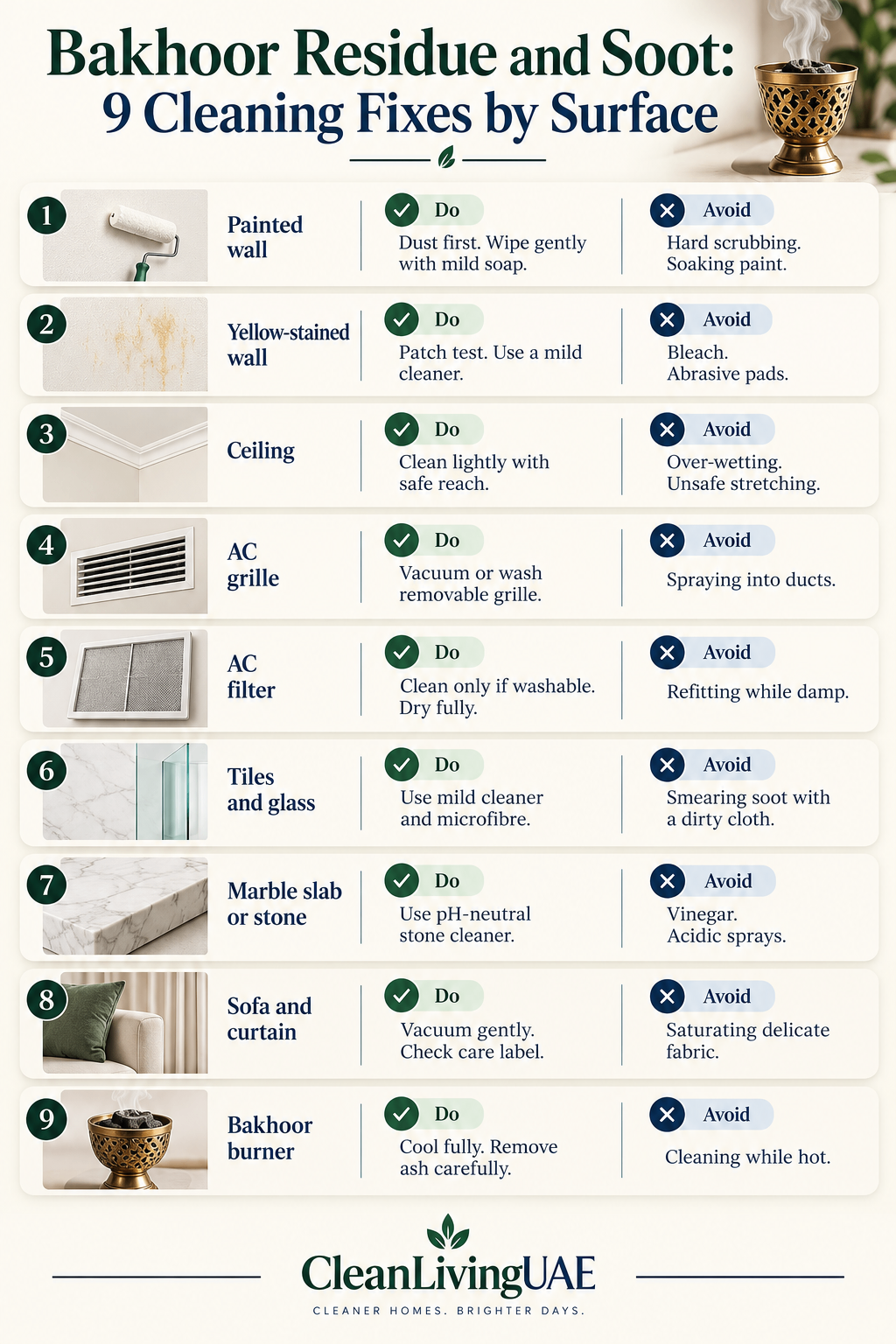
How to Remove Bakhoor Residue and Soot: 9 Fixes by Surface
| Surface | Main Residue | Recommended Approach | Avoid | Patch Test Needed |
|---|---|---|---|---|
| Painted walls (dry soot) | Black or grey soot | Vacuum, then dry soot sponge | Wet wiping first, scrubbing | Yes |
| Painted walls (yellow or oily) | Fragrance film with dust | Mild soap solution on a well-wrung cloth | Bleach, solvents, abrasive pads | Yes |
| Ceilings | Soot and yellow film | Dry methods from a stable ladder, minimal moisture | Soaking, overreaching, touching sprinklers | Yes |
| AC vents and grilles | Dust with smoke particles | Vacuum, damp wipe, wash removable grilles | Spraying into ducts | Usually not needed for plastic |
| AC filters | Dust and oily tint | Vacuum, lukewarm rinse, dry in shade | Hot water, direct sun, refitting damp | Not applicable |
| Tiles and glass | Ash, film, dust | Dry wipe, mild detergent, dry finish | Pressing grit into glass | Rarely needed |
| Marble and stone | Ash, oily film | pH-neutral cleaner, rinse, dry | Vinegar, lemon, acidic and abrasive cleaners | Yes |
| Furniture and fabrics | Ash, smoke odour, film | Vacuum, care-label methods, light damp wipe on wood | Overwetting, ignoring care labels | Yes |
| Burner surroundings | Ash and heavy residue | Clean only when cold, heat-resistant tray | Cleaning while hot, immersing electric burners | Depends on finish |
Tips to Prevent Bakhoor Residue Buildup
- Place the burner away from walls, curtains and shelves, and avoid positioning it directly below AC return grilles or smoke detectors.
- Use a heat-resistant tray to contain ash.
- Ventilate briefly during or after use when outdoor conditions allow, for example by opening a window or using an extract fan. Avoid opening windows during dusty or sandstorm conditions.
- Burn smaller amounts for shorter periods, particularly in small rooms.
- Electric burners avoid charcoal ash, but they still release smoke and fragrance residue.
- Dry-dust surfaces near the burner as part of a regular routine before film builds up. The weekly cleaning checklist for UAE homes can help structure this.
- Check AC filters more often during periods of more frequent bakhoor use, such as gatherings or festive occasions. See the Eid deep cleaning guide and Ramadan cleaning preparation.
- Consider a washable paint finish when repainting rooms where bakhoor is used frequently.
- An air purifier with a HEPA filter can help capture airborne particles, although it will not remove residue already deposited on surfaces. See air purifiers for UAE homes.
When to Repaint or Call a Professional
Some situations are better handled by a painter, stone specialist or AC technician than by continued home cleaning. It may be time to stop trying to remove bakhoor residue and soot at home when:
- Stains remain after two or three gentle cleaning attempts
- Discolouration appears to sit within the paint film
- Ceilings are too high to reach safely
- Residue covers large areas or multiple rooms
- Marble or stone shows absorbed oil stains or dull etched patches
- AC vents show recurring dark spots, musty odours or leaks
- Valuable fabrics, rugs or antique furniture are affected
Conclusion
The safest way to remove bakhoor residue and soot is mainly a matter of sequence and restraint. Dry particles should come off first, oily film should be treated with mild, surface-appropriate solutions, and every uncertain surface should be patch tested. Removable AC grilles and filters can be cleaned at home, while ducts and internal components are best left to qualified technicians. Based on UAE conditions, combining careful burner placement, regular dry dusting and closer attention to AC filters is often the most practical way to keep residue from building up again.
Frequently Asked Questions
Does bakhoor leave stains on walls?
Regular bakhoor use is commonly associated with yellow or brown film and dark soot marks on walls and ceilings, especially near the burner and on upper walls where warm smoke rises.
Is bakhoor residue the same as soot?
Not exactly. Soot is made of fine dark combustion particles, while bakhoor residue often also includes an oily fragrance film and household dust that sticks to it. Each needs a different cleaning approach.
Can soot be removed with water?
Water is not the best first step. Wiping dry soot with a wet cloth often smears it into the paint. Removing loose particles and using a dry soot sponge first is the commonly recommended approach.
What is the safest way to clean walls without removing paint?
Dry dust first, then use a few drops of mild dish soap in warm water on a damp, well-wrung microfibre cloth after a patch test. Wipe gently in sections and dry afterwards.
How do you remove bakhoor residue from walls?
Remove loose ash and dry soot first with a vacuum brush or dry soot sponge. Then patch test a mild dish soap solution and wipe gently with a damp, well-wrung microfibre cloth, drying each section afterwards.
When should you call a professional cleaner or AC technician?
A professional is advisable when stains remain after two or three gentle attempts, ceilings are too high to reach safely, residue covers large areas, or AC vents show recurring dark spots, musty odours or leaks.
How do I clean dirty AC vents at home?
Switch off the AC, vacuum the grille face with a soft brush, and wipe with a damp microfibre cloth. Removable grilles can be washed in mild soapy water and dried fully before refitting.
Can I clean AC ducts myself?
Cleaning inside ducts, coils and fan coil units is best left to a licensed technician. Spraying cleaner into ducts or reaching beyond the grille can damage components and may affect the system.
How often should AC filters be cleaned in homes that use bakhoor?
There is no single interval for all systems. Filters may collect residue faster where bakhoor is used frequently, so checking them more often than usual and following the manufacturer’s guidance is a practical approach.
Can vinegar be used to clean bakhoor residue from marble?
No. Vinegar and other acidic cleaners can etch marble, limestone and travertine. A pH-neutral stone cleaner or a mild dish soap solution is the safer option.
Sources
This guide draws on established cleaning and care guidance, including the US Environmental Protection Agency study on emissions from burning incense, The Home Depot guide to cleaning painted walls, Sherwin-Williams advice on washing painted walls, Bane-Clene directions for dry cleaning soot sponges, Angi guidance on cleaning soot from walls, the Natural Stone Institute guide to the care and cleaning of natural stone, LG instructions for cleaning split AC filters and Daikin guidance on cleaning air conditioner filters.