Why Dust Builds Up Fast in UAE Homes (And How to Fix It) - 2026 Guide
By the CleanLivingUAE Editorial Team
Published: 30th April 2026
Based on UAE residential conditions and cleaning patterns. Reviewed by the CleanLivingUAE Editorial Team.
Introduction
Many residents across Dubai, Abu Dhabi, and Sharjah ask the same question – why dust builds up UAE homes so fast. Surfaces cleaned one evening are dusty again by the next morning. This happens in high-rise apartments in Dubai Marina, mid-floor blocks in Abu Dhabi, villa compounds in Sharjah, and townhouse communities in Ajman and Ras Al Khaimah.
The UAE apartment dust problem is not about how often you clean. It is about where the dust comes from and why it keeps coming back. Desert sand, year-round air conditioning, sealed apartments, shared building corridors, and constant construction activity all play a role. Indoor dust UAE apartments collect is finer and harder to remove than dust in most other countries.
This guide explains the dust causes UAE homes face, identifies the right tools for local conditions, and provides a clear step-by-step approach any UAE resident can follow.
QUICK ANSWER
Dust builds up in UAE homes due to desert sand, frequent dust storms, air conditioning circulation, and multiple entry points like doors and balconies. Fine particles remain airborne and settle quickly on surfaces, making daily dust accumulation common across apartments and villas.
Dust Causes UAE Homes Face – What Is Behind the Problem
The dust causes UAE homes face come from both inside and outside the home. The indoor dust UAE apartments collect is not the same as household dust in Europe or North America. It is finer, heavier during certain seasons, and constantly arriving from sources that do not stop on their own.
Desert Environment and Fine Particles
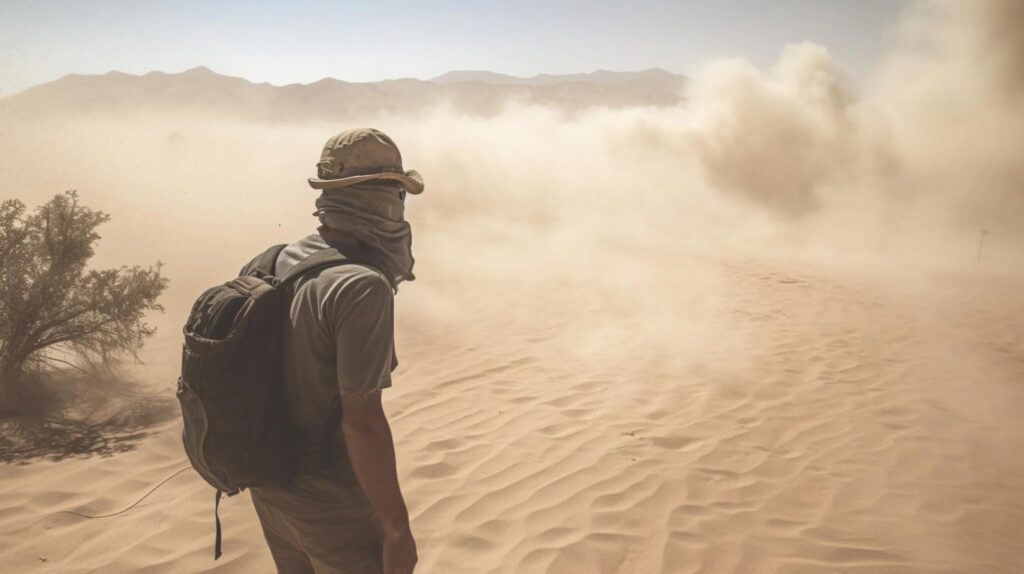
The main reason why dust builds up UAE homes so fast is the desert. The UAE sits next to the Arabian Desert, and fine sand particles are always present in outdoor air. These particles are so small they pass straight through standard window screens, door gaps, and air conditioning intake points.
The UAE National Centre of Meteorology confirms that Shamal winds – northwesterly winds that blow strongest between June and September – push large amounts of fine particles across UAE cities. During these periods, desert dust in homes UAE-wide increases significantly. Many residents in Dubai and Abu Dhabi report seeing dust settle on surfaces within a few hours of cleaning during Shamal season. This is one of the most direct dust causes UAE homes experience and one of the hardest to prevent without physical controls at entry points.
This type of dust behaves differently from larger particles. It sticks to curtains, sofas, and textured walls more easily. It floats in the air longer before settling. Once disturbed – by movement, air conditioning airflow, or someone walking past – it rises back into the air and the cycle starts again.
Compared to countries like the UK or Germany, where household dust is mostly made up of fabric fibres and skin cells, UAE dust contains a much higher proportion of fine mineral sand. This is a key reason UAE homes accumulate dust at a rate that surprises many residents who have moved here from abroad.
HVAC and Airflow Systems
Air conditioning runs all year in the UAE. Most Dubai and Abu Dhabi apartments use split-unit AC systems or central ducted systems. These systems push the same indoor air around the apartment continuously. When they do this, they also move around whatever dust particles are already floating in the air.
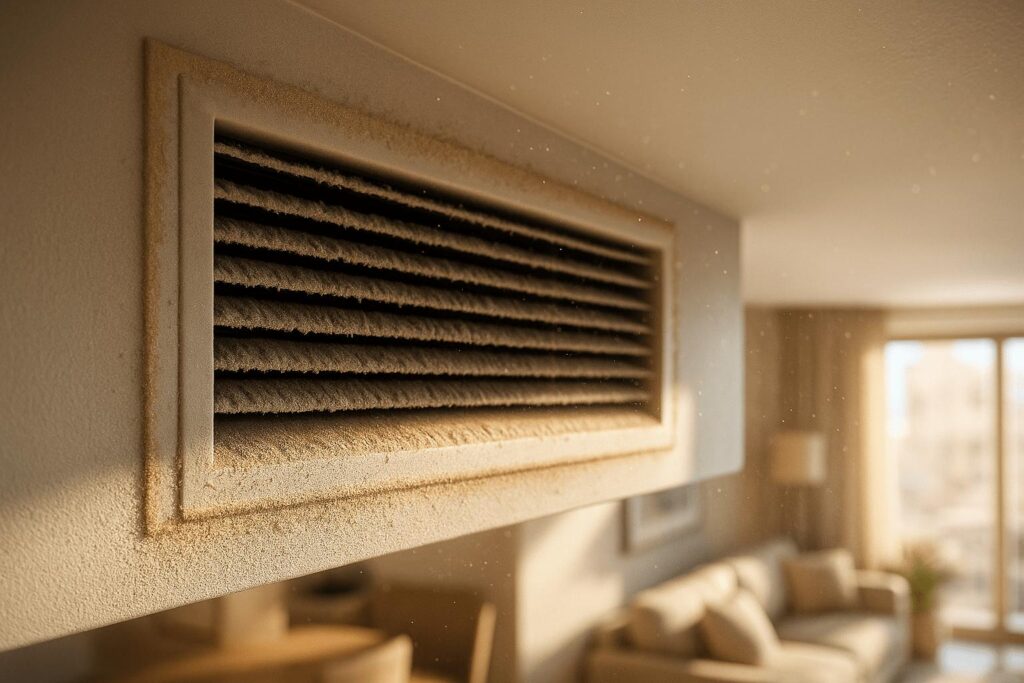
When AC filters are not cleaned regularly, they stop working properly. Instead of trapping dust, they start blowing it back into the room. This is one of the biggest dust causes UAE homes face from inside – and one that many residents overlook because the filters are out of sight.
In apartments and villas with ducted AC systems – common in larger units across Dubai and Abu Dhabi – dust builds up inside the ducts over time. Every time the AC turns on, some of that dust gets pushed back out into the room. In older buildings where ducts are rarely cleaned, this is a significant hidden source of indoor dust UAE apartments collect on a daily basis.
Entry Points – Doors, Windows, and Balconies
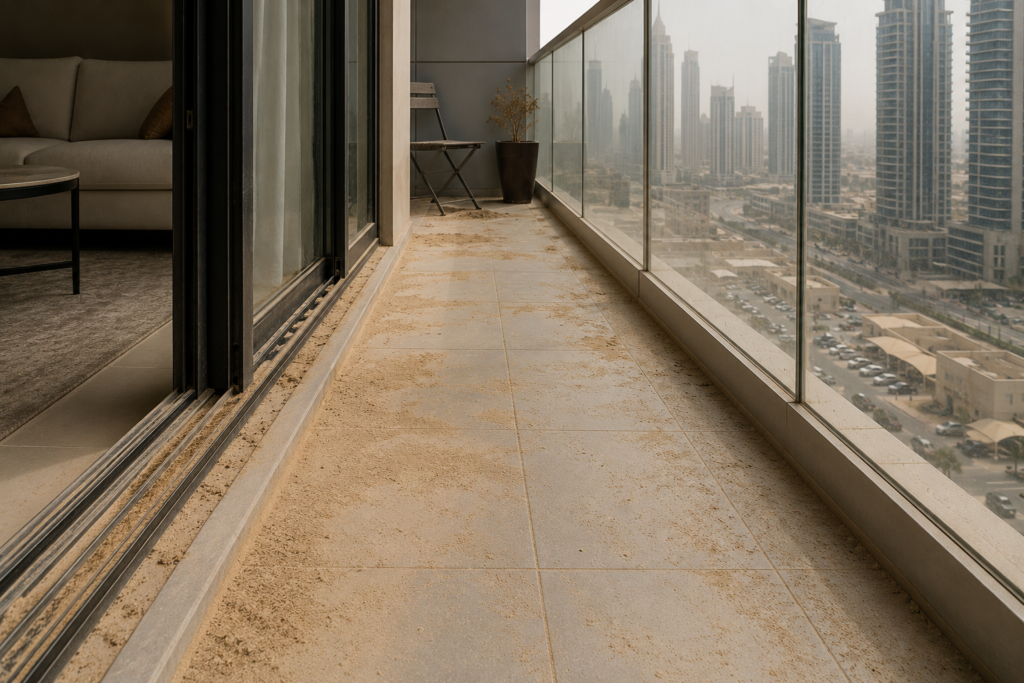
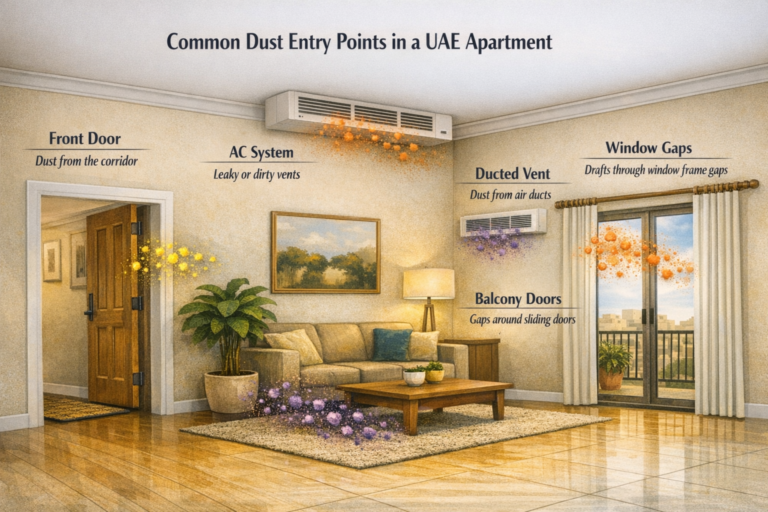
Most UAE apartments have large balcony sliding doors, windows, and access to shared corridors. All of these are paths for desert dust to enter the home.
Balcony-facing rooms collect more dust than interior rooms. This is especially noticeable in apartments near construction sites, busy roads, or open ground – areas found across Al Quoz in Dubai and Mussafah in Abu Dhabi.
Even when balcony doors and windows are closed, old or worn seals allow fine dust through. Standard window mesh keeps insects out but is not fine enough to block desert silica particles. This is one of the main reasons how to stop dust in UAE homes is difficult without checking and replacing worn seals regularly.
Lower-floor residents – especially those on floors one to five – tend to report more dust than those on higher floors. Ground-level activity from foot traffic, vehicles, and landscaping sends particles into the air directly outside their windows and doors.
Apartment Living Patterns
Living in a shared apartment building adds dust sources that villa residents do not face in the same way. Corridors, lifts, and stairwells see constant foot traffic throughout the day. Every time someone enters from outside, they bring particles in on their shoes and clothing.
Building cleaning standards vary widely across developments in Dubai, Abu Dhabi, and Sharjah. In buildings where corridors are swept rather than vacuumed, dust is moved around rather than removed. Residents then carry that dust into their units every time they open the front door. This adds to the indoor dust UAE apartments collect day after day regardless of how well individual units are cleaned.
Table of Dust Entry Points and Recommended Actions
| Entry Point | Dust Type | Risk Level | Recommended Action |
|---|---|---|---|
| Balcony sliding doors | Fine sand, coarse particles | High | Keep closed during Shamal, inspect seals annually |
| AC system and filters | Fine recirculated particles | High | Clean filters monthly |
| Window frame gaps | Fine silica | Medium-High | Foam seal tape, inspect frames annually |
| Front door and corridor | Tracked particles from shared spaces | Medium | Double-layer entry mat, remove footwear at entry |
| Ducted AC vents | Accumulated duct dust | Medium | Professional duct clean annually or biennially |
Table of Main Dust Causes UAE Homes Face by Impact Level
| Cause | Impact Level | Why It Happens in UAE |
|---|---|---|
| Desert sand and silica particles | Very High | UAE sits next to the Arabian Desert – fine particles are always in the outdoor air |
| Shamal winds and dust storms | High | Seasonal winds between June and September carry heavy particle loads across UAE cities |
| AC recirculation | High | Year-round sealed AC systems push indoor particles around continuously |
| Construction and urban development | Medium-High | Large-scale construction is ongoing across Dubai, Abu Dhabi, and Sharjah |
| Balconies and window gaps | Medium | Main physical entry points for outdoor desert dust |
| Shared building corridors | Medium | Foot traffic brings tracked particles inside on every entry |
Why Dust Builds Up UAE Homes So Fast After Cleaning
One of the most common frustrations among UAE residents is how quickly dust returns after cleaning. Many people in Dubai apartments and Abu Dhabi villas report seeing visible dust again within one to two days of a thorough clean. This is not a sign that something is being done wrong. It reflects a continuous cycle that surface cleaning alone cannot stop.
The continuous dust cycle is the core reason why dust builds up UAE homes so fast. Fine desert particles enter through gaps, vents, and AC systems. They settle on surfaces. Normal movement and airflow disturb them and send them back into the air. In a sealed, air-conditioned apartment there is nowhere for those particles to go – they just circulate and settle again. Without fixing the entry points and the airflow, the cycle repeats no matter how often surfaces are wiped.
External versus internal sources need different solutions when thinking about how to reduce dust UAE apartment residents deal with every day. External sources – desert wind, construction activity, open land near the building – cannot be stopped but can be reduced at the point of entry through sealing and mats. Internal sources – AC recirculation, fabric shedding, daily movement around the home – can be reduced through filter cleaning, microfiber tools, and air purification. Both categories of dust causes UAE homes face need to be tackled together.
Air circulation in sealed apartments makes the problem worse. In countries with cooler climates, opening windows regularly lets dust escape naturally. In Dubai, Abu Dhabi, and Sharjah, windows stay closed for most of the year because of the heat. The AC system becomes the only source of airflow. Dust disturbed by cleaning or daily activity has nowhere to go – it just keeps moving around the same space until it is captured by a filter or wiped away. This is why how to stop dust in UAE homes requires a complete system, not just one change.
How UAE Homes Differ from Other Countries
In cooler climates, household dust is mostly made up of larger particles – fabric fibres, skin cells, and pollen – that settle quickly and are easier to pick up with standard tools. In the UAE, the dominant particle is fine mineral silica from the desert. According to the World Health Organization’s guidelines on particulate matter, fine particles smaller than 2.5 microns stay airborne much longer than larger particles and get into indoor spaces more easily.
This difference means that cleaning methods and tools that work well in other countries are often not enough for the indoor dust UAE apartments and villas collect. It also means that HEPA-rated filtration – in both vacuum cleaners and air purifiers – is more important in UAE conditions than in most other places.
How to Reduce Dust UAE Apartment and Villa Residents Can Follow
The steps below address how to reduce dust UAE apartment and villa residents face every day. They are listed in order of impact – starting with prevention before moving to cleaning.
STEP 1
Control Dust Entry
Use doormats and keep doors/windows closed during windy conditions to reduce incoming sand.
STEP 2
Capture Fine Dust Properly
Use a vacuum with HEPA filter or microfiber tools to trap fine particles instead of spreading them.
STEP 3
Clean Surfaces Effectively
Use damp mopping or proper cleaning solutions to remove settled dust from floors and surfaces.
STEP 4
Maintain a Daily Routine
Follow a light daily cleaning system to prevent dust from building up quickly.
Step 1 – Reduce Entry Points
Stopping dust from entering in the first place is more effective than cleaning it up more often. Based on UAE conditions, the following actions tackle the dust causes UAE homes face directly at the source.
- Place entry mats with a rough outer surface and absorbent inner layer both outside and inside the front door
- Check balcony door and window seals once a year – replace any rubber or foam strips that are worn or cracked
- Keep balcony doors closed during Shamal winds or when outdoor dust is visibly high
- Ask building management to use vacuum-based corridor cleaning rather than dry sweeping
- Apply foam seal tape around window frames during periods of heavy construction nearby – common in areas such as Dubai South, Saadiyat Island, and other active development zones
Step 2 – Remove Existing Dust Properly
How dust is removed matters as much as how often it is removed. Wiping surfaces with a dry standard cloth does not capture dust – it pushes fine particles into the air where they float and resettle within minutes.
- Use a slightly damp microfiber cloth on hard surfaces – this traps fine particles instead of spreading them
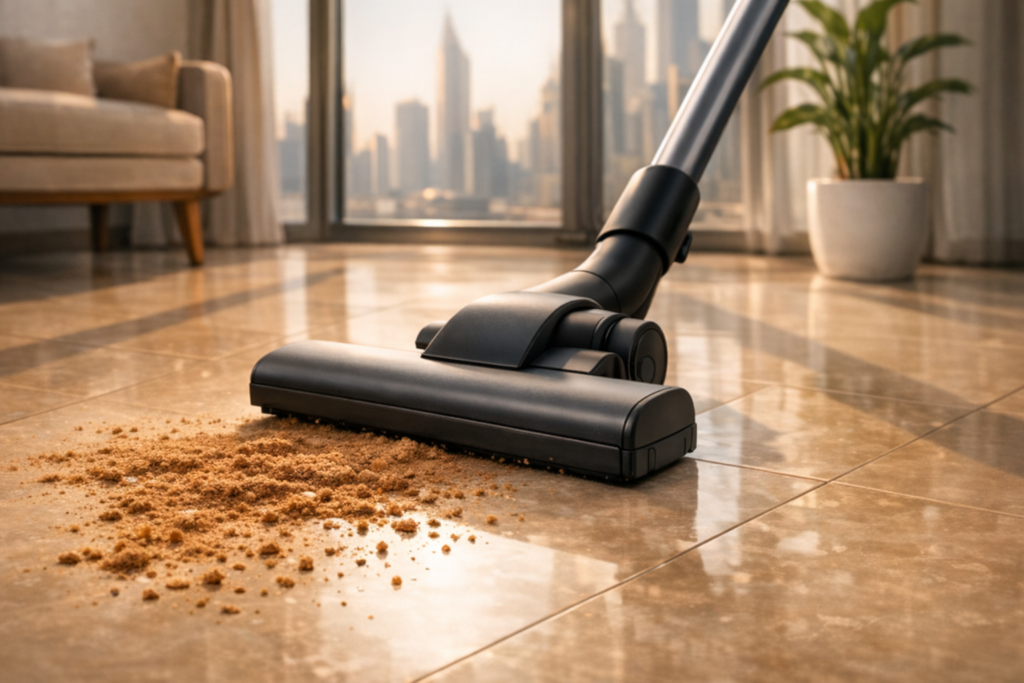
- Always vacuum before mopping – vacuuming first removes the loose particles so mopping does not push them into floor gaps and grout lines
- Clean from top to bottom – start with high shelves and furniture before moving to the floor
- Wash curtains, cushion covers, and other soft items regularly – fabric holds desert dust and releases it back into the air with every movement
Internal link: For sand on floors specifically, see how to remove sand from UAE floors
Step 3 – Use the Right Cleaning Tools
Standard cleaning tools are not designed for the fine desert particles that explain why dust builds up UAE homes so fast. The two most effective tool types for UAE conditions are HEPA vacuum cleaners and microfiber cleaning systems.
HEPA filters capture particles as small as 0.3 microns. Fine desert sand falls within this size range. A standard vacuum filter cannot trap these particles – they pass straight through the exhaust and go back into the air. A HEPA vacuum captures them instead, which makes a real difference for how to stop dust in UAE homes during daily cleaning.
Microfiber cloths and mop heads work by attracting and holding fine particles through static. This makes them far more effective than cotton or synthetic alternatives for the fine dust typical of UAE homes. Flat microfiber mop systems work especially well on the tile and marble floors found in most Dubai and Abu Dhabi apartments and villas.
Step 4 – Maintain a Daily Routine
Short, regular cleaning is more effective than occasional deep cleans for managing the UAE apartment dust problem. A daily routine of 10 to 15 minutes covering main living areas and high-traffic surfaces keeps accumulation at a manageable level and reduces how much effort each clean requires.
Table of Daily, Weekly, and Monthly Dust Control Schedule
| Task | Daily | Weekly | Monthly |
|---|---|---|---|
| Microfiber wipe of surfaces | Yes | – | – |
| Microfiber mop hard floors | Yes | – | – |
| Shake out and check entry mats | Yes | – | – |
| Close balcony doors during dust events | Yes | – | – |
| Vacuum all floors including edges | – | Yes | – |
| Wipe ceiling fans and light fixtures | – | Yes | – |
| Wipe window sills and door frames | – | Yes | – |
| Wash microfiber cloths and mop heads | – | Yes | – |
| Clean AC split-unit filters | – | – | Yes |
| Wash curtains and cushion covers | – | – | Yes |
| Vacuum upholstered furniture | – | – | Yes |
| Inspect window and door seals | – | – | Yes |
| Professional duct clean – ducted systems | – | – | Annually |
Best Tools to Stop Indoor Dust UAE Apartments Accumulate
Some product mentions may include affiliate links.

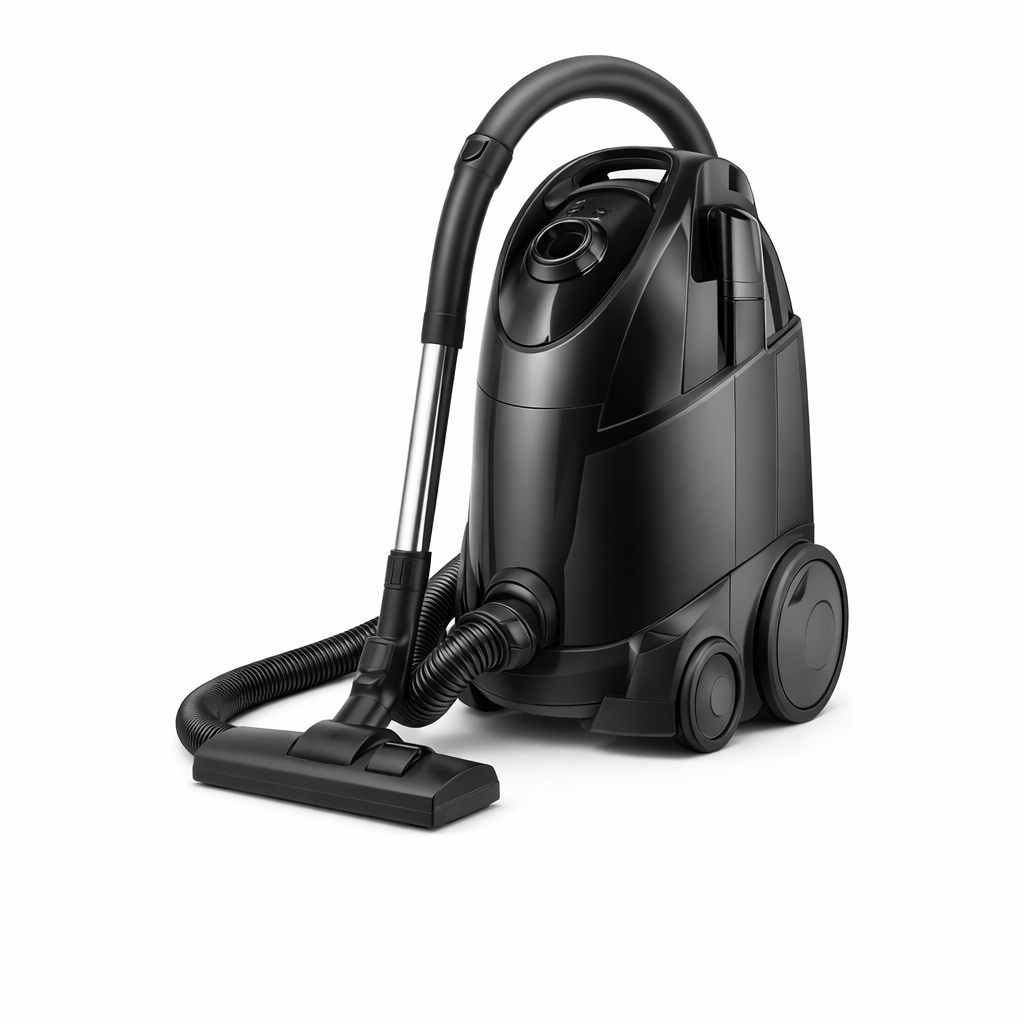
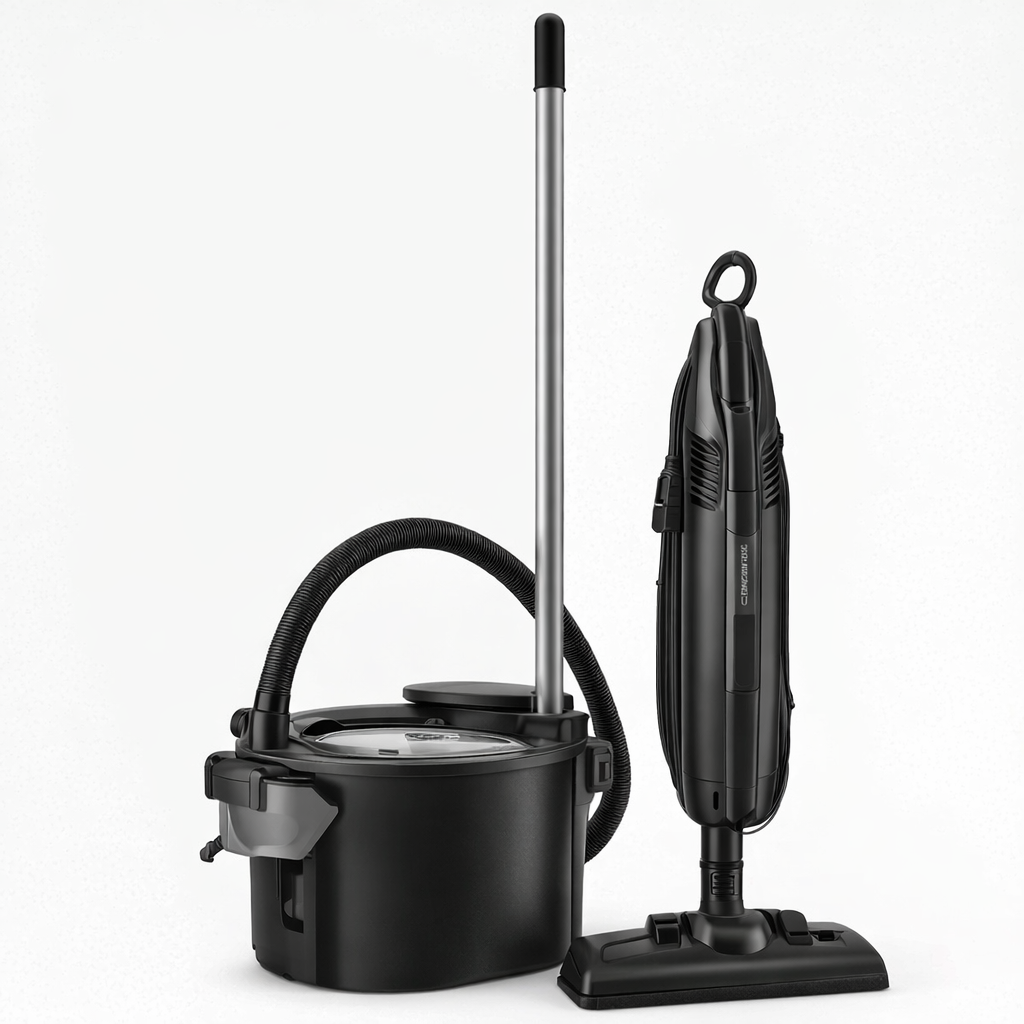
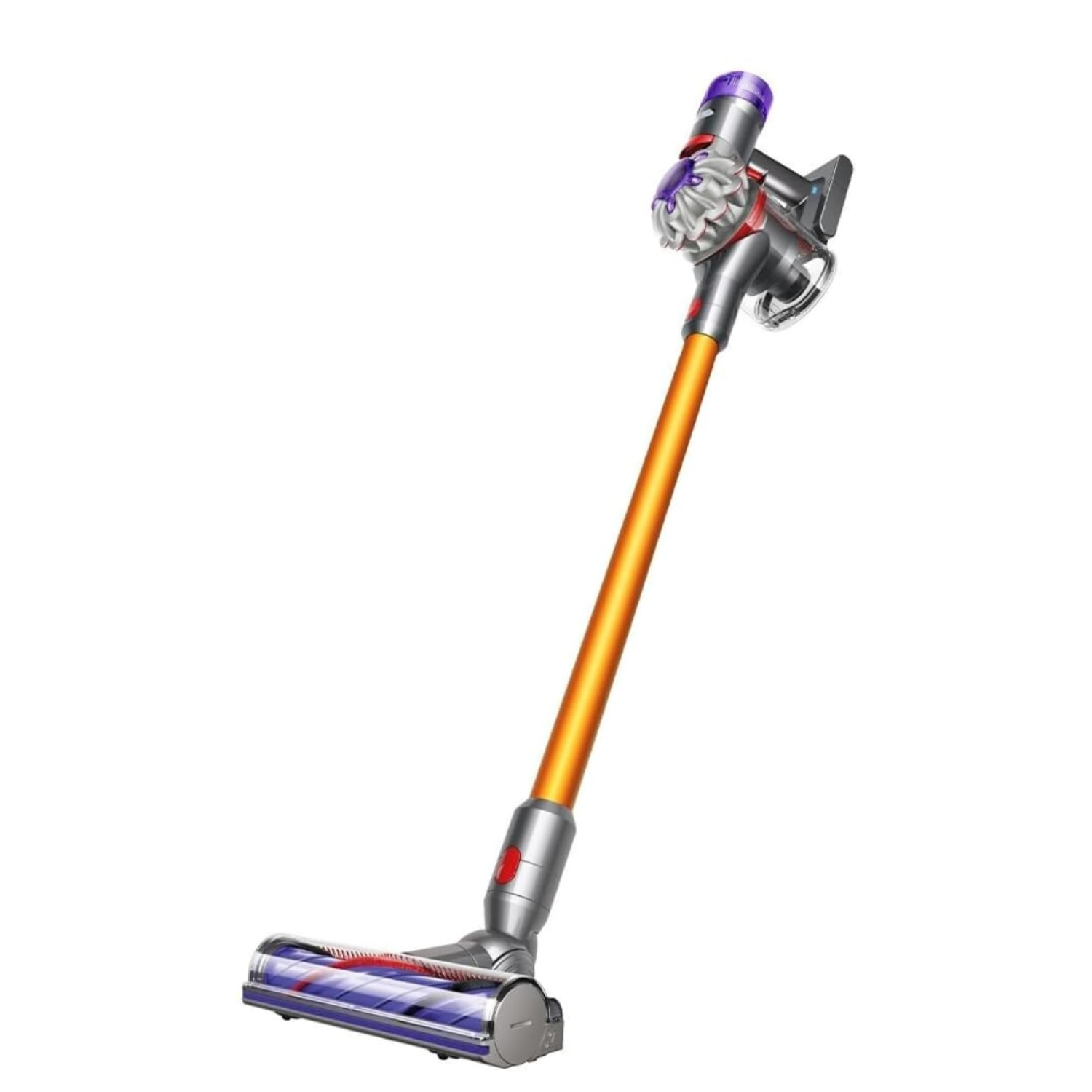
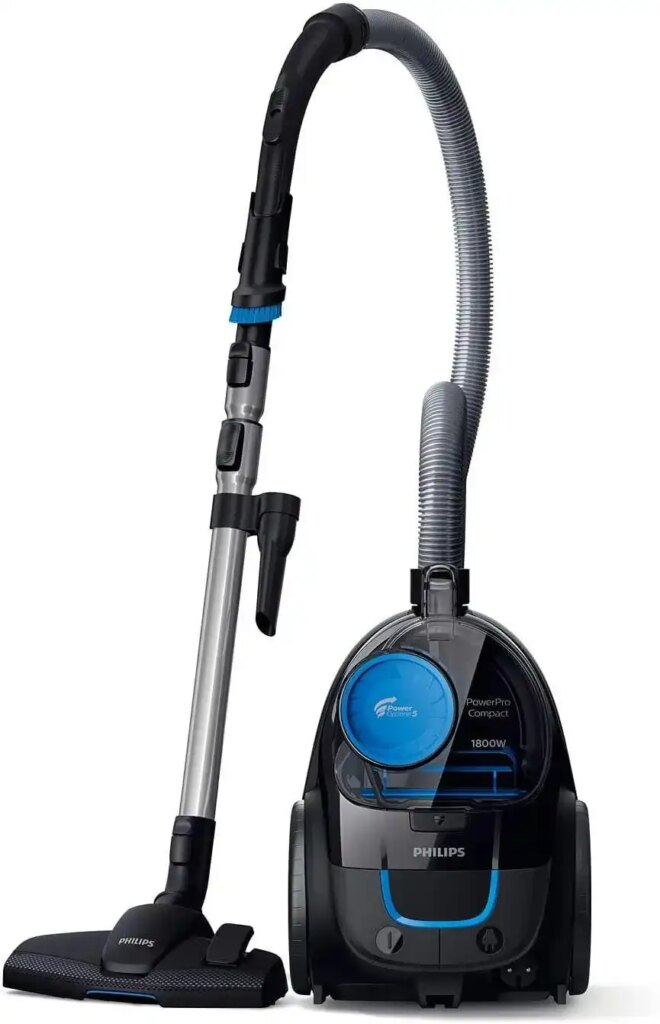
Vacuum Cleaners
HEPA vacuums trap fine dust and prevent it from recirculating into the air.
View Options →

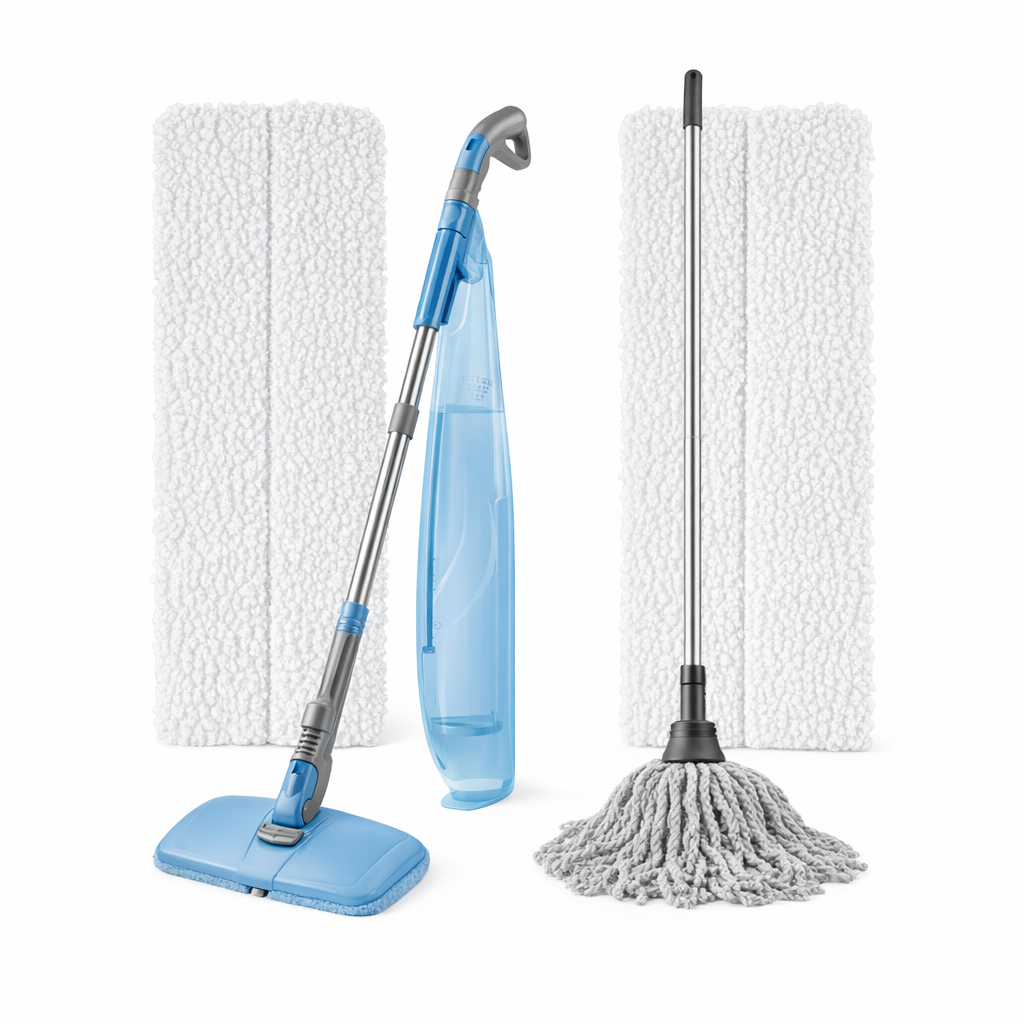
Microfiber Systems
Capture fine dust effectively without spreading particles into the air.
View Options →

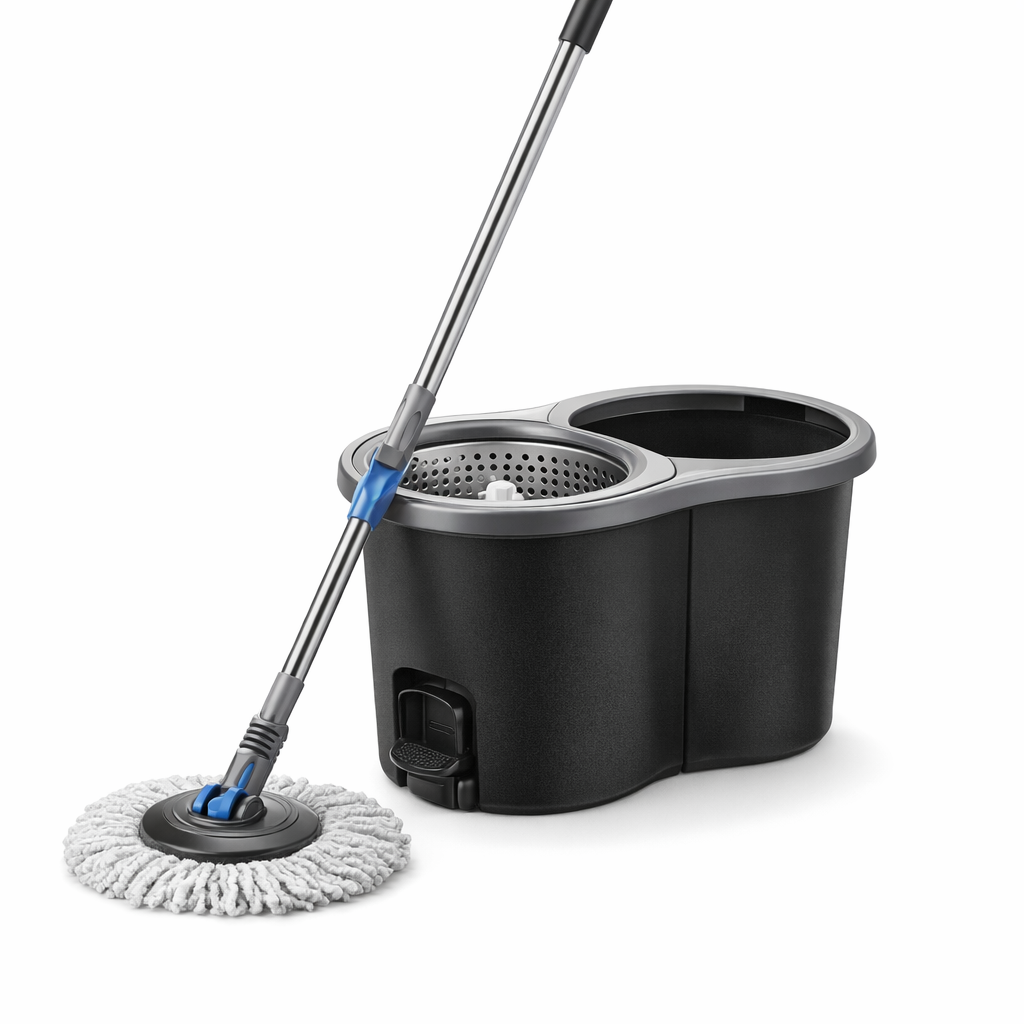
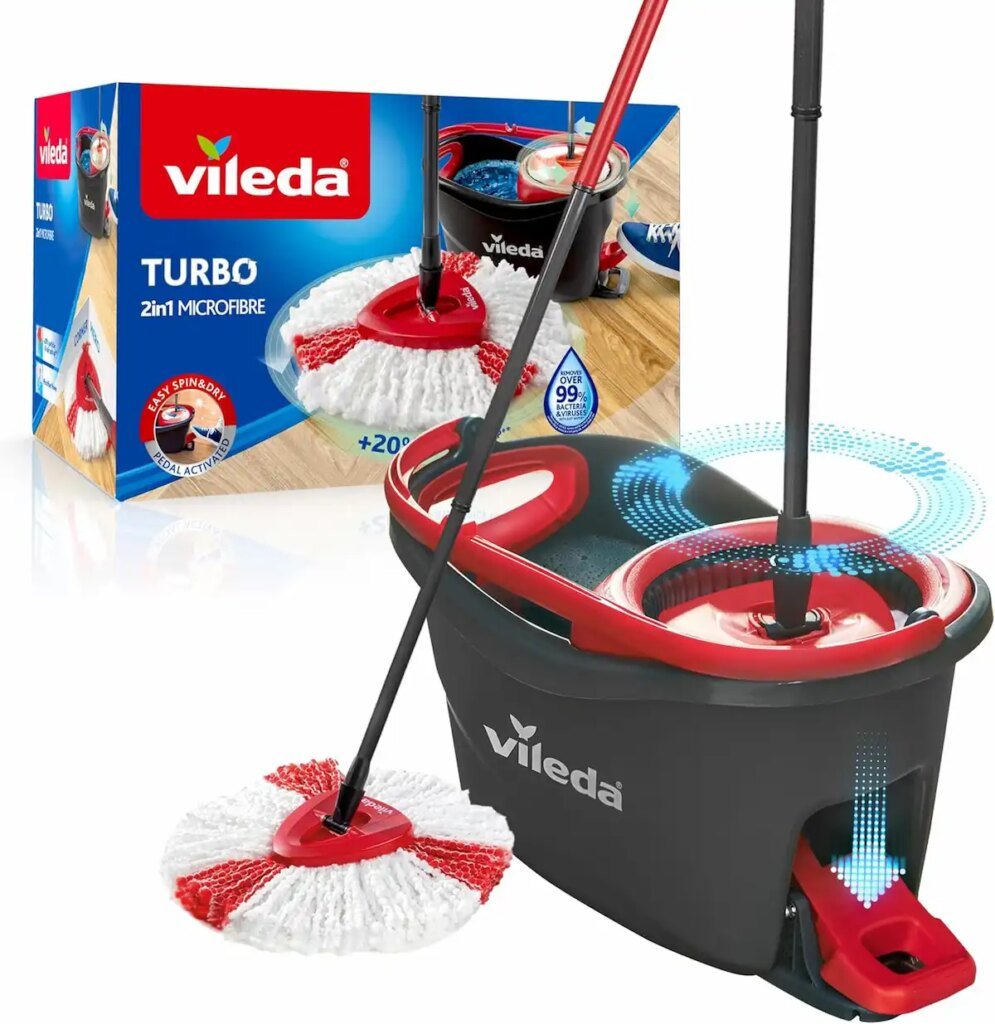
Spin Mops
Effective for removing remaining dust after vacuuming using clean water.
View Options →

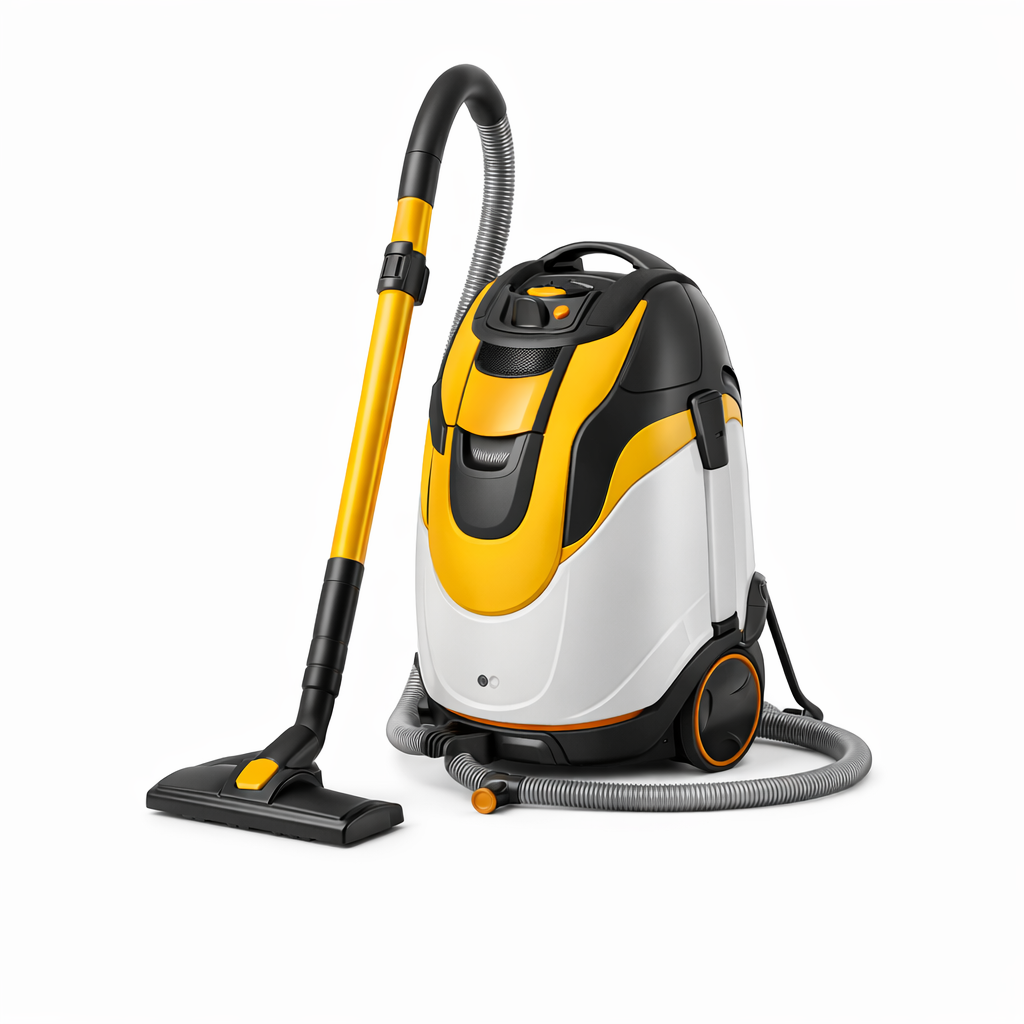
Steam Cleaners
Best for deep cleaning surfaces, not for daily dust removal.
View Options →
The tools below are commonly used to manage indoor dust UAE apartments and villas collect. Each is explained based on how well it suits UAE conditions. No personal testing claims are made.
HEPA Vacuum Cleaners
A HEPA vacuum is one of the most practical tools for how to stop dust in UAE homes. Standard vacuums can blow fine desert particles back out through the exhaust. A HEPA vacuum traps them instead. For UAE use, look for a sealed-system HEPA model – this means all the air passes through the filter with no gaps or bypasses.
Cordless models are convenient for quick daily use across multiple rooms. Bagged models are a good choice in high-dust UAE environments because the bag seals the dust when removed, rather than releasing it back into the air the way an open canister can. Browse HEPA Vacuum Cleaners on Amazon.ae.
Microfiber Cleaning Systems
Microfiber cloths and mop heads attract fine dust through static and hold it rather than pushing it across surfaces. This makes them significantly more effective than regular cotton cloths or mops for the fine desert silica that explains why dust builds up UAE homes so consistently.
Flat microfiber mop systems are well suited to the tile and marble floors common in UAE apartments and villas across Dubai, Abu Dhabi, and Sharjah. One important note – always wash microfiber without fabric softener. Softener coats the fibres and removes the static that makes microfiber effective for capturing fine dust. Browse Microfiber Cleaning Systems on Amazon.ae
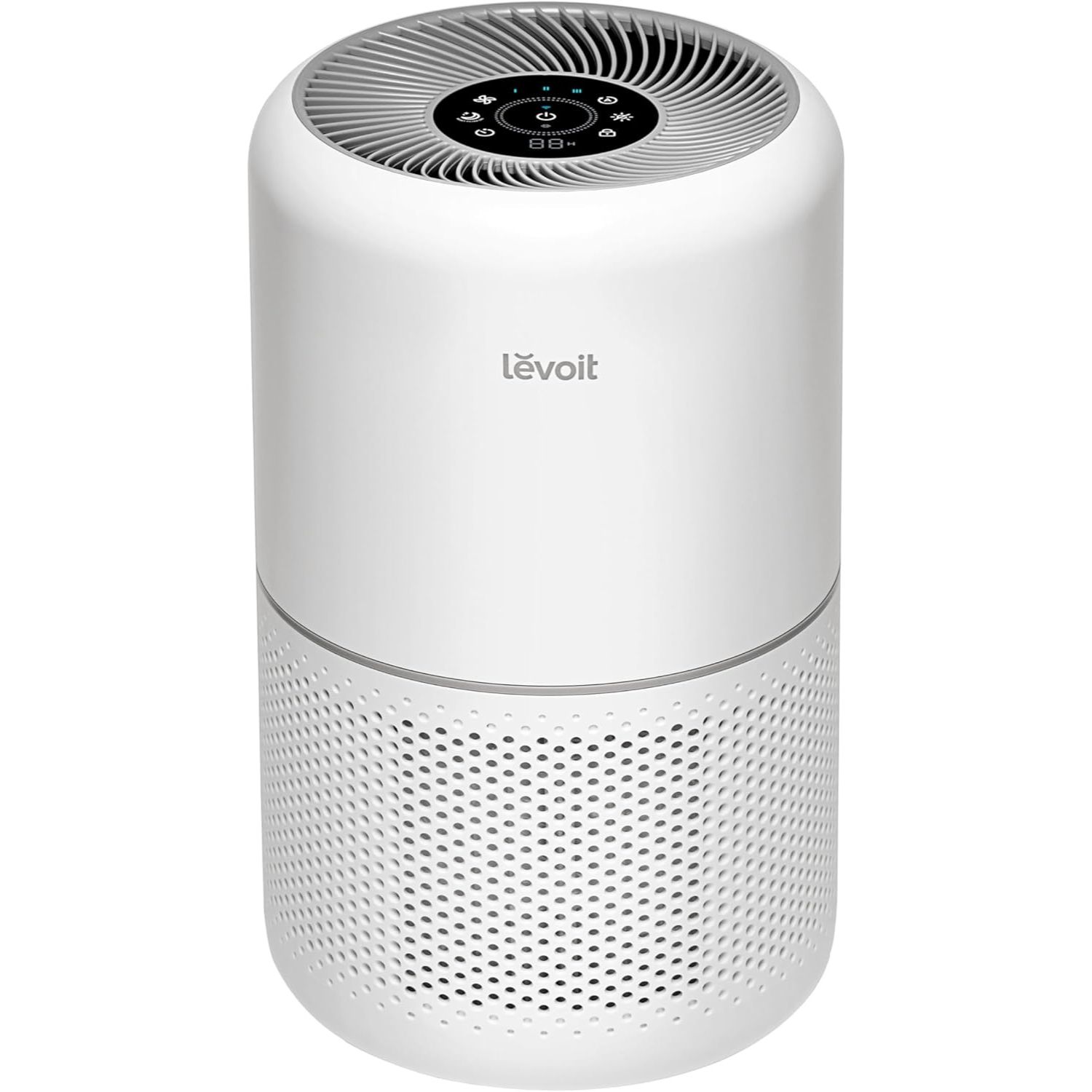
Air Purifiers with HEPA Filtration
An air purifier does not replace regular cleaning. What it does is reduce the number of fine particles floating in the air – the particles that settle on surfaces again after cleaning. In a sealed, air-conditioned UAE apartment where the AC pushes the same air around all day, a HEPA air purifier running in the background can make a noticeable difference to how quickly dust builds up.
The key is sizing. The unit needs to match the size of the room. A small purifier in a large open-plan living area will not have much effect. Check the CADR rating – this is a standard measure of how much air the unit can clean per hour – and match it to the room’s square footage. Browse HEPA Air Purifiers on Amazon.ae.
Entry Mats
Entry mats are one of the simplest and most cost-effective tools for reducing how much desert dust enters the home in the first place. A mat with a rough outer surface scrapes particles off shoes. An absorbent inner layer catches the finer dust that remains. Rubber-backed mats sit flat on smooth tile floors and are easier to lift for cleaning.
Mats need to be shaken out every day and washed once a week. A mat that is not cleaned regularly becomes full of dust and starts releasing it back into the home – the opposite of what it is there to do. Browse Heavy Duty Coir entry mats on Amazon.ae.
Table of Tool Selection Guide by UAE Home Type
| Tool | Small Apartment | Large Apartment | Villa | Budget Level |
|---|---|---|---|---|
| Cordless HEPA vacuum | Ideal | Good | Supplemental | Mid |
| Corded HEPA vacuum | Limited | Ideal | Ideal | Mid-High |
| Flat microfiber mop | Ideal | Ideal | Ideal | Low |
| HEPA air purifier up to 30m2 | Ideal per room | Per room | Per room | Mid |
| HEPA air purifier 50m2 and above | Not necessary | Ideal for open plan | Ideal for main living area | High |
| Coarse entry mat | Ideal | Ideal | Essential | Low |
| Balcony door seal tape | Recommended | Recommended | Situational | Low |
Comparison Table – Dust Reduction Methods
| Method | Best For | Pros | Cons | UAE Suitability |
|---|---|---|---|---|
| HEPA Vacuum | Floors, rugs, upholstery | Captures fine desert silica, versatile, sealed system options available | Higher cost, requires monthly filter maintenance | High – directly addresses indoor dust UAE apartments accumulate |
| Microfiber Mop | Hard floors – tile and marble | Traps dust through static, washable, low cost | Less effective on heavily textured surfaces | High – ideal for UAE apartment and villa flooring |
| HEPA Air Purifier | Airborne particles in sealed rooms | Continuously filters recirculated air | Does not clean surfaces, ongoing filter replacement cost | Medium-High – useful addition in sealed AC apartments |
| Entry Mats | Front door and balcony threshold | Low cost, stops particles at the source | Must be cleaned regularly to stay effective | High – directly targets tracked-in desert dust |
| Manual Dry Cloth | Quick surface wipes | No equipment needed | Pushes dust into the air rather than capturing it | Low – not effective for fine desert particles |
Desert Dust in Homes UAE – What Actually Works by Property Type
Why dust builds up UAE homes differently across property types is easier to understand when looking at what each type of home is dealing with.
Heat removes the option of opening windows for most of the year. From around May to October across Dubai, Abu Dhabi, and Sharjah, windows stay closed because of the temperature. The home becomes a sealed space where the AC is the only source of airflow. This makes AC filter cleaning more important in the UAE than almost anywhere else, because a dirty filter is the main thing pushing indoor dust UAE apartments collect back into the air continuously.
Dust frequency in the UAE is year-round. Shamal winds between June and September make things worse, but fine desert dust in homes UAE-wide is present in every month of the year. A daily cleaning habit is more practical and more effective than relying on occasional deep cleans.
Table of Dust Severity by UAE Home Type and Floor Level
| Living Situation | Primary Dust Source | Severity | Priority Action |
|---|---|---|---|
| Low-floor apartment floors 1-5 | Ground traffic, vehicles, landscaping | High | Entry mats, sealed doors and windows |
| Mid-floor apartment floors 6-15 | AC recirculation, corridor foot traffic | Medium-High | Monthly filter cleaning, daily microfiber routine |
| High-floor apartment floor 16 and above | Airborne fine particles, wind exposure | Medium | HEPA air purifier, window seal check |
| Villa with garden in Dubai or Abu Dhabi | Tracked garden sand, outdoor shoe contact | Medium-High | Entry mats, outdoor footwear storage, regular vacuuming |
| Villa near open land or construction | Desert wind, active construction nearby | High | All entry point controls, HEPA vacuum, air purification |
Villas in areas such as Arabian Ranches, Al Raha Gardens, or Khalifa City tend to deal with coarser sand tracked in from gardens and outdoor areas. Entry mats and regular vacuuming are the priority here. Apartments – especially on higher floors in Dubai Marina, JLT, or along Corniche Road in Abu Dhabi – tend to receive more fine airborne particles through the AC intake. Air purification and window sealing matter more in these settings. Lower-floor apartments near busy roads or active construction sites consistently show the highest indoor dust UAE apartments accumulate across all residential types.
COMMON MISTAKES TO AVOID
- Mopping without removing loose sand first
- Using the wrong tools for fine dust (non-microfiber or no HEPA vacuum)
- Cleaning too infrequently for UAE dust conditions
- Ignoring AC filter maintenance
- Leaving windows or balconies open during windy conditions
- Using dry cloths that spread dust instead of trapping it
- Using too much water, which can spread fine dust residue
Pro Tips for Reducing Dust
HVAC Maintenance Schedule For UAE Conditions
| Task | Frequency | Why It Matters |
|---|---|---|
| Wipe split-unit AC filters | Monthly | Desert particle loads clog filters faster than in cooler climates |
| Deep clean split-unit AC filters | Every 3 months | Prevents fine silica from being pushed back into the room |
| Check ducted vents for visible dust | Every 6 months | Dust builds up in ducts and gets released every time the AC runs |
| Professional duct cleaning | Annually or biennially | Important for older buildings and central AC systems across Dubai and Abu Dhabi |
| Replace HEPA air purifier filter | Per manufacturer guidance – typically 6 to 12 months | UAE dust loads shorten filter life compared to standard estimates |
Quick Dust Control Checklist
Daily
- Wipe main surfaces with a damp microfiber cloth
- Microfiber mop hard floors in living areas
- Shake out entry mats
- Keep balcony doors closed during dusty or windy conditions
Weekly
- Vacuum all floors including edges and under furniture
- Wipe ceiling fans, light fittings, and tops of appliances
- Wipe window sills and door frames
- Wash microfiber cloths and mop heads
- Wipe the front grille of the AC unit
Monthly
- Clean or replace AC split-unit filters
- Wash curtains and cushion covers
- Vacuum sofas, chairs, and mattress surfaces
- Check window and door seals for gaps or wear
- Clean behind and under large furniture and appliances
FAQs – Why dust builds up fast in UAE Homes
Why does dust build up in UAE homes so fast compared to other countries?
Why dust builds up UAE homes faster than most countries is down to fine desert silica entering continuously through AC systems, window gaps, and door seals. UAE dust contains a higher proportion of fine mineral particles than household dust in cooler climates. This makes it faster to reaccumulate and harder to control with standard cleaning methods.
Is it normal to see dust every day in Dubai and Abu Dhabi apartments?
Yes. Daily dust is a common experience for residents across Dubai, Abu Dhabi, and Sharjah. The UAE apartment dust problem is driven by environmental and structural factors – desert silica, AC recirculation, and construction activity – that continue regardless of how often individual apartments are cleaned.
Does AC make the dust problem worse in UAE homes?
Yes, when filters are not maintained on schedule. AC systems that recirculate room air without clean filters continuously redistribute fine particles rather than trapping them. This is one of the primary dust causes UAE homes face from inside and one of the most impactful things to fix for how to reduce dust UAE apartment residents deal with daily.
How do dust storms affect desert dust in homes UAE-wide?
Shamal wind events significantly increase the amount of fine particles in outdoor air. During these events, desert dust in homes UAE residents live in increases noticeably as particles push through any available gap. Keeping balcony doors and windows sealed during Shamal events is the most direct step to limit the impact on indoor dust UAE apartments collect during these periods.
Why is UAE dust finer than dust in other countries?
UAE desert dust is made up largely of fine mineral silica from the Arabian Desert. According to WHO guidelines on particulate matter, fine particles smaller than 2.5 microns stay in the air much longer than larger particles and get into indoor spaces far more easily. This is a key reason why dust builds up UAE homes at a rate that many residents moving here from abroad find surprising.
Can dust be prevented completely in UAE homes?
Complete prevention is not realistic given the constant external desert sources across the UAE. However, how to stop dust in UAE homes from reaching difficult levels is achievable through a combination of sealed entry points, monthly AC filter cleaning, daily microfiber cleaning, and a suitable air purifier.
Do air purifiers help with indoor dust UAE apartments collect?
Yes, when the unit is correctly sized for the room. Air purifiers with true HEPA filtration reduce the number of particles floating in the air in sealed, air-conditioned spaces. They address the portion of indoor dust UAE apartments hold in the air that surface cleaning cannot reach. A unit that is too small for the room will have limited effect.
How often should UAE apartments be cleaned to manage the dust problem?
Based on UAE conditions, a daily microfiber wipe and floor routine combined with weekly vacuuming and monthly AC filter cleaning is the most practical schedule for managing the UAE apartment dust problem on an ongoing basis. Occasional deep cleans alone do not break the continuous accumulation cycle.
Is dust worse near construction sites in Dubai and Abu Dhabi?
Yes. Construction activity is one of the most significant dust causes UAE homes face in developing areas. Residents near active sites in areas such as Dubai South, Saadiyat Island, Yas Island, and similar zones commonly report higher indoor dust levels. Additional window sealing and more frequent filter cleaning are practical responses for these locations.
Why do balconies increase indoor dust UAE apartments collect?
Balcony sliding doors are one of the main physical entry points for desert dust in homes UAE-wide. Even when closed, worn seals around balcony door frames allow fine silica to pass through. Balcony-facing rooms consistently collect more surface dust than interior rooms, particularly on lower floors or near construction activity.
Final Thoughts
The reason UAE homes accumulate dust so consistently has a clear answer – desert geography, sealed air-conditioned living, AC recirculation, construction activity, and shared apartment building environments all combine to create conditions where dust keeps coming back regardless of how often you clean.
The most effective approach combines monthly AC filter maintenance, entry point controls through mats and sealing, the right tools including a HEPA vacuum and microfiber system, and a short daily routine. No single step removes the problem entirely given the constant external desert dust sources across the UAE. But addressing all of them together makes the UAE apartment dust problem genuinely manageable.
For apartment residents across Dubai, Abu Dhabi, and Sharjah, AC maintenance, entry mats, and a HEPA air purifier cover the main dust causes UAE homes face day to day. Villa residents should focus on entry point control and regular vacuuming given the additional sand tracked in from outdoor areas. How to stop dust in UAE homes is not one action – it is a simple system applied consistently.
For a complete daily routine, see daily cleaning routine for UAE apartments
Sources
Content informed by guidance and data from the following organisations: UAE National Centre of Meteorology (Shamal wind events and dust storm frequency); World Health Organization – Ambient Air Quality Guidelines (particulate matter classification and PM2.5 guidance); ASHRAE – Indoor Air Quality Guidelines (HVAC filtration standards and recirculation impact); UAE Ministry of Climate Change and Environment (UAE environmental and climate conditions). All references accessed April 2026.
Desert Environment
Fine silica particles are always present in the air due to winds and surrounding desert landscapes.
Entry Points
Doors, windows, shoes, and balconies allow dust and sand to enter your home daily.
Air Conditioning Systems
AC systems circulate indoor air and can spread fine dust particles if filters are not regularly cleaned.
Indoor Air Circulation
Air movement inside apartments and villas allows dust to travel between rooms and settle on surfaces.
- Introduction
- Dust Causes UAE Homes Face
- Why Dust Builds Up UAE Homes So Fast After Cleaning
- How to Reduce Dust UAE Apartment and Villa Residents Can Follow
- Best Tools to Stop Indoor Dust UAE Apartments Accumulate
- Desert Dust in Homes UAE – What Actually Works by Property Type
- Common Mistakes To Avoid
- Pro Tips for Reducing Dust
- HVAC Maintenance Schedule For UAE Conditions
- Quick Dust Control Checklist
- FAQs – Why dust builds up fast in UAE Homes
Explore tools designed for desert dust and sandy conditions.
AED 218.00
HEPA air purifier designed to reduce fine dust in UAE homes.
AED 1,240.00
Cleaning Cloth
AED 58.99
AED 145.00
- Check AC filters regularly for dust buildup
- Inspect doors and windows for gaps
- Monitor balcony and outdoor dust exposure
- Avoid opening windows during dusty conditions
- Use entry mats to reduce sand indoors
- Identify high-dust areas (near roads or construction)
- Clean vents and air circulation points
- Track how quickly dust returns after cleaning
- Reduce fabric surfaces that trap dust
- Maintain a consistent cleaning routine