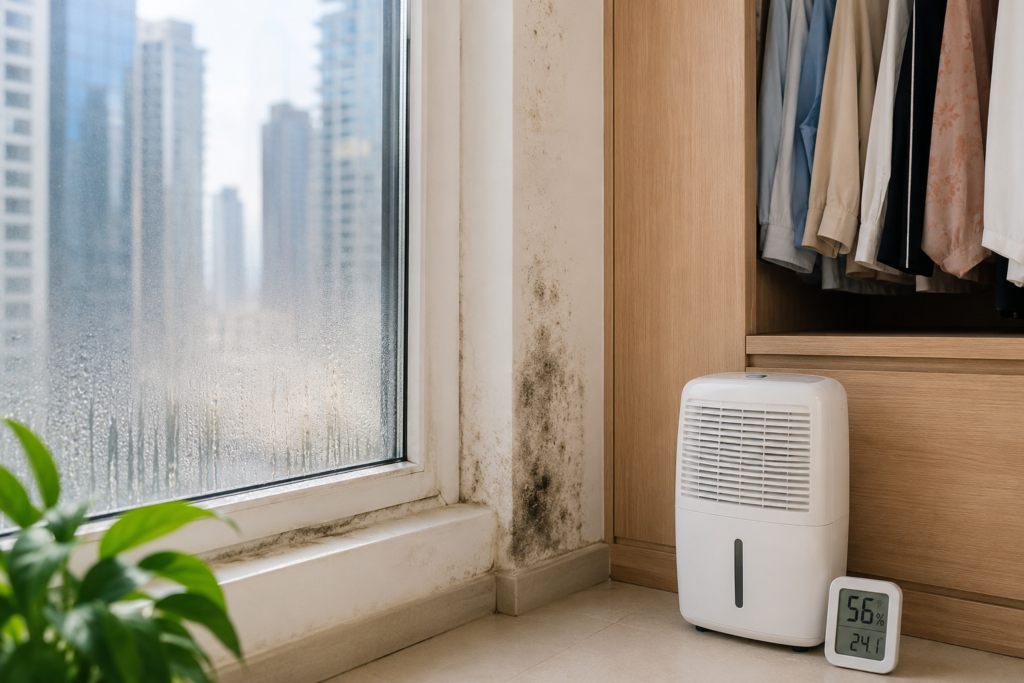
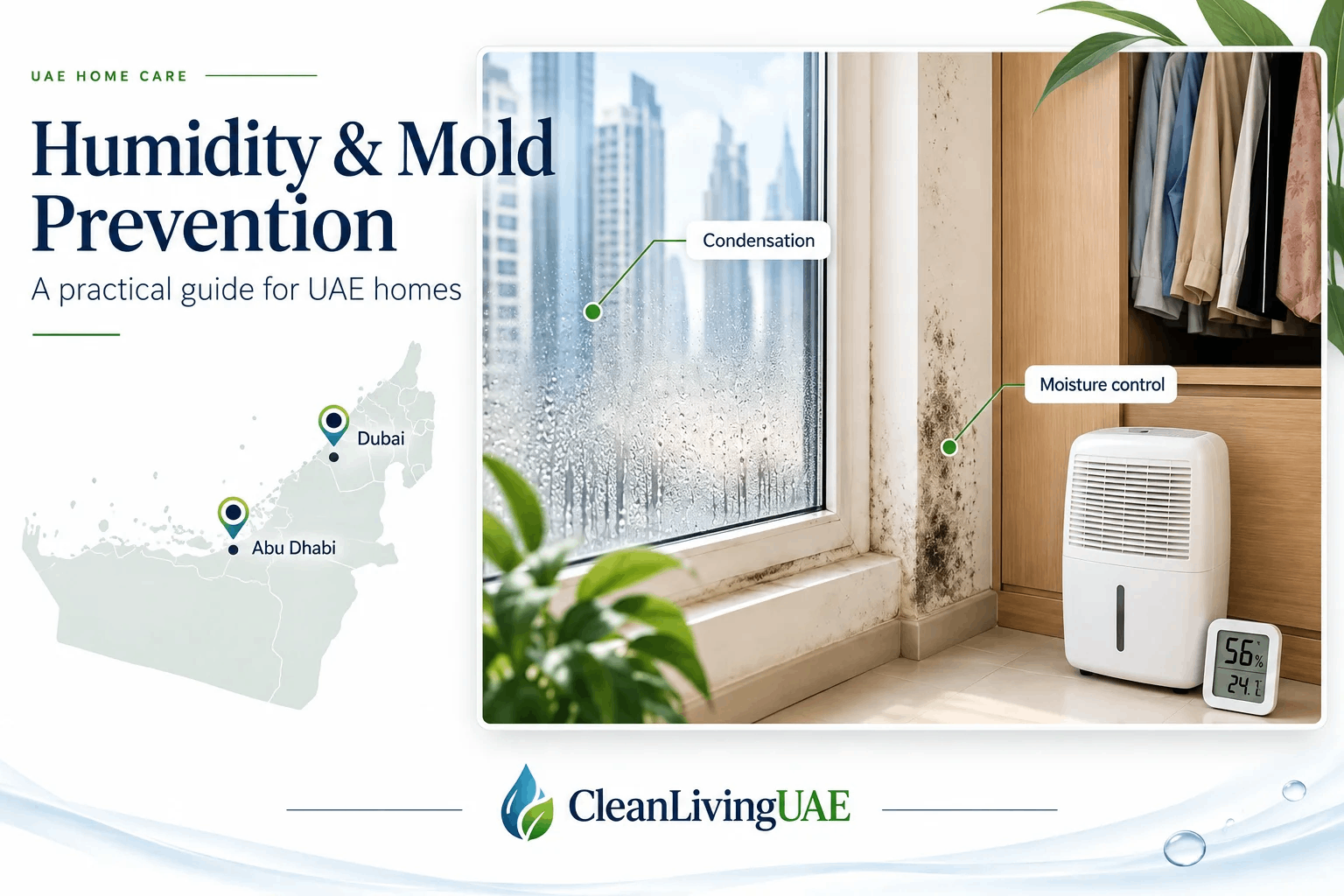
 Humidity and mold prevention in UAE homes is a year-round task. Coastal cities such as Dubai, Abu Dhabi, Sharjah, Ajman, Ras Al Khaimah and Fujairah often have high outdoor humidity, particularly on summer nights and early mornings, while inland areas such as Al Ain are generally drier but still see seasonal spikes.Inside sealed, air-conditioned apartments and villas, that moisture meets cool walls, windows and AC units. The result is a common humidity problem in Dubai and across the UAE: condensation, musty smells and mold in bathrooms, wardrobes, AC units and laundry areas.
This guide explains why moisture builds up, which humidity levels to aim for, and 11 practical ways to reduce condensation and help prevent mold in UAE apartments and villas.
If damp patches may come from plumbing or appliance leaks, the UAE water leak detector comparison explains sensors for accessible leak-prone areas. Sensors warn when water reaches their probes; they do not repair leaks or identify moisture hidden inside walls.
Humidity Problem? Start Here
Use this table to match what is visible in the home with the most likely cause and a sensible first step.
Scroll sideways to see the full table.
| What you notice | Likely issue | First action |
|---|---|---|
| Humidity consistently above 60% | Excess indoor moisture | Check ventilation and consider dehumidification |
| Mold around the shower or ceiling | Bathroom moisture staying too long | Run the exhaust fan and dry wet surfaces |
| Mold behind a wardrobe | Poor airflow and a cool exterior wall | Move the wardrobe 5-10 cm from the wall |
| Water on windows or balcony doors | Condensation | Avoid overcooling and wipe moisture away |
| Musty smell when the AC starts | Moisture, a dirty filter or a drainage issue | Check the filter and arrange an AC inspection if it persists |
| Mold returns after cleaning | Moisture source not resolved | Look for a leak, condensation or ventilation problem |
| Clothes or wardrobe smell damp | Trapped humidity | Improve airflow and measure relative humidity |
| Room feels humid despite AC | AC may not be removing enough moisture | Measure humidity before choosing a solution |

Humidity Control UAE: Measure, Diagnose, Then Choose
Use the prevention guide for moisture sources and daily habits. The supporting guides below answer different questions, so a purchase decision follows diagnosis rather than replacing it.
| Question | Next guide | What it resolves |
|---|---|---|
| Is the room humidity actually high? | Air quality monitors and humidity readings | Check that the chosen monitor measures relative humidity; compare readings over time. |
| Is the problem moisture or dust? | Air purifier vs dehumidifier UAE | Separate particle filtration from moisture removal. |
| Which moisture-control appliance fits the room? | Best dehumidifiers UAE comparison | Compare capacity, noise, drainage and storage. |
| Is Albert suitable for this use? | Stadler Form Albert UAE review | Review one model in detail after comparing alternatives. |
| Does the smell start with the AC? | Musty AC smell diagnosis | Check maintenance and drainage instead of masking odours. |
| Is visible mould already present? | Mold removal tools UAE | Consider surface suitability and when professional assessment is needed. |
A Simple Humidity Log Before Buying
Record the room, time, temperature and relative humidity before and after showers, cooking or indoor laundry drying. Keep the monitor away from direct AC airflow and follow its placement instructions. Note condensation, leaks and odours alongside readings; a room average can miss a damp surface.
Compare the same locations on more than one day. Persistent high readings suggest a moisture-control problem, while a stain near plumbing or a damp patch that returns in one location calls for investigation of a leak or building defect.
According to EPA moisture and ventilation guidance, indoor relative humidity should remain below 60%, ideally 30-50%. Outdoor ventilation should suit the weather and air quality. A fan alone does not remove water vapour, and a dehumidifier does not repair a leak or remove existing mould.
11 Practical Ways for Humidity and Mold Prevention in UAE Homes
These steps start with the lowest-cost habits and move towards monitoring and maintenance. Most can be applied in both apartments and villas.
1
Improve Bathroom Ventilation
Run the bathroom exhaust fan for at least 20-30 minutes after each shower. If the fan is weak or noisy, it may need cleaning or replacing with a higher-capacity unit, which in rented homes is usually arranged through the landlord or building management. In cooler months, opening a bathroom window during and after showering is a simple low-cost option.
Before replacing a weak or noisy fan, compare bathroom exhaust fans for UAE homes by mounting position, duct and cut-out dimensions, controls and electrical rating. Confirm whether the bathroom uses shared extraction, and obtain building approval before making changes.
2
Clean AC Filters Regularly
Clogged AC filters reduce airflow across the indoor coil, which can increase condensation and leave more moisture inside the unit. In UAE homes, filters commonly need cleaning every two to four weeks in summer. The AC filter cleaning guide UAE covers removal, washing and refitting for split units.
3
Keep Airflow Behind Furniture
Move sofas, beds, wardrobes and shelving 5-10 cm away from exterior walls. This reduces the still-air pocket where condensation forms. Even a small gap helps in UAE apartments where space is limited.
4
Avoid Drying Laundry in Sealed Rooms
When indoor drying cannot be avoided, use an exhaust fan that vents outdoors or suitable dehumidification. A portable fan moves air but does not remove moisture from a sealed room. Open windows only when outdoor conditions are suitable; warm, humid outdoor air can add moisture even when its relative humidity reading is lower than indoors.
5
Use Kitchen Extraction Consistently
Kitchen extractors work best when switched on at the start of cooking, not only when steam becomes visible. Consistent use removes moisture before it settles on cabinet undersides, walls and ceilings.
6
Wipe Condensation Promptly
Wipe condensation from windows, cold pipes and AC housings as soon as it is noticed. The US EPA advises drying damp or wet materials within 24-48 hours to help prevent mold growth. Keeping a microfiber cloth near balcony door frames, window sills and AC bases makes this a quick daily habit.
7
Reduce Clutter in Humid Spaces
Tightly packed bathrooms, under-sink cabinets and wardrobes restrict airflow and hold moisture. Reducing stored items in these zones improves circulation and leaves fewer surfaces where mold can take hold.
8
Keep Wardrobes Ventilated
Leaving wardrobe doors slightly ajar, or using louvred doors, lets air move inside and reduces moisture on the back wall. For enclosed storage, compare moisture absorbers for UAE wardrobes and cupboards, including tubs, hanging bags and sachets. These are supplementary measures for small enclosed spaces; persistent room humidity, leaks or recurring damp need investigation of the source.
9
Monitor Indoor Humidity
A basic digital hygrometer shows relative humidity and temperature, which helps spot rising moisture before mold appears. Readings that stay above 60% suggest ventilation, AC maintenance or dehumidification needs attention. Hygrometers are sold at UAE hardware stores and on Amazon.ae.
10
Dry the Shower Area After Use
A squeegee removes standing water from shower glass and tiles before it evaporates into the room. Hanging towels spread out rather than folded helps them dry faster. For grout and tile maintenance, a steam cleaner can help on sealed hard surfaces.
11
Deal With AC Drainage Problems Quickly
A blocked AC drain can cause the condensate tray to overflow inside the unit or leak into the wall. Dripping, water marks on the wall below a unit, or pooling nearby should be reported promptly. In rented UAE homes, AC maintenance responsibility is usually set out in the tenancy contract and building rules, so check the agreement and report issues in writing.

If visible mold has already developed, prevention alone may not be enough. Small surface patches can often be cleaned once the moisture is controlled, while recurring or widespread growth may need professional assessment. The guide to mold removal tools for UAE homes covers cleaning approaches and when professional help may be appropriate.
Ideal Indoor Humidity Levels for UAE Homes
Scroll sideways to see the full table.
| Humidity level | Indoor comfort | Mold risk | Recommendation |
|---|---|---|---|
| Below 30% | Very dry and potentially irritating | Very low | Unusual in UAE coastal areas |
| 30-40% | Slightly dry | Low | Acceptable, most likely in inland areas in winter |
| 40-60% | Comfortable for most people | Low to moderate | Practical target range for many UAE homes |
| 60-70% | Noticeably humid | Moderate to high | Improve ventilation and investigate persistent high readings |
| Above 70% | Uncomfortable and sticky | High | Mold growth becomes more likely if humidity stays high |
In coastal UAE homes during summer, aiming for the lower end of the range (40-50%) gives more margin against condensation. The US EPA recommends keeping indoor relative humidity below 60%, ideally between 30% and 50%, to help limit mold growth. Outdoor humidity spikes can push indoor levels up quickly when ventilation or AC maintenance is neglected.

Recommended Humidity by Room
Scroll sideways to see the full table.
| Room | Target humidity | Key risk if exceeded |
|---|---|---|
| Bedroom | 40-50% | Mattress moisture and wardrobe condensation |
| Bathroom | Below 60% once the room has dried after a shower | Grout mold, ceiling mold and silicone deterioration |
| Wardrobe | 40-50% | Fabric mold and back-panel condensation |
| Living room | 40-55% | Wall condensation behind furniture |
| Kitchen | Below 55% | Cabinet undersides, grout and ceiling moisture |
| Laundry area | Below 55% | Ceiling mold, wall corners and drain overflow |
Why Humidity Is a Problem in Dubai and UAE Homes
A humidity or moisture problem in Dubai homes usually comes from warm, humid outdoor air meeting cooler air-conditioned rooms, which causes condensation on walls, windows and AC units.
Most of the UAE’s population lives along the Arabian Gulf and Gulf of Oman coasts, where outdoor humidity is often much higher than many residents expect, particularly on summer nights and early mornings. Current and historical readings are published by the UAE National Center of Meteorology.
Sealed Buildings and Limited Ventilation
UAE residential buildings are designed to keep heat out, and windows stay closed for much of the year. Moisture from cooking, showering, breathing and laundry therefore has limited opportunity to escape, and many high-rise apartments have little natural cross-ventilation.
Temperature Difference and Condensation
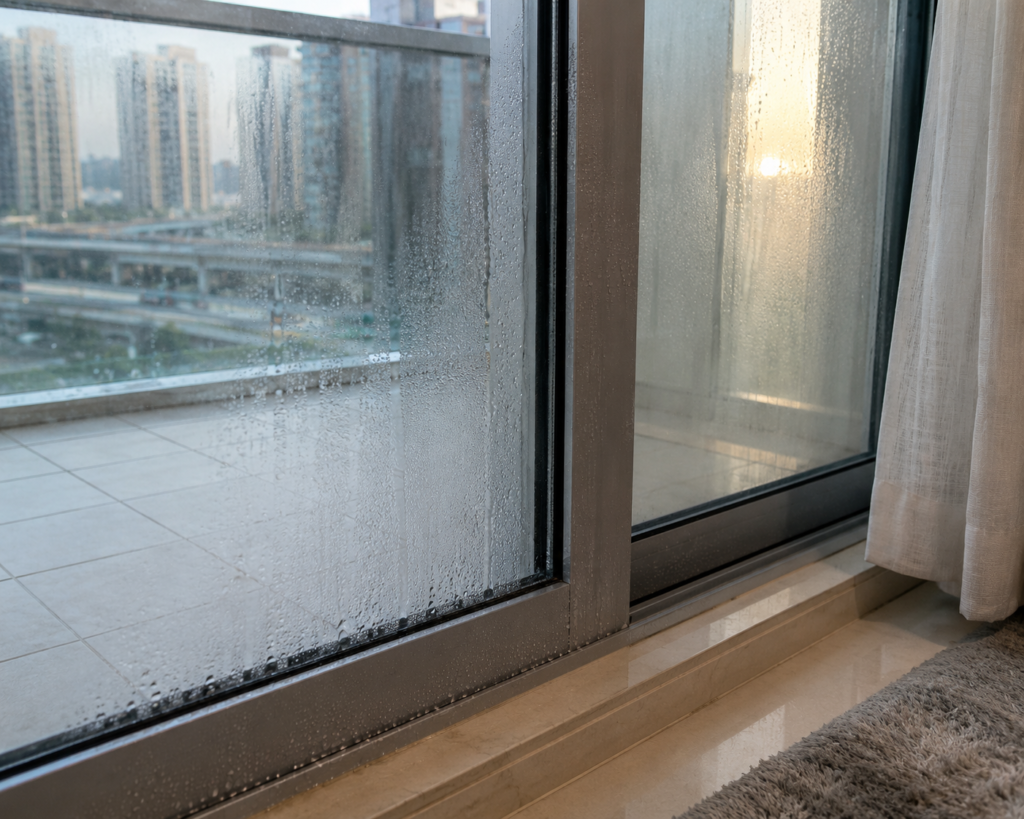
In peak summer, outdoor air above 40°C meets indoor surfaces cooled to around 22-24°C. This temperature gap is a main driver of condensation on windows, balcony door frames and exterior-facing walls in UAE apartments.
A damp smell near an AC vent does not automatically confirm mold, but repeated odours can point to retained moisture, a dirty filter or a drainage problem. The guide to musty AC smells in UAE homes explains how to narrow down the source.
Common Moisture Sources
Coastal Air Infiltration
Humid coastal air enters through balcony doors, windows and small building gaps, especially in high-rise apartments near the shoreline.
Warm Air Meeting Cool Surfaces
When hot, humid air reaches walls, windows and tiles cooled by AC, condensation can form quickly, particularly overnight and in the early morning.
Constant AC Operation
Split AC units produce condensation while they cool. A dirty filter, blocked drain or very low thermostat setting can leave that moisture inside the unit or the room.
Indoor Laundry Drying
Drying clothes in closed rooms releases a large amount of moisture into the air, especially when no fan or extraction is running.
Bathroom Steam Without Extraction
Bathrooms with weak or unused exhaust fans hold steam after showers, and moisture settles on ceilings, grout, mirrors and wall corners.
Cooking in Enclosed Kitchens
Compact apartment kitchens collect cooking steam quickly when the extractor is weak or not used consistently.
Apartment vs Villa Differences
Apartments tend to develop concentrated humidity problems because of smaller rooms, fewer exterior walls and AC systems that are sometimes controlled by building management. Villas usually offer more ventilation options and maintenance control, but larger floor areas mean more potential mold zones if moisture is not managed.
What Hygrometer Readings Can Tell You
Indoor humidity changes with the season, the time of day and household activity. Rather than relying on typical figures, it helps to compare readings in the same room at different times and look at the pattern.
Scroll sideways to see the full table.
| Situation | What readings often show | What to check |
|---|---|---|
| Summer, coastal apartment, no active control | Readings staying above 60% for long periods | AC filters, drainage, extraction and whether a dehumidifier is needed |
| Cooler months with windows opened daily | Readings usually closer to the comfortable range | Keep ventilating and use the season for deep cleaning |
| Bathroom straight after a shower | A sharp rise that should fall within 30-60 minutes | Fan performance if readings stay high |
| Bedroom with AC running overnight | Moderate readings, with condensation possible on cold glass | Thermostat setting and window condensation in the morning |
| Room used for drying laundry | Readings rising well above the rest of the home | Use a fan or extraction while clothes dry |
| Wardrobe on an exterior wall | Higher readings than the room around it | Gap behind the wardrobe and door ventilation |
If a room stays above 60% most of the day despite ventilation and AC maintenance, extra dehumidification is worth considering.
How Mold Develops in UAE Apartments and Villas
Mold needs moisture, a surface to grow on and a suitable temperature. Indoor temperatures in UAE homes suit mold growth all year, so moisture is the factor residents can control most directly. Mold commonly appears:
- On bathroom ceiling corners and grout lines
- Inside wardrobes and on the back panels of cabinets against exterior walls
- Around AC vents and filter housings
- Behind washing machines and under kitchen sinks
- On balcony door frames, window seals and rubber gaskets
- In shoe cabinets and storage areas with poor airflow
Dust and household residue on surfaces can provide organic material for mold once moisture is present, which is one reason regular dusting matters in UAE homes.
Note: The US EPA suggests that mold covering more than about 10 square feet (roughly 1 square metre) may need professional help. Mold on porous materials such as plasterboard, carpet or mattresses is harder to remove fully, and self-cleaning is best limited to small areas on hard, non-porous surfaces.
Common Signs of a Humidity Problem
- Condensation on windows or mirrors that does not clear within about 30 minutes
- A persistent musty or earthy smell in rooms, wardrobes or storage areas
- Dark spots on walls, ceilings, grout or silicone seals
- Warping or swelling of wooden furniture, doors or skirting boards
- White powdery deposits (efflorescence) on tiles or walls near balcony doors
- Peeling paint or wallpaper, particularly on exterior-facing walls
- Some residents also report stuffiness or allergy-like symptoms indoors; health concerns should be discussed with a medical professional
Most Common Mold Areas in UAE Homes
Bathrooms
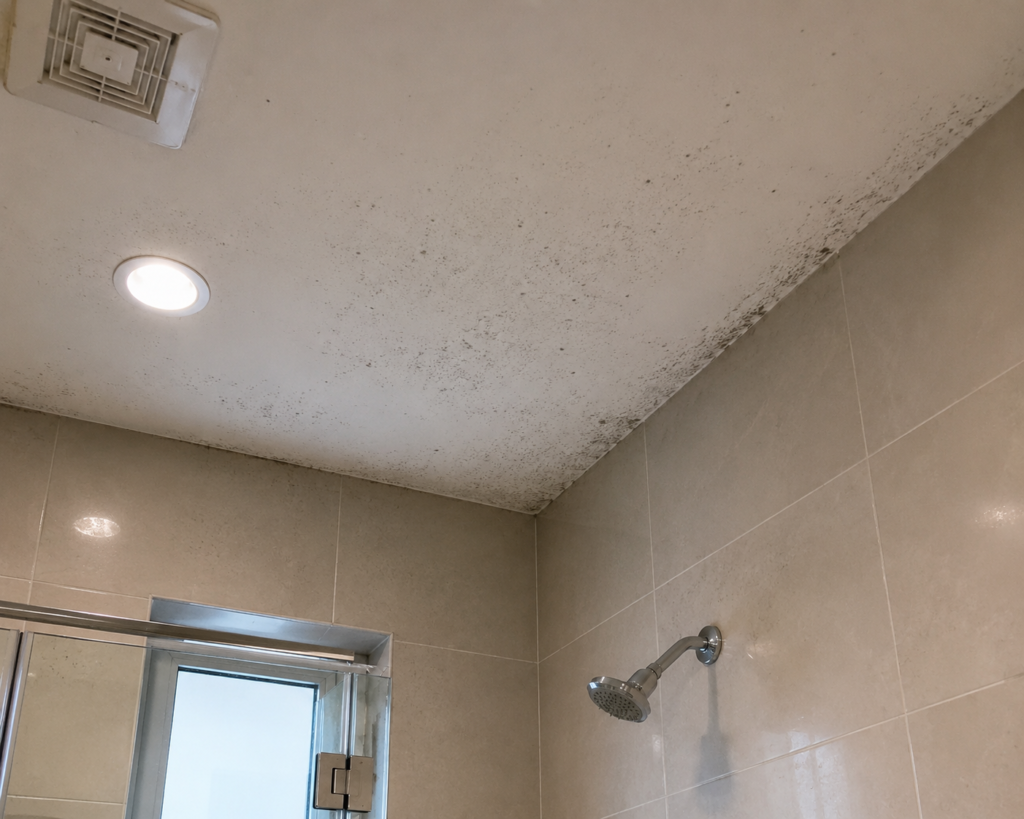
Hot showers create steam quickly in compact spaces. Grout lines, ceiling corners, behind toilets, under-sink cabinets and the silicone around shower trays are common starting points. Ceiling spots that appear or spread after summer are often reported in coastal UAE apartments.
Wardrobes
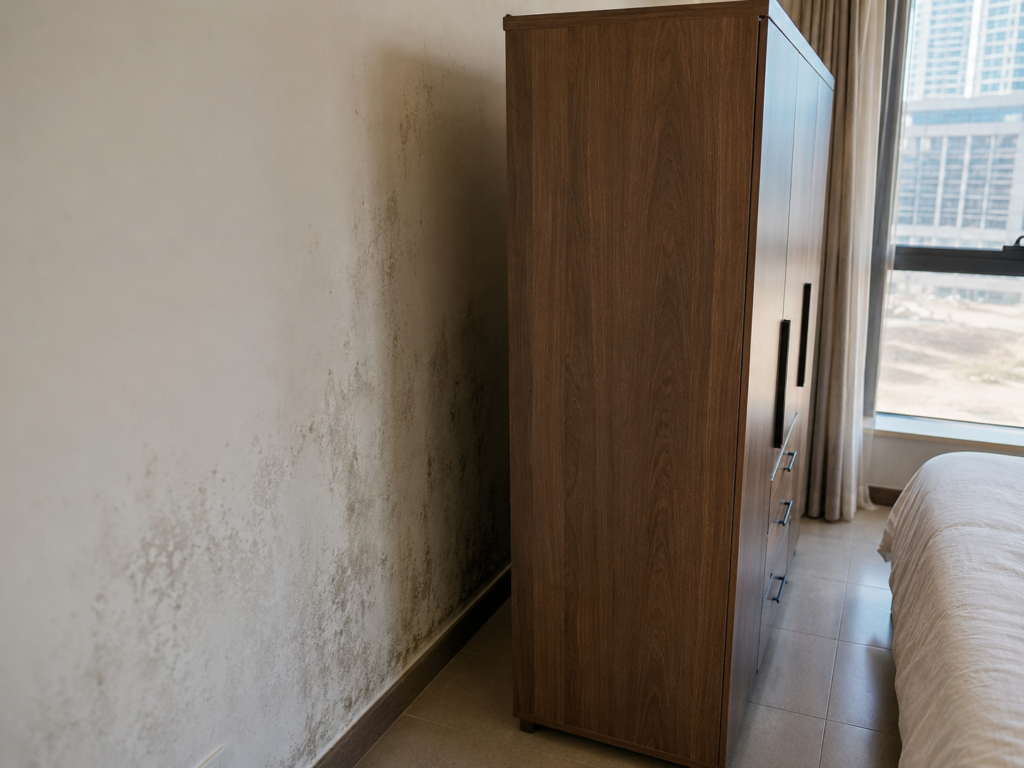
Wardrobes against exterior-facing walls stay cooler than the room, so condensation can form on the wall behind them. Moisture then transfers to clothing and the back panel. A musty smell from clothes after returning from a summer trip is often the first sign residents notice.
Behind Furniture
Sofas, beds and shelving pushed against exterior walls trap still air where condensation forms. This is one of the most overlooked mold locations and is often found only when furniture is moved.
AC Vents and Units
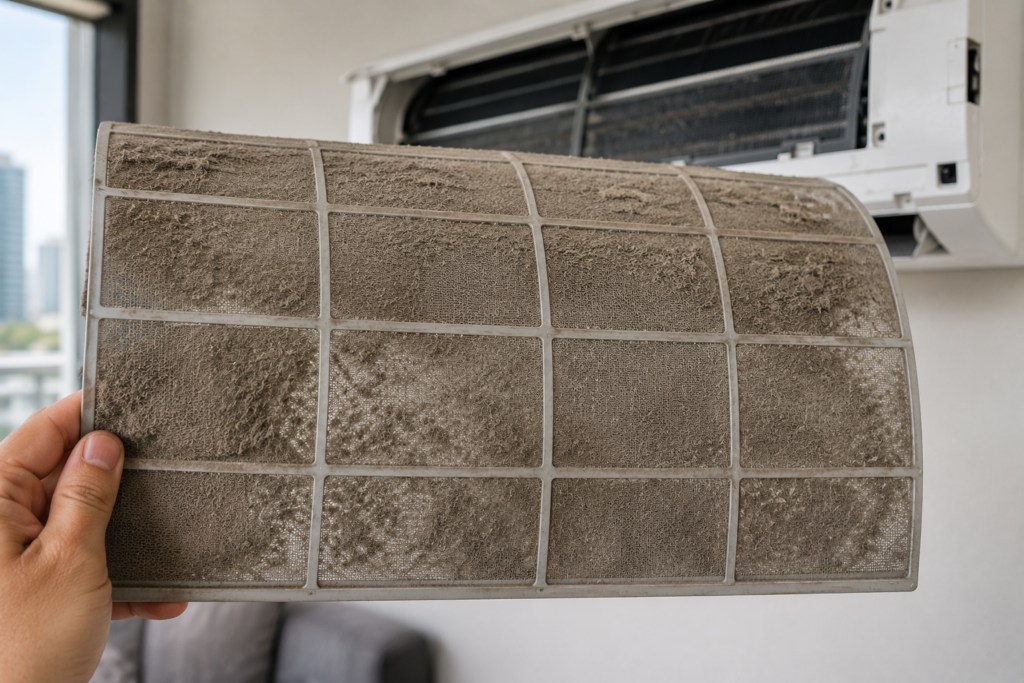
Blocked AC drainage lets condensation collect inside the unit. Mold on the coil or internal housing can then release spores into the room when the unit runs. A musty smell at start-up can indicate retained moisture, drainage problems, dirty components or possible mold growth.
Kitchens
Enclosed apartment kitchens with weak or unused extractors collect steam on walls, cabinet undersides and ceilings. Limescale from hard water can leave rough deposits on tiles and grout that hold moisture longer. Moisture around a fridge door seal can add to residue and smells, although the source is often food or a hidden spill; see the guide to checking hidden fridge smell sources.
Laundry Areas
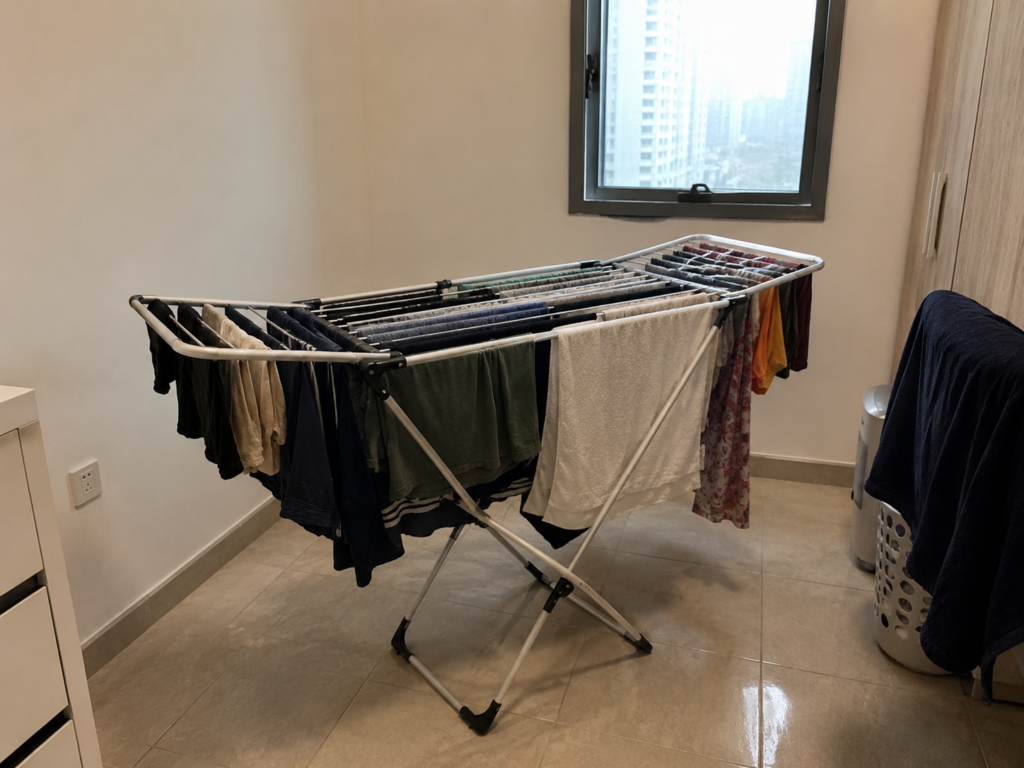
Indoor laundry drying raises local humidity noticeably. Without extraction, laundry rooms and bathrooms used for drying often develop mold in wall corners and on ceilings above drying racks.
Window Frames
Condensation collects in sliding window tracks overnight, particularly on lower floors and in coastal buildings. Moisture mixed with dust and mineral deposits in these channels can support mold even with regular surface cleaning.
Bathroom Mold Prevention UAE
Bathroom condensation control combines daily habits with periodic maintenance.
Grout Cleaning and Resealing
Grout is a common starting point for bathroom mold. Cleaning with a grout brush and a suitable bathroom or mold cleaner removes surface growth, and applying a penetrating grout sealer once dry can make grout less absorbent. Follow the product label and ventilate the room while cleaning.
Shower Ventilation Habits
Switching the exhaust fan on before the shower starts helps remove steam before it saturates the room. Where there is no fan, leaving the door open with a portable fan pushing air out gives partial ventilation. In cooler months, opening a window during showering is a practical natural option.
Silicone Sealant Inspection
Silicone around baths, shower trays and vanity units can crack or separate over time. Checking it every six months and replacing it when gaps or dark staining appear helps stop water getting behind tiles. For mineral marks on tiles and glass, see the hard water stains UAE guide.
Hard Water and Exhaust Fan Maintenance
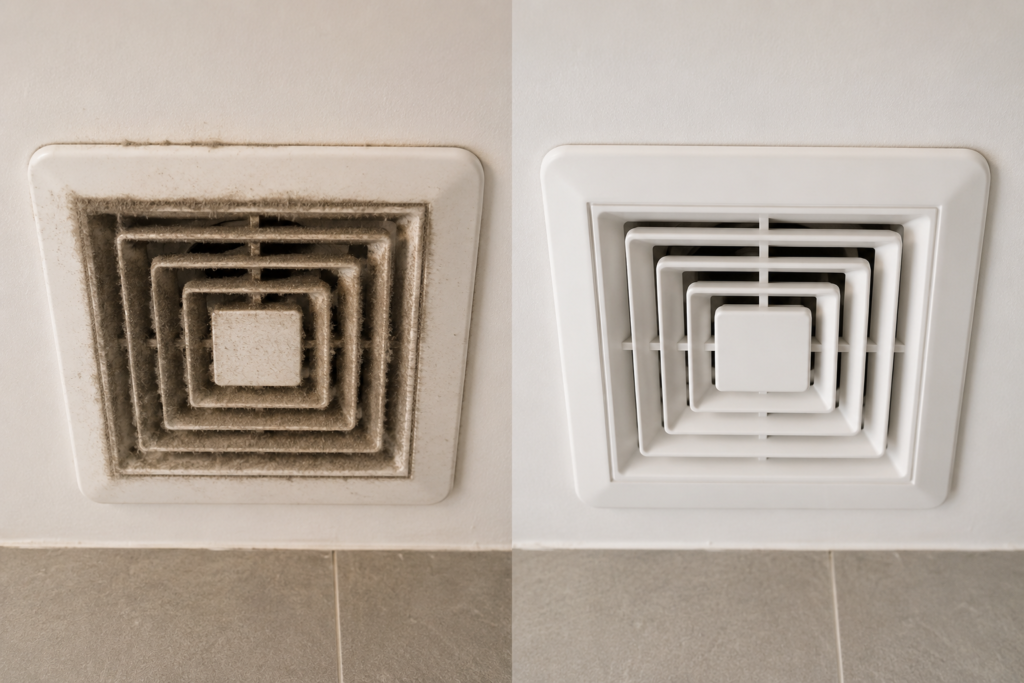
UAE tap water can leave calcium and magnesium deposits on tiles and grout, creating rough surfaces where moisture clings longer. Regular descaling reduces this buildup; the guide to limescale removal solutions in the UAE compares options. Bathroom exhaust fan grilles collect dust quickly in UAE homes and are worth cleaning monthly to maintain extraction.
AC and Humidity Problems in UAE Apartments
AC units remove some moisture as a by-product of cooling, but they are not designed as dehumidifiers. Moisture problems often start when maintenance is neglected.
Dirty Filters and Overcooling
A clogged filter reduces airflow over the coil, which can increase condensation beyond what the drain handles. Very low thermostat settings (below about 20°C) widen the gap between cooled surfaces and humid air. Settings around 22-24°C are commonly recommended as a balance between comfort and condensation.
Blocked Drainage and Musty Smells
AC drain lines collect dust, biological growth and scale. A musty smell when the unit starts may indicate mold on the coil or blower wheel. Accessible surfaces can be wiped, but coil and drain cleaning is usually a job for an AC technician. Some manufacturers offer a fan-only or self-dry mode that helps dry internal parts after cooling; check the unit’s manual.
Humidity Imbalance Between Rooms
Cooling only the bedrooms while other areas stay closed and unventilated can create condensation where humid and cool air meet. Ceiling or portable fans that move air between rooms reduce local moisture build-up. The indoor air quality UAE guide covers airflow and ventilation in more detail.
Wardrobe and Bedroom Moisture Prevention
Wardrobes on Exterior Walls
Wardrobes on external walls can collect condensation on the back panel because of the temperature difference between the cooled room and the warmer building envelope. Over time, moisture can warp MDF panels and allow mold in corner joints. Keeping a gap behind the wardrobe and using louvred or partly open doors are two of the simplest preventive measures.
Clothing and Mattress Care
Store only fully dry clothing, as slightly damp items add moisture to nearby garments. Breathable storage bags suit seasonal clothing. For mattresses, a breathable protector, regular rotation and leaving the bed uncovered for a short time in the morning help body moisture evaporate.
Apartment vs Villa Humidity Problems UAE
Scroll sideways to see the full table.
| Factor | Apartment | Villa |
|---|---|---|
| Natural ventilation | Limited; windows may face shared areas | Greater; cross-ventilation possible in cooler months |
| Outdoor exposure | Balcony is the main outdoor zone | Several outdoor areas; garden moisture can affect ground-floor rooms |
| Humidity build-up speed | Faster due to smaller volume and concentrated sources | Slower overall, although individual rooms can behave similarly |
| Airflow between rooms | Often limited in compact layouts | Usually better where layouts allow air movement |
| AC system control | Sometimes centrally controlled by building management | Individual units with more owner or tenant control |
| Most common mold areas | Bathrooms, wardrobes on external walls and window frames | Ground-floor bathrooms, utility rooms and covered outdoor areas |
| Maintenance responsibility | Shared between tenant, landlord and building management, depending on the contract | Usually the owner or tenant, depending on the contract |
Signs You May Need a Dehumidifier
These signs suggest that ventilation habits alone may not be enough:
- Condensation on windows or balcony door frames most mornings, regardless of AC settings
- Wardrobe contents smell damp even with doors left open
- Bathroom moisture lingers well after showering with the fan running
- The home feels sticky or heavy through the day even with AC running
- Mold returns to grout or window frames within a few weeks of cleaning
- Hygrometer readings stay above 60% in the bedroom or living area
Where these signs are present, a portable dehumidifier in the most affected room can support ventilation during humid months. The best dehumidifiers UAE guide covers capacity, placement and running costs for apartments and villas.
7 Humidity Mistakes That Can Make Mold Worse in UAE Homes
Scroll sideways to see the full table.
| Mistake | Why it causes problems | Better approach |
|---|---|---|
| Switching the AC off completely when away in summer | Indoor heat and humidity rise, and rapid re-cooling can cause condensation on surfaces | Leave the AC on a higher setting, such as 26-28°C, instead of switching it off |
| Setting the AC very low | Very cold surfaces attract condensation from humid air | Keep settings around 22-24°C where comfortable |
| Pushing furniture against exterior walls | Traps still air and allows condensation behind furniture | Keep a 5-10 cm gap behind furniture on exterior walls |
| Never opening windows in cooler months | Misses one of the lowest-cost ventilation opportunities of the year | Ventilate daily in cooler months when outdoor humidity is lower |
| Ignoring bathroom moisture after showers | Persistent surface moisture is a common cause of bathroom mold | Run the exhaust fan and squeegee shower walls after each use |
| Not checking AC drainage | A blocked drain can overflow inside the unit, with damage hidden for months | Check below indoor units monthly for drips or water marks |
| Drying laundry in a sealed room | Wet laundry releases moisture that concentrates quickly | Run an exhaust fan or portable fan while laundry dries |
Tools That Support Humidity and Mold Prevention
Some product mentions may include affiliate links.
The most useful tools depend on the room. Bathrooms usually need condensation control, wardrobes need moisture absorbers, and larger villas may need stronger dehumidification.
Hygrometers
A hygrometer measures relative humidity and temperature. Checking readings in several rooms gives a clearer picture than a single device. Options are available on Amazon.ae and at UAE hardware stores.
Dehumidifiers
Portable dehumidifiers extract moisture from room air and are rated in litres per day. Smaller units often suit single rooms in apartments, while villas and storage rooms may need higher capacity. See the best dehumidifiers UAE comparison.
Moisture Absorbers
Passive absorbers using silica gel or calcium chloride suit wardrobes, shoe cabinets and under-sink areas. Rechargeable versions are more economical for ongoing use.
Squeegees and Microfiber Cloths
Removing water from shower walls, mirrors and window frames promptly is a low-cost prevention step. See the guides to shower squeegees and microfiber cloths.
Air Purifiers
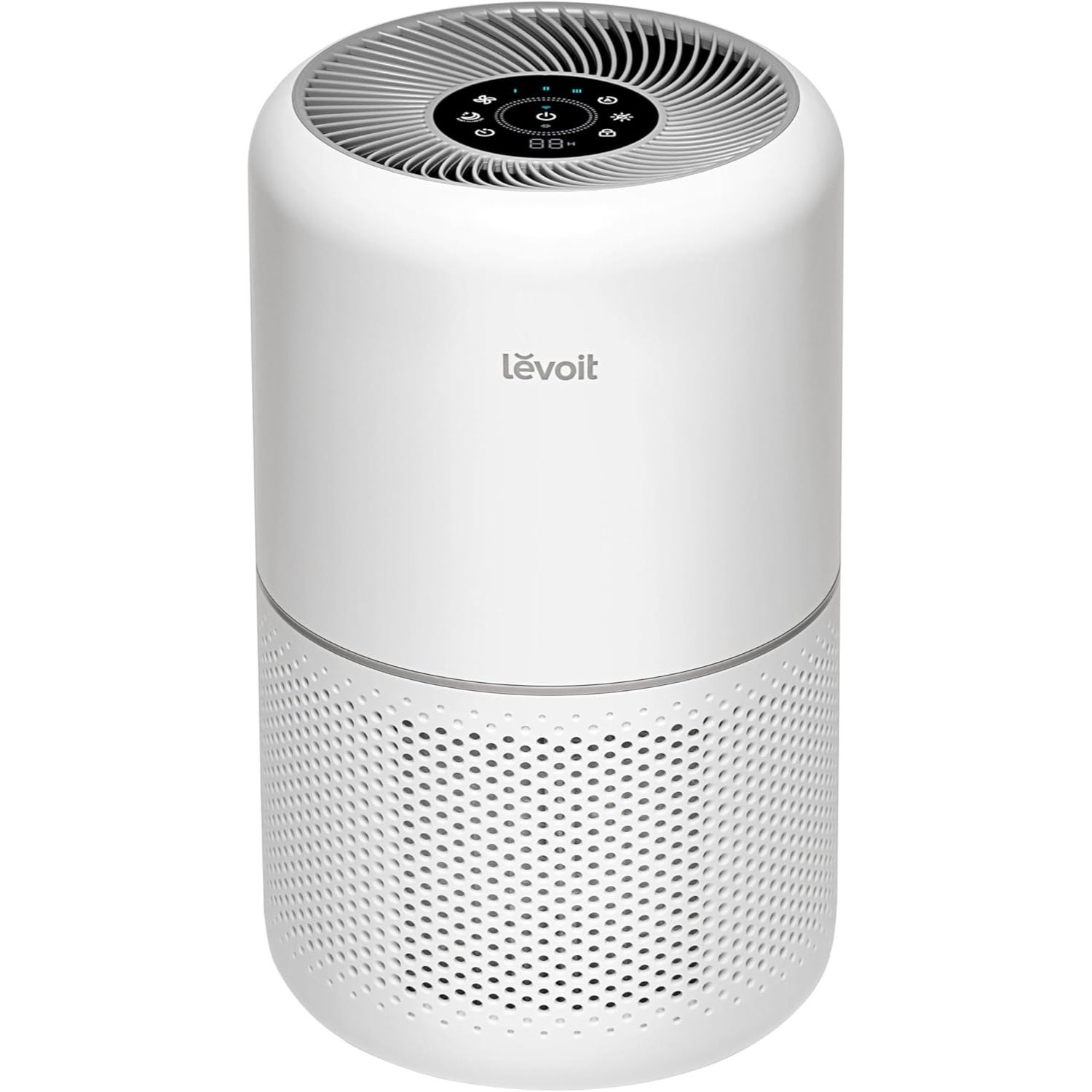
A HEPA air purifier can capture airborne particles, including some mold spores, but it does not reduce moisture. See best air purifiers UAE and the air purifier vs dehumidifier guide.
Steam Cleaners
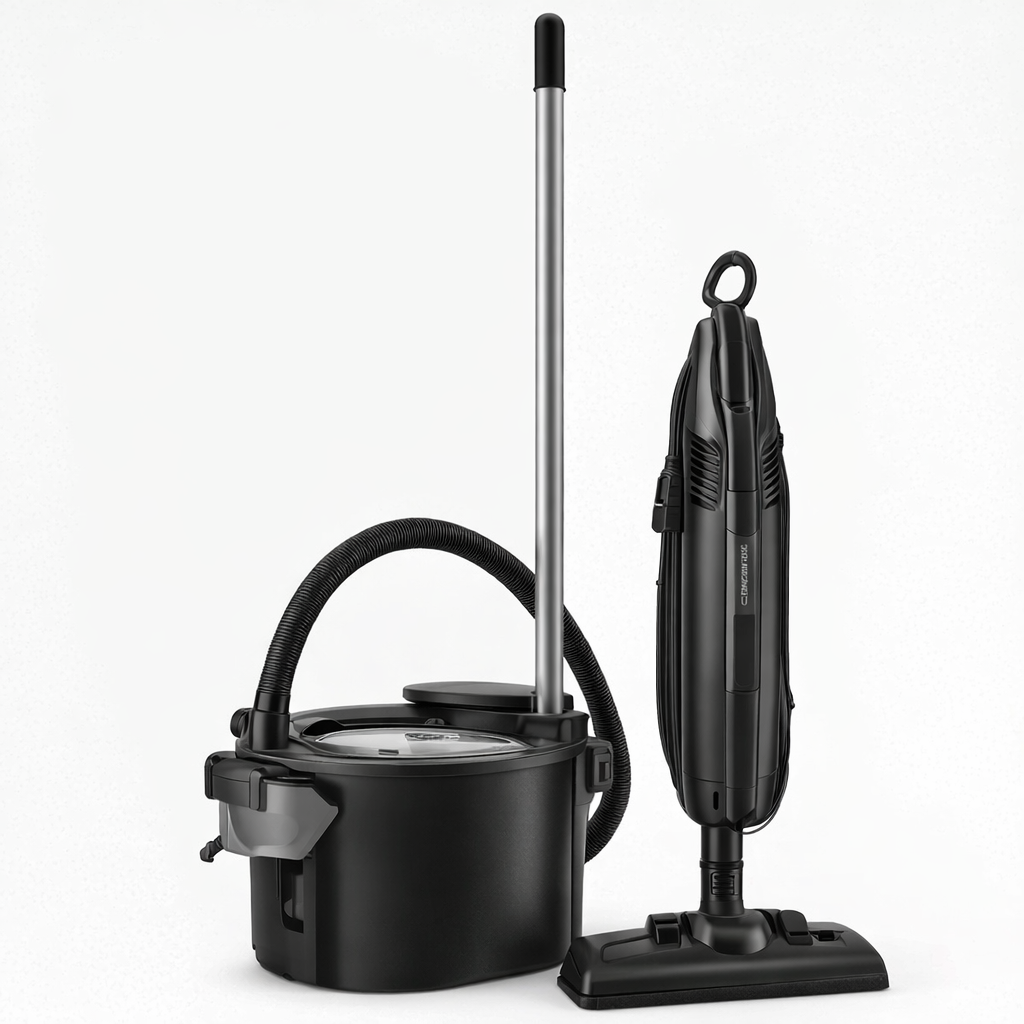
Steam can help clean grout, silicone and tiled surfaces with surface mold. It is not suitable for soft furnishings, painted walls or structural mold. See best steam cleaners UAE.
Mold Removal Products
Products formulated for surface mold on hard, non-porous materials should be used with ventilation and suitable gloves, following the label. See the mold removal tools guide.
Exhaust Fan Cleaning Tools
A soft brush or vacuum brush attachment clears dust from fan grilles. Internal motor cleaning is best left to a maintenance technician. See best bathroom cleaning tools UAE.
Summer Humidity Checklist for UAE Homes
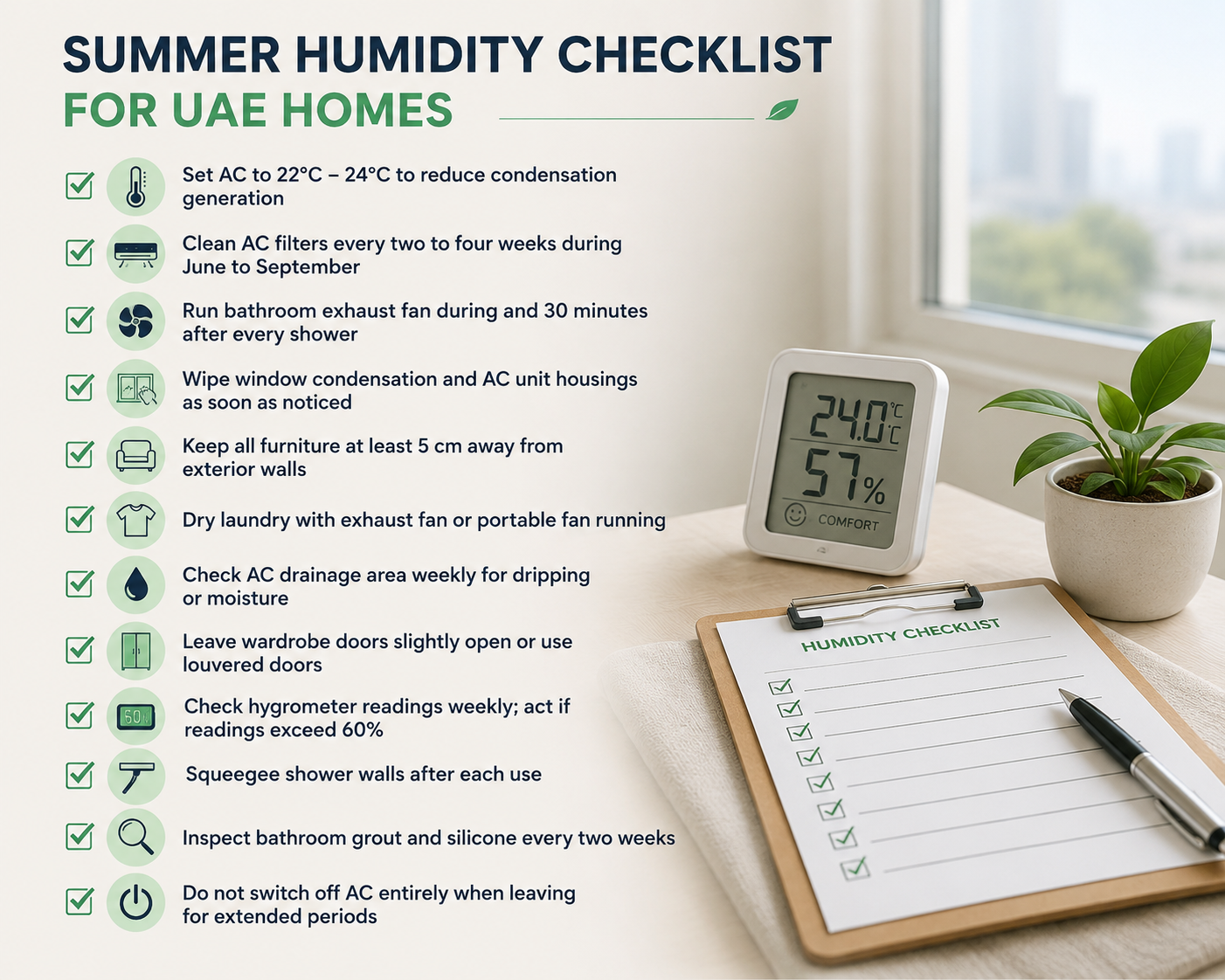
Download a printable copy of the checklist to keep on the fridge or in a utility cupboard.
Quick Moisture Reset for UAE Apartments
When moisture has built up noticeably, with musty smells, condensation on balcony door frames or a sticky indoor feel, this sequence helps bring conditions back under control.
- Ventilate: Open windows for 10-15 minutes if outdoor conditions allow (most practical in cooler months or early morning) and run all exhaust fans.
- Wipe condensation: Dry visible moisture from window frames, sills, wall corners and behind furniture with a microfiber cloth, starting with bathrooms and kitchens.
- Check AC filters: Remove the filters, wash them if clogged, let them dry fully and refit them.
- Dry the bathroom: Squeegee the glass, wipe shower walls, spread towels out to dry and run the exhaust fan for 30 minutes.
- Improve airflow: Move furniture a few centimetres away from exterior walls and open internal doors so air can circulate.
Seasonal Moisture Timeline for UAE Homes
Scroll sideways to see the full table.
| Season | Main problem | Recommended action |
|---|---|---|
| Summer (June-September) | Peak coastal humidity, AC condensation and overcooling | Clean AC filters every 2-4 weeks, keep AC around 22-24°C and check drainage monthly |
| Autumn transition (October-November) | Interiors retain summer moisture | Start ventilating more and inspect wardrobes and bathrooms |
| Winter (December-February) | Temperature swings can cause occasional condensation | Ventilate daily, deep clean grout and check window seals |
| Spring (March-May) | Dusty, windy periods keep windows closed and AC use rises | Run AC with clean filters, check drainage and door and window seals |
| Humid spells (year-round) | Very humid nights can cause morning condensation | Wipe windows and sills and monitor indoor humidity |
When to Call a Professional
Prevention and surface cleaning suit many household humidity and mold situations. Professional assessment is sensible when:
- Mold covers more than about 1 square metre
- Mold returns within a few weeks of cleaning, suggesting an ongoing moisture source
- Mold affects soft furnishings, mattresses, plasterboard or structural surfaces
- Water damage, staining or dampness is spreading through walls or ceilings
- AC units keep leaking or dripping despite filter cleaning
- A strong musty smell persists with no visible source
- Anyone in the home is more vulnerable, such as young children, older adults or people with respiratory conditions
In UAE rental properties, responsibility for structural moisture and AC repairs is usually set out in the tenancy contract. Tenants can document dampness, persistent mold on exterior walls and AC drainage faults with photos and report them in writing to the landlord or building management.
Conclusion
Humidity and mold prevention in UAE homes works best as a year-round routine, with extra attention from June to September. Regular AC maintenance, consistent extraction, prompt condensation removal and monitoring with a hygrometer address most moisture sources in apartments and villas. Where mold is extensive, keeps returning or affects porous materials, professional assessment is the appropriate next step.
For related guides, see the cleaning guides UAE hub, best dehumidifiers UAE, best air purifiers UAE, indoor air quality UAE and the air and dust control UAE hub.
Frequently Asked Questions About Humidity and Mold in UAE Homes
What is the ideal indoor humidity level for UAE homes?
A relative humidity between 40% and 60% is a commonly recommended range. In coastal areas during summer, aiming for 40-50% gives more margin against condensation. The US EPA recommends keeping indoor humidity below 60%, ideally 30-50%.
Why does mold keep coming back in a UAE bathroom after cleaning?
Recurring mold usually means the moisture source has not been fixed. Common causes include weak or dusty exhaust fans, cracked silicone that lets water behind tiles, and surfaces left wet after showers. Improving ventilation and sealing is more effective than repeated cleaning.
Does turning off the AC when leaving home cause humidity problems?
Switching the AC off for long periods in hot, humid weather lets indoor temperature and humidity rise. When the home cools again, condensation can form on windows, walls, vents and AC parts. A moderate setting while away helps reduce large swings.
How often should AC filters be cleaned to prevent humidity problems?
In UAE conditions, filters commonly need cleaning every two to four weeks in summer and after dusty or sandy periods. The why dust builds up in UAE homes guide explains how dust affects indoor systems. Clean filters maintain airflow and reduce excess condensation inside the unit.
What causes condensation on apartment windows in Dubai?
Condensation forms where warm, humid air meets glass cooled by AC. It is most common in coastal buildings and on lower floors. Avoiding very low AC settings and wiping condensation promptly are the main corrective steps.
Is mold inside AC units common in UAE homes?
Mold inside split AC units is often reported where units are not cleaned regularly or drains are blocked. Washing the filter and wiping accessible surfaces is usually within resident maintenance, while coil and drain cleaning is best handled by an AC technician.
Can drying laundry indoors cause mold in UAE apartments?
Wet laundry releases a lot of moisture. In a closed apartment without ventilation, this raises humidity noticeably and can contribute to mold on nearby walls. Running an exhaust fan or portable fan while clothes dry reduces the effect.
Which areas of a UAE villa are most prone to mold?
Ground-floor bathrooms, utility and laundry rooms, covered outdoor areas and rooms with little sun or airflow are common problem zones. Rooms that are rarely used or kept closed can also build up moisture unnoticed.
How can wardrobe mold be prevented in a UAE apartment?
Keep a 5-10 cm gap between the wardrobe and any exterior wall, use louvred doors or leave doors slightly open, store only fully dry clothing and add moisture absorbers inside. Checking the back panel every few months helps catch problems early.
When should UAE residents call a professional for mold?
Professional help is appropriate when mold keeps returning after cleaning and ventilation improvements, covers more than about 1 square metre, comes back through fresh paint, affects porous materials, or when water marks appear on walls or ceilings without a visible source.
Sources
- World Health Organization: WHO guidelines for indoor air quality: dampness and mould
- US Environmental Protection Agency: A brief guide to mold, moisture and your home
- UAE National Center of Meteorology: weather and climate information
- AC manufacturer maintenance guidance for filter cleaning, drainage checks and ventilation
Guidance in this article is general and based on public health and environmental sources. It is not a substitute for a professional inspection where mold is extensive or recurring.