Quick Signs Your UAE Home Needs Better Dust Prevention
- Dust returns to surfaces within 24 hours of cleaning
- Balcony door tracks fill with sand quickly between sessions
- AC vents show grey or brown buildup on the cover grille
- Sticky dust films appear on tiles and glass during humid months
- Floor corners and skirting boards collect fine debris within days
Why Dust Builds Up So Quickly in UAE Homes
Understanding the sources of indoor dust is the first step in applying prevention effectively. UAE homes experience several compounding factors that most other climates do not.
Desert Fine Particulate Exposure
The UAE sits adjacent to some of the largest sand and dust-producing landscapes in the world. Fine particulate matter from the Arabian Desert, including particles below 10 microns in diameter, is small enough to pass through standard window seals and air gaps. Unlike coarser sand, these particles remain airborne for extended periods and settle across every horizontal surface indoors. Wind events accelerate this process dramatically, but even on calm days, background particulate levels are elevated compared to non-desert regions. The UAE National Center of Meteorology monitors and publishes dust and particulate activity data that residents can use to assess outdoor conditions before ventilating.
Construction Dust in Urban Areas
Dubai, Abu Dhabi, Sharjah, and other UAE cities continue major construction and infrastructure activity. Sites near residential towers and villa communities generate significant amounts of cement dust, silica particles, and disturbed ground-level dust that travel into nearby homes. Residents in areas with active construction within a 1-2 kilometre radius often report noticeably higher indoor dust levels than those in established neighbourhoods, per commonly shared resident observations.
High AC Dependence and Recirculation
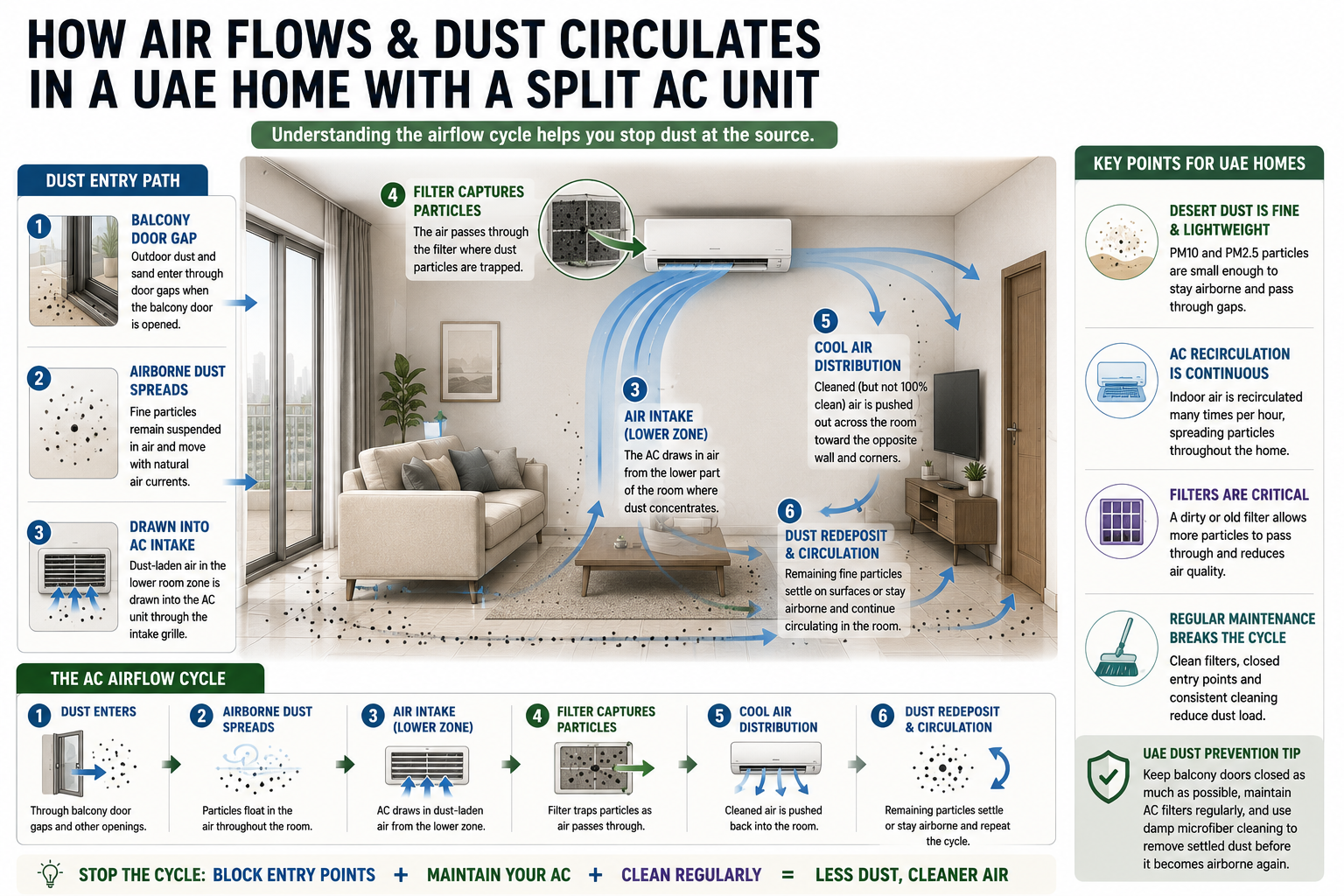
UAE homes operate air conditioning systems for the majority of the year. Unlike homes in temperate climates where windows can be opened freely, UAE residents rely on closed-loop AC systems that continuously recirculate indoor air. When AC filters are not maintained consistently, the system redistributes fine particles throughout every room it serves. Split AC units draw air from the room, pass it across the filter, and return it – meaning any particles that bypass or accumulate near the unit are effectively spread wider over time.
Reducing the amount of fine dust entering the home can also reduce the buildup reaching AC filters and grilles. If the system already produces a damp or stale odour, follow the guide to musty AC smells in UAE homes.
Humidity Causing Sticky Dust Buildup
Coastal areas of the UAE, particularly during summer months from June through September, experience humidity levels that can exceed 80 percent. When fine dust particles combine with moisture in the air, they become adhesive and bond to surfaces more aggressively than dry dust. This is particularly visible on tiles, glass surfaces, and AC vent covers, where a thin film of compacted dust can develop within days. This sticky layer is harder to remove than loose dry dust and makes prevention even more important during summer months.
UAE Dust Prevention Tip: The World Health Organization’s air quality guidelines identify fine particulate matter (PM2.5 and PM10) as a primary indoor and outdoor air health concern. UAE residents in desert-adjacent locations are exposed to elevated background particulate levels year-round, making consistent indoor prevention habits especially relevant to long-term air quality management.
Balcony and Entryway Transfer
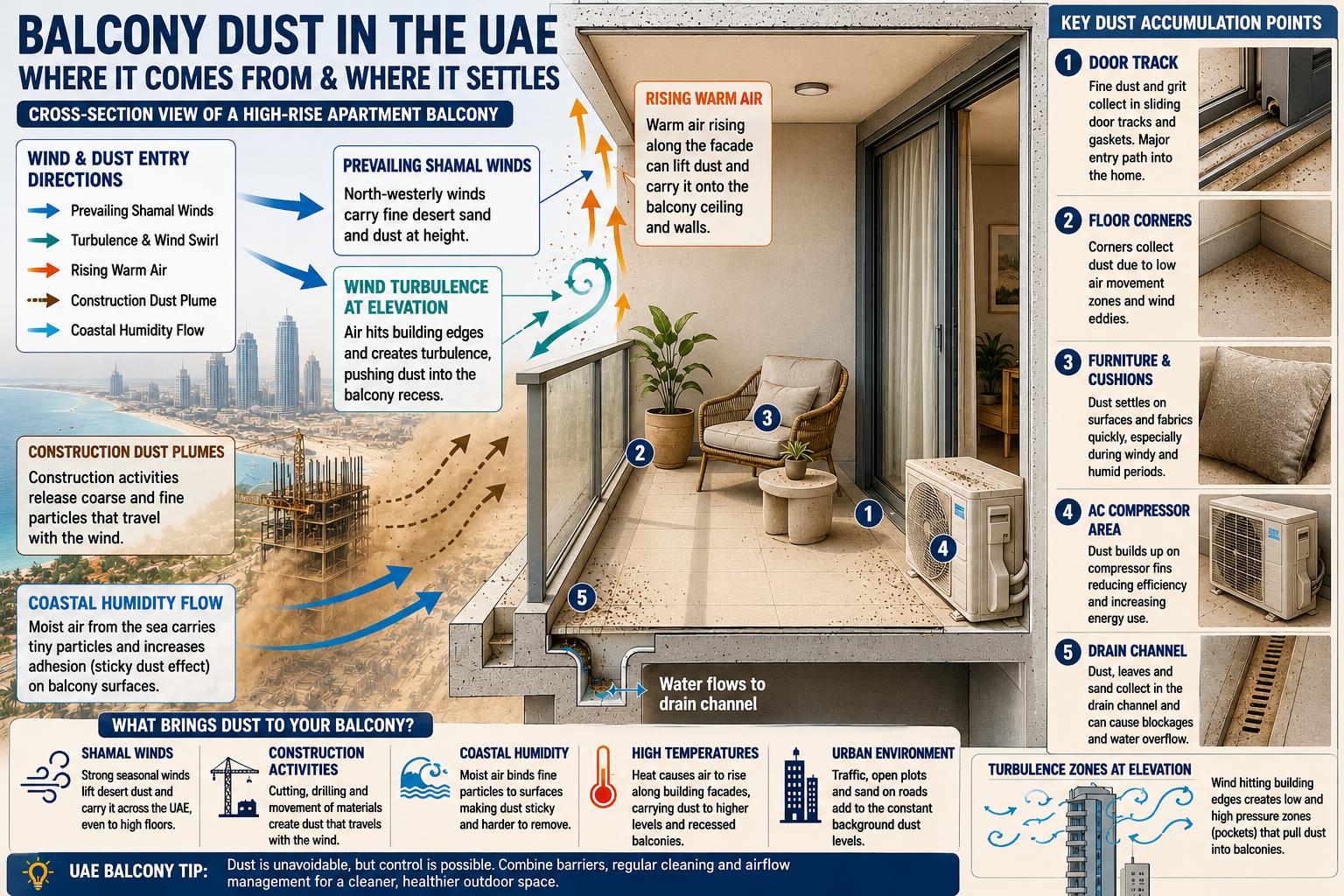
Balconies act as direct collection zones for airborne dust and sand. Every time a balcony door opens, a volume of particulate-laden air enters the living space. Entryways function similarly – shoes, bags, and clothing carry fine particles from shared corridors, carparks, and outdoor spaces. These two entry points are among the highest contributors to indoor dust accumulation in UAE apartments and are the most effective prevention targets.
Dust Sources by Severity
| Source | Dust Contribution |
|---|---|
| Balcony and balcony door transfer | Very High |
| Entry shoes and clothing | High |
| AC filter bypass and recirculation | High |
| Open windows during Shamal events | High |
| Curtains and upholstered furniture | Medium |
| Open wardrobes and storage | Medium |
| Floor corners and under-furniture zones | Medium |
| Indoor laundry drying | Low to Medium |
The Most Important Dust Prevention Principle
The single most effective approach to dust prevention in UAE homes is source control: stopping dust before it spreads indoors rather than waiting until it has settled across surfaces.
This principle applies at three levels. First, entry-point management reduces how much dust enters the home to begin with. Second, containment strategies limit how far dust that does enter can spread. Third, airflow management reduces the mechanisms that carry and redistribute particles once indoors.
A layered approach combining all three levels consistently outperforms any single tactic applied in isolation.
Quick Summary:
- Block dust at the point of entry before it circulates
- Manage airflow to avoid spreading existing particles
- Maintain AC systems to prevent recirculation
- Reduce surfaces and fabrics that trap and hold dust
- Build consistent habits rather than relying on periodic deep cleans
The UAE Dust Prevention Pyramid
The following framework organises prevention priorities in order of impact for UAE homes. Addressing higher layers first produces the greatest reduction in baseline indoor dust before moving to lower tiers.
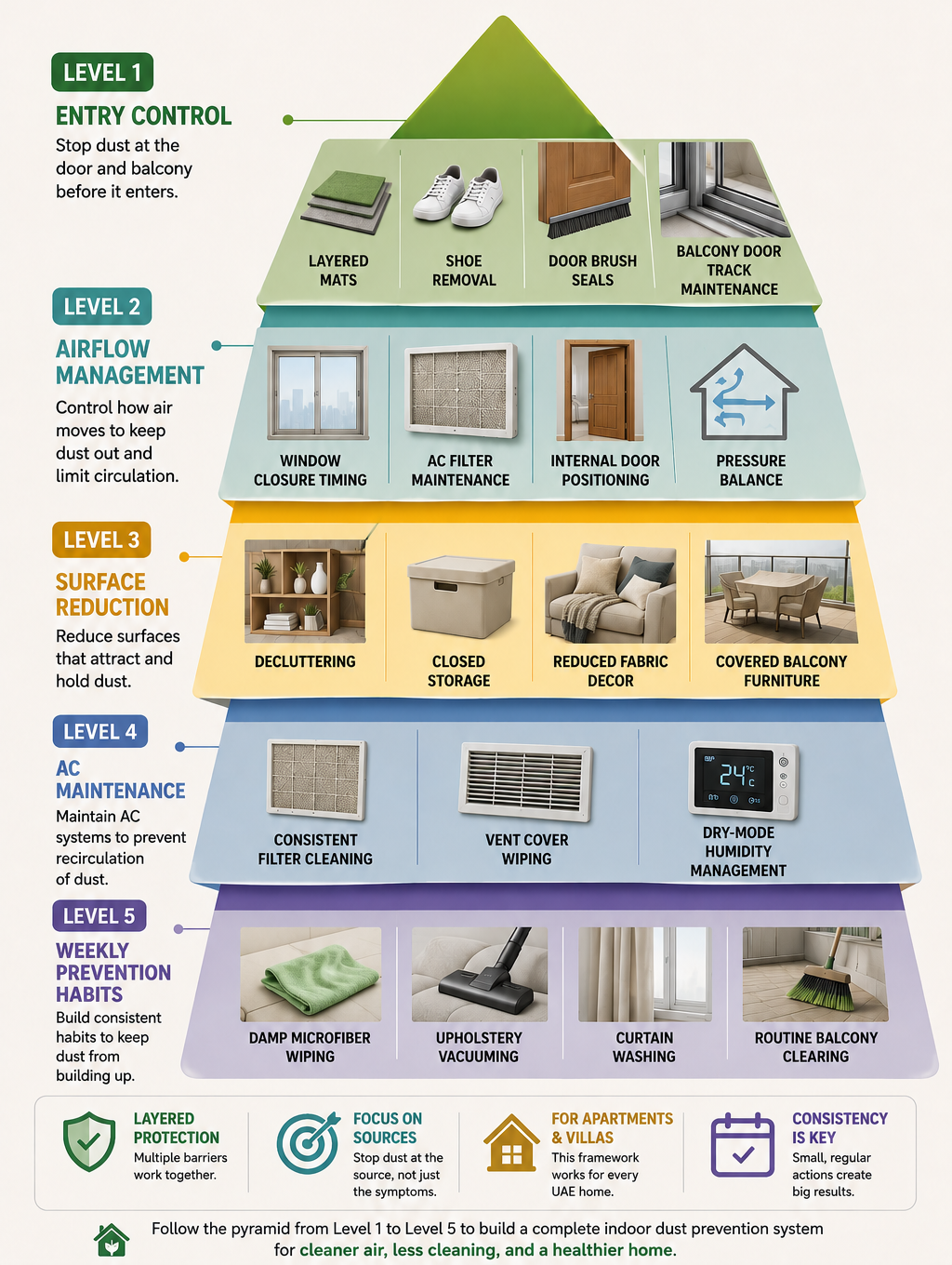
This pyramid is designed as a repeatable CleanLivingUAE framework applicable to both apartments and villas. Addressing each level in sequence builds a complete indoor dust prevention system rather than a collection of isolated tasks.
21 Practical Dust Prevention Tips for UAE Homes
1. Use Layered Entry Mats
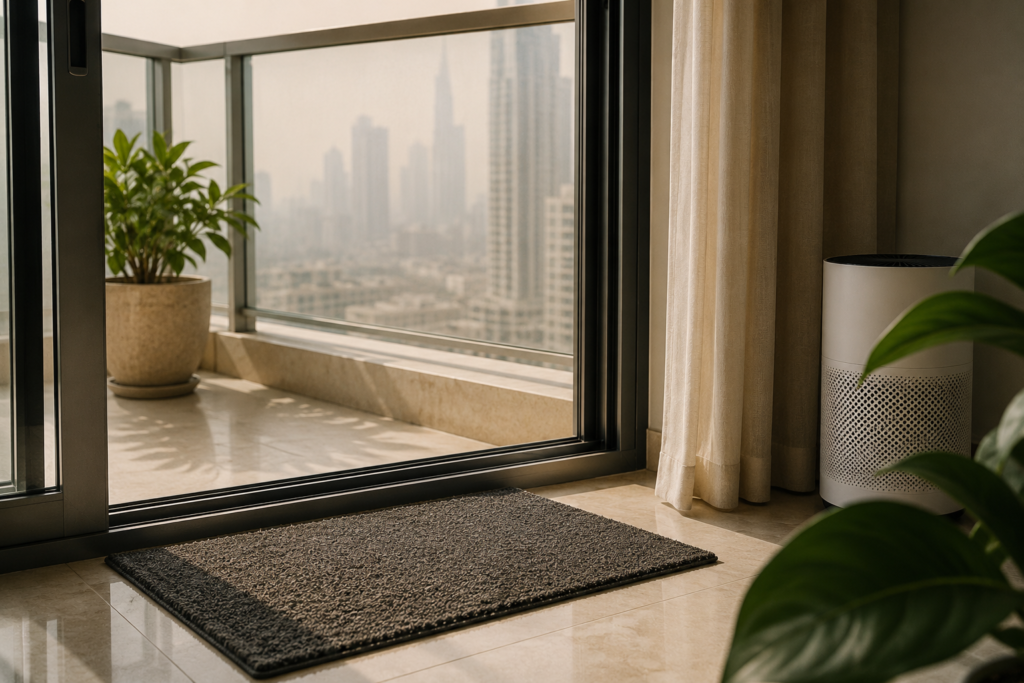
Single entry mats capture some debris, but a layered system performs significantly better in UAE conditions. Place a coarse-fibre outdoor mat outside the door to scrape visible sand from shoes, followed by a finer absorbent mat inside the door to capture finer particles. In villa settings, a third mat a short distance inside the entryway adds further protection. Mats should be shaken outside and cleaned at least twice weekly during dusty periods.
UAE Dust Prevention Tip: During Shamal season, mat cleaning frequency should increase to daily for homes near open ground or construction sites.
For product options, see the CleanLivingUAE guide to the best entry mats for UAE Homes.
2. Remove Shoes Near Entrances
Shoes are among the most consistent sources of tracked-in fine particles in UAE apartments. Establishing a shoe removal point near the front door and using a closed shoe cabinet rather than open racks prevents particles on soles from being carried further into the home. Sandals and open-toed shoes worn outdoors carry considerably more fine dust than enclosed footwear, making this habit especially relevant in the UAE context.
3. Clean Balcony Tracks Regularly
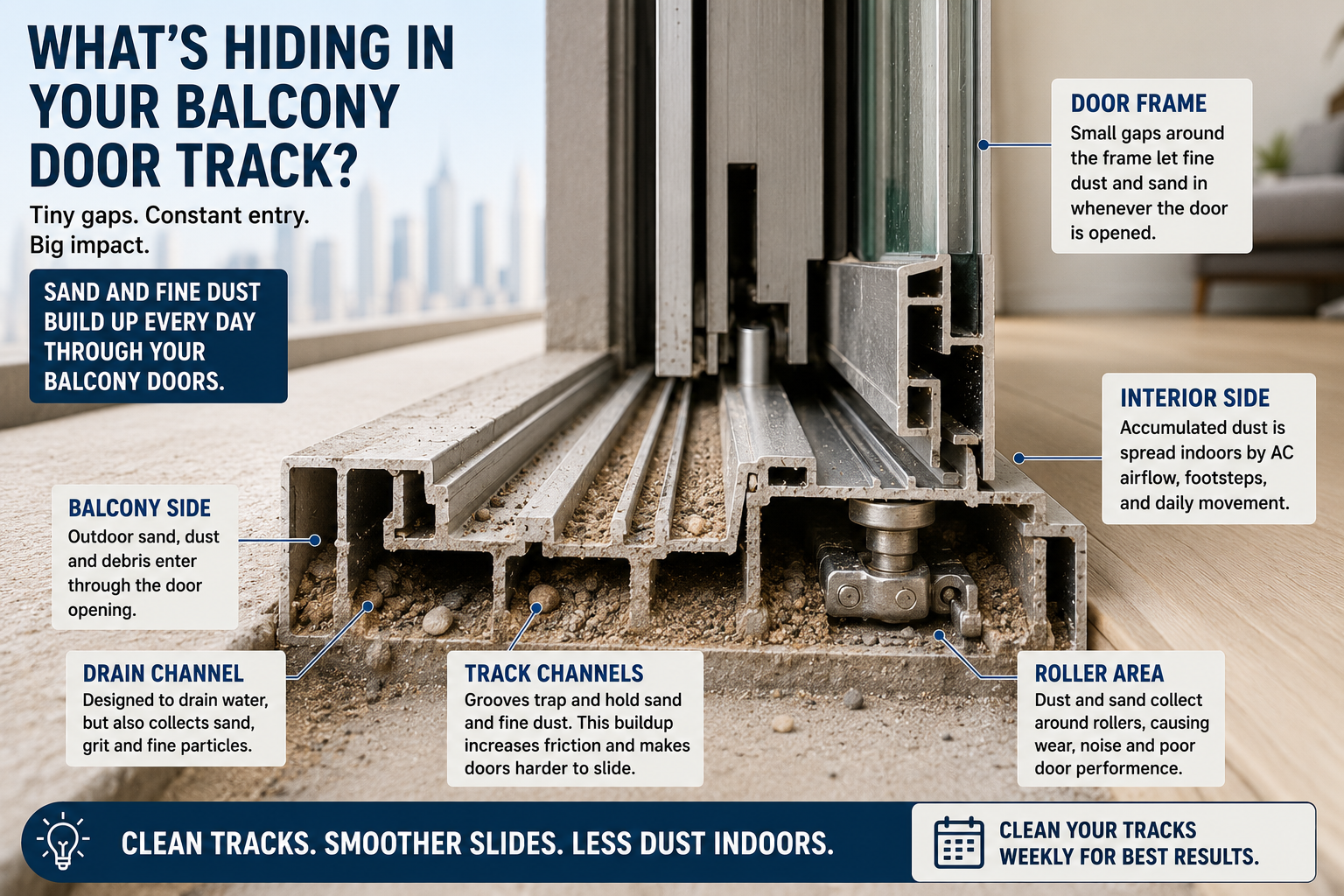
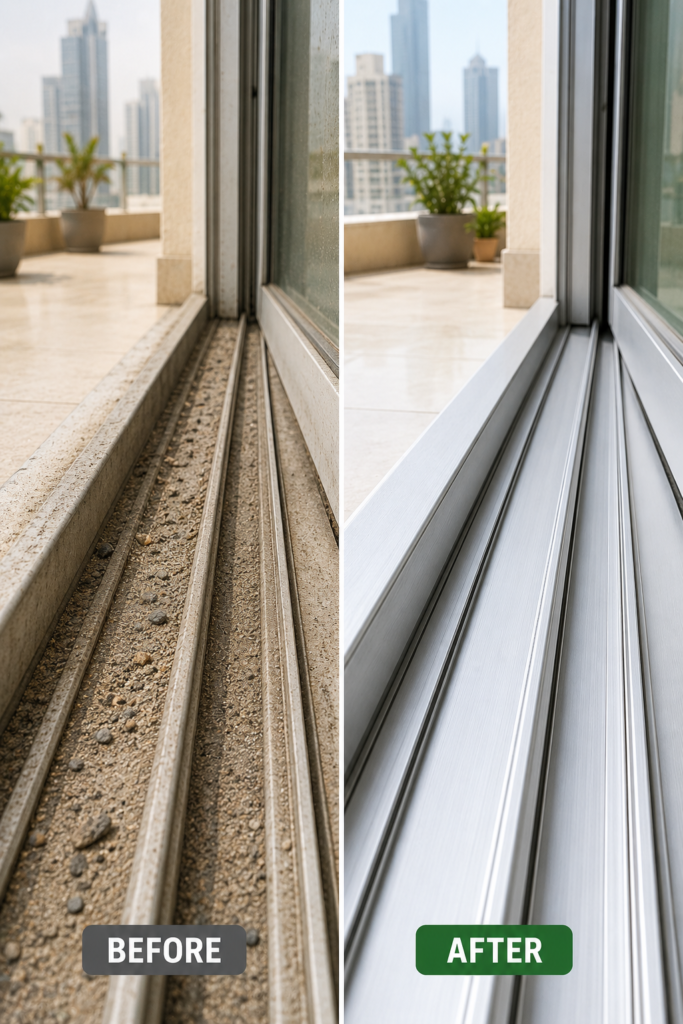
Balcony door tracks are one of the most overlooked dust accumulation points in UAE apartments. Fine sand collects densely in these channels and is displaced into the interior air each time the door slides open or closed. Cleaning tracks with a damp cloth or a narrow vacuum attachment at least once per week reduces the volume of particles that become airborne during daily use. Tracks should be inspected after any sandstorm event regardless of routine schedule.
4. Keep Windows Closed During Dusty Periods
Natural ventilation is beneficial in many climates but counterproductive in UAE conditions during dusty periods. Shamal winds, sandstorm events, and peak summer dust haze make open windows a direct route for outdoor particulate matter to enter the home. Monitoring UAE weather applications or checking regional air quality index readings before opening windows helps residents avoid introducing large volumes of outdoor dust unnecessarily. This is particularly important for bedrooms and living rooms.
UAE Dust Prevention Tip: The period from March through May carries the highest Shamal risk. Keeping windows closed between 10am and 6pm during this season significantly reduces indoor particle counts in many UAE apartment settings.
5. Use Damp Microfiber Cleaning Instead of Dry Dusting
Dry dusters, feather dusters, and dry cloths displace dust into the air rather than capturing it. Particles become temporarily airborne and resettle across a wider area, often onto surfaces that were not originally dusty. Damp microfiber cloths trap particles on contact and prevent resettlement. This is one of the most consistently effective dust prevention habits available and requires no specialist products beyond basic microfiber cloths and water.
See the CleanLivingUAE guide to the best microfiber cloths for dust UAE for product comparisons.
6. Clean AC Filters Consistently
AC filter maintenance is not just a cleaning task – it is a dust prevention measure. Clogged filters allow particles to bypass filtration and re-enter the circulated airstream. In UAE conditions, where AC systems run for 10-12 months per year, filters require cleaning more frequently than manufacturer schedules suggest for temperate climates. A common practical guideline for UAE residents is to inspect filters every 3-4 weeks and clean them when visible grey or brown material is present.
UAE Dust Prevention Tip: Dubai Municipality recommends regular maintenance of AC systems in residential properties as part of indoor air quality management. Allowing filters to become heavily loaded before cleaning significantly increases the particle bypass rate within the unit.
See the CleanLivingUAE article on AC filter cleaning UAE for step-by-step guidance.
7. Reduce Cluttered Surfaces
Horizontal surfaces covered with decorative objects, books, remote controls, and miscellaneous items create multiple dust collection points that are difficult to clean efficiently. Each item on a surface requires individual lifting and wiping, which means cluttered areas are cleaned less thoroughly and less frequently in practice. Reducing surface items to functional essentials minimises the total dust-accumulating area within the home and makes routine wiping faster and more complete.
8. Wash Curtains More Frequently
Curtains and fabric blinds act as large vertical dust filters in UAE homes. They collect airborne particles continuously, and when disturbed, they release captured dust back into the room air. A washing frequency of every 4-6 weeks during dusty seasons is a practical guideline for UAE apartments with regular AC use. Lightweight synthetic curtains tend to accumulate less dust than heavier woven fabrics and are easier to maintain on a higher-frequency wash schedule.
9. Keep Balcony Furniture Covered
Uncovered balcony furniture accumulates dense layers of dust and fine sand that transfer to clothing and shoes when used, then into the indoor space. Furniture covers – even basic lightweight fabric covers – dramatically reduce surface accumulation. When balcony furniture is brought indoors or brushed against during use, the particle transfer to the interior is substantially lower. Covers should be shaken out away from the building entrance rather than at the balcony threshold.
UAE Dust Prevention Tip: After any sandstorm event, brush down balcony furniture covers and wash them before use to avoid transferring a concentrated layer of fine particles indoors.
10. Vacuum Upholstery Regularly
Fabric sofas, chairs, and cushions trap fine particles at a level comparable to carpets. In UAE homes where residents spend significant time seated and where AC airflow continuously carries particles toward low-traffic settling zones, upholstery becomes a significant secondary dust reservoir. Vacuuming upholstery with an appropriate attachment at least once per week helps prevent this accumulation from building into a larger airborne source during movement or use.
For suitable vacuum options, see the CleanLivingUAE guide to the best HEPA vacuums UAE.
11. Use Sealed Storage Bins
Open shelving, cardboard boxes, and uncovered storage containers accumulate dust rapidly and are difficult to clean thoroughly. Transitioning to sealed plastic or lidded fabric storage bins reduces the dusty surface area within wardrobes, utility areas, and spare rooms. Cardboard boxes in particular absorb and hold fine particles and should be avoided for long-term storage in UAE conditions.
UAE Dust Prevention Tip: Storage areas under beds are among the highest-accumulation zones in UAE apartments. Sealed flat storage containers used in this zone reduce both particle buildup and the amount of material that becomes airborne when the space is accessed.
12. Control Indoor Humidity
While outdoor humidity cannot be controlled, indoor humidity levels can be managed through AC settings and ventilation timing. Maintaining indoor humidity between 40 and 60 percent reduces the moisture-adhesion effect that makes dust harder to remove. Many UAE split AC units offer a dry mode or dehumidification function that reduces humidity without aggressive cooling, which is particularly useful during peak summer months. Lower indoor humidity means particles are less likely to bond to surfaces and are easier to remove during routine cleaning.
Readers weighing an air purifier against a dehumidifier for combined dust and humidity control can compare both in the air purifier vs dehumidifier UAE guide.
UAE Dust Prevention Tip: The UAE Ministry of Climate Change and Environment identifies indoor air quality management – including humidity control – as a component of healthy residential environments. Split AC dry mode is the most practical tool available to apartment residents for managing indoor humidity without additional equipment.
13. Manage Laundry Drying Carefully
Drying laundry indoors on racks or over door frames is common in UAE apartments due to the impracticality of outdoor drying during dusty or humid periods. Wet laundry releases moisture vapour that raises indoor humidity, which in turn makes dust stickier and harder to manage. If indoor drying is necessary, concentrating it in one room with good AC airflow and keeping that room door closed minimises the humidity spread. Drying laundry outdoors on balconies during high-dust events also brings significant amounts of fine particles back into the home on fabric surfaces.
14. Use Door Brush Seals
The gap at the base of front doors, balcony doors, and utility room doors is a consistent entry point for fine sand and dust, particularly during Shamal wind events. Self-adhesive door brush seals or draught excluders are low-cost solutions that reduce this transfer meaningfully. In older UAE apartment buildings where door seals have degraded, this is one of the highest-return prevention investments available.
15. Maintain Balcony Drain Channels
Blocked balcony drains allow water to pool, which mixes with accumulated dust to form a dense residue that dries and becomes a secondary dust source. When the balcony surface dries out or is disturbed by footsteps or wind, this residue breaks back into airborne particles. Keeping drain channels clear allows rain and cleaning water to evacuate the balcony surface efficiently, reducing the concentration of particle-laden residue near the door threshold.
16. Focus on Floor Corners and Skirting
Dust accumulates in corners, along skirting boards, and under furniture at a disproportionately high rate compared to open floor areas. These zones are often missed during routine vacuuming or sweeping because they require additional attention and access. Incorporating a deliberate corner-and-skirting sweep into weekly routines removes particles that would otherwise be disturbed and redistributed by foot traffic and AC airflow over time.
UAE Dust Prevention Tip: A narrow crevice attachment on a vacuum cleaner reaches most skirting zones effectively and reduces the amount of loose material available to become airborne.
17. Reduce Fabric-Heavy Decor
Rugs, fabric throws, decorative cushions, wall hangings, and heavy curtain layering each contribute to the total dust-trapping surface area within a UAE home. In desert dust conditions, every fabric surface accumulates particles that require regular attention. Evaluating which fabric items are genuinely necessary and replacing some with hard-surface alternatives – smooth blinds instead of heavy curtains, for example – reduces the overall maintenance requirement and lowers the volume of particles held in the home at any given time.
18. Use Proper Ventilation Timing
Ventilation should be timed to minimise dust ingress. Early morning hours, typically between 5am and 7am, and late evening hours after 9pm often carry lower ambient particulate levels than midday and afternoon periods when solar heating lifts surface dust and wind activity peaks. Residents who wish to ventilate naturally should concentrate this during lower-risk time windows and close windows before activating AC systems to avoid drawing in outdoor air through the AC return.
UAE Dust Prevention Tip: The UAE National Center of Meteorology provides dust forecasts and air quality index data. Checking this before opening windows during spring months takes under one minute and can prevent a significant increase in indoor particle levels.
19. Clean After Sandstorms Immediately
Delaying post-sandstorm cleaning allows fine particles that have settled on surfaces to dry fully and become more easily displaced by movement, foot traffic, and AC airflow. Addressing balconies, entry mats, door tracks, and window ledges within the first few hours after a sandstorm event prevents a significant secondary distribution of particles into interior spaces. A damp wipe of all horizontal surfaces in entry areas should be the first cleaning action taken after any significant Shamal or sandstorm event.
20. Separate Outdoor and Indoor Cleaning Tools
Using the same mop, broom, or cloth for both balcony and indoor surfaces transfers concentrated outdoor dust into interior areas. Maintaining separate clearly labelled cleaning tools for outdoor and indoor use prevents this cross-contamination. Balcony mops and brushes should be stored on the balcony itself or in sealed containers to avoid shedding particles into indoor storage areas.
21. Build a Consistent Weekly Prevention Routine
Dust prevention relies on consistency rather than intensity. A routine that addresses the key accumulation points – entry mats, AC filters, door tracks, balcony surfaces, and upholstery – performed every week at a moderate level is more effective than occasional deep cleaning with no maintenance in between. Building these tasks into a fixed weekly schedule reduces both the time required per session and the total dust load maintained within the home.
For a complete reference, see the CleanLivingUAE weekly cleaning checklist UAE.
Recommended Tools for Dust Prevention UAE
Some product mentions may include affiliate links.
Microfiber Cloths for
Fine Dust Removal
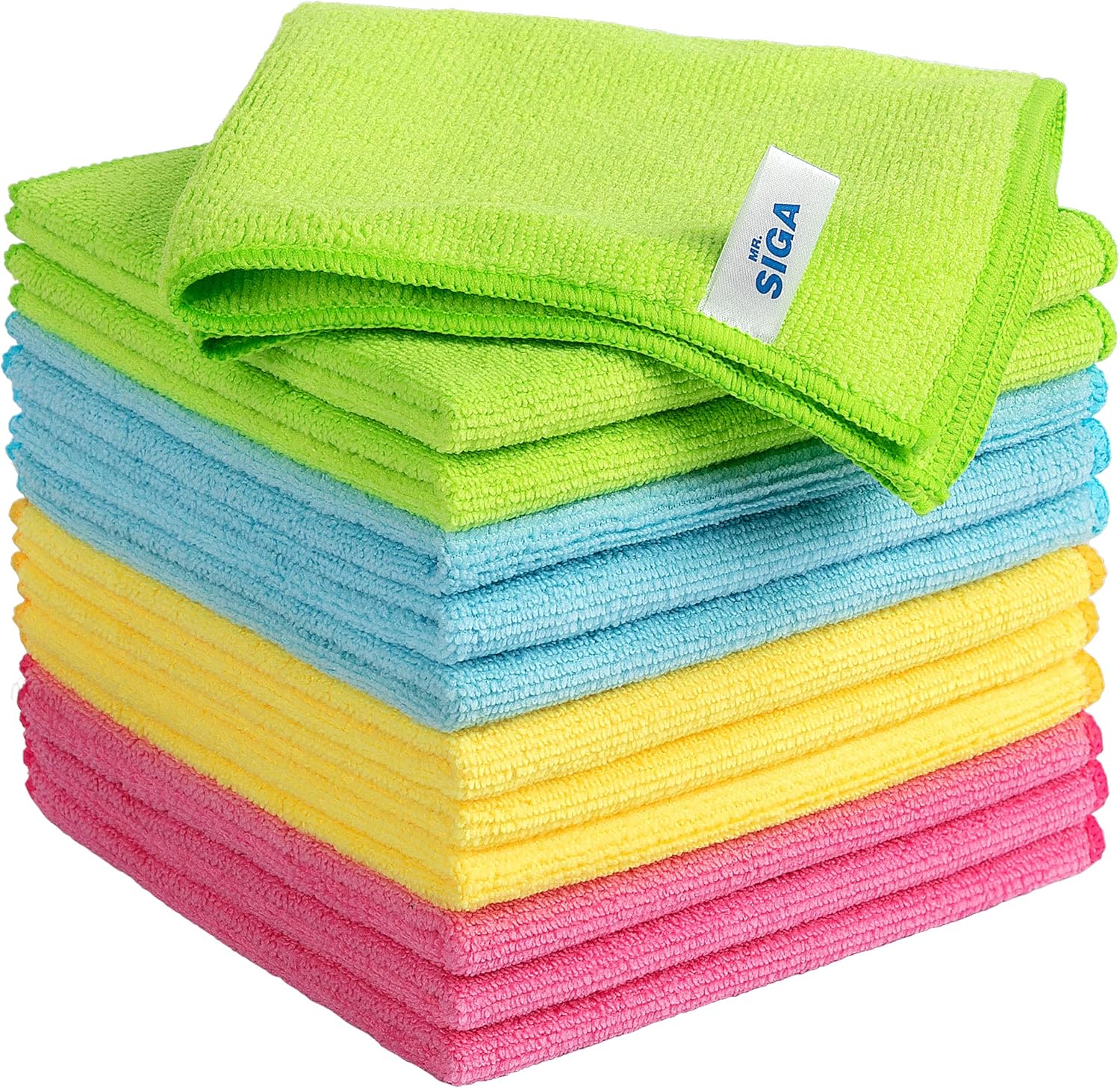
Microfiber cloths help trap fine UAE dust instead of spreading it across surfaces. Separate cloths for dry dusting and wet cleaning improve cleaning efficiency.
HEPA Vacuum Cleaners for
UAE Dust Control
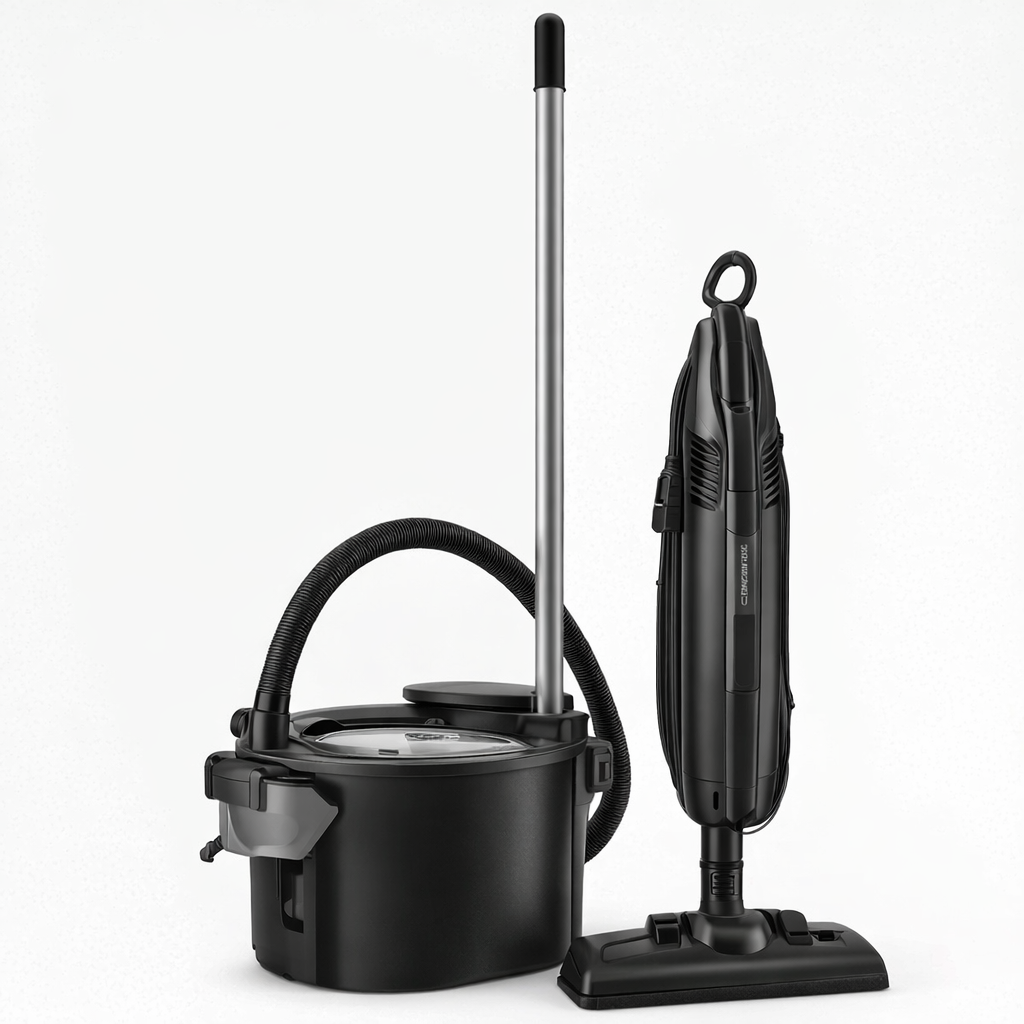
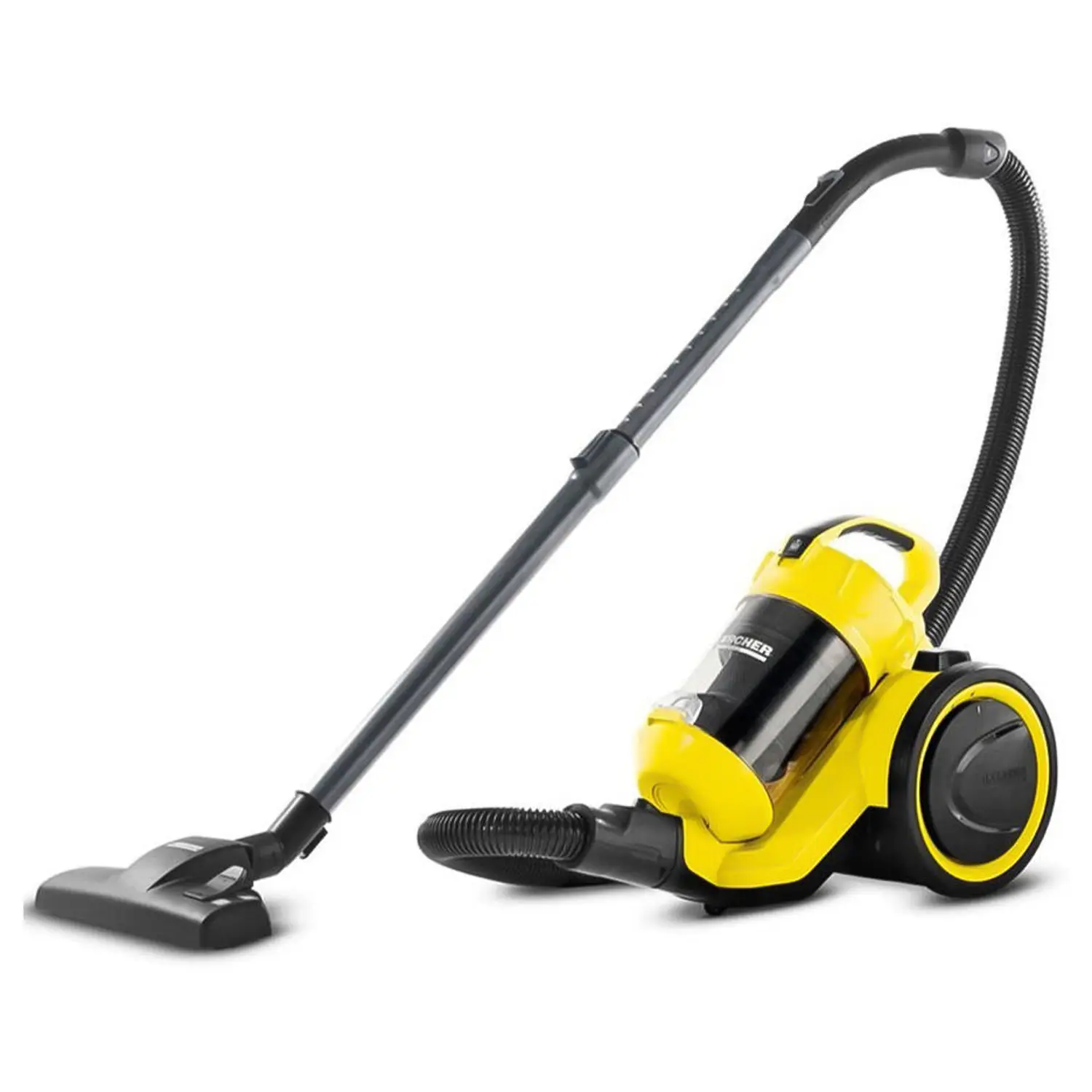
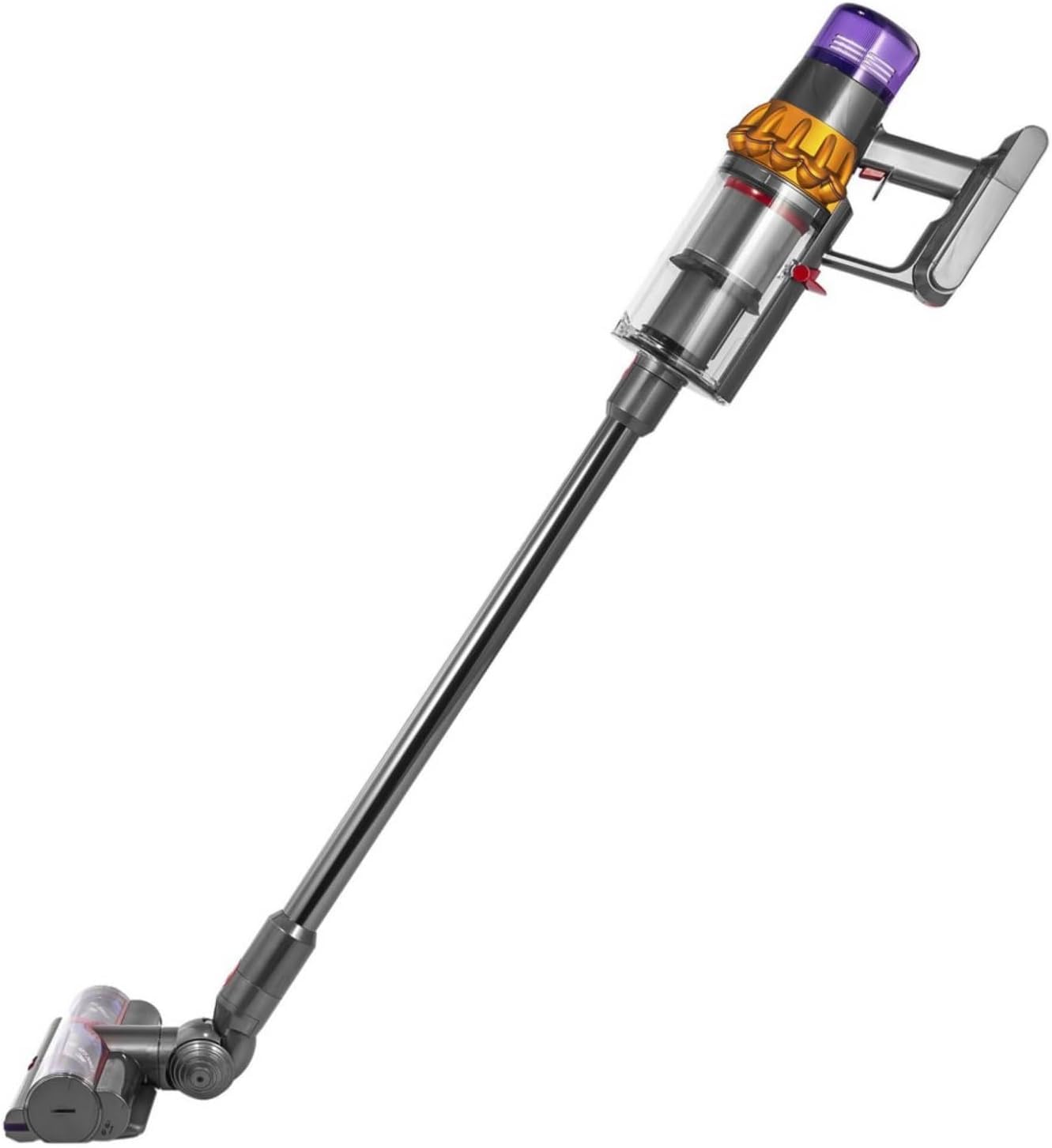
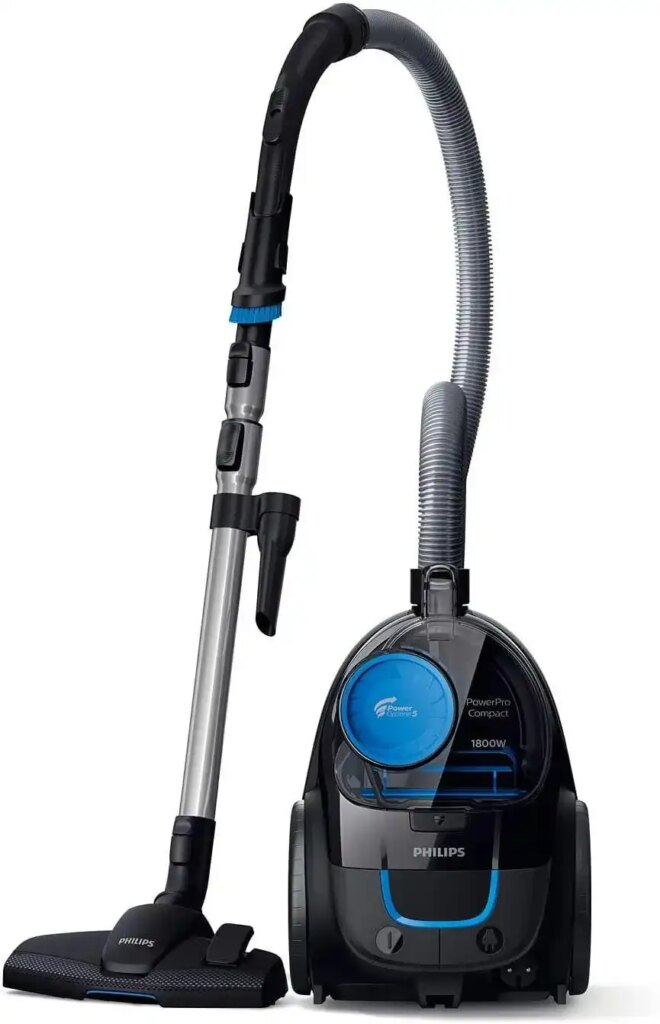
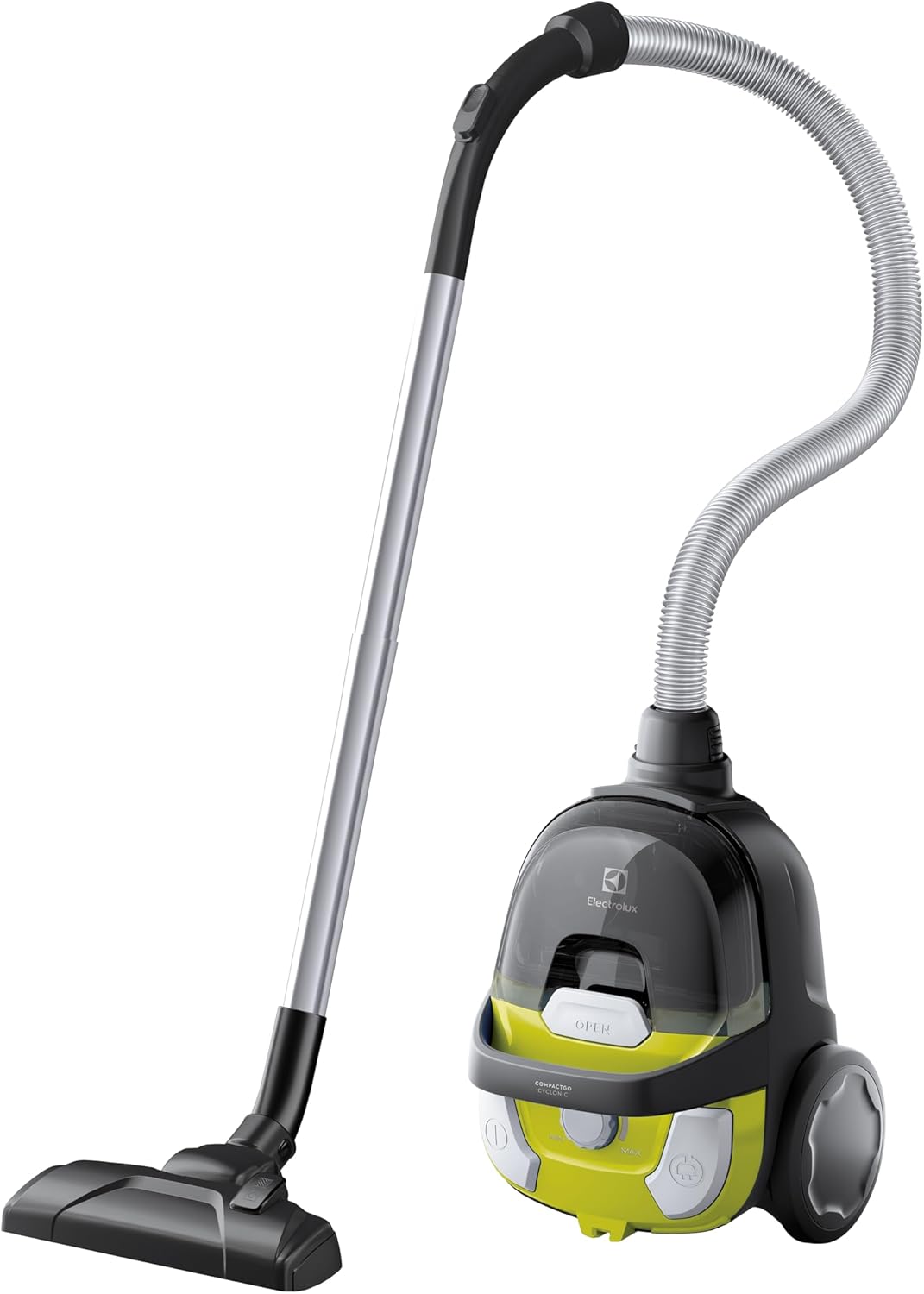
HEPA vacuum cleaners capture fine dust and sand particles commonly found in UAE homes. They are effective for tile, marble, rugs, and upholstery.
Dusting Tools for
Dust Removal
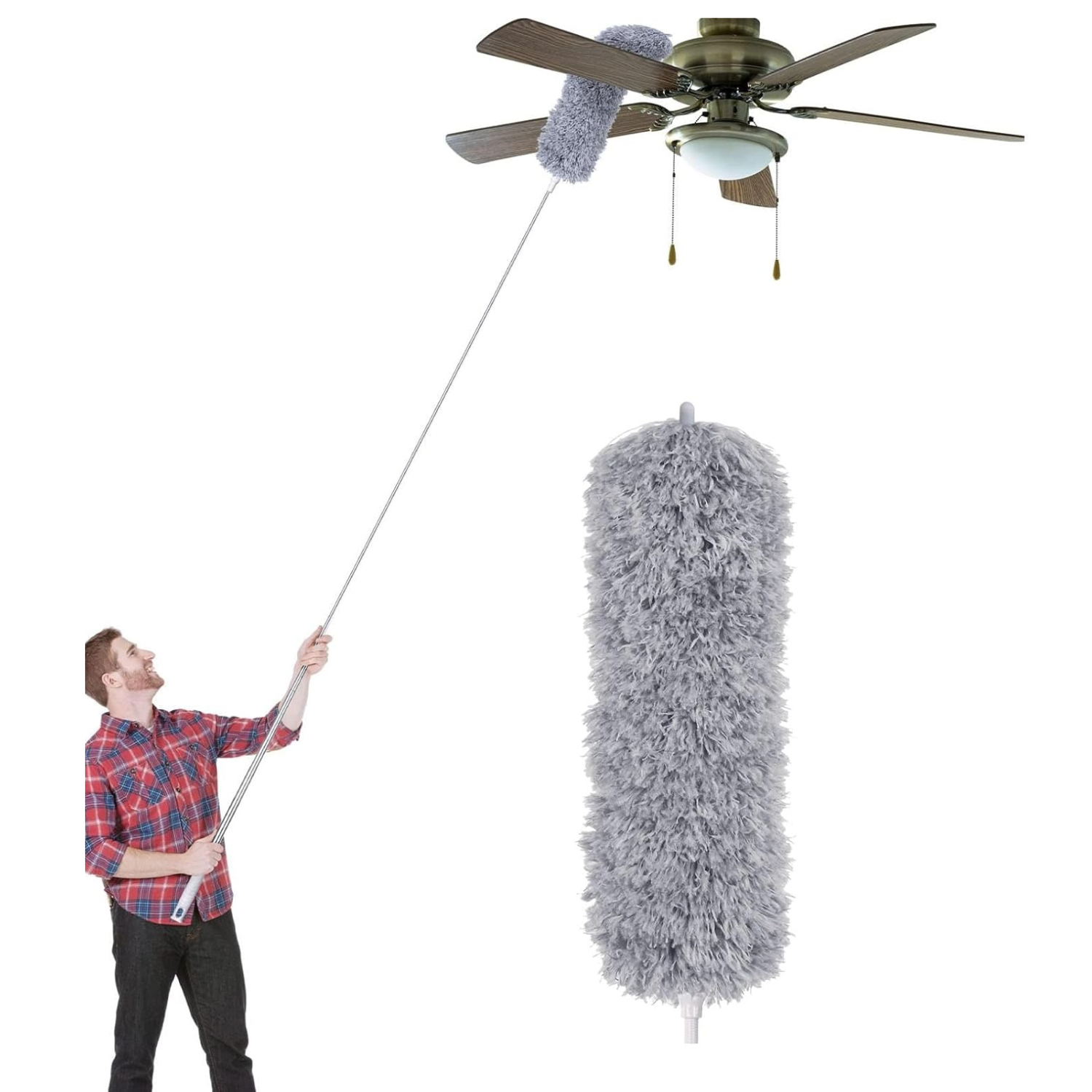
Electrostatic extendable dusters trap fine particles without spreading them, making them well suited to UAE homes with tall ceilings and hard-to-reach surfaces.
AC Vent Brushes for
Dust Accumulation
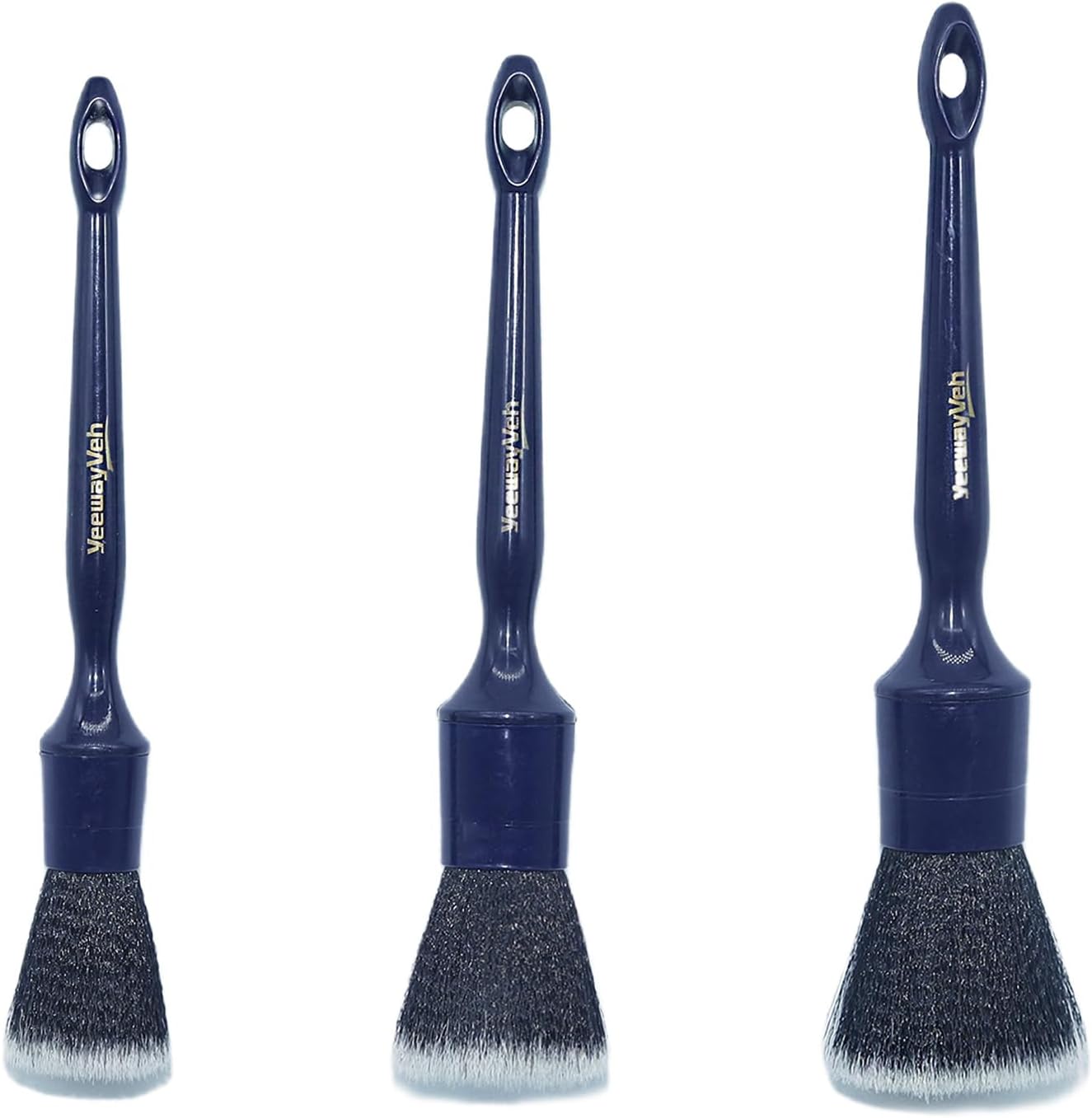
Narrow-profile brushes fit between AC louvre slats to remove dust buildup between professional filter services, without damaging the unit.
Spin Mops and Floor Mops
for post-cleaning
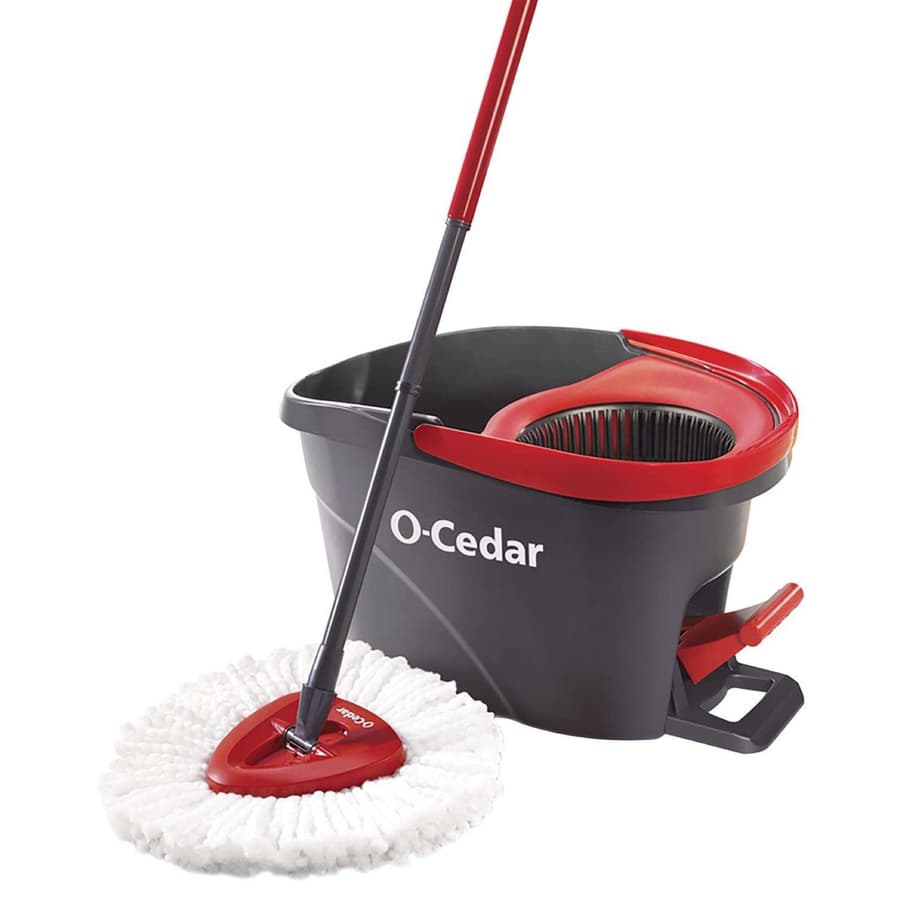
Spin mops with microfiber heads capture residual fine particles on hard floors when used after vacuuming that it may have missed.
Air Purifiers for Managing
Fine Indoor Dust
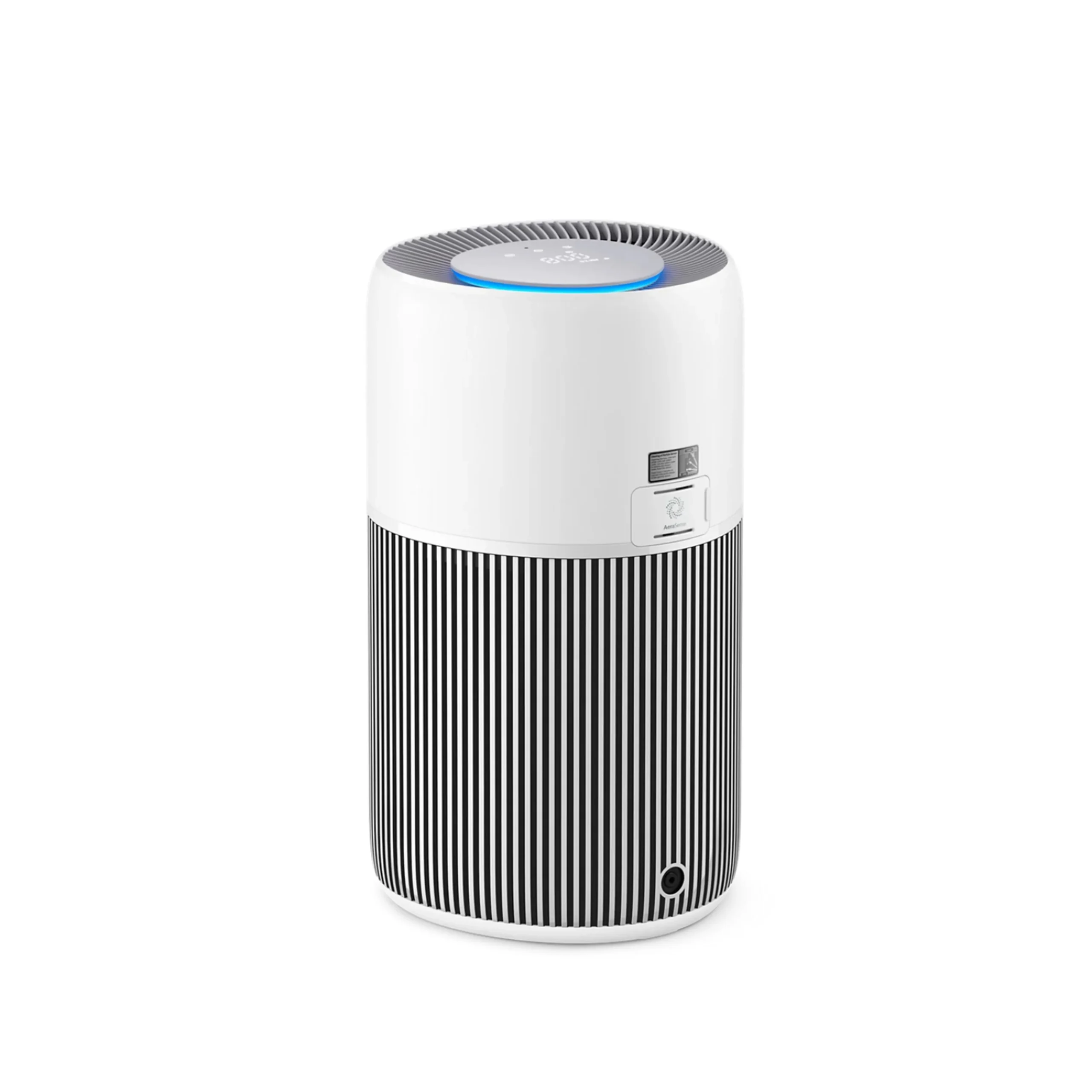
HEPA air purifiers help reduce airborne dust and fine sand during dusty periods. Bedrooms and living rooms are the most common placement areas in UAE homes.
Best Areas to Focus on for Dust Prevention
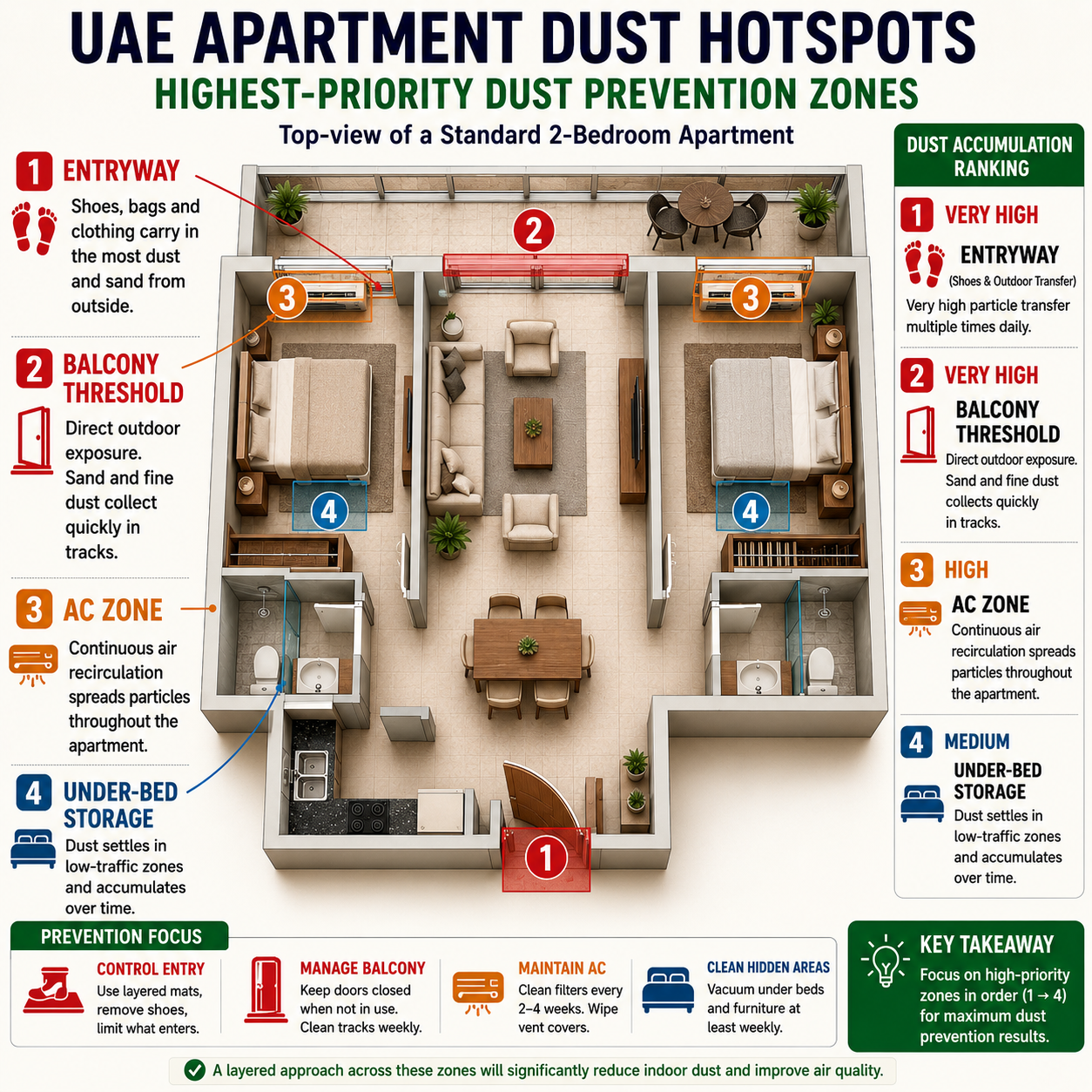
Entryways
The entryway is the single highest-impact zone for dust prevention in UAE apartments. Shoes, bags, and clothing bring in the majority of tracked particles from outside. Layered mats, a closed shoe cabinet, and a damp wipe of the floor near the door after each entry session address the primary source before dust reaches the rest of the home.
Balconies
Balconies act as direct outdoor-to-indoor transfer zones. Keeping the balcony door closed during high-dust periods, maintaining clean door tracks, covering furniture, and clearing drains reduces the volume of material that enters the living space. The balcony is the first outdoor area to address during and after sandstorm events.
For detailed balcony-specific guidance, see the CleanLivingUAE article on how to reduce dust in Dubai homes.
Bedrooms
Bedrooms accumulate fine particles through AC airflow, fabric surfaces on beds and curtains, and clothing stored in open wardrobes. Enclosed wardrobe storage, regular bedding washing, and consistent AC filter maintenance are the most effective bedroom-specific prevention strategies.
Living Rooms
Living rooms typically have the highest fabric surface area in a UAE apartment – sofas, cushions, rugs, and curtains all collect dust. Reducing unnecessary fabric items, vacuuming upholstery weekly, and wiping all horizontal surfaces with damp microfiber cloths are the primary living room prevention measures.
AC Zones
The area immediately around AC units and return air vents is a high-concentration zone for fine particulate buildup. Keeping the AC filter clean and wiping the vent cover and surrounding wall surface weekly prevents recirculation of accumulated particles. The floor directly below a wall-mounted AC unit also collects more fine dust than other floor areas.
Storage Spaces
Utility rooms, storage cupboards, and under-bed spaces collect dust that is rarely addressed in routine cleaning. Using sealed containers, keeping storage areas organised and accessible, and including them in the monthly cleaning rotation prevents large particle reserves from building up undetected.
Apartment vs Villa Dust Prevention Strategies
Dust prevention in Dubai apartments specifically requires attention to construction dust from ongoing development in areas such as Business Bay, Dubai Creek Harbour, and Dubai South – fine construction particulate combines with desert dust to create a denser airborne mixture than in areas without active building projects.
| Factor | Apartment | Villa |
|---|---|---|
| Outdoor exposure | Lower – mainly through balcony and corridor access | Higher – multiple exterior doors, garden areas, and open ground around the property |
| Airflow complexity | Simpler – usually one or two balcony exposures with limited wind angles | More complex – multiple facades exposed to wind from different directions |
| Balconies | Usually one or two; manageable with regular track and drain maintenance | Often multiple, including ground-level patios that collect more coarse sand |
| Gardens and ground-level areas | Not applicable – shared external areas are usually managed by building maintenance | Resident responsibility; uncovered garden soil and gravel are major dust sources |
| Entry doors | Single front door via internal corridor; lower outdoor exposure at entry | Direct external entry; higher exposure to outdoor particulates at every door |
| Window exposure | Windows usually face specific directions; easier to manage with targeted closure habits | Windows on multiple facades; requires whole-property window management during Shamal events |
| Recommended cleaning frequency | Weekly surface wipes; biweekly floor attention; monthly deep prevention check | More frequent floor and entry cleaning; exterior checks after sandstorms are essential |
Common Dust Prevention Mistakes
Dry sweeping before vacuuming: Using a dry broom on tiled floors lifts fine dust into the air, where it remains suspended for an extended period before resettling. Vacuuming or damp mopping is significantly more effective at removing particles from the surface permanently.
Overusing feather dusters: Feather dusters displace particles rather than capturing them. Fine desert dust released from a duster becomes airborne and distributes further across the room before settling again. Damp microfiber cloths are more appropriate for UAE dust conditions.
Ignoring AC filters: AC filter neglect is one of the most consistent causes of elevated indoor dust in UAE homes. When filters are visibly grey, the AC system is already distributing unfiltered particles through every room it serves.
Opening windows during Shamal periods: Many residents open windows for natural ventilation during spring months without checking weather conditions. During active Shamal events, this introduces significant volumes of fine desert dust in a short period.
Storing cardboard boxes openly: Cardboard absorbs and holds fine dust at a high rate. Open cardboard storage in spare rooms, under beds, or in utility areas creates secondary dust reservoirs that are disturbed each time the storage area is accessed.
Using low-quality entry mats: Thin synthetic mats that slide easily on tile floors capture minimal debris and flatten quickly. They create the appearance of dust control without providing meaningful particle interception at the entry point.
Neglecting balcony surfaces before entering: Walking directly from a dusty balcony onto interior floor surfaces without foot-wiping transfers visible sand and fine particles immediately to the indoor floor zone.
Seasonal Dust Prevention in the UAE
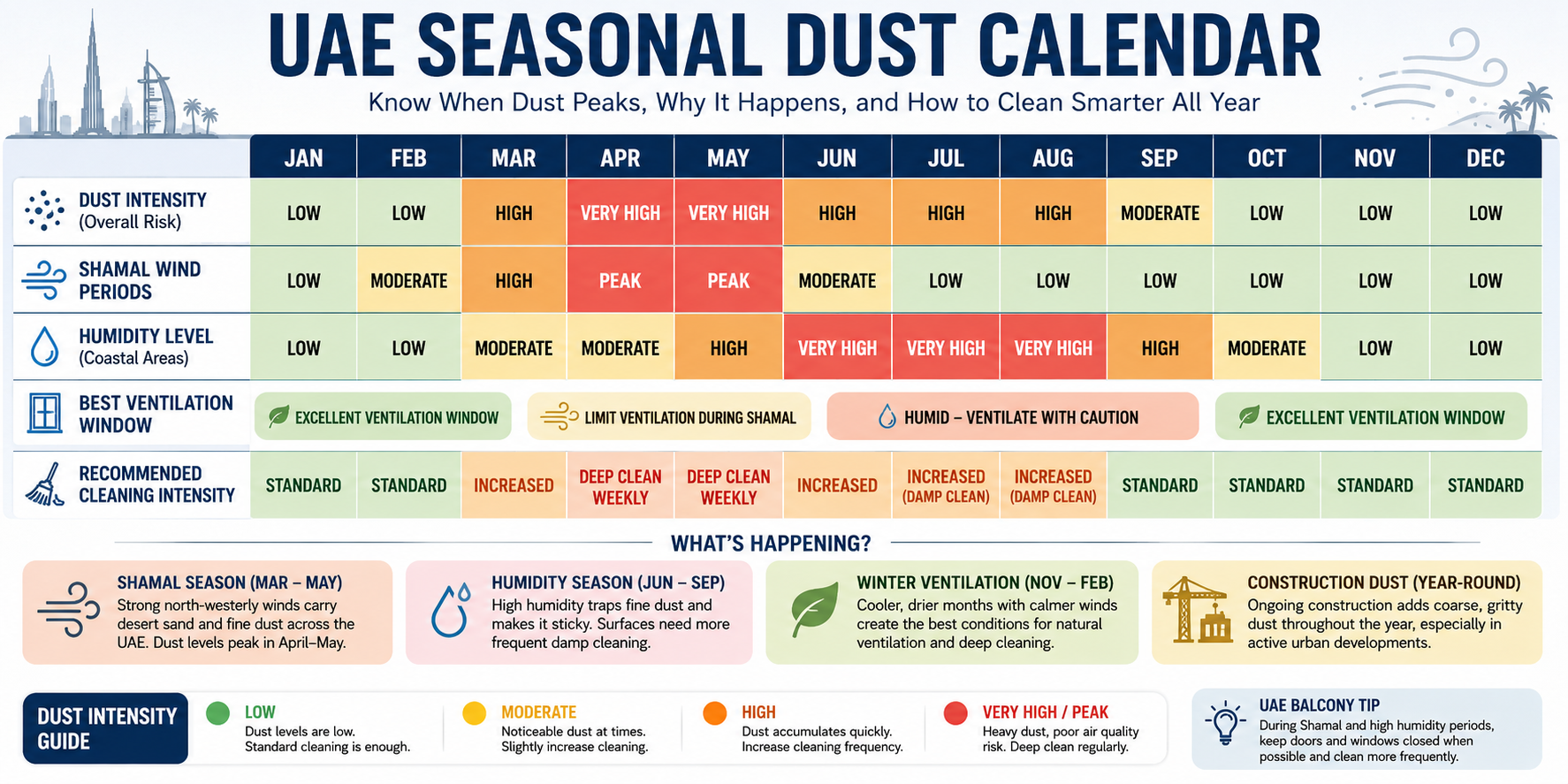
Spring Shamal Season
The period from approximately March through May represents the highest-risk window for dust ingress in most UAE locations. Shamal winds from the north-northwest carry fine desert particles over long distances at low altitude. Preventive action during this period should increase in intensity: mats cleaned more frequently, windows kept closed during daytime hours, and balcony door seals inspected before the season begins.
Peak Summer Humidity
June through September brings high humidity alongside continued dust accumulation. The combination of moisture and fine particulates creates sticky surface deposits that are harder to remove than dry dust. AC systems work harder during this period and filters accumulate material more quickly. Humidity management through dry-mode AC settings reduces the adhesion effect that makes summer dust harder to prevent.
UAE Dust Prevention Tip: Coastal UAE areas including Dubai Marina, JBR, and Abu Dhabi’s Corniche zones experience higher humidity levels than inland areas during summer. Residents in these locations benefit from more frequent damp-cloth wiping of surfaces during June through September compared to residents in inland areas such as Al Ain or Sharjah inland districts.
Autumn Transition
October and November mark a reduction in humidity and a shift in wind patterns. This period is generally lower in dust intensity but benefits from a post-summer reset: a thorough clean of AC units, a balcony deep clean, and an inspection of all entry seals before winter usage patterns begin.
Winter Ventilation Months
December through February offers the most comfortable conditions for natural ventilation in the UAE. Outdoor dust levels are lower during winter months and temperatures allow windows to be opened in early morning and evening without heat discomfort. This is the most appropriate period for ventilating the home naturally while limiting AC recirculation, which reduces indoor particle buildup during the cooler season.
Best Materials and Surfaces for Lower Dust Retention
Surface and material choices within UAE homes affect how quickly dust accumulates and how difficult it is to remove during routine prevention cleaning.
Matte versus glossy surfaces: Glossy tiles and surfaces show dust more visibly, which is often mistaken for higher accumulation. In practice, smooth glossy surfaces release dust more easily during cleaning because particles have less surface texture to grip. Matte finishes accumulate particles in micro-textures and can be harder to clean completely.
Textured tiles: Deeply textured floor tiles commonly found in UAE bathrooms and utility areas accumulate fine sand in their surface patterns. These require more thorough cleaning to prevent buildup in grout lines and surface recesses.
Composite and engineered materials: Composite cabinetry with sealed surfaces and smooth laminates accumulate less dust than natural wood with grain texture. This is relevant for kitchen and wardrobe fitouts in UAE apartments where renovation is possible.
Fabric choices: Natural cotton and linen fabrics generate more fibre debris and trap external particles more densely than tightly woven synthetic alternatives. Choosing tighter weave fabrics for cushions, curtains, and covers reduces their contribution to total indoor dust.
Closed storage: Open shelving holds dust across every stored item and shelf surface. Closed-door cabinets and drawers limit the accessible surface area for dust to settle, reducing the frequency of interior cleaning required.
Minimal fabric layouts: Reducing the number of fabric-heavy items in high-airflow zones – living rooms and bedrooms near AC vents – directly reduces the total particle-holding capacity of the interior space.
How Airflow Affects Indoor Dust
Airflow is the primary mechanism by which dust particles that have entered a UAE home are distributed across rooms and surfaces. Understanding basic airflow behaviour helps residents make practical decisions about AC settings, door positions, and ventilation timing.
Pressure differences between indoor and outdoor spaces influence how much outside air enters through gaps around doors and windows. When an AC system reduces indoor air pressure slightly relative to outdoor conditions, fine particles are drawn in through small gaps and cracks more readily. Ensuring door seals are intact and avoiding running AC systems with windows or balcony doors partially open helps maintain a more neutral pressure balance.
AC return airflow carries particles from the floor area and lower room zones upward toward the filter intake. Fine particles that settle on the floor near AC units are regularly re-lifted into the airstream during AC operation. This is why the floor zone immediately below and around wall-mounted AC units accumulates fine dust at a higher rate than other floor areas.
Open internal doors allow the AC system to circulate air across the entire apartment regardless of where the unit is positioned. When rooms with high dust ingress – such as rooms adjacent to balconies or entry zones – have their doors left open, particles are redistributed by the AC airstream to bedrooms and other lower-exposure rooms. Keeping entry-adjacent room doors closed during high-dust periods can reduce distribution to the rest of the apartment.
Curtain movement driven by AC airflow also redistributes settled particles from fabric surfaces back into the room air. Heavy curtains near AC vents require more frequent cleaning because they both trap particles and release them during normal operation.
UAE Dust Prevention Tip: A common and underappreciated mistake is running the AC with a balcony door partially open for airflow. This creates an active pathway that draws outdoor particulates directly into the AC intake zone, bypassing whatever filtering happens when the unit operates with a sealed space.
For related reading, see the CleanLivingUAE guide to the best air purifiers UAE.
Simple Weekly Dust Prevention Routine
| Task | Frequency | Prevention Benefit |
|---|---|---|
| Clean entry mats | 2-3 times per week; daily during Shamal season | Removes accumulated particles before they are tracked further indoors |
| Inspect and clean AC filter | Every 3-4 weeks; inspect weekly during dusty season | Prevents particle recirculation through the AC airstream |
| Wipe horizontal surfaces with damp microfiber | Weekly | Removes settled particles before they form heavier dust layers |
| Clean balcony door tracks | Weekly; after each sandstorm event | Reduces particles displaced into indoor air when the door opens |
| Vacuum upholstery and soft furnishings | Weekly | Clears fabric surfaces that act as secondary particle reservoirs |
| Wipe balcony furniture covers or surfaces | Weekly; after any visible dust event | Prevents outdoor particle transfer into living spaces |
| Check and manage indoor humidity | Weekly during summer months | Reduces moisture adhesion that makes dust harder to remove |
| Inspect balcony drain channels | Monthly; after heavy dust accumulation | Prevents dust and moisture residue buildup near the balcony door threshold |
| Clean floor corners and skirting boards | Weekly | Removes high-accumulation zones before foot traffic redistributes particles |
| Wash curtains or fabric blinds | Every 4-6 weeks | Clears large particle-holding surfaces before dust re-enters room air |

Final Thoughts
Dust prevention in UAE homes is a practical and achievable goal when approached as a system rather than a collection of individual tasks. The 21 strategies outlined here address the primary pathways through which fine desert particulate, construction dust, and humidity-bonded particles enter and accumulate within UAE apartments and villas. Applying dust prevention tips UAE residents can sustain consistently – particularly entry-point management, AC filter maintenance, and damp microfiber cleaning habits – reduces both the frequency and intensity of cleaning required throughout the year. Prevention does not eliminate dust entirely in a desert environment, but it significantly reduces the baseline accumulation level and the workload associated with maintaining a clean indoor space.
For additional guidance, see the CleanLivingUAE articles on how to remove sand from floors UAE, best entry mats for dust UAE, and the weekly cleaning checklist UAE.
Frequently Asked Questions
How often should UAE residents clean their AC filters to prevent dust buildup?
In UAE conditions, AC filters should be inspected every 3-4 weeks and cleaned whenever visible grey or brown material is present. During peak dust months from March through May, inspection every 2 weeks is a practical guideline. Consistent filter maintenance prevents recirculation of fine particles through the AC airstream and is one of the highest-impact dust prevention actions available to residents.
What is the most effective entry mat setup for a UAE apartment?
A two-mat layered system works best in most UAE apartment settings. A coarse-fibre mat placed outside the front door captures visible sand and larger debris from shoe soles. A finer absorbent mat inside the door captures smaller particles. Both mats should be cleaned several times per week during dusty periods and replaced when they lose their ability to trap material effectively.
Should windows be kept closed at all times in UAE homes?
Not at all times, but selectively. Windows should be kept closed during active Shamal events, sandstorm conditions, and peak daytime hours from March through May. During winter months from December through February, early morning and evening ventilation is practical and beneficial. Using weather and air quality applications to check outdoor conditions before opening windows helps residents make informed decisions.
What causes dust to become sticky in UAE homes during summer?
High outdoor humidity – particularly in coastal UAE locations during June through September – combines with fine airborne particles to increase their moisture content. When these particles settle on surfaces, they bond more firmly than dry dust. This effect is most visible on tiles, glass, and AC vent covers and makes prevention more important during humid months than during dry season.
Is it better to vacuum or sweep tiled floors in UAE apartments?
Vacuuming is significantly more effective than sweeping for UAE tile floors because dry sweeping lifts fine particles into the air where they remain suspended before resettling. Vacuuming removes particles from the floor permanently rather than displacing them. Following vacuuming with a damp mop captures any residue the vacuum left behind.
How does balcony door gap sealing help with dust prevention?
The gap at the base of balcony doors is one of the most consistent entry points for fine sand and dust in UAE apartments, particularly during wind-driven Shamal events. Self-adhesive door brush seals or draught excluders reduce this gap and block the passage of fine particles that would otherwise accumulate near the door threshold and be tracked further into the interior. This is a low-cost and durable prevention measure.
What indoor humidity level should UAE residents aim for to reduce dust adhesion?
A general guideline for indoor humidity in UAE homes is between 40 and 60 percent. Above 60 percent, moisture combines with fine particles to create the sticky dust films commonly observed on tiles and glass. Most UAE split AC units can manage indoor humidity through their dry or dehumidify settings.
Does reducing fabric decor actually make a difference to dust levels in UAE apartments?
Yes, in practical terms. Every fabric surface in a UAE home – rugs, curtains, upholstered furniture, cushions, and fabric wall treatments – holds fine particles that accumulated through AC airflow and foot traffic. Reducing the total fabric surface area reduces the volume of particles the home retains at any given time and makes routine prevention cleaning faster and more complete. The difference is most noticeable when large rugs or heavy curtain layers are removed from high-traffic rooms.
How quickly should post-sandstorm cleaning be done to prevent further indoor spread?
Addressing the entry zones, balcony door tracks, window ledges, and floor areas near external doors within the first few hours after a sandstorm event prevents the large volume of settled particles from drying fully and becoming more easily displaced by foot traffic and AC airflow. Delaying until the following day allows the particle layer to compact and become harder to remove cleanly.
Are door brush seals practical in UAE apartment buildings where door design cannot be modified?
Most UAE apartment buildings allow tenants to fit self-adhesive door brush seals to the base of interior-facing doors including front doors and balcony door frames without structural modification. These products attach to the door face or floor-contact surface without requiring drilling and are removable without damage at the end of a tenancy. They are widely available on Amazon.ae and in hardware stores across Dubai and Abu Dhabi.
Dust Prevention Methods Compared – UAE Home Guide
| Prevention Method | Effectiveness | Effort Level | Apartment Suitable | Villa Suitable | Best Season |
|---|---|---|---|---|---|
| Layered entry mats | High | Low | Yes | Yes | Year-round; highest impact in spring |
| Shoe removal at entry | High | Very low | Yes | Yes | Year-round |
| AC filter cleaning | Very high | Low to medium | Yes | Yes | Year-round; critical spring to summer |
| Damp microfiber cleaning | High | Low | Yes | Yes | Year-round |
| Balcony door track cleaning | Medium to high | Low | Yes | Yes | Year-round; essential after sandstorms |
| Door brush seals | Medium | Very low; install once | Yes | Yes | Most effective in spring Shamal season |
| Keeping windows closed | High during events | Very low | Yes | Yes | Spring and summer |
| Reducing fabric decor | Medium | Medium; one-time adjustment | Yes | Yes | Year-round |
| Balcony furniture covers | Medium | Low | Yes | Yes | Spring and summer |
| Sealed storage bins | Medium | Low; one-time change | Yes | Yes | Year-round |
| Ventilation timing management | Medium | Very low | Yes | Yes | Most relevant in spring; useful year-round |
| Curtain washing schedule | Medium | Medium | Yes | Yes | Year-round; increase frequency in spring |
| Humidity control via AC dry mode | Medium to high in summer | Low | Yes | Yes | Summer, June to September |
| Immediate post-sandstorm entry cleaning | High | Low to medium | Yes | Yes | Spring sandstorm events |
| Separate indoor and outdoor cleaning tools | Medium | Very low | Yes | Yes | Year-round |
Sources
Information in this article draws on guidance published by the UAE National Center of Meteorology on dust activity and Shamal wind patterns across the Emirates; the World Health Organization Air Quality Guidelines on fine particulate matter (PM2.5 and PM10) and indoor air health; indoor air quality and residential maintenance standards referenced by Dubai Municipality; environmental health guidance from the UAE Ministry of Climate Change and Environment; and residential air quality data published by Saniservice UAE in the context of AC maintenance and indoor particle levels in UAE homes.