
Why Car Cleaning Is Different in the UAE
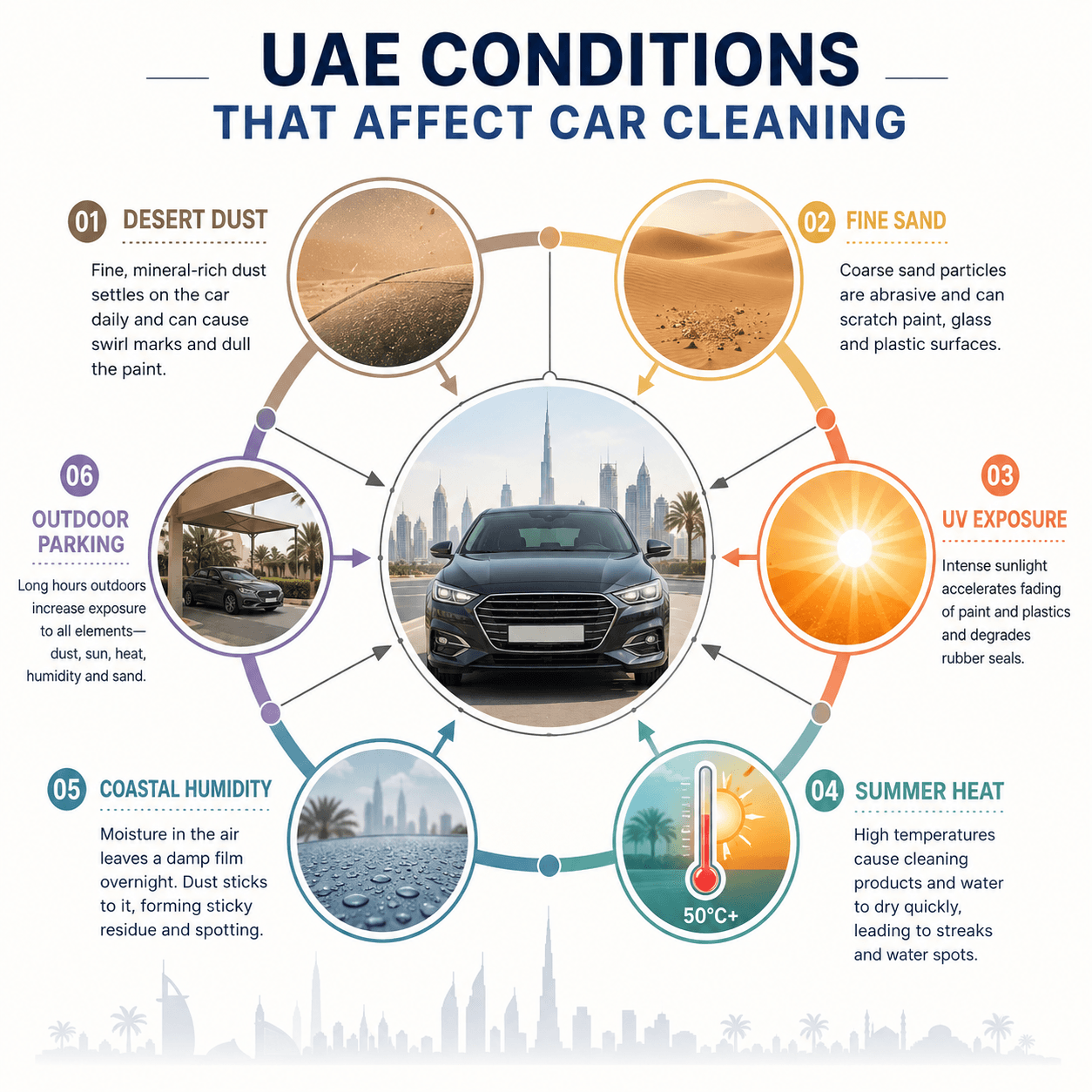
Vehicles in the UAE face a cluster of environmental pressures at the same time. Understanding each one explains why a tailored approach matters.
Desert dust is fine, mineral-rich, and almost constant. It settles on horizontal surfaces within hours and works into door seams, badge edges, and trim gaps. Because the particles are small and hard, they behave like a mild abrasive when dragged across paint or glass.
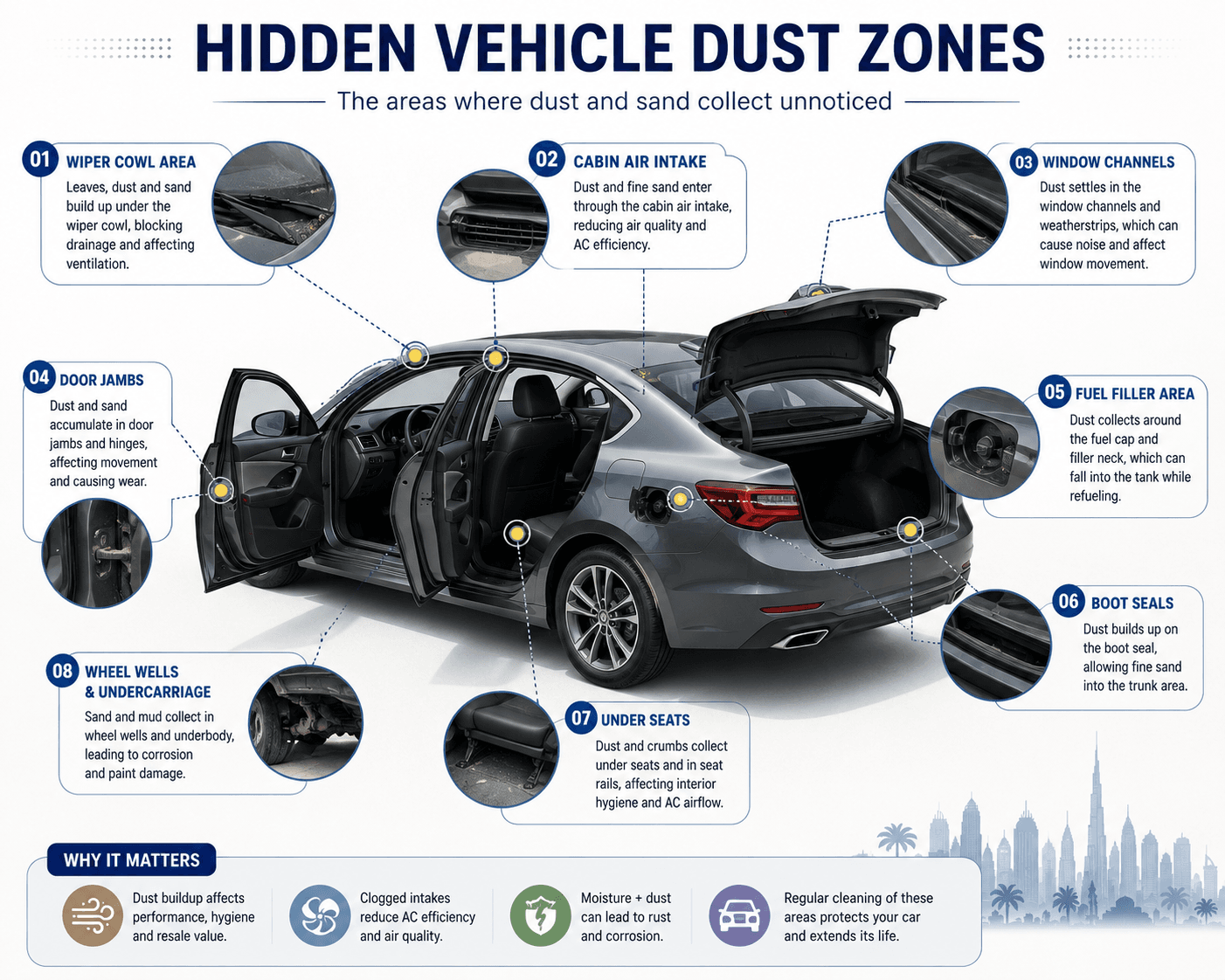
Fine sand particles are coarser than household dust and are commonly described as more aggressive on clear-coat finishes. After windy days or sandstorms, sand can build up in wheel wells, under wipers, and along window channels.
Ultraviolet exposure is high year-round. Strong sunlight is commonly associated with accelerated fading of paint, dashboard plastics, and trim, as well as degradation of rubber seals over time.
Summer temperatures regularly push surfaces well beyond comfortable handling levels. Hot panels cause water and cleaning products to dry quickly, which often leads to streaking and mineral spotting.
Coastal humidity in areas near the Gulf can leave a damp film overnight. When dust settles onto a humid surface, it is more likely to bond, forming the sticky residue many UAE drivers report after still, humid mornings.
Frequent outdoor parking, whether in open community lots, sandy plots, or uncovered driveways, increases exposure to all of the above. Even short daily commutes expose a vehicle to repeated dust settlement.
For broader context on why dust behaves the way it does in this region, the related guidance on dust and sand cleaning in UAE homes explains the same particle behavior that affects home surfaces and vehicles alike.
Car Cleaning Dubai vs Abu Dhabi vs Northern Emirates
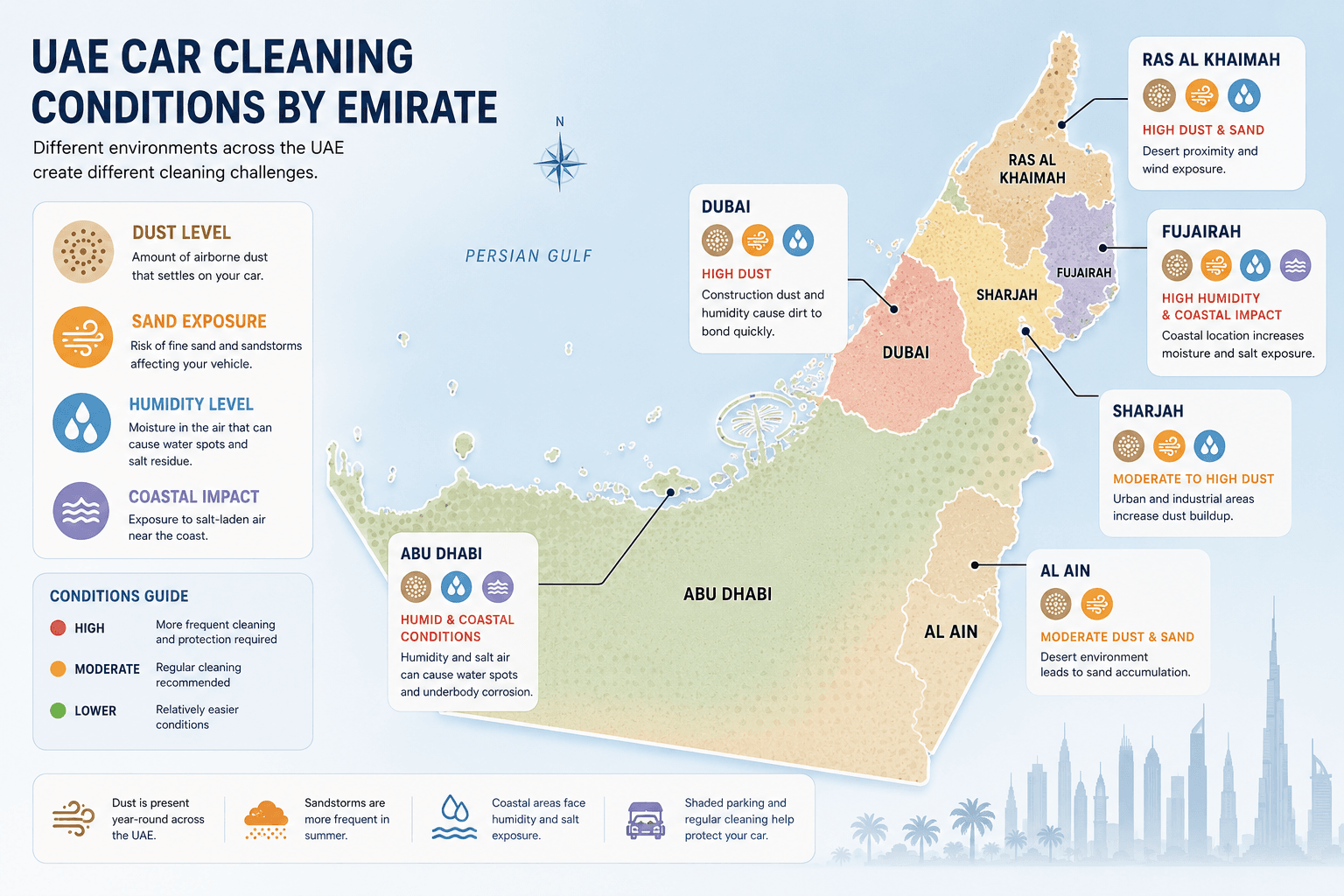
Conditions vary across the Emirates, and the dominant contamination type often shifts with location. The differences are general tendencies rather than fixed rules, but they help residents prioritise.
In Dubai, ongoing construction activity is a notable factor. Construction dust is often fine and gritty, and it can bond quickly in humidity, which is why pre-rinsing before any wiping is especially relevant for vehicles parked near active sites.
In Abu Dhabi and other coastal areas, humidity and salt-laden air are more prominent. A damp film overnight and salt residue on lower panels are commonly reported, so rinsing the underbody and wheels after time near the coast is a useful habit.
In Sharjah and parts of the industrial belt, a mix of urban and industrial dust tends to settle as a persistent film. Frequent gentle washing keeps this from building into a bonded layer.
In Ras Al Khaimah, Fujairah, and desert-adjacent areas, direct desert exposure increases coarse sand accumulation in wells, seals, and channels, particularly after windy periods.
| Area | Dominant Contamination | Practical Focus |
|---|---|---|
| Dubai | Construction and urban dust | Frequent washing, prompt pre-rinse |
| Abu Dhabi | Coastal humidity and salt | Underbody and wheel rinsing |
| Sharjah | Urban and industrial dust film | Regular gentle maintenance washes |
| Northern Emirates, RAK and Fujairah | Desert sand exposure | Clearing wells, seals, and channels |
The Hidden Cost of Poor Car Cleaning
Neglected cleaning rarely shows its full effect immediately. The cost tends to accumulate quietly across several areas.
Paint damage is the most visible long-term concern. Dragging dust and sand across a dry surface can create fine scratches and swirl marks. Over months, these dull the finish. Baked-on contamination and water spotting can etch into clear coat if left through repeated heat cycles.
Interior deterioration often follows UV and dust exposure. Dashboards, door cards, and trim can fade, crack, or develop a chalky surface. Fine dust settling into fabric and stitching is commonly associated with premature wear and persistent dullness.
Reduced resale value is a practical consequence in a market where presentation matters. Faded paint, cracked dashboards, sand-worn seats, and cloudy headlights all weigh on perceived condition.
AC performance impact can arise when dust accumulates around cabin air intakes and vents. A clogged cabin filter is often associated with weaker airflow and dust circulation inside the car, which mirrors the same issue covered for homes in the AC filter cleaning guide for UAE.
Visibility and safety concerns include hazy windscreens, sand-pitted glass, and dust-coated mirrors. Reduced clarity is most dangerous at dawn, dusk, and during low-sun glare, all common driving conditions in the UAE.
Common Sources of Vehicle Contamination in the UAE
Identifying where contamination comes from helps prioritise cleaning effort.
| Contamination Source | Typical Effect | Severity | Priority Response |
|---|---|---|---|
| Sandstorms | Heavy dust and sand layering on all surfaces | High | Rinse and safe removal soon after |
| Construction dust | Fine, often gritty film that bonds in humidity | Medium to High | Frequent gentle washing |
| Parking lots | Daily dust settlement and tyre debris | Medium | Routine rinsing and wiping |
| Beaches | Salt-laden air and sand on lower panels | Medium | Rinse underbody and wheels |
| Desert excursions | Sand packed into wells, seals, and interior | High | Thorough post-trip clean |
| Humidity-related film | Sticky dust bonding overnight | Medium | Pre-rinse before wiping |
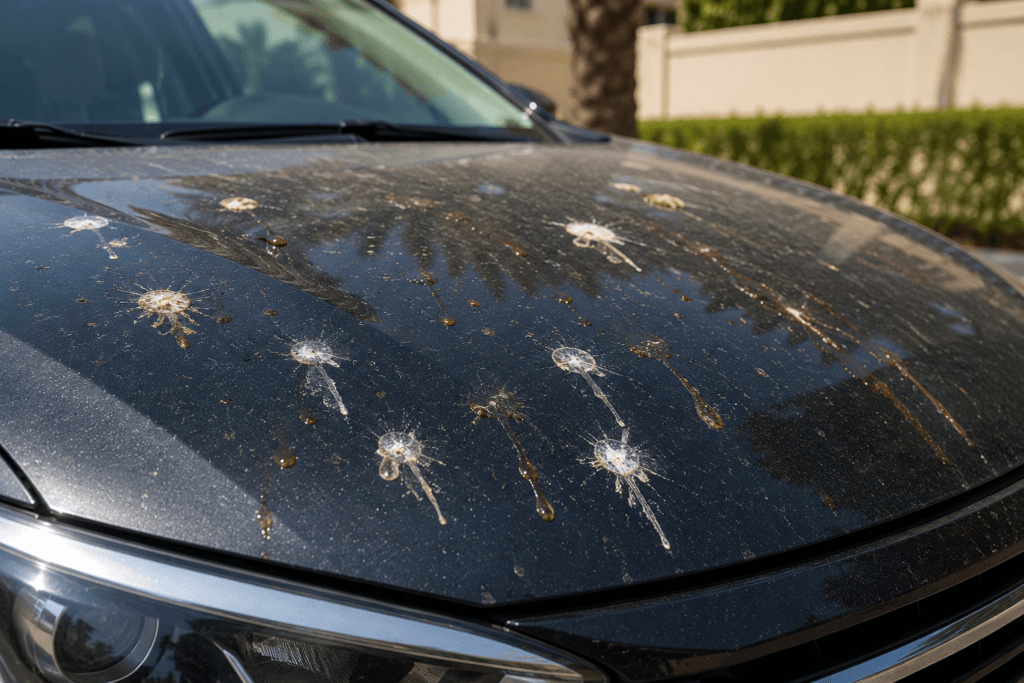
| Bird droppings | Acidic etching of clear coat | High | Remove promptly, do not scrub dry |
| Tree sap | Sticky residue that hardens in heat | Medium | Soften and lift gently |
Understanding UAE Vehicle Dust
Fine Dust vs Sand Particles
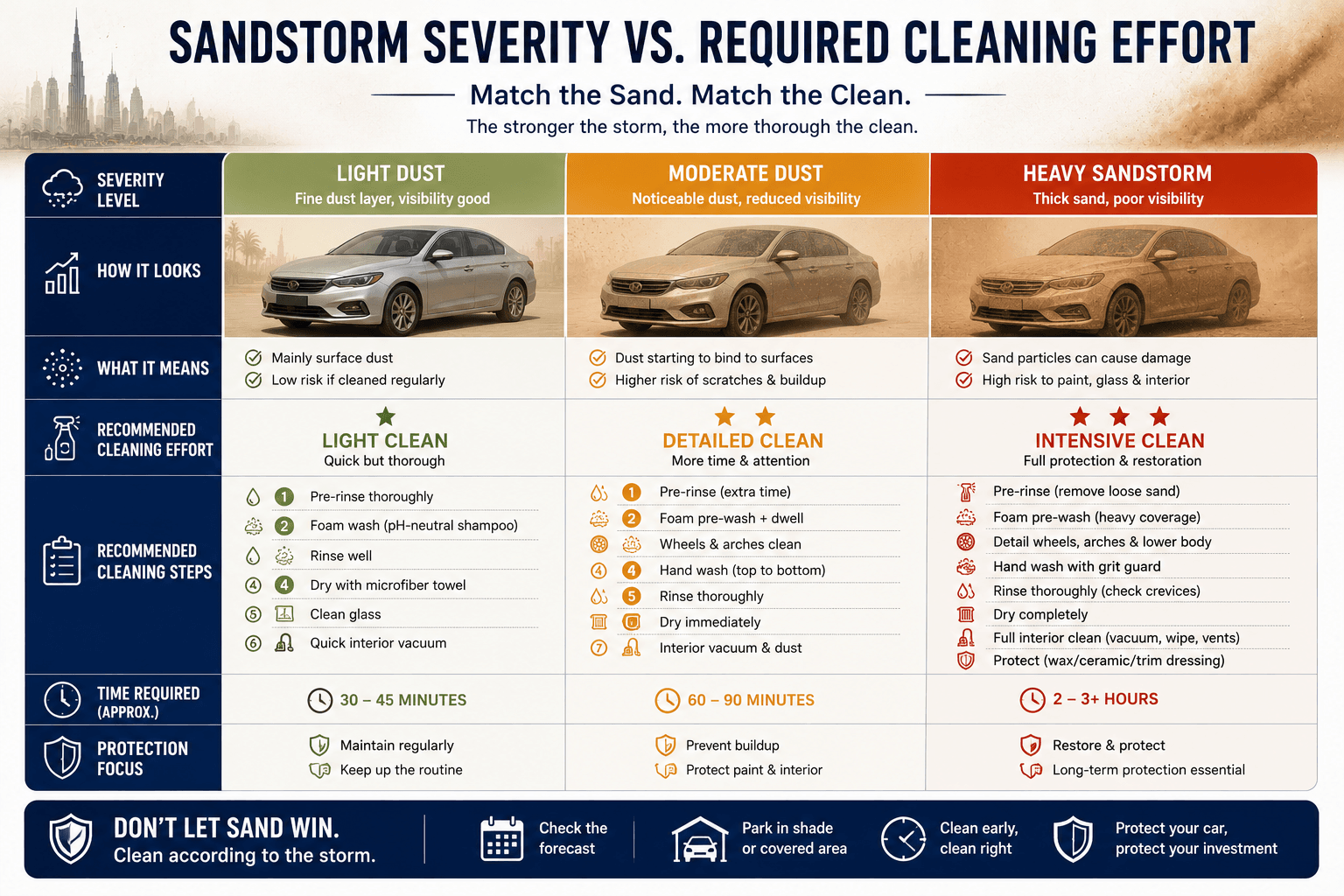
Fine dust and sand differ in size, weight, and behaviour. Fine dust is light, settles quickly, and clings to surfaces, especially when humidity is present. Sand is heavier and coarser, tends to collect in low points and channels, and is more likely to scratch when moved across a surface under pressure. Recognising the difference matters because dust often needs a gentle lift or rinse, while sand needs to be flooded or blown away rather than wiped.
How Dust Damages Paint
Paint damage from dust is mechanical rather than chemical in most cases. When a cloth or sponge drags hard particles across the clear coat, it can leave hairline scratches. Repeated dry contact builds visible swirl marks that scatter light and dull the finish. In humid conditions, dust can bond to the surface, and removing bonded dust without proper lubrication increases scratch risk further.
How Dust Damages Interior Surfaces
Inside the cabin, dust settles into vents, seams, fabric, and textured plastics. On dashboards exposed to direct sun, embedded dust combined with UV is commonly associated with a faded, chalky appearance over time. In fabric seats and carpets, fine particles work below the surface, where ordinary wiping cannot reach, contributing to gradual dulling and wear.
Why Dry Wiping Can Cause Scratches
Dry wiping is one of the most common causes of avoidable paint damage in the region. A dry cloth offers no lubrication, so any embedded grit is pressed and dragged directly against the finish. The practice is widespread because it appears quick and convenient, yet it is frequently linked to the swirl marks visible on many vehicles after months of daily dusting. Using a rinse or a quick-detailer lubricant before any contact reduces this risk substantially.
[INFOGRAPHIC PLACEMENT] Title: Fine Dust vs Sand Particles Description: A side-by-side comparison showing particle size, weight, settling behavior, and damage type for dust versus sand. Alt Text: Comparison infographic of dust and sand particles for car cleaning UAE
The UAE Car Cleaning System
A layered system keeps each task in the right order and prevents the most common forms of damage. The five layers move from preventing contamination, to handling it safely, to cleaning, and finally to protection.
Some product mentions in the following sections may include affiliate links. The guidance remains focused on method and prevention rather than specific purchases.
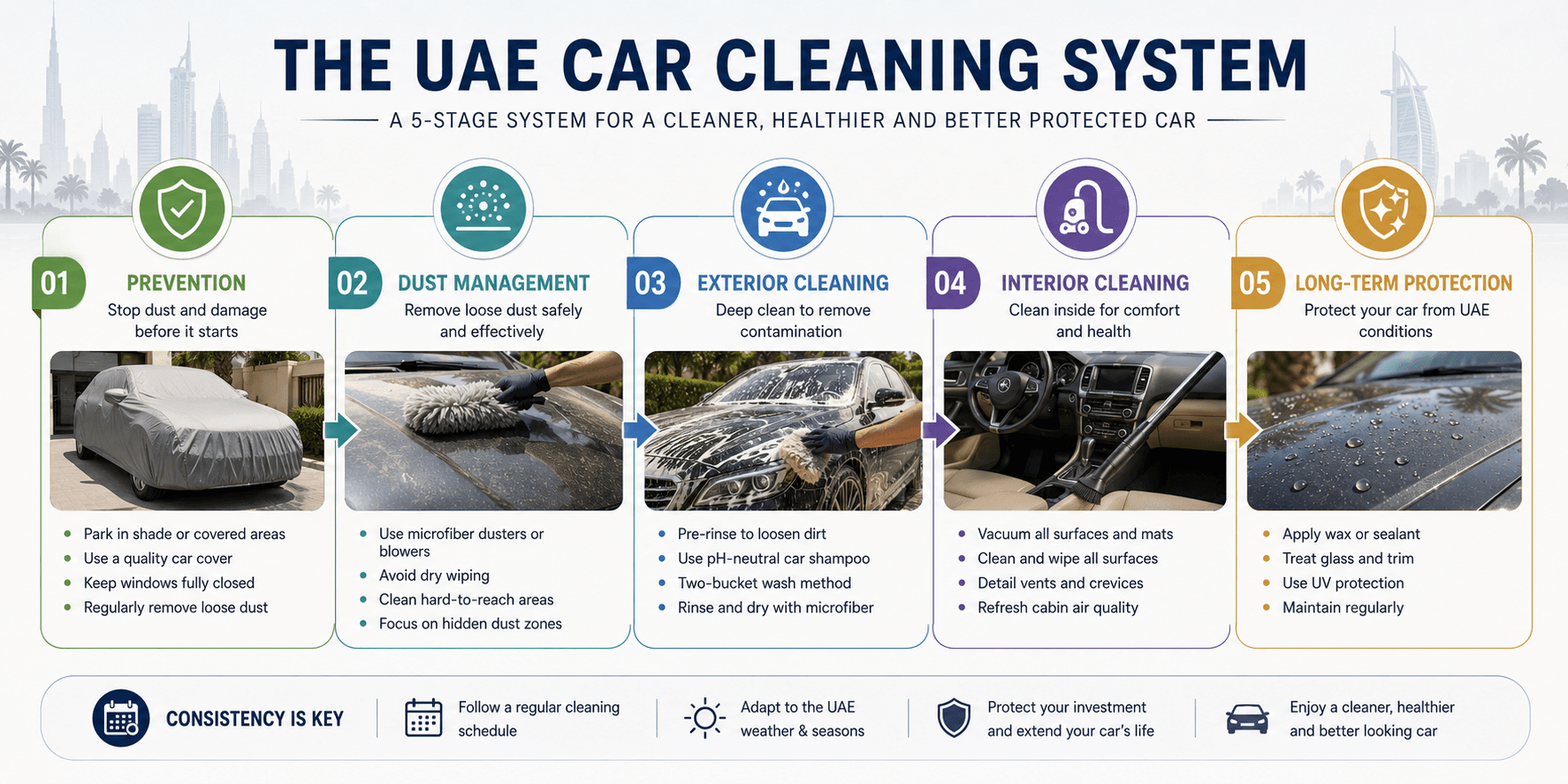
Layer 1 – Prevention
Prevention reduces how much cleaning is needed and how aggressive it must be.
Parking choices have the largest single effect. Covered, shaded, or basement parking limits dust settlement and UV exposure. Where only open parking is available, positioning away from sandy edges and construction activity helps.
Car covers protect against dust, sap, and droppings when parking outdoors for long periods. A breathable, well-fitted cover is preferable, since loose covers can flap and rub the paint in wind.
Window shades placed on the windscreen and side glass reduce cabin heat and slow dashboard fading. They also lower interior surface temperatures, which makes interior cleaning safer and more comfortable.
Garage considerations apply mostly to villa and townhouse residents. Keeping a garage swept and dust-controlled prevents the vehicle from collecting settled dust even while parked indoors.
Layer 2 – Dust Management
Dust management is the step most often skipped, yet it protects the paint more than any product.
Safe dust removal means lifting dust rather than grinding it in. A pre-rinse with water, a gentle leaf blower, or a quick-detailer spray paired with a clean microfibre cloth all lift particles with minimal friction. Pressure should stay light, and the cloth should be folded to a fresh face frequently. For long-parked vehicles, a breathable car cover and a rinseless wash product reduce how often abrasive contact is needed at all.
Pre-rinse principles apply before any wash. Flooding the surface with water loosens and floats away the bulk of dust and sand, so the wash mitt encounters far less grit. This single habit prevents most wash-induced scratching.
Sandstorm response should be prompt but careful. After a storm, the priority is to rinse heavy sand off before any contact wiping. The same staged approach used for homes after a storm, described in the post-sandstorm cleaning guide for UAE, applies to vehicles: clear the loose material first, then clean, then protect.
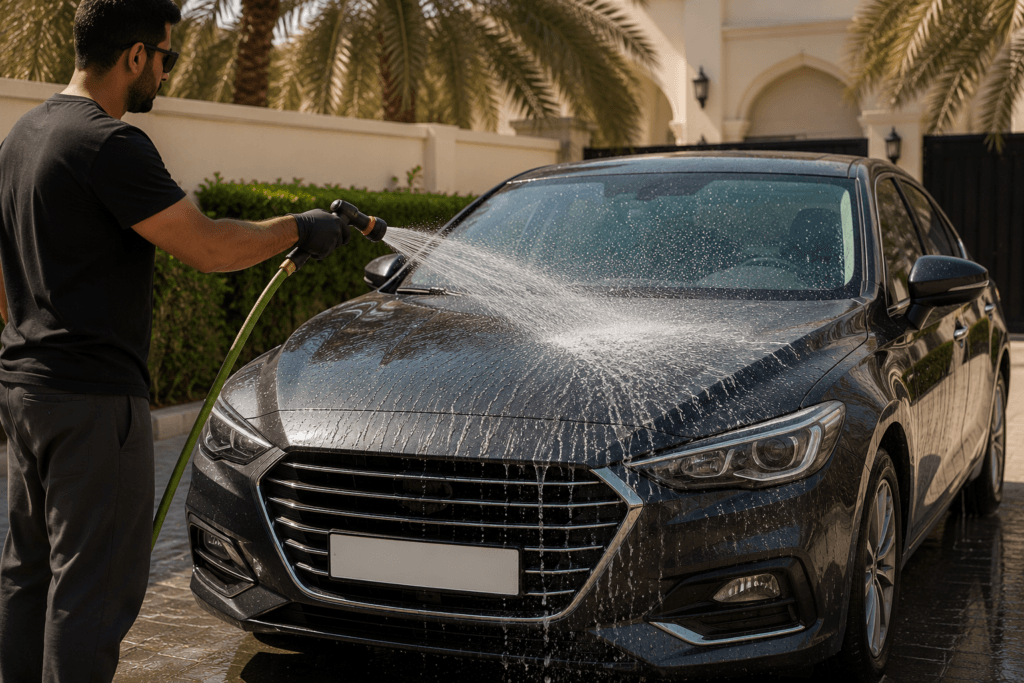
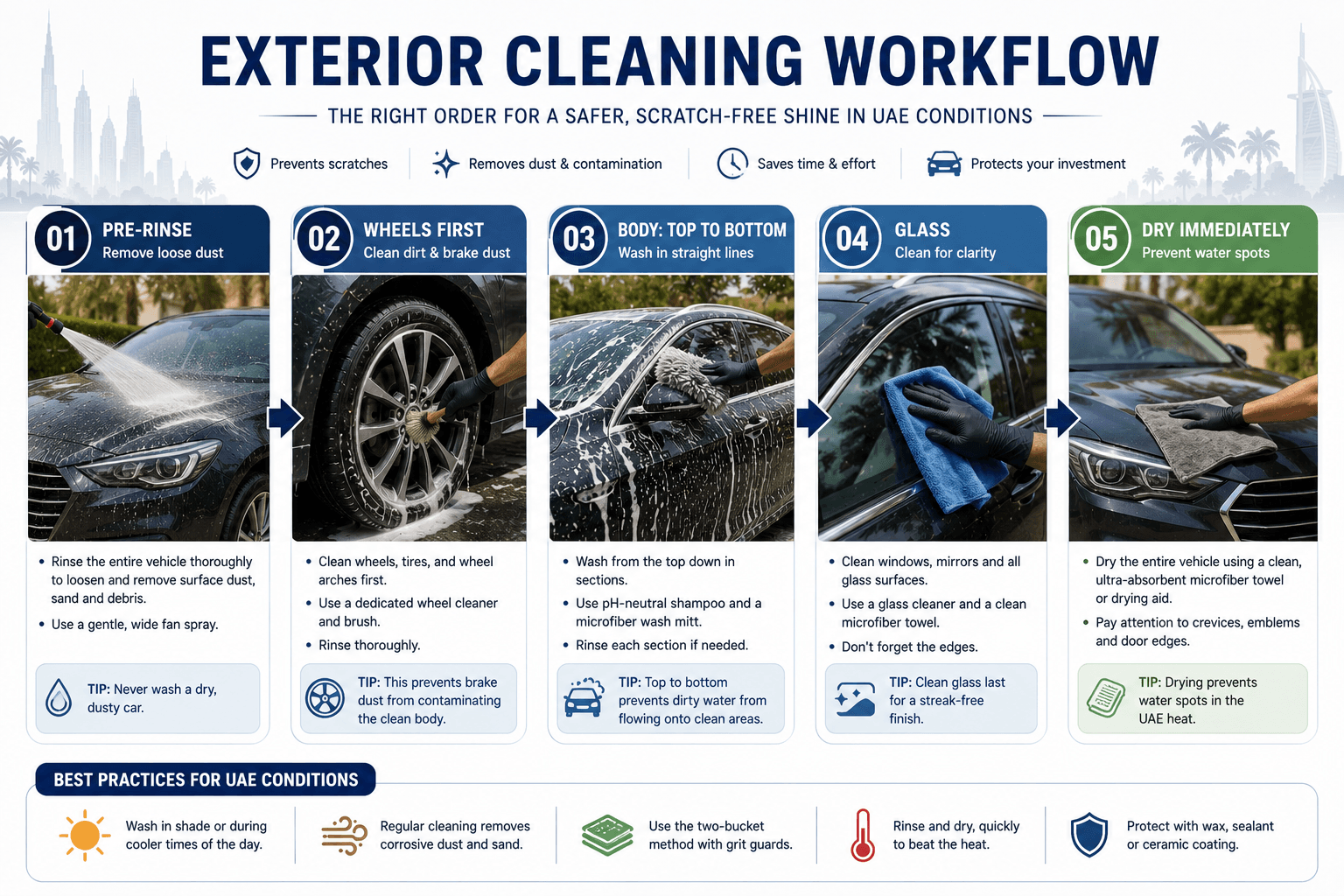
Layer 3 – Exterior Cleaning
Exterior cleaning is most effective when done during cooler hours, in shade, and from the dirtiest areas to the cleanest.
Wheels are usually the dirtiest part and are cleaned first to avoid splashing grime onto clean panels. Brake dust, sand, and road grime collect here and in the wheel wells.
Tyres benefit from a rinse and a dedicated cleaner, with a water-based dressing applied afterward to limit cracking from heat and UV.
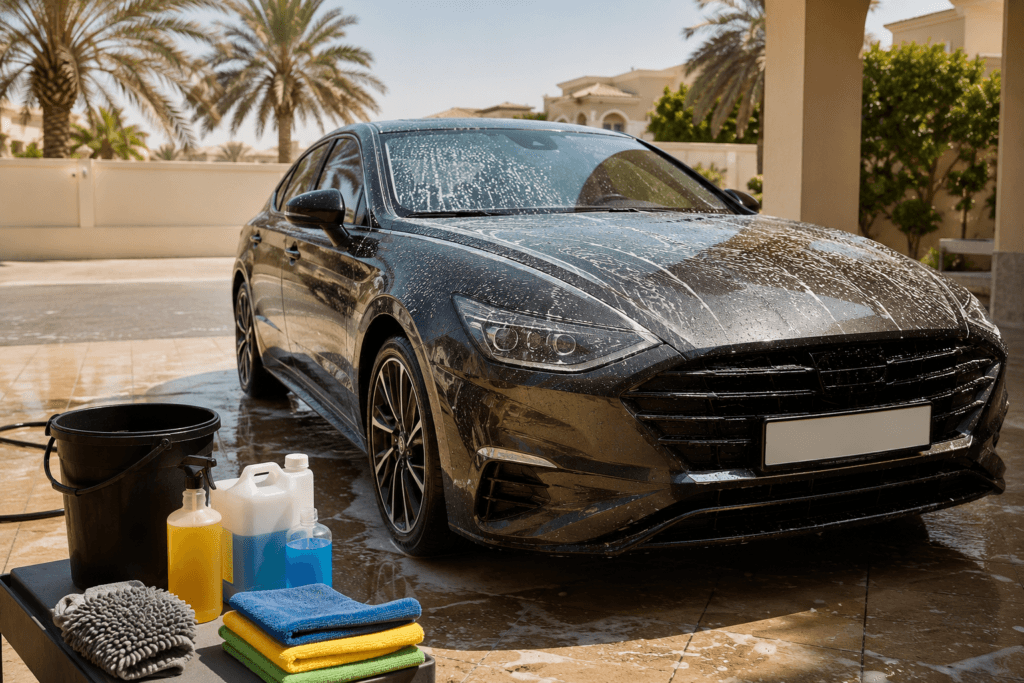
Body panels are washed top to bottom using the two-bucket method where possible: one bucket for clean soapy solution and one for rinsing the mitt. A clean wash mitt and a separate drying towel reduce the risk of dragging grit across the finish. Sections should be rinsed before the solution dries.
Glass is cleaned after the body, using a glass-specific cleaner and a separate cloth to avoid wax smearing. Streaks form quickly in heat, so working in shade and drying promptly helps.
Mirrors collect dust along edges and housings. A detailing brush or cotton swab helps reach the seams where sand gathers.
Drying immediately with a clean microfibre or drying towel prevents mineral spotting, which is a frequent problem when water evaporates on hot panels before it can be removed.
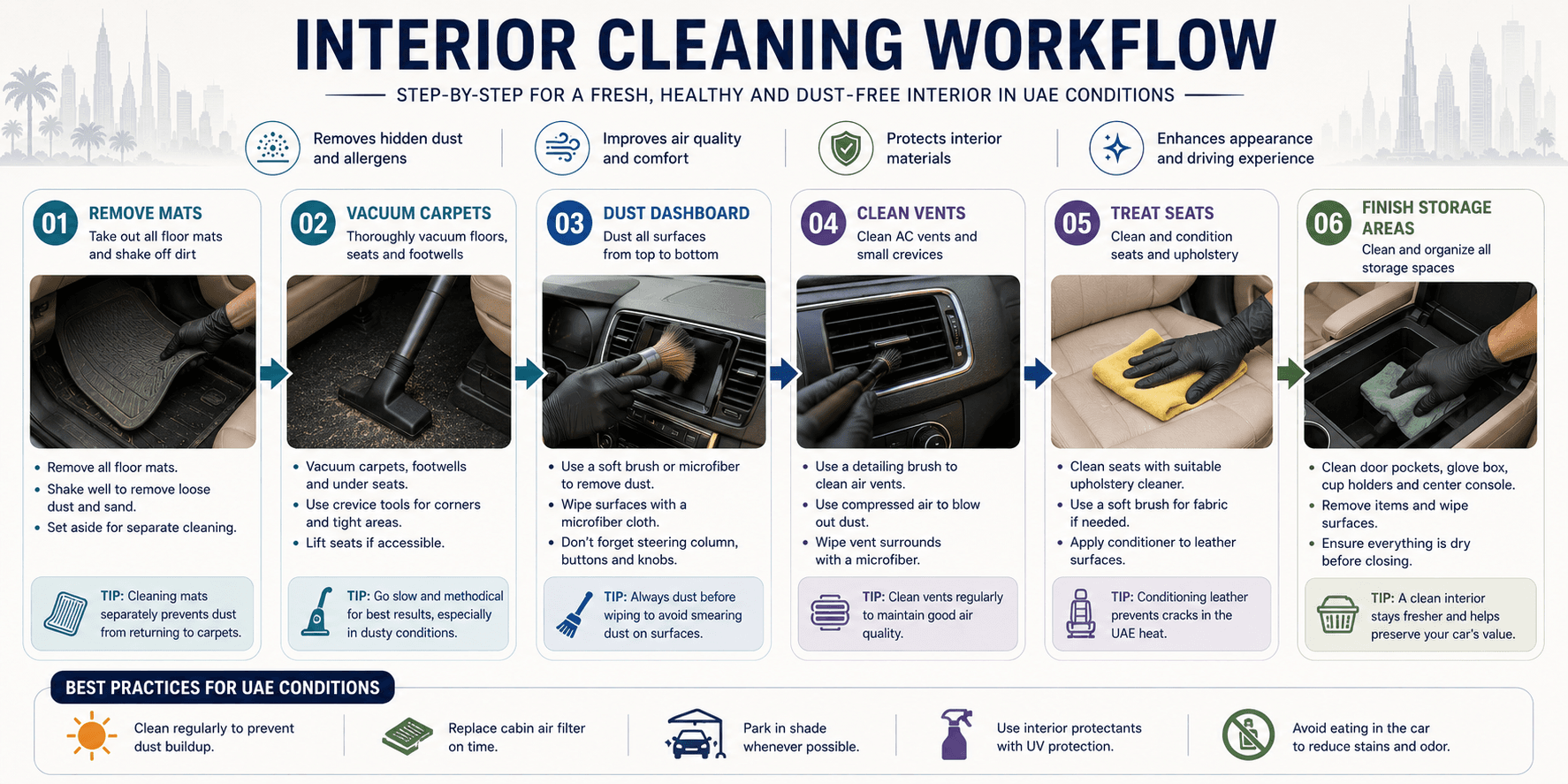
Layer 4 – Interior Cleaning
Interior cleaning addresses both appearance and air quality inside the cabin.
Dashboard surfaces should be dusted with a soft brush or microfibre, then wiped with a slightly damp cloth or a UV-protective dressing. Dry wiping a dusty dashboard can scratch glossy trim.
Seats vary by material. Fabric seats benefit from vacuuming followed by spot cleaning, while leather seats respond to a damp wipe and a conditioner suited to leather.
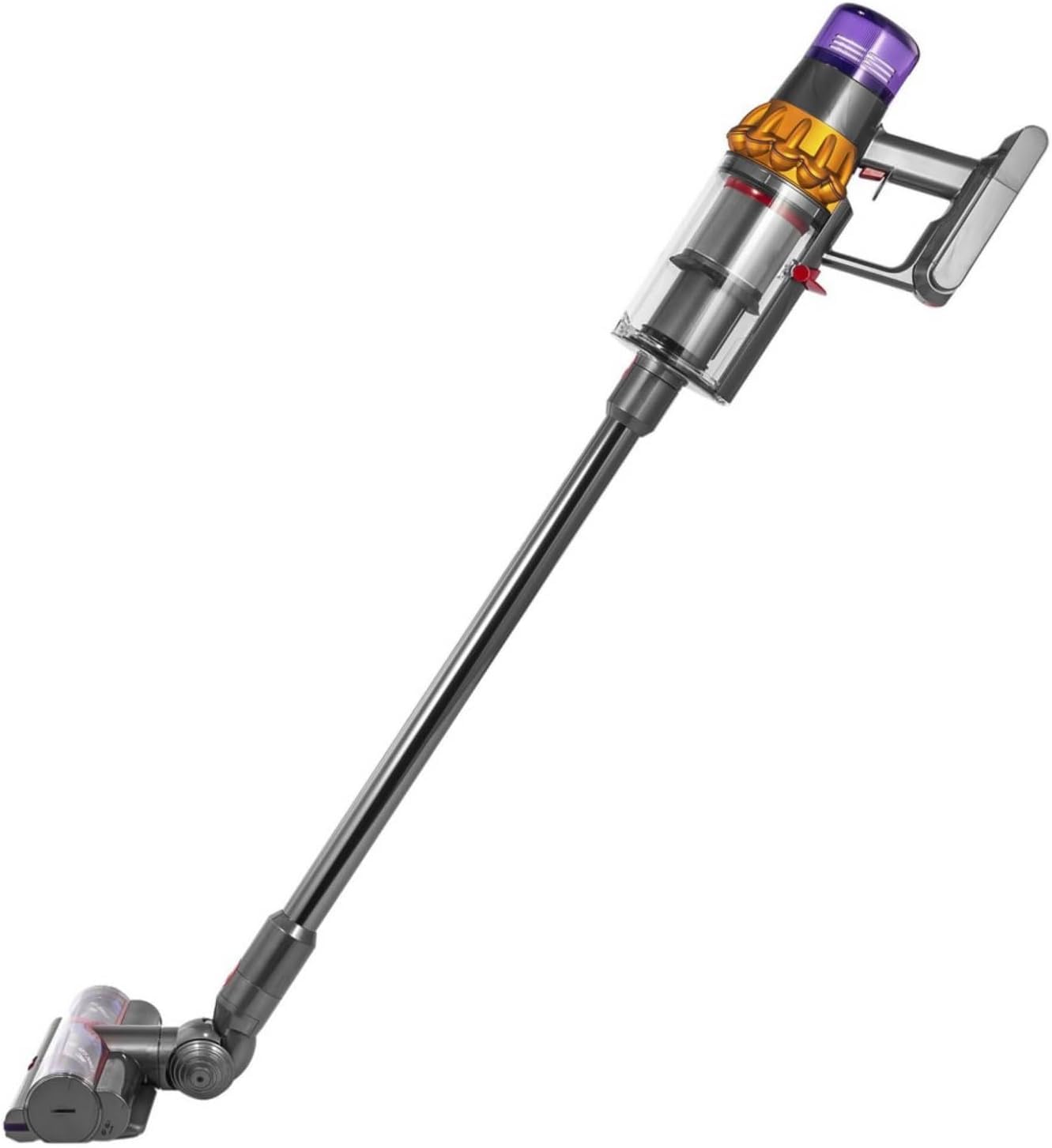
Carpets and floor mats hold the most embedded sand. Removing mats, shaking them out, and vacuuming both the mats and the carpet beneath reaches grit that surface wiping misses. A cordless vacuum is convenient for this and for quick weekly upkeep, similar to the home use described in the guide to cordless vacuums in the UAE. A set of detailing brushes also helps lift dust from vents and seams.
Floor mats deserve separate attention because rubber or all-weather mats trap and contain sand effectively and are easy to rinse.
Storage compartments such as door pockets, cup holders, and the centre console collect fine dust and debris. A detailing brush and a small vacuum nozzle clear these areas.
Layer 5 – Long-Term Protection
Protection extends the results of cleaning and reduces future effort.
Waxing or sealing adds a sacrificial layer that helps water and dust release more easily and offers some UV resistance. In high heat, products formulated for warm climates tend to last longer.
Paint protection options range from synthetic sealants to ceramic coatings. These are commonly associated with easier cleaning and better resistance to dust bonding, though they do not eliminate the need for routine washing.
Interior UV protection through dressings on the dashboard and trim, combined with window shades, slows fading and cracking that strong sunlight is known to accelerate.
Rubber seal maintenance involves cleaning and conditioning door and window seals so they stay flexible. Dried, brittle seals are commonly linked to wind noise, leaks, and dust entry into the cabin.
Apartment vs Villa Car Cleaning Strategies
Living situation strongly influences what cleaning approach is practical. The constraints differ, so the strategy should too.
| Factor | Apartment Residents | Villa Residents |
|---|---|---|
| Parking type | Basement or shared community parking | Private driveway or garage |
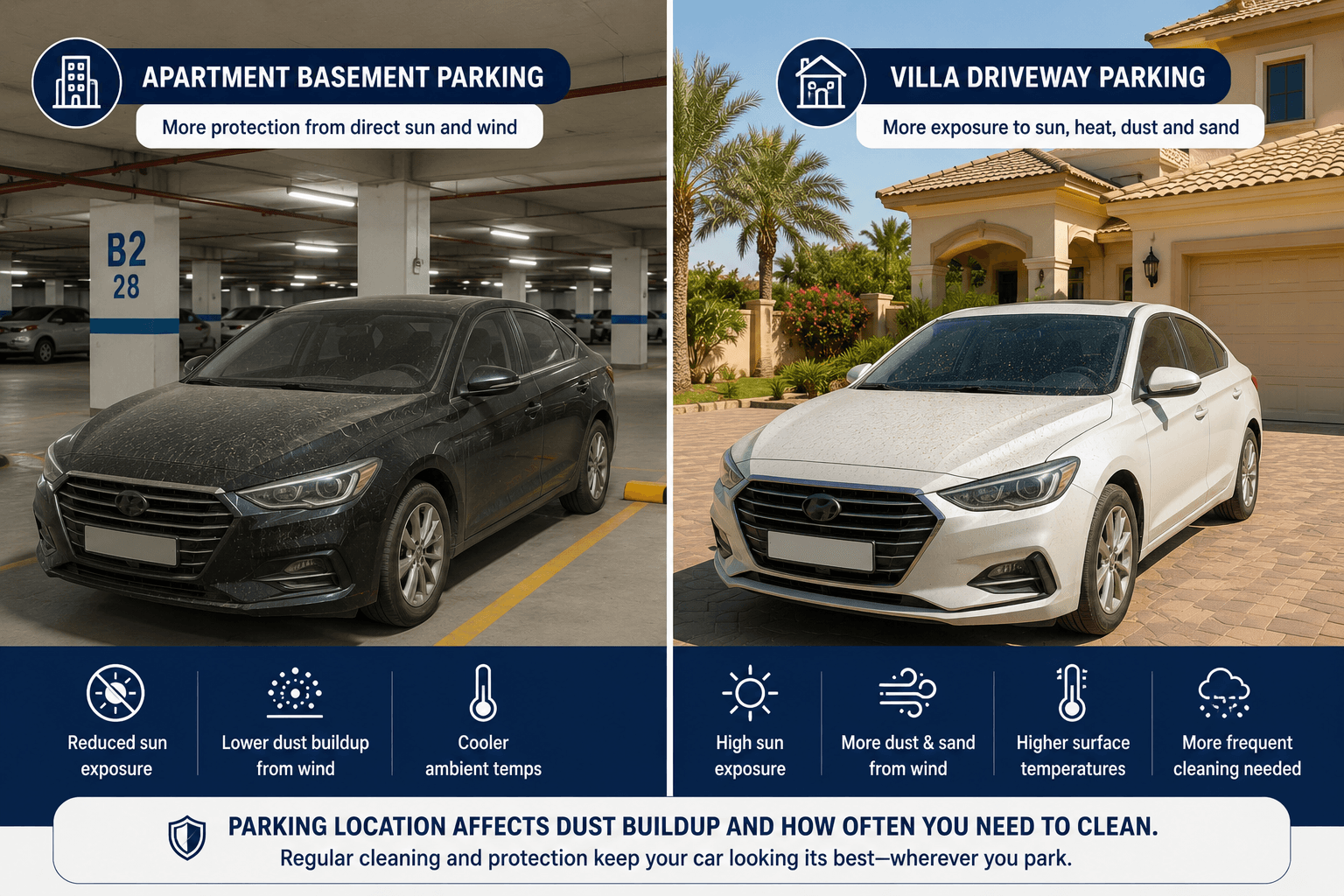
| Dust exposure | Often lower if covered, higher in open lots | Higher with outdoor exposure |
| Water access | Often limited or restricted | Usually available outdoors |
| Suitable methods | Rinseless or waterless washing, quick detailing | Full two-bucket washing possible |
| Cleaning area | Restricted, may rely on building rules | Larger working space |
| Frequency need | Frequent light maintenance | Regular full washes plus upkeep |
Apartment Residents
Apartment residents often park in basement or shared community spaces. Basement parking reduces dust and UV but may restrict washing. Community parking can vary from sheltered to fully exposed. Where water access is limited, rinseless or waterless washing methods and quick-detailer maintenance are practical, since they require minimal water and can be done in a designated area where building rules allow. Light, frequent upkeep suits this setting better than occasional heavy washing. The space-efficient approach overlaps with the ideas in the small apartment cleaning setup guide for the UAE.
Villa Residents
Villa residents usually have driveway or garage access and more space. This allows full washing with a pre-rinse and the two-bucket method. The trade-off is greater outdoor exposure, especially for vehicles left in open driveways through the day. Larger cleaning areas make it easier to address wheels, underbody, and interior thoroughly, but the same heat and timing rules apply: work in shade and during cooler hours.
Car Cleaning Methods Comparison
The method that suits a vehicle depends largely on water access and living situation. The comparison below summarises the main options.
| Method | Water Use | Apartment Friendly | Sand Removal |
|---|---|---|---|
| Traditional wash | High | Moderate | Excellent |
| Rinseless wash | Low | Excellent | Good |
| Waterless wash | Very low | Excellent | Light dust only |
Traditional washing with a pre-rinse remains the most thorough option for heavy sand, which makes it well suited to villa driveways. Rinseless and waterless methods suit apartment residents with limited water access, with the caveat that waterless products are best reserved for light dust rather than heavy post-sandstorm contamination.
UAE Car Cleaning Schedule by Parking Type
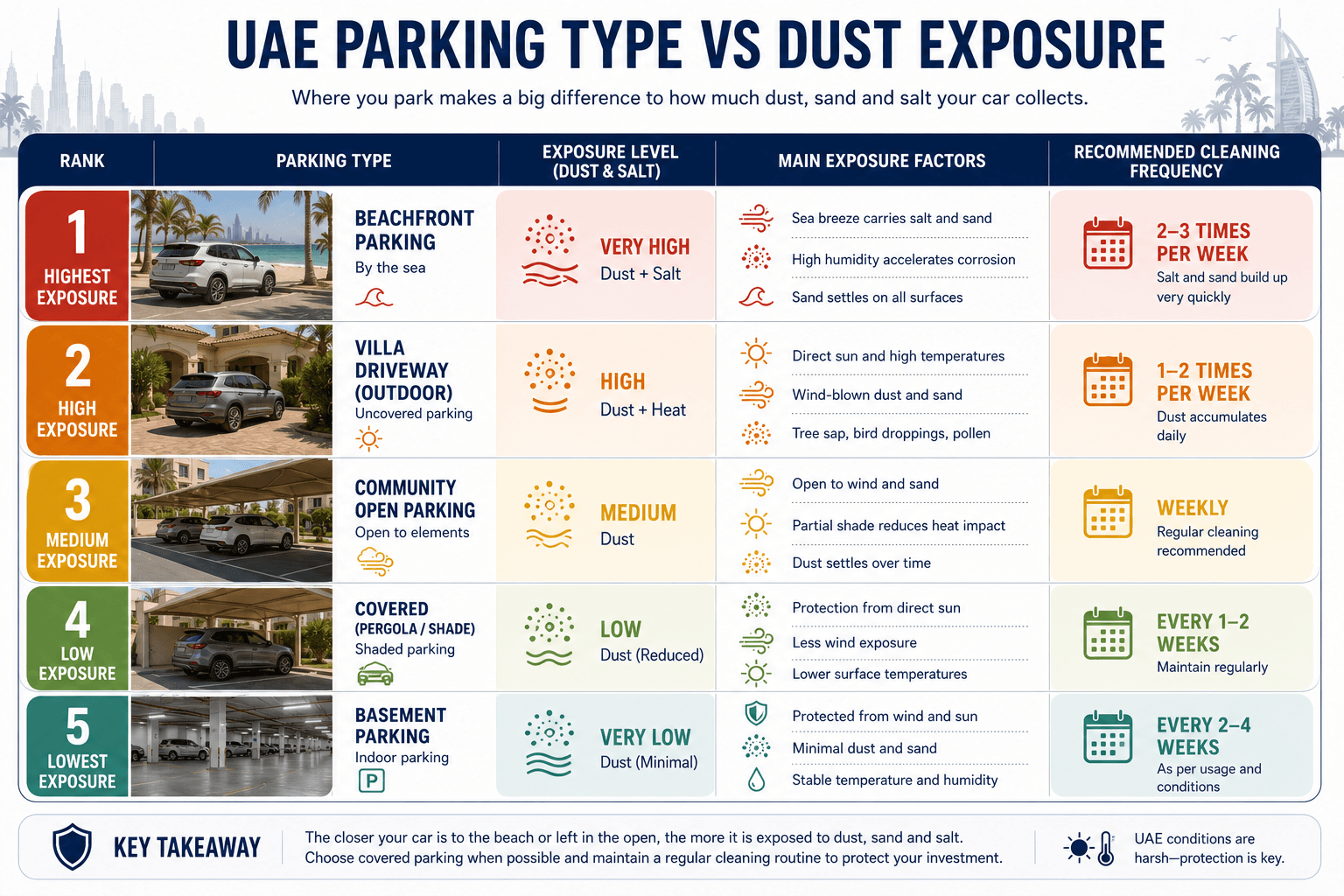
Parking type is one of the strongest predictors of how often a vehicle needs attention, because it determines exposure to dust, sun, and salt air. The frequencies below are practical baselines that should be adjusted up during sandstorm season.
| Parking Type | Recommended Wash Frequency |
|---|---|
| Basement parking | Every 2 to 3 weeks |
| Covered parking | Every 1 to 2 weeks |
| Outdoor community parking | Weekly |
| Villa driveway | Weekly |
| Beachfront areas | Weekly plus salt rinse |
Car Washing Rules in UAE Communities
Where and how a vehicle can be washed is not always a free choice in the UAE, so it is worth checking local rules before setting up a routine.
Many apartment communities restrict washing in driveways, parking lots, or basement bays, often for drainage, hygiene, or shared-space reasons. Some buildings designate a specific area or permit only approved mobile or in-house services.
Residents should check their building management or community guidelines before washing on site, since penalties or warnings can apply in stricter developments.
Water-use restrictions may also apply in certain communities or during specific periods, which is one reason rinseless and waterless methods are popular among apartment residents in the UAE.
Best Time to Wash Your Car in UAE
Timing affects results as much as method, because surface temperature, sunlight, and dust conditions change through the day and across seasons. The guidance below is a practical baseline.
| Season | Best Time to Wash |
|---|---|
| Summer | Before 8 AM or after sunset |
| Winter | Morning or afternoon |
| Sandstorm period | After the dust settles and wind reduces |
Washing on cool panels and out of direct sun is the consistent principle in all seasons. During summer in particular, early morning or evening washing avoids the rapid drying that causes streaking and water spotting on hot surfaces.
Seasonal Car Cleaning UAE
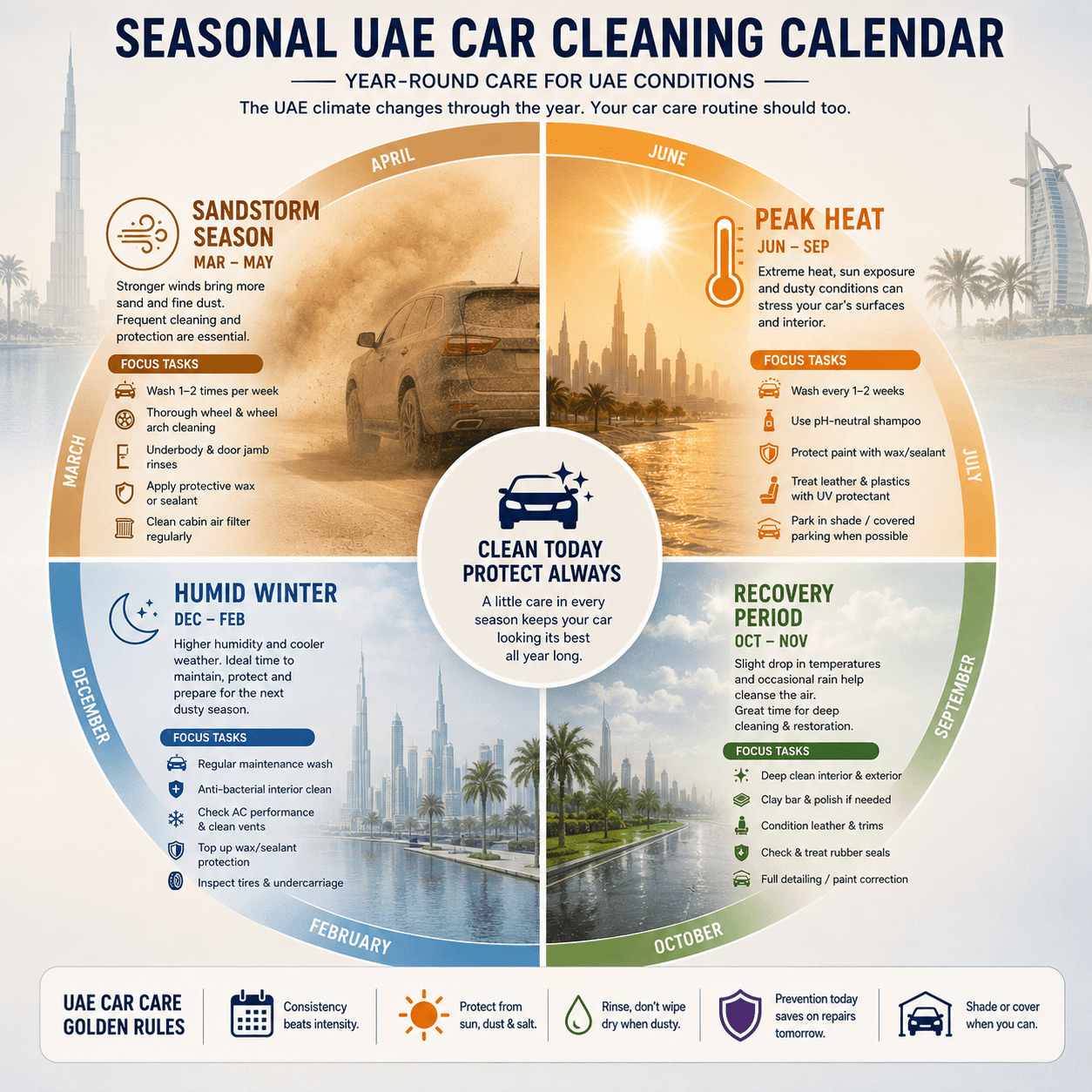
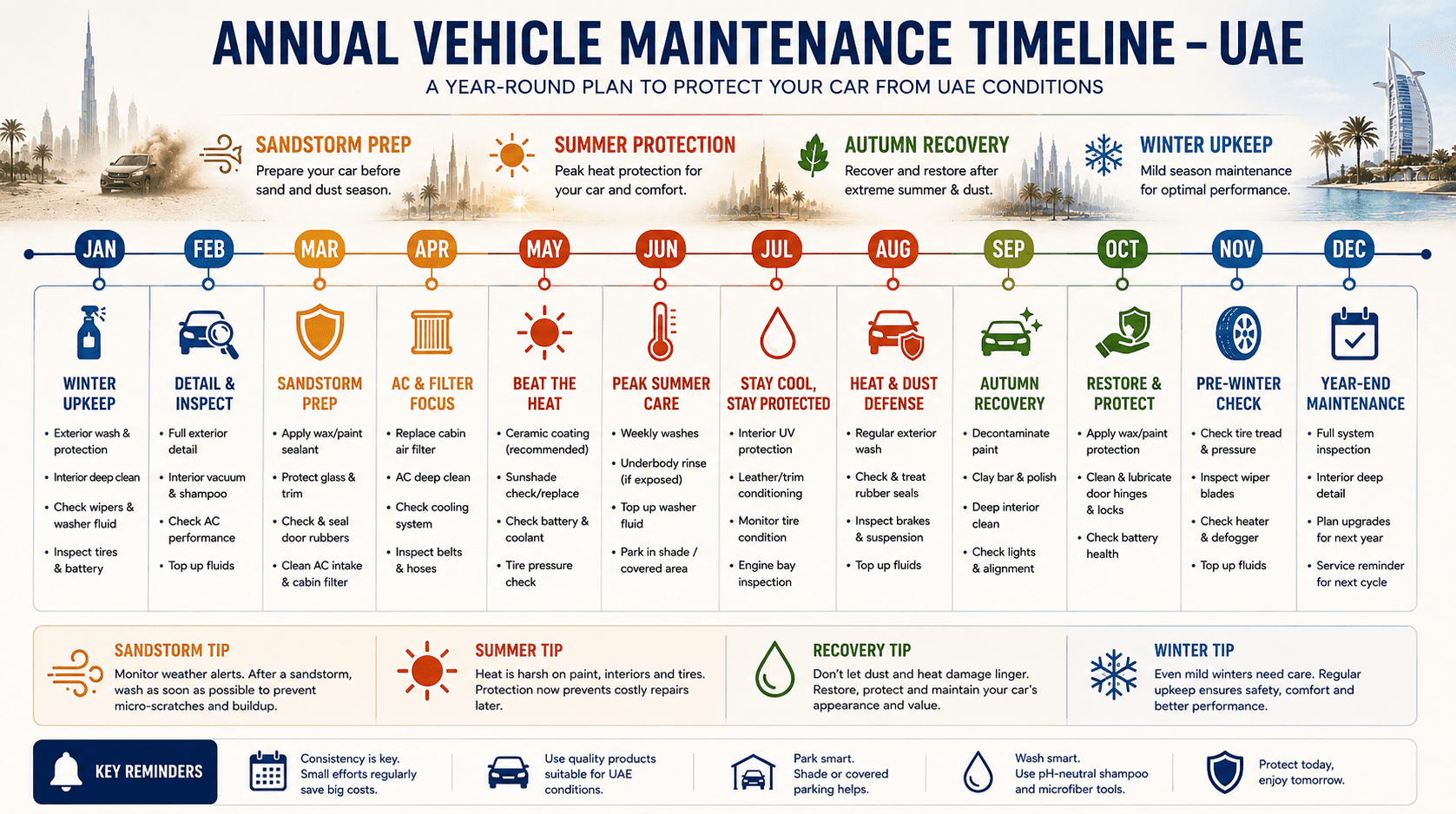
UAE conditions shift through the year, and cleaning effort can be planned around them. The seasonal pattern is a guideline, since weather varies by year and emirate.
| Season | Main Challenge | Cleaning Focus |
|---|---|---|
| Spring, March to May | Sandstorms and rising dust | Prompt rinsing, frequent dust management |
| Summer, June to September | Extreme heat and UV | Cooler-hour washing, UV protection, water spotting control |
| Autumn, October to November | Recovery from summer wear | Deeper cleaning, paint and interior restoration |
| Winter, December to February | Humidity, fog, and outdoor use | Glass clarity, seal care, regular upkeep |
Spring Sandstorm Season
Spring brings the most active dust and sandstorm conditions. The priority is prompt rinsing after windy days and consistent dust management before any wiping. Keeping a cover ready and checking window channels and wiper bases for sand are useful habits during this period.
Summer Heat Management
Summer is dominated by heat and UV. Washing is safest in early morning or after sunset, in shade, on cool panels. Water and products dry rapidly on hot surfaces, so working one small section at a time and drying immediately controls spotting. Window shades, interior UV protection, and warm-climate wax become especially valuable now. The same heat-management thinking used for homes in the summer dust survival guide for the UAE applies to vehicles.
Autumn Recovery Cleaning
As temperatures ease, autumn is a practical time for a more thorough clean to address the cumulative effect of summer. This may include a deeper paint clean, reapplying protection, and a detailed interior session to remove embedded dust built up over the hottest months.
Winter Maintenance
Winter brings cooler air, occasional fog, and higher humidity in some areas. Glass clarity and demisting matter more for safe driving, and seals benefit from conditioning. Outdoor use tends to increase in cooler weather, so regular upkeep keeps dust under control. For a wider seasonal framework that pairs with vehicle care, see the seasonal cleaning guide for the UAE.
Car Interior Cleaning in UAE Conditions
The cabin requires its own attention because dust, heat, and humidity affect it differently from the exterior.
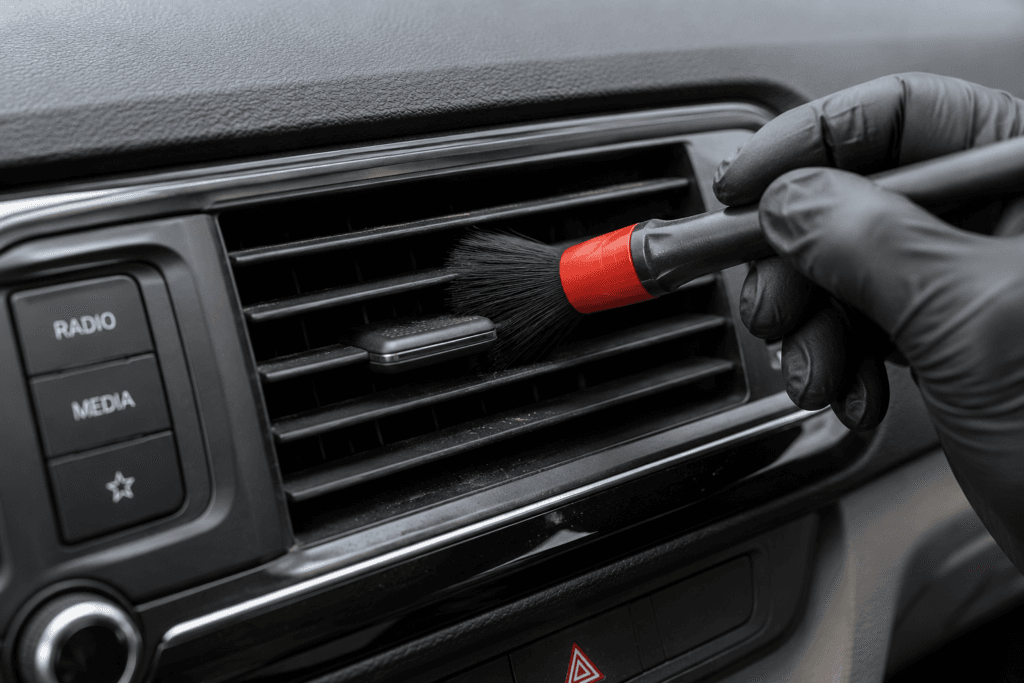
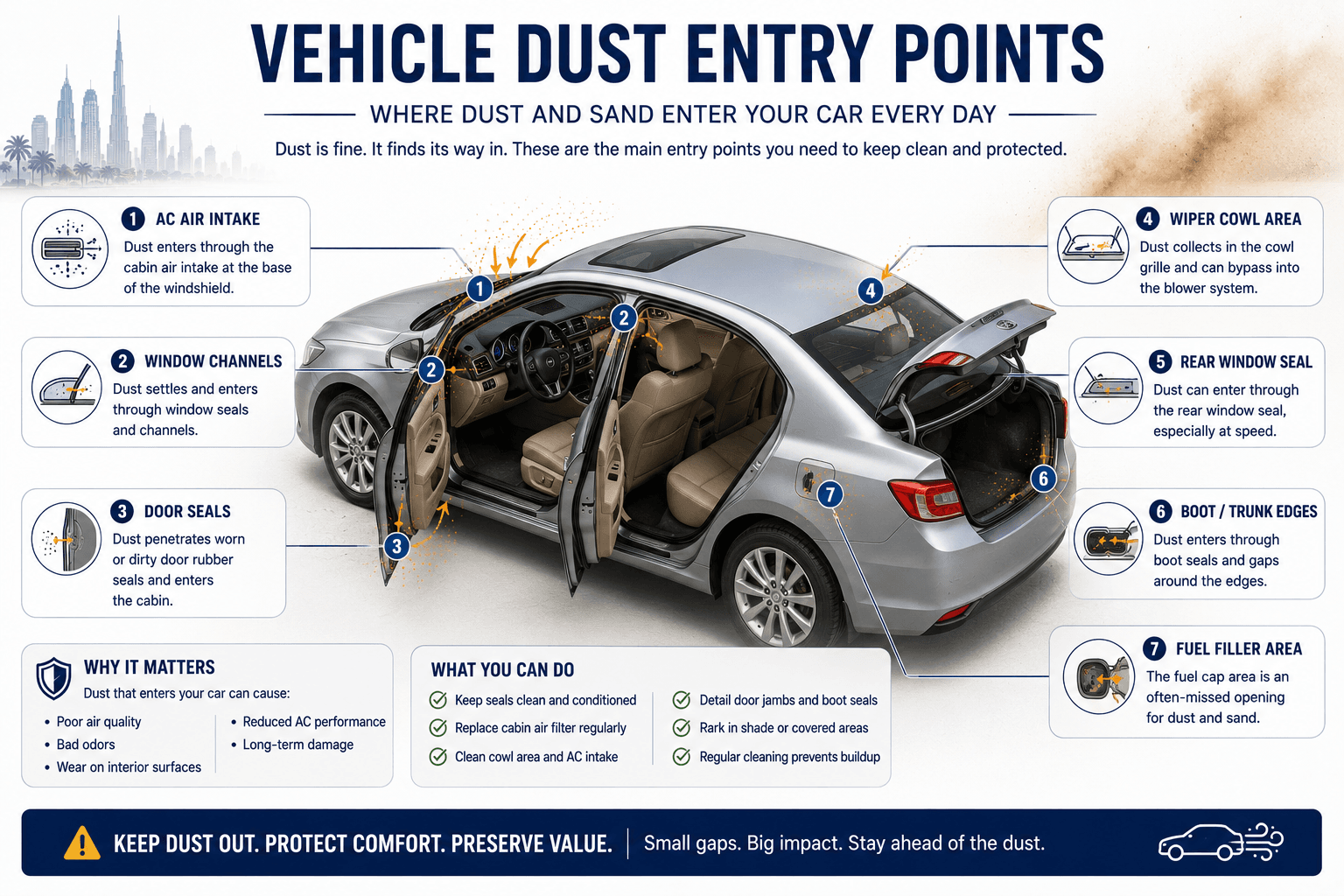
AC vents collect fine dust along their slats. A soft detailing brush, a small vacuum nozzle, or low-pressure air clears them without pushing dust deeper into the system.
Cabin filters in many vehicles trap incoming dust. When a cabin filter becomes saturated, reduced airflow and dust circulation inside the car are commonly reported. Checking and replacing it according to the vehicle manual is a practical maintenance step in dusty conditions.
Dust accumulation points include the dashboard top, door tops, the rear parcel shelf, seat seams, and the area around gear levers. Addressing these regularly prevents visible buildup.
Fabric care relies on vacuuming first, then spot cleaning stains with a suitable upholstery cleaner. Letting fabric dry fully avoids trapped moisture, which humidity can otherwise prolong. The same principles used for home seating in the guide to upholstery cleaning tools for the UAE apply to car seats.
For a complete product-focused checklist, see our guide to best car cleaning tools UAE.
Leather care uses a damp wipe followed by a conditioner formulated for leather. Conditioning helps counter the drying effect of heat and UV that is commonly linked to cracking over time.
Child seat cleaning should follow the seat manufacturer guidance. Removable covers can usually be washed, and the seat structure benefits from vacuuming sand and crumbs from crevices.
Interior Material Care
| Material | Recommended Approach | What to Avoid |
|---|---|---|
| Dashboard plastics | Soft dusting, damp wipe, UV dressing | Dry wiping, high-gloss greasy products |
| Leather seats | Damp wipe, leather conditioner | Harsh solvents, soaking |
| Fabric seats | Vacuum, then spot clean | Over-wetting, leaving damp fabric |
| Carpets and mats | Vacuum, shake out, rinse rubber mats | Surface wiping only |
| Glass interior | Glass cleaner, separate cloth | Wax-contaminated cloths |
| Rubber seals | Clean and condition | Letting them dry and crack |
Car Glass and Visibility Maintenance
Clear glass is a safety matter as much as an appearance one, given frequent low-sun glare and dusty air.
Windscreens accumulate a fine film that becomes obvious under direct sun. Cleaning inside and out, with separate cloths, reduces glare and streaking. Functioning wipers and topped-up washer fluid help clear sudden dust.
Side windows collect dust along the top edge where they retract. Lowering the window slightly to clean the upper strip reaches the part that otherwise stays dirty.
Mirrors need both the glass and the housing cleaned, since sand collects in the seams and at the base.
Sand abrasion prevention matters because repeated dry wiping of gritty glass can leave fine scratches and, over time, a hazy surface. Rinsing or lubricating before wiping protects glass clarity just as it protects paint.
How Car Cleaning Connects to Home Dust Management
Vehicle cleaning and home dust control are closely linked in the UAE, and treating them together produces better results than handling either alone.
Sand and dust enter homes via vehicles. Particles cling to clothing, bags, and shoes after a drive, then transfer indoors. A clean cabin reduces how much of this travels into living spaces.
Floor mats are a major transfer point. Car mats that hold sand carry it into garages and entryways, and indoor entry mats then catch what makes it to the door. Pairing both, as covered in the guide to entry mats for the UAE, interrupts the chain.
Garage dust affects villas. A dusty garage settles onto a parked vehicle and is then walked into the home, so garage upkeep supports both car and home cleanliness.
Parking garages affect apartments. Communal basement parking can carry fine dust into lifts and corridors, which eventually reaches apartments. Keeping the vehicle and its mats clean limits the dust an apartment resident brings upstairs. The broader household approach is set out in the dust and sand cleaning hub.
Common Car Cleaning Mistakes in the UAE
Several recurring habits cause most avoidable damage in local conditions.
Dry dust wiping drags hard particles across paint and glass and is the leading cause of swirl marks. A rinse or detailer spray first prevents this.
Washing during peak heat causes rapid drying, streaking, and mineral spotting. Cooler hours and shade solve it.
Using dirty cloths reintroduces grit to clean surfaces. Folding to fresh faces and washing cloths regularly keeps them safe to use.
Ignoring wheel wells allows packed sand and brake grime to build up, which can affect both appearance and components.
Neglecting interior dust lets fine particles embed in fabric and vents, contributing to wear and weaker airflow.
Delaying sandstorm cleanup allows sand to bond in humidity and sit against paint and glass longer, increasing the chance of damage.
Recommended Car Cleaning Frequency
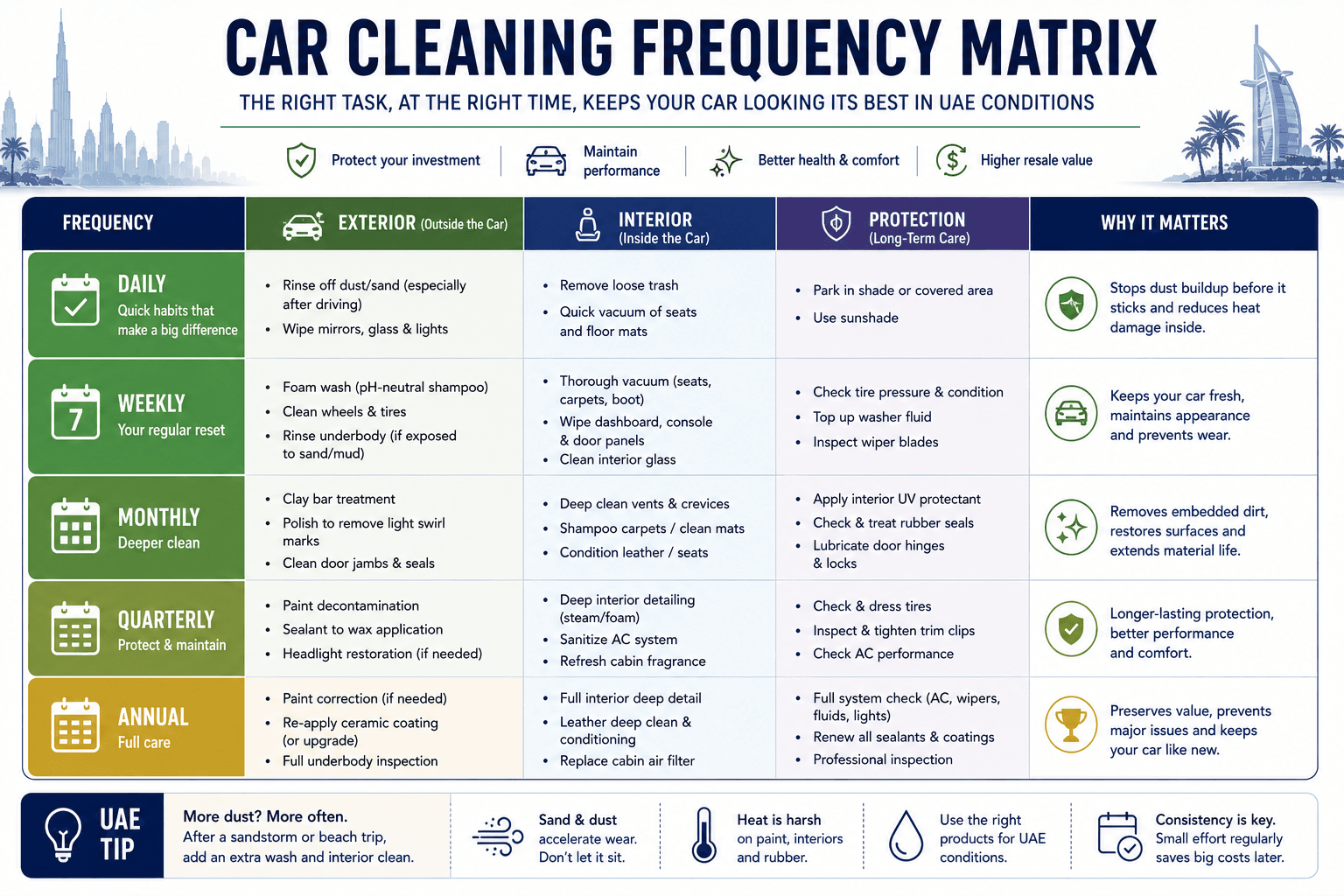
Frequency depends on parking, driving, and season, so the schedule below is a practical baseline rather than a fixed rule.
| Frequency | Recommended Tasks |
|---|---|
| Daily | Quick visual check, remove bird droppings or sap promptly, clear loose dust from glass if needed |
| Weekly | Light exterior maintenance wash or detailer wipe, interior vacuum, dashboard dusting, glass clean |
| Monthly | Full exterior wash with pre-rinse, wheel and tyre cleaning, deeper interior clean, AC vent dusting |
| Quarterly | Wax or sealant reapplication, leather conditioning, cabin filter check, seal conditioning |
| Annual | Paint protection review, thorough detail, headlight clarity check, comprehensive interior restoration |
Car Cleaning Checklist UAE
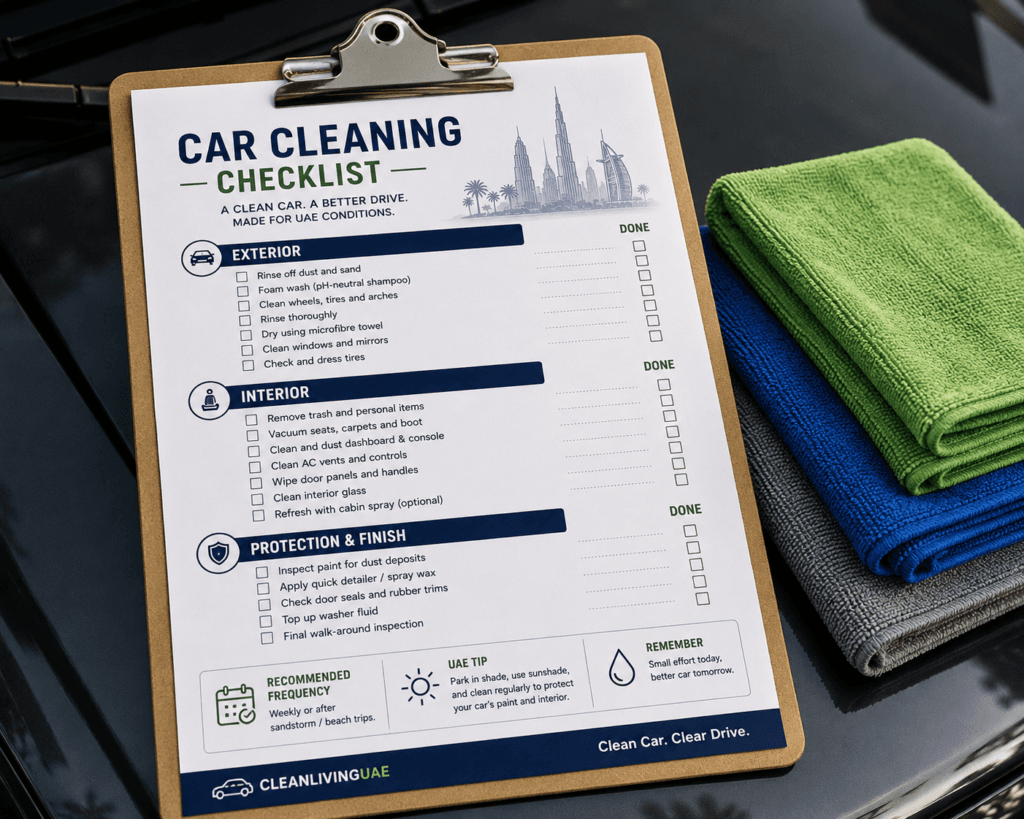
This checklist is designed for printing and quick reference.
Prevention
- Park in shade or covered parking when possible
- Use a breathable cover for long outdoor parking
- Fit windscreen and window shades
Dust management
- Pre-rinse or blow off loose dust before any wiping
- Use clean microfibre and a detailer when rinsing is not possible
- Respond promptly after windy days or sandstorms
Exterior
- Wash in cooler hours and in shade
- Clean wheels and tyres first
- Wash body top to bottom, two buckets where possible
- Clean glass and mirrors with separate cloths
- Dry immediately to prevent spotting
Interior
- Remove and clean floor mats
- Vacuum carpets, seats, and storage areas
- Dust dashboard and clean AC vents
- Treat leather or fabric as appropriate
- Check cabin filter condition
Protection
- Reapply wax or sealant on schedule
- Apply interior UV protection
- Condition rubber seals
When Professional Detailing Makes Sense
Routine cleaning can be handled at home, but certain situations are better suited to professional detailing. Heavy swirl marks or oxidation that need machine polishing, deep interior contamination after desert trips, ceramic coating application, headlight restoration, and odour or stain removal beyond surface cleaning are commonly handled more effectively by experienced detailers. Professional help is also practical for residents with limited space, water access, or time. The decision often comes down to the condition of the vehicle, the result required, and whether the necessary tools and environment are available at home. A dedicated guide on professional car detailing UAE options is planned as a future addition to this cluster.
For a complete product-focused checklist, see our guide to best car cleaning tools UAE.
Editorial Methodology
This guide was prepared by the CleanLivingUAE Editorial Team using manufacturer maintenance recommendations, established vehicle care practices, and the regional environmental conditions that affect vehicles across the Emirates. The aim is to provide practical, neutral guidance rather than product endorsements or personal testing claims. Recommendations are framed as general best practice, and readers are advised to follow their own vehicle owner manual for model-specific cleaning and maintenance instructions.
Conclusion
Car cleaning UAE works best as a structured system rather than an occasional chore. By preventing contamination where possible, managing dust safely before any contact, cleaning the exterior and interior methodically, and maintaining long-term protection, residents can keep vehicles looking presentable and protect their condition against desert dust, sand, heat, and humidity. Adjusting the routine to the season, the emirate, and to whether the vehicle is parked in an apartment or villa setting makes the effort both efficient and effective. For most owners, a consistent car cleaning UAE habit of light maintenance, paired with prompt response after sandstorms, consistently outperforms infrequent heavy cleaning in local conditions.
Related UAE Cleaning Guides
- Dust and Sand Cleaning UAE
- Post-Sandstorm Cleaning UAE
- Seasonal Cleaning UAE
- AC Filter Cleaning Guide UAE
- Small Apartment Cleaning Setup UAE
Download the Free UAE Car Cleaning Checklist (PDF)
A printable version of this routine is available as a free download, designed to keep on hand in the car or garage.
The checklist includes:
- Daily vehicle inspection checklist
- Weekly cleaning schedule
- Sandstorm recovery checklist
- Summer protection checklist
- Annual maintenance planner

Frequently Asked Questions
How often should I clean my car in the UAE?
A light weekly maintenance clean plus a full monthly wash suits most car cleaning UAE routines, with more frequent attention during sandstorm season or for vehicles parked outdoors.
Is it safe to wash my car in summer heat?
Washing is safest in early morning or after sunset, in shade, on cool panels, because water and products dry quickly on hot surfaces and can cause streaking and spotting.
Why does my car get so dusty even when parked indoors?
Fine desert dust circulates widely and settles even in basements and garages, so indoor parking reduces but does not fully eliminate dust accumulation.
Does car cleaning differ between Dubai and Abu Dhabi?
Dubai vehicles often face more construction dust, while Abu Dhabi and coastal areas deal more with humidity and salt air, so coastal vehicles benefit from regular underbody and wheel rinsing.
Can I wipe dust off my car without water?
Dry wiping can scratch paint because dust acts like a mild abrasive, so a detailer spray with a clean microfibre cloth or a rinse is recommended before any contact.
What should I do to my car after a sandstorm?
Rinse heavy sand off first to avoid scratching, then wash the vehicle, clean glass and seals, and clear sand from wheel wells and window channels.
How do I protect my dashboard from cracking in the UAE?
Using windscreen and window shades, parking in shade, and applying a UV-protective dressing are commonly associated with slower dashboard fading and cracking.
Why is the air from my car AC dusty?
A saturated cabin air filter is often linked to weaker airflow and dust circulation, so checking and replacing it per the vehicle manual can help.
Is waterless or rinseless washing suitable for apartment residents?
Yes, these methods use minimal water and suit residents with limited water access, provided loose dust is lifted gently and clean cloths are used.
When is professional detailing worth it?
Professional detailing is practical for paint correction, ceramic coatings, deep interior contamination, headlight restoration, or when space, water, or time at home limits regular car cleaning UAE upkeep.
This is a practical, informational guide. Vehicle care needs vary by car model, materials, and manufacturer guidance, so checking your owner manual for specific cleaning and maintenance recommendations is advised.
Sources
Guidance in this article draws on publicly available regional and manufacturer information, including weather and climate data from the UAE National Center of Meteorology, ambient air quality context from the World Health Organization, tyre and rubber care guidance from Michelin and Bridgestone, and established vehicle cleaning and paint care practices described by Meguiar’s and Turtle Wax. Readers should always refer to their own vehicle owner manual for model-specific cleaning and maintenance recommendations.