Introduction
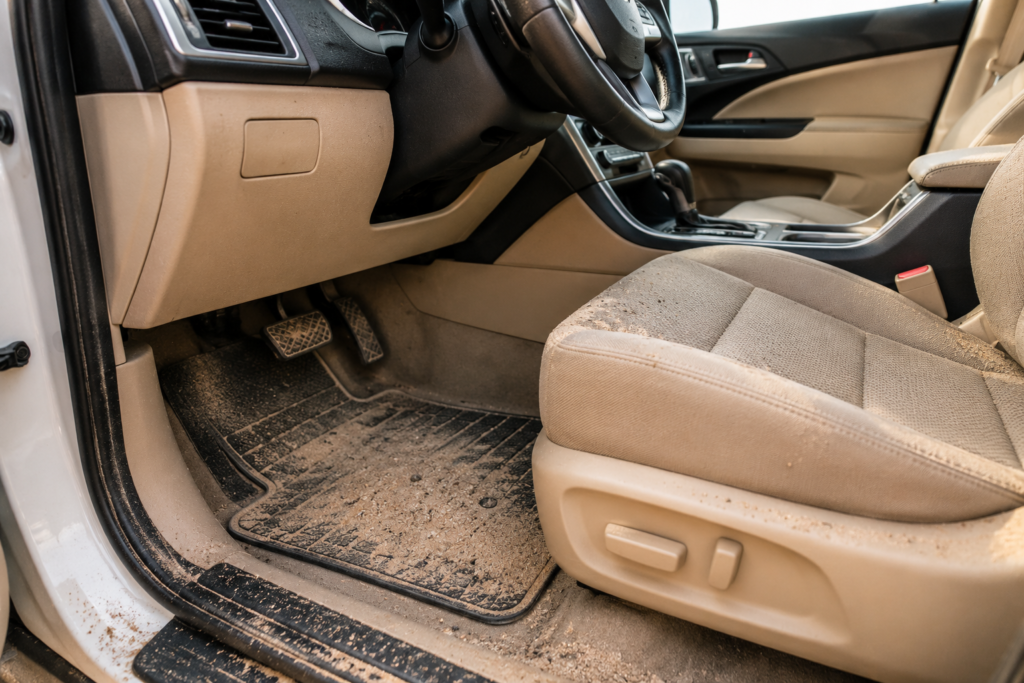
Sand removal from car interior UAE is a common cleaning challenge because fine desert sand enters through shoes, floor mats, door seals, AC vents, boot areas, and open windows. Across Dubai, Abu Dhabi, Sharjah, Ajman, Ras Al Khaimah, Fujairah, and Umm Al Quwain, vehicle interiors face continuous exposure to airborne dust and windblown sand. Left unaddressed, fine sand particles abrade surfaces, embed into upholstery fibres, and accumulate in areas that standard wiping cannot reach.
Why Sand Builds Up Inside UAE Cars
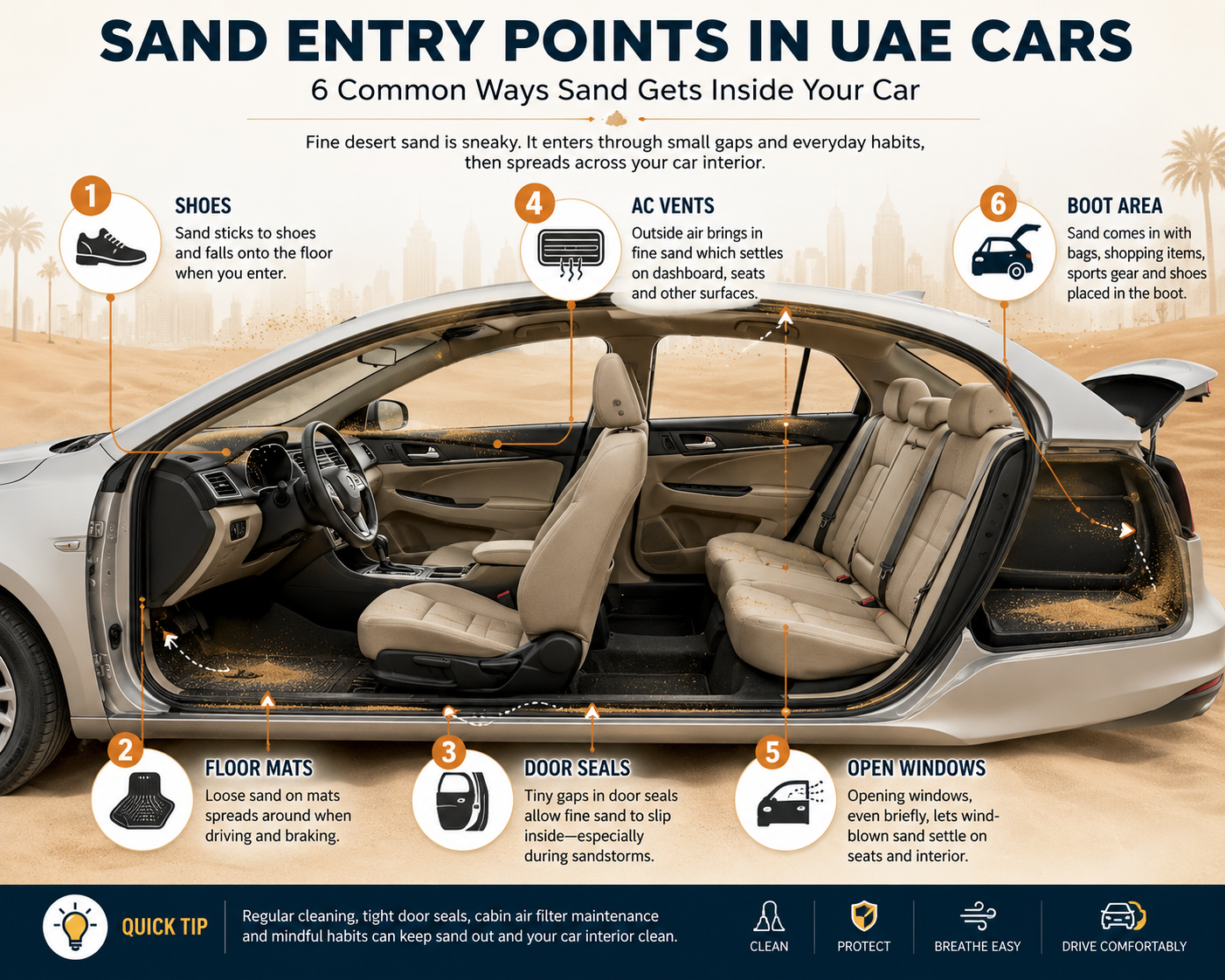
UAE roads pass through desert terrain, industrial zones, and coastal areas where sand and dust remain airborne for extended periods. Several factors cause sand to accumulate faster inside vehicles in this region than in most other climates.
Footwear transfer is the most consistent cause. Sand attaches to shoes and sandals during entry and releases onto floor mats and carpets immediately. In households where multiple occupants use the vehicle daily, this transfer becomes the primary source of interior sand buildup.
AC vents draw in exterior air, and during periods of high dust concentration, fine particles bypass cabin air filters and settle on dashboards, centre consoles, and upholstery surfaces. Older vehicles with degraded cabin filters are particularly susceptible.
Door and window seal gaps allow sand ingress during sandstorms. Even with windows fully closed, microscopic particles penetrate around seals that have worn over time. Boot areas accumulate sand from bags, shopping items, and footwear placed directly on the carpet.
Open windows during brief stops – a common habit in UAE residential areas and car parks – allow wind-carried sand to settle on seats and dashboards within minutes during dusty conditions. For a broader look at how airborne particulates affect enclosed spaces, see the Indoor Air Quality UAE guide.
Quick Sand Removal Checklist
- Remove and shake floor mats away from the vehicle
- Dry vacuum all carpet areas before wiping
- Use a soft brush attachment on seat fabric
- Clean AC vents with a detailing brush before vacuuming
- Vacuum the boot area and under rear seats
- Wipe hard surfaces with a dry microfiber cloth first, then a lightly damp cloth
- Replace or clean the cabin air filter if sand is exiting the vents
CleanLivingUAE Tip If sand continues appearing on the dashboard shortly after cleaning, inspect the cabin air filter and AC intake system. In UAE conditions, overloaded cabin filters can recirculate fine dust back into the vehicle interior. Replacing the cabin filter is one of the highest-impact single actions for reducing interior dust accumulation in UAE vehicles.
Best Tools for Removing Sand From Car Interiors
Some product mentions may include affiliate links.
Selecting the right tools determines how effectively sand is removed without spreading particles across surfaces. The following tools are commonly recommended for UAE car interior cleaning conditions.
If sand keeps collecting in carpets, mats, and seat gaps, this guide to car cleaning tools for sand can help you choose the right vacuum, brush, cloth, and detailing tools.
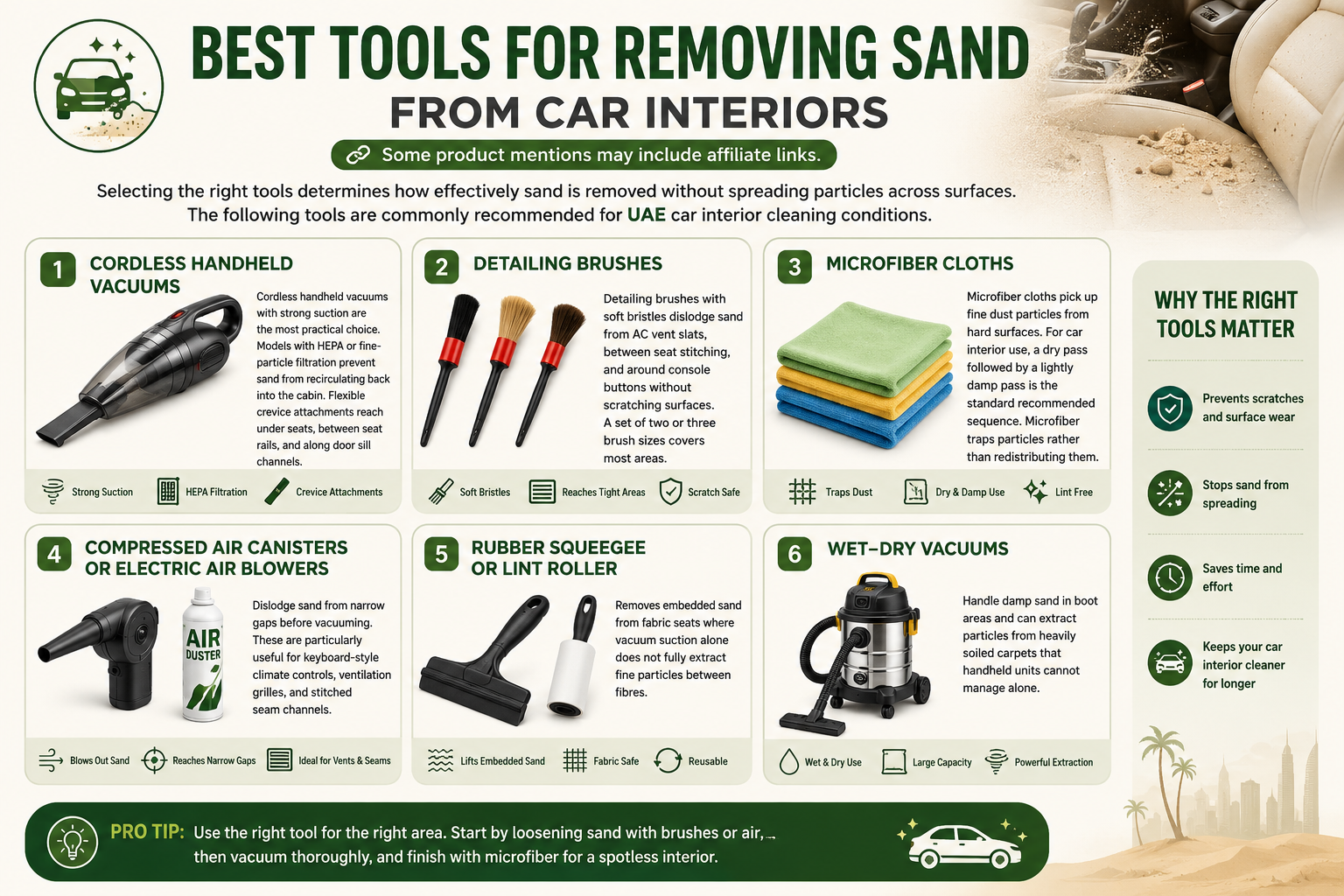
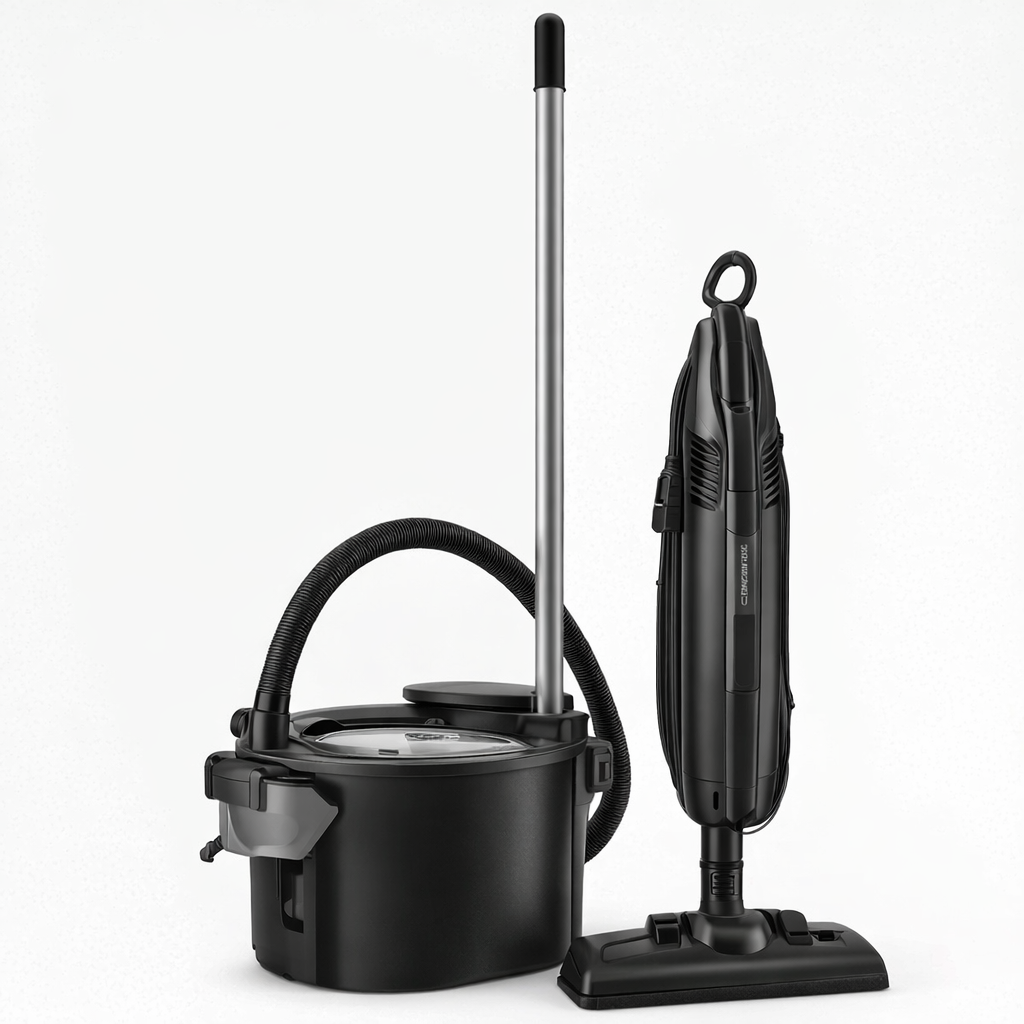
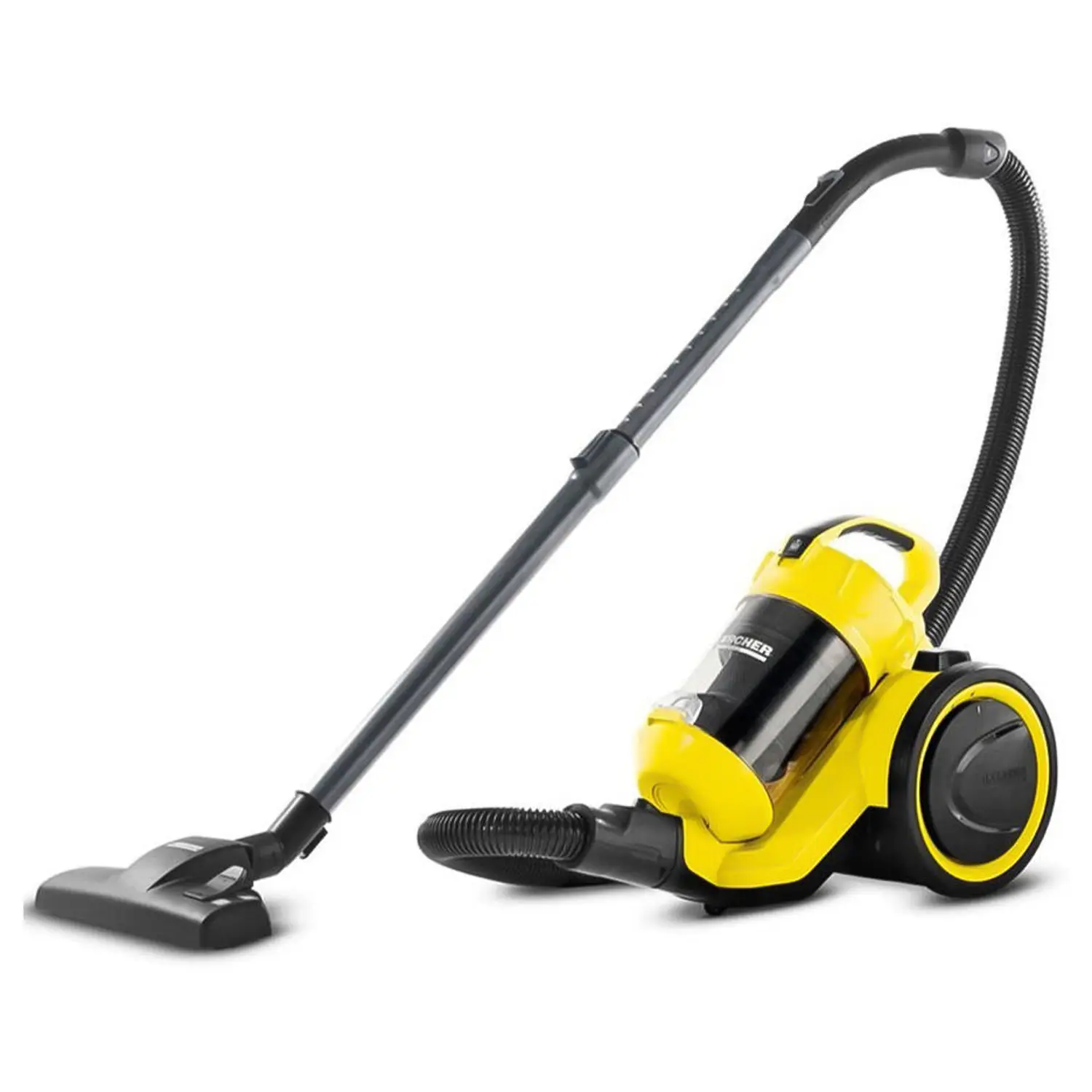
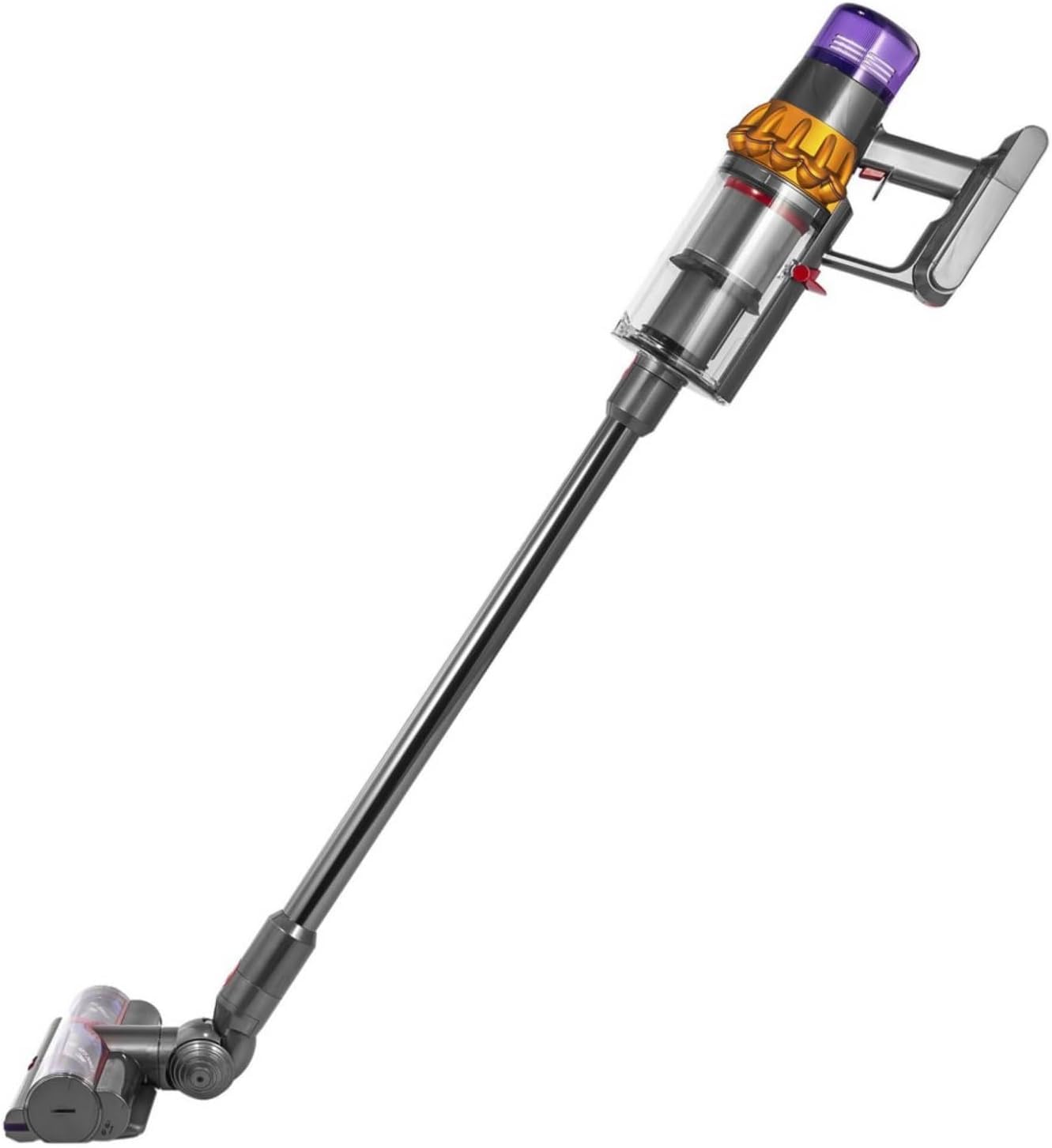
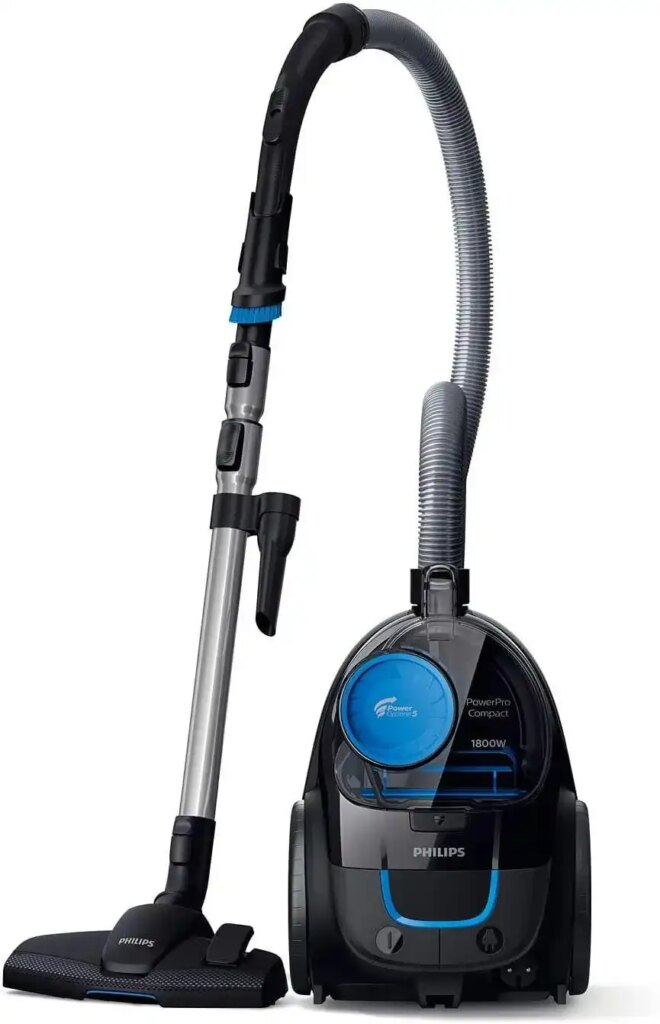
Cordless handheld vacuums with strong suction are the most practical choice for car interiors. Models with HEPA or fine-particle filtration prevent sand from recirculating back into the cabin during cleaning. Flexible crevice attachments reach under seats, between seat rails, and along door sill channels. For a full comparison of models available in the UAE, see Best Vacuum Cleaner for Sand UAE and Best Cordless Vacuums UAE.
Detailing brushes with soft bristles dislodge sand from AC vent slats, between seat stitching, and around console buttons without scratching surfaces. A set of two or three brush sizes covers most areas.
Microfiber cloths pick up fine dust particles from hard surfaces. For car interior use, a dry pass followed by a lightly damp pass is the standard recommended sequence. Compared to paper towels or cotton rags, microfiber traps particles rather than redistributing them. Recommended options are covered at Best Microfiber Cloths for Dust UAE.
Compressed air canisters or small electric air blowers dislodge sand from narrow gaps before vacuuming. These are particularly useful for keyboard-style climate controls, ventilation grilles, and stitched seam channels.
A rubber squeegee or lint roller removes embedded sand from fabric seats where vacuum suction alone does not fully extract fine particles between fibres.
Wet-dry vacuums handle damp sand in boot areas and can extract particles from heavily soiled carpets that handheld units cannot manage alone.
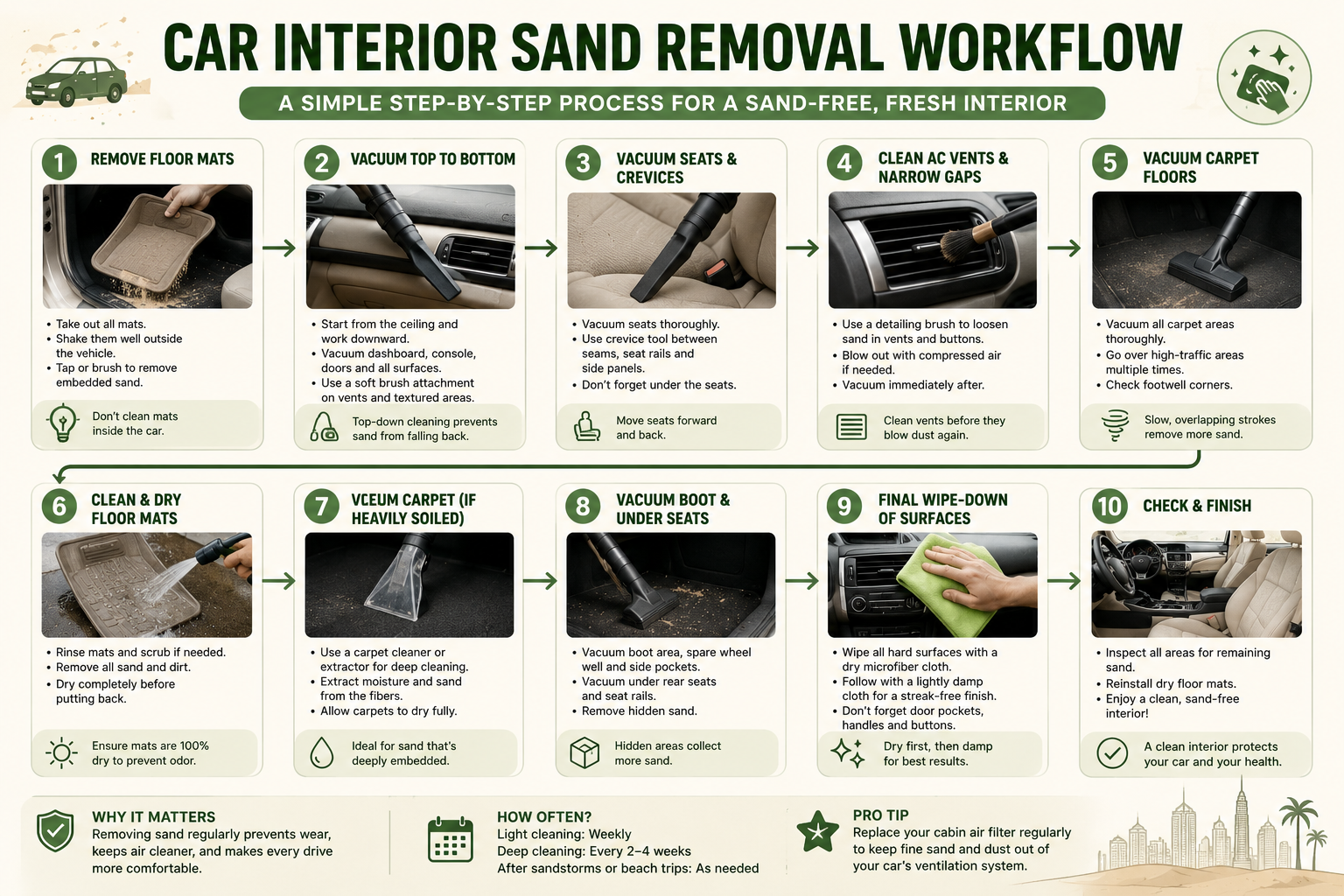
Step-by-Step Sand Removal From Car Interior UAE
Following a consistent sequence prevents sand from being redistributed to already-cleaned areas.
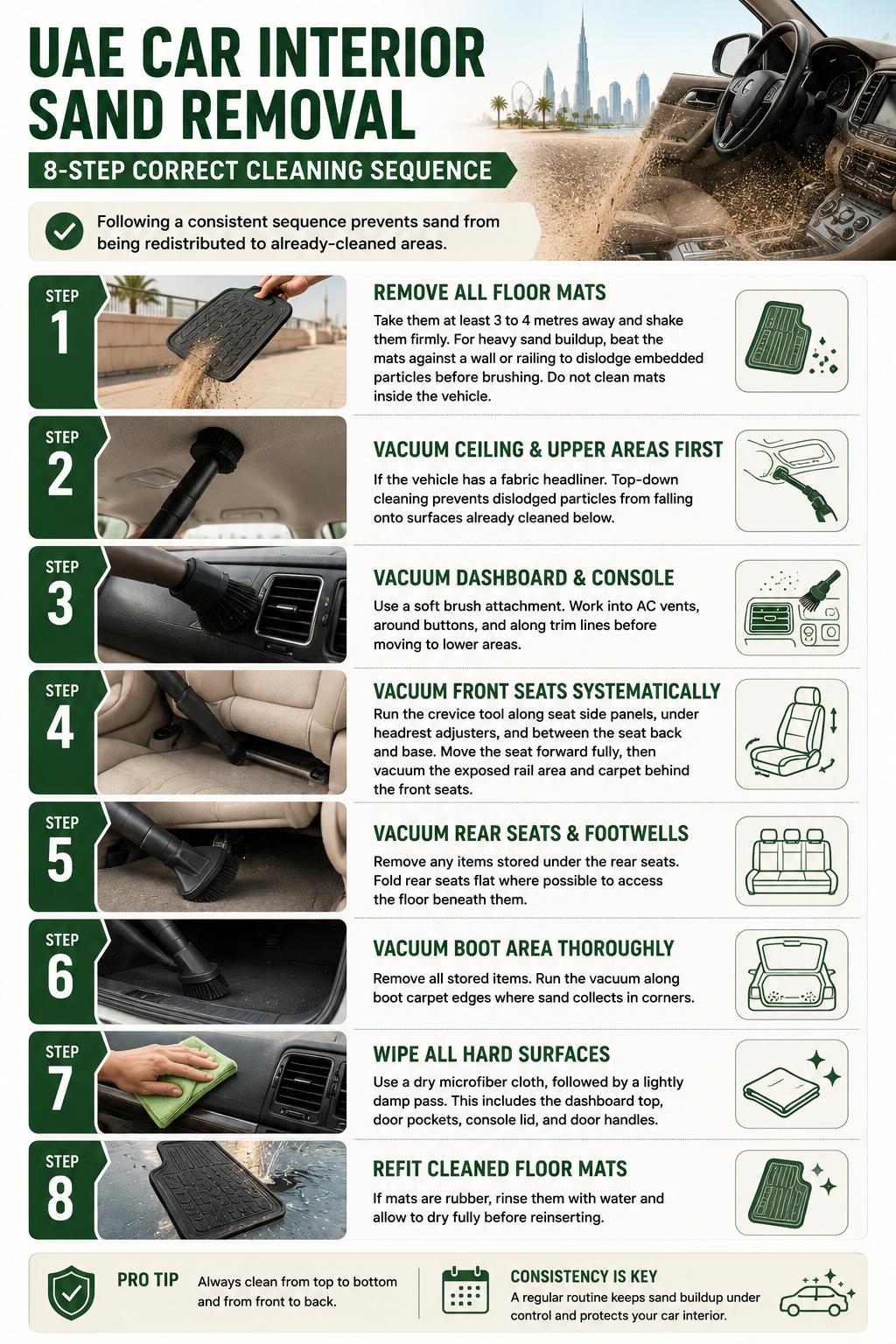
Step 1: Remove all floor mats from the vehicle. Take them at least 3 to 4 metres away and shake them firmly. For heavy sand buildup, beat the mats against a wall or railing to dislodge embedded particles before brushing. Do not clean mats inside the vehicle.
Step 2: Vacuum ceiling and upper areas first if the vehicle has a fabric headliner. Top-down cleaning prevents dislodged particles from falling onto surfaces already cleaned below.
Step 3: Vacuum the dashboard, door panels, and centre console area using a soft brush attachment. Work into AC vents, around buttons, and along trim lines before moving to lower areas.
Step 4: Vacuum front seats systematically. Run the crevice tool along seat side panels, under headrest adjusters, and between the seat back and base. Move the seat forward fully, then vacuum the exposed rail area and carpet behind the front seats.
Step 5: Vacuum rear seats and footwell areas. Remove any items stored under the rear seats. Fold rear seats flat where possible to access the floor beneath them.
Step 6: Vacuum the boot area thoroughly. Remove all stored items. Run the vacuum along boot carpet edges where sand collects in corners.
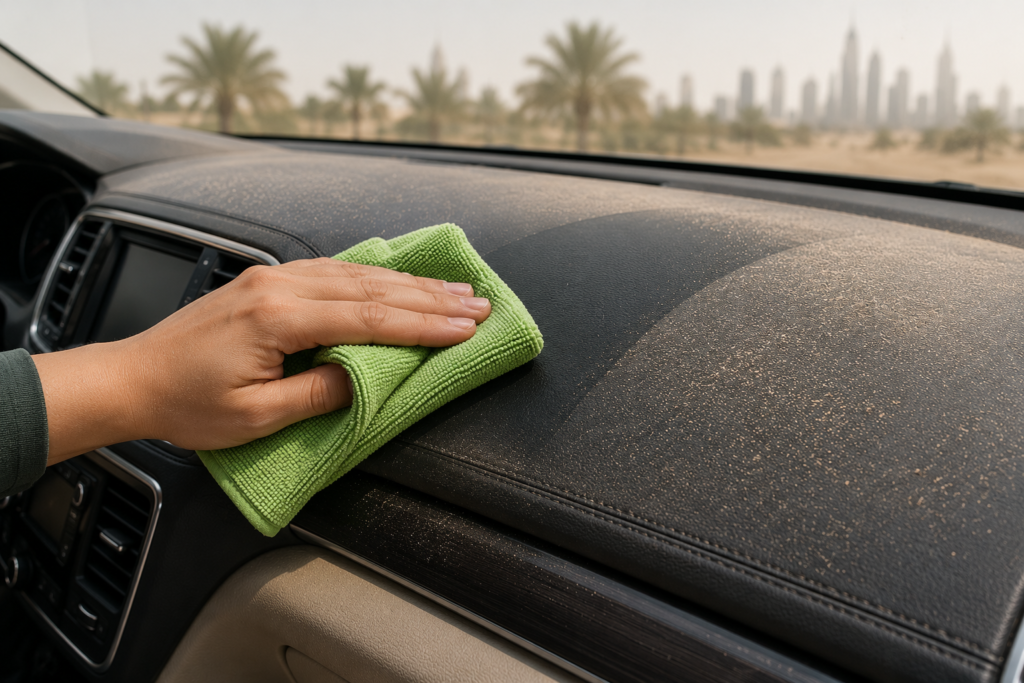
Step 7: Wipe all hard surfaces with a dry microfiber cloth, followed by a lightly damp pass. This includes the dashboard top, door pockets, console lid, and door handles.
Step 8: Refit cleaned floor mats. If mats are rubber, rinse them with water and allow to dry fully before reinserting.
How to Remove Sand From Car Mats
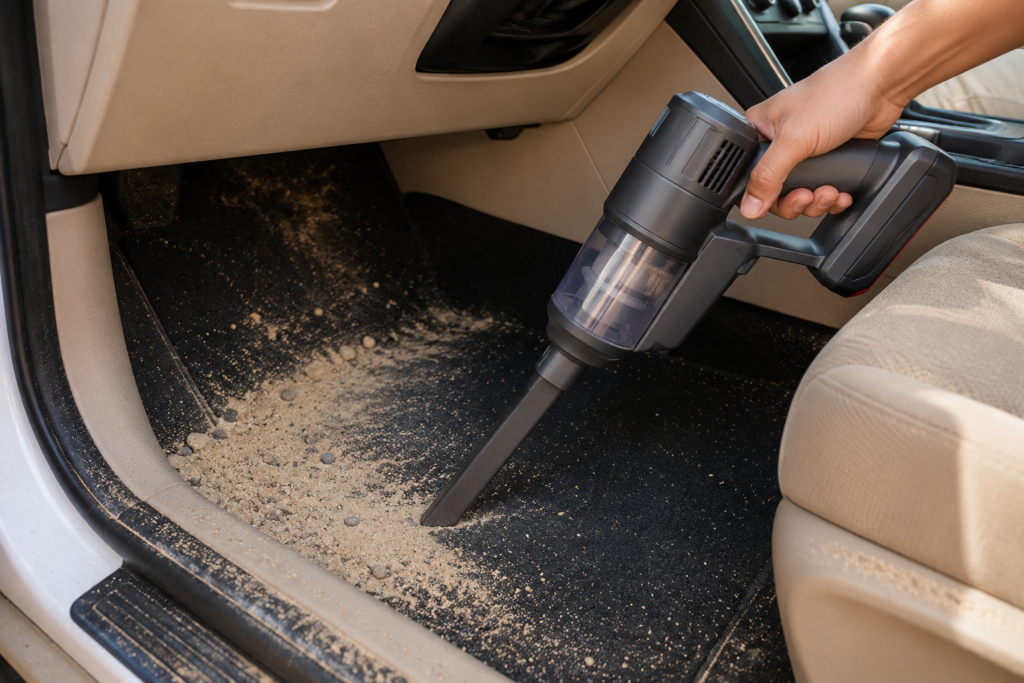
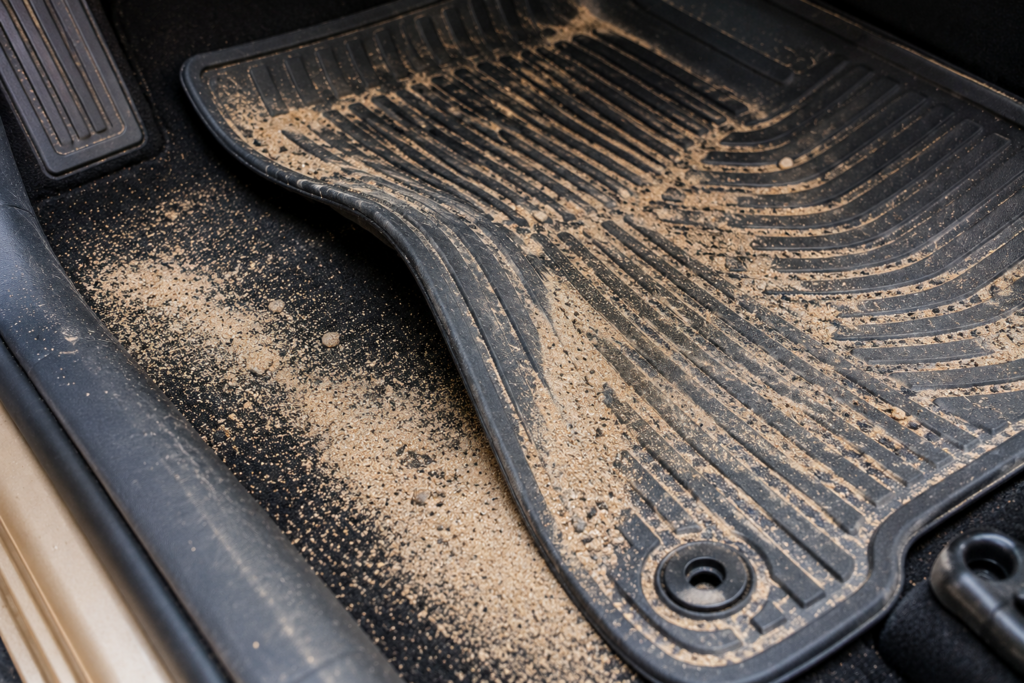
Floor mats receive the highest sand concentration of any interior surface because footwear deposits sand directly onto them at every entry point.
Rubber mats: Take the mat outside, shake it firmly, then rinse with a hose or bucket of water. Scrub with a stiff brush if sand is embedded in the ridges. Allow the mat to dry completely in a shaded area before returning it to the vehicle. Wet rubber mats trap moisture under them, which can affect the carpet underneath over time.
Fabric or carpet mats: Shaking alone does not remove fine sand embedded deep in the pile. After shaking, vacuum both sides of the mat using a brush attachment. For heavier buildup, beat the mat against a hard surface first to loosen compacted particles before vacuuming.
In UAE conditions where sand accumulates quickly, rubber mats are generally considered more practical because they rinse clean and dry faster than fabric alternatives. Rubber mats with raised edge channels also contain sand rather than allowing it to spread onto the carpet underneath.
Replacing mats at the end of cleaning rather than the beginning prevents freshly cleaned carpets from being contaminated again.
How to Remove Sand From Car Seats
Car seats in UAE vehicles commonly show sand accumulation in seam stitching, between seat and backrest cushions, and along the base edge where the seat meets the floor carpet.
Fabric upholstery: Begin with a dry vacuum pass using a soft upholstery attachment. Run the nozzle along the seat surface in parallel passes, then switch to the crevice tool for seam channels and the gap between seat and backrest. A lint roller applied across the seat surface after vacuuming lifts fine particles that suction missed.
Leather or synthetic leather seats: Vacuuming removes loose particles. Follow with a dry microfiber cloth wipe across the full seat surface, paying attention to stitched seam channels where sand collects. A soft detailing brush can dislodge particles from between stitching before the final wipe.
Avoid using water or cleaning sprays directly on fabric seats without checking the manufacturer’s guidance. In UAE conditions, excess moisture in seats can encourage mould growth, particularly during the high-humidity summer months from June through September.
Child seats should be removed from the vehicle periodically for full sand removal, as they accumulate sand under the base and along their strap channels where standard vacuuming cannot reach.
For microfiber cloth options suitable for car seat cleaning, see Best Microfiber Cloths for Dust UAE.
How to Remove Sand From Car Carpets
Car carpets are the most difficult surface to fully clean because sand embeds below the surface pile and resists standard vacuuming. UAE conditions mean fine particles accumulate quickly, particularly in footwell areas.
Dry extraction sequence: Sprinkle a small amount of dry baking soda or dedicated carpet cleaning powder across the carpet surface. Allow it to sit for 5 to 10 minutes. The powder absorbs moisture that causes fine sand to clump and cling to fibres, making particles easier to extract. Vacuum thoroughly using a brush roller attachment.
For stubborn embedded sand, use a stiff-bristled carpet brush to agitate the carpet pile before vacuuming. Work in short back-and-forth strokes to lift particles from deeper within the fibre. Follow with a second vacuum pass.
Wet extraction methods, such as steam cleaning or carpet shampoo machines, are effective for deep cleaning but require adequate drying time. In UAE summer conditions, poorly dried carpets can develop mould or mildew smell within 24 to 48 hours. If using a wet method, ensure the vehicle is parked in a well-ventilated area with doors open or windows partially down during drying.
For sand in car carpet UAE situations involving heavy post-sandstorm accumulation, two or three vacuuming passes with a brush agitation between each pass typically produces better results than a single extended pass.
How to Clean Sand From Car Boot Areas
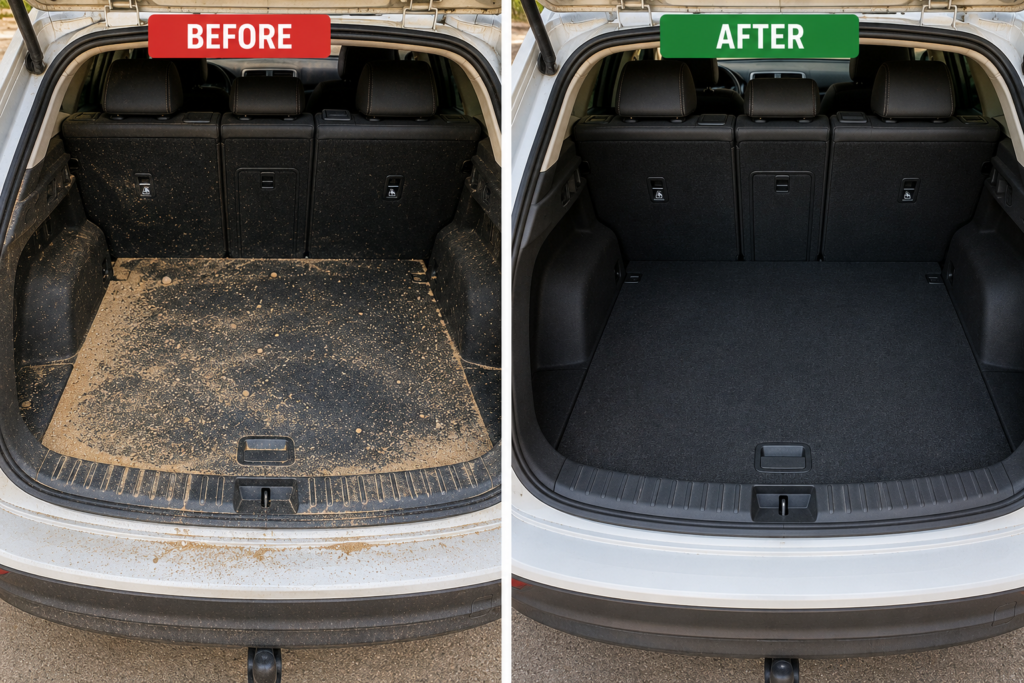
The boot is commonly the most neglected area for sand removal and can accumulate significant quantities, particularly in vehicles used for beach visits, camping trips, shopping, or carrying sports equipment.
Remove all stored items from the boot before beginning. Fold or lift the boot carpet if it is a removable piece to expose the spare tyre compartment underneath. Sand collects in this lower cavity and is invisible during normal cleaning.
Vacuum the entire boot floor using a crevice attachment along the edges and corners. Pay attention to the rubber seal channel around the boot opening, which collects sand at the base.
For removable boot carpets, take them outside and follow the same mat-cleaning sequence: shake, beat, brush, and vacuum. Rinse rubber boot liners if applicable.
Hard plastic or rubber boot liners are the preferred option in UAE vehicles used for active outdoor purposes, as they contain sand, are easy to rinse, and do not retain moisture the way fabric liners do.
Most Common Areas Where Sand Hides Inside UAE Cars
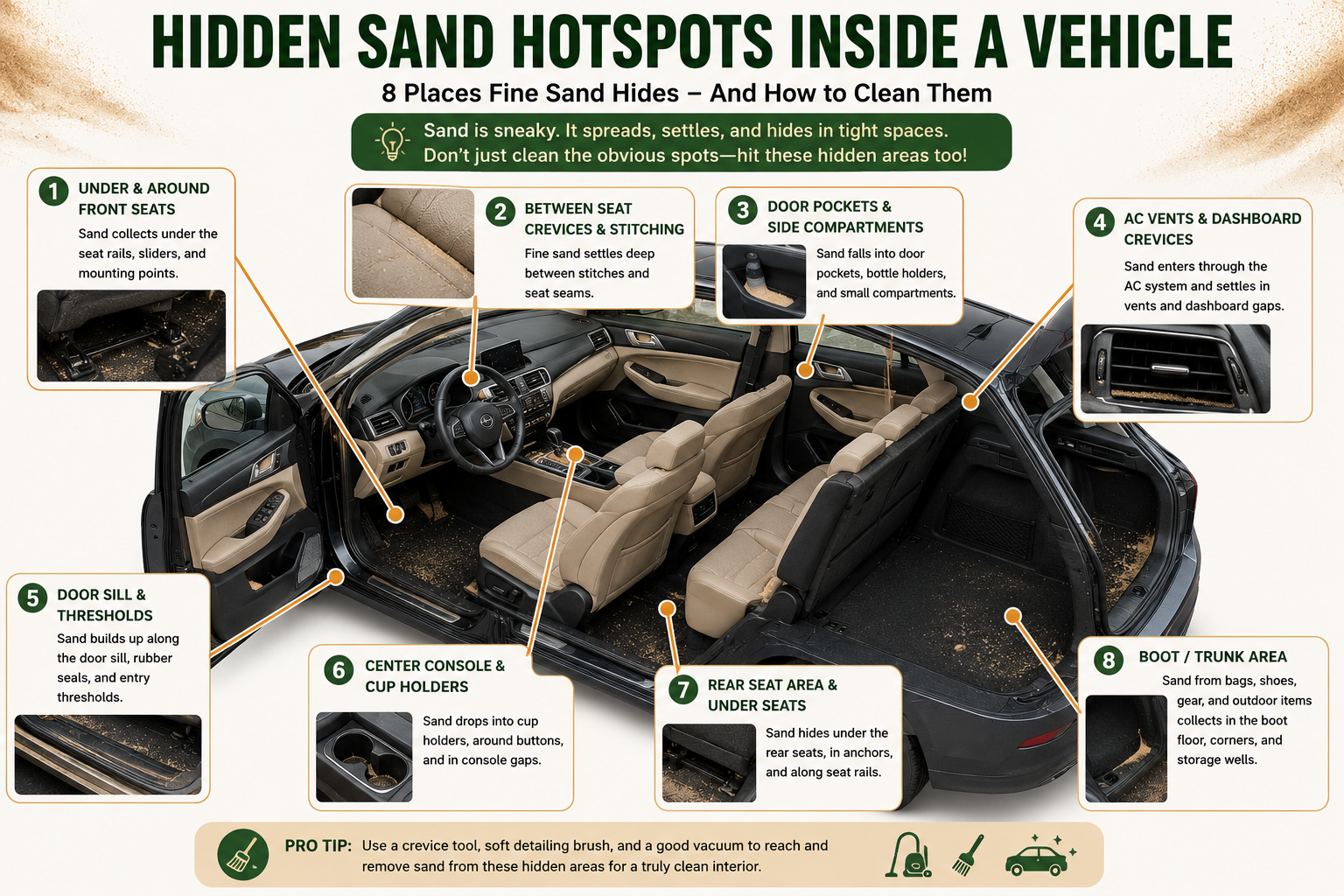
Desert sand and fine dust do not distribute evenly inside a vehicle. Certain areas collect significantly higher concentrations and are frequently missed during routine cleaning. Identifying these hotspots before starting a session improves coverage and reduces the likelihood of sand redistributing after cleaning is complete.
- Under seat rails – The metal rail channels that allow seats to slide forward and back trap fine sand that falls through the carpet during normal use. Standard vacuum passes do not reach the full depth of these channels without a narrow crevice attachment.
- Seat belt anchors and buckle slots – Sand accumulates around the base of seat belt anchor points and inside buckle slots. Detailing brushes dislodge particles from these recesses before vacuuming.
- Door pockets – Lower door pockets collect sand carried in on hands and bags. The corrugated or ribbed lining common in UAE market vehicles traps fine particles in each ridge.
- AC vents – Horizontal vent slats accumulate desert sand and fine dust that enters through the ventilation system. This sand is redistributed into the cabin whenever the air conditioning runs.
- Cup holders and console compartments – Fine sand settles at the base of cup holders and in centre console storage areas. A small detailing brush clears these before vacuuming.
- Boot corners and spare wheel compartment – Boot carpet corners and the cavity beneath the boot floor, where the spare tyre sits, are among the least cleaned areas in UAE vehicles yet accumulate substantial sand from beach visits, camping, and general use.
- Child seat bases – Sand collects under child seat bases and within the ISOFIX channel recesses where the seat connects to the vehicle. Child seats should be unclipped and removed periodically to access these areas.
- Seat stitching and seam channels – Decorative stitching on fabric and leather seats creates narrow channels where fine particles lodge and resist standard vacuuming.
How to Remove Sand After a Sandstorm
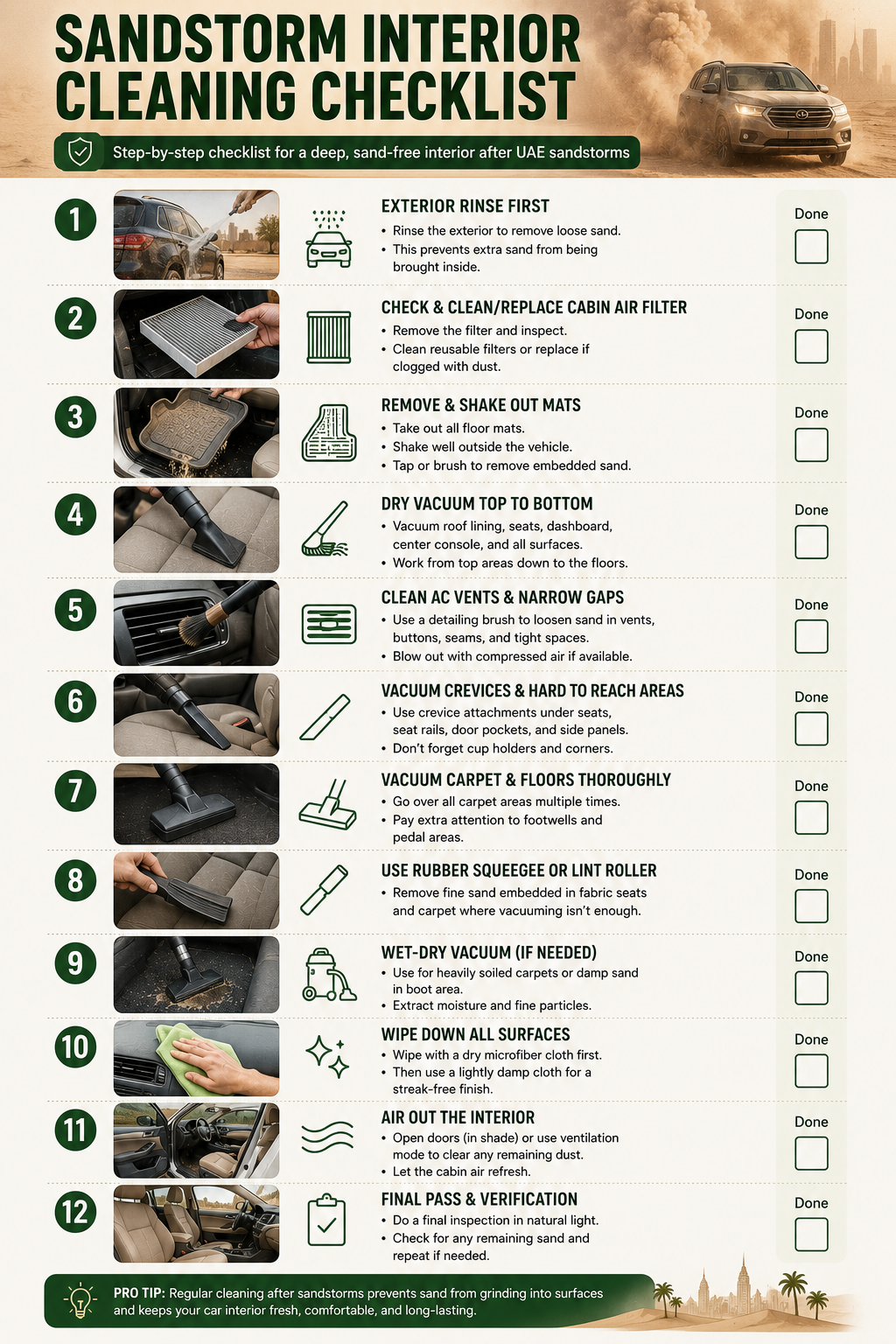
Post-sandstorm car interior cleaning requires a more systematic approach than routine maintenance cleaning because fine airborne particles penetrate every gap simultaneously.
After a sandstorm, allow the exterior to be rinsed or wiped before opening any doors or windows. Opening the vehicle before exterior cleaning moves sand from the body surfaces into the cabin.
Begin interior cleaning by vacuuming the AC vents and dashboard area before touching any other surface. Sandstorm dust settles heavily on horizontal interior surfaces and enters through vent systems during the storm. If AC vents are visibly coated with dust, replace or clean the cabin air filter before running the air conditioning again, as a clogged or loaded filter will distribute particles through the interior when the system runs.
Follow the standard step-by-step sequence, but plan for two to three complete passes through all areas. Post-sandstorm sand is typically finer and lighter than footwear-deposited sand and redistributes easily during cleaning if suction is not maintained continuously.
Check door seal channels after a sandstorm. Fine particles accumulate in rubber seal grooves and transfer back into the cabin when doors are opened and closed after cleaning.
For vehicles left exposed during a severe sandstorm in emirates such as Ras Al Khaimah, Fujairah, or Abu Dhabi’s interior regions, professional detailing may be necessary to fully address sand that has penetrated behind dashboard panels and into the ventilation ducting.
For broader car cleaning guidance including exterior wash and maintenance, see Car Cleaning UAE.
Apartment Parking vs Villa Parking: Interior Sand Differences
The parking environment significantly affects how quickly sand accumulates inside a vehicle and which cleaning approach is most appropriate.
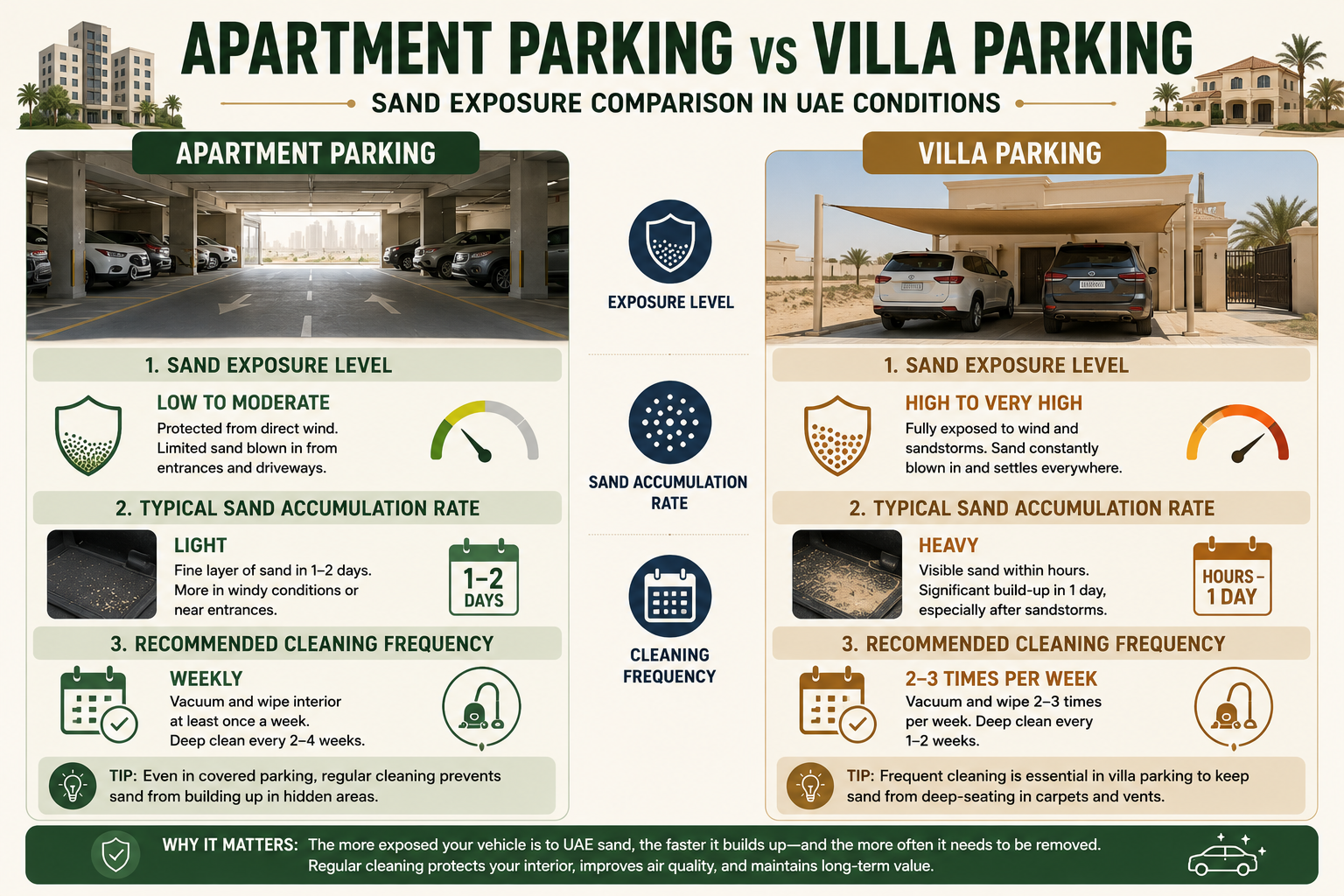
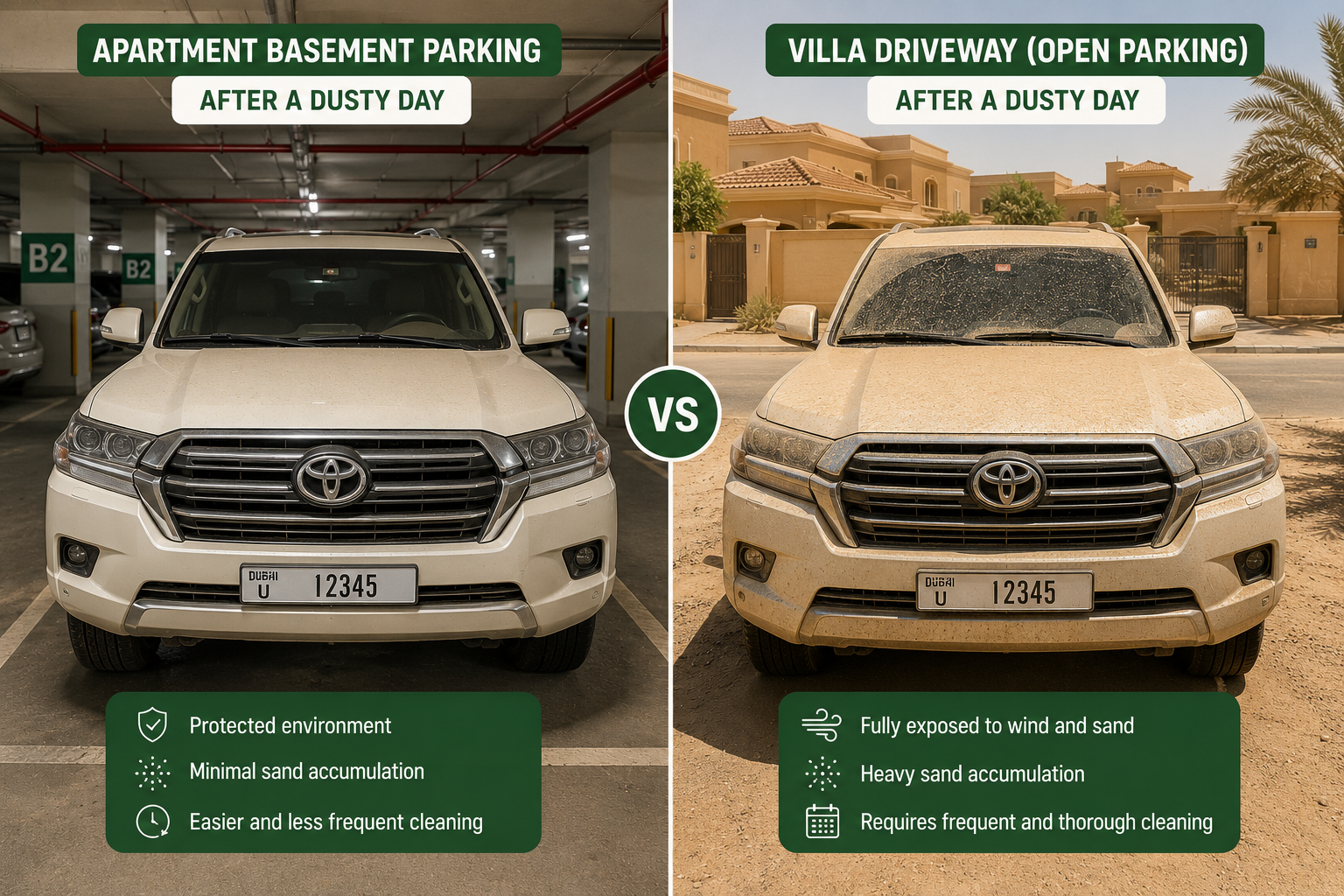
Apartment parking (covered multi-storey or basement) provides the strongest protection against direct sandstorm exposure. However, these structures are often shared with construction activity in developing areas of Dubai, Sharjah, and Ajman, and concrete dust combined with fine sand creates a gritty residue that coats vehicle surfaces even in covered spaces. Air circulation within parking structures can keep dust particles suspended for extended periods after cleaning activity nearby.
Vehicles in covered apartment parking typically require cleaning of horizontal interior surfaces every 7 to 10 days and a full interior sand removal session every 2 to 4 weeks under normal UAE conditions.
Villa parking (open driveway or courtyard) exposes vehicles to full sandstorm impact and daily windblown sand. Without the buffer of a structure, sand deposits on vehicles during even moderate wind events. Vehicles parked on villa driveways in areas such as Mirdif, Al Ain, and Umm Al Quwain, which see more direct sand exposure, require interior cleaning every 5 to 7 days and a full session after any significant weather event.
Shaded villa carports reduce direct sand deposition but do not prevent fine particles carried by wind from settling on the vehicle. The gap between the interior cleaning schedule for covered apartment parking and open villa parking is typically one to two sessions per month.
Product and Tool Comparison Table
Vacuum vs Air Blower vs Brush: Which Removes Sand Best?
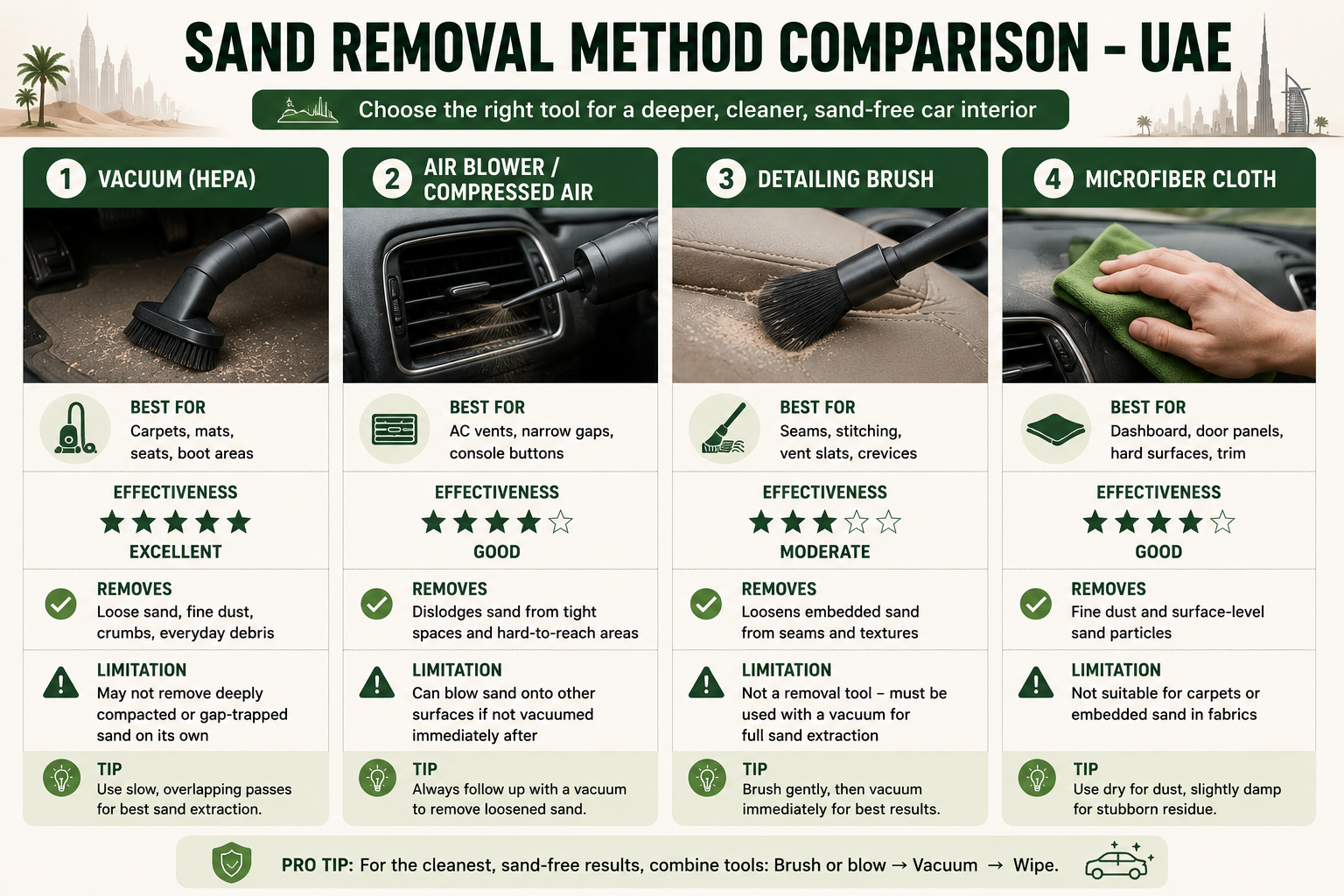
The three most commonly used methods for car interior sand removal each perform differently depending on the surface type, the depth of sand penetration, and whether sand is loose or compacted. Understanding the strengths of each method determines which to apply first and which to use as a follow-up.
The most effective sequence combines all three methods in order: brush or air blower to dislodge, vacuum immediately to extract. Using an air blower or brush without vacuuming afterwards moves sand between surfaces rather than removing it from the vehicle.
Weekly Car Interior Sand Prevention Routine
A consistent weekly routine reduces the effort required for full sand removal sessions by preventing accumulation from reaching embedded levels.
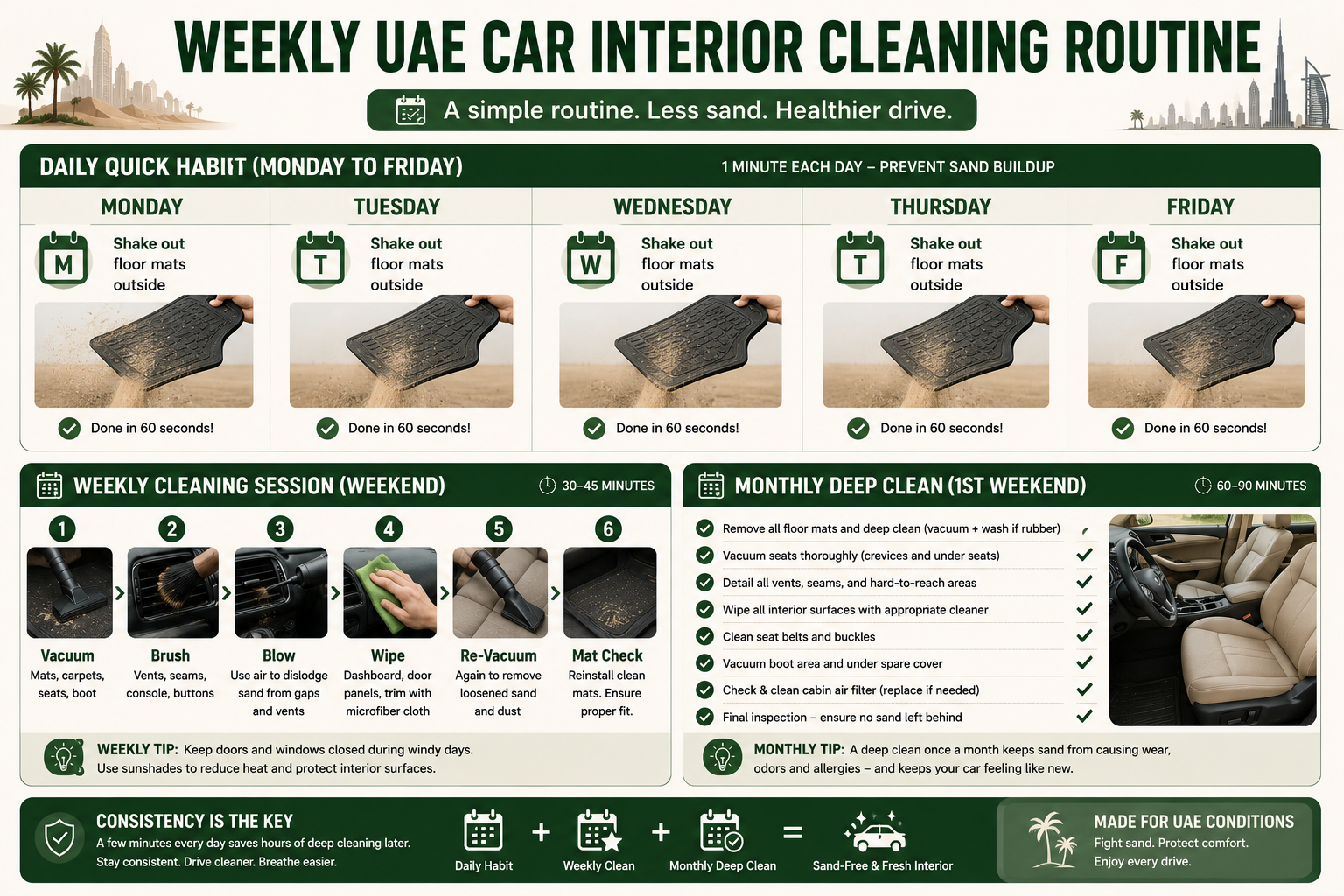
Monday to Friday: Shake out floor mats after use on any day where significant footwear sand transfer is expected. This takes under 2 minutes per session and removes the primary daily sand source before it embeds.
Weekly session (suggested on weekend): Remove all mats and shake or rinse them. Vacuum the footwells, seat bases, and boot area using a handheld vacuum. Dry wipe the dashboard and console with a microfiber cloth. This session typically requires 15 to 20 minutes for a standard 5-seat vehicle.
Monthly: Vacuum the full interior including under seats, seat rail channels, and door sill areas. Check and clean or replace the cabin air filter. Inspect door seal channels for accumulated sand and wipe clean with a dry cloth.
After any sandstorm: Complete the full post-sandstorm sequence before the weekly routine resumes.
Free Download: Car Interior Sand Removal Checklist UAE
A printable checklist covering the full sand removal sequence for UAE vehicles – including post-sandstorm steps, boot area cleaning, and weekly prevention routine – is available as a free PDF download. Save it to your phone or print it for use at home.
Common Mistakes to Avoid
Vacuuming before removing mats spreads sand from the mats back onto carpets that have already been cleaned. Mats should always be removed first.
Using wet cloths on fabric seats without allowing adequate drying time increases the risk of mildew, particularly during UAE summer months when humidity inside parked vehicles is high.
Blowing compressed air without following immediately with vacuum suction redistributes sand from one area to another rather than removing it from the vehicle.
Cleaning the exterior before the interior is complete results in reopening doors and windows and introducing fresh particles onto cleaned surfaces.
Skipping AC vents during cleaning allows sand to continue circulating through the cabin every time the air conditioning runs. Vent cleaning should be part of every full interior session.
Reinserting damp rubber mats before they are fully dry traps moisture under them, which can cause mildew in the carpet underneath over time.
Using abrasive brushes on leather surfaces to dislodge sand can scratch the material. Soft detailing brushes and microfiber cloths are appropriate for leather seats and trim.
Recommended Sand Removal Tools for UAE Vehicles
Some product mentions may include affiliate links.
The following tool categories cover the full range of sand removal tasks in UAE car interiors, from quick daily mat shakes through to post-sandstorm deep cleans. Product options for the UAE market are covered in detail across the linked guides below.
Cordless and handheld vacuums are the foundation of any UAE car interior cleaning kit. HEPA-filtered models prevent fine desert sand from being expelled back into the cabin during use. For a full comparison of options available on Amazon.ae, see Best Vacuum Cleaner for Sand UAE and Best Cordless Vacuums UAE.
Microfiber cloths are the recommended finishing tool for all hard interior surfaces after vacuuming. For options tested against UAE dust conditions, see Best Microfiber Cloths for Dust UAE.
Detailing brush sets (AED 25 to 80) are available across major UAE retailers and online via Amazon.ae. A set of three brush sizes covers AC vents, seam channels, and console areas without requiring a vehicle-specific kit.
Rubber floor mats fitted to vehicle model specifications are widely stocked at Carrefour, ACE Hardware, and through Amazon.ae. Mats with raised edge channels provide the best sand containment for UAE driving conditions.
This guide to car cleaning tools for sand can help you choose the right vacuum, brush, cloth, and detailing tools.
When Professional Car Interior Cleaning May Be Needed
Routine sand removal through the methods described above is effective for standard accumulation. However, certain situations indicate that professional car interior detailing may produce better results.
Post-sandstorm interiors where sand has penetrated behind dashboard panels and into the ventilation ducting require equipment and access that standard home tools do not provide. Signs of this level of penetration include sand exiting from AC vents when the system runs even after a standard cleaning session.
Heavily stained or embedded carpet areas where multiple dry and wet cleaning attempts have not fully removed sand or the residue it leaves behind may benefit from professional steam extraction equipment.
Vehicles that have not received a full interior clean for an extended period accumulate compacted sand below the carpet backing layer. Standard vacuuming cannot reach this depth without professional extraction.
Leather upholstery showing fine scratch marks from embedded sand particles may require conditioning treatment alongside professional sand removal to restore the surface.
In Dubai, Abu Dhabi, and Sharjah, professional car interior detailing services typically range from AED 80 to AED 350 for a full interior clean, depending on vehicle size, level of soiling, and service package selected.
For broader car cleaning guidance, see Car Cleaning UAE and Car Cleaning.
Final Recommendation
Sand removal from car interior UAE is most effective when approached as a consistent routine rather than a reactive deep clean. The combination of immediate mat removal after use, weekly vacuuming of key areas, and a monthly full interior session prevents sand from reaching the embedded levels that require significant time or professional intervention to address.
For UAE vehicles exposed to regular sandstorms, open parking, or frequent beach and off-road use, investing in a quality cordless vacuum with fine-particle filtration and a set of rubber floor mats returns measurable value in reduced cleaning time and better interior condition over the long term.
The step-by-step sequence and tool recommendations outlined above address the specific conditions of desert sand and fine airborne dust that affect vehicles across all seven UAE emirates, and apply equally to daily commuter vehicles, family SUVs, and commercial vehicles used across the region.
Post-Beach Car Cleaning Checklist UAE
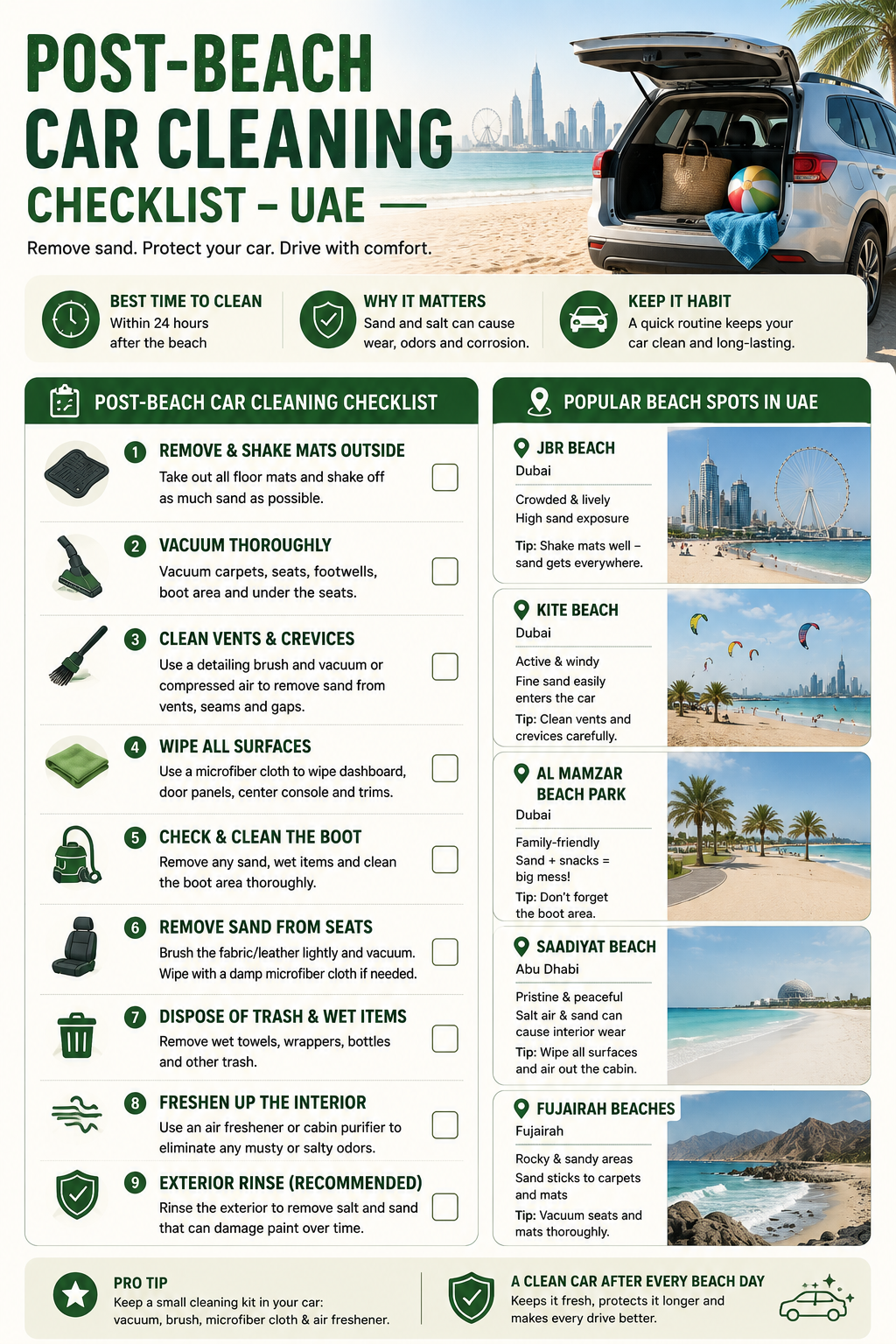
Vehicles used for beach visits require an additional cleaning focus beyond standard sand removal because beach sand is typically coarser, wetter, and more heavily loaded with salt than the fine desert dust that accumulates through general use. Popular UAE beach locations including JBR, Kite Beach, Al Mamzar, Saadiyat Island, and Fujairah corniche each produce distinct sand types that behave differently during interior cleaning.
Wet or damp beach sand clumps together and embeds more deeply in carpet fibres than dry desert sand. It also deposits salt residue that attracts moisture over time. The following checklist applies specifically to post-beach car interior cleaning across the UAE.
- Allow wet items (towels, bags, clothing) to dry before placing them back in the vehicle after the beach visit where possible
- Shake or rinse rubber boot liners before they dry with wet sand attached, as dried clumped sand is harder to remove than fresh wet sand
- Vacuum boot carpet and footwells with a wet-dry vacuum if beach sand is damp
- Wipe seat surfaces and door panels promptly if wet beachwear has made contact with upholstery
- Check under child seats and in cup holders for wet sand that will harden as it dries
- Rinse rubber floor mats thoroughly after beach visits rather than shaking only, as dried beach sand residue leaves a salt film on rubber surfaces
- Allow the vehicle to ventilate with doors open in a shaded area after beach cleaning to reduce moisture retention in carpets and seat foam
For guidance on managing dust after sandstorms across the home and vehicle, see Dust After Sandstorms UAE and Post-Sandstorm Cleaning UAE. For indoor air quality guidance relevant to desert sand and AC dust, see Indoor Air Quality UAE and the Air and Dust Control UAE hub.
The free Car Interior Sand Removal Checklist UAE available above covers post-beach cleaning steps alongside the full routine sequence.
Frequently Asked Questions
How often should sand be removed from a car interior in the UAE?
Under normal UAE conditions, floor mats should be shaken out two to three times per week, a light interior vacuum should be done weekly, and a full sand removal session covering all surfaces should be completed every two to four weeks. After sandstorms, a full session is recommended before the regular schedule resumes.
What is the most effective tool for removing sand from UAE car carpets?
A cordless or corded vacuum with a brush roller attachment is commonly considered the most effective tool for car carpet sand removal. The rotating brush agitates carpet fibres and lifts embedded particles that suction alone cannot extract. Following vacuuming with a stiff carpet brush pass and a second vacuum run produces better results on heavily soiled carpets.
Can sand damage a car interior over time if not cleaned regularly?
Sand particles are abrasive and can cause gradual surface wear on fabric upholstery, leather trim, and plastic surfaces when they accumulate over extended periods. Repeated contact and movement over fine sand embedded in seats and carpets accelerates material degradation. Regular removal reduces wear on interior surfaces and maintains cabin air quality.
Is it better to vacuum or shake car mats for UAE sand removal?
Shaking removes the majority of loose sand quickly and should always be the first step. Vacuuming after shaking extracts finer particles embedded in the mat pile or rubber ridges that shaking alone does not dislodge. Both steps together produce more complete results than either method alone.
Should car AC vents be cleaned during interior sand removal?
Yes. AC vents accumulate sand and dust, and running the air conditioning after a sandstorm without cleaning the vents redistributes particles through the cabin. Detailing brushes used on vent slats before vacuuming the area are the standard recommended method. Checking and replacing or cleaning the cabin air filter as part of the routine is also commonly advised.
What type of floor mat is best for UAE cars?
Rubber floor mats with raised edge channels are generally considered the most practical option for UAE conditions. They contain sand at the entry point, clean quickly with water, and do not retain moisture the way fabric mats do. Models fitted to the specific vehicle shape prevent gaps that allow sand to reach the carpet underneath.
How long does a full car interior sand removal session take?
For a standard 5-seat vehicle with moderate sand accumulation, a full interior session covering mats, carpets, seats, dashboard, vents, and boot typically takes 30 to 50 minutes. Post-sandstorm sessions may take longer due to the higher volume of fine particles and the additional steps required for vent and filter checks.
Can sand damage a car’s AC system if it enters through the vents?
Sand accumulation on AC filters reduces airflow and forces the system to work harder. Sustained operation with heavily loaded filters increases energy consumption and can affect component longevity over time. Replacing or cleaning the cabin air filter every 3 to 6 months is a commonly recommended interval for UAE conditions, with more frequent checks after sandstorms.
Is professional car interior detailing worth it for UAE residents?
Professional detailing is considered worthwhile for vehicles with heavy accumulated sand, post-sandstorm penetration into ducting, or carpet and upholstery that standard tools have not been able to fully clean. For routine maintenance, the home cleaning sequence described above is sufficient. Professional detailing services in Dubai, Abu Dhabi, and Sharjah typically range from AED 80 to AED 350 depending on vehicle size and service scope.
What precautions should be taken when cleaning car interiors after a UAE sandstorm?
The exterior of the vehicle should be rinsed or wiped before opening any doors, to prevent surface sand from falling into the cabin. AC vents and the cabin air filter should be checked before running the air conditioning. The cleaning sequence should proceed top-down, finishing with floor areas and the boot. Two to three passes through all areas are typically needed for thorough post-sandstorm removal.
Sources
Information in this article draws on guidance from the UAE National Centre of Meteorology on sandstorm frequency and particulate conditions across the UAE, Dubai Municipality environmental quality standards, ServiceMarket home and vehicle maintenance guidance for UAE residents, Bayut home care articles covering UAE apartment and villa living conditions, and The National lifestyle coverage of dust, sand, and indoor air quality in UAE homes and vehicles.